
Articles by Author
As the new year emerges, the world welcomes a fresh start, usually with hopes of a new beginning with some luck thrown into the mix. The practice of welcoming a new cycle in the calendar is probably one of the most universal holiday celebrations in the world, and it is often celebrated by eating legumes for luck. I love the idea of a new start as much as I love the seasons, and over the years I have relished the idea of welcoming the new year with simplicity and good, wholesome food.
Legumes, including beans, peas and lentils, are considered to be symbolic of money, and thus considered a harbinger of prosperity and good luck in the new year. Several of them resemble coins, and the fact that they swell up when soaked in water also extends the analogy that the prosperity grows with time.
Traditions vary in different parts of the world. In Italy there is a preference for sausages with green lentils eaten just after midnight. In a similar vein, in Germany they ring in the new year with split peas, while in Japan lucky foods eaten during the first three days of the year include sweet black beans. Closer to home in the southern United States, it’s traditional to eat black-eyed peas in a dish called Hopping John. When the dish is served with collard greens, the odds of prosperity are increased, because green symbolizes the color of money.
More from Zester Daily:
» Lentils in the new year keep resolutions on track
» For good luck in the new year, think green and round
» Japanese namasu brings good luck in the new year
» Use fine salumi and change your new year’s luck
On an Indian table, legumes are a cornerstone ingredient, soul food actually, something that we celebrate on days good and bad, so the idea of a bowl of legumes served any which way easily translates to good luck for me.
The new year often comes with resolutions for eating healthy, and legumes are healthy and readily available during the winter months when other things are somewhat lean. The cornucopia of red, yellow, green and white lentils, along with the dozens of red, white and black beans, ensure we have plenty of options to pick from at the beginning of the year and beyond.
Legumes are rich in protein and high in fiber and are lower in calories than most meat-based sources of protein, offering a healthy and filling option for your plates and palates. While most legumes will cook down to soft and satisfying goodness, they have a whole variety of flavors, tastes and textures to ensure your palate is interesting and innovative.
Most beans and complex lentils can be cooked ahead of time in a slow cooker for four hours or for 20 minutes in a pressure cooker. Cook legumes with water and a little salt and use in your recipe as needed. Cooked beans and lentils can be stored in your refrigerator for up to five days or alternately place them in a zip-lock bag and freeze to use as needed.
The water the beans are cooked in is actually fairly tasty and good for you and can be added to soups and stews. On any given week, I have a few of these bags handy and ready to be added into flavorful dishes, assuring me full-flavored stews without the trappings of extra sodium and preservatives.
For your new year, I offer you two versions of classic dishes the way we enjoy them in my household and a recipe for collard greens to ensure we are in the green for the coming year.
Hopping John (Rice Cooked With Black-Eyed Peas)
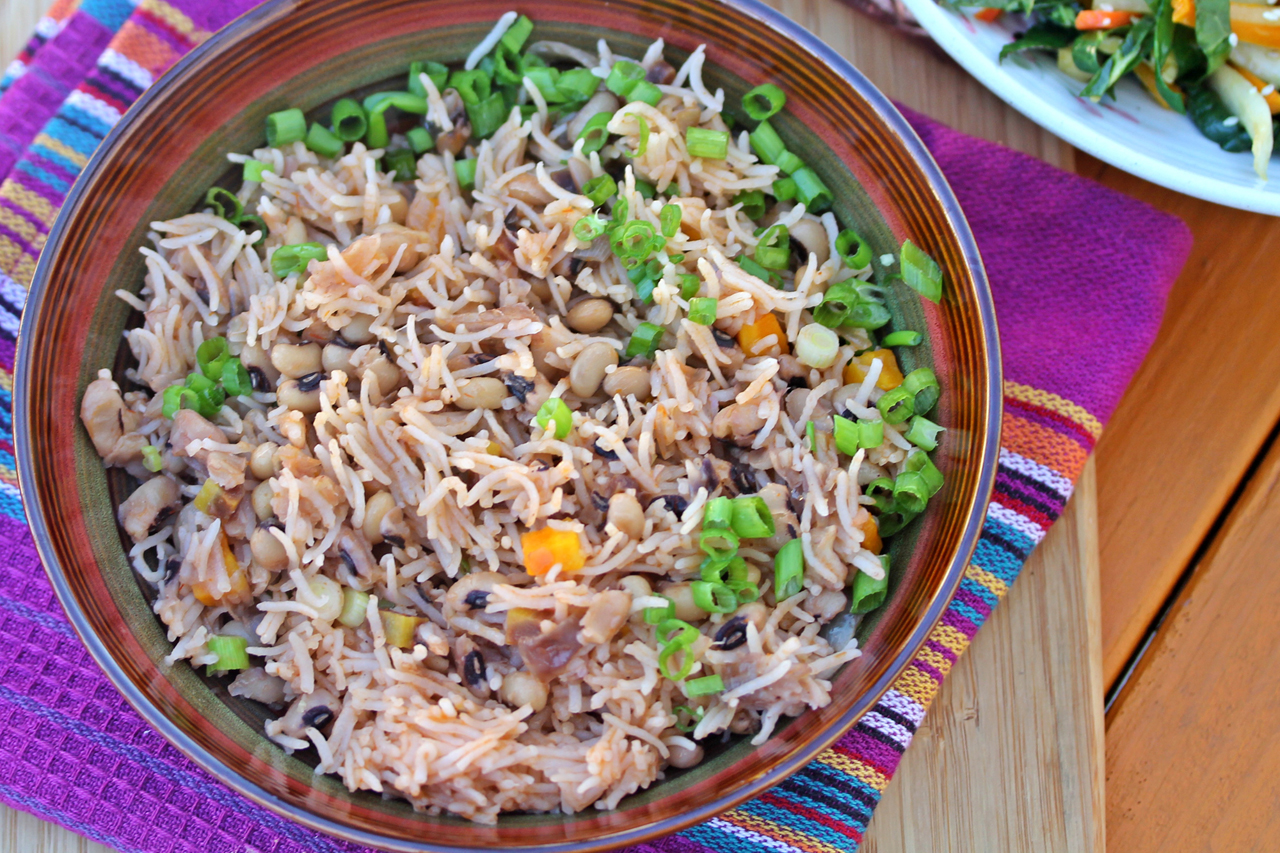
Hoppin John. Credit: Copyright 2015 Rinku Bhattacharya
For my recipe for this Southern dish, I have actually ditched all meat-based products to create a dish that is flavorful and delicate. If served with love and affection, it will indeed convince you that this year you shall be lucky with or without money. My secret ingredient is that I do, in fact, cook my black-eyed peas from scratch and save some of the simmering liquid to use for cooking my rice dish. The dish resembles a pilaf, which probably takes it closer to the Senegalese roots of this traditional dish.
Of course, to maximize the green, I garnish my variation of Hopping John with finely chopped green onions. New Year’s or otherwise, add this dish to your table and you are bound to feel well-nourished on a cold day. For a quick visual of how to make this dish, watch this video.
Prep time: 10 minutes
Cook time: 25 minutes
Total time: 35 minutes
Yield: 6 servings
Ingredients
2 tablespoons extra virgin olive oil
1 tablespoon butter
1 medium-sized onion, diced
2 cloves garlic, minced
1 or 2 ribs of celery, finely chopped
1 or 2 carrots, diced
1 cup white rice (I used basmati rice, which will give this recipe a very delicate and elegant finish.)
2 1/2 cups stock or water
1 cup cooked black-eyed peas
1 teaspoon salt (or to taste)
1 teaspoon freshly ground black pepper
2 tablespoons red wine vinegar (optional)
Chopped green onions for garnish
Directions
- In a pot with a tight-fitting lid, add the olive oil and butter and heat until the butter is melted.
- Add the onion and garlic and sauté for about 5 minutes, until the onion softens considerably and begins to turn pale golden.
- Add the celery and carrot and stir well.
- Stir in the rice and mix well. Add the stock or the water and cup of black-eyed peas.
- Add the salt and the pepper and bring the mixture to a simmer. Cover and cook the rice for 18 minutes. Note: This time works for basmati rice; for other rice varieties allow a few more minutes. Essentially the rice should be soft and all the water should be absorbed.
- Let the rice rest for about 10 minutes, then remove the lid and fluff. Sprinkle with the red wine vinegar if using and garnish with the green onions if using.
Note: If you are cooking the black-eyed peas yourself, save the cooking liquid and use it for the rice, in lieu of the stock or water.
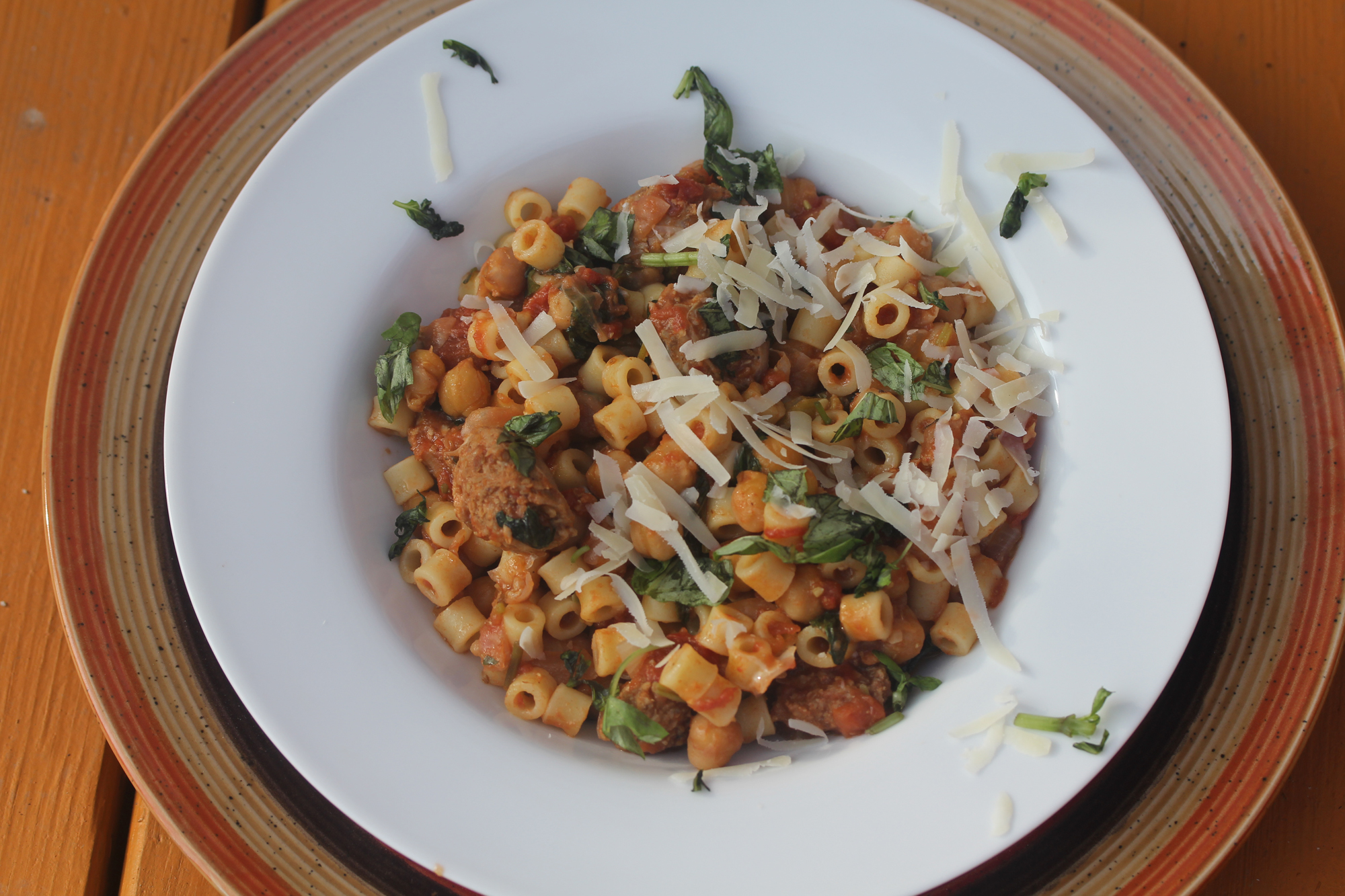
Pasta With Spicy Sausage and Chickpeas
This southern Italian dish is often made with brown lentils and spicy Italian sausage and often enjoyed on New Year’s Day. I make this with chickpeas and add lots of fresh basil to provide a fresh touch of brightness. Since we like our flavors spicy, I use andouille chicken or turkey sausage and add in some freshly ground cumin and fennel. For a quick visual on how to make this dish, watch this video.
Prep time: 10 minutes
Cook time: 25 to 30 minutes
Total time: 35 to 40 minutes
Yield: 4 to 6 servings
Ingredients
3 tablespoons extra virgin olive oil
3 cloves garlic, minced
1 small red onion, very finely diced
1 1/2 cup of crushed red tomatoes or tomato sauce
1 teaspoon sugar
1 teaspoon salt, or to taste
3/4 cup of cooked chickpeas
1 cup of chopped spicy sausage (Italian or andouille)
1/2 teaspoon freshly ground cumin
1/2 teaspoon freshly ground fennel
1 1/2 cups pasta cooked until al dente (a small shape such as a pipette or ditalini)
2 to 3 tablespoons finely chopped basil
Freshly grated Parmesan to finish
Directions
- Heat the oil and add the minced garlic and cook until the garlic is pale golden. Add in the onions and sauté until soft and wilted (about 4 to 5 minutes).
- Add the chopped tomatoes and the sugar with about 1/2 cup of water.
- Stir in the salt and bring to a simmer.
- Add the chickpeas, sausage cumin and fennel and cook through for about 2 minutes.
- Add the pasta and mix well.
- Turn off the heat, garnish with the chopped basil and Parmesan and serve.
Collard Green and Roasted Root Vegetable Slaw
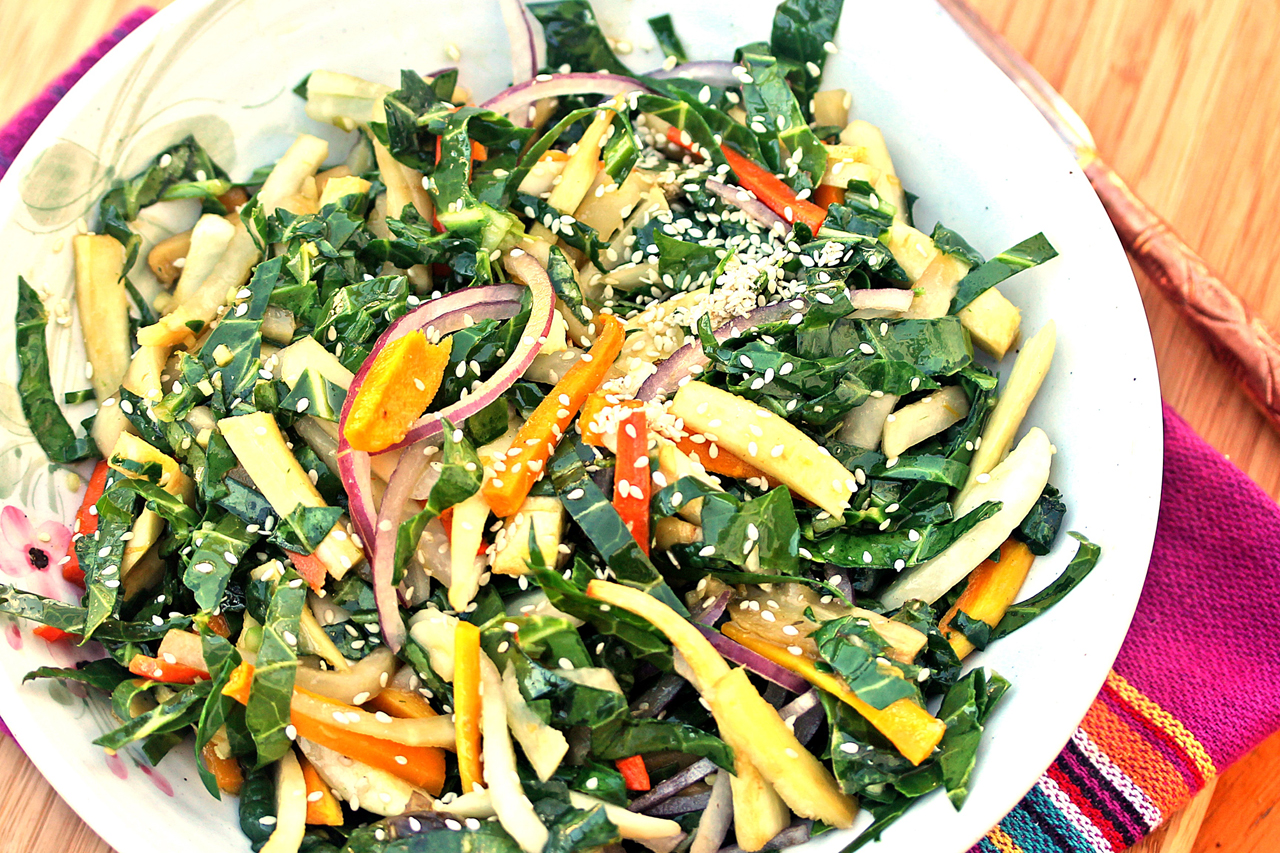
Collard Green and Roasted Root Vegetable Slaw. Credit: Copyright 2015 Rinku Bhattacharya
This dish is a beautiful medley of root vegetables, tossed with very finely chopped collard greens tossed in an assertive Asian-inspired marinade.
Prep time: 15 minutes
Cook time: 20 minutes
Total time: 35 minutes
Yield: 4 to 6 servings
For the roasted vegetables:
2 medium-sized turnips
3 medium-sized carrots
4 small to medium parsnips
2 tablespoons olive oil
1 tablespoon freshly grated ginger
2 tablespoons maple syrup (I have a strong preference for Crown Maple Syrup)
3 tablespoons tamari or soy sauce
For the greens and the remaining dressing:
1 medium-sized bunch of collard greens
2 teaspoons sesame oil
1/2 teaspoon to 1 teaspoon red cayenne pepper
1 tablespoon olive oil
3 tablespoons red wine vinegar
Sesame seeds for garnish
Directions
- Preheat oven to 350 F.
- Peel the turnips, carrots, parsnips and julienne into thin strips.
- Place the vegetables in a roasting pan. In a small bowl mix the olive oil, ginger, maple syrup and the tamari, and drizzle the vegetables with the mixture.
- Roast the vegetables for 20 minutes.
- Meanwhile, stack the collard leaves over each other and thinly slice the leaves, to create a chiffonade. Place in a large bowl.
- Add in the roasted vegetables, reserving the pan juices.
- Pour the pan juices into a mixing bowl, add in the sesame oil, cayenne pepper, olive oil and vinegar and mix well.
- Add the dressing to the collard and vegetable mixture and toss lightly. Sprinkle with the sesame seeds and serve.
Main photo: Pasta with Spicy Sausage and Chickpeas. Credit: Copyright 2015 Rinku Bhattacharya
I am always amused when I hear of Diwali or other such festivals being referred to as the Indian Christmas. After all, in my mind Christmas is the Indian Christmas.
As a child, I looked forward to being invited for Christmas with my friends for whom this was a family festival. So many distinct recipes are a part of the Indian Christmas tradition — rum-laced moist fruitcakes, rose cookies, a roasted rack of goat and many others. As with other traditions, holidays always have a regional twist and take the flavors of the regional origins of the family.
One of my fondest Christmases was one spent with my friend Ruth’s family, maybe now almost three decades ago. It was the first time I was allowed to spend two days without my parents at a friend’s house, and the spirit was nothing like I had ever seen. Their small house was filled with family from various parts of India, mostly from southern India, where the family had its roots. They all congregated in Ruth’s house, as her father was the oldest of the siblings and therefore had the honor of hosting the holiday. Tinsel and shiny wrappers were all around as everyone quickly and furiously set about decorating the house.
Fond memories of Christmas in the kitchen
More from Zester Daily
» Celebrating Christmas – and fruitcake – in East India
» Homemade Christmas wine, the Kerala way
My attention, of course, strayed to the kitchen. Even as a child, it was always about the kitchen for me. The sweet scents of coconut oil and citrusy curry leaves tantalized my spirits with aromas so amazing and yet so distinct from my mother’s kitchen. That is the magic of an Indian kitchen — every cook uses the same collection of spices so differently.
Ruth’s aunt, whom she called Appachi, was amused to see my interest in the food, and she started explaining some of her foods and techniques to me, and I was hooked.
The tiny kitchen was filled with an assortment of dishes, all neatly arranged in copper serving spots. She proudly lifted the lid of a pot that had been slow cooking for the whole afternoon to reveal a whole duck, and seeing the small, diminutive bird, I initially wondered what the fuss was about.
She fried an assortment of golden-spiced potatoes in coconut oil and carefully placed the duck in the center of large china serving plate, something she proudly told me was a wedding gift she had received more 20 years ago — something she often brought along for Christmas, for serving her signature duck. Around the duck went the crisp, golden potatoes, and she hoisted and brought in the gorgeous dish just in time to place at the center of the table.
She was greeted with huge sighs of appreciation by the living room crowd, who had completed their decor, filling the room with red and silver glitter. Lights twinkled and ornaments shone on a large faux Christmas tree.
Amid this magical spirit, we sat and feasted, listening to stories and talking the night away.
Over the years, I have carried memories of the duck and fried potatoes, later joined by another wholesome recipe, for an Indian version of shepherd’s pie. I have re-created them and share with you for a Christmas feast with an Indian touch.
Spicy Roast Garlic and Curry Leaf Duck
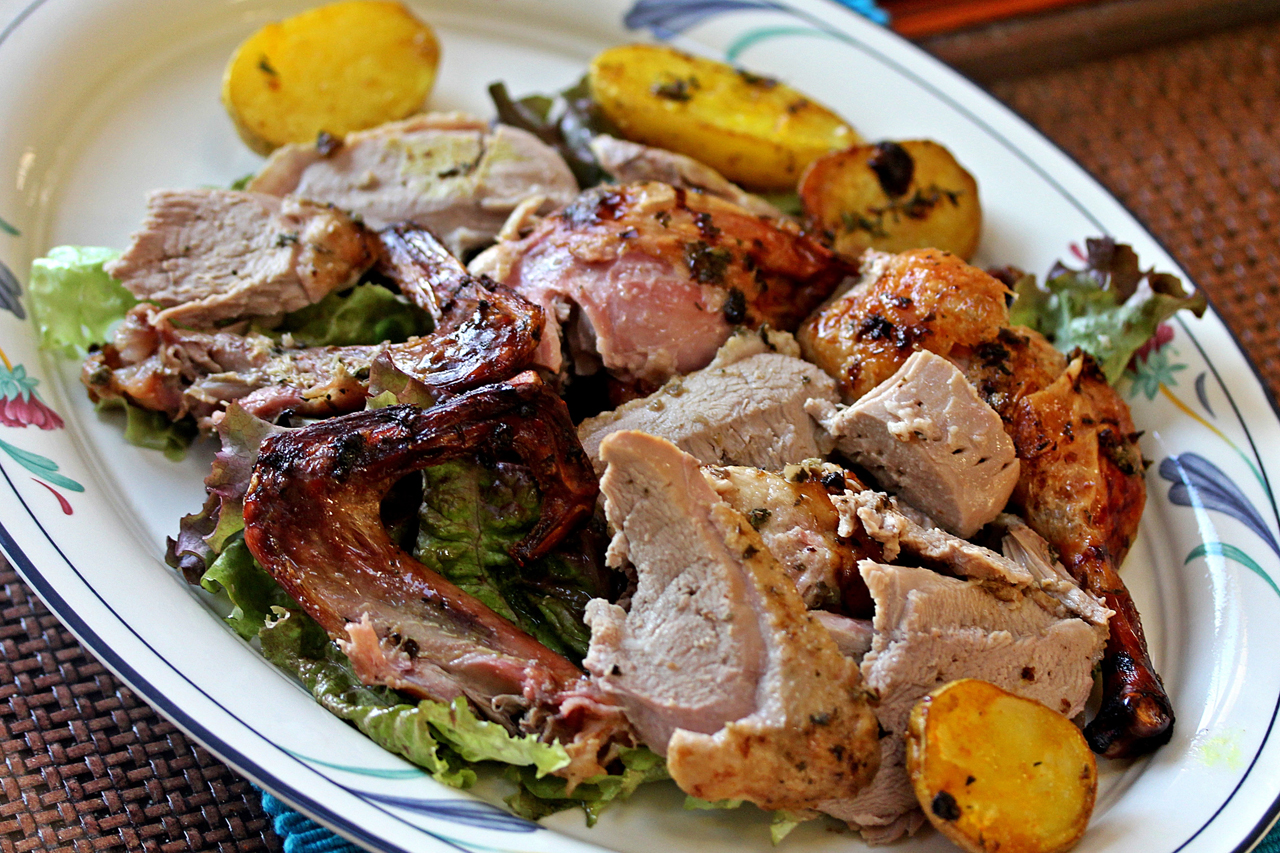
A platter of carved Spicy Roast Garlic and Curry Leaf Duck, with a side of roasted potatoes. Credit: Copyright 2015 Rinku Bhattacharya
Prep time: About 10 minutes, plus 24 to 48 hours to marinate
Cook time: 3 1/2 to 4 hours
Total time: About two days.
Yield: Makes 4 to 6 servings.
Ingredients
1 medium-sized red onion
30 cloves of garlic
1 tablespoon freshly ground ginger
1 tablespoon black peppercorns
1/4 cup fresh lime juice
1 tablespoon kosher salt
3 sprigs of curry leaves
1 medium-sized duck (about 3 to 4 pounds)
Directions
1. Place the onion, half the garlic, ginger, peppercorns, lime juice, salt and 2 springs of curry leaves in a blender and blend until smooth.
2. Carefully loosen the duck skin and spread the mixture all over, as well as into the cracks and crevices. Refrigerate the duck for 1 or 2 days.
3. Preheat oven to 325 F and cook the duck, breast side down, for about 1 hour. After cooking, the duck should have released a fair amount of fat.
4. Reserve about 3 tablespoons of the duck fat, turn the duck and baste thoroughly with the fat.
5. Cover the duck with foil and cook for 2 more hours.
6. Remove the foil, baste the duck again, then dot it with the remaining garlic and curry spring.
7. Increase the heat to 375 F and cook the duck for another 45 minutes, or until nice and crisp.
8. Carve the duck and serve with roasted potatoes.
Turmeric, Thyme and Bay Leaf Roasted Potatoes
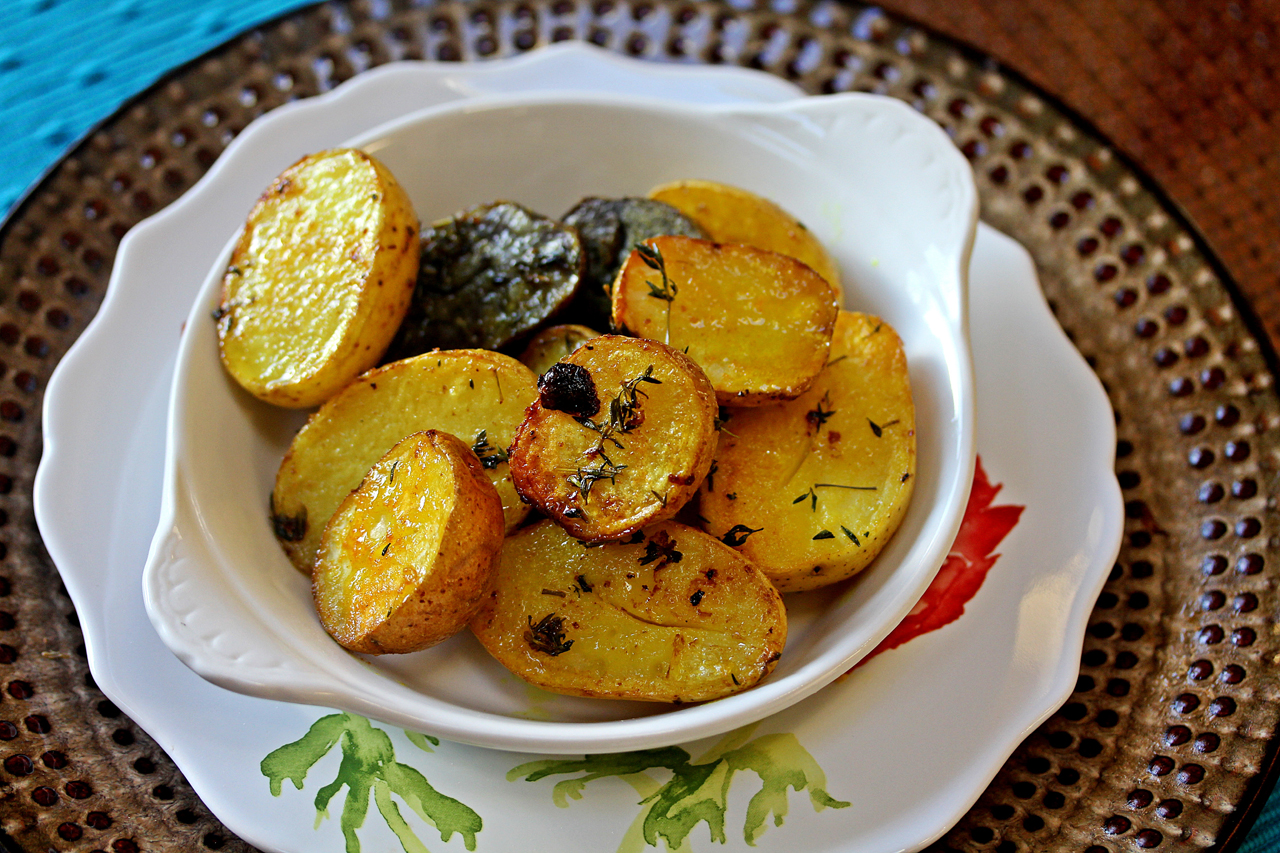
Turmeric, Thyme and Bay Leaf Roasted Potatoes. Credit: Copyright 2015 Rinku Bhattacharya
A beautiful, simple and very flavorful rendition of roasted potatoes, this makes a perfect side dish for almost any meal. If you are making this with my roast duck recipe, add in the reserved duck fat; if not, simply add in another tablespoon of coconut oil.
Prep time: 5 minutes
Cook time: 40 minutes (mostly unattended)
Total time: 45 minutes
Yield: Makes 4 to 6 servings.
Ingredients
15 to 20 small red-skinned baby organic potatoes (or use a multicolored medley)
2 tablespoon coconut oil
2 tablespoons reserved duck fat (from recipe above) or 1 tablespoon coconut oil
1 teaspoon salt (or to taste)
1 teaspoon freshly ground black pepper
1 teaspoon turmeric
1 tablespoon finely chopped thyme, plus more to garnish
2 to 3 bay leaves
Fresh lime juice to finish
Directions
1. Cut the potatoes in half and toss with the coconut oil, duck fat, salt, ground black pepper, turmeric, thyme and bay leaves.
2. Place in a 350 F oven and cook for about 40 minutes.
3. Remove from the oven and garnish with extra thyme and sprinkle with fresh lime juice to finish.
Anglo-Indian Shepherd’s Pie
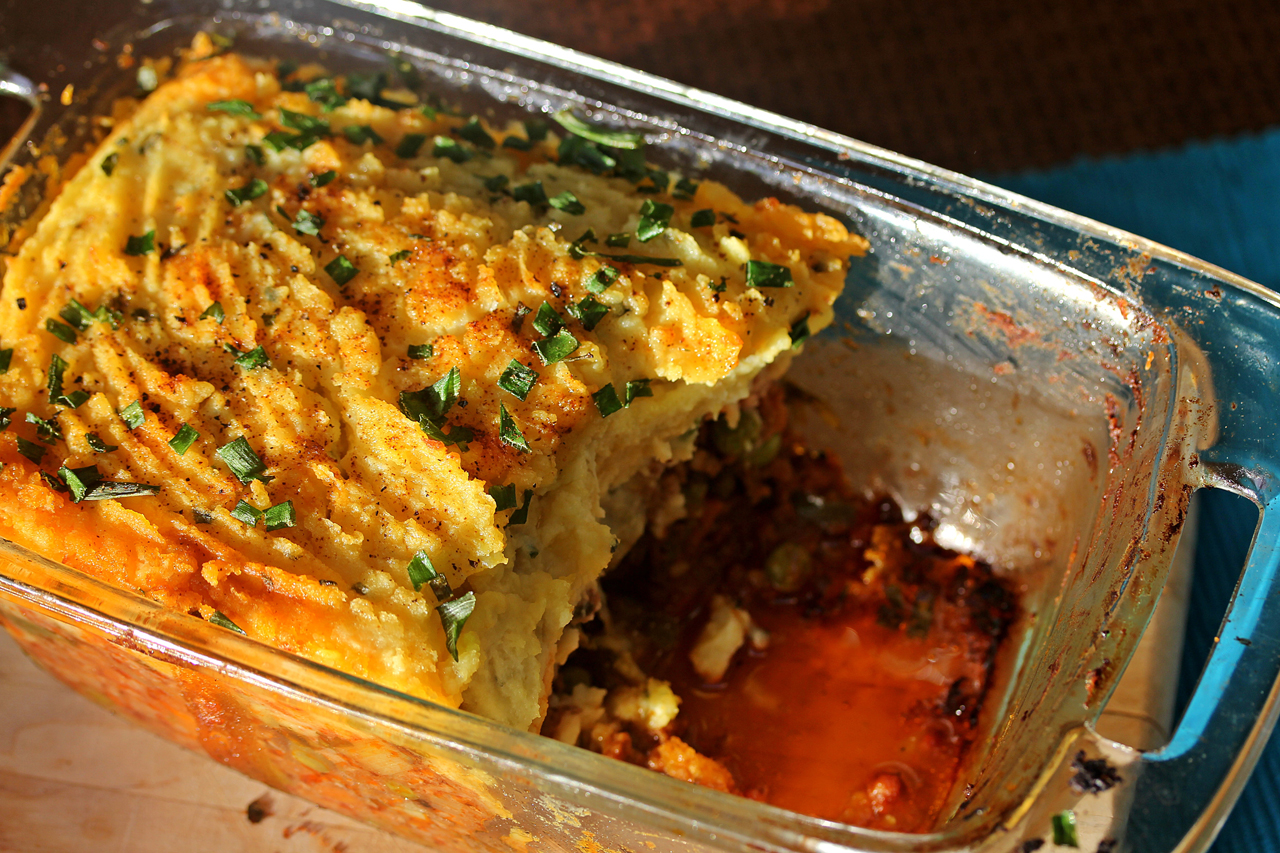
Anglo-Indian Shepherd’s Pie. Credit: Copyright 2015 Rinku Bhattacharya
When I first tasted this dish, I was unaware of its more traditional cousin, the cottage or shepherd’s pie; it had simply been presented to me as pie. I fell in love with this deep, seductive version, which offers layers of pure indulgence and flavor. The flavorful mashed potato topping, scented with garlic and rosemary, adds to the magic of this deep and flavorful dish.
My filling has loads of vegetables and can very easily be transformed into a vegetarian dish by swapping the meat for finely diced shitake mushrooms.
Prep time: 10 minutes
Cook time: 1 hour
Total time: 1 hour, 10 minutes
Yield: Makes 6 to 8 servings
Ingredients
For the mashed potato topping:
4 medium-sized Yukon gold potatoes
1 tablespoon olive oil
1 tablespoon butter
1 tablespoon fresh minced garlic
4 tablespoons sour cream or Greek yogurt
1 tablespoon freshly minced rosemary
1/2 cup grated parmesan cheese
1 cup broth or low-fat milk
Chopped chives
For the filling:
2 tablespoons oil
2 medium-sized onions, diced
1 tablespoon freshly grated ginger
1 large stick cinnamon
6 to 8 cloves
3 to 4 pods cardamoms
1 medium-sized sweet potato, diced
2 medium-sized carrots, diced
1 or 2 golden beets, diced
1 cup ground turkey or lamb
1 teaspoon salt (or to taste)
1 cup tomato sauce
1 cup port wine
1 teaspoon red cayenne pepper
1 tablespoon all-purpose flour
1 tablespoon finely chopped chives
Directions
1. Cut the potatoes in half and boil in plenty of salted water until they are soft but not mushy. Cool and peel the potatoes and place in a mixing bowl.
2. Heat the olive oil and butter in a pan and add in the minced garlic and cook until fragrant.
3. Pour the seasoned oil over the potatoes, then mash.
4. Mix in the sour cream or yogurt, rosemary, parmesan cheese and broth and mix in until smooth. Set aside.
5. Preheat oven to 350 F.
6. Heat the oil for the filling and add in the onions and ginger and saute for 5 to 7 minutes, until soft and wilted.
7. Place the cinnamon, cloves and cardamom in a spice bag if desired and combine with the sweet potato, beets, ground turkey or lamb and salt. Mix well and cook until the meat is no longer pink.
8. Add in the tomato sauce, port wine and cayenne pepper and cook for 15 minutes, or until the sauce is about half the original volume.
9. Stir in the all-purpose flour to thicken further.
10. Pour this mixture into a casserole dish (I find a loaf pan works well) and top with the mashed potatoes.
11. Bake for 30 minutes or until the topping is beginning to turn golden.
12. Remove from the oven, garnish with chives and serve.
Main image: Anglo-Indian Shepherd’s Pie is a traditional holiday dish for the author. Credit: Copyright 2015 Rinku Bhattacharya
In the tradition of Bengali Hindus, the auspicious fortnight, or Debipaksha, ends on the full moon night with a prayer to Lakshmi, or Lokkhi in Bengali, the goddess of wealth, peace and prosperity.
In most parts of India, people pray to Lakshmi during Diwali. However, in Bengal, this is done during the festival of Kojagori Lokkhi Puja. This tradition dates back to an ancient king who had promised an artisan he would buy all his wares. The artisan had created an image of Alokkhi, or the anti-Lakshmi, and the king — not wanting to break his promise — bought the image, in turn bringing bad luck and financial distress to his kingdom. Finally, his queen kept a night vigil, fasting and praying to the goddess Lokkhi, who was pleased, and peace and prosperity were restored to his land.
More from Zester Daily:
» From Capricorn to Aquarius, a perfect dish for Indian festival
» Indian red rice revival relies on organic farmers
The festival of Kojagori Lokkhi Puja has been one of my favorites, mostly because of the silent power of this very domestic goddess, possibly an ancient measure of preserving the status of the homemaker. The goddess is of a silent and fastidious temperament and is said to favor a calm and peaceful household where there is no waste or turmoil.
The focus of this Puja is, therefore, on the peace and calm of the home and is usually done by the women in the household. In Bengal, a new bride or homemaker is likened to Lokkhi, with a hope of ensuring that careless treatment of her will bring bad luck to the household.
Lokkhi Puja is sandwiched between the flashy Durga Puja, a four-day festival of elaborate fanfare, and Kali Puja, the invocation of the powerful goddess of the night. Somehow these goddesses, with their multiple hands, weapons and fierce aspirations, seem too dramatic for me. The gracious Lokkhi, who stood on an open lotus (a common flower in Bengal) with her pet owl, seems approachable and very real.
In preparation for the festival

Figurines of Lakshmi, called Lokkhi in Bengali, the goddess of wealth, peace and prosperity. Credit: Copyright 2015 Rinku Bhattacharya
The first task for the festival, usually done the day before, begins with getting the Lokkhi figurines. However, unlike other figurines, the Lokkhi is never immersed in the Ganges. The morning of the puja begins with a scrupulous cleaning of the household, and I remember this being one of the days my grandmother woke me up early so as not to invoke the ire of the goddess, who is not partial to laziness.
The cleaned floors are decorated with alpona, or a traditional design made with rice flour paste that typically has a series of feet that enter the house and none leaving it. My grandmother would leave the rest of the design making to me (often shaking her head at my lack of symmetry in making these patterns), but made the decorations for the central prayer room herself.
Today, with my grandmother gone, none of the decoration happens, but I do have her silver Lokkhi, something she inherited from her mother-in-law.
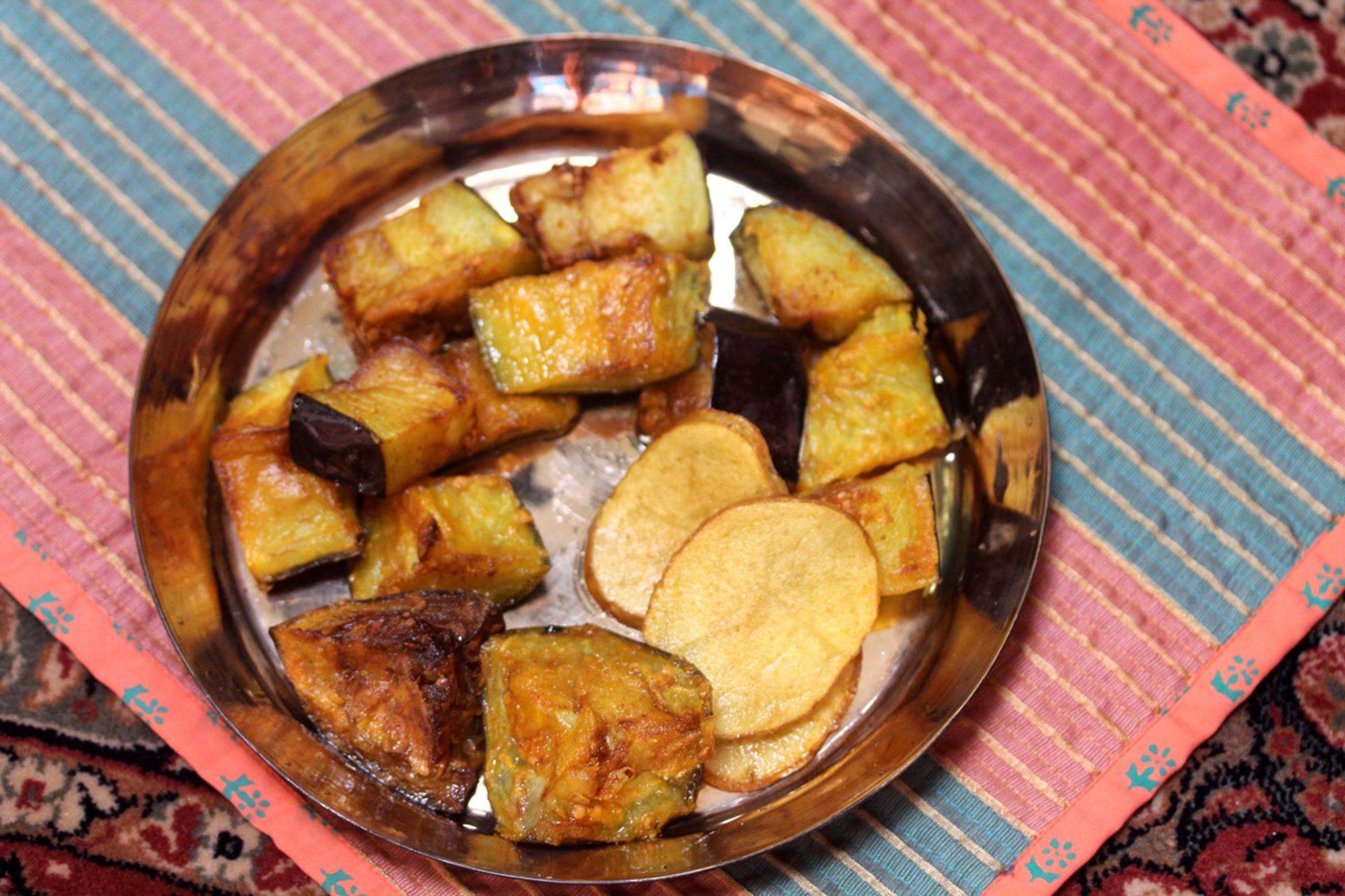
The foods of the puja are slightly different from the traditional offerings of khichuri seen in other pujas. For Kojagori Lokkhi Puja, you typically see a repast of luchi, or puffed Bengali breads, and a variety of fried vegetables, most commonly potatoes and eggplants. While this may seem simple, eggplant wedges coated with salt, turmeric and cayenne and then deep fried to a soft and sensuous texture and enjoyed with crisp and puffy puris can indeed be something to appease a flighty goddess.
Other traditional offerings include coconut toffee balls, called narus, and various assortments of rice products, such as puffed rice, puffed rice coated with jaggery and, as in all occasions, rice pudding. In an agrarian economy where rice is the main product or crop, prosperity is indeed associated with rice, and it is considered unlucky to run out of rice in a household, probably accounting for my penchant for keeping at least one spare 10-pound bag around to this day.
The preferred flower for Kojagori Lokkhi Puja is the lotus, making it very difficult to procure unless you hit the flower shops first thing in the morning.
To help you bring some peace and happiness to your table, I share with you these recipes for coconut toffee balls, Bengali fried eggplant and potatoes, and my slow cooker rice pudding. As autumn turns into winter, may there be peace and prosperity in everyone’s life.
Narkoler Naru (Coconut Toffee Balls)

Narkoler Naru, or Coconut Toffee Balls. Credit: Copyright 2015 Rinku Bhattacharya
Recipe from “The Bengali Five Spice Chronicles”
Prep time: 15 minutes
Cook time: 30 minutes
Total time: 45 minutes
Yield: 20 small balls
Ingredients
2 cups grated coconut (I use the frozen variety)
3/4 cup powdered jaggery (cane sugar)
1/2 teaspoon cardamom powder
Preparation
- In a wok or skillet over very low heat, cook the coconut, stirring frequently, for 15 to 20 minutes. The coconut should begin turning light brown and aromatic and begin releasing some oil.
- Add the jaggery and continue cooking on low, stirring frequently, until the jaggery is melted and the mixture is well browned and very fragrant and toffee-like. Plenty of coconut oil should be glistening in the mixture.
- Stir in the cardamom powder and mix well.
- Remove from heat and let cool until the mixture is able to be handled.
- Shape the mixture into small balls. These balls keep well for a couple of weeks at room temperatures of up to 70 F or refrigerated. If refrigerated, they should be brought the room temperature before serving.
Begun Bhaja (Bengali Fried Eggplants)
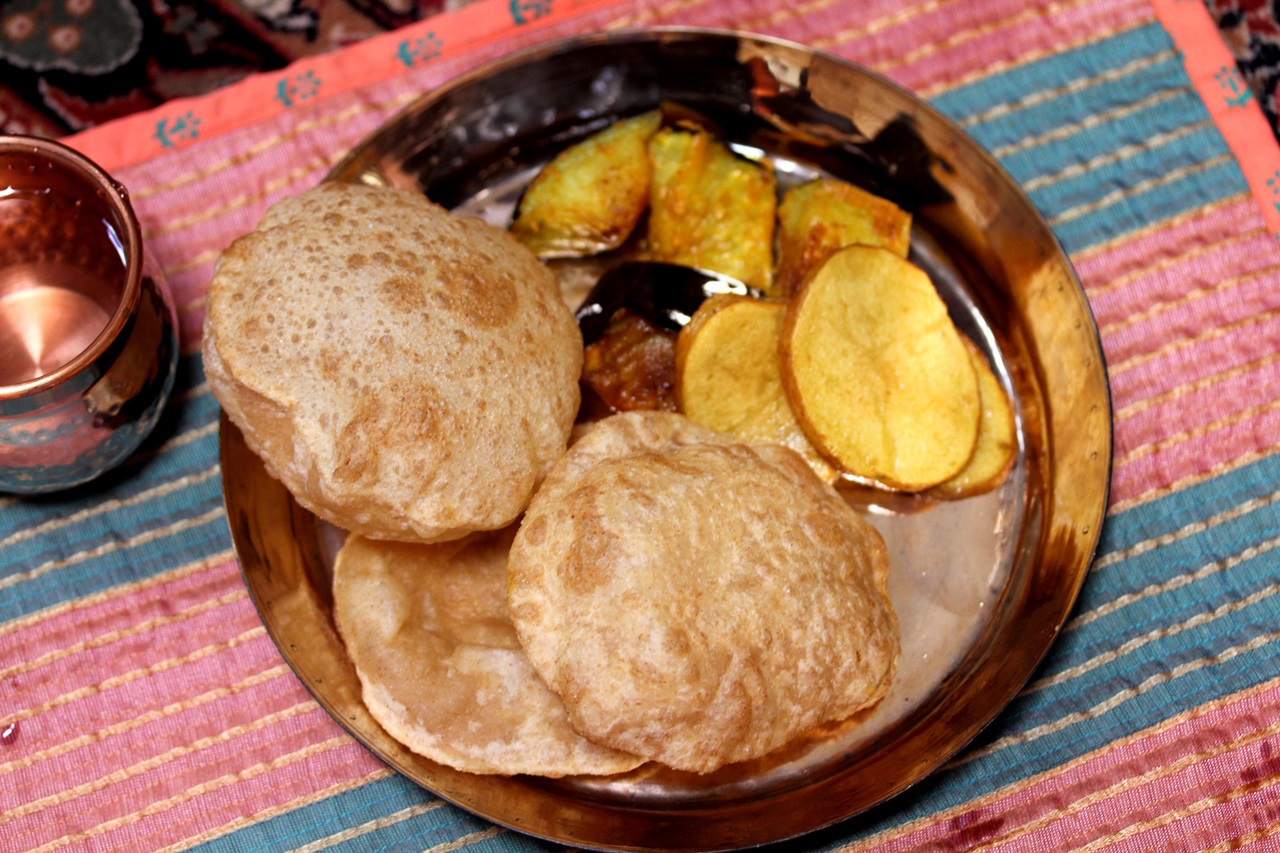
Begun Bhaja, or Bengali Fried Eggplants, with luchi, a puffed bread. Credit: Copyright 2015 Rinku Bhattacharya
Recipe adapted from “The Bengali Five Spice Chronicles.”
When choosing an eggplant, pick with care because a seedy eggplant is a recipe for disaster. Ideally, pick a smaller, smooth eggplant that feels light and has shiny, dark purple skin. This recipe can also be used to cook potato slices.
Prep time: 15 minutes
Cook time: 20 minutes
Total time: 35 minutes
Ingredients
1 medium-sized eggplant, about 1 1/2 pounds
1/2 teaspoon turmeric
1 teaspoon salt
1 teaspoon red cayenne pepper
3 tablespoons rice flour (optional, but it gives it a nice crisp texture)
Oil for deep frying
Directions
- Cut the eggplant into slices or wedges and place them in a large mixing bowl.
- Add the turmeric, salt and red cayenne pepper to the bowl and toss the eggplant so it is well coated.
- Place the eggplant in a colander and let it drain for about 15 minutes.
- Spread the rice flour on a clean surface and lightly dip the outer flesh of the eggplant in the rice flour. The flour does not have to be even. It should be a light coating.
- Heat the oil in a wok. While the oil is heating, line a plate with plenty of paper towels.
- Carefully place a few of the eggplant pieces into the oil and fry for 3 to 4 minutes until very soft and golden.
- Drain the eggplant pieces carefully and place them on the paper towel-lined plate.
- Fry and drain the remaining pieces of eggplant.
- Serve hot with luchis (Bengali puffed bread) or rice and lentils.
Slow Cooker Saffron and Cardamom Rice Pudding
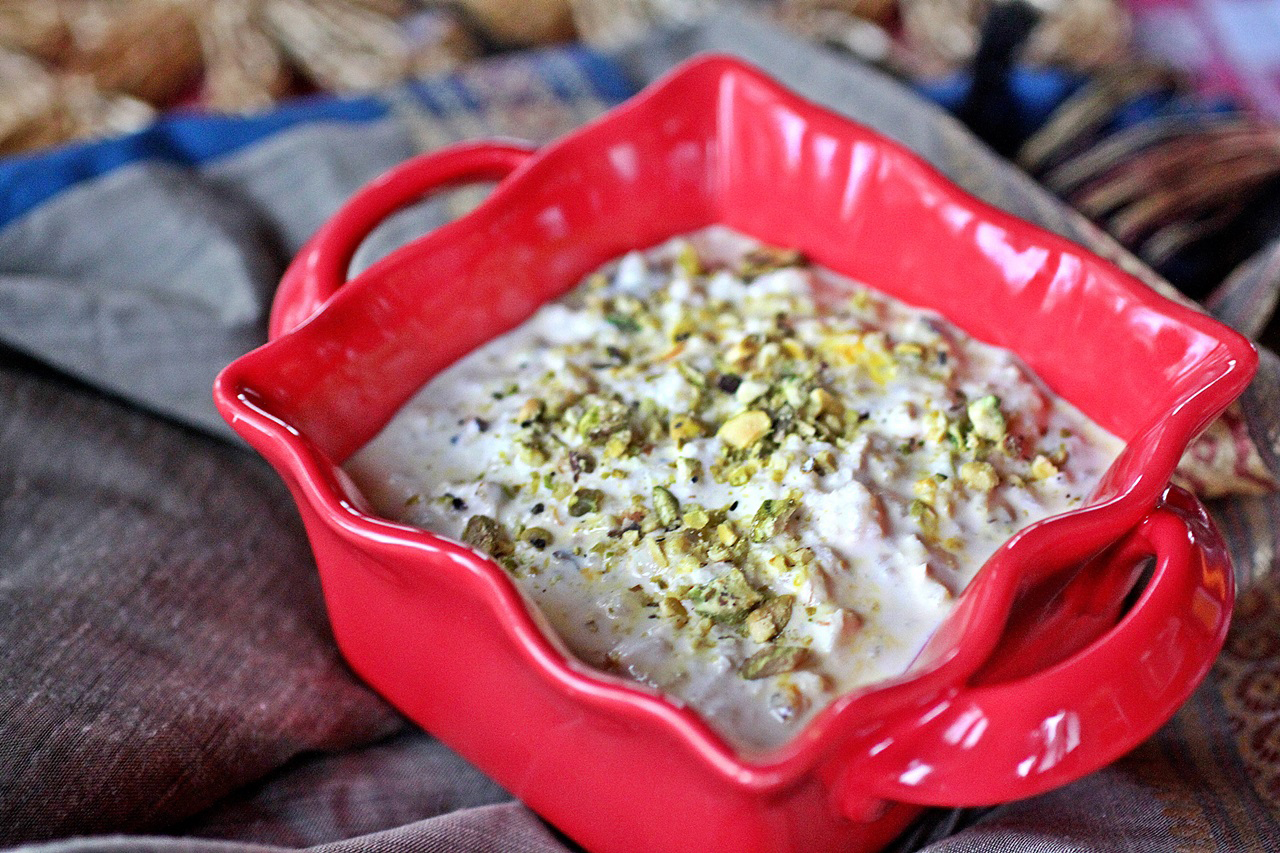
Slow Cooker Saffron and Cardamom Rice Pudding. Credit: Copyright 2015 Rinku Bhattacharya
Recipe from “Spices and Seasons: Simple, Sustainable Indian Flavors”
Prep time: 5 minutes
Cook time: 5 hours (in a slow cooker)
Total time: About 5 hours
Ingredients
1/2 gallon half-and-half
3/4 cup short-grained rice, such as jasmine rice
6 green cardamoms, lightly bruised
3/4 cup raw turbinado or maple sugar (or more to taste)
1/2 cup chopped nuts such as pistachios or pecans (optional)
Directions
- Combine the half-and-half, rice and cardamoms in the slow cooker and set it to cook on high for five hours..
- After two hours, remove the slow cooker cover and give the mixture a good stir, ensuring the rice mixes well with the milk. Replace the lid.
- After another hour and a half, stir the mixture well. By this point, the rice should be fairly soft and meshing into the milk. Stir in the sugar and let the rice pudding continue cooking for another hour and a half.
- Stir well once it is done cooking. Discard the cardamoms if you wish. Let the pudding rest for at least 30 minutes and garnish with nuts before serving if you wish. Serve hot or cold, depending on your preference.
Main photo: Bengali Fried Eggplants, or Begun Bhaja. Credit: Copyright 2015 Rinku Bhattacharya

When tomato season arrives in August, we are so excited about our salads and tomato sandwiches that we often forget that the season happily continues well into fall. Tomatoes can be used in many ways beyond luscious salads. Here is a selection of unusual and interesting ways to use this vivacious favorite.
More from Zester Daily:
» Savor summer tomatoes all winter long
» Improv night! Family meals made easy
» 8 spicy secrets for cool summer meals
» What to do with tomatoes? Make pasta and sauce
Main photo: Shakshouka, a hearty meal that is great for breakfast and perfect for a family dinner. Credit: Copyright 2015 Rinku Bhattacharya

An often underrated gift of summer is the bountiful presence of fresh herbs. At this time of year, like no other, herbs infuse distinct and potent flavors into your meals.
Take a summer vacation from a traditional garnish when you’re using those herbs. Think fenugreek fried chicken. Or an icy pineapple freezer pop infused with ginger and lemon verbena. Or grilled corn slathered with basil-and-goat-cheese butter.
10 fresh ideas for summer herbs
Click through this slideshow to find 10 unique ideas for using summer herbs from the garden — and from your market:
More from Zester Daily:
» How to grow the best herbs at home
» Lavender: 7 ways to perfume your food
» Fenugreek works its magic on sweet potatoes
Main photo: Nothing says summer like a fresh-fruit ice pop. Freeze pineapple with fresh summer herbs ginger and lemon verbena for a cold sweet treat that’s light and refreshing. Credit: Copyright 2015 Rinku Bhattacharya
Want a fresh way to spice up your summer grilling routine? Pair those grilled meats with Indian condiments.
While Indian foods are better known for their spicy heat, there are several Indian condiments that can cool off your summer table while appealing to a range of palates: sweet, spice, tart or savory.
More from Zester Daily:
» An ideal way to add zing to a meal with spicy apricot chutney
Spices known for their cooling qualities include cumin, cayenne and black salt. The cooling spices are all part of the prescription for summer for Ayurveda: the thousands-years-old holistic approach to health and wellness.
Carrot and Cucumber Raita With Almonds
A raita is an Indian-style cucumber salad, paired with natural yogurt. In this version from my cookbook, “Spices & Seasons: Simple, Sustainable Indian Flavors,” I add freshly grated carrots and crunchy almonds.
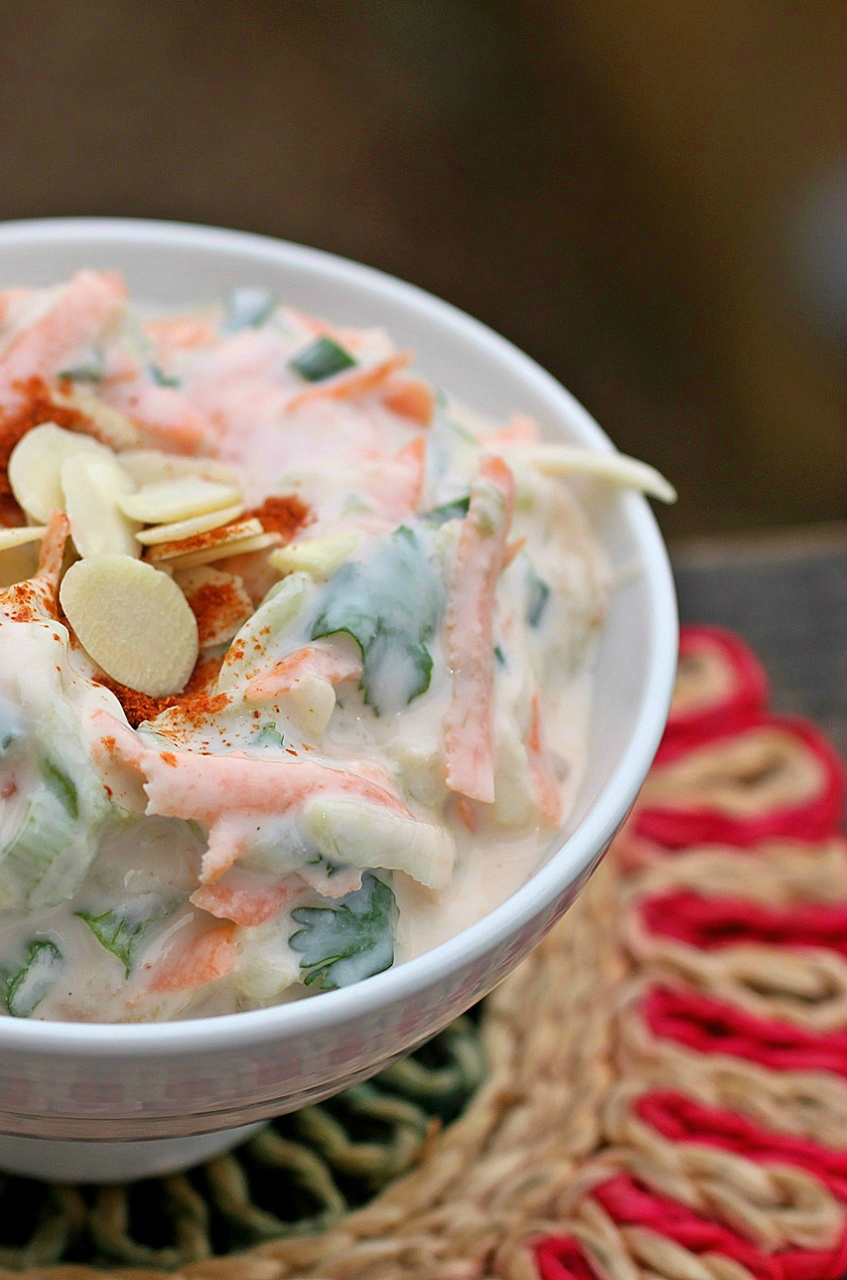
This yogurt salad is colorful, refreshing and full of protein and vitamins. Serve it on crackers or grilled bread. Credit: Copyright 2014 Rinku Bhattacharya
Prep time: 15 to 20 minutes
Yield: 6 servings
Ingredients
2 medium cucumbers
1 medium carrot
2 tablespoons almonds, coarsely ground or sliced
1 tablespoon fresh mint leaves, minced (optional)
3/4 cup low-fat plain yogurt
1/2 teaspoon salt, or to taste
1/2 teaspoon sugar
Freshly ground black pepper
A sprinkle of red pepper flakes (optional)
Directions
1. Peel the cucumbers and grate into a mixing bowl, discarding any whole seeds.
2. Peel the carrot and grate into the same bowl. Add the almonds and mint, if using.
3. In a separate bowl, beat the yogurt, salt, sugar and black pepper until well mixed. Stir into the cucumber mixture.
4. Garnish with the red pepper flakes, if using.
Mint and Cilantro Chutney
Spicy, green and fresh, this classic condiment is found year-round on the Indian table and can be served with most any dish. Traditionally, it derives its tartness from unripe green mangoes. This recipe simplifies it by using lime juice instead.
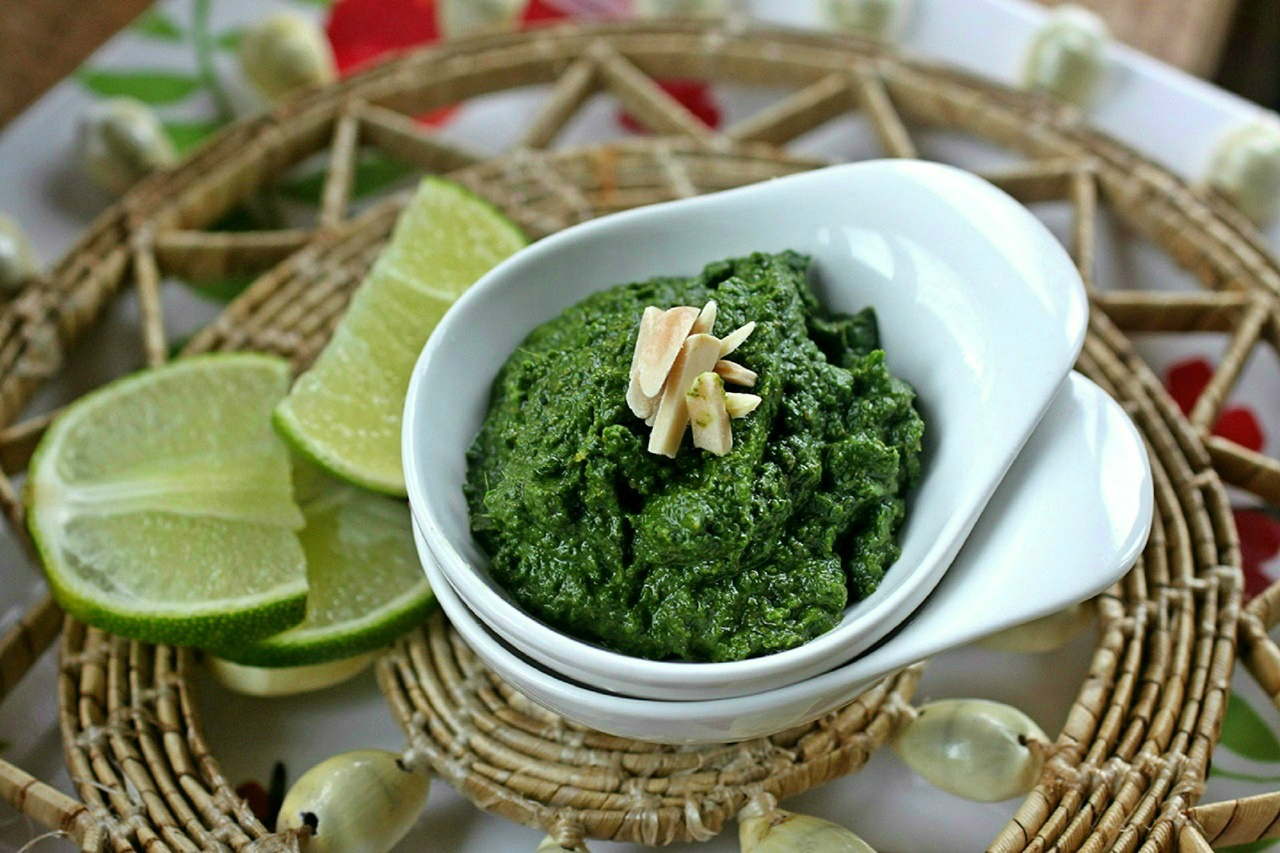
Mint and Cilantro Chutney, a simple-to-make dish from the “Spices & Seasons” cookbook, is a classic condiment found year-round on the Indian table. Credit: Copyright 2014 Rinku Bhattacharya
Prep time: 10 minutes
Yield: 1 cup
Ingredients
1 bunch cilantro (about 3 cups)
2 bunches mint leaves (about 1 1/2 cups)
2 green serrano chilies
1 teaspoon cumin powder
1/2 teaspoon salt, or to taste
1 teaspoon black salt
1 teaspoon sugar
2 teaspoons oil (mustard or canola)
2 tablespoons fresh lime juice
Directions
1. Place all of the ingredients into a blender.
2. Grind mixture until smooth. This chutney will keep for 3 to 4 days in the refrigerator, but the color will darken because of the lime.
Tamarind and Date Chutney
This tantalizing recipe is a superb alternative to barbecue sauce. It’s great on chicken wings or mixed with mayonnaise and drizzled over your favorite protein.
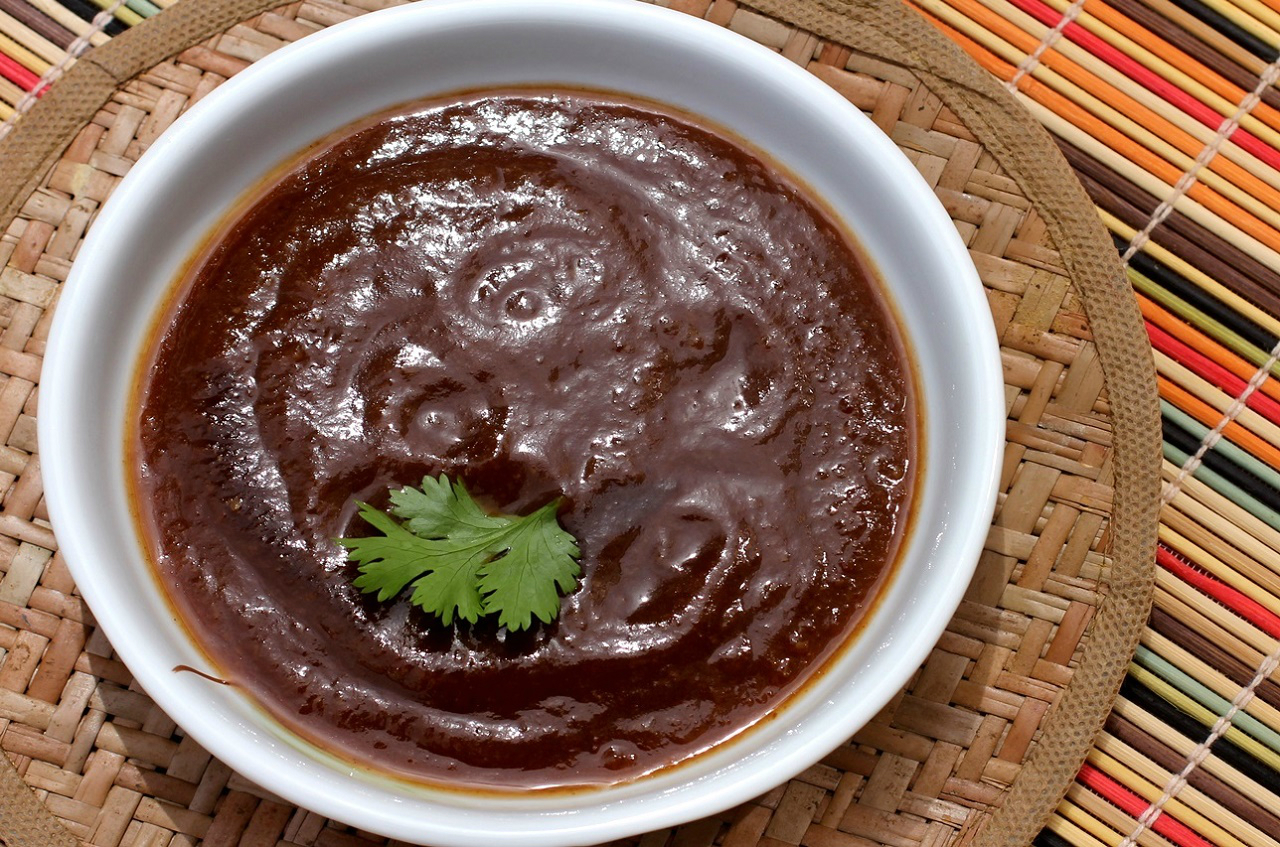
Tamarind and Date Chutney is another classic Indian condiment; this version from “Spices & Seasons” is what I call the Indian barbecue sauce. Credit: Copyright 2014 Rinku Bhattacharya
Prep time: 10 minutes
Cook time: 15 minutes
Total time: 25 minutes
Yield: 1 cup
Ingredients
1 jar tamarind paste (I prefer Swad or Laxmi brands)
1 cup chopped, pitted dates
1/2 cup brown sugar or jaggery
1/2 teaspoon black salt
1 teaspoon fennel seeds
1 teaspoon cumin seeds
2 dried red chilies
Directions
1. Place the tamarind paste, dates, brown sugar, black salt and 2 cups of water in a pot. Bring to a boil. Reduce heat; simmer for 10 minutes. Cool slightly.
2. Meanwhile, place the fennel and cumin seeds in a heavy skillet and toast until the seeds darken and smell fragrant, about 20 to 30 seconds. Add the chilies and toast for a few more seconds.
3. Grind the seeds and chilies in a spice grinder until powdery.
4. Blend the tamarind mixture in a blender until smooth. Return to the pot, stir in the spice mixture and cook for another 5 minutes.
5. Cool and store in air-tight jars in the refrigerator for up to three months.
Indian Onion Relish
A popular feature in many Indian restaurants, this smoky, tangy condiment is a nice substitute for your usual relish on grilled hot dogs.
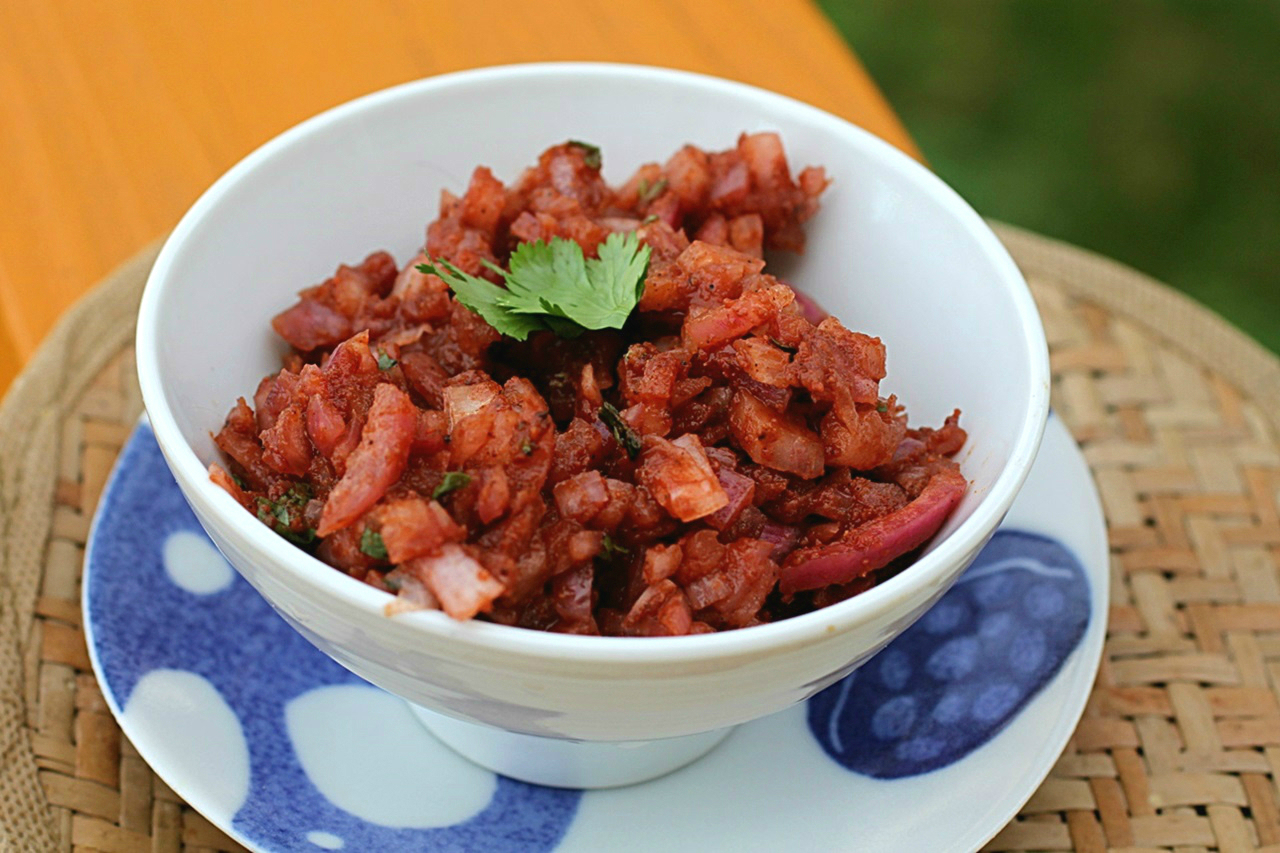
A popular feature in many Indian restaurants, this cumin-laced relish is a nice alternative to your usual relish on a hot dog. Credit: Copyright 2015 Rinku Bhattacharya
Prep time: 2 hours
Yield: 1 cup
Ingredients
2 large white onions, finely diced
1 tablespoon cumin seeds
½ tablespoon black peppercorns
1/3 cup tomato ketchup
3 tablespoons fresh lime juice
1 1/2 teaspoons black salt
1 tablespoon sugar
1 teaspoon red cayenne pepper
2 tablespoons minced cilantro
Directions
1. Chill the diced onions in the refrigerator for an hour.
2. Lightly toast the cumin seeds and black peppercorns and grind to a powder.
3. In a mixing bowl, add powdered spices, ketchup, lime juice, black salt, sugar and the red cayenne pepper and mix well with the chopped onions.
4. Return to the refrigerator and chill for another hour (or up to 6 hours) before serving. Garnish with cilantro and serve.
Pear and Raisin Chutney
This chutney from my cookbook pairs well with grilled tofu, pork or fish — and is wonderful added to a burger. Or serve it alongside a basket of warm tortilla chips.
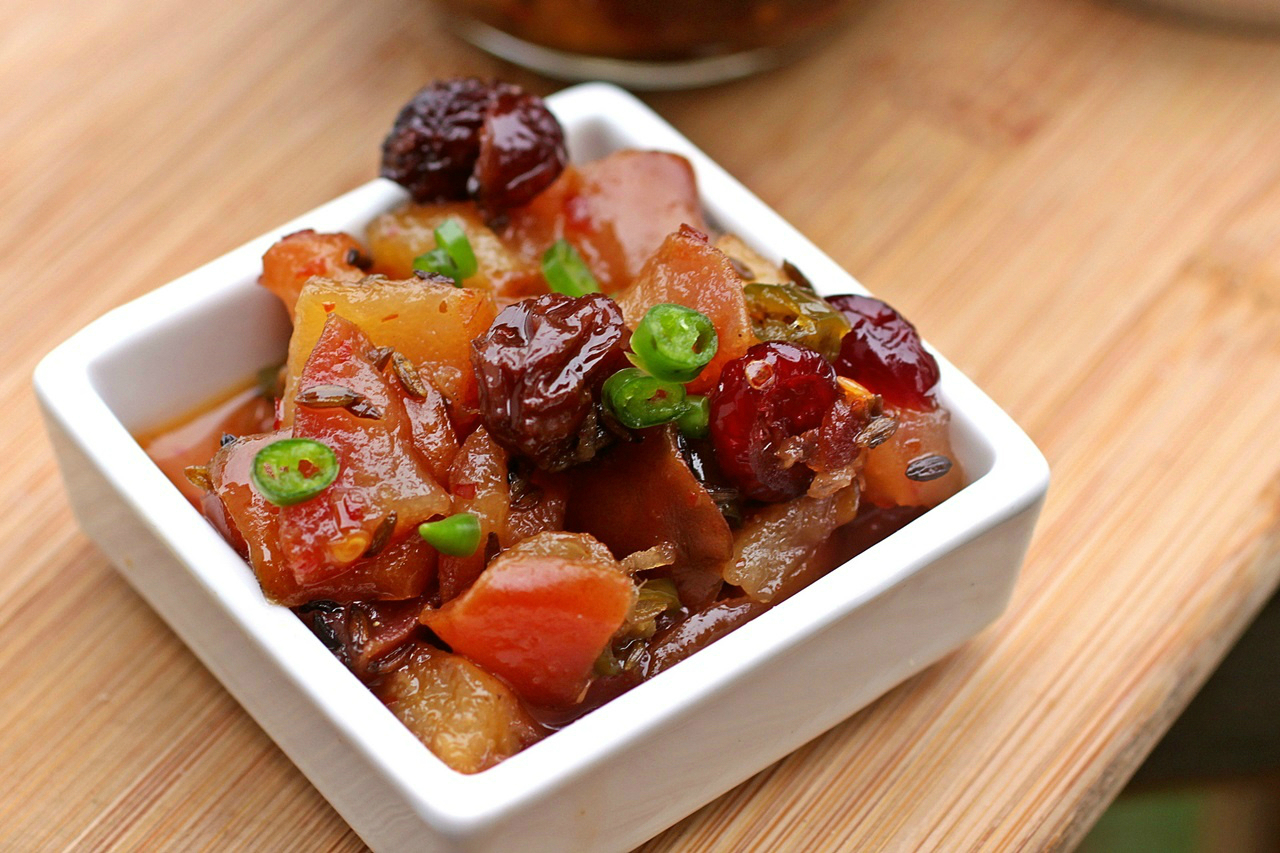
This Pear and Raisin Chutney recipe from my cookbook pairs perfectly with grilled tofu, pork or fish — or try it as a relish on a burger. Credit: Copyright 2014 Rinku Bhattacharya
Prep time: 15 minutes
Cook time: 15 minutes
Total time: 30 minutes
Yield: 3/4 cup
Ingredients
4 to 6 medium red pears, cored and diced (not peeled)
1 lime
1 tablespoon oil
1 1/4 teaspoons fennel seeds
1/2 teaspoon red pepper flakes
2 tablespoons finely grated ginger
2 tablespoons malt or cider vinegar
1/3 cup sugar or brown sugar
1/3 cup mixed raisins
1 to 2 tablespoons chopped dried sweetened cranberries
2 long green chilies (young cayenne or Italian), minced
Directions
1. Place the pears in a colander and squeeze the lime juice over them.
2. Heat the oil on medium heat for 5 minutes. Add the fennel seeds and wait until they sizzle and turn a few shades darker, about 20 to 30 seconds.
3. Add the red pepper flakes and stir.
4. Add the pears, ginger, vinegar, sugar, raisins and cranberries and stir. Let the sugar dissolve and bring the mixture to a simmer. Simmer for 5 minutes, until the raisins swell and the pears become soft — but not mushy.
5. Sprinkle with minced chilies before removing the heat.
6. Store and use as needed. This mixture will keep in the refrigerator for six to eight months.
Citrusy Roasted Beets With Tempered Spices
A cross between a salad and a light pickle, this healthy condiment adds a gentle tartness to tender young beets. This recipe is a lighter and healthier version of the traditional beetroot and cheese salad, and is dairy- and nut-free.
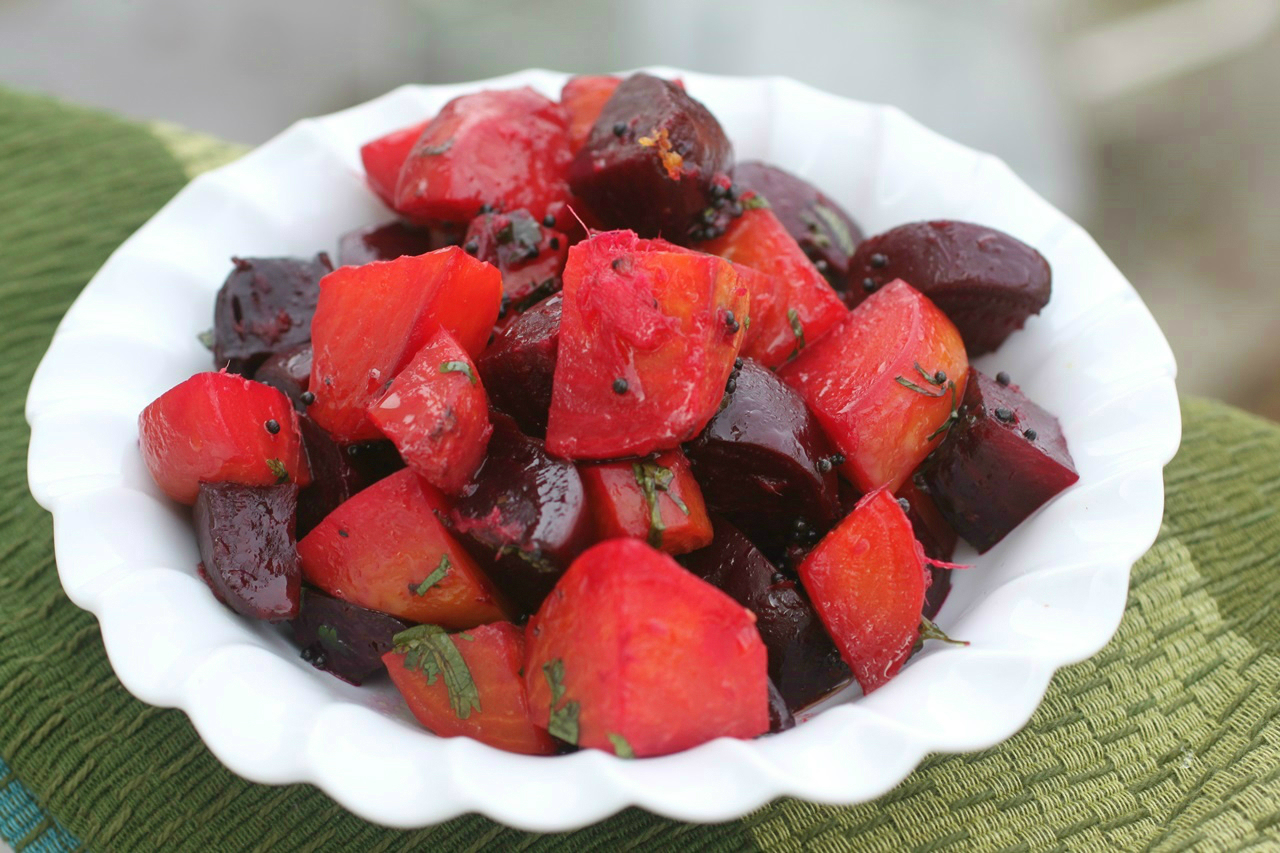
This healthy condiment, also from “Spices & Seasons,” adds a gentle tartness to tender young beets, seasoning them with ginger, black pepper, Clementine juice and mustard seeds. Credit: Copyright 2014 Rinku Bhattacharya
Prep time: 10 minutes
Cook time: 45 minutes
Total time: 55 minutes
Yield: 6 servings
Ingredients
3 medium red beets, greens removed
3 medium yellow beets, greens removed
2 to 3 tablespoons oil
1 teaspoon fennel seeds
1 teaspoon mustard seeds
2 cloves garlic, minced
1 teaspoon ginger paste
1/2 teaspoon black salt
1/2 lime
1 orange or Clementine, cut in half
Several grinds black pepper
1 tablespoon cilantro, finely chopped
Directions
1. Preheat oven to 375 F.
2. Wrap the beets in foil and roast for 35 to 40 minutes. Allow beets to cool and then peel and cut into wedges.
3. Heat the oil in a wok or skillet. Add the fennel and mustard seeds. When they begin to crackle, add the garlic and ginger paste and sauté lightly until the mixture is fragrant.
4. Stir in the roasted beets and black salt and mix well.
5. Squeeze in the lime juice and orange or Clementine juice and mix well.
6. Stir in black pepper.
7. Garnish with cilantro and serve.
Slow Cooker Plum, Date and Rhubarb Chutney
This beautiful tangy ruby red chutney can be made with plums or any stone fruit of your choice. It takes a lot of cooking to obtain its deep jam-like consistency, which can be challenging during the summer, but I use the slow cooker in my recipe to keep my kitchen cool.
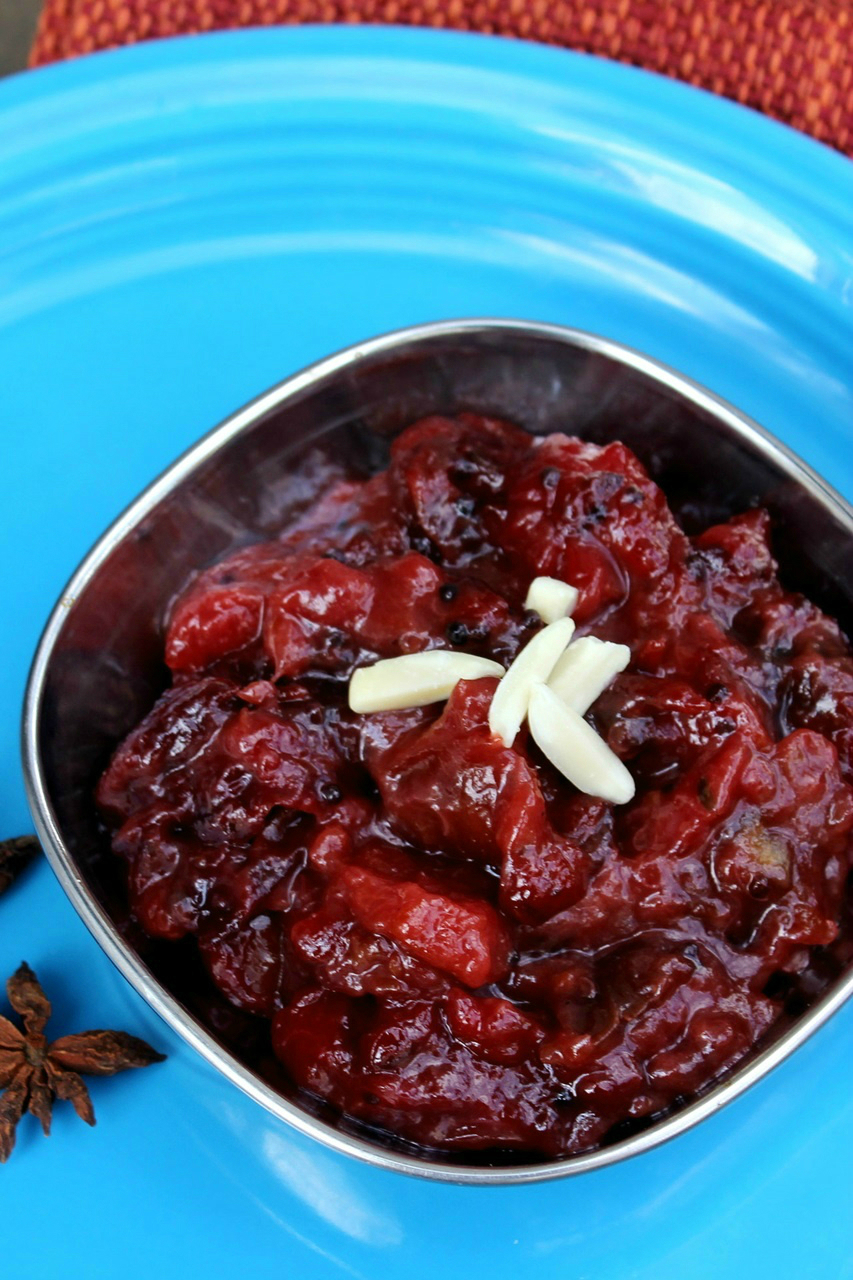
This tangy, ruby-red chutney can be made with plums or any stone fruit of your choice. Credit: Copyright 2015 Rinku Bhattacharya
Prep time: 15 minutes
Cook time: 3 hours in a slow cooker
Total time: 3 hours, 15 minutes
Yield: About 3 cups
Ingredients
1 pound of rhubarb, trimmed and cut into small pieces
4 pounds of purple plums, stoned and coarsely chopped
4 tablespoons minced ginger
3 to 4 star anise
1 large stick cinnamon
1 1/2 teaspoons red cayenne pepper
1 cup of chopped and seeded dates
1/2 cup chopped almonds (optional)
1/4 cup maple syrup
Directions
1. Place the rhubarb, plums, ginger, star anise, cinnamon, cayenne pepper, dates, almonds (if using) and the maple syrup in the slow cooker and cook on high setting for 3 hours.
2. Stir the mixture occasionally to help with the consistency.
3. After three hours you should have a fragrant, sticky and colorful medley.
4. Remove the whole spices and save the chutney in a clear jar and use as needed to perk up your meal.
Classic Cucumber Raita With Mint
Omnipresent on the summer table and year-round in India, this is the more traditional version of raita. I sometimes add dill instead of — or alongside — the mint and serve this as the perfect pair to salmon.
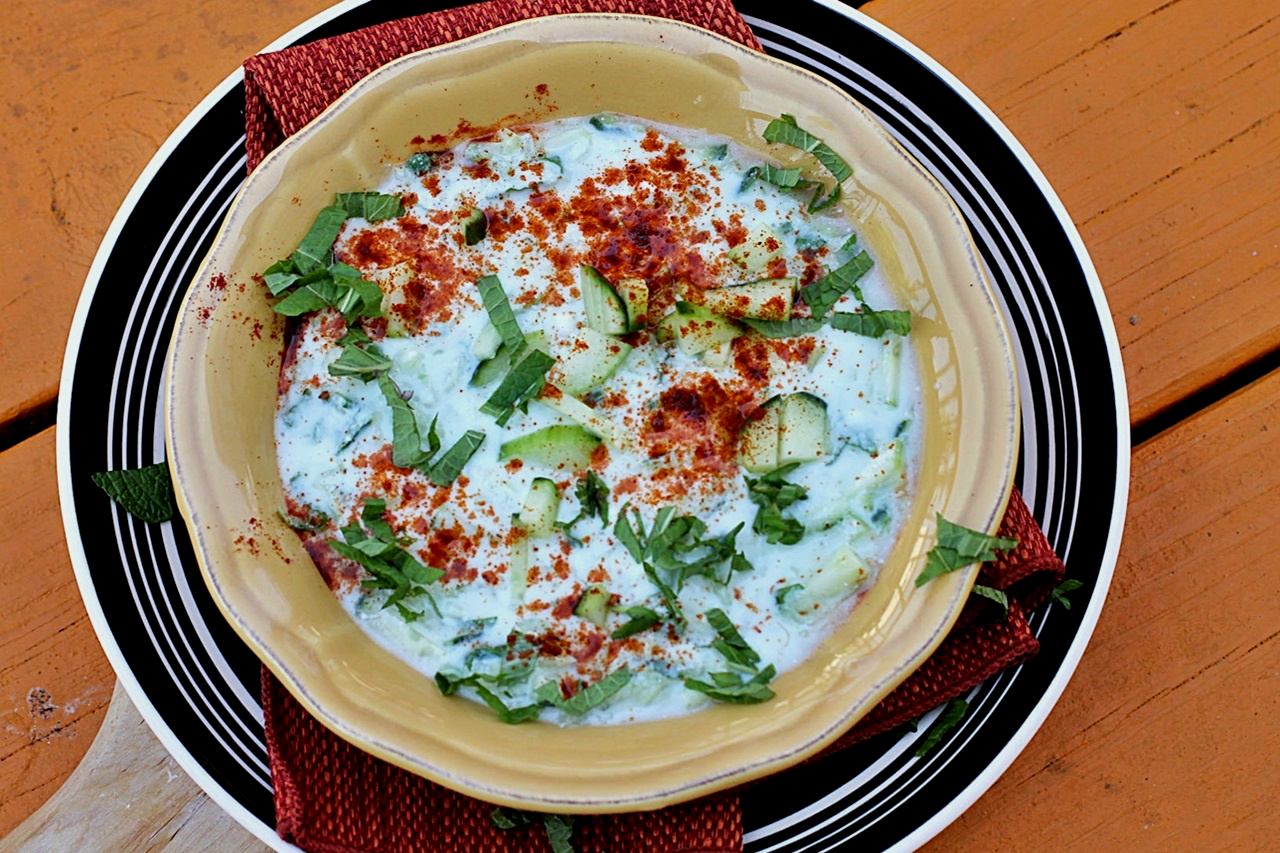
Omnipresent on Indian tables in the summer and all year round, this Cucumber and Mint Raita is perfect with almost any dish. Try it with dill to mix things up. Credit: Copyright 2015 Rinku Bhattacharya
Prep time: 25 minutes, plus 1 hour for chilling if you prefer the raita chilled
Yield: 4 to 6 servings
Ingredients
2 medium-sized English or Persian cucumbers (about 1 1/2 pounds)
1 1/2 cups of day-old natural yogurt
1/2 cup fresh mint leaves
1/2 teaspoon black or Himalayan salt
1/4 teaspoon ground cumin
1/2 teaspoon freshly ground black pepper
1/4 teaspoon sugar
Cayenne pepper (optional)
Directions
1. Peel the cucumbers.
2. Grate about three-quarters of the cucumbers and finely chop the rest, keeping the chopped cucumbers separated from the grated cucumbers.
3. Place the grated cucumbers in a mixing bowl.
4. In a separate bowl, add the yogurt and beat well.
5. Mince the mint leaves and add to the yogurt.
6. Add the black salt, cumin, black pepper and sugar and beat well. Gently fold in the grated cucumbers.
7. Top with diced cucumbers and sprinkle with cayenne.
8. Chill up to an hour or serve immediately.
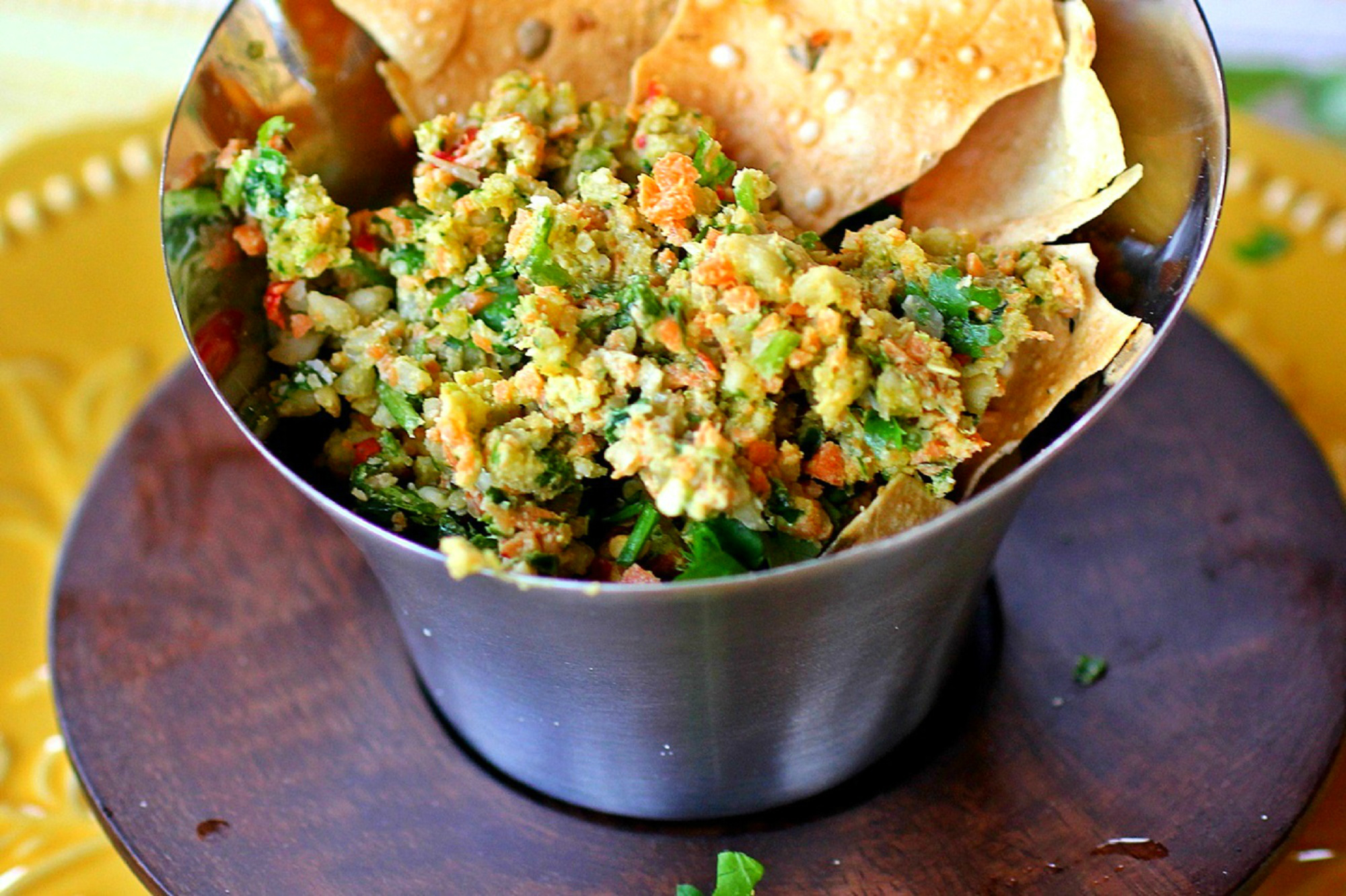
Main photo: The heat of the chilies in this Chili Peanut Relish is nicely balanced by the creamy, crunchy peanuts. This quick dish — you can make it in about 10 minutes — is delicious with fish and vegetables. Credit: Copyright 2014 Rinku Bhattacharya