
Articles by Author
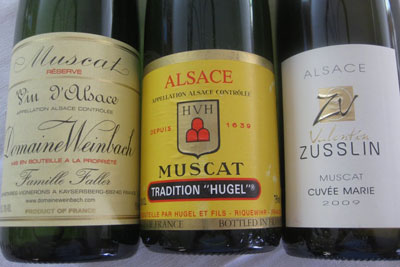
Among the wines of Alsace, Muscat is probably the least known — and the most surprising. Its relative obscurity is explained by the fact that there’s just so little of it.
Of the total vineyard area in Alsace, Muscat accounts for just 362 hectares (900 acres), or a little more than 2% of all plantings. Compare this with Riesling (3,376 hectares, 8,300 acres or 22% of planting) and you get the picture. There’s just not enough of this wonderful wine to go ’round.
Why such tiny quantities? Mainly because Muscat is famously difficult to grow. I sometimes think if grapes were people, Riesling might be a nicely brought-up young man, mature beyond his years, a touch preppy, a sure hit with mothers-in-law. Muscat, by contrast, would be the temperamental teenager — every parent’s nightmare. She’s susceptible to the slightest rebuff, always ready to flounce out in a huff. In a word: complicated.
Muscat grapes finicky, but payoff is worth it
Marie Zusslin of organic and biodynamic Domaine Valentin Zusslin in Orschwihr, agrees that the grape is thoroughly “capricieux” (capricious). She underlines how difficult it is to work with at every stage, right through the growing cycle and into the cellar. “You can’t let Muscat out of your sight for a moment if you want to be sure to preserve its structure and its delicate aromas,” she commented in an email.
More from Zester Daily:
And the surprise element? Muscat in Alsace is always made as a dry or off-dry wine. This sets it apart from Muscat from other parts of France and elsewhere in Europe, where it is most often made sweet, and sometimes additionally fortified with alcohol. Crisp, dry, distinctly grapey — it’s the only wine that actually tastes like a juicy mouthful of fresh grapes — and delicately aromatic, Muscat is the classic Alsatian aperitif. At the world-famous Auberge de l’Ill in Illhauesern, where pre-dinner drinks are served on long, lazy summer evenings in the garden fringed with weeping willows that bend low to the river, sommelier Serge Dubs delights in offering un verre de Muscat as an appetite sharpener — très typique and more fun than the conventional alternatives, such as a glass of Champagne or Crémant d’Alsace.
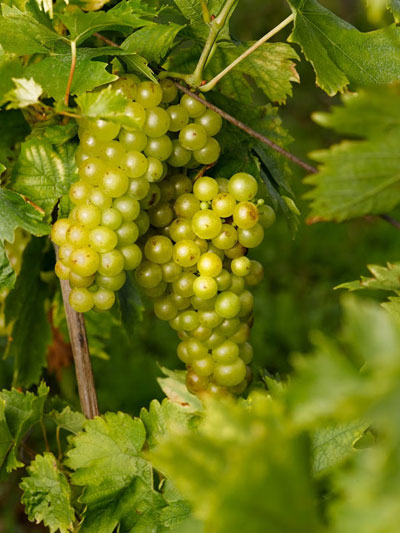
Muscat grapes on the vine. Credit: SPACH Conseil Vins Alsace
Two distinct varieties of Muscat are cultivated in Alsace: Muscat Blanc à Petits Grains (often known locally as Muscat d’Alsace) and Muscat Ottonel. Received wisdom, shared by Jancis Robinson in the magisterial Wine Grapes, is that Petits Grains, a small-berried variety (as indicated by the name), is the superior grape, finer and more delicate and with high acidity, which gives it good backbone. Ottonel is softer, with all the blockbusting Muscat aromas, but it’s generally considered less elegant.
Traditionally, Muscat produced in Alsace was a blend of the two: Petits Grains for acidity and structure and Ottonel for seductive, ripe-fruit aromas, explains Thierry Meyer, former wine commentator on Alsace for the French wine guide Bettane & Desseauve.
Still, today you will find winemakers who are of the opinion that a blend is best, probably one that majors on the supposedly finer Petits Grains at the expense of the purportedly clumsier Ottonel. Marc Hugel of the eponymous domaine in Riquewihr is firmly in the blending camp and considers Muscat made purely from Ottonel to be “an aberration.” Zind-Humbrecht, for its part, is leaning ever more heavily in the direction of Petits Grains for its celebrated Muscat (also a blend). On the other hand, Domaine Zusslin in Orschwihr, Domaine Weinbach in Kaysersberg and Frédéric Mochel in Traenheim make beautiful Muscat from 100% Ottonel. But whichever of the two grapes winemakers use and in whatever proportion, all agree that choice of terroir, careful winemaking and plenty of TLC throughout the cycle are key.
However, because you won’t find any mention of the relative proportions of the two varieties on the label, this is not something to fret about. Concentrate, rather, on tracking down what you can (try www.winesearcher.com for suppliers) and savor this fruity, fragrant summer drink to the full.
Summer is time for Muscat
If Muscat’s credentials as the perfect seasonal aperitif are well established, it also stars in combination with light summery cuisine. The preferred local match is with asparagus, but — in Alsace at least — the season is now closed and the markets are full of beautiful early vegetables (baby carrots or zucchini, fingerling potatoes, fava beans and sugar snaps). Try Muscat with a platter of these with linguine in a lightly creamy emulsion based on the jus from the barely- cooked vegetables, or with a salad of summer leaves topped with soft fresh goat’s cheese.
Catherine Faller at Domaine Weinbach in Kaysersberg advises partnering Muscat with her celebrated snail soup, richly flavored with parsley, chervil and garlic. “The wine picks up le petit côté végétal (the slightly vegetal hints) of snails in their herby broth,” she explains. A favorite match of mine is Muscat with a dish of lightly gingered prawns in a sauce of lemongrass-infused coconut milk, whose delicate flavors echo the floral-spicy nature of the wine. For a final summer showstopper, try an Alsace Muscat with a soft-centered Pavlova meringue topped with passion fruit and strawberries and a lick of honey.
Top photo: Three favorite Muscats, from Domaine Weinbach, Domaine Zusslin and Hugel et Fils. Credit: Sue Style
Last summer we spent a memorable couple of nights as guests of Alpine farmers Ernst and Margrit Kübli in their Chalet Horneggli high above Saanenmöser, in Switzerland’s Bernese Oberland.
During our short stay, we observed with respect as they worked from dawn to dusk, milking the cows, making the cheese, mucking out the cows’ stable, cutting and gathering the hay — and then doing it all again next day.
More from Zester Daily:
» Sorbet’s magic ingredient: Rhubarb compote
» How to make (mostly) homemade grape jelly
I confess I’m not much of a preserve person, but this one really hit the spot for me. Not only does it taste amazingly fresh and fruity, it’s also far less sweet than most jams. Two reasons for this, explained Margrit: First, she adds commercial pectin (especially useful for rhubarb, which has little of its own), which means the setting point is reached much faster than with most jams, so the fruit keeps all its natural character and flavor. Second, where generally the ratio of sugar to fruit is 1 to 1, Margrit cuts it back to half this amount — to 2 pounds of fruit she adds only 1 pound of sugar. This means the jam will not keep for long and you should store it in the fridge and use it up fairly promptly. This, I promise, is no hardship.
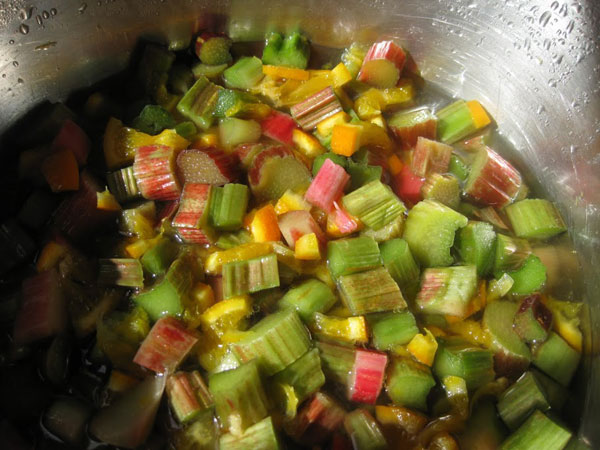
Rhubarb and Orange Preserve
Makes four to five 1-pound jars
The joy of this jam recipe is it’s so quick and easy — who wants to be trapped in the kitchen boiling up preserves for hours in hot weather? You can tackle the task in two easy steps. First, trim and slice the rhubarb, chop the oranges very finely and put in a large bowl with the sugar. Next day, tip the fruit into a preserving pan, bring to a boil, simmer gently, then add pectin and boil very briefly till it reaches setting point.
Ingredients
2.2 pounds (1 kilogram) rhubarb
2 thin-skinned oranges, untreated at harvest
1 pound (500 grams) plus 2 tablespoons sugar
1½ ounces (40 grams, or 4 tablespoons) powdered commercial pectin
2-3 sprigs of fresh mint (optional)
Directions
1. Wash the rhubarb, trim away the ends and cut in ½-inch slices.
2. Scrub the oranges but do not peel. Cut away a slice of peel from the stalk end and from the opposite end.
3. Slice the fruit very thinly, remove all pips and cut slices in tiny dice.
4. Put rhubarb and oranges in a large bowl, add 1 pound sugar, mix well, cover the bowl and leave to macerate for a few hours or overnight, stirring occasionally — the fruit will make lots of juice and the sugar will dissolve.
5. Tip the fruit into a preserving pan, adding any sugar lurking at the bottom of the bowl.
6. Add the mint sprigs (if using), bring the fruit and sugar to a boil, stirring, then turn down the heat and allow to cook at the barest simmer for 10 minutes till the fruit is just soft.
7. Mix the pectin with 2 tablespoons sugar and stir it into the fruit, raise the heat and boil hard for 3 minutes or until setting point is reached — test by tipping a little jam into a chilled saucer and draw a finger through it. It should leave a distinct channel and the surface will wrinkle slightly. If not, continue to boil a few minutes more.
8. Once the setting point is reached, pour jam into clean, warm jars and cover while still hot.
9. Keep the jam in the fridge and use within two to three months.
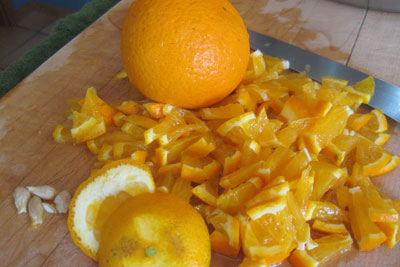
Top photo: Oranges for use in the rhubarb and orange preserve. Credit: Sue Style
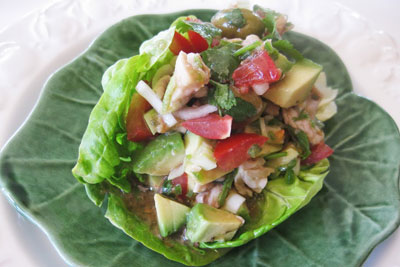
When summer comes, the temperature soars and if the very thought of cooking makes you break out in a sweat, it’s time for ceviche. This marinated fish salad is claimed by many Latin American countries, notably Mexico, Ecuador and Peru. But for me, ceviche’s heart belongs to Mexico, for no better reason than this is where I first met it and fell hard for its cool, sharp-sweet flavors (lime juice, ketchup and Worcestershire sauce), its soft-crunchy textures (oily fish, diced chili and scallion) and its patriotic red-white-and-green Mexican colors (fish, tomatoes, avocado and cilantro).
In Mexico, the fish most often used is sierra, from the mackerel family. While you can use almost any fresh fish filets for ceviche, mackerel gives the most authentic results. It’s generally inexpensive, plentiful and — a bonus here — rich in Omega-3 oils. (I’ve also made ceviche with salmon, which works fine, too.)
Good ceviche starts with fresh fish
The key is the fish should be sparkling fresh. How to tell? Mackerel, being an oily fish, spoils faster than leaner specimens, so let your nose be your guide: It should smell of nothing but the sea.
More from Zester Daily:
» Mexico City’s best ceviche: A travel writer’s search
Besides the fish — cut into neat filets and divested of as much of that beautiful skin as possible — you need a plentiful supply of juicy limes. The fish is not cooked in the conventional sense of the word, but the citric acid in the limes denatures the protein and “cooks” the fish without heat. You can tell it’s done when the flesh has turned from a dull, grayish color to a whiter shade of pale and becomes opaque, no longer translucent.
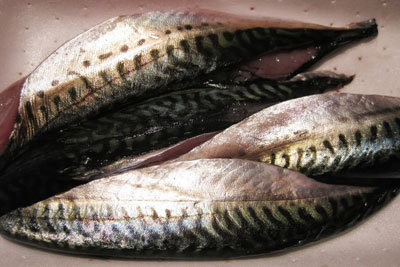
Mackerel. Credit: Sue Style
What you add to your ceviche thereafter can vary quite a bit, but tomatoes, cilantro, chopped onion or scallions and some spice in the form of Worcestershire sauce and/or fresh chili are all obligatory. Some (myself included) add a smidgen of tomato ketchup, which adds a nice sweet note, while others add oregano as well as cilantro.
If the weather has turned warm and you’re lucky enough to find mackerel in your store or fish market — better still, if the fisherman/woman in your family comes home with a net brimming with these beautiful creatures — think ceviche. Here’s how.
Ceviche
Serves 4 to 6 as an appetizer
Ingredients
For the ceviche:
4 fresh mackerel, filleted (8 filets, to give about 1 pound when trimmed and skinned)
Juice of 3 limes
4 tablespoons olive oil
2 tablespoons ketchup
A generous splash of Worcestershire sauce
2 scallions or 1 small onion
1-2 fresh green chilis (such as jalapeños)
3 medium tomatoes
Plenty of chopped cilantro
A pinch of dried oregano
Salt and pepper
1 avocado
For garnish and serving:
12 green olives, pitted
Tortilla chips or crackers to serve
Directions
1. Slide a very sharp knife between the flesh and skin to remove as much skin as possible from the filets.
2. Remove any extraneous bones and cut the flesh in ½-inch cubes.
3. Put fish cubes in a bowl and cover with lime juice. Refrigerate at least 4 hours or until the flesh turns opaque.
4. Tip the fish into a strainer held over a bowl
5. Stir the olive oil, ketchup and Worcestershire sauce vigorously into the strained marinade, whisking well for a vinaigrette until emulsified.
6. Put the fish back into this dressing.
7. Chop the scallions or onion very finely and add to the fish.
8. Cut chilis in half lengthwise, scrape out seeds, chop finely and add to the fish.
9. Remove cores from tomatoes but do not peel, then cut into small cubes and add to the fish.
10. Stir in the chopped cilantro and oregano and season to taste with salt and pepper.
11. Cut avocado in quarters, strip away skin and cut in cubes the same size as the fish.
12. Stir avocado cubes into the fish — do this gently so as not to bruise the avocado.
13. Refrigerate the ceviche till well chilled.
14. Serve in glasses or on a plate cupped inside a lettuce leaf, and garnish with olives.
15. Serve tortilla chips or salty crackers separately.
Top photo: Ceviche. Credit: Sue Style
Zester Daily contributor Sue Style lived in Mexico for seven years and is the author of “The Mexican Cookbook.” She’s now based in Alsace, France, where she writes for various publications and for suestyle.com.
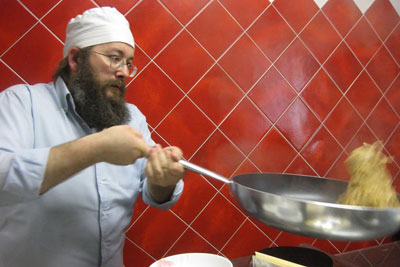
Piedmont means pasta. It’s also a signifier for truffles and Barolo, but those will be for another time. And pasta is one of my own personal passions. Admittedly, I don’t pursue my passion with quite the same single-minded dedication as Bill Buford — described vividly in his book “Heat” — but it’s high on my list of go-to foods.
When in Italy I’m drawn to different, unusual types of pasta as a jackdaw to jewelry. At home I love making it, saucing it and, of course, eating it. So when, on a recent visit to Piedmont, Italy, with a group of friends, an invitation arrived from pasta-meister Mauro Musso of La Casa dei Tajarin in Alba to observe him at work, followed by a degustazione of four or five different pastas, each teamed up with its own sauce and wines to match, I accepted without a moment’s hesitation.
Musso comes from a farming family. In 1994, when the farm was flooded out in a particularly vicious spell of Piedmont weather, the family was forced to abandon the land and move to Alba. Musso, by his own admission, was down and out. He looked for employment and wound up working for a supermarket. “Not my thing,” he admits, adding, “I stuck it for a bit, then decided I’d rather be my own boss.” His experience of working with large-scale food production and retailing led him in quite the opposite direction. His plan was to make pasta on an artisan scale from specialist, organic flours and sell directly to the public.
Three years ago, he carved out a tiny workspace (he calls it his laboratorio) on the ground floor of the family home. He produces two different shapes of pasta: the classic Piedmontese tajarin, after which the business is named (called tagliolini or taglierini in other parts of Italy), slender strands of egg-based pasta that melt on cooking into a state of gently yielding deliciousness and which lend themselves to all kinds of saucery; and casarecce, a more robust, egg-less type that demands correspondingly feisty accompaniments.
Variety of grains lend themselves to dozens of types of pasta
Within these two categories — fine and egg-based, chunky and egg-less — he makes 25 distinct kinds of pasta; the difference lies in the flours used.
More from Zester Daily:
Why so many different kinds of flour? Musso is well aware of the rise in wheat allergies and intolerances in recent years, from the severe medical condition of celiac disease to the less serious but nonetheless genuinely felt discomforts grouped under the heading of gluten intolerance. His theory is that most of us have been raised on a diet of highly refined flour from a restricted range of wheats that have been selected over centuries, principally for their yields and resistance to disease. This limited range, he claims, could help to explain these digestive problems.
Rather than restrict himself to the classic white flour types used in industrial pastas, he experiments with flours milled from ancient varieties of wheat and rye, or from grains and cereals with little or no gluten such as millet, teff, quinoa, amaranth and carob.
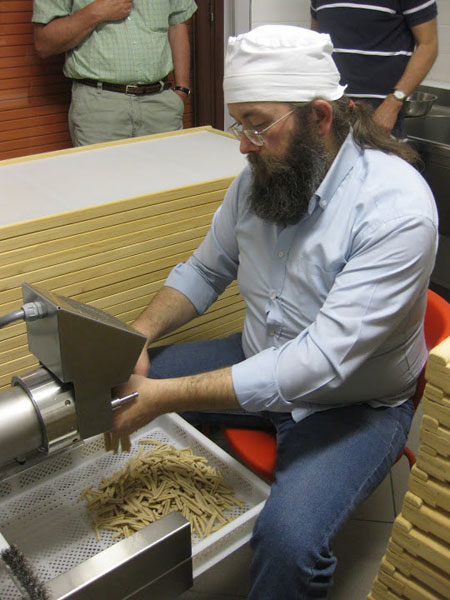
The day of our visit, Musso’s mamma showed us into the laboratorio, where he was absorbed in the task of making casarecce from rye flour with the help of his trusty assistant, his dad. First the flour went into the hopper at the top of the pasta machine and water was dribbled in through a funnel. This was mixed to a loose, breadcrumb-like texture. Finally, as if by magic, this dry, unpromising-looking mixture emerged from the extruder as silken ropes of pasta, which Musso patiently snipped into short lengths wielding a huge pair of scissors, rather like Struwwelpeter. The cut pasta was laid on large, flat, sieve-like trays and transferred to walk-in drying rooms, where it would spend 15 hours. E basta!
We settled down in the small dining room adjoining the kitchen, a bottle of Carica l’Asino (a fragrant white from a long-lost Piedmontese variety) was uncorked and we tucked into our first taste of rye flour tajarin. The characteristic earthy flavor of rye was matched with perfect simplicity by ribbons of sage (“from the herb garden”) and lashings of lightly salted butter (“from Normandy — it’s the best!”). Casarecce came next, made from a blend of emmer wheat and rye (gorgeous, chunky texture and taste), which met their match with Musso’s homemade pesto loaded with basil, garlic, lightly toasted local hazelnuts and olive oil. The wine, similarly characterful, was a deep, golden Muntà, a blend of Cortese and little-known local variety Favorita from biodynamic grower Andrea Tirelli.
Delicate strands of tajarin from durum wheat wound themselves around tomato-infused mussels for our next dish, and the wine, an outstanding, mineral-infused Riesling “K” from Paul Kubler, took me straight back home to Alsace. By now we were beginning to flag. With the promise (or maybe the threat) of Musso’s homemade bunet (chocolate flan) hanging in the air, we negotiated a deal with our pasta-meister and skipped (with reluctance) a planned dish of whole-wheat casarecce with a meat sugo in favor of yet more silken tajarin with mushrooms, accompanied by a sprightly Dolcetto d’Alba from Rivella Serafino.
More than a demo, more than instructions on which pasta works best with which sauce, more even than a memorable meal, it turned out to be a lesson in the importance of valuing and using what grows locally to make flavorsome, healthy foods and wines of simple distinction.
The lesson is being learned and word is getting around about this pasta iconoclast — he’s one of the so-called “heretics” in a recent short film titled “Storie di eretici nell’Italia dei capannoni,” a lament for an Italy increasingly overrun by factories and warehouses. On Saturday mornings, customers stop by on their way home from the market in Alba to stock up on his pastas, and Musso is also building up a loyal following among local chefs. It’s an irresistible story of a fine artisan product from a passionate individualist rooted in his beloved Piedmont.
Anyone who’s ever traveled in the Swiss Alps will know that farming there is nothing new. Wherever you go, you will see doe-eyed, moleskin-brown cows grazing vertiginous, brilliant green, manicured hillsides, their fragrant milk destined for great wheels of hard mountain cheese. But fish farming? It sounds unlikely — a bit like salmon farming in the Yemen — but it’s true.
The story began with the Lötschberg rail tunnel, which enters the Alps at Frutigen in the heart of the Bernese Oberland and emerges the other side at Raron in the Valais.
More from Zester Daily:
The tunnel is the latest example of the Swiss flair for engineering. As often happens when tunneling in the Alps, the project hit a few snags. Chief among these was the water runoff from rain and melting snow, which filters through the limestone layers to the tunnel below. Thanks to the geothermal effect, the water is warmed on its descent through the mountain to a rather comfortable 64 F. To channel it directly into the local river would have played havoc with the wild fish population, accustomed to an icy alpine torrent.
The solution came from engineer Peter Hufschmied, head of site management for the tunnel and a keen angler. Instead of expending energy in cooling down the water before allowing it to run off, why not take advantage of the warmth to raise fish? Simultaneously, they would use any surplus energy to heat greenhouses where tropical plants and fruits would grow. A perfect – and perfectly sustainable — solution.
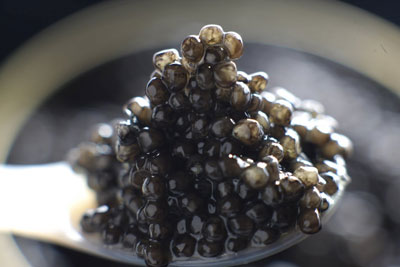
The Tropenhaus in Frutigen was born, a pilot project was put in place in 2002, and by 2005 the first sturgeon were introduced. The original Swiss caviar, christened Oona (a word with Celtic roots suggesting “unique” or “extraordinary”), was harvested in the winter of 2011-12. Now leading Swiss chefs such as Heiko Nieder at the Dolder Grand in Zürich, Werner Rothen of Restaurant Schöngrün at the Paul Klee Centre in Bern, and Ivo Adam of Restaurant Seven in Ascona on Lake Maggiore can’t get enough of it.
At least 27 different sturgeon species are raised or fished for caviar. From these, the Tropenhaus chose the Siberian sturgeon, Acipenser baerii. It’s a strange and wonderful beast, light gray to brown in color with five rows of bony plates along its back and sides; an elongated, upturned snout; and a kind of four-pronged goatee beard. In captivity, the females of the species will mature at approximately 6 years of age, which makes them an economic proposition for farming. (Wild Siberian sturgeon needs at least 20 years to reach maturity.)
Once mature, the females are stunned and killed, the sac of roe is lifted out and set aside and the fish is deftly filleted. The fillets — firm, dense and devoid of bones — feature on the menus of the two on-site Tropenhaus restaurants and are also sold to restaurants and shops (including select branches of the Swiss retailer Coop, which is also the Tropenhaus’ main shareholder). Some fillets are sold fresh, others are smoked to create a delicacy not unlike smoked eel.
Harvesting roe for caviar a simple process
Considering the mystique surrounding caviar, the process for making it seems simple, at least as demonstrated by caviar-meister Tobias Felix. Clad in a hairnet, overalls, a plastic apron and white boots and equipped with surgical mask and latex gloves, he looks like a cross between an astronaut and a surgeon.
First, taking care not to damage the precious eggs, he gently coaxes and massages them through a wire mesh, leaving behind the membrane that surrounds them. Next, he rinses the eggs in cold water, drains them in a fine-meshed sieve and painstakingly picks out impurities with tweezers. At this stage, the eggs are a dull grayish-black; only when he adds the carefully calculated measure of salt will they take on their characteristic glossy sheen. The newly salted caviar is promptly transferred into custom-made tins, which are sealed hermetically. The entire process takes 15 minutes from start to finish.

For the final step, the tin is embedded in a sleek, black sphere, which in turn is enclosed in a solid chunk of glass resembling an ice cube, made at the Hergiswil glass factory on Lace Lucerne, an ultra-chic piece of packaging that won a coveted Red Dot Design award in 2012.
The likelihood of Swiss caviar coming to a table anywhere near you is probably slim. “The quantities are tiny (production in the first year was around 300 kilograms, 700 pounds) and for the moment we are focusing just on Switzerland,” admits marketing manager Andreas Schmid. But there are ambitious plans afoot: Production is set to increase tenfold, and then they will consider the export market.
Even farmed, Swiss caviar will never be cheap; that’s at least part of its mystique. (Thirty grams or 1 ounce of Oona costs 144 Swiss francs, or $155 U.S.) But now that caviar from wild fish is out of bounds due to a disastrous combination of damming, overfishing, pollution and poaching, farmed caviar is increasingly meeting demand for this prized product. Sturgeon is already raised on fish farms all over the world, from France, Spain and Italy to Russia, China, Canada and the United States.
Now Switzerland has joined the ranks.
Top photo: A spoonful of Oona caviar. Credit: Tropenhaus Frutigen
The Salon du Chocolat, founded in Paris by the aptly named Sylvie Douce and François Jeantet, has a mission that few right-minded people would quarrel with: to promote the understanding and enjoyment of chocolate. Since its first Paris manifestation 18 years ago, countless other editions have been staged in 21 different cities worldwide, from New York to Tokyo to Moscow to Shanghai. It’s a magnificent show, wherever it happens. Each one has its own indigenous flavor and character.
One of the venues for the Salon du Chocolat is Switzerland. This, remember, is the land of Rodolphe Lindt, inventor of the conching process, which involves patient heating and repeated rolling of the cocoa mass to smooth away the gritty particles naturally present. It was here, too, that Daniel Peter, together with his friend and colleague Henry Nestlé, produced the first solid milk chocolate bars that would keep without spoilage. And then, of course, the Swiss are the acknowledged world champion chocolate-scoffers, putting away an impressive 12 kilos (close to 27 pounds) per person per year.
Perhaps the only surprise about Switzerland’s Salon du Chocolat is that it took until 2012 for the first show to be staged in Zurich. The 2013 edition recently closed its doors after three exhausting, exhilarating days starring a cast of about 90 chocolatiers, pastry chefs and chocolate experts from all over the world. “This year’s Salon was another sweet success,” enthuses Kerrin Rousset, a chocolate and confectionery connoisseur based in Zurich and responsible for working with the Salon team in Paris to come up with the program of events for the Swiss show.
From fashion to food, Salon du Chocolat is all things chocolate
Stunning new chocolate creations were presented to (and enthusiastically sampled by) the public. Sylph-like models in chocolate-trimmed designer gowns paraded nonchalantly up and down the catwalk. Chocolatiers and pastry chefs from boutiques and top restaurant kitchens demonstrated in Choco Démo, including Swiss Chocolate Masters David Pasquiet and Claudia Schmid. Conferences in the chocosphere filled up quickly, with the public eager to learn about pairing chocolate with wine, whiskey or even with beer, or to debate issues such as the sourcing and sustainability of cacao.
Any Salon du Chocolat, wherever it takes place, provides an opportunity to apply a finger on the pulse of what’s happening in the chocolate world, so I was delighted to do my bit to find out what’s new. Among the many developments visible (and tastable), my favorite — speaking here more as a cook than a chocolatière/pastry chef — is the growing trend for salt in chocolate.
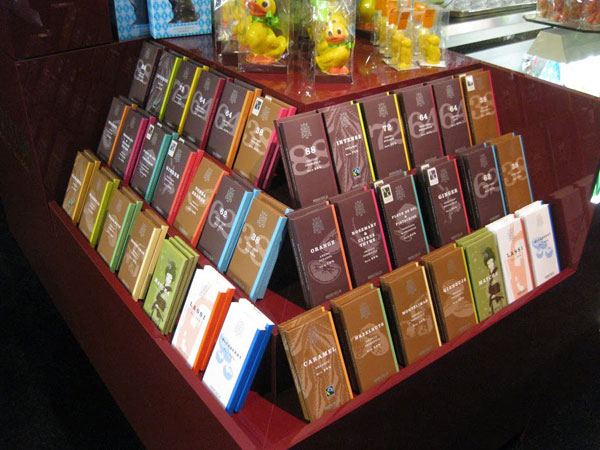
Of course, the salty-sweet dimension is hardly novel. The Bretons have used crunchy demi-sel butter in candy forever, and sweet Scottish shortbread is pleasingly seasoned with salt. Nowadays any self-respecting chocolatier seems to have a salt-speckled chocolate in his/her range. Even Toblerone has joined the game, with a sky-blue packaged bar whose familiar toasted almonds are tossed in crunchy salt crystals. Repeatedly at the salon, I was struck by the degree to which salt — provided it’s added with enormous care and in the right quantity — can enhance fine chocolate, allowing complex flavors to bloom while adding a piquant counterpoint to balance sweetness plus an element of crunch. Two stars for me were Beschle of Basel’s 64% dark chocolate with fleur de sel and pistachios, and their startlingly good Lassi, a white chocolate lifted by the addition of yogurt, lime and a whisper of salt.
Nibbling my way around the Salon, I made a few more discoveries. The first was there’s nothing quite like a chocolate bar (as opposed to truffles, pralines or other composite delights) for getting the full chocolate hit. Every one of the top chocolatiers present displayed positive libraries of bars — square, round, rectangular, large, medium or bite-sized, and all packaged to within an inch of their lives.
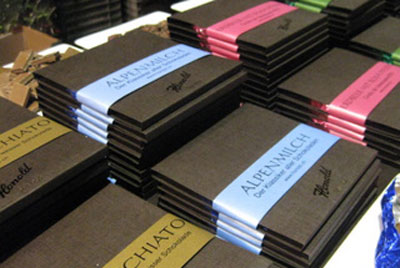
Another revelation was that milk chocolate should not be scorned. Chocolate snobs (I have to admit I’m probably one) generally favor the dark varieties and play one-upmanship games on cacao percentages, the higher the better. That was until I discovered Alpenmilch by celebrated Zurich chocolatier Honold — sinfully smooth and seriously chocolatey, amazing depth of flavor with marked toffee notes, a reminder that Switzerland is the Heimat of milk chocolate. (“High as the Alps in flavor” was the proud marketing slogan for Daniel Peter’s original Gala milk chocolate).
And for one who also has been know to purse lips at the very suggestion of flavored chocolates, I made short work of Honold’s dark (65%) Venezuelan Criollo, dusted with a discreet shower of strawberry flakes and crushed pink peppercorns. Not to mention anything from the newly established, Budapest-based ChocoMe, which makes big, bold, beautifully packaged bars bulging with fruit, nuts and spices.
Salon du Chocolat calendar for 2013
Salvador de Bahia: July 6-8
Paris (professional): Oct. 28-30
Paris (open to the public): Oct. 30-Nov. 3
Lyon, France: Nov. 8-11
Cannes, France: Nov. 22-24
More from Zester Daily:
» Paris’ Salon de l’Agriculture exhibits French food roots
» Salone del Gusto grows with slow-food movement
Final mention of another important trend in the choco-world: The increasing interest in where and how chocolate is sourced — “from bean to bar” is the buzz phrase. The same kind of thing that happened with Terra Madre and Slow Food’s Salone del Gusto is taking place within the Salon du Chocolat: Terra Madre, once a colorful sideshow representing grower-producers from the Third World, is now an integral part of the Salone del Gusto. In just the same way, the Salon is broadening its focus beyond the pure hedonistic pleasure of chocolate to embrace pressing themes like transparent sourcing, conservation, sustainability and equitable work practices.
Original Beans (Amsterdam) and Idilio Origins (Basel), present at the Zurich Salon, are widely admired for their ethical business model and emphasis on sustainability. Each sets up long-term contracts with individual cacao growers not only in traditional grower countries like Ecuador and Venezuela but also, in the case of Original Beans, in the war-torn Congo, which has no history as a cacao producer. They pay significantly above fair-trade rates and focus on single-origin chocolate, emphasizing not only on the cacao type (Criollo is king) but also the terroir in which it is grown.
The Salon du Chocolat provides a fabulous showcase not just for the finest chocolate but also for the latest trends. The good news is there’s one coming soon to a city near you.
Top photo: Alpenmilch chocolate bars. Credit: Sue Style
Zester Giveaway
Learn how to make traditional Vietnamese cuisine. Enter here to win one of 5 copies!
Upcoming Events
-
see all of our
Upcoming Events
-

Oregon Brewers Festival July 24-28Takes place on July 24, 2013Oregon Brewers Festival The Oregon Brewers Festival is one of the nation’s longest running and best loved craft beer festivals. The festival exists to provide…
-
Santa Barbara Urban Wine Trail Passport Weekend July 26-July 28Takes place on July 26, 2013Santa Barbara Urban Wine Trail Passport Weekend Join us the weekend of July 26th for the second annual Santa Barbara Urban Wine Trail Passport Weekend. …
-

Gilroy Garlic Festival July 26-28Takes place on July 26, 2013Gilroy Garlic Festival The 35th annual “Ultimate Summer Food Fair”; three days of incredible food, beverages, arts & crafts and live entertainment. 10 tons of…
SmartBrief