Articles in Agriculture
Who would have thought, 30 years ago, that New Zealand would be producing Pinot Noir with an international reputation? It has all happened in an incredibly short time, so that several of the original pioneering winemakers are still involved in the industry. And a recent tasting in London and New York demonstrated just how successful Pinot Noir is in New Zealand.
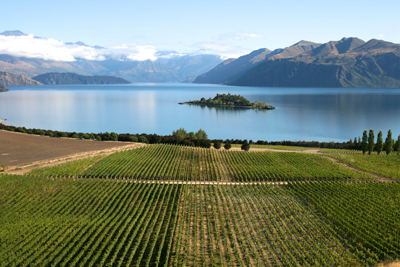
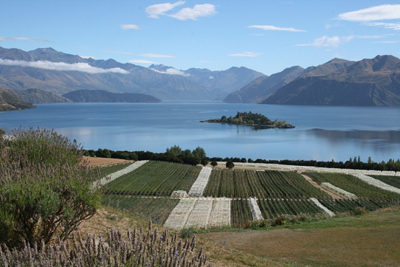
This was a tasting that I could not possible miss: three decades of Rippon Vineyards Pinot Noir, beginning with the 1990 vintage, which I tasted as a vat sample the very first time that I went to New Zealand. Rippon Vineyards in Central Otago was one of the first New Zealand vineyards that I visited. It is the most fabulously beautiful spot, with breathtaking views over Lake Wanaka toward the Southern Alps. Central Otago lies on the 45th parallel, which makes its vineyards some of the southernmost in the world — there is not much land between Otago and Antarctica. Whereas most New Zealand vineyards are on the country’s east coast, Central Otago enjoys a continental climate, with harsh winters and warm summers. Schist is the dominant soil at Rippon.
Two-part series:
» Part 1: Why New Zealand Pinot Noir Works: A Pioneer’s Story
» Part 2: A Milestone Tasting From Rippon Vineyards
More from Zester Daily:
» The unstoppable Oregon Pinot
These days, Nick Mills makes the wine at Rippon, but it was his father, Rolfe, who was the true pioneer. Rolfe’s grandfather bought the land in 1912, and Rolfe began planting vines in 1975.
“It was all very much a learning curve, experimenting with many different grape varieties,” Nick said. “Pinot Noir was just one of several. And nothing was known about different clones. You got cuttings from other growers, and there was a strong element of self-sufficiency and indeed isolation.”
The first commercial wines of Rippon were made in 1989, and in 1990 a talented Austrian winemaker, Rudi Bauer, took over for a few years. (He now has his own estate, Quartz Reef.) Back in 1990 there were just six wineries in Central Otago; nowadays there are 120 wine growers, though not all with their own winemaking facilities.
New Zealand Pinot Noir has regional variations blossom
At the time that Rippon was getting started, Chard Farm and Gibbston Valley were also experimenting with Pinot Noir, among other grape varieties, in Central Otago. And at the bottom of New Zealand’s North Island, Larry McKenna, who had arrived in Martinborough in 1986, was busy putting Martinborough Vineyards on the map for Pinot Noir, alongside his neighbours at Ata Rangi and Dry River.

Nick Mills and his wife, Jo, at Rippon.
Credit: Briar Hardy-Hesson
Elsewhere on the South Island, there were pockets of Pinot Noir in Nelson, Waipara and Marlborough. Today, Pinot Noir is the most widely planted red variety in the country, and the regional variations are becoming more apparent. I generally find that wines from Central Otago are riper and richer, from enjoying long hours of summer daylight, while those from Martinborough are more savory and maybe more structured.
But back to Rippon. Carrying on the family tradition, Nick studied winemaking, including a course on biodynamics, in Beaune and worked with winegrowers in the Côte d’Or. Sadly, Rolfe died in 2000, and in 2003, Nick’s mother suggested that it was time for Nick to come back to Rippon and take over responsibility for the winemaking.
He talked of how his winemaking has developed. “There are so many things to consider. Whole bunches? Do you add the stems? Are they ripe? You need to understand your fruit.” He certainly shows that he does with this range of wines, which tell the story of the family land.
Read the detailed tasting notes.
Top photo: Rippon Vineyards. Credit: Briar Hardy-Hesson
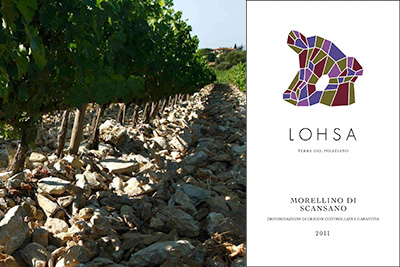
After splurging on plenty of great (and expensive) wines during the holidays, I’m ready to retrench. At $15, this bright, juicy 2011 Lohsa Morellino di Scansano is the right kind of deal, a medium-bodied red packed with generous flavors of cherry, raspberry, earth and spice, and intriguing aromas of dark cherries and violets. It’s yet another example of the fine values to be found in Italy’s less well-known wine regions.
This red comes from the Maremma, a hilly coastal strip in western Tuscany on the Tyrrhenian Sea, where the local name for the Sangiovese grape is Morellino. Wine was produced there back in Etruscan times, but it wasn’t until Bolgheri, the northern part of the Maremma, gained prominence as the home of Super Tuscan wines like Sassicaia that anyone looked farther south and discovered Morellino.
Elin McCoy’s Wine of the Week
2011 Lohsa Morellino di Scansano Terre del Poliziano
Price: $15
Region: Tuscany, Italy
Grape: 85% Sangiovese, 15% Ciliegiolo
Alcohol: 13%
Serve with: Roast pork loin, braised lamb shanks, mushroom ragu with polenta
More of Elin’s wine picks:
» A juicy, organic red from Montepulciano
» A crowd-pleasing party red wine from the Loire Valley
Thirty-five years ago there were only about 10 wineries that grew their own grapes in the district of Scansano, which includes 3,700 acres of vines in most of the towns in the southernmost area of Tuscany. Now there are several hundred wineries, fueled by a mini-land rush of buying and planting.
The reputation of the wines climbed, which is why the Morellino di Scansano appellation finally gained DOCG status starting with the 2007 vintage. Few wine drinkers, I’ve discovered, understand what those letters mean — Denominazione di Origine Controllata e Garantita — and often don’t realize they stand for Italy’s highest quality wine category. Rules govern everything from where the grapes can be grown to which ones must be used. To be labeled Morellino di Scansano, a wine has to contain at least 85% Sangiovese and come from a historic area that surrounds the medieval town of Scansano. Unlike most DOCG wines, Morellino is usually released less than a year after the harvest, which translates into fresh, lively reds. This one is aged for eight months in old oak casks.
Lohsa sets the table
The Lohsa Estate in Magliano belongs to the Carletti family, which established the beautiful Il Poliziano winery in Montepulciano, farther north in Tuscany, in 1961. Federico, son of the founder Dino, like so many restless enologists, wanted to experiment in other regions, and he expanded the family holdings into the Maremma in the 1990s as an independent “Terre del Poliziano” project. He produced his first Morellino in 1998.
The 2011 Lohsa Morellino di Scansano is a simple wine, but it has an enticing, gulpable charm. The appellation’s sunny mild winters, cool winds from the sea in summer, and stony soil all combine to make reds that are softer, rounder and more succulent than other Tuscan wines from the same grape, like Chianti. In other words, they’re delicious, especially for the price, which is why they’re wildly popular in Rome’s wine bars.
Top composite photo: A view of the Lohsa Estate and label for 2011 Lohsa Morellino di Scansano Terre del Poliziano. Credit: Courtesy of the Lohsa Estate
These are notes from a tasting that spanned three decades of Rippon Vineyards Pinot Noir.
1990 — This was the second commercial vintage of Pinot Noir, made from vines planted in 1982. A very warm vintage, with an early harvest. Medium colour, with an evolved rim. Quite a soft vegetal red fruit nose. A silky palate, with ripe red fruit, depth and texture with a good balance. A touch of fruitcake on the finish and a dry finish. Extraordinarily lively for a wine that is 30 years old, proving that New Zealand Pinot Noir can age.
1991 — A slightly cooler vintage. Medium colour. Some velvety vegetal notes on the nose. A very perfumed palate, ripe and rounded; mature and silky. A lovely glass of wine.
Two-part series:
» Part 1: Why New Zealand Pinot Noir Works: A Pioneer’s Story
» Part 2: A Milestone Tasting From Rippon Vineyards
More from Zester Daily:
» The unstoppable Oregon Pinot
1992 — Again, a slightly cooler vintage. Quite a deep young colour. Intense ripe red fruit on both nose and palate. A firm streak of fine tannin to balance the fruit, and still quite youthful.
1993 — Another cooler year. Quite a deep colour, ageing slightly on the rim. Quite a firm dry nose with red fruit, and on the palate some depth, with a vegetal note balancing some red fruit. Quite a dry finish.
1995 — The eruption of Mount Pinatubo in 1994 had a serious impact on subsequent vintages. A very cool year, but the wine does not taste unripe. Quite a light colour. Very vegetal nose, with some silky red fruit. Elegant fruit on the palate, silky and ripe, with a balancing streak of tannin.
1998 — Quite a light colour. A firm dry note on the nose, with a streak of hay. Ripe fruit on the palate, quite rounded and ripe, with more depth and texture that the nose would indicate.
A new decade at Rippon vineyards
2000 — From now on vine age starts to have an impact. Quite a deep colour. A smooth silky nose. A touch raisiny on the palate, but with some soft tannins. A warm finish.
2003 — Nick’s first vintage. He compared it to 2001 in Burgundy, neither a warm nor a cool vintage. Medium colour, beginning to evolve. Quite an elegant dry raspberry nose. And on the palate, some fresh vegetal and raspberry fruit, with some texture. Medium weight, with a fresh finish.
2005 — A small yield thanks to a cool, windy December during flowering. Medium colour, evolving a little. Quite a firm dry nose, and also on the palate. Firm raspberry fruit, with a note of acidity as well as tannin. Quite tight knit, with a fresh finish.
2006 — This was a warm year. Medium colour, with a dry vegetal note on the nose. The palate was quite rounded, with some texture and dry raspberry notes. Quite fleshy, and still very youthful, with good length and depth.
2007 — The smallest yield in the last decade thanks to spring frosts and a windy December, but an excellent ripening season. Quite a deep colour. A firm nose, with fresh dry raspberry fruit. Good acidity. Some elegant texture and a refreshing finish. Very classic. One of my favourite wines in the tasting.
2008 Mature Vines — A hot summer giving a good yield and healthy grapes. The first vintage of this cuvée, from the original vines. Medium colour. Quite a firm dry raspberry fruit on the nose. The palate is still very youthful, with fresh tannins, and dry raspberry fruit. Firm and textured, with ageing potential.
2009 Mature Vine — Medium colour. Quite fresh and ripe, and again on the palate fresh, ripe fruit with some balancing acidity and tannin. A warm note on the finish. Good depth.
2009 Emma’s Block — Medium colour. Elegantly perfumed nose. Medium weight, with rounded ripe fruit. Elegant and fragrant.
2009 Tinker’s Field — Quite fresh intense fruit on the nose and palate. Rounded raspberries; elegant with depth. Lovely texture and concentration, with a long firm finish.
2010 Mature Vine — A warm summer. Good colour. Rounded concentrated nose, and on the palate, lovely texture with concentration, ripe fruit and structure. Smooth tannins and great length. A broader wine than either Emma’s Block or Tinker’s Field.
2010 Emma’s Block — Quite deep colour. Rounded nose, and on the palate great texture with ripe fruit and balancing tannins. Ripe, concentrated and youthful with a tight knit finish.
2010 Tinker’s Field — Deep colour. Ripe perfumed fruit and on the palate, more structured, with firm tight knit red fruit. A youthful concentrated finish. And a great finale to a historic tasting, which amply demonstrates how suitable Central Otago is for the production of that most temperamental of grape varieties, Pinot Noir. Rolfe Mills had the vision to realise the potential of grape growing in countryside that had been dedicated to sheep farming, and his son Nick has the passion to continue to stretch the boundaries of Pinot Noir.
Top photo: Rippon Vineyards. Credit: Briar Hardy-Hesson
The Greater Los Angeles area hasn’t had stone milling for more than a century, but bakers Nan Kohler and Marti Noxon are addressing that lack. The partners held an open house in November for family and friends at their new enterprise, Grist & Toll, in Pasadena.
Kohler and Noxon, who also is a screenwriter and producer, are part of a larger effort to rebuild regional American flour mills. As artisanal baking becomes more popular and bakers become more sophisticated about quality, locally sourced ingredients, the mills contribute to America’s baking renaissance.
More on Zester Daily:
» Learning to bake crusty bread, California style
The afternoon was a celebration of flour. In the parking lot, baker Michael O’Malley fed loaves into his mobile bread oven. He belongs to the Los Angeles Bread Bakers, a Meetup group with 800 members, some of whom prepared dough for the event with flour that Kohler ground on a small mill at her home.
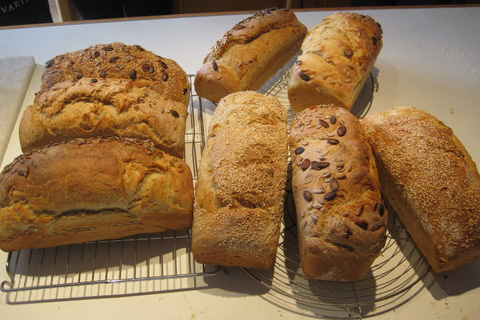
The breads vanished more quickly than they baked, sitting on a table under a tent just long enough to be cut and devoured. While cooling is acknowledged as the last and some say crucial phase of cooking in artisan bread baking, there was no waiting this day.
Inside, plenty of snacks gracing the small retail space disappeared, too. The flour, however, sat quite still. As the Osttiroler, a type of pine-planked Austrian mill that is quite beautiful, took its first turns and ground California wheat berries into flour, people stared in reverent interest. Some walked up to the bucket of flour and touched the light red stuff, running it between their fingers and over their hands. But mostly people just looked. How often do you get to watch this ingredient get made?
Getting back to our local flour roots
All flour used to be local. Before advances in transportation and technology centralized grain production in the United States, if you wanted flour, you got it from the local miller. During the 1800s and 1900s, milling centers shifted around the country, following the paths of waterways and railroads. At different points, Kansas City, St. Louis, Minneapolis and Buffalo, N.Y., held the crown for flour production. Currently, the U.S. milling industry processes 900 million pounds of wheat a year, but it is too soon to predict the output for Grist & Toll.
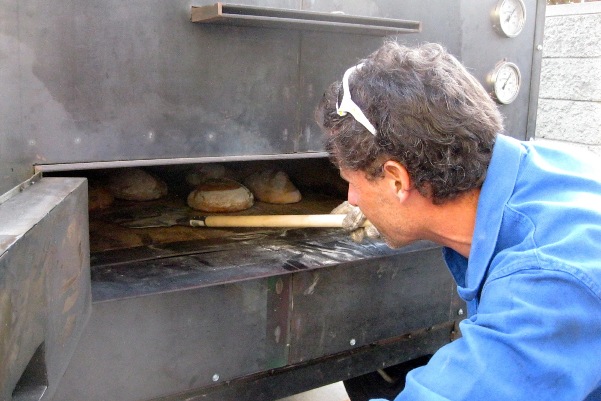
Michael O’Malley checks on bread in his mobile bread oven at Grist & Toll. Credit: Amy Halloran
However, demand for fresh flour is evident. The mill is part of a nationwide trend to re-regionalize grain and flour production. There are a lot of reasons why these staples are crucial as people rebuild local food systems. In an interview at Jones Coffee, around the corner from the not yet open mill, Kohler considered why.
“For so many years, flour has just been a filler ingredient,” she said. “It gives something body and structure, and helps your cookies and cakes rise, but we haven’t had the ability to think of it as a texture building block or flavor building block until very recently.”
The conversation about alternative grains, she said, is fairly recent. Maybe only the last five years, the baking community has started to think of flour as a potentially influential flavor player.
“The most important stuff was your butter, your chocolate, dried cranberries or nuts,” she said. “No curious baker said why, and does it matter, and how can we find out?”
Now, however, the ball is rolling. Last year at the MAD symposium in Copenhagen, Denmark, Stone Barns chef Dan Barber asked more than 300 of his peers to consider the potential of wheat.
For much longer, a number of projects around the country have been working to promote the use of local grains. Skowhegan, Maine, has an Osttiroler stone mill, too. The Somerset Grist Mill is in the former county jail, making flour and rolling oats from grains produced in Aroostook County. Some farmers there are shifting from potatoes to grains to provide raw ingredients for the enterprise.
That Maine project is community driven, started by people who wanted their area to be known for more than New Balance sneakers and logging. Central New York has a farmer-miller-baker partnership serving artisan bakers and consumers in the region, as well as the New York City market. New York’s Farmer Ground Flour is a farmer driven enterprise undertaken by Thor Oeschner as he saw the land he rented gobbled up for real estate.
Grist & Toll fits into the list of baker-driven ventures, like Wild Hive Community Grain Project, Don Lewis’ mill in New York’s Hudson Valley, and Carolina Ground, the mill started by Jennifer Lapidus that uses grains from North and South Carolina.
Conversations about grains
Most baker-initiated projects, though, center on artisan bread baking, and Kohler’s focus has been pastry. A home baker who used to work in the wine industry, she turned her passion for pastry into a farmers market operation. That passion took another leap, and she ran the bakery for a restaurant.
Grist & Toll also plans to make education a part of its mission. “The beautiful thing about flour is I’m not just creating this product for a select consumer or group of people,” Kohler said. “Flour, even though it’s been missing from this farm-to-table conversation, it touches everybody, every household, every restaurant, school.”
Grist & Toll will be open for limited hours during the holidays and plans its full grand opening for after the first of the year, but the pallets of organic wheat grown in Santa Barbara County ready to mill hint at what this operation means: more control over what types of wheat are being planted, fresh flour hitting local kitchens, and conversations about grains that go beyond the big fat fear of gluten.
Top photo: Homemade bread. Credit: Sue Style
Forgive me if the U.S. Food and Drug Administration’s recent announcement to control antibiotic use in food animals didn’t have me reaching for the Champagne.
For while the FDA’s recommendations to phase out the use of antibiotics as growth promoters and proposal to require veterinary approval of all antibiotic use on farms sound like a good idea, their voluntary nature will result in nothing more than business as usual when it comes to farm antibiotic abuse. Call me a cynic, but leopards don’t readily change their spots. For years, food animal industry lobby groups and drug companies have aggressively denied any link between antibiotic use in farming and antibiotic-resistant bacteria. Yet the very same groups have all publicly welcomed the FDA’s recommendations. Why? Because they know they are wholly inadequate.
More from Zester Daily:
» What’s hiding behind our food labels? Deceit.
I won’t go into the limitations of the FDA’s proposals here, as several respected commentators have already done a very good job of that. But suffice to say that despite decades of mounting scientific evidence that the routine non-therapeutic use of antibiotics on industrial farms is leading to the development of life-threatening multiple antibiotic-resistant bacteria, the end result is nothing more than a strongly worded FDA “recommendation” for action, without any mandatory requirements or enforcement measures to stop the intensive farming industry from putting profit ahead of human health. The same old abuse of these life-saving medicines will continue on industrial farms across the U.S., just under a slightly different guise.
So why should you care? Here are 10 things we all need to think about before we allow Big Ag to continue squandering antibiotics in food animal production.
According to the U.S. Centers for Disease Control and Prevention, at least 2 million Americans are infected with antibiotic-resistant bacteria every year, and 23,000 will die as a result.
1. There are two major factors driving the dramatic rise of antimicrobial resistant diseases. First, we’ve become too complacent about eating food from animals routinely given antibiotics. Second, we take far too many antibiotics when they are not actually needed.
2. We’re embroiled in an apparent “war” against bacteria, with antibiotics routinely given to livestock, the inappropriate prescription of antibiotics in humans, and the widespread inclusion of antibacterials in toothpaste, soap and even clothing. But all we’re doing is encouraging antibiotic-resistant bacteria.

Andrew Gunther. Credit: Courtesy of Animal Welfare Institute
3. It might surprise you to know that we each carry more than 4 pounds of friendly bacteria in our gut. The number of bacterial cells in and on our bodies (about 100 trillion) outnumbers the number of human cells by a whopping 10 to 1. These organisms play a vital role in maintaining our health and without them we’d be dead.
4. We need to trust our natural immune systems to protect us from disease, resorting to antibiotics only when absolutely necessary.
5. When it comes to antibiotics in farming, we use more antibiotics per pound of meat produced than any other nation in the world. A staggering 80% of all antibiotics produced in the U.S. are used on food animals.
6. It is widely accepted that disease outbreaks are inevitable in the cramped and stressful conditions found on most factory farms. But instead of improving conditions, the animals are given low or “subtherapeutic” doses of antibiotics in their feed or water, whether they need them or not, to prevent disease and maximize productivity. For example, most chicks receive two antibiotics, lincomycin and spectinomycin, for the first few days of their lives because they are forced to live in environments where respiratory diseases would otherwise be inevitable. In other words, intensive livestock systems are actually designed around the routine use of antibiotics. It’s the only way to keep the animals alive and growing.
7. In June 2013, Consumer Reports found potential disease-causing organisms in 90% of ground turkey samples purchased from stores nationwide. Many of the bacteria species identified were resistant to three or more antibiotic drug classes.
8. While good food-hygiene practices are essential when handling and cooking raw meat, an accidental spill in the refrigerator can now result in potentially untreatable, yet entirely preventable, life-threatening antibiotic-resistant diseases. Safe handling instructions must never be used to justify farming systems which actively encourage antibiotic-resistance or to absolve companies of any responsibility for the illnesses or deaths that result.
9. The major meat industry bodies claim there is no conclusive scientific evidence that antibiotic use in farming contributes significantly to an increase in antibiotic resistance in humans. However, the Centers for Disease Control and Prevention doesn’t agree and is calling for the responsible use of antibiotics, where “These drugs should only be used to treat infections,” whether that’s in humans or animals.
10. When it comes to the responsible use of antibiotics in farming, the U.S. livestock industry is already years behind the European Union, where antibiotic use on farms is strictly controlled. Europe’s livestock industry survived this change without any dramatic reduction in efficiency of meat production and the cost of food in Europe didn’t skyrocket as a result. So why not here? New legislation — The Preservation of Antibiotics for Medical Treatment Act of 2013 (PAMTA) — would end the inappropriate and indiscriminate use of antibiotics in intensive farming in the U.S. Are your representatives supporting it?
This isn’t about blaming farmers and vets: They’re simply responding to the contractual demands of Cargill, Purdue, Tyson and others that dominate our food supply. No, this is about waking up to the real costs of so-called cheap meat. We’re talking about farming systems that are not only designed around the routine use of antibiotics to keep billions of animals in such abysmal conditions alive and growing, but which knowingly encourage the development of life-threatening antibiotic-resistant diseases.
I somehow doubt that any sane American would willingly allow the squandering of these potentially life-saving antibiotics simply for cheap meat. Because when you sit down and really think about a future where antibiotics will no longer be effective — and where common diseases such as strep throat may kill our loved ones unabated — there really is no such thing as cheap meat, is there?
Got you thinking? Animal Welfare Approved farmers only use antibiotics to treat sick animals, just as in humans. We also know that if farmers use antibiotics responsibly the risk of antibiotic resistance is absolutely minimal. The result? Pain and suffering in farm animals is minimized, the risk of disease is reduced, and the efficacy of antibiotics — for humans and livestock — is protected. You can find your nearest supplier at www.AnimalWelfareApproved.org.
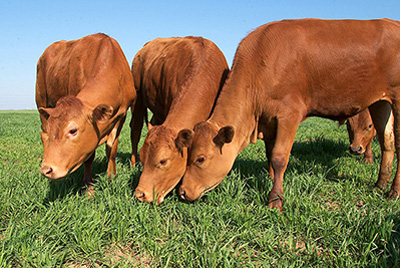
Top photo: Cattle grazing. Credit: Stephen Ausmus / USDA
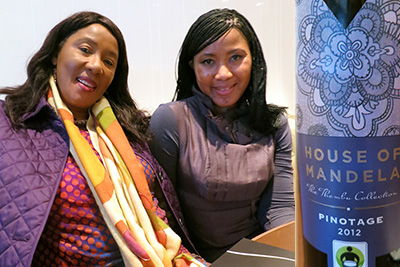
After the death of great South African leader Nelson Mandela, I’ve been thinking about his political and moral legacy and a family wine I encountered in October. This 2012 House of Mandela Thembu Collection Pinotage, with its earth, plum and cherry flavors, is an easy-on-the-palate red produced by his daughter and granddaughter. Think of it as part of Mandela’s wine legacy.
An affordable red from South Africa’s signature grape Pinotage, it’s graced with a colorful label based on Mandela’s traditional dashiki shirts. Part of the profits will go to the family foundation and to the Africa Rising Foundation, which aims to alleviate poverty. It’s certified Fair Trade, which means producers get a set minimum price for their grapes and workers get a living wage.
Elin McCoy’s Wine Of The Week
2012 House of Mandela Thembu Collection Pinotage
Price: $15
Region: Western Cape, South Africa
Grape: 100% Pinotage
Alcohol: 14.3%
Serve with: Spicy pizza, rich beef stew
More from Zester Daily:
Back in October, I tasted through the House of Mandela lineup with Mandela’s daughter, Makaziwe (Maki) Mandela, 59, and her granddaughter, Tukwini, 38, the team behind the wines. “When we explored the idea,” Makaziwe Mandela told me, “we found out very few black people owned wineries.”‘
The two women asked U.K.-based Master of Wine Lynne Sherriff to help them find winemaking partners to create their wines. (They hope eventually to have their own winery.) Highly conscious of their family heritage, they gave Sherriff a list of requirements: In addition to producing quality wines, the wineries had to be family owned, use good labor practices and respect the country’s biodiversity. They selected several, including Fairview Estate, and use winemaker Erlank Erasmus to oversee the 10 wines, but members of the Mandela family taste and vote on the blends. Of the three whites and three reds in the more affordable Thembu Collection, this Pinotage was the most interesting.
A cross between Pinot Noir and Cinsaut, the Pinotage grape was created by a South African professor in 1925 and is regarded as the country’s own variety. The best wines from it have the bright fruity flavors of Pinot Noir as well as the robust, plummy-earthy ones of Cinsaut. Most of the grapes for this House of Mandela version come from the hot, dry Swartland region north of Cape Town, a hotbed of old bush vines and winemaking experimentation.
Mandela, who loved white wines, gave his blessing to the House of Mandela wine enterprise. Which makes this 2012 Thembu Collection Pinotage a worthy drink to celebrate peace on earth this holiday season.
Top composite photo:
As befits the City of the Big Shoulders, the Chicago outpost of the food emporium Eataly, which opened last week, is the largest to date, with two floors totaling 63,000 square feet and containing some 10,000 products, 23 eateries, 21 retail areas devoted to specific products, two espresso bars, two wine bars, a Nutella bar and a fine-dining restaurant.
While Eataly is a huge space with an immense number of offerings, it’s quite the opposite of the alienating experience of mega-grocery stores. Instead of dutifully pushing a cart up and down sterile, fluorescent-lighted aisles, getting your nameless, faceless (and often tasteless) boxed and canned goods, you pleasantly wander past floor-to-ceiling windows and in and out of a maze of small eateries and counters. Each counter is dedicated to a specific item: vegetables, meats, cheeses, fish, olive oil, beer, wine and much more.
Bringing an Old World market experience to modern urban shopping
About halfway through my meander, it occurred to me that Eataly is the perfect marriage of old and new. It’s a place where the Old World 10-stop shopping experience (going to the fishmonger, the sausage maker, the cheese shop, the baker, and a half dozen other small shops), meets the convenience of the New World one-stop shopping experience.
More from Zester Daily:
» The secret to perfect Italian tomato sauces
» What makes gelato better than ice cream
» Eating thrifty, Italian style
And there are plenty of eating and drinking opportunities to indulge in while you shop. You can stop at the pizza corner for a true Neapolitan pizza, the fritto stand for fried foods, the rosticceria for roasted meats or the panini shop for a sandwich. For drinks, there’s a beer hall and two cafes, one upstairs and one down. Wines are served in the central piazza area, which is crowned with a Hemingway quote: “Wine is the most civilized thing in the world.”
In fact, the Eataly Chicago is dedicated to Ernest Hemingway. This may seem incongruous, but Eataly’s founder, industrialist Oscar Farinetti, a great fan of Hemingway’s work, explains that the author was born and raised in the Chicago suburb of Oak Park and spent significant parts of his life in Italy. That he was also a man of large appetites is just icing on the cake.
I’ve been making pilgrimages to Eataly ever since the first one opened in 2007 in an old vermouth warehouse in the Lingotto district of Turin, at the far end of the Fiat factory. Farinetti’s brainchild is a paean to food that is “good, clean and fair.” These are the watchwords of Farinetti’s friend, Slow Food founder Carlo Petrini, who champions food that is delicious and untainted by chemicals. He also is devoted to treating farmers and food workers fairly. Farinetti and Petrini want shoppers to stop being passive consumers and instead become active “co-producers” by learning who produced what food, and how, and why that’s important.
brockman-eataly1
In fact, one tenet of the Eataly Manifesto is “Eat. Shop. Learn.” Another tenet explains: “We feel that it’s not just important that we know everything about what we sell and serve, but that you also learn about the products we are so passionate about. We share with you the stories of the people and places behind all that we offer. The more you know the more you enjoy.”
Local sourcing and fresh produce at Eataly Chicago
In keeping with the precepts of Slow Food, Eataly Chicago has paid special attention to local sourcing. There is a whole section of canned and bottled goods made by Chicagoan Lee Greene’s Scrumptious Pantry, a selection of West Loop Salumi’s cured meats, pork from Bensmiller’s Farm in Iowa, Piedmontese beef from Toro Ranch in Nebraska and many more products from other Midwestern producers.
Among the can’t-miss features at Chicago’s Eataly is the vegetable butcher. As soon as you walk in the doors, you are greeted by a beautiful farmstand-like display of seasonal fruits and vegetables. You can then take your selections to the vegetable butcher, who will trim your artichokes, peel your carrots, shred your cabbage or do whatever you need for ease of cooking once you get it home.
The store’s Gelateria Alpina gelato bar offers favorites such as nocciola (hazelnut) and cioccolata (chocolate), as well as seasonal offerings. In addition to hand-scooped gelato, and unique to the Chicago store, are soft-serve gelato spigots!
As Federico Fellini says in a quote gracing a wall in Chicago’s Eataly, “Life is a combination of magic and pasta.” His words could just as well be applied to Eataly Chicago, that is, if you consider “pasta” a metonym for all great food. And great food makes us better. As Sophia Loren is quoted, in yet another Eataly sign, “Everything you see I owe to spaghetti.”
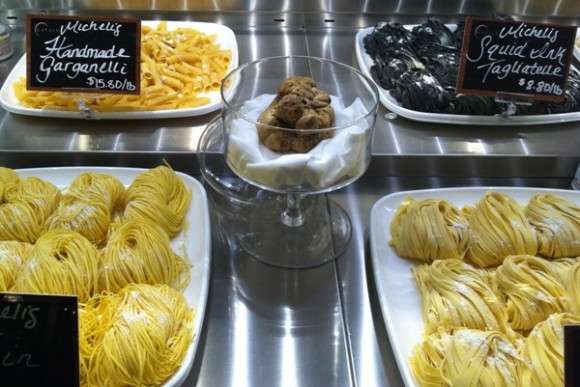
Top photo: Pasta for sale at Eataly’s newest location in Chicago. Credit: Terra Brockman
One of my favorite bistro restaurants in New York City is Le Philosophe, which offers a delicious, reasonably-priced blanquette de veau as well as a list of wines that won’t break the bank. This gulpable 2010 Chateau du Coudray Montpensier Chinon, with its fresh ripe spiced-berry flavors and soft tannins, is one of them. Its refreshing fruity style resembles that of Beaujolais-Villages, but this red has more spice and depth. It was perfect with the creamy main course I savored at Le Philosophe.
Elin McCoy’s Wine of the Week
2010 Chateau du Coudray Montpensier Chinon
Price: $14
Region: Loire Valley, France
Grape: 100% Cabernet Franc
Alcohol: 12.5%
Serve with: Blanquette de veau, roast pork
More holiday party selections:
Chinon is a historic town in the Loire Valley and also the name of an appellation where almost all the wine is red, made primarily from Cabernet Franc grapes. The vineyards, which cover 19 communes, span both sides of the pretty, winding Vienne River. My introduction to the area, though, was through history, when I came as a student to tour the town’s famous stone castle, the grand 11th-century Chateau de Chinon, built on a high rocky outcrop above the river. It has a complex early past: English King Henry II rebuilt it and resided there in the 12th century; later it was captured by the French, and it’s where Joan of Arc claimed divine voices told her that Charles VII, the Dauphin of France, would give her an army to fight in Orleans. Writer Francois Rabelais made Chinon’s wines famous in the 16th century.
U.S. catches up with 2010 Chateau du Coudray Montpensier Chinon
I first drank these delicious, fragrant reds in Paris bistros and wine bars 20 years ago, but they’ve become popular in the U.S. only in the past five or so years. That’s partly because wine lovers are now hunting alternatives to big, alcoholic reds. When Cabernet Franc is grown in cooler climates like the Loire Valley it makes wines that are lighter bodied and more aromatic than Cabernet Sauvignon, but have some of the same character. And the newfound popularity of Loire reds has also been helped because they are often stunning bargains.

Chateau de Chinon. Credit: Franck Badaire / Wikimedia Commons
Climate change and improved vineyard practices have helped make Chinon’s wines more appealing. When Cabernet Franc doesn’t ripen fully, the wines taste lean, green and herbaceous. In recent, warmer vintages, the wines have been richer. The 2010 vintage was one of the best of the past few decades.
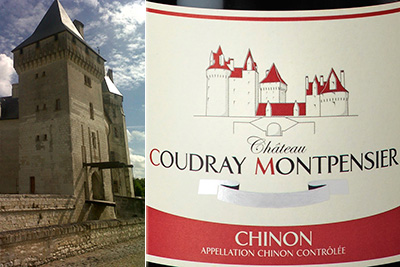
Chateau du Coudray Montpensier was built in the 15th century, but was only established as a winery 10 years ago. Its 2010 Chinon is well worth seeking out.
Top photo: Chateau du Coudray Montpensier and wine label for Chateau du Coudray Montpensier Chinon. Credit: Courtesy of Chateau du Coudray Montpensier