Articles in Drinking
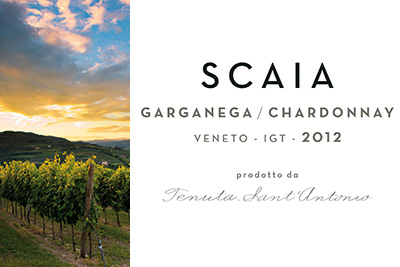
Red wine blends are booming in popularity in the U.S., and I predict that in 2014 white blends will follow suit. The floral and citrus-scented 2012 Tenuta Sant’Antonio Scaia Garganega/Chardonnay is a bargain Italian example: dry, fresh, fruity, tangy and perfect as an apéritif or with steamed mussels. It also happens to be more interesting than you might expect for an under-$15 wine.
Satisfying white blends have a long history in European wine regions, and in the past few years innovative California winemakers have turned to Italy for inspiration.
Elin McCoy’s Wine of the Week
2012 Tenuta Sant’Antonio Scaia Garganega/Chardonnay
Price: $13
Region: The Veneto, Italy
Grape: 60% Garganega, 40% Chardonnay
Alcohol: 12.5%
Serve with: Aperitifs, mussels in broth, vegetable risotto
More of Elin’s wine picks:
The Veneto region in northeast Italy, where the Tenuta Sant’Antonio Scaia comes from, has a mild climate, thanks to nearby Lake Garda, and a winemaking history that goes back to the ancient Greeks. It’s a region of wine contrasts, home to Amarone, a unique red made by a labor-intensive process of semi-drying grapes, and mass-market commercial companies that pump out millions of boring bottles a year.
The Tenuta Sant’Antonio Scaia blends a familiar international variety with a local Italian grape that’s widely planted throughout the Veneto. Late-ripening, Garganega is the variety that dominates Soave Classico, which must be made in a specified district near the city of Verona. The grape resembles Chardonnay in that both vary widely in taste depending on where they’re grown, when they’re picked, and how the wine is made.
Garganega grown on the Veneto’s flat plains for quantity rather than quality becomes simple, mediocre plonk. At Tenuta Sant’Antonio, grapes are planted on rolling hills, yields are kept low, and bunches are harvested by hand, all in the name of quality.
The four Castagnedi brothers — Massimo, Armando, Tiziano, and Paolo — who founded Tenuta Sant’Antonio worked as viticultural and technical wine consultants before starting the winery in 1989. They bought land in the Valpolicella zone adjacent to their father’s vineyard property, joined the two, then planted grapes and began making wine.
The Castagnedis produce a wide range of classic reds and whites under the Tenuta Sant’Antonio label, and are best known for their more expensive, top-quality Amarones, Valpolicellas, and Soaves. They describe the Scaia wines (the word refers to stone flakes in the chalky soil where the vines grow) as “modern interpretations” of traditional classics.
Happily, this doesn’t include aging in oak, which overwhelms the Garanega grape. The 2012 Sant’Antonio Scaia Garganega/Chardonnay is fermented at cold temperatures and aged in stainless steel, which preserves fruit and crispy acidity. The wine is much better than the ocean of easy-drinking whites from the Veneto. While it doesn’t have the character and style of the very best Soaves, it does have a juicy, mouth-filling personality and an attractive, everyday-drinking kind of price.
Top composite photo: 2012 Tenuta Sant’Antonio Scaia Garganega/Chardonnay label and vineyard. Credit: Courtesy of Tenuta Sant’Antonio
California wine is finally getting interesting, and wine lovers can dare to hope that America’s premier wine region will produce more wines of higher quality.
What? Those $200 Napa Valley Cabernets aren’t great wines? Sorry to say, most are not. The good news is a group of winemakers is stepping away from California’s pack mentality to produce wines that reflect both an appreciation of the place the grapes are grown as well as an understanding that bigger is rarely better when it comes to wine.
BOOK LINK
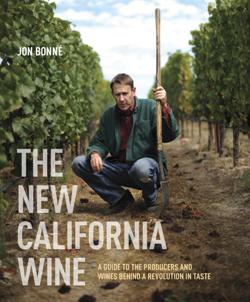
“The New California Wine: A Guide to the Producers and Wines Behind a Revolution in Taste”
By Jon Bonné
Ten Speed Press, 2013, 304 pages
And, be still my heart, they aren’t afraid to say it. Out loud. In print. San Francisco Chronicle wine critic Jon Bonné has captured their voices and given early support to this movement in his recently released “The New California Wine: A guide to the producers and wines behind a revolution in taste” (Ten Speed Press).
During the past half-dozen years, I’ve met with established winemakers who talk about dialing back the alcohol levels on their wines. They claim a deep longing to produce “European” style wines with greater finesse and character. Then they beg, “Please, don’t quote me!” Inexplicably, they seem to think they can accomplish this transformation so slowly that their public — and the critics — will barely notice the change.
Documenting the historic shift
Shifting directions is risky. Timid American baby boomers learned about wine by leaning heavily on critical scores, buying what they were told they “ought” to drink. So when the two overlords of California wine criticism — Robert M. Parker’s Wine Advocate and Wine Spectator’s Jim Laube — championed high-alcohol fruit bombs, America’s first generation of wine drinkers eagerly fell in line behind them.
The rare winemaker willing to be quoted declaring a dramatic shift in style away from that norm has crumbled when facing angry consumers wondering why they had been paying top dollar for wines that the winemaker suddenly says are not what they ought to be.
From his perch at the Chronicle, Bonné was able to dig deep into California’s wine culture to find the winemakers who never compromised. Years of walking vineyards in every corner of the state paid off in the discovery of Steve Matthiasson, Tegan Passalacqua, Ted Lemon and dozens of other pioneers making wine to suit their personal taste rather than to score critical points. “Just three or four years ago, these guys were really out in the wilderness,” Bonné says.
Their stories of reviving abandoned vineyards in marginal growing areas, cobbling together wineries in deserted warehouses, and striking crazy work-for-free deals with vineyard owners sound more like the do-it-yourself culture that is transforming the American food scene than the big-money mentality that dominates California wine.
More than one kind of California wine
Bonné is a wine geek who delights in highly nuanced details of grape farming and cellar work. And, while that can result in a slow read at times, it’s an important plus. These are the distinctions that make a difference and separate the pioneers from more established vintners. Bonné empowers his readers by carefully explaining these specifics. And, bless him, he spares us the poetic hyperbole that hobbles so many wine books.
“This story was totally evolving as I was writing it,” says Bonné. “It was terrifying and exhilarating.” The first wine writer to make a strong statement about the promise of these emerging winemakers, and by comparison drive home the problems with California’s established wine industry, Bonné takes a risk. The nascent movement is so small it could easily dissipate.
The established “cult Cabernets” will not go away, Bonné says. Rather, support for these new wines will grow. “The people who had given up on California will turn around,” he predicts. In the future, there will be more than one kind of California wine.
Eventually, “there will be a transfer of power” in the American wine industry, he says. “This emerging generation is drinking with a level of curiosity that is very different from their parents.”
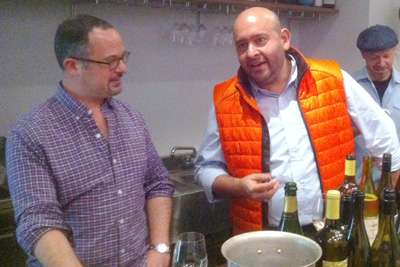
Jon Bonné and Rajat Parr at domaineLA. Credit: Corie Brown
Judging by a recent crowd of young wine lovers eagerly tasting through a selection of California wines championed by Bonné, he’s calling it right. At domaineLA, a Los Angeles wine shop with a reputation for promoting an international selection of well-priced, high quality wines, Jon Bonné and Rajat Parr. was joined by leading Santa Barbara small-production vintners Sashi Moorman and Rajat Parr, partners in Sandhi Wines, and Napa Valley-based winemaker Steve Matthiasson. This year, Bonné named Matthiasson the San Francisco Chronicle’s “Winemaker of the Year.”
The wines had bold, pronounced flavors, yet they retained the lift of natural acidity. All but a couple of the dozen wines on offer were priced below $40 a bottle. And the alcohol levels were all under 14%, a mark of a classic European-style wine.
Questioning the dominance of Napa Valley’s over-extracted and over-priced bruisers will soon go from taboo to “told you so.”
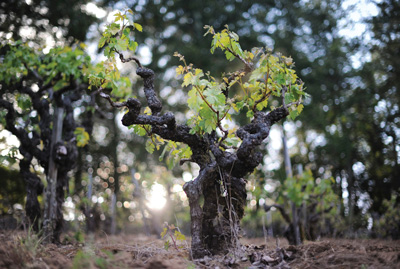
Top image: The beginning of growth on an old vine. Credit: Courtesy of Ten Speed Press, publisher of “The New California Wine” by Jon Bonné

In my front yard are two old, thorny Meyer lemon trees. I do nothing special for these trees, just let them have water and sunshine. And I have no control over the sunshine. Twice a year those dwarf trees are loaded with lemons. They cannot be more than 6 feet tall, but both produce hundreds of pounds of lemons each. The weight comes from the abundance of juice each lemon holds.
Meyer lemons are very thin skinned with a fragrant, almost floral scent. The zest will make any dish pop with flavor. I use it instead of butter on steamed asparagus, sprinkle it into green salads for extra zip, and mix it into both sweet and savory types of dough.The harvests are always so abundant I give bags of lemons to friends and neighbors, make lemonade, lemon curd and lemon cake. But most important, I make limoncello. I make lots of limoncello because I like to give some of it away. I also like to give some to myself.
But this limoncello is slightly different than the traditional Italian style of limoncello. I use the entire lemon in the initial infusing. Most recipes call for lemon zest only, but my Meyer lemons are so lovely I like to include the juice in the process. The majority of the flavor and aroma of the lemon is found in the zest, but the juice adds another layer of citrus intensity to the limoncello. The pith of the Meyer is also not as bitter as other lemons because it is a sweeter lemon. It is thought to be a cross between a regular lemon and a Mandarin or other variety of orange.
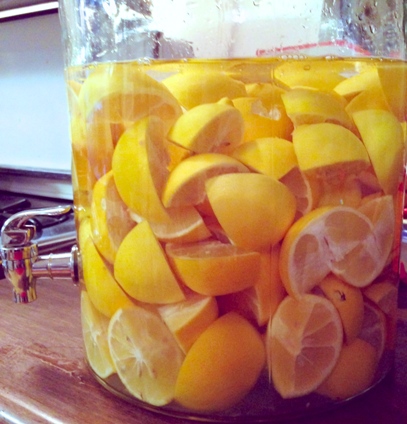
Meyer lemons in vodka, becoming limoncello. Credit: Cheryl Lee
Traditionalists would say this is not true limoncello, as my method is different, if only slightly so. I was even chastised by a 21-year-old from Belgium after I posted a picture of my quartered lemons steeping in vodka on my Instagram page. She wrote “You have to peel the lemons and put them in the alcohol (not the entire lemon).” Well, all right then.
Now that a girl from Europe young enough to be my daughter has tried to set me straight, I will continue to do it my way. The limoncello I make is absolutely delicious, so I see no need to alter my recipe, even if I am bucking tradition and offending Italians the world round. If you make something that you like, even if you do not follow the traditional way of making it, it’s all right.
The lemons should be steeped for two weeks, but can be steeped up to four weeks. When ready to finish the limoncello, be sure to have a lot of clean bottles or jars to fill with the liquid gold. Or if keeping it all to yourself, one large jar.
Meyer Lemon Limoncello, California Style
Makes 2 to 3 quarts
Ingredients
10 to 15 Meyer Lemons, preferably organic, scrubbed
1 (750 milliliter) bottle vodka or Everclear (grain alcohol)
2 cups water
1½ to 2 cups raw sugar
1 cup honey
Equipment
1 large glass vessel to prepare the limoncello (large enough to accommodate 15 lemons and a bottle of alcohol)
Smaller bottles or jars to keep the finished limoncello (enough to accommodate about 3 quarts)
Directions
1. Cut the lemons into quarters and place into a large, clean jar.
2. Pour the bottle of vodka over the lemons.
3. Seal the jar and place it in a cool corner of the kitchen.
4. Let the lemons steep in the vodka for 2 to 4 weeks.
5. Strain the alcohol into a large bowl, reserve.
6. Place the lemons, water, sugar and honey into a large pot.
7. Turn the flame to low.
8. Using a potato masher, smash the lemons to release all their juices. Mash and stir until the sugar and honey are dissolved.
9. Strain the syrup, discard the lemons, and let the syrup cool.
10. Mix the reserved alcohol and the syrup.
11. Pour the limoncello into your jars and/or bottles. Place the bottles into the refrigerator, and let the limoncello rest for at least a day, preferably a week, before drinking.
Top photo: California-style limoncello. Credit: Cheryl Lee
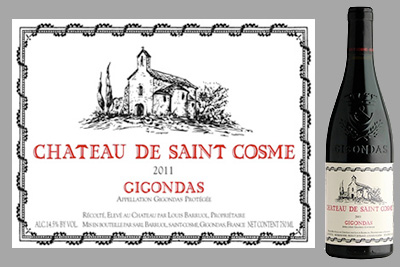
When the temperature drops to zero and snow piles up in drifts outside my door (as it did last week), I want a rich, filling stew for dinner and a warm, generous red wine to match. The ripe, plummy 2011 Château de Saint Cosmé Gigondas is a classic choice, meaty and structured, yet fresh, savory and exuberantly fruity, with notes of blackberry and pepper. It was one of my highlights at a recent tasting with Gigondas producers at New York’s Rouge Tomate restaurant.
Gigondas is a village with a very pretty town square and an appellation in France’s southern Rhône Valley that produces only red wine. It lies in the foothills of the Dentelles de Montmirail, jagged limestone formations with 2,600-foot peaks that resemble sharp teeth or a rooster’s comb.
Elin McCoy’s Wine of the Week
2011 Château de Saint Cosmé Gigondas
Price: $34
Region: Gigondas, Southern Rhone, France
Grape: 60% Grenache, 20% Syrah, 18% Mourvèdre, 2% Cinsault
Alcohol: 14.5%
Serve with: Daube of beef with olives and tomatoes, braised short ribs
More from Zester Daily:
» A juicy, organic red from Montepulciano
» A crowd-pleasing party red wine from the Loire Valley
The wine, based on the Grenache grape, is often called the the poor man’s version of more famous and expensive red from Châteauneuf-du-Pape 10 miles to the south. It’s not a comparison producers like. At the dinner, Château de Saint Cosmé owner and winemaker Louis Barruol pleaded, “We want to be loved for what we are, not as a cheap Châteauneuf!”
In fact, the terroir in Gigondas is different from that of Châteauneuf, and wines from vineyards at higher elevations, like those from Saint Cosmé, can have more perfume and finesse, though usually less complexity. The blend of grapes must include no more than 80% Grenache, at least 15% Syrah and/or Mourvèdre, and up to 10% other Rhône varieties.
Saint Cosmé Gigondas
Built on what was once the site of a Roman villa, Saint Cosmé is the most ancient estate in the region, with cellar vats that were carved into rock in Roman times. The Barruol family has owned the property since 1570, and Barruol, who took over in 1992, is the 14th generation.
Saint Cosmé produces several single-vineyard Gigondas bottlings in addition to this standard cuvée, which includes a greater percentage than usual of the gnarled old vines around the château. Tucked into the hills above the valley floor, the vineyards are shaded by the Dentelles, which helps preserve the wines’ bright acidity. A regime of aging in old oak barrels keeps them from being too oaky.
I plan to savor more 2011 Château de Saint Cosmé Gigondas again very soon. The end of winter is a long way away.
Top composite photo: 2011 Château de Saint Cosmé Gigondas bottle and label. Credit: Courtesy of Château de Saint Cosmé
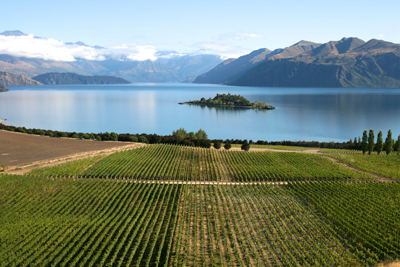
Who would have thought, 30 years ago, that New Zealand would be producing Pinot Noir with an international reputation? It has all happened in an incredibly short time, so that several of the original pioneering winemakers are still involved in the industry. And a recent tasting in London and New York demonstrated just how successful Pinot Noir is in New Zealand.
This was a tasting that I could not possible miss: three decades of Rippon Vineyards Pinot Noir, beginning with the 1990 vintage, which I tasted as a vat sample the very first time that I went to New Zealand. Rippon Vineyards in Central Otago was one of the first New Zealand vineyards that I visited. It is the most fabulously beautiful spot, with breathtaking views over Lake Wanaka toward the Southern Alps. Central Otago lies on the 45th parallel, which makes its vineyards some of the southernmost in the world — there is not much land between Otago and Antarctica. Whereas most New Zealand vineyards are on the country’s east coast, Central Otago enjoys a continental climate, with harsh winters and warm summers. Schist is the dominant soil at Rippon.
Two-part series:
» Part 1: Why New Zealand Pinot Noir Works: A Pioneer’s Story
» Part 2: A Milestone Tasting From Rippon Vineyards
More from Zester Daily:
» The unstoppable Oregon Pinot
These days, Nick Mills makes the wine at Rippon, but it was his father, Rolfe, who was the true pioneer. Rolfe’s grandfather bought the land in 1912, and Rolfe began planting vines in 1975.
“It was all very much a learning curve, experimenting with many different grape varieties,” Nick said. “Pinot Noir was just one of several. And nothing was known about different clones. You got cuttings from other growers, and there was a strong element of self-sufficiency and indeed isolation.”
The first commercial wines of Rippon were made in 1989, and in 1990 a talented Austrian winemaker, Rudi Bauer, took over for a few years. (He now has his own estate, Quartz Reef.) Back in 1990 there were just six wineries in Central Otago; nowadays there are 120 wine growers, though not all with their own winemaking facilities.
New Zealand Pinot Noir has regional variations blossom
At the time that Rippon was getting started, Chard Farm and Gibbston Valley were also experimenting with Pinot Noir, among other grape varieties, in Central Otago. And at the bottom of New Zealand’s North Island, Larry McKenna, who had arrived in Martinborough in 1986, was busy putting Martinborough Vineyards on the map for Pinot Noir, alongside his neighbours at Ata Rangi and Dry River.

Nick Mills and his wife, Jo, at Rippon.
Credit: Briar Hardy-Hesson
Elsewhere on the South Island, there were pockets of Pinot Noir in Nelson, Waipara and Marlborough. Today, Pinot Noir is the most widely planted red variety in the country, and the regional variations are becoming more apparent. I generally find that wines from Central Otago are riper and richer, from enjoying long hours of summer daylight, while those from Martinborough are more savory and maybe more structured.
But back to Rippon. Carrying on the family tradition, Nick studied winemaking, including a course on biodynamics, in Beaune and worked with winegrowers in the Côte d’Or. Sadly, Rolfe died in 2000, and in 2003, Nick’s mother suggested that it was time for Nick to come back to Rippon and take over responsibility for the winemaking.
He talked of how his winemaking has developed. “There are so many things to consider. Whole bunches? Do you add the stems? Are they ripe? You need to understand your fruit.” He certainly shows that he does with this range of wines, which tell the story of the family land.
Read the detailed tasting notes.
Top photo: Rippon Vineyards. Credit: Briar Hardy-Hesson

Peter Mondavi Sr., the patriarch of Charles Krug Winery, turned 99 on Nov. 8. Over the years, I’ve attended many outstanding events in Napa Valley, but this birthday dinner aced them all. It was a memorable and historic celebration.
Looking youthful (for 99), Mondavi blew out a handful of candles topping the lemon cake baked by his granddaughter, Lia Mondavi.
“I’ve been in this business for 70 years, a business that has its ups and downs,” the Napa Valley legend said moments later. “I’m looking forward to a great future.”
Spoken like a man with no intention of ever growing old. Indeed, now that he is on to his 100th year, major celebrations are planned for his centenary during the 2014 Auction Napa Valley weekend, to be held June 5 to 7.
Wine and work the secrets to Mondavi’s longevity
When I met Peter Sr. last summer, he told me that wine accompanies every lunch and dinner. And he takes the staircase to access his office. He has little choice: There is no elevator in that part of the building.
More from Zester Daily:
“His youthfulness is not only because of the glass of wine but he comes to the office every day,” Peter Mondavi Jr. said as he welcomed party guests to the newly designed hospitality center at Charles Krug Winery.
For 67 years, Peter Sr. has been involved in every aspect of the winery’s operations, even though he admits his sons Peter Jr. and Mark now do most of the work. The patriarch’s spirit and legacy are very much a part of Charles Krug, Napa Valley’s oldest winery, founded in 1861.
The Mondavi family’s “farm-to-table” dinner was orchestrated by chef Larry Forgione, culinary director of the Conservatory for American Food Studies at the Culinary Institute of America at Napa Valley’s Greystone campus.
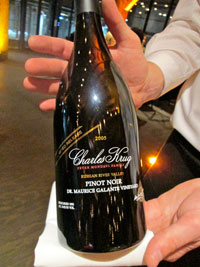
A 2005 Limited Release Dr. Galante Vineyard Pinot Noir. Credit: Mira Honeycutt
Forgione conducts a 15-week culinary program for CIA students at the Charles Krug 3-acre organic farm. On weekends, food prepared by students is offered at a pop-up restaurant at the CIA.
The four-course birthday dinner started with a salad of frisee, arugula, fresh burrata cheese and shaved Conservatory duck prosciutto made from the CIA Conservatory & Charles Krug farm. This was paired with a delicious 2012 Chardonnay from Carneros.
“Dad bought the Carneros vineyard in the late 1960s with an intention to make sparkling wine,” Peter Jr. said. “He bought it for $2,000 an acre.” You can add a few zeros to the going price of an acre in Carneros these days.
Peter added that the Charles Krug olive oil on the table was another of his dad’s endeavors. His older brother, Mark, had planted some olive trees, he said. “Dad did not like to see the fruit go to waste,” Peter Jr. said. The resulting olive oil is for private consumption only.
The second course of sweet potato gnocchi with braised Napa Valley heritage rabbit and black truffle ragout was superb with the 2005 Limited Release Dr. Galante Vineyard Pinot Noir, from the Russian River region of Sonoma. This is the only vineyard outside Napa from which the Mondavi family sources fruit.
Two Napa Cabernets, a 1983 Vintage Selection (decanted from a 12-liter bottle) and a 2010 Vintage Selection, were superb served with wood-grilled California pastured veal loin served atop Bale Grist Mill polenta, chanterelles, wild black trumpet mushrooms, goosefoot spinach and cipollini onions.
A fragrant quince tart with goat’s milk caramel paired with Lot XVI Limited Release Zinfandel Port added a perfect final touch to this remarkable evening.
The birthday party was a joint celebration because it coincided with the opening of Charles Krug’s newly restored Redwood Cellar, which has been transformed into a hospitality center.

Peter Mondavi Sr. Credit: Mira Honeycutt
In the cavernous room filled with flowers and candles, some 100 Napa luminaries gathered for the celebration, including Barbara and John Shafer, Molly Chappelet, Bob and Evelyn Trinchero, Liz Martini, Dan and Nancy Duckhorn, nephews Tim and Michael Mondavi with wife Isabel and Napa’s grande dame herself, Margrit Mondavi, widow of Peter Sr.’s brother Robert.
One of Napa’s National Historic Landmarks, the 1862 Redwood Cellar housed 173 large redwood tanks in the not-too-distant past. The legacy of this historic tank room has been maintained as you see its aged redwood recycled on exposed walls. The tank room has been transformed into a swanky, contemporary-style tasting lounge/bar and hospitality center designed by the team of noted Napa architect Howard Backen.
I asked Peter Sr. what he thought of the recycled wood on the walls. “I was a bit leery about it, but it worked out very well,” he said with a smile.
The $25 million improvements to the family’s eight Napa Valley estate vineyards and historic winery began a decade ago and ended with completion of the hospitality center. Of this final renovation, son Mark ruefully remarked: “You can only do so much with $8 million.”
Top photo: Peter Mondavi Sr. blows out the candles on his birthday cake at a party celebrating his 99th birthday. Credit: Mira Honeycutt
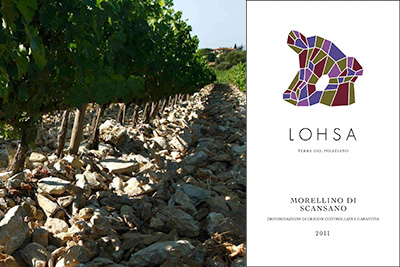
After splurging on plenty of great (and expensive) wines during the holidays, I’m ready to retrench. At $15, this bright, juicy 2011 Lohsa Morellino di Scansano is the right kind of deal, a medium-bodied red packed with generous flavors of cherry, raspberry, earth and spice, and intriguing aromas of dark cherries and violets. It’s yet another example of the fine values to be found in Italy’s less well-known wine regions.
This red comes from the Maremma, a hilly coastal strip in western Tuscany on the Tyrrhenian Sea, where the local name for the Sangiovese grape is Morellino. Wine was produced there back in Etruscan times, but it wasn’t until Bolgheri, the northern part of the Maremma, gained prominence as the home of Super Tuscan wines like Sassicaia that anyone looked farther south and discovered Morellino.
Elin McCoy’s Wine of the Week
2011 Lohsa Morellino di Scansano Terre del Poliziano
Price: $15
Region: Tuscany, Italy
Grape: 85% Sangiovese, 15% Ciliegiolo
Alcohol: 13%
Serve with: Roast pork loin, braised lamb shanks, mushroom ragu with polenta
More of Elin’s wine picks:
» A juicy, organic red from Montepulciano
» A crowd-pleasing party red wine from the Loire Valley
Thirty-five years ago there were only about 10 wineries that grew their own grapes in the district of Scansano, which includes 3,700 acres of vines in most of the towns in the southernmost area of Tuscany. Now there are several hundred wineries, fueled by a mini-land rush of buying and planting.
The reputation of the wines climbed, which is why the Morellino di Scansano appellation finally gained DOCG status starting with the 2007 vintage. Few wine drinkers, I’ve discovered, understand what those letters mean — Denominazione di Origine Controllata e Garantita — and often don’t realize they stand for Italy’s highest quality wine category. Rules govern everything from where the grapes can be grown to which ones must be used. To be labeled Morellino di Scansano, a wine has to contain at least 85% Sangiovese and come from a historic area that surrounds the medieval town of Scansano. Unlike most DOCG wines, Morellino is usually released less than a year after the harvest, which translates into fresh, lively reds. This one is aged for eight months in old oak casks.
Lohsa sets the table
The Lohsa Estate in Magliano belongs to the Carletti family, which established the beautiful Il Poliziano winery in Montepulciano, farther north in Tuscany, in 1961. Federico, son of the founder Dino, like so many restless enologists, wanted to experiment in other regions, and he expanded the family holdings into the Maremma in the 1990s as an independent “Terre del Poliziano” project. He produced his first Morellino in 1998.
The 2011 Lohsa Morellino di Scansano is a simple wine, but it has an enticing, gulpable charm. The appellation’s sunny mild winters, cool winds from the sea in summer, and stony soil all combine to make reds that are softer, rounder and more succulent than other Tuscan wines from the same grape, like Chianti. In other words, they’re delicious, especially for the price, which is why they’re wildly popular in Rome’s wine bars.
Top composite photo: A view of the Lohsa Estate and label for 2011 Lohsa Morellino di Scansano Terre del Poliziano. Credit: Courtesy of the Lohsa Estate
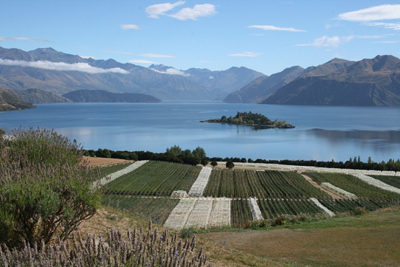
These are notes from a tasting that spanned three decades of Rippon Vineyards Pinot Noir.
1990 — This was the second commercial vintage of Pinot Noir, made from vines planted in 1982. A very warm vintage, with an early harvest. Medium colour, with an evolved rim. Quite a soft vegetal red fruit nose. A silky palate, with ripe red fruit, depth and texture with a good balance. A touch of fruitcake on the finish and a dry finish. Extraordinarily lively for a wine that is 30 years old, proving that New Zealand Pinot Noir can age.
1991 — A slightly cooler vintage. Medium colour. Some velvety vegetal notes on the nose. A very perfumed palate, ripe and rounded; mature and silky. A lovely glass of wine.
Two-part series:
» Part 1: Why New Zealand Pinot Noir Works: A Pioneer’s Story
» Part 2: A Milestone Tasting From Rippon Vineyards
More from Zester Daily:
» The unstoppable Oregon Pinot
1992 — Again, a slightly cooler vintage. Quite a deep young colour. Intense ripe red fruit on both nose and palate. A firm streak of fine tannin to balance the fruit, and still quite youthful.
1993 — Another cooler year. Quite a deep colour, ageing slightly on the rim. Quite a firm dry nose with red fruit, and on the palate some depth, with a vegetal note balancing some red fruit. Quite a dry finish.
1995 — The eruption of Mount Pinatubo in 1994 had a serious impact on subsequent vintages. A very cool year, but the wine does not taste unripe. Quite a light colour. Very vegetal nose, with some silky red fruit. Elegant fruit on the palate, silky and ripe, with a balancing streak of tannin.
1998 — Quite a light colour. A firm dry note on the nose, with a streak of hay. Ripe fruit on the palate, quite rounded and ripe, with more depth and texture that the nose would indicate.
A new decade at Rippon vineyards
2000 — From now on vine age starts to have an impact. Quite a deep colour. A smooth silky nose. A touch raisiny on the palate, but with some soft tannins. A warm finish.
2003 — Nick’s first vintage. He compared it to 2001 in Burgundy, neither a warm nor a cool vintage. Medium colour, beginning to evolve. Quite an elegant dry raspberry nose. And on the palate, some fresh vegetal and raspberry fruit, with some texture. Medium weight, with a fresh finish.
2005 — A small yield thanks to a cool, windy December during flowering. Medium colour, evolving a little. Quite a firm dry nose, and also on the palate. Firm raspberry fruit, with a note of acidity as well as tannin. Quite tight knit, with a fresh finish.
2006 — This was a warm year. Medium colour, with a dry vegetal note on the nose. The palate was quite rounded, with some texture and dry raspberry notes. Quite fleshy, and still very youthful, with good length and depth.
2007 — The smallest yield in the last decade thanks to spring frosts and a windy December, but an excellent ripening season. Quite a deep colour. A firm nose, with fresh dry raspberry fruit. Good acidity. Some elegant texture and a refreshing finish. Very classic. One of my favourite wines in the tasting.
2008 Mature Vines — A hot summer giving a good yield and healthy grapes. The first vintage of this cuvée, from the original vines. Medium colour. Quite a firm dry raspberry fruit on the nose. The palate is still very youthful, with fresh tannins, and dry raspberry fruit. Firm and textured, with ageing potential.
2009 Mature Vine — Medium colour. Quite fresh and ripe, and again on the palate fresh, ripe fruit with some balancing acidity and tannin. A warm note on the finish. Good depth.
2009 Emma’s Block — Medium colour. Elegantly perfumed nose. Medium weight, with rounded ripe fruit. Elegant and fragrant.
2009 Tinker’s Field — Quite fresh intense fruit on the nose and palate. Rounded raspberries; elegant with depth. Lovely texture and concentration, with a long firm finish.
2010 Mature Vine — A warm summer. Good colour. Rounded concentrated nose, and on the palate, lovely texture with concentration, ripe fruit and structure. Smooth tannins and great length. A broader wine than either Emma’s Block or Tinker’s Field.
2010 Emma’s Block — Quite deep colour. Rounded nose, and on the palate great texture with ripe fruit and balancing tannins. Ripe, concentrated and youthful with a tight knit finish.
2010 Tinker’s Field — Deep colour. Ripe perfumed fruit and on the palate, more structured, with firm tight knit red fruit. A youthful concentrated finish. And a great finale to a historic tasting, which amply demonstrates how suitable Central Otago is for the production of that most temperamental of grape varieties, Pinot Noir. Rolfe Mills had the vision to realise the potential of grape growing in countryside that had been dedicated to sheep farming, and his son Nick has the passion to continue to stretch the boundaries of Pinot Noir.
Top photo: Rippon Vineyards. Credit: Briar Hardy-Hesson