Articles in Health

In this tweet-driven, entertainment-focused world, it’s hard to break through the clutter. But the giant bus advertisement featuring two plates of bacon, eggs and pancakes caught my eye. “Do just a couple extra pancakes and two slices of bacon really make a 400-calorie difference?”
It does. And now I know the consequences.
More from Zester Daily:
Portion control is the latest weapon in America’s battle against obesity.
“We understand it’s a bit of a shift,” says Paul Simon, a physician and director of the county’s Division of Chronic Disease and Injury Prevention. “Here we are promoting some foods that aren’t viewed as particularly healthy. But what we’re saying is, “If you’re going to eat this, at least eat less.”

An advertisement used in the Choose Health LA campaign. Credit: Los Angeles County Department of Public Health
While the dramatic rise in obesity levels in America has slowed in recent years, the overall picture is sobering. More than one-third of all adults in this country are obese, and by 2030 an estimated 42% will be overweight, according to the Centers for Disease Control and Prevention. Obesity is approaching tobacco use as the leading preventable cause of death in the United States and is an important risk factor for diabetes, heart disease, stroke, arthritis and many forms of cancer.
There is some good news. Intensive health education, mandatory fitness testing and the passage of a law restricting the sale of sugary beverages on school campuses seems to have paid off in California, according to Simon. Between 1999 and 2005, the obesity rates among fifth-, seventh- and ninth-grade students in Los Angeles County climbed 1% every year — an increase of 15,000 more obese children annually. But in 2005, those obesity levels plateaued and appear to be on the decline. A similar improvement was seen among preschool children enrolled in a federal program that provides nutritional counseling and subsidized food for low-income families.
But the same is not true for these children’s parents. Among adults in Los Angeles County, the obesity level nearly doubled to 23.6% between 1997 and 2011. Health officials are pursuing a variety of tactics in their battle against the obesity epidemic, from the expansion of bike paths and workplace wellness programs to encouraging supermarkets to promote healthier purchases. Next up: a program that will reward restaurateurs who offer healthy dining options, such as smaller portions, offering to box up half-portions and ample access to water.
Not everyone likes these ideas, particularly when they cut into profits. Beverage companies and business groups have filed a lawsuit to stop New York City’s ban on the sale of supersized sodas and other sugary drinks. Some of those same companies have complained about L.A. County’s campaign against sugary beverages. One of those ads showed a bottle of soda being poured into a glass filled with sugar packs and the question, “YOU WOULDN’T EAT 22 PACKS OF SUGAR, WHY ARE YOU DRINKING THEM?”
Need to count calories? Here are simple ways to keep numbers in check
Interested in learning more about combating calorie creep? Check out the “Choose Health LA,” website, which offers a slew of interesting factoids and the following advice:
Think small: Everything in the kitchen — from portions to dinnerware — has grown since the 1950s. The surface area of the average dinner plate has increased by more than one-third over that period. Try substituting a salad plate for your dinner plate, making it easier to keep your portions small. And reduce the temptation to over-consume by serving up single portions, leaving the serving bowls on the counter.
Avoid mindless eating: Sit down in front of your television with a small bowl of snacks and leave the bag in the cupboard. Just 10 extra calories a day — a stick of Doublemint gum or three small Jelly Belly jelly beans — will add a pound to your waistline in a year, according to Brian Wansink, food psychologist and author of “Mindless Eating, Why We Eat More Than We Think.”
Ditch the “clean plate” club: The average restaurant meal today is more than four times larger than in the 1950s. When dining out, don’t hesitate to leave food on your plate, share entrees or ask for a doggie bag for the leftovers.
Downsize your fast food: Hamburgers are four times larger today than they were in the 1950s. By choosing the smaller version of a burger, soft drink and fries over the supersized version, you can save 570 calories, which is more than one-quarter of your daily caloric needs.
Sip smartly: Substitute water, low-sugar or unsweetened beverages or nonfat or low-fat milk for sugary beverages. To find out just how much you could save by cutting back on your soda fix or frozen coffee drink, check out Choose Health LA’s sugar calculator.
Top photo: Paul Simon is a physician and director of Los Angeles County’s Division of Chronic Disease and Injury Prevention. Credit: Los Angeles County Department of Public Health

Cultures all around the world have rejuvenating herbal tonics, taken to strengthen and support the body. Think of the spring tonics our grandparents knew and swore by. A number of these elixirs are also aphrodisiacs, employed to arouse our emotions and feelings of love. With Valentine’s Day coming up, what better time to give them a try?
Botanical aphrodisiacs are often highly-prized and costly (ginseng, for example), but the romantic cocktails, cupcakes and sorbet (we got inventive!) below call for five main ingredients that are inexpensive and readily available in the U.S.
Aphrodisiac list to remember
Each has a cultural tradition of promoting health and well being while also supporting libido: Ashwagandha, native to India; damiana, found in Central and South America; horny goat weed from China; maca from Peru; and schisandra from China. All can be obtained as organic dried herbs or powders from Starwest Botanicals. Many are also available from Frontier Coop. Organic fairly-traded Ayurvedic herbs can be found at Banyan Botanicals, and if you’d like to try growing any of these plants yourself, Horizon Herbs can supply seeds.
ZESTER DAILY CONNECTION
Book giveaway: This Valentine’s Day create seductive elixirs at home!

» Click here for a chance to win both “Aphrodisia” and “Kitchen Medicine” by Julie Bruton-Seal and Matthew Seal.
» Or buy “Aphrodisia” here.
You may be inspired to try these treats for Valentine’s day but remember they can be enjoyed any time, alone or with a partner. Here’s to health and pleasure!
Evening Energizing Cocoa
Ashwagandha, Withania somnifera, a relative of the tomato, is one of the most important tonic and restorative herbs in Ayurveda, India’s ancient science of life and medicine. In India, ashwagandha root is traditionally boiled in milk as a drink. It has a slightly bitter taste, so we like to combine it with cocoa to make a relaxing and restorative evening drink, adding the aphrodisiac effects of chocolate to that of the ashwagandha.
Serves 2
Ingredients:
½ to 1 teaspoons ashwagandha powder
2 teaspoons cocoa powder (or to taste)
¼ teaspoon cardamom powder
1 cup milk or almond milk per person
10 drops vanilla essence
honey or maple syrup to taste
Directions:
1. Mix dry ingredients in a saucepan.
2. Add milk and bring just to the boil, then remove from heat.
3. Add in the vanilla and sweetener to taste.
* * *
Damiana Iced Tea
Damiana, Turnera diffusa, is a tonic herb found in Texas, Central America and tropical parts of South America. Damiana is a tonic for both sexes, balancing hormones and supporting the nervous system as well as increasing libido.
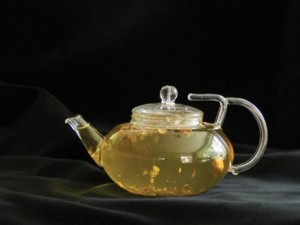
Damiana tea. Credit: Julie Bruton-Seal
Serves 2
Ingredients
2 heaped teaspoons damiana
1 heaped teaspoon mint
some rose petals
Directions
1. Put ingredients into a jug.
2. Pour boiling water on them, brew for 5 minutes.
3. Strain and chill.
4. Serve over ice.
* * *

Horny goat weed. Credit: Julie Bruton-Seal

Horny goat weed leaves. Credit: Julie Bruton-Seal
Horny Goat Weed Liqueur
Horny goat weed, or Epimedium, is an herb worth trying for the name alone. It is grown as ground-cover plant in dry shade, and the species used as aphrodisiacs are Epimedium grandiflorum, E. sagittatum and E. brevicornum. The leaves, which can be used fresh or dried, have a pleasant mild taste and a mild stimulant effect.
Makes about two weeks’ supply for one person.
Ingredients
A handful of dried horny goat weed leaves
A slice or two of orange
3 or 4 cardamom pods
1 tablespoon brown sugar
About a cup of whisky
Directions
1. Loosely fill a jam jar (roughly ½ pint size) with the dry ingredients
2. Pour in enough whisky to fill the jar and submerge the contents.
3. Put the jar in a warm dark place for two weeks then strain and bottle.
4. Enjoy a small liqueur glassful, sipped slowly, as and when you wish.
* * *
Maca Cupcakes With Vanilla Fudge Icing
Maca, Lepidium meyenii, looks a bit like a turnip and is a staple in the high Andes. Its strengthening and hormone balancing benefits are cumulative over long periods, though some people find it immediately stimulating. The powder smells like butterscotch, but blander and with a slightly bitter taste. Maca can be added to porridge, breads and cakes. Our favorite maca recipe is for these cupcakes. Matthew loves the combination of hard, sweet icing, a soft, light cake and sensuous strawberry melting in the mouth.
Makes 10 to 12 cupcakes
Ingredients for cupcakes

Maca cupcakes. Credit: Julie Bruton-Seal
½ tablespoon vinegar
1 tablespoon corn syrup or honey
4 tablespoons butter
½ cup light brown sugar
½ cup milk or oat milk
1 cup white flour
2 tablespoons maca powder
1 tablespoon boiling water
½ teaspoon baking soda
Directions
1. Warm vinegar, corn syrup, butter and sugar together in a pan.
2. When softened, beat until mixture becomes a creamy batter.
3. In another container, mix milk, flour and maca powder.
4. When well blended into a runny batter, pour over the cake batter.
5. Mix the two batters together to form a semi-liquid mixture.
6. Pour into 10 or 12 muffin cases.
7. Bake at 180 C (350 F) for 15 to 20 minutes, until golden on top and cooked through.
8. Cool, and add icing, as below.
Vanilla Fudge Icing

Matthew Seal and Julie Bruton-Seal. Credit: Jen Bartlett
For 10 or 12 cupcakes
Ingredients
1 teaspoon butter
1½ cups sugar
½ cup milk
½ teaspoon salt
½ teaspoon vanilla extract
10 small, very ripe strawberries
Directions
1. Melt butter and sugar in a saucepan.
2. Add milk and stir continually until it reaches boiling point.
3. Continue cooking until the mixture arrives at the soft ball stage (115 C, 240 F).
4. Cool a little, add vanilla extract and beat until smooth.
5. Spread on the cup cakes.
6. If the icing gets too stiff, warm it over hot water.
7. Decorate the top of each cupcake with a small, very ripe strawberry while the icing is still soft.
* * *
Schisandra Syrup and Sorbet
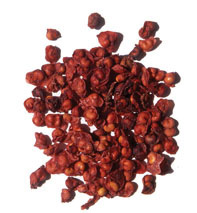
Schisandra berries. Credit: Julie Bruton-Seal

Schisandra sorbet. Credit: Julie Bruton-Seal
Schisandra, Schisandra chinensis, berries are the fruit of a Chinese vine in the magnolia family and are known as “five flavor berries” for their complex taste. Besides their aphrodisiac effect, they promote overall health and vitality, improve memory and concentration and help protect the liver, support the endocrine system and act as a powerful antioxidant.
Serves 2
Ingredients for syrup
1 cup schisandra berries
3 cups water
1 cup sugar
Directions
1. Put schisandra berries into a pan.
2. Add the water and simmer gently with the lid on for 30–40 minutes.
3. This stage is complete when the berries have given their brown-black color to the water.
4. Allow to cool for a few minutes.
5. When almost cool, put in blender and blend for a few moments.
6. Strain through a sieve.
7. Add sugar, and bring to a boil, cooking for a couple of minutes longer.
8. Allow to cool, giving a rich syrup
Ingredients for sorbet
1 cup schisandra syrup (as above)
Juice of 2 or 3 oranges, freshly squeezed
1 ripe banana
Directions
1. Mix the syrup and orange juice.
2. Peel and slice the banana and freeze it.
3. When frozen or nearly frozen, add the banana to the syrup mix.
4. Beat with a hand blender until creamy, then freeze again.
5. Serve in a chilled dish.
Top photo: Ashwaganda. Credit: Julie Bruton-Seal
Indian food lovers in the United States often have a vague concept of what biryanis are — a perception that stems from Indian restaurants that spike basmati rice with spices and dot it with either pieces of meat or vegetables. From the Persian biriyan (to fry before cooking), true biryanis were introduced and made popular by several invaders; the Moghuls were a prime influence, having gathered their knowledge from the Persians. The Nawabs of Lucknow and the Nizams of Hyderabad also popularized these layered meat-rice-nut dishes all across India, where there are more than 35 varieties.
The fancier the occasion, the more elaborate the biryani — some even included pounded silver leaves. I consider such biryanis to be meals in themselves; the only accompaniments they need are a simple yogurt-based raita (even a bowl of plain yogurt will suffice), pickles (either homemade or store-bought), and flame-toasted lentil wafers (papads).
The constitution of a biryani is rather simple. First, meat is often marinated and braised, spiced and simmered in various sauces. To prepare the rice layer, clarified butter is perfumed with whole spices, and sometimes with nuts and raisins. Then basmati rice is steeped in the butter (with water) to partially cook it. Finally, alternating layers of the meat curry and rice pulao are spread in a casserole and baked until the flavors mingle and the rice grains are tender. Although many of the biryanis are meat-based, vegetarians have adapted these dishes to include legumes and vegetables.
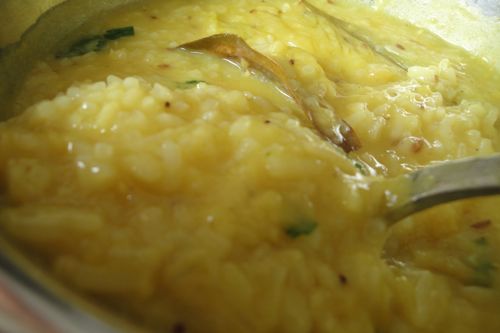
Kichidi, a savory and soothing porridge
Now, don’t get me wrong, I love biryanis, but the dish that gets no respect is one that is a close sibling, albeit a dowdy one in some Indians’ minds. Kichidis are soothing and simple porridges usually eaten when convalescing from an illness. The easily digestible grains, when eaten with plain yogurt, make for a comforting meal. Often, the trilogy of pickles, papads and yogurt accompanies kichidis to complement the porridge’s softness with pungency and crunch.
Of all the stories I heard in my childhood days, the one that always made me sit up and listen was this one about kichidis. To set the stage, it’s helpful to know about Akbar, the third and highly revered emperor of the Moghul empire, who ascended the throne at the tender age of 13, around 1556. Over the course of his rule, he developed a deep bond and friendship with his trusted inner circle adviser, Birbal, whose wit, impartiality, compassion and intelligence were legendary. Stories were penned over the years that regaled many a child at bedtime. This one particularly stuck with me, appealing to my culinary sensibilities.
Kichidi parable
Birbal listened patiently to the poor Brahmin’s predicament. The Brahmin, with teeth still chattering from the previous night’s bone-chilling experience in the frigid waters of the lake, recounted how he was promised 100 rupees for spending the night in its icy bed. He had managed to survive the frigidity by cozy thoughts that his children’s bellies would soon be filled with the help of this small fortune. He called upon Rama for strength, hands folded in pious servitude, looking toward a lighted oil lamp 200 feet away for the only flicker in an otherwise charcoal-black night. His prayers helped him make it to the crack of dawn, when he emerged from the lake with frozen, shriveled skin but a warmed heart filled with the hope of a hot meal for his hungry babies.
The court ministers marveled at the Brahmin’s fortitude and quizzed him at length on his successful survival. But once they heard that he had made it through with the “warmth” from the flickering light 200 feet away, they refused him his meager prize.”You cheated us you insolent man,” they fumed. “You heated yourself with the oil lamp 200 feet away.” The Brahmin’s earnest pleadings fell on deaf ears even when he insisted on presenting his case to the usually fair-minded emperor, Akbar.
Birbal stroked his beard as he listened to the Brahmin’s misery. It was time to teach the cruel ministers and Akbar a lesson. He invited them to a simple dinner of kichidi in his palatial courtyard. With help from the Brahmin, he lit a small fire from dried twigs. He fashioned a supporting structure 50 feet high from which dangled a large earthenware pot filled with rice, lentils and gold-yellow turmeric. The crowds gathered and waited with growing impatience for the humble, delicately spiced porridge.
Akbar’s anger rose along with the wisps of smoke from the pitiful twig fire as he demanded explanation for Birbal’s obvious stupidity in trying to cook a pot of kichidi 50 feet away from such a weak flame. “Jahanpana,” he said with respect, addressing him as King of the World, “if a flickering light 200 feet away could warm a Brahmin standing in waist-high icy-cold water, why can’t I cook this kichidi only fifty feet away.” Akbar realized his folly, duly reprimanded his ministers, and ordered them to pay the Brahmin five times what was promised to him. Birbal once again prevailed!
Rice-Lentil Porridge with Caramelized Onion (Pyaaz kichidi)
Makes 6 servings (about ½ cup each)
Ingredients
1 cup uncooked white basmati or long-grain rice
½ cup split and skinned green lentils (mung/moong dal — yellow in this form)
4 cups cold tap water
½ teaspoon ground turmeric
2 tablespoons ghee or melted butter
1 teaspoon cumin seeds
1 medium-size red onion, cut in half lengthwise and thinly sliced
2 to 4 fresh green Thai, cayenne or serrano chilies, stems removed, slit in half lengthwise (do not remove seeds)
1 medium-size tomato, cored and finely chopped
2 tablespoons finely chopped fresh cilantro leaves and tender stems
1 teaspoon coarse kosher or sea salt
¼ teaspoon black peppercorns, coarsely cracked
Directions
1. Plunk the rice and dal into a medium-size saucepan and add enough water to cover the grains. With your fingertips gently rub and swish the grains, at which point the water will get cloudy. Pour the water out and repeat three to four times, until the water remains relatively clear; drain.
2. Add 4 cups cold water to the pan and bring it to a boil over medium-high heat, stirring once or twice to separate the grains. Skim off any suds that may float to the top. Stir in the turmeric, lower the heat to medium, and simmer, partially covered, until most of the water evaporates. Cover the pan and continue to simmer about 5 minutes.
3. Turn off the burner and allow the pan to sit undisturbed an additional 5 to 10 minutes.
4. Meanwhile, heat the ghee in a medium-size skillet over medium-high heat. Sprinkle in the cumin and let it sizzle, turn reddish brown, and smell nutty, about 10 to 15 seconds. Immediately add the onion and chilies and stir-fry 4 to 6 minutes, until the onion turns purple-brown, 5 to 7 minutes. This is a good time to make sure your stove fan is on because of the pungent fumes from the roasting chilies.
5. Add the remaining ingredients and stew the mélange, uncovered, stirring occasionally, until the tomato softens, 2 to 4 minutes.
6. Scrape the skillet’s contents into the now-cooked rice-lentil mixture and mix well; serve.
Tip: If onions, chilies and tomatoes bother your stomach, leave them out. The humble cumin seeds and ghee are equally satisfying on their own.
Top photo: Indian kichidi. Credit: Raghavan Iyer
I don’t know anyone who wakes up on Jan. 1 cheering, “Woo-hoo, I can’t wait to go on a diet.” Most of us hate to diet. But as a rite of passing into a new year with well-intentioned resolution, The Diet is an annual dilemma that needs to be looked at a bit differently. In this first month of 2013, let’s resolve not to diet. Let’s anti-diet.
More on healthy eating at Zester Daily:
» A one-egg omelet that really satisfies
You can already see the ads on TV. Lose weight with this system, here’s an impossible-to-believe before-and-after shot of [insert you] after some charlatan’s weight-loss scam. We know most of these don’t work and don’t last. You’ve got the low-carb diet, the calorie-restriction diet, the açai berry diet — all cruel and unusual over a prolonged period. And not sustainable either.
This discussion is mostly for post-holiday bellies and diminishing a gut that’s bigger now than it was before Thanksgiving. It is not for anyone diagnosed as morbidly obese. For that you need medical advice. But anyone looking for a resolution you can live with should be thinking about wellness. And that means a new way of eating and of shopping, getting into a heartfelt ritual of improving the quality of the food you eat.
Here are five candid points that have helped me and could possibly help you.
1. Eat clean
This means getting habituated to eating better, shopping for, and simply cooking, fresh fruits and vegetables and a piece of meat or fish for dinner. Stay away from what I view as unclean food, usually posing as low-calorie frozen dinners. They’re not lean on unnatural ingredients and certainly not anything resembling cuisine. Another example is a commercial spinach dip available at a big box member store. It’s got an ingredient label of biblical proportions. Sure, the dip’s got spinach and dairy, but it also includes hydrolized soy protein, high fructose corn syrup. What’s this stuff? Why not wilt some fresh spinach (or defrost frozen spinach) and mix it with some garlic, Worcestershire and real sour cream or thick yogurt? Dinner is perhaps a serving of fresh chicken with two vegetables. Those vegetables might be steamed peas and mashed sweet potato. That’s clean.
2. Stop eating crap
Yes, I said crap. The commercial spinach dip, mentioned above, is unnatural. Potato chips as a side dish with a sandwich are nutritionally ridiculous. Cheetos, as yummy as they are for salt addicts, are not food. Twizzlers aren’t food. Pizza has trick nutrition, because with it calories and fats can pile up fast. I recommend avoiding it while you’re getting started this year. Ignore nutritionists who encourage daylong snacking. I say stop snacking, and this should help a few pounds here and there melt away.
Don’t forget the stop-eating-crap rule when you’re eating out too. Over the next couple of weeks, don’t get trapped in the salad-is-diet-food myth. There’s low nutrition in lettuce and lots of calories in dressing. When you find yourself out for lunch or dinner, make your own meal. Look over a menu to see what ingredients are on it, then ask the waiter to tell the chef you want the chicken breast out of the chicken sandwich and bring it with the side of chard that comes with the steak entrée. Sometimes the chef can be very obliging.
3. Get used to being a little hungry
This rule goes well with the stop-snacking rule. Some experts say hunger pangs send the body into starvation mode. Snacking your way to satiety is self-defeating.
A few hunger pangs are a sign your stomach is getting accustomed to less. Also, eat dinner early so you’re up more hours to burn calories. You may go to bed a bit hungry, but there’s always breakfast eight hours away.
4. Go to a farmers market
You’ll eat seasonally and you’ll be able to practice one of the best pieces of nutrition advice ever to come along: Eat your colors. Buy orange produce such as winter squash, yams, carrots and oranges. Go green with chard, spinach, kale, broccoli, even frozen peas. Get your red from beets, red cabbage and pomegranates. If you hate beets, don’t eat them. The variety from eating colors keeps boredom at bay. A farmers market will awaken your interest in fresh food, which obviously requires some skill to cook, and that brings me to the next rule.
5. Learn to cook
Zester readers may know more than the average reluctant cook about getting a meal on the table, but many people indulge their interest in food by eating out and making excuses for not cooking.

Microwaved chicken that tastes like baked. Credit: Elaine Corn
You won’t think that time spent cooking robs you of time spent doing other things if you decide that cooking is one of those other things. Taking charge of what goes into your body benefits you on many fronts: your budget, your nutrition and your control of all ingredients that enter your body. If you regard the knobs on a stove like they’re controls on a nuclear reactor, then cook in your microwave. About 99% of homes have microwaves. I’ve used the microwave to cook an entire meal that’s clean, nutritious and not too expensive.
Ultimately if you can make yourself a reasonable promise, you’ll feel better, you’ll lose that holiday gut, and you may well be on your way to some new good habits.
“Baked” Chicken From the Microwave
Serves 4
Ingredients
1 whole cut-up fryer, bones in, pieces rinsed and dried with paper towel
Salt and ground black pepper
2 to 3 tablespoons olive oil
1 tablespoon oregano (leafy type, not powdered)
Few sprinkles paprika, for color and a bit of kick
Directions
1. To make the breasts of relative size to the rest of the pieces, cut the breasts in half crosswise. Arrange chicken pieces on a microwavable large dinner plate like spokes, with the plump ends along the rim of the plate and narrower ends toward the center.
2. Season with salt and pepper, drizzle with olive oil, sprinkle with oregano and paprika. Do not cover.
3. In a microwave equipped with a turntable, microwave on high, in 5-minute intervals, for up to a total of 10 to 15 minutes*, until meat is browned and no longer pink inside.
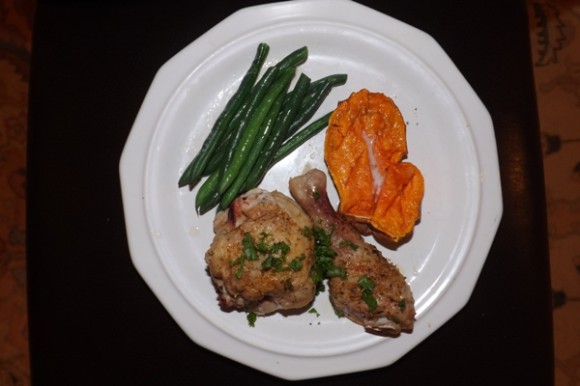
4. Serve with fresh microwaved green beans and half a sweet potato.
* Depending on microwave’s wattage power, your chicken may cook very quickly or slowly. At home, mine is done in about 12 minutes. At a friend’s house with an older model, the chicken was done in 14 minutes. You can stop the microwave at any time to check progress.
Microwaved Yam
Serves 2
This is the easiest type of produce to microwave.
Ingredients
1 medium-sized yam
Dab of butter
Directions
1. Halve yam lengthwise. Lay both pieces on a large dinner plate, flat side down. Puncture several air slits in the skin for steam to escape. Do not cover.
2. Microwave on high for 5 minutes. Test doneness by piercing with sharp knife. If it glides easily into the yam, the yam is done. If not, microwave 1 minute more.
3. Turn yam halves over, cut slits and top each with a small dab of butter. Serve hot.
Microwaved Fresh Green Beans With Butter
Serves 2 or 3
Ingredients
⅓ pound green beans (pick tender ones instead of big fat ones)
Sprinkling of salt
1 pat of butter
Directions
1. Trim stems off beans. Set beans in a shallow bowl with a tablespoon of water. Sprinkle with salt. Set dab of butter in center.
2. Cover the bowl with a plate. Steam-microwave for 90 seconds. If the beans are still too crunchy for your taste, microwave for another 15 seconds. Scoop the beans out of bowl with a slotted spoon and set on the serving plate with the chicken and yam.
Healthy “baked” chicken, green beans and yams from the microwave. Credit: Elaine Corn

Last in our series to cleanse and detoxify is triphala, the three fruits. It includes three plum-like fruits that are astringent and high in tannins. It seems appropriate to end this miniseries with fruits that are common, abundant and nutrient-rich in South Asian cultures. Why not explore an Ayurvedic formulation that focuses on the lower intestines, the end of the line, so to speak? And remember to pair your foods and herbs with yoga breathing and asanas to increase the impact.
Origin and culinary and traditional medicine uses of triphala
HELP FOR
THE HECTIC HOLIDAYS
In this three-month series, learn to pair simple herbal and yoga techniques to build immunity, counter holiday stress and start the New Year cleansed, detoxed and armed to activate your resolutions.
NOVEMBER: Double your body strength with simple yoga postures to stimulate your dynamic immune system:
» Amla
DECEMBER: Anti-stress herbs and calming yoga and breathing exercises:
» Brahmi
JANUARY: Detox herbs to recalibrate, rebalance and activate resolutions:
» Triphala
EAT TO HEAL: Previous articles covering the numerous benefits of herbs and foods:
black pepper | cilantro | cinnamon | cardamom | holy basil | nutmeg| ginger | turmeric | thyme | bay leaf | parsley
Contemporary research
Each fruit possesses a great number of beneficial plant chemicals. When studied individually in test tubes, in animals or in people, the favorable effects are large and all encompassing. The three fruit extracts demonstrate powerful antioxidant capacity. They effectively scavenge and eliminate free radicals that can cause great damage on a molecular level. More recent and promising experimental studies are reviewed in the Journal of Alternative and Complementary Medicine and confirm that triphala plant chemicals act as potent antineoplastic, radioprotective and chemoprotective agents. In a recent article in Evidence-Based Complementary and Alternative Medicine, triphala powder, when administered according to Ayurvedic principles, significantly stimulated the immune response in a clinical Phase I study.
Yoga for detoxification
Take your yoga postures to a higher level. Continue to engage in all the forward bends, bridge poses and standing and seated twists that gently massage and stimulate your abdominal area. But now remember your yoga teacher’s pleas to pay attention to your breath. Use your breath as an anchor to center. And remember to be mindful of the quality of your breath just like you are mindful of your food. For breath, too, is your food.
For a reliable source for organic plants, botanicals and spices, try Frontier; for Ayurvedic products, try Banyan Botanicals. Before taking any substances, always consult with your chosen health-care professional. To ensure proper yoga training, seek the advice of a certified yoga specialist.
Photo: A rishi documenting traditional healing systems. Credit: Sarah Khan
The new year of the Gregorian calendar is here. Determined to shed some of the excesses of the past? Stick with real food, treat it like medicine, engage in some active yoga poses and sail into the New Year ready to set in motion your resolutions for your mind and body. This January, I offer you two common Ayurvedic herb formulas: trikatu and triphala, a total of six medicinal plants or fruits. The first of the two is trikatu churna, translated from Sanskrit into three (tri) pungents (katu) powder (churna). The formulation is made up of long pepper, black pepper and ginger. It is a classic signature taste for a South Asian palate and a time-tested medicinal formulation to stimulate, cleanse and heal: Food, medicine and taste all in one.
HELP FOR
THE HECTIC HOLIDAYS
In this three-month series, learn to pair simple herbal and yoga techniques to build immunity, counter holiday stress and start the New Year cleansed, detoxed and armed to activate your resolutions.
NOVEMBER: Double your body strength with simple yoga postures to stimulate your dynamic immune system:
» Amla
DECEMBER: Anti-stress herbs and calming yoga and breathing exercises:
» Brahmi
JANUARY: Detox herbs to recalibrate, rebalance and activate resolutions:
» Triphala
EAT TO HEAL: Previous articles covering the numerous benefits of herbs and foods:
black pepper | cilantro | cinnamon | cardamom | holy basil | nutmeg| ginger | turmeric | thyme | bay leaf | parsley
Origins and culinary and traditional medicine uses for trikatu
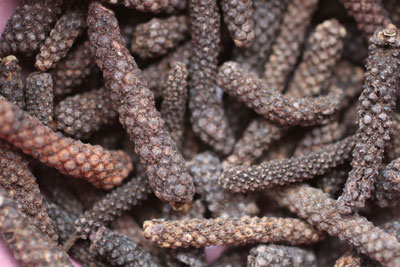
Review past articles on black pepper (Piper nigrum) and ginger (Zingiber officinale) to gain an understanding of their origins and medicinal and culinary uses. Long pepper, Piper longum or Pippali, from which the word pepper derives, is a Tamil and Malayalam word. Indigenous to northeast India from Assam to the Himalayas and all hotter regions of South Asia, the pungent spice arrived in Europe long before black pepper, and researchers estimate that in Roman times it costs nearly triple that of black pepper. Though today Pippali is not as prevalent in the spice world, it has its own unique flavor. Still in the pepper family and used in South Asian and African cuisines, long pepper imparts a hotter, more potent and pungent kick than its sister, black pepper.
In Ayurveda, ground dried black and long pepper fruits are mixed with ginger rhizome in a 1:1:1 ratio. The Ayurvedic formulation is used mainly to treat upper respiratory problems and improve digestion. For many traditional and integrative medicine practitioners, the core of healing begins in the gut. Support the digestive system, and often the many instances of disease can resolve themselves. To begin to cleanse, one must first support the digestive system to function optimally. The sum effect of the “three pungents,” or trikatu rasayana, may be larger than the individual plants alone. Synergy allows for greater clinical efficacy in some instances, and in others (as in many time-tested formulations), it may provide protection that each plant alone cannot provide. Often the sharp powder is mixed with honey and licked to sweeten the delivery.
Contemporary research
Most studies are conducted on individual plant extracts. And among plant-based practitioners all over the world, there is debate as to whether the whole plant or individual extracts are best for treatments. Most biomedical research gives preference to the single-extract approach. To study an entire food or plant that is filled with hundreds or thousands of individual plant chemicals is practically too overwhelming to consider. So when I quote contemporary medical research, often what is largely available are studies on plant extracts. The major component of black pepper and long pepper is the alkaloid piperine, the pungent principle.
According to a study in Critical Reviews in Food Science and Nutrition, dietary piperine stimulates digestive enzymes, improves digestive ability and significantly reduces food transit time through the gastrointestinal tract. Piperine in in vitro studies appeared to protect against oxidative damage. In fact, black pepper, long pepper or piperine powerfully influenced antioxidant molecules and antioxidant enzymes in a number of experimental situations of oxidative stress. A note of caution, however: Piperine can increase the uptake of some pharmaceutical drugs you might be taking. Always consult with your health care practitioner before initiating any course of treatment.
Yoga for detoxification
Detoxification often begins with supporting the digestive and elimination systems. All yoga poses that facilitate the gentle massaging, stretching and contracting of the abdomen are especially effective. Warmup asanas might include gentle cat, cow and forward bend, then move on to extended triangle and finish with seated spinal twists.
For a reliable source for organic plants, botanicals and spices, try Frontier; for Ayurvedic products, try Banyan Botanicals. Before taking any substances, always consult with your chosen health-care professional. To ensure proper yoga training, seek the advice of a certified yoga specialist.
Top photo: Long pepper. Credit: Sarah Khan
Zester Daily readers have shown an appreciation for a stunning variety of stories over the past year. A quick scan of the 2012 reader favorites reveals a yen for Ruth Bourdain’s dishes, cuisine from every corner of the world, food preservation, photography, films, wine insider news and a treasured recipe for flavored marshmallows — as well as a critique of American taste.
Snippets of the 12 most popular Zester Daily contributors’ stories, plus the five most popular Soapboxes, are below. Follow the story links to read the complete text. Follow the contributor links to read more by each author.
The stories are listed in reverse order.
Top contributors’ stories of 2012
12. THE ORIGINS OF CURRY by Raghavan Iyer: Before I try to define the word “curry,” let me create an image for you from my college laboratory days in India where I pursued a degree in chemistry over 20 years ago. As I busied myself measuring crystals of …
11. OLD-SCHOOL SOY SAUCE by Manuela Zoninsein: There’s no one right ritual or rule to guide your eating extravaganza on Jan. 23. The Chinese New Year involves a number of great food traditions. Dumplings are reminiscent of coins in ancient China and will thus bring …
10. TEN BEST FOODIE FLICKS by David Latt: If cold weather traps you indoors for months each winter, you might run through your queue of streaming movies pretty quick. Why not entertain yourself with a library of the best …
9. HOW KERMIT LYNCH TAUGHT AMERICANS HOW TO DRINK WINE by Patrick Comiskey: Forty years ago, Kermit Lynch abandoned the handmade purse industry and opened a wine shop in Berkeley, Calif., and in doing so, became one of the great innovators of …
8. WINE’S ACCUSED GRIFTER, RUDY KURNIAWAN by Corie Brown: By the summer of 2006, when I first noticed Rudy Kurniawan at Christie’s in Beverly Hills, he had transformed the market for old wine from a sleepy backwater into a high-stakes free-for-all. Only the richest wine collectors knew him. Or thought they did …
7. THANKSGIVING CONUNDRUM: TO BRINE OR NOT TO BRINE by Louisa Kasdon: Turkey conversation season is upon us again, with our annual quest for a crisp, moist, perfect bird. Some swear by …
6. EATING TO BEAT CANCER: DIET MAY PROVE TO BE A CURE by Harriet Sugar Miller: Last night, it was cauliflower curry on a bed of leeks while my husband grilled his own slab of meat. The night before I ate solo — and downed an enormous bag of kale chips (please don’t tell him) flavored with cashew dust and too much …
5. FOOD SHOOTING TIPS on March 23 by David Hagerman: We all know what a beautiful food photograph looks like. Unfortunately, our cameras are clueless. Here are tips for making the most of …
4. IN DEFENSE OF TRUFFLE OIL by Lynne Curry: Midwinter is high season for fresh truffles in Oregon’s Willamette Valley. With the help of an experienced truffle hunter (or a trained dog), I could spend …
3. SICILY’S EGGPLANT CEVICHE FOR SUMMER by Clifford A. Wright: The end of summer offers the cook a wealth of sparkling fruits and vegetables for culinary transformation. One of my favorite …
2. CANNING JARS FROM FAUX TO BEST PRESERVING CHOICES by Susan Lutz: About six months ago, I salvaged a beautiful marinara sauce jar that I intended to refill with home-canned sweet pickles made using my mother’s recipe. And if I hadn’t taken a 12-week course to become a certified Master Food Preserver, I might have …
1. FLAVORED MARSHMALLOWS MADE FROM SCRATCH by Charles Perry: When you hand people homemade marshmallows, they’re always dazzled. These are actual marshmallows, but with a lush, moist texture you never find in store-bought versions. If you want your friends to keep thinking you’re a wizard, don’t tell them how simple it is …
Top Soapboxes of 2012
5. DÍA DE LOS MUERTOS IS FOR AMERICANOS, TOO by Veronica Gonzalez-Smith: In the small town of El Paso, Texas, my siblings and I grew up at a unique intersection of Mexican and American culture. As kids, we traveled in and out of …
4. THE INFANTALIZATION OF AMERICAN TASTE by Michael Krondl: Though the plague of cupcake shops has not spared any city in this great union, it would be hard to find one that illustrates my point better than …
3. CALIFORNIA’S EXCITING NEW WINES BUCK THE MAINSTREAM by Eric Asimov: We live in the most wonderful era in history to love wine. Right now, Americans have access to a greater diversity of wines than ever before, wines made in more styles from more …
2. THE FORGOTTEN QUINCE by Jane McMorland Hunter: Nowadays most people hardly know what a quince looks like. Until the 19th century, it was a commonplace orchard fruit throughout North America and Europe; now it has become …
1. RUTH BOURDAIN DISSES AND DISHES WITH ZESTER by Ruth Bourdain: It’s been more than two years since the debut of Ruth Bourdain, the sensational and often raunchy Twitter persona whose name and sensibilities are a mashup/spoof of former Gourmet editor Ruth Reichl and outspoken celebrity chef Anthony Bourdain. The true identity of Ms. Bourdain is still under wraps, but her tweets show her to be ….
* * *
And that’s our list for 2012 … Here’s to discovering Ms. Bourdain’s identity in 2013!
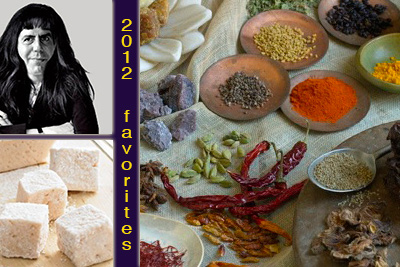
Photo illustration, clockwise from top left:
Ruth Bourdain. Credit: Ruth Bourdain
Indian spices (originally published in 660 Curries). Credit: Ben Fink
Homemade marshmallows dusted with confectioners’ sugar. Credit: StockFood
Photo illustration credit: Karen Chaderjian
Your second anti-stress plant for this month of December is Brahmi. Always at the side of streams and close to the water’s edge, Brahmi, or Bacopa monnieri (also spelled Bacopa monniera), is a creeping plant that reduces anxiety and may extend your memory. It is another rasayana in a long line of Ayurvedic plants to stash in your cabinet for a sense of calm and peace of mind. And when you pair your herbs with yoga breathing techniques, you just might double your tranquility, or at least quell the storm churning within.
Traditional medicine and contemporary research on Brahmi
In Ayurveda, Brahmi treats memory decline and inflammation. It acts as an effective nerve and brain tonic. Used to treat forms of epilepsy in the past, it acts as a mild sedative, but instead of dulling the mind it enhances mental clarity and focus. Often the whole plant is dried, processed and administered in a form that is most beneficial for the patient. Contemporary research in Nutrition Journal 2012 identifies two plant chemicals, Bacoside A and Bacoside B, that are assumed to be the key to Brahmi’s clinical efficacy in numerous animal studies and some human studies.
Yoga breathing for stress
In the last article, I introduced basic nadi shodhana, or alternate nostril breathing. Continue the practice, but now, before you begin, check and see which nostril is more open. Is it the left one or the right? In yogic terms, the left nostril represents ida, the right one pingala. Broadly, ida/left nostril represents the feminine, the moon and contemplation; pingala/right nostril represents the masculine, the sun and action. Depending on what nostril dominates, you can plan your yoga practice and your day. If ida dominates and you are more contemplative, engage in those more reflective activities. If you are restless, perhaps it is time to take a walk since your right nostril/pingala is more open. This way you can work with your body, be more in tune with its rhythms and ultimately more aware.
Brahmi milk decoction
Ingredients
½ cup whole milk or water
½ teaspoon of Brahmi powder
Honey to taste
Ingredients
1. Heat milk or water on a low setting, add powder and stir for 3 minutes.
2. Let the decoction sit for 2 to 3 minutes, then strain.
3. Add honey and sip. You do not have to strain the powder, and you may ingest it, though some do not enjoy the gritty feel.
For a reliable source for organic plants, botanicals and spices, try Frontier; for Ayurvedic products, try Banyan Botanicals. Before taking any substances, always consult with your chosen health-care professional. To ensure proper yoga training, seek the advice of a certified yoga specialist.
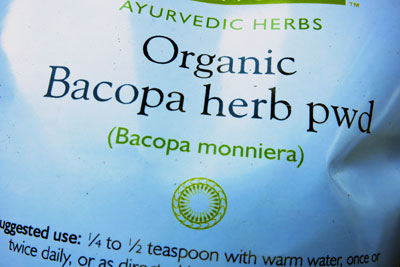
Photo: Herbal Brahmi powder. Credit: Sarah Khan