Articles in Chefs
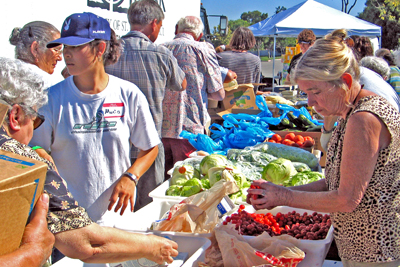
When Seattle chef Maxime Bilet says he was presented with the “most amazing challenge,” you want to know more. After all, what could be more difficult than creating barbecue with a smoker, a sous-vide bath, a centrifuge or liquid nitrogen?
Think simple, really simple.
“You pretty much have nothing other than what’s in the food bank. You have to make a delicious dish from these ingredients in under 20 minutes. And you have nothing but the basic tools,” says Bilet, the 30-year-old co-creator of “Modernist Cuisine” and its sister cookbook “Modernist Cuisine at Home,” a groundbreaking exploration of cooking, art and science.
Food bank? Basic tools? Under 20 minutes? Dorothy, we are clearly not in Nathan Myhrvold’s kitchen anymore. (Myhrvold, a former Microsoft executive and master French chef, was the force behind “Modernist Cuisine.”)
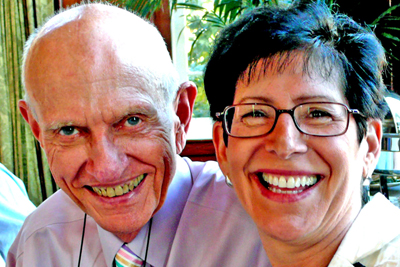
Peter Clarke and Susan Evans. Credit: Duane Poole
University of Southern California professors Peter Clarke and Susan Evans enlisted Bilet in their ambitious project to transform the diet of Americans dependent on the free food distributed by food banks. They began in 1991 with a program to pair up the nation’s 200-plus food banks — whose inventory consisted largely of cereals, canned goods and convenience foods — with produce distributors who had surplus fruits and vegetables.
Clarke and Evans quickly discovered that getting fresh beans or squash into the food bank community pantries wasn’t enough. They needed to help people figure out what to do with the vegetables or risk having the produce dumped in the garbage.
Food bank visitors don’t have easy path to healthy eating
Time and resources are big barriers to healthy eating. Many of the people dependent on pantries are seniors or the working poor, who are juggling a couple of part-time jobs while raising children. They often suffer from diabetes or other chronic diseases. A growing number are Latino and Asian immigrants who aren’t familiar with the vegetables eaten in the United States. And their kitchens aren’t likely to be stocked with sharp knives, food processors or expensive spices.
They need food that is simple to make, fast and filling, which is why their default meals often come in a can, a microwaveable carton or a fast-food bag.
So Clarke and Evans created QUICK! Help for Meals, a computer program that provides pantry clients with recipes that incorporate the produce of the day and are available in English or Spanish. They found that by customizing the recipes to the individual’s needs — family size, health issues, flavor preferences — they could double the amount of vegetables people took home.
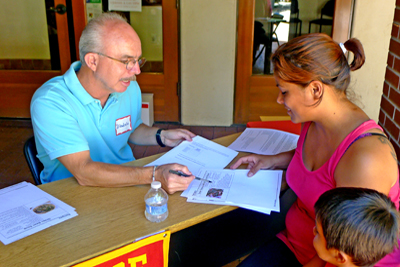
Dio Velasco (left), a field researcher for QUICK! Help for Meals, gathers reactions to recipes from a pantry client at Our Savior Center in El Monte, Calif. Credit: Peter Clarke
Clarke and Evans scoured cookbooks and the Internet to build a recipe list based around the vegetables most commonly found in food banks: zucchini, broccoli, green beans, carrots, potatoes, sweet potatoes, onions, root vegetables and cabbage. They also sought the help of top food professionals.
Brian Wansink, Cornell University food psychologist and author of “Mindless Eating, Why We Eat More Than We Think,” taught them about the hidden things that influence people’s food choices. His research shows that restaurants can increase sales by 20% with menu descriptions that evoke positive feelings, such as “Grandma’s oatmeal cookies.” With his assistance, Clarke and Evans revised their recipes and are currently testing the dressed-up versions at several Southern California pantries.
Lachlan Sands, the executive chef at Le Cordon Bleu College of Culinary Arts Los Angeles, and his students reviewed several hundred recipes for ease of preparation, flavor and nutritional value. “The number one thing is that the food is properly cooked,” Sands says. “People don’t like Brussels sprouts because they have such a strong flavor. But if you cook them right, they are nutty and sweet.”
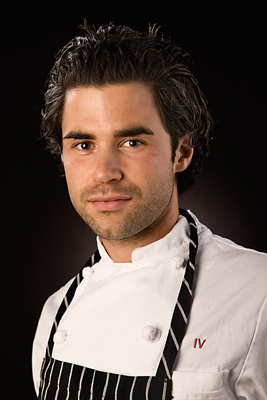
Chef Maxime Bilet. Credit: Ryan Matthew Smith
Bilet was asked to use his culinary wizardry to develop recipes with kid appeal, an important priority for pantry clients. His biggest challenge was “making a head of cabbage awesome to a kid who’s accustomed to eating Big Macs.” The solution? Cut the cabbage into thick wedges, baste them with a little oil and salt to release the water and then roast them with a few sprinkles of feta cheese or brown sugar and honey. “When in doubt, roast,” he says. “Kids prefer the softer textures with vegetables and they love that roasted flavor.”
Bilet also created a whole-grain stew featuring sautéed zucchini, brown rice and creamed corn, all popular pantry items. “It had all the flavor notes,” says Bilet. “It had the vegetableness, the nuttiness and substance of rice and the creaminess and sweetness of creamed corn. The kids loved it.”
Bilet, who recently left Myhrvold’s cooking lab to pursue new adventures, believes food empowerment can become a powerful tool for improving public health in America. And he credits Clarke and Evans with helping lead the charge. They are now working with researchers to transfer QUICK! Help for Meals to a smartphone app to make it easier for pantries to administer. “It’s just so brilliant,” Bilet says.
Photo: Fresh produce is handed out at a community pantry. Credit: Peter Clarke
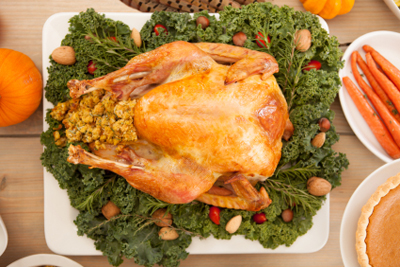
Turkey conversation season is upon us again, with our annual quest for a crisp, moist, perfect bird. Some swear by brining the turkey (or any poultry) in a bucket with spices and salt to improve flavor and texture. I’m a skeptic with a standard home kitchen. Our family is big, and so are the birds we roast to feed them. Do I really need to give my 18-pound turkey an overnight beauty bath? Is the mess worth the work?
I asked Chef Tony Maws, chef owner of the award-winning bistro Craigie on Main in Cambridge, Mass. Maws, a recent James Beard Best Chef Northeast winner, is known around town as a perfectionist. One of the pioneers of the locavore movement and nose-to-tail cooking, in his early days Maws was known as a chef whose standards were so high that local suppliers wept during deliveries to his restaurant as he inspected and refused their local bounty. Maws has mellowed a bit. But he’s still a stickler known for serving perfect poultry. He seemed like a good person to ask about brining.
It turns out that although he has a great brining recipe (see below), he doesn’t think it’s a make-or-break step for a turkey. He gets dozens of frantic calls from his regular diners around Thanksgiving, he says. “Foil, not foil? High temp, low temp? Turn the bird midway, or roast it standing up? Almost none of it matters since there is so much variability in cooking a turkey. But a lot of people do ask me about brining.”
Brining a turkey is
just one way to cook a quality bird
Maws thinks brining is just one of the things you can do to turn out a terrific bird. Brining, he explains, is an attempt to put two things into equilibrium by osmosis: the natural salinity of the fresh bird and the higher salt of the brine. The idea is that you can equalize the saline content in the bird and keep it moist and juicy and add a flavor kick to a pretty, plain protein without adding more salt. “The hard thing is that you can’t taste what is happening to the raw bird as it as brining, so you sort have to take it on faith.”
Maws says it never hurts a turkey — or any poultry — to be brined for six to eight hours or overnight, and it helps even more if you can rest the bird for another day out of the brine before serving, but he doubts it is practical for most households to add two more steps to a busy holiday ritual. “Brining is an effective tool, but sort of a hassle for a standard home kitchen. Very few people have the space to refrigerate a big turkey in a bucket of water overnight. Not everyone has a restaurant-scale walk-in.”
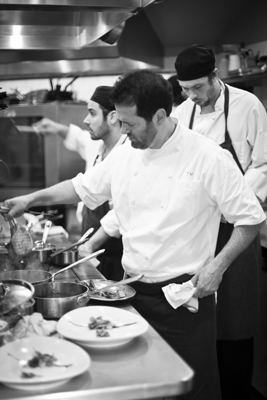
Tony Maws. Credit: Michael Piazza
“Look,” he says, rubbing his beard stubble with a faintly piratical smile, “I know it’s sacrilegious, but the idea of cooking a whole turkey in a standard stove and having it come out perfectly done is ridiculous. Breasts and legs need different amounts of time for optimal doneness. Even if you set your oven to 350 degrees Fahrenheit the temperature even in a fancy home oven fluctuates between 325 degrees and 425 degrees Fahrenheit. Between the corners of the oven and the contours of the bird, it’s always a different temperature at any given moment.”
Maws says when the breast is done, the legs still need some time. If you use the internal temperature of the legs as a guide, you dry out the breast. He’s given up on roasting a whole turkey and prefers to buy a good bird, break it down and roast it in pieces, removing the breast from the oven and letting the legs spend more time in the heat. According to Maws, the ideal interior temperature for a turkey breast is 143 F (62 C) and for the legs it is 150 F (66 C). As you can tell, he’s a pretty precise guy.
His suggestion for diehards married to the ooh-aah public presentation of a pristine golden bird: “Bring it out, show it around, take it back to the kitchen and put the legs back in the oven for 10 more minutes. That’s what the French do.”
Maws’ inflexible turkey rule: “Buy a good turkey. I’m not trying to be hippy-dippy, but all the things you read about free-range and natural birds are true. Turkeys are large, lean birds, much leaner than a plump, fat chicken, so you want to pay special attention to how the turkeys are raised and fed. The better and healthier the bird, the better the texture and flavor.”
Tony Maws’ Poultry Brine
Ingredients
5 liters of water, or less if you are using a brining bag for a 12- to 14-pound turkey
60 grams kosher salt
11 grams Kombu
1 teaspoon dried thyme
2 teaspoons coriander seeds
2 teaspoons fennel seeds
2 allspice berries
2 juniper berries
1 teaspoon chili flakes
2 cloves
Directions
Mix all the ingredients together in a bucket or container large enough to accommodate the turkey. Add the bird once thoroughly mixed.
Photo: A Thanksgiving turkey. Credit: iStockPhoto
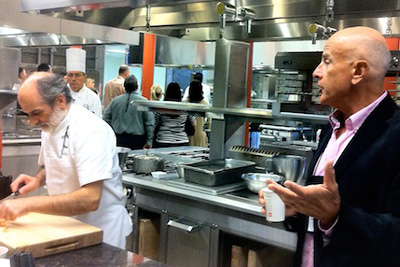
Food is a mirror of who we are, Zester Daily contributor Clifford A. Wright told the more than 700 food professionals attending the 15th annual Culinary Institute of America Worlds of Flavor conference last week. Rather than a single reflection, “food is a constantly changing picture of where we came from and where we are going.”
And with these words, Wright opened CIA’s annual international festival at its Napa Valley campus last week, a three-day event jam-packed with lectures, demonstrations and cooking lessons featuring more than 70 of the world’s leading food authorities, each illustrating a different aspect of the Eurasian migration of flavor.
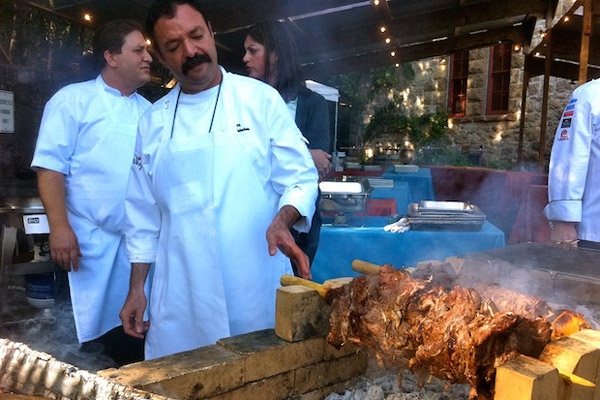
Musa Dagdeviren, chef/owner of the renowned Ciya Sofrasi in Istanbul, demonstrating his signature open-fire kebab cooking. Credit: Corie Brown
Wright was one of many speakers with a Zester connection. Zester contributor Jody Eddy moderated a cooking demonstration. Michael Krondl, Naomi Duguid, Joan Nathan, Skiz Fernando, Diane Kochilas and Hiroko Shimbo were among the guest authors who have written a Soapbox for Zester. (Shimbo’s Soapbox will appear later this month.)
A charming and gregarious raconteur, Wright spoke several times during the conference, entertained the crowd with his “Cliff’s notes” version of the history of the spice trade — a 1,000-year tale of rich people scouring the world for ways to improve the quality of their dining experience. The more wealth there was, the fiercer the trade in spices and other foods that could survive long journeys. One cuisine borrowed from another in a chain that continues today.
The highlight of the CIA event, however, was the dazzling collection of international chefs who rolled up their sleeves and share their kitchen secrets with the crowd.
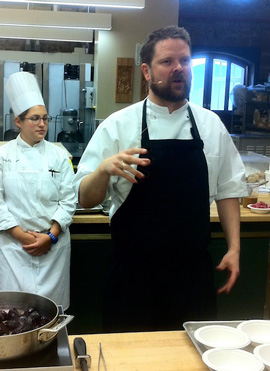
Gunnar Karl Gíslason, chef/owner of Dill restaurant in the Nordic House in Reykjavik, has roasted beets warming in a cooking demonstration while he explains his Icelandic cuisine. Credit: Corie Brown
- Italy’s Corrado Assenza, chef/owner of Caffé Sicilia, a cutting edge pastry-coffee-ice cream bar in the baroque town of Noto in southeastern Sicily.
- China’s Yu Bo, considered the Ferran Adrià of China, is the chef/owner of Yu’s Family Kitchen in Chengdu, capital of Sichuan province.
- Turkey’s Musa Dagdeviren, chef/owner of Ciya Sofrasi in Istanbul celebrating traditional Anatolian cuisine.
- Spain’s Ángel León, chef/owner of Aponiente in Puerto de Santa Maria in Cádiz developing plankton cuisine.
- England’s Yotam Ottolenghi, chef/owner of five London restaurants whose cookbook “Jerusalem” has been a smash hit around the world.
- San Francisco’s Mourad Lahlou, chef/owner of Aziza in San Francisco, known for modern interpretations of traditional Moroccan cuisine.
- American Maxime Bilet, co-author with Nathan Myhrvold of “Modernist Cuisine: The Art and Science of Cooking,” a technologist pushing the limits of kitchen science.
Iceland was represented by Gunnar Karl Gíslason, a young chef whose extraordinary take on his country’s local flavors has made Dill in the Nordic House in Reykjavik a leading light in a country searching for its culinary soul. Zester’s Eddy, co-author of the chef’s upcoming book, told the story of Iceland’s culinary struggles after the devastating economic crisis in 2008. Long dependent on imported food, the cold country has been forced to become self-sufficient for the first time in generations. Gíslason’s hyper-local cuisine using native sea salts, seaweed, livestock and root vegetables took off, creating a first-ever potential to export distinctive Icelandic flavors to other countries.
A satellite in the world of flavor
Malaysia-based Zester contributor Robyn Eckhardt wasn’t able to attend CIA’s event. She’s busy with a new assignment: writing a twice-a-month column on street food for Wall Street Journal Asia. Check it out at Wall Steet Journal Asia.
Top photo:
Clifford Wright leads a cooking demonstration at CIA’s Worlds of Flavor with Corrado Assenza, a leading Italian pastry chef and owner of Caffé Sicilia in Noto, Italy. Credit: Corie Brown
Whenever I’m in Pisa, on the Tuscan coast, I stop in to see Paul De Bondt, one of the world’s top chocolate artisans. He and his partner, Cecilia Iacobelli, have long been in the vanguard of chocolate flavour and design, and their ideas for chocolate have been copied the world over.
In their small chocolate factory, where everything is still done by hand, Paul is working with white chocolate on the day I visit.
“Try a little,” he says.
“Thanks, I’m not crazy about white chocolate, but since you made it, I’ll taste a piece,” I reply. I should have known: As with everything he makes, it’s delicious. Not overly sweet, not overly milky, with the clean finish that is one of De Bondt’s trademarks.
“Guess what? It’s sugar-free,” he says, as he continues to fill the molds of his trademark bars. I am amazed. I’ve tried sugar-free chocolate from time to time, just to see what it tastes like, and I’ve always found it unpleasant: sickly sweet, often with the metallic taste of artificial sweeteners and low-quality cocoa. How could this be sugar-free? What kind of sweetening agent is in it?
“For four years, we’ve been making a range of five sugar-free bars: three of varying degrees of dark chocolate, two different milk chocolate bars, and this white chocolate,” he says. “We have many loyal customers who asked us to start making chocolate for diabetic family members, so we developed this range. The sweetening agent is natural maltitol, and it’s quite different from synthetic and artificial sweeteners in taste and substance.”
The secret of sugar-free chocolate
Maltitol is a sugar alcohol with fewer calories than sugar. But unlike other sweeteners, maltitol has the same volume as sugar, so it doesn’t change the recipe to work with it. It has 75% of the sweetening capabilities of sugar (sucrose), but only 60% of the calories, and its glycemic index is 53% of sugar’s, Paul explains. That’s what makes it suitable for use in these “sugar-free” chocolates.
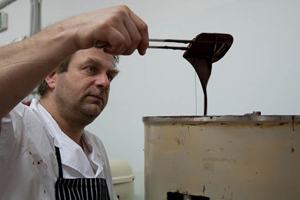
Paul De Bondt at his small chocolate factory in Pisa, Italy. Credit: Carla Capalbo
“For us, the structure of the chocolate — its mouthfeel — is important, yet that’s something many other chocolate producers don’t take into consideration. The maltitol works well for these bars because it behaves very much like sugar,” he explains. “Each person with diabetes has to find their own balance with food, so we don’t make any claims for how much of our chocolate they can eat, but the diabetics and dieters we know keep coming back for more,” he says.
Cecilia says the goal is to have each of the chocolate bars be complex and have a distinct character. “We also use pure, natural vanilla instead of the artificial vanilla so often found in commercial chocolates,” she says. “That may seem a novel idea to some producers, but we’ve been doing it for 20 years.”
I taste my way through the range of five sugar-free bars, going from the marvelously creamy white through the milk chocolate bars (with 36% and 40% cocoa) up through the dark bars (with 56%, 65% and 72% cocoa). As with all the duo’s chocolate bars, each is the result of a different blend of selected cocoas from various provenances. The 36% milk chocolate, for example, is made of three cocoa varieties, and is clean and balanced, with notes of milk and honey (though there is no honey in it); the 65% is a blend of just two types of cocoa, but has an intense character with notes of dried fruits; the 72% is darker in colour and tone, full-bodied yet with floral notes that stay in the mouth long after the chocolate has been swallowed.
This chocolate raises the bar for people who can’t eat sweetened chocolate. It’s so good you don’t have to be diabetic to want to eat it! Nor do you have to travel to Pisa to buy it (though Pisa is one of my favorite Tuscan towns, and far less touristy than Florence or Siena). De Bondt is in the process of setting up a new mail-order site, and will ship on demand. Some of the De Bondt chocolate range is also available from Buon Italia in Chelsea Market, in New York City.
Top photo: De Bondt chocolate bars. Credit: Carla Capalbo
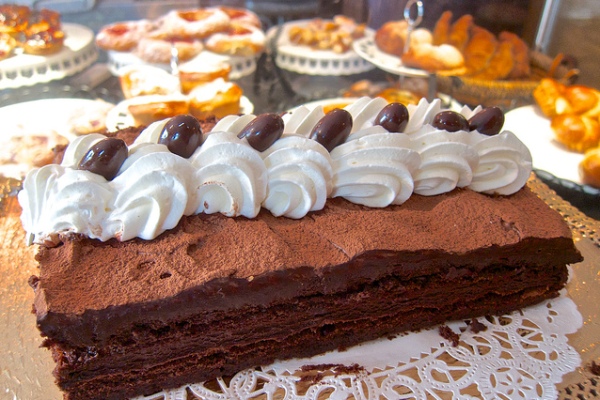
Thanksgiving celebrates family and traditions. Shaped by a lifetime of expectations, most people think the meal must include turkey, stuffing, gravy, cranberry sauce and sweet potatoes.
Dessert is more variable, although pumpkin pie often seems to be on the menu. In our house apple pie and bread pudding are also constants.
For this Thanksgiving, I’ve decided to bend tradition and bring a flourless chocolate cake to the table.
On a late summer trip to the Berkshires, I was won over by French pastry chef Jean Yves and his deliciously light, flourless chocolate cake.
Knowing I was coming to the area for a visit, he invited me to a hosted tasting at Patisserie Lenox, the cozy shop he and his wife Yulia Bougouin own and operate in Lenox, Mass..
Bringing French pastry to the Berkshires
Chef Yves’ pastries are exactly what one expects to find in a French bakery: light and flaky croissants, richly flavored puff pastries with a light custard filling, airy and buttery brioche, brightly colored macaroons, chocolate glazed éclairs, fresh fruit tarts and elaborately decorated cakes.
What one doesn’t expect in the Berkshires is a French bakery.
The area is renowned for the art and music festivals that dominate the summer season. Performances at Jacobs Pillow Dance and concerts at Tanglewood are the prominent but not the only arts celebrations in the area.
The bakeries and restaurants in Lenox are good but definitely not French. So the natural question to put to Yves is why the Berkshires?
Marriage made in the kitchen
Sitting down for coffee and a slice of his cake, Yves smiled as he talked about how he created one of his signature confections, a two-layer, flourless chocolate cake with a ganache filling.
As a young man, he worked at elegant Le Grenouille on the Upper East Side of New York.
The job demanded he create new desserts to satisfy an always hungry, upscale clientele. He remembered the densely flavored chocolate and thick whipped cream he employed to make rich chocolate cakes when he worked in a German bakery. He applied French patisserie techniques to those ingredients.
The result was a cake that combined the essence of chocolate and cream without being heavy. It’s dense with flavor and light on the palate.
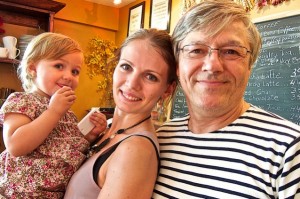
Jean Yves, wife Yulia Bougouin and daughter Sonya at Patisserie Lenox in Lenox, Mass. Credit: David Latt
He looked down at his hands before he explained how he found himself in the Berkshires.
Having worked in New York City, in the kitchens of well-known chefs and on Long Island in his own bakeries, he freed himself from a life that was falling apart when he discovered a soulmate in a young Russian chef who was as proud of her soups as he was of his cakes, tarts and pastries.
This was a marriage made in the kitchen. Yves and Bougouin decided to raise their young daughter in the second home he had built in the woods and recast their lives in the Berkshires.
The flourless chocolate cake — topped with cocoa powder, swirls of freshly made whipped cream and hand-dipped chocolate-covered whole almonds — was one of the ways he celebrated his new life and business in Lenox.
Patisserie Lenox Flourless Chocolate Cake
Use good quality ingredients for better tasting cakes. Avoid butter, cream and chocolates made with artificial ingredients and stabilizers.
Serves 6-8
For the cake
6 eggs
12 ounces of bittersweet chocolate
1 cup of sugar
¾ cup of water
2 cups of whipped cream
¼ cup cocoa powder
10 chocolate-covered almonds or coffee beans or whole berries (optional)
For the ganache
1 cup of heavy cream
1 pound bittersweet chocolate
½ pound of butter
3 cups of whipped cream
1 cup of egg white
2-3 tablespoon granulated sugar
Directions to make the cake
1. Whip 6 eggs and 1 cup of sugar until you reach three times the original volume.
2. Cut chocolate into small pieces, the size of chocolate chips, or use chocolate chips.
3. Pour ¾ cup boiling water over the chocolate, mix to melt the chocolate. Let cool but not harden.
4. Mix the eggs, melted chocolate and whipped cream and gently fold them together.
5. Line two ¼ sheet pans with parchment paper.
5. Divide the mixture and pour into the pans.
6. Cook in a preheated, 350 F oven for 20 minutes.
7. Remove the cake from the oven. It may be a bit jiggly and will look as if it is not done.
8. Refrigerate overnight.
Directions to make the mousse
1. Bring the cream to a gentle boil, pour into the chocolate, mix to melt the chocolate.
2. Mix in the butter to create the ganache.
3. Whip egg whites with 2 tablespoons sugar, until the mixture peaks.
4. Sweeten the whipped cream with one tablespoon sugar.
4. Fold the egg whites into the ganache and mix in 2 cups of whipped cream at the same time.
Directions to complete the cake
1. Place the two refrigerated cakes on a work surface. Pour and smooth out ¾ of the mousse on top of one of the cakes.
2. Flip the second pan so that that cake ends up in the first pan. Remove the parchment from the top of the newly assembled “sandwich” cake.
3. Refrigerate for a couple of hours until the cake is set.
4. Put a large plate, serving platter or cutting board on top of the pan. Flip the pan so the “sandwich” cake slides out of the baking pan.
5. Take off the second parchment paper and smooth out the rest of the mousse on top of the cake.
6. Dust the cake with cocoa powder so the top is completely covered.
7. Decorate with the remaining whipped cream and top with chocolate covered almonds or coffee beans, or berries.
Photo: Jean Yves’ flourless chocolate cake. Credit: David Latt
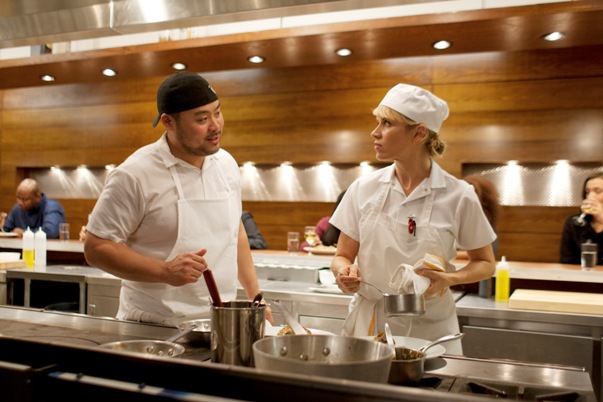
If you are not watching the HBO series “Treme,” trust me, from a food fanatic’s point of view, you are seriously missing out. The series, created by David Simon and Eric Overmeyer first roared into America’s living rooms on April 11, 2010, with all the stunning force of Hurricane Katrina.
Set in the devastated city of New Orleans, the story line picks up three months after that life-changing event. Although most of the recurring characters are fictional, so many real-life musicians and chefs make regular appearances that New Orleanians have come to regard “Treme” as “our reality TV show.”
From the very start, the writers and producers recognized the important role that food plays in New Orleans’ everyday life and how it figured into the rebuilding of the city. Actress Kim Dickens plays chef/restaurateur, Janette Desautel, a character loosely modeled on Chef Susan Spicer. To ensure authenticity, Spicer was brought on from the start for consultation with culinary matters such as drafting Desautel’s menu and teaching basic knife skills to the actors.
Familiar faces in fictional kitchens
The show is largely shot on location in New Orleans, so these professional touches were needed to make the actors look and behave at home in a professional kitchen setting. Chef Aaron Burgau’s Uptown restaurant, Patois, provided the location for Desautel’s, Janette’s restaurant in the first season.
By Season 2, David Simon had recruited Tony Bourdain to write the food-focused episodes. “I’d been a long time fan of David Simon’s, so when he called me about working on ‘Treme,’ I squealed like a little girl!” Bourdain said.
Bourdain recruited friends who happened to also be celebrity superstar chefs. Eric Ripert, Tom Colicchio, Wylie Dufresne and David Chang to make a surprise appearance at Desautel’s before Janette closes her restaurant and trades the Big Easy for the Big Apple.
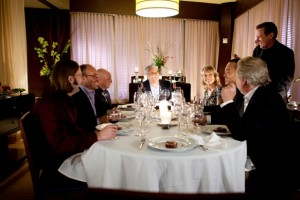
Celebrity chefs dine together in a scene from “Treme.” Credit: Paul Schiraldi/HBO.
“Treme’s” executive producer, Nina Noble, and production designer, Chester Kaczenski, made a whirlwind trip through New York kitchens. They used Ripert’s Le Bernadin to shoot on location. When Janette goes to work for David Chang at the fictional Lucky Peach restaurant, Kaczenski so meticulously recreated Chang’s Momofuku kitchen on a set in a New Orleans’ West Bank warehouse that Chang said he had a “freaky, out of body experience” the first time he saw it.
Scenes set in famous New Orleans bars and restaurants are peppered throughout all three seasons of “Treme.” Chef Leah Chase re-creates her annual Holy Thursday Gumbo Z’herbes luncheon at Dooky Chase so that the fictional political characters could make an appearance as the real New Orleans politicos always do. We see Spicer at her French Quarter restaurant, Bayonne, celebrate a traditional Christmas feast at the 150-year-old Tujague’s and enjoy a bird’s-eye view of the rollicking at the annual Galatoire’s lunch on the Friday before Mardi Gras.
A fantasy menu
Season 3, which debuted in September, sets the culinary bar high in the very first episode. Chang, Janette’s fictional boss, brings her along to an exclusive chefs’ dinner. New Orleans’ restaurant Mila provides the edgy, New-York-style location for a fictional, establishment, Brulard’s. Bourdain’s script has Ripert, Colicchio and Dufresne dining with Jonathan Waxman and Alfred Portale on a fantasy menu of pâtés and charcuterie, salmon en croute with dill cream, lievre a la royale and isle floatant, all washed down with a 1961 Chateau Latour Grand Vin.
Later, when Janette heads home to open a new upscale eatery, Desautel’s on the Avenue, Kaczenski created an entire, functional new restaurant, using much of the real equipment from “Lucky Peach.” Chef Emeril Lagasse takes Janette under his wing when her own new looming celebrity overwhelms her then, there is a strictly New Orleans version of the celebrity chef dinner when chefs Spicer, John Besh, Donald Link, Scott Boswell, and JoAnne Clevenger of the Upperline dine together at Janette’s new restaurant.
If you can’t get enough of chef reality TV, catch up on “Treme’s” Season 1 and 2, available online and on DVD. I promise you Sunday nights filled with guilty food porn-style pleasure as you join me for another new serving of delicious “Treme.”
Photo: David Chang and Kim Dickens in “Treme.” Credit: Paul Schiraldi/HBO
Chef Austin Kirzner added a cup of butter to the sauté pan and used his tongs to stir the quickly melting butter together with chopped shallots, garlic, rosemary and Worcestershire sauce. He lifted the pan off the burner letting gas flames jump an inch into the air. He looked deeply into the sauce and decided, “Just a touch more butter.”
After suffering the punishment of Katrina, New Orleans is back. Tourists have returned to the city for good times, good food and good music. Walking around the city, you hear music everywhere — on the street, in parks, bars and nightclubs. In the French Quarter, restaurants and bars line every block.
Restaurants are crowded with diners enjoying café au lait and beignets heavily dusted with powdered sugar at Café du Monde, fried chicken at Willie Mae’s Scotch House Restaurant, hog jowls, charcuterie and ham at pork-centric Cochon, Oceana‘s Cajun gumbo and Jambalaya and fresh seafood at Red Fish Grill.
I’ve always wanted to visit New Orleans. Recently I was able to stay for a long weekend. To help me understand the food scene, Kirzner, executive chef at Red Fish Grill, agreed to give me an overview and a cooking demonstration.
Musicians and cooks
“The first thing to understand about the city,” Kirzner explained — and he should know, he’s a fifth-generation New Orleanian — is “in New Orleans, you’re either a cookor a musician. They’re both held in high esteem like doctors.”
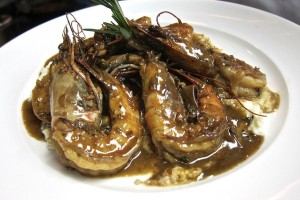
BBQ Shrimp with cheesy grits at Red Fish Grill in New Orleans. Credit: David Latt
Kirzner tells me that New Orleans cooking takes its influences from around the world and from different parts of the state. In the city you’ll find dishes typical of Louisiana where Cajun cooking predominates. “One pot cooking- red beans, étouffée, gumbos and jambalaya — family-style stuff you’d see in a fish camp or at home.” Every part of the state has its way of making these standards.
What sets New Orleans cuisine apart from the rest of the state is the embrace of its French influence, which he sums up as: “It must have butter. It must have cream. We take it to the extreme.”
There will be heads-on shrimp
The dish he demonstrates is a classic: New Orleans BBQ Shrimp. “You have to understand,” he tells me, “it’s not barbecued. Nobody knows how it came to be called that. Lots of restaurants make a version of the dish. Every one is different.”
Some restaurants serve the dish with the shell on as well as the head and tail. That makes for very messy dining.
For Kirzner, even though some of his customers are put off by the shrimp heads, he insists that’s what gives the sauce its distinctive, sweet richness.
In his version, to make the shrimp more diner-friendly, he leaves on the head and tail but strips the shell off the body.
Surprisingly easy to cook in 5 to 10 minutes, the dish should be prepared just before serving. Letting it sit around won’t do anybody any good.
In the restaurant, he flavors the shrimp with Creole seasoning. To illustrate how New Orleans cooking borrows freely from other cuisines, for the cooking demonstration, he used freshly chopped rosemary.
New Orleans Heads-On BBQ Shrimp
With fish and shellfish coming from the Gulf, New Orleans takes pride in the quality of the seafood served at its restaurants.
If you live in an area with fresh shrimp, definitely use them. Frozen shrimp will be OK, but you owe it to yourself to use heads-on shrimp at least once and that may require a trip to an Asian market where they are readily available.
A very large sauté pan is needed so the shrimp don’t sit on top of one another. That creates the best char and caramelization.
Serves 2
Kirzner’s note: This dish is prepared only two servings at a time because increasing the number of shrimp beyond 12 would require increasing the dish’s amount of sauce. Reducing the larger amount of sauce would require more cooking time, resulting in over-cooked shrimp.
Ingredients
12 to 14 raw colossal shrimp, bodies peeled, with heads and tails left on
2 teaspoons kosher salt
2 teaspoons finely chopped, fresh rosemary (or use the same amount of Creole seasoning)
1 teaspoon fresh garlic, minced
1 tablespoon fresh shallots, minced
2 tablespoons Worcestershire sauce
1½ tablespoons freshly ground coarse black pepper
1 to 3 tablespoons light lager beer, like New Orleans Abita beer (water can be substituted)
½ lemon, seeded
¼ pound butter, cold and unsalted (preferably Plugrá or other European-style butter), cut into ½-inch cubes
Directions
1. Season the shrimp with kosher salt. Set aside.
2. In a heavy 10-inch stainless-steel sauté pan on high heat, char the rosemary, garlic and shallots.
3. Add the half-peeled, salted shrimp, Worcestershire sauce, black pepper and 1 tablespoon beer (or water)
4. Squeeze the juice from the lemon over the shrimp.
5. Over high heat, cook the shrimp while gently stirring and occasionally turning the shrimp.
6. After about 2 minutes of cooking, the shrimp should start turning pink on both sides, indicating they are nearly half cooked. If the shrimp are the colossal size, add additional 2 tablespoons beer (or water) to the pan; otherwise, don’t add additional liquid. Remove the shrimp.
7. Reduce the heat to medium-high and continue cooking as you gradually add the cold pieces of butter to the pan.
8. Swirl the butter pieces until they are incorporated into the pan juices, the sauce turns light brown and creamy as it simmers. Add back the shrimp and coat with the sauce, turning frequently until the shrimp are just cooked through. This will take about 2 minutes total if the shrimp are extra-large, and about 3 minutes total if they’re colossal. Do not overcook the shrimp.
9. Remove the shrimp to a serving platter. Pour the sauce over the shrimp and carry to the table.
Serving suggestion: Pour the shrimp and sauce into a heated pasta bowl. Serve the shrimp and sauce immediately either with grits, rice or alongside slices of warm, crusty French bread for sopping up the sauce. Chef Kirzner prefers Leidenheimer French Bread.
Red Fish Grill executive chef Austin Kirzner with a dish of his BBQ Shrimp with cheesy grits. Credit: David Latt
New Orleans is known for producing rock star chefs in the style of Emeril Lagasse and John Besh, but the original rock star chef of the Crescent City was a 19th-century German woman, Elizabeth Kettenring Bégué, who invented the meal we all now call brunch.
Elizabeth was just 22 years old in 1853 when she traveled from Germany to New Orleans to join her brother, who worked as a butcher in the French Market. She married one of her brother’s friends, Louis Dutriel, who owned a coffee shop across the street from the market, where she began to serve her brothers and his butcher friends a big late-morning meal.
After Dutriel’s death, this thoroughly modern woman married the bartender, Hippolyte Bégué, a man eight years her junior. They changed the restaurant’s name to Bégué’s and her multi-course, three-hour meals became a favorite with tourists who began to edge out the butchers who had previously dominated the dining room.
Post-Civil War New Orleans was a boomtown by the time the Cotton Exposition, a World’s Fair of sorts, opened in 1884. Breakfast at Bégué’s became the No. 1 tourist attraction. Visitors wrote months in advance for reservations, and the Bégués had one of the first telephones in the city installed to try to keep up with travelers’ requests.
Pelican discovers it owns a treasure
In 1900, the Southern Pacific Railroad persuaded her to share her recipes and published “Madame Bégué’s Creole Cookery.” The book was originally intended as a tourist guide as cookbooks were relatively rare at that time. It remained in print until 1937, long after her death in 1906.
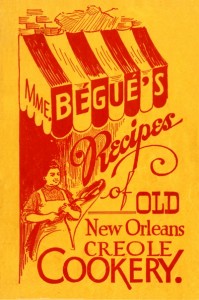
“Madame Bégué’s Creole Cookery.” Credit: Courtesy of Pelican Books
Madame Bégué’s fame and her place in culinary history have faded over time. Tujague’s Restaurant, a former competitor, moved into the Bégué’s space across from New Orleans French Market in 1914 and still operates there today. The Pelican Publishing Co. owned the rights to “Madame Bégué’s Creole Cookery,” but even they had forgotten about her book until Zelda Magazine editor Don Spiro contacted them for permission to use a recipe from her book. When Pelican executives realized what a precious treasure they owned, they decided to republish it this fall.
I agreed to write a foreword for the re-edition, but once I read the recipes, which included instructions like “clean a nice, young chicken,” it became clear to me that without a 21st-century redo, Bégué’s book would be nothing more than a novelty. Pelican Publishing agreed to follow her original recipes with updated versions in the re-issue so that today’s home cooks could easily replicate her classics.
Cooking classes from 19th century, beyond brunch
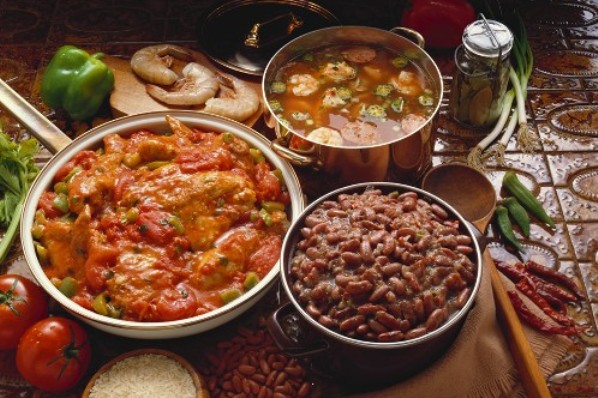
That is how I came to spend the summer taking cooking classes from a 19th-century ghost. Usually, I am the cooking teacher, but under Madame’s tutelage, I threw many culinary preconceptions out of the kitchen window and followed her directions. I learned to make stuffed eggs without the usual addition of mayonnaise and pickle relish. Instead, softened butter bound the stuffing and blanched carrot provided a sweet and colorful accent.
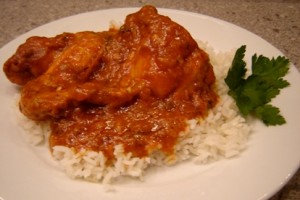
Creole chicken from Madame Bégué’s recipe. Credit: Poppy Tooker
Madame taught me to parboil “shrimps” before adding them to gumbo and jambalaya — something totally counterintuitive to any 21st-century chef. This was likely a food safety step for her, intended to prolong freshness before refrigeration. Previously, my greatest concern was to keep shrimp from becoming mushy, the texture I relate with overcooking. The shrimp in Madame’s recipes retained a firm, toothsome texture and were quite pleasing.
Her German heritage was revealed by the lard, which she used in almost every recipe. Sometimes I substituted butter, sometimes vegetable oil. Again and again, Madame surprised me when dishes I’ve cooked my entire life became new through her methodology.
Thank you, Madame. The cooking classes were great fun and I learned so much. Welcome to the 21st century!
Photo: Creole chicken, red beans and rice and gumbo like Madame Bégué would serve at brunch. Credit: StockFood
Zester Giveaway
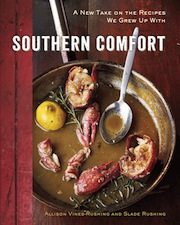 Fall in love with recipes, inspired by New Orleans. Enter here to win one of 5 copies!
Upcoming Events
-
see all of our
Upcoming Events
-
Vermont Brewers Festival July 19-20Took place on July 19, 2013Vermont Brewers Festival Welcome to the 21st Vermont Brewers Festival. An Artisan Craft Beer Festival celebrating Artisan Craft Beer and the Brewers who brew them….
-
Kirkland Uncorked July 19-21Took place on July 19, 2013Kirkland Uncorked Kirkland Uncorked is a regional showcase of art, food and wine of the picturesque shores of Lake Washington in Kirkland, WA taking place…
-
Food & Wine Conference July 19-21Took place on July 19, 2013Food & Wine Conference The Food and Wine Conference brings together bloggers, small business owners, winemakers, chefs, public relations professionals, traditional media, new media, authors…
SmartBrief