Articles in Thanksgiving
If you are hosting the holiday meal, Thanksgiving is the best of times and the worst of times.
My mother believed that Thanksgiving was the best holiday of the year, and I agree with her wholeheartedly. Thanksgiving gives us time to pause and enjoy our family and friends. But hosting the meal can seem daunting, with so many details to take care of, so much food to get on the table and so much to clean up.
How can a host or hostess cope with Thanksgiving Day Anxiety (TDA)? Follow the example of restaurants and caterers, who feed large crowds all the time. They plan out every detail so there are no surprises.
The Guest List
The first step is to establish how many people are coming. That will tell you how many chairs you’ll need and how big the dining room table has to be.
These days, many people have dietary restrictions, so it is good to know about those as well. In the invitation, ask whether there are ingredients or foods your guests need to avoid.
If you expect a lot of children, decide where you want them to play and organize that space as carefully as the dining room.
Menu Planning
The next step is to write the menu.
If friends and family want to contribute to the meal, work out who will bring what and give people assignments so you don’t end up with three platters of green beans and no pumpkin pie.
Organize your recipes and do the math. Most recipes are written for four servings. Multiply as appropriate for the number of your guests.
Go through the ingredients lists for all dishes and write up a master ingredients list. For example, if the stuffing recipe calls for 1 cup of mushrooms and the gravy recipe needs ½ cup of mushrooms, you know you need a total of 1½ cups of mushrooms for the meal. Put that on your master ingredients list.
Once you have a master list, divide up which ingredients you want to buy at farmers markets, specialty stores (like bakeries and cheese shops) and the supermarket.
We rely on farmers markets for fresh produce. In our Southern California neighborhood, four days from Thanksgiving, we’ll shop at the Sunday Palisades farmers market for produce that can last most of a week: root vegetables like beets from Underwood Farm or yams and sweet potatoes from Yang Farms and G Farms for pluots and oranges.
For us, the Wednesday Santa Monica farmers market is a good place to pick up leafy greens, berries and fresh fruit. Any farmers market the day before Thanksgiving is going to be crowded, so get there early.
If you want a specialty turkey (organic, kosher, heritage), it likely needs to be ordered in advance from your local butcher or supermarket.
Time Line
Just about as important as settling on the menu is understanding what needs to be done and when.
Put into your time line details like when you will clean the house, wash and dry the tablecloth, check and clean all the dishes, silverware and glasses you want to use and, if you don’t have enough, when you will pick up what you need to borrow from a friend.
Do you have enough chairs? If not, determine when you will pick up extra ones and from where. Also indicate when you will pick up flowers and the turkey.
If you are ordering a cake from a local baker or a ready-to-serve dinner, put that into your time line, and check when they open and close. You wouldn’t want your guests to miss enjoying your turkey because you arrived after the store was closed.
But if you are cooking all or part of the meal, your menu is a big part of the time line. Take the time to sit down — maybe with a glass of wine — and organize the dishes in terms of preparation and cooking time.
Some dishes can be prepped or made the day before. For instance, we always serve a roasted beet salad that we make on Wednesday. We also wash, dry and wrap in aluminum foil the sweet potatoes and baked potatoes that we will cook Thursday.
If you are buying a ready-to-serve meal, you still have to allow time to reheat the dinner. If you are cooking the entire meal, which we love doing even if it makes the day crazy-hectic, you need to account for every minute of the day.
Our kitchen is the size of a New York closet, which I like because I don’t have to move much when I want to go from the sink to the stove, but with two or more people, it’s packed.
Be aware of your resources. I love the six burners of our Wolf stove — they help big-time on Thanksgiving — but because there is only one oven, we have to strategize when to bake our pies because the turkey will monopolize the oven for most of the day.
We write up a schedule for the day’s cooking that looks something like this:
6 a.m.: Wash and prep the turkey.
6 a.m.: Sauté onions, Italian sausage, shiitake mushrooms, parsley and garlic for the stuffing.
6:30 a.m.: Preheat the oven to 350 degrees F. Stuff the turkey.
7 a.m.: Put the turkey in the oven.
7:30 a.m.: Make the cranberry sauce.
And so on, going hour by hour, we back time each dish so we know when it has to be cooked so it will be on the table at 3 p.m. when we want to serve dinner.
Clean Up
Don’t forget to pre-plan cleanup to work out who will be doing what.
Since our house is small and the kitchen is open to the dining room, we clean as we go. After each course, we are joined by members of the dinner party who help bus the dishes and silverware into the kitchen. After they help clean up between courses, they reset the table with clean plates.
We have a tradition of taking a walk with our friends and family around the block after the main course, before desserts are served. A selected few remain behind to clean up the dining room and kitchen so when everyone returns, desserts are on the table with fresh plates and silverware.
Having organized the cleanup as part of the meal, the kitchen is in good shape and we can enjoy dessert.
Hosting Thanksgiving dinner for a crowd is always crazy, but planning out the day in as much detail as possible helps keep the craziness manageable and fun.
Zester Daily contributor David Latt is a television writer/producer with a passion for food. In addition to writing about food for his own site, Men Who Like to Cook, he has contributed to Mark Bittman‘s New York Times food blog, Bitten, One for the Table and Traveling Mom. He continues to develop for television but recently has taken his passion for food on the road and is now a contributor to Peter Greenberg‘s travel site and the New York Daily News online.
Photo: Thanksgiving dinner at the author‘s home. Credit: David Latt
Every November, the advice about roasting turkey comes fast and furious. But for rank beginners it’s a confusing world. What they’re looking for is hand-holding, and it just doesn’t exist. Besides, even if it did, whose hand do you hold? The celebrity chef with his hidden staff of 20 or your mother who consistently ruined turkey? Who do you believe with so many ideas and pieces of advice?
I cooked my first turkey probably when I was about 20 or 21 and away at college the year I didn’t come home for Thanksgiving. The one thing I remember was that it was a joint effort and we were all clueless. I don’t remember the turkey, but I bet it was dry and crumbly.
The reason it’s often late in life that we cook our first turkey is for years we’re always going home where our mom, aunt or grandmother does the cooking and we’re playing football waiting for food. Then suddenly, perhaps in our late 20s, we’ve got to cook a turkey. So we hit the cookbooks to find their myriad pieces of advice: Do this, don’t do that.
Here are the 10 steps to a perfect turkey, your first turkey. Follow these instructions and these instructions alone and you’ll be a happy camper.
- Place an order for a fresh turkey with your local butcher and pick it up the Wednesday before Thanksgiving. Do not freeze it. If it’s too late for that, place your frozen turkey in the refrigerator the Monday before Thanksgiving to defrost. Buy a turkey big enough to feed your party and to have leftovers for one or two more days. You don’t want enough leftovers for weeks or people will get sick of it. So for 10 to 12 people a 16- to 18-pound turkey is more than enough. A stuffed 18-pound turkey will take 4½ hours to cook at 350 F.
- A few days before you’ll cook, place an oven thermometer in your oven then set the oven to 350 F for an hour and see if it’s calibrated correctly. If it is not, make the proper adjustments.
- If you don’t have the following, buy them at the supermarket:
- an independent oven thermometer
- a quick-read thermometer
- a disposable aluminum roasting pan
- kitchen twine
- bamboo skewers
- a bulb baster
- aluminum foil.
- Decide whether you want a stuffing. Most people want stuffing. Choose your stuffing from a favorite cookbook or heirloom recipe. On Thanksgiving Day, remove the turkey from the refrigerator and remove the bag containing the gizzards and neck and use them to make a gravy (follow any recipe from any cookbook). Stuff the body and tail cavity, not too loosely and not too tightly. Preheat your oven to 350 F. Remove and discard any pop-up thermometer in the turkey.
- Make sure your work surface is large and uncluttered. After stuffing the tail cavity, make sure the skin flap covers the opening and lies flat on the counter. Take a long length of kitchen twine and wrap around the turkey so it encircles the bird and the wings are flat against the body and tie off tightly.
- Stuff the body cavity, then take a skewer and lace it through the two sides of the opening, as if you were stitching leather. When they are closed, the sharp point should be facing down. Use a length of kitchen twine and lace it around the skewer as if you were lacing shoes and tie it off. With another length of kitchen twine tie the ends of the legs together to further close up the opening. (Some turkeys come with a plastic hold on the legs to do this, which you can use). Place in the roasting pan and smear room-temperature butter on the breast halves, which is the top exposed portion. Sprinkle top and bottom with salt.
- Place in the oven and roast the turkey until some juice and fat has accumulated in the roasting pan. Baste by pulling the rack out a little and using the bulb baster to suck up some juices and then squirt it over the breast (mostly) and the legs. Roast the turkey 13½ minutes per pound and baste every 20 minutes. Be careful because the turkey could be done before the time you’ve calculated, so keep taking its temperature with the quick-read thermometer.
- When the turkey is three-fourths done, make a triangle with the aluminum foil and place over the breast meat and continue roasting.
- The turkey is done when the quick-read thermometer is 160 F measured in the breast. Push the thermometer in but make sure it’s not touching bone and not touching the stuffing. Remove the turkey and let it rest for 25 minutes before carving. This is important so the juices can sink back into the meat and so the meat won’t shred when you carve. When carving, the white meat is the breast meat and the dark meat is the thighs and legs.
- Cautionary note: You will see many cookbooks and temperature guides saying a turkey should be roasted until 185 degrees F internal temperature. This is absolute nonsense. Roasting to that temperature will leave you with crumbly dry meat.
Zester Daily contributor Clifford A. Wright won the James Beard / KitchenAid Cookbook of the Year Award and the James Beard Award for the Best Writing on Food in 2000 for “A Mediterranean Feast.” His latest book is “Hot & Cheesy” (Wiley) about cooking with cheese.
Photo: Clifford A. Wright with assistant Lori Alston preparing a turkey for students at the Venice Cooking School in Los Angeles. Credit: Michelle van Vliet

Dear kids,
This is again a year when neither of you will be home for Thanksgiving. There will be lots of family around, plenty of cousins and nephews. Even a few strays that need a Thanksgiving hookup in Boston. But you two, my own gems, are nine hours apart from each other, and each of you is six hours from me.
So Katie and Evi, I share with you important tips for Thanksgiving.
Make sure that you take both bags of stuff out of the turkey. The first year I made Thanksgiving by myself, (when you, my oldest, my now mother-to-be, was a newborn), I thought there was only one thing to remove. The finished product looked beautiful but had a distinct liver and petroleum aftertaste.
Get a meat thermometer for the turkey. The color of the skin is only a cosmetic indicator.
Make more stuffing than you need. The recipe really doesn’t matter, though my favorite has both raisins and cornbread. Turkeys don’t hold as much stuff as people want to eat. Bake the rest in a pan and keep it moist with turkey or chicken stock.
Don’t be tempted by all the exotic recipes in magazines. Thanksgiving is about food that people remember, not food that is memorable. Stick with the basics. And use fresh thyme.
Buy lots of brown sugar and butter. Use both liberally. Especially on the sweet potatoes. This is not an olive oil meal.
 Green is not a Thanksgiving color, but Brussels sprouts can work. Make a huge salad to help balance off all the orange, yellow and gold.
Go light on the truffle oil in the mashed potatoes. It gets to overkill very easily.
In a pinch, the recipe on the cranberry bag is not bad. I add balsamic vinegar and a little horseradish to give it kick. And a little frozen orange juice. I really like National Public Radio’s Susan Stamberg’s piece about her mother-in-law’s cranberry sauce. It’s seminal.
Too many pies are not enough pie. Most people like pecan. Pumpkin looks right, but really, why bother?
Invite the strays. Like Passover, a really good Thanksgiving dinner should have at least one extra plate for Elijah. No one should eat Thanksgiving dinner alone.
Next year in Boston.
Love,
Mom
Zester Daily contributor Louisa Kasdon is a Boston-based food writer, former restaurant owner and founder of letstalkaboutfood.com. She is a columnist for the Boston Phoenix, the food editor for Stuff Magazine and has contributed to Fortune, MORE, Cooking Light, the Boston Globe, Boston Magazine and the Christian Science Monitor, among others.
Photo, from top:
Louisa Kasdon.
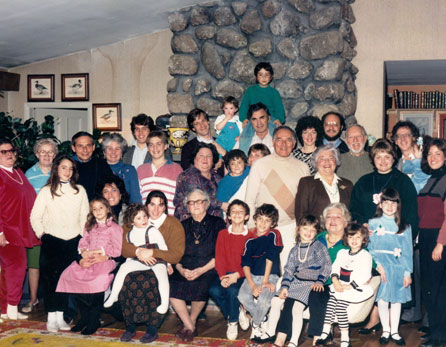
Louisa Kasdon’s family at Thanksgiving many years ago. Credit: Louisa Kasdon.
Thanksgiving may be an American holiday, but the foods that define it are definitely privy to regional and cultural interpretation. For many years, Thanksgiving dinner at my parents’ house consisted of a mashup of classic menu items combined with Chinese dishes that my mom would make or that our relatives would bring over. It was never clearly one way or the other: It was always both.
Next to the roast turkey, there would either be a roast duck, soy sauce chicken or drunken chicken (didn’t matter that it was Thanksgiving, and poultry was obviously covered). Sometimes, we’d also have a brown sugar-glazed ham, but someone would bring roast pork anyway. Our vegetables of choice were rarely green beans: Instead, there was bok choy or gai lan. In proximity to the stuffing and mashed potatoes would be — you guessed it — a bowl of steamed rice. The cranberry sauce almost always went untouched, as few of our guests were ever adventurous enough to try it. At the end of the meal, along with the requisite pumpkin pie, we drank oolong tea and had fresh fruit (often Asian pears).
I’m pretty sure my family’s early experiences with the holiday aren’t unlike those of many other immigrant families. Thanksgiving was a time for everyone to get together around a celebratory meal, so who cared whether some of the items on the table might have seemed incongruous with the others.
This year, I decided to come up with an alternative to the typical roast turkey that could also work other times of the year. My inspiration: tea-smoked duck, but without all the complicated steps and work.
Instead of a whole turkey, I worked with a bone-in, skin-on turkey breast half, which makes more sense for smaller gatherings (the recipe is easily doubled for a whole breast) or for those who don’t like to have a ton of leftovers. To infuse the bird with deep, smoky notes without actually cooking it over smoldering tea leaves, I utilized one of my favorite shortcuts: a potent brine. Flavored primarily with Lapsang Souchang, a black tea with an intensely smoky profile, the brine also contained the requisite salt and sugar components, as well as soy sauce, star anise, and black and Sichuan peppercorns.
To further enhance the sweet-smoky flavors of this turkey, I added a honey-soy-five-spice glaze, brushed onto the skin during the last half hour of roasting. Reminiscent of a traditional Chinese banquet dish, but adapted to use a traditional Thanksgiving bird, I’m pretty sure this smoky tea-brined turkey will be a hit in our household. I’ll just have to make sure to tell my aunts to bring something else instead of an extra chicken or duck, like, say, ginger-scallion crab.
Smoky Tea-Brined Turkey
Serves 4 to 6
To adapt this recipe for use with a whole 6- to 7-pound turkey breast, simply double the recipe for the brine as well as the glaze.
Ingredients
Directions
- In a 4-quart saucepot, heat the water, salt, soy sauce, star anise, black peppercorns, Sichuan peppercorns and brown sugar over high heat until the salt and sugar have dissolved, stirring occasionally. Remove from heat and stir in the tea leaves. Let cool to room temperature.
- Place the turkey breast in a large bowl or pot and pour the brine on top. Cover and refrigerate 4 to 6 hours.
- Preheat an oven to 400 F. Line a baking sheet with aluminum foil and set a wire cooling rack on top. Remove the turkey from the brine and rinse thoroughly under cool water. Discard brine. Pat turkey dry with paper towels and place on the prepared baking sheet, skin-side up.
- Roast the turkey 45 minutes.
- Meanwhile, prepare the glaze: Whisk together the honey, five-spice powder, soy sauce and rice wine vinegar in a small bowl until smooth. After the turkey has roasted 45 minutes, brush it with the glaze mixture. Continue roasting until a thermometer inserted into the thickest part of the turkey registers 165 F, about 30 minutes longer, brushing the turkey every 10 minutes and tenting the turkey loosely with foil if it begins looking too dark.
- Transfer turkey breast to a cutting board and tent loosely with foil. Let rest 20 minutes before carving.
Zester Daily contributor Sandra Wu is a San Francisco-based food writer, editor and recipe developer who currently works as a test kitchen cook at Williams-Sonoma’s corporate headquarters.
Photo: Applying the honey-soy-five-spice glaze. Credit: Sandra Wu
With all the heaviness on the holiday table, now’s the time to try Brussels sprouts in a light new way: raw and shaved into a fluffy cloud.
Brussels sprouts may not be the first thing that comes to mind when you think of holiday fare, but they have had an honored place in Britain for centuries, alongside the roast goose or game. Perhaps it was the British tendency to cook vegetables to death that have given Brussels sprouts a raw deal. The solution, naturally, is to eat them raw.
Once they’re shaved whisper-thin, simply toss with olive oil, lemon juice, salt and pepper. Or get more festive by mixing and matching with toasted nuts (pecans, walnuts or hazelnuts), fruit (dried cranberries, fresh apples or pomegranate), and cheese (shaved Parmesan, cheddar, or even fresh ricotta for a creamy, slaw-like salad).
First, make sure you have the freshest sprouts possible. Ideally look for vegetables grown in cold weather that were recently harvested. Like other members of the vast crucifer family that also includes kale, cabbage, broccoli, etc, Brussels sprouts are very hardy and able to survive even hard freezes. They do this by producing more sugars, which serve as a cellular anti-freeze, and also increase the sweetness of the sprouts.
If you can get a freshly harvested whole stalk, with the sprouts still attached, all the better. At a local farmers market you may see these Dr. Seuss-like plants that are 3 to 4 feet tall, with the elegant, miniature cabbages spiraling up the stalk. Sprouts will keep well this way, and you can break the buds off the stalk as needed.
Brussels sprouts, like all of the cabbage family, are high in vitamin C, fiber and folate. They also have been shown to have beneficial effects in preventing certain types of cancer. But the best reason to eat them is that they taste terrific. Even former sprouts-phobes may not even recognize what they are eating when you serve them these salads.
Brussels Sprouts Salad, Plain or Fancy
Ingredients
3 tablespoons extra virgin olive oil
2 tablespoons fresh lemon juice
salt (more or less, depending on the saltiness of your cheese)
Directions
- Shave the Brussels sprouts as thinly as possible using a mandolin, sharp slicing blade of a food processor, or a very sharp knife.
- Put into a large bowl and toss gently with the olive oil, lemon juice and salt.
- Add the nuts and cheese (if desired). Toss.
- Shave more cheese on top as a garnish, and serve.
Buttery Brussels Sprouts Salad With Apples, Walnuts and Maple Syrup
Ingredients
2 medium apples, cut into small cubes or chunks
¼ cup maple syrup
Sea salt and pepper to taste
½ cup walnuts (or other nut of your choice)
¼ pound aged cheddar cheese, cut into small cubes
Directions
- Cut up the apples and toss with 1 teaspoon lemon juice in a large bowl.
- Shred the sprouts and add to the bowl. Add salt, pepper and remaining lemon juice.
- Stir maple syrup into the melted butter. Drizzle over sprouts and apples and toss well. Add toasted walnuts and cheddar chunks.
- Toss and serve.
Terra Brockman is an author, a speaker and a fourth-generation farmer from central Illinois. Her latest book, “The Seasons on Henry’s Farm,” now out in paperback, was a finalist for a 2010 James Beard Award.
Photo: Raw Brussels sprouts. Credit: Terra Brockman
Another Thanksgiving is upon us: Whatever will we drink? Even if that question isn’t boring a hole in the back of your head, it behooves you to have a strategy to come at this wildly ungainly meal.
When it comes to marrying the meal with wine, Thanksgiving is never easy. A mashup of bitter and sweet, sour and salty, rich and richer, dishes of varying weights and textures are thrown together like the gaudiest of holiday wardrobes, leaving attempts at pairing, as I wrote here last year, feeble or palliative, “an omnivorous varnish heaved upon the meal like so much paint upon a Jackson Pollock canvas.” I can’t think of a single wine that can get you from start to finish. But there is, I think, a single variety, which, in all its global variants, might be up to the task. A grape so versatile that it may serve as your go-to variety for the meal of all meals.
I’m talking about grenache, one of the world’s most ubiquitous varieties, inhabiting everything from the world’s humblest peasant wines to some of its most profound, a wine that has not only several shades of red but also shines as a pink and a white (if you grant me that Grenache Blanc, an isolated mutation, is roughly its twin).
Best of all, Grenache is quite literally a global phenomenon, a grape grown wherever enough sunshine and warmth allow full ripeness, which means not only it is ubiquitous, but it bears a range of flavors that can meet the mashup head-on.
Pinks
Let us start with Rosé. Of all the red grapes employed to go pink, perhaps the most effortless conversion comes from Grenache. The variety produces Rosé wines that are fruity but not overbearing, bright and vivid, with an energy and charm that few other pink wines can match, and are sturdy enough to serve at the holiday feast.
Many of Spain’s Rosados are made of all or part Grenache. An entire appellation in the southern Rhône, Tavel, devotes itself to Rosés made largely with Grenache, wines of a piercing maraschino red with bold, intense flavors that can make for an ideal accompaniment to a turkey leg. Closer to home, look for pink wines from Verdad and Beckmen, both Rosé specialists.
Whites
In the last decade, California had devoted hundreds of acres Grenache’s white sibling, Grenache Blanc, owing in part to Tablas Creek’s efforts in propagating Rhône varieties. It has adapted well, and may even be more expressive here than in France; here it retains more acidity than most other white Rhône varieties, gives lift to white blends and carries a lemony scent in the glass — an ideal Thanksgiving aperitif. The Central Coast winery Tangent, I believe, produces the most in the state; Tercero winemaker Larry Schaffer may have the surest hand in the state with the variety.
Reds
At its best, red Grenache is nothing if not exuberant: alive with vibrant red flavors of cherries, red plums, strawberries. What it lacks in gravitas it often makes up for with a kind of frisky, almost frivolous energy. That is often how they play out in Australia, where the best stocks of old vine grenache are in the McLaren Vale (seek out bottlings from D’Arenberg and Yangarra). Among domestic producers, Stolpman and Unti are making some of the more exciting monovarietal bottlings in the state.
Winemakers usually ground that friskiness by blending in more structured varietal components, most often Syrah, Mourvèdre and Carignane, to provide some depth to the flavors and frame the heady vitality that Grenache frequently brings to a wine.
This is a global practice; in Rioja, Spain, Garnacha provides lift and spice to the otherwise dour Tempranillo. In Priorat, wines of unvanquished power are given a core plumminess with Carignane. A similar formula is followed in Roussillon, on the French slopes of the Pyrenees, wines with a succulent core of dark red fruit flavors, and lingering impressions of licorice, olive and bay.
In Australia the blends are known as GSMs, for their component parts, Grenache, Syrah and Mourvèdre. The red raspberry scents of Grenache are anchored by darker blue hues of the latter two varieties. The same practice is increasingly common in California and Washington, where those three varieties are used in different percentages to produce wines of charm and depth, in wines such as Z Cuvee from Zaca Mesa, Bonny Doon’s Le Cigare Volant, Villa Creek’s Avenger, Tablas Creek’s Patelin and Gramercy Cellars’ Columbia Valley blend, “The Third Man.”
The pinnacle of blended Grenache-based wines is in the southern Rhône and is centered in three appellations: Vacqueyras, Gigondas and Châteauneuf du Pape. Here is Grenache in all its glory, showcasing the power, headiness and complexity that the variety is capable of. While more than a half-dozen varieties can be employed in blends from these places, it is most often paired with Mourvèdre, Syrah and Cinsault. Despite rich, vibrant fruit, the wines tend to act as vectors of minerality reflecting the complex soils of each region; it is a place where a single producer might make a wine from one or all of the subregions; for Gigondas and Vacqueyras, explore the wines of Montirius, Paul Jaboulet and St. Cosme; in Châteauneuf du Pape, splurge on the wines of Ogier, Beaucastel, La Nerthe and Vieux Telegraphe.
Stickies
Grenache is even helpful when it comes to the dessert course: Roussillon is home to one of France’s most distinctive sweet red wines, the portlike, Grenache-based Banyuls. Ideal for the savory pie course — one of the better known is from Domaine du Mas Blanc — or if you can find it, seek out the haunting Banyuls from Jacques Laverriere, “Clos Chatart.”
Pecan pie and other caramelly creations are best accompanied by an Australian Tawny, a grenache blend harvested late and aged in barrels to render a toffee’d sweetness in the wines, smooth, rich and satisfying, like Yalumba’s celebrated Museum Reserve.
Zester Daily contributor Patrick Comiskey is a senior contributor for Wine & Spirits Magazine, where he serves as chief critic for non-California domestic wines and contributes articles on the wines of California, Oregon and Washington.
Photo: St. Cosme in Gigondas. Credit: Patrick Comiskey
Stressed about planning a family Thanksgiving dinner? Overwhelmed at the prospect of planning a menu? Stuck trying to choose the perfect green vegetable for the big dinner?
Take the guesswork out of your Thanksgiving planning and follow this step-by-step plan for dinner, complete with a timeline. We even have you covered with the perfect just-like-homemade dessert.
The menu:
- turkey
- gravy
- cranberry sauce
- stuffing (baked separately)
- sweet potatoes on the side
- broccoli, boiled or steamed
- bumpkin pie
- Take turkey out of refrigerator.
- Preheat ove.
- Make pie.
- Make stuffing to bake separately.
- Trim broccoli, wrap and save in refrigerator.
- Make cranberry sauce.
- Make sweet potatoes, will go in oven with turkey.
- Season turkey and put in oven.
- Put big pot of salted water on stove with steamer basket.
- Set up coffeemaker.
- Clean up kitchen, take a shower and get dressed for company.
- Turkey’s done, can sit one hour.
- Pour juices off turkey, let fat rise in refrigerator.
- Make gravy.
- Stuffing and sweet potatoes done, will stay hot 30 minutes.
- Put wine and other drinks on buffet or table.
- Bring broccoli water to a boil.
- Carve turkey.
- Put cranberry sauce on table.
- Put baked stuffing and sweet potatoes on table.
- Cook broccoli.
- Bring broccoli to table.
- Meal time.
- Enjoy meal.
- Flick on coffeemaker.
- Serve pies.
Bumpkin Pie
The biggest surprise to new cooks is that canned foods usually avoided by purists aren’t across-the-board offenses. One of the most reliable canned products is pumpkin pulp (often labeled as solid-pack pumpkin). Without a real pumpkin to peel, boil or roast, seed and mash, these pies come together quickly. You don’t even need a mixer, only a whisk.
Here’s a shortcut sure to horrify culinary elites: Go buy a package of pre-made pie shells. You can get good quality, even whole wheat pastry. Thaw them slightly. They’ll be just soft enough to re-crimp the edges with your fingers so they look homemade.
Ingredients
Directions:
- Take crusts out of freezer to partially thaw. Preheat oven to 400 F. Set rack on lowest notch.
- Get out a big mixing bowl. Whisk pumpkin, cream and milk. Whisk in eggs one by one. Whisk until smooth.
- Whisk in sugar and spices.
- Re-form pie dough edges with thumb and forefinger to remove tell-tale stamped-out fork imprints, so they look homemade. Place pie plates on a cookie sheet (to catch any drips).
- Fill shells with pumpkin filling (each will hold about 2 cups)
- Bake at 400 F for 8 minutes. Set a timer! Reduce heat to 350 F and bake 35 minutes more. Pies are done when a knife inserted into center comes out clean.
Zester Daily contributor Elaine Corn is a James Beard Award-winning cookbook author and food editor. A former editor at the Louisville Courier-Journal and the Sacramento Bee, Corn has written six cookbooks and contributed food stories to National Public Radio.
Photo: Bumpkin pie, on Grandmother Shirley Siegel’s china inherited by the author.
Credit: Elaine Corn
On the third Friday and Saturday of every November, in countless homes in America, smart cooks are preparing dishes based on leftovers from Thanksgiving. There are some wonderful dishes to be had on these days, and here are two great ways to provide delicious non-tiresome post-Thanksgiving dishes. The first — no big surprise here — is turkey soup. But this isn’t your mother’s turkey soup. Why settle for the same old soup when you can, with little effort, enliven it?
It begins with that beautiful roasted turkey carcass, the big chunks of leftover meat having been taken off, that goes into a stockpot and is covered with water and made into a flavorful broth. A good time to do this is Thursday evening once Thanksgiving dinner is over. Let the carcass simmer in the stockpot overnight, adding whatever vegetables you’d like to get rid of in your refrigerator such as an onion, celery, carrots, leeks, scallions, garlic, parsley, cilantro, sage or other herbs and peppercorns. Strain the broth Friday morning and reduce the remaining broth over high heat if you like a rich tasting stock.
Now things get interesting. First, you’ll make some crêpes that will be stuffed with cheese and folded over, placed in the soup bowl, and then soaked with the boiling turkey broth.
Turkey Soup With Gruyère-Stuffed Crêpes
Serves 4
Ingredients
Directions
- In a bowl, beat the eggs until frothy. Add the milk, flour, parsley, 1 tablespoon Parmesan cheese, salt and nutmeg. Beat some more, then set aside at room temperature for 20 minutes. (You can use a blender for this step if you like.)
- Over medium-high heat, heat a 9-inch crêpe pan or nonstick pan, then rub the surface of the pan with a little lard or oil, using a paper towel, so there is only a film on the surface.
- Pour in enough batter, 3 to 4 tablespoons, to cover the bottom of the pan, twirling the pan as you do it so the batter covers the entire bottom. The batter should be thin enough to spread rapidly, not slowly like pancake batter. Use the first crêpe as a test case.
- Once the crêpe is in the pan, cook until the top surface looks dry, then flip and cook the other side, about 1 minute in all. The earlier crêpes will take a little bit longer to cook and the latter ones less as the pan gets hotter.
- As they finish cooking, set the crêpes aside, making sure they cool before placing another one on top of them. Alternatively, separate them with sections of plastic wrap or aluminum foil as you continue cooking. The crêpes can be frozen at this point if desired or left at room temperature if using the same day.
- Sprinkle some Gruyère cheese on each crêpe, then roll them up tightly like a handmade cigar. Arrange 2 crêpes in each serving bowl, side by side, bending them if you must.
- Bring the turkey broth to a boil then ladle over the crêpes so the liquid only comes up to about a third of the crêpe. Cover and let the crêpes absorb the broth and serve hot.
Another great dish to make with Thanksgiving leftovers, especially if you have out-of-town guests who need to be fed (effortlessly) over that weekend, is a twist on a Lebanese dish called fatta. Fatta refers to a family of culinary preparations popular in the eastern Mediterranean in which pieces of stale, toasted or fried flatbread are crumbled and used as a foundation for a casserole. For a lighter dish, toast the bread rather than frying it.
Turkey Fatta
Ingredients
Directions
- Heat the oven to 350 F.
- In a large sauté pan, heat 1 cup oil over medium-high heat, until nearly smoking, then fry the bread until golden, about 10 seconds a side. Set the fried bread aside to drain on paper towels. Let the oil cool, then discard the oil and wipe the pan clean with a paper towel, or use another pan for the next step.
- In a large sauté pan, heat the extra virgin olive oil over medium-high heat, then add the onion and garlic and cook, stirring constantly so the garlic doesn’t burn, until the onion is translucent, about 5 minutes. Add the turkey, baharat and cinnamon, season with salt and pepper, and cook, stirring occasionally, until the turkey is heated through, 3 to 4 minutes. Set aside.
- Arrange the fried bread on the bottom of a 12-by-9-by-2-inch (or similarly sized) casserole. Cover with the turkey mixture and spread the yogurt over that. Sprinkle the walnuts on top. Bake until the yogurt is hot but not bubbling, 15 to 20 minutes. Serve hot.
Zester Daily contributor Clifford A. Wright won the James Beard / KitchenAid Cookbook of the Year Award and the James Beard Award for the Best Writing on Food in 2000 for “A Mediterranean Feast.” His latest book is “Hot & Cheesy” (Wiley) about cooking with cheese.
Photo: Thanksgiving turkey. Credit: Clifford A. Wright
 Over 100 flavor-packed Caribbean, African and Southern recipes — all vegan! Enter to win one of five copies.