In mid-April, the people of Bengal — a region straddling Bangladesh and parts of India, including my hometown in West Bengal — celebrate the Bengali New Year.
Bengalis of all religious persuasions celebrate this secular holiday with music, song and, of course, plenty of good food. So today I share with you food. Lots of it. Twenty-six Bengali dishes, to be precise
More from Zester Daily
» Fenugreek works its magic on sweet potatoes
People also buy new clothes and other new items with the belief that something done at the beginning of the year repeats itself year-round. Bengali traders crack open fresh new account books called the haal khata on this day.
A new year ahead, with taxes behind us
Ironically, the Bengali New Year, which falls during a season when the U.S. tax deadline looms, originated in the Mughal Empire, when it marked a fresh beginning after the collection of taxes.
So, celebrate the end of tax season with me by delving into this regional cuisine.
Bengal, with its west monsoon climate and proximity to rivers, offers a diet rich in fish, greens, rice and vegetables. Its seasonings are distinct and prominent with the use of mustard, poppy seeds, ginger and a Bengali Five Spice Blend consisting of mustard, cumin, nigella, fenugreek and fennel. This seasoning is called panch phoron: panch means five and phoron means tempering.
The Bengali meal ranges from light to heavy courses, with a sweet and sour chutney to cleanse the palate before dessert.
This slideshow offers an insight into some of the most traditional dishes on the Bengali table.
Starting the new year with a family recipe that travels well
The fact that the holiday lands midweek this year puts a wrinkle on food celebrations.
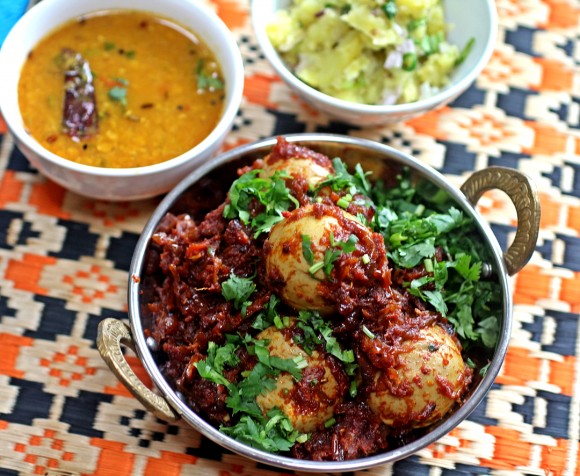
This year, however I’ve resurrected a well-seasoned egg dish that my grandmother used to call her “picnic dimer dalna” or picnic egg curry.
Our “picnics” consisted usually of multilayered lunch boxes, filled with puffy fried breads known as luchi and drier curries like alur dom. In our family’s case, it included these eggs, since my grandmother felt that we should get our protein as growing children.
This dish travels very well, and actually improves as leftovers. My children now love this as a special breakfast treat and it can be enjoyed with toasted bread almost as much as the luchi, which can be difficult to pull off on a school-day morning. The eggs, however, can be made the night before.
This particular recipe is also known as Kosha Dimer Dalna. The word kosha in Bengali refers to slow-cooked and refers to the slow-cooked onions in the dish.
This year, if you feel that you just might need an excuse for a new beginning and an opportunity to revisit your New Year’s resolutions, join the Bengalis in celebrating our Bengali New Year.
Kosha Dimer Dalna (Egg Curry with Clingy Caramelized Onion Sauce)
Prep time: 20 minutes
Cook time: 45 to 50 minutes
Total time: 65 to 70 minutes
Yield: 6 to 8 servings
Ingredients
4 tablespoons oil
3 medium-sized onions, sliced
1 tablespoon grated ginger
2 to 3 cardamoms
2 medium-sized tomatoes
1 teaspoon red cayenne pepper, or to taste
8 eggs, hard-boiled and shelled
1 teaspoon salt, or to taste
1/4 teaspoon turmeric
Chopped cilantro to garnish
Directions
1. In a heavy-bottomed pan, heat the oil and add in the sliced onions. Cook the onions on low heat, until they gradually wilt, soften and turn golden brown. This process will take about 30 to 35 minutes, but should not be rushed.
2. Add in the ginger and stir well.
3. Add in the cardamoms, tomatoes and red cayenne pepper. Cook for about five minutes until the mixture thickens and the tomatoes begin to soften.
4. In the meantime, make slits on the sides of the eggs and rub them with the salt and the turmeric.
5. Mix the eggs into the tomato mixture and cook for about 5 minutes, until the eggs are well-coated with the onion base.
6. Sprinkle with the cilantro and serve.
Main photo: My grandmother made this Kosha Dimer Dalna or egg curry as a picnic treat for us when I was growing up in Kolkata in India’s West Bengal province. Credit: Copyright Rinku Bhattacharya


Comments