Clifford Wright
From:
Santa Monica, California
Books by author
Hot & Cheesy

A Mediterranean Feast

The Best Soups in the World
Bake Until Bubbly: The Ultimate Casserole Book
Some Like It Hot: Spicy favorites from the world’s hot zones
Little Foods of the Mediterranean
Real Stew
One-Pot Wonders
Articles by Author
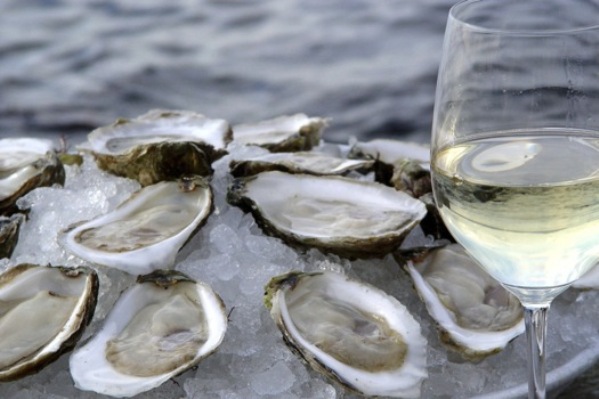
A Valentine’s Day menu needs to include oysters. First, just because it is tradition. Also, our hero of love, Giacomo Girolamo Casanova de Seingalt (1725-1798), the famous Venetian adventurer whose reputation as a seducer of women was so great his name became synonymous with the art of seduction, says so.
More from Zester Daily:
» A Valentine’s Day menu of aphrodisiacs
» Create your own aphrodisiacs for Valentine’s Day
» Feel the love of tonics and cupcakes
Casanova wrote in his autobiography that cultivating and pleasing the senses was his main preoccupation. “Ho molto amato anche la buona tavola ed insieme tutte le cose che eccitano la curiosità” (I very much loved a good table and everything that excites the curiosity), he remarked.
Casanova ate 50 oysters every day for breakfast. Several studies show that the amorous benefits of this might not just be an old wives’ tale. Oysters are rich in zinc, which is important for hormone production related to sexual activity. It is important to eat the oysters raw, though, as cooking reduces this aphrodisiacal effect. Casanova also suggested how to serve them: “I placed the shell on the edge of her lips and after a good deal of laughing, she sucked in the oyster, which she held between her lips. I instantly recovered it by placing my lips on hers.”
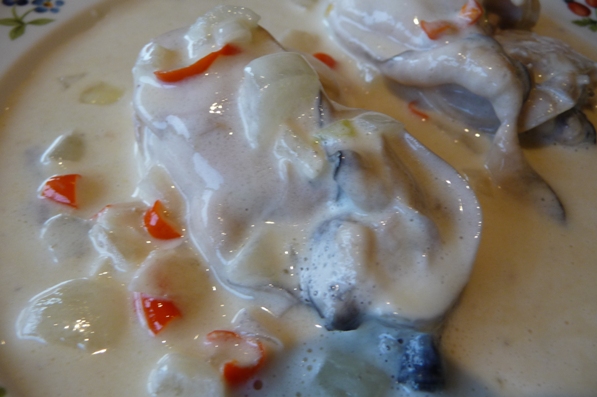
Oysters in Thai chile cream sauce. Credit: Clifford A. Wright
Here is a delightful little recipe that will tingle both the senses and the expectation. The recipe is for two, of course, because three’s a crowd on Valentine’s Day.
Oysters in Champagne Cream Sauce With Thai Chile
Serves 2 as an appetizer
Ingredients
1 tablespoon unsalted butter
2 tablespoons finely chopped onion
1 red Thai chile, thinly slivered
4 shucked Pacific oysters with their juice
3 tablespoons Champagne
¼ cup heavy cream
Salt and freshly ground black pepper to taste
Directions
1. In a small nonstick skillet, melt the butter over high heat and then add the onion and chile and cook, shaking the pan, until translucent, about 1 minute.
2. Add the oysters and their juice, pour in the Champagne and let it evaporate for 30 seconds.
3. Pour in the cream and cook over high heat, shaking the pan and turning the oysters until their edges curl up, about 4 minutes.
4. Remove the oysters to a plate or place back in their shell and continue cooking the liquid until denser and saucy, about 2 minutes. Season with salt and pepper. Pour over the oysters and serve.
Top photo: Oysters on the half shell with a perfect white. Credit: Jon Rowley
The idea that foods have aphrodisiac properties is quite old and found in all cultures, but this notion has waned with the rise of modern science.
Arab Muslim culture has had its aphrodisiacal foods, a phenomenon surprising to many people who think of Islam as a prudish religion that bans alcohol and frowns upon the sexual explicit.
However, a millennium ago, the elite in Europe began to change their attitudes toward eating, stimulated by the place of food in Muslim theology as represented in depictions of the Garden of Delights. The sensual pleasures of eating as portrayed in the Garden intrigued Europeans who began to associate luxurious dining with the food of the Arabs. Muslim sensuousness must have appeared attractive as a counterpoint to the ascetic life demanded of Christians. Already by the 12th century the Arabs had a rich poetry concerning wine and sexually explicit literature.
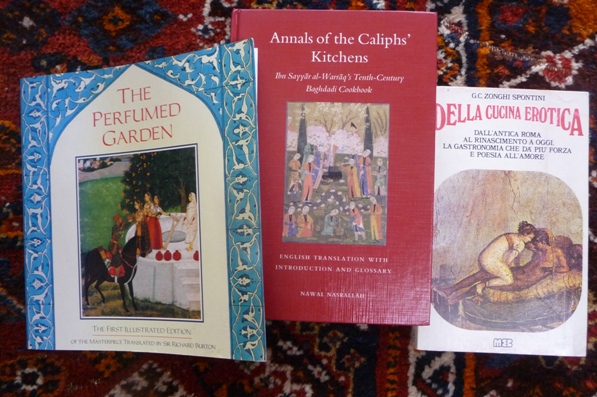
In the Arabic tradition there are “the two good things,” the translation of the Arabic al-atyabān. I always found it interesting that there isn’t a single mention of this idea in Arabic gastronomical thinking in any book on Arab cuisine or, for that matter, in any Mediterranean cookbook. But I alluded to these good things in my book “A Mediterranean Feast.” The two good things are food and sex.
More from Zester Daily:
» A Valentine’s Day menu of aphrodisiacs
» Create your own aphrodisiacs for Valentine’s Day
» Feel the love of tonics and cupcakes
Food and sex are two of the three “fleshly delights” of this world in a saying attributed to the seventh-century Arab poet Ta’abbata Sharrān. “I have never enjoyed anything as much as these three things: eating flesh, riding on flesh, and rubbing flesh against flesh.” The Arabic literary interactions of food and sex are manifold. Some stories find the women berating their husbands for eating and drinking too much but neglecting them in bed.
A good appetite for food and for love was seen as perfectly compatible. There’s the story of Aishah bint Talha, a granddaughter of the Prophet Muhammad’s father-in-law, who says to her husband the morning after the wedding night, “I have never seen anyone like you; you have eaten as much as seven men, prayed as much as seven men, and [had sex] as much as seven men.”
Food and sex inspire writers
Many of these stories, such as the bawdy tale of “The Porter and the Three Ladies of Baghdad” in “The Thousand and One Nights,” have a narrative formula that can almost be described as eating, drinking and having sex.
The stories get randier as in the “Slaughterhouse-cleaner and the Noble Lady,” also in “The Thousand and One Nights.” The lady wants revenge on her unfaithful husband and gets it by having an affair with the filthiest man she can find, the guy who cleans the latrines. He says, after their coitus, that he’d like to kiss the lady’s left hand (used for wiping) rather than her right hand (used for eating). This mixture of kitchen humor with scatological humor reflects the fact that the lady first looked for her husband in the outhouse but had found him instead in flagrante delicto in the kitchen, rogering a cook.
But the battle between love and food in Arabic poetry doesn’t always end in a truce. A Hispano-Arab poet, Ibn Mascūd, renounces love for food:
“If you ask me with whom I am in love and why my eyes
Pour forth tears,
I say: a sikbāj*, dishes of jamalī
Bruised white flour is sweeter to me than the saliva of the beloved who is embraced.”
Western aphrodisiacs
The West has its own aphrodisiacal food traditions, although the dishes might be different.
Lovers turn to chiles, because of their active ingredient capsaicin; bananas, because of their phallus shape; asparagus (same reason); oysters, for their zinc content and their tactile resemblances; vanilla, because it’s a stimulant for the nerves; salmon and walnuts, because of their omega-3 content, which keeps sex-hormone production humming; red wine, because it relaxes and reduces inhibitions; pomegranates, because they increase genital sensitivity; and chocolate.
There, now you should have a good idea of and guide to what you’ll prepare your sweetheart on Valentine’s Day.
* Sikbāj dishes, a kind of stew made with vinegar, were of Persian origin and very popular in the 10th century; jamalī is a kind of stew with innards.

Many cooks overlook the unusual vegetable called the Jerusalem artichoke, also known as the sunchoke.
The best part of the sunchoke is the tuberous rhizomes that can be eaten raw or cooked. The tuber looks like a knobby potato and tastes similar to artichoke heart. The plant can grow 6 feet high in a sunny and dry location.
A word tour of name confusion
More from Zester Daily:
» Veggie soup that will warm you up
» Purée of winter vegetable soup
» Roasted kabocha squash soup with kale
» Lentil and cabbage minestrone
» Spring Jerusalem artichoke and parsnip soup with a sorrel swirl
Its Latin binomial is Helianthus tuberosus L., indicating that it is a tuber related to the sunflower.
The sunchoke’s name in various languages indicates the confusion about its origins. In Arabic it is known as tirfās, ṭarṭūfa, kamāiyya balād al-āmrīk. This name combines the words for truffles and country potato of America. In French, Italian and Spanish it is known as topinambur, the name of a Brazilian tribe that has nothing to do with the origin of the plant. In English and Turkish, the sunchoke is the Jerusalem artichoke and yerelması, the Jerusalem, which brings us to how it got that name as the plant has nothing to do with either Jerusalem or artichokes.
The sunchoke is native to Canada and portions of the eastern United States. It first entered Italy in 1617 and was grown in the Farnese garden in Rome with the name girasole articiocco (sunflower artichoke).
The English name “Jerusalem” has long been claimed to be a corruption of the Italian word girasole, sunflower, but agricultural historian Redcliffe Salaman pointed out that the name “Jerusalem” was used to refer to Jerusalem artichokes before girasole. He argues that “Jerusalem” is a corruption of Terneuzen, a town in Holland from where the sunchoke was first introduced to England.
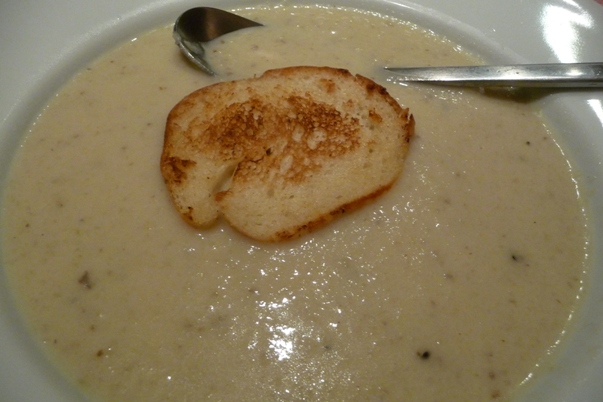
Cream of Sunchoke Soup. Credit: Clifford A. Wright
The sunchoke was first introduced to France from Canada no earlier than 1607 by lawyer and historian Marc Lescarbot and explorer Samuel de Champlain. It entered Provence about the same time as it did Italy and recipes are rarely found for sunchokes anywhere else in the Mediterranean but these two locales.
How to choose and store sunchokes
When buying, storing and preparing the sunchoke for cooking, look for firm tubers with unblemished skin. Choose the tubers that are the least knobby and make sure there are no spongy spots.
Store them in a plastic bag in the refrigerator crisper drawer where they will keep for two weeks. They go well with goose and other meat. Because the tubers can turn black when cooking, do not use an aluminum pan. A delightful way to use sunchokes is in soups such as this one from the Piedmont region of Italy.
Cream of Sunchoke Soup
Serves 4
Ingredients
2 ounces (½ stick) unsalted butter, divided
8 slices of French baguette
6 sunchokes (about 1 pound), peeled and thinly sliced
2 large onions, chopped
1 quart chicken or vegetable broth (preferably homemade)
½ cup heavy cream
2 teaspoons salt
Freshly ground black pepper to taste
Directions
1. In a large sauté pan, melt 1 tablespoon of the butter over medium heat and then cook the bread slices until golden on both sides, about 5 minutes. Set aside.
2. In a large saucepan, melt the remaining butter over medium heat and add the sunchokes and onions, stirring them and cooking until softened, about 15 minutes.
3. Add the broth and bring to a boil over high heat for 15 minutes, then remove from the heat.
4. Pass the soup through a food mill and transfer to a saucepan.
5. Bring to a boil and add the cream. Once it’s hot, season with salt and pepper and serve with the bread.
Top photo: Sunchokes (Jerusalem artichokes). Credit: Clifford A. Wright
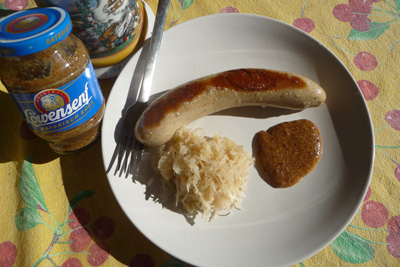
German food can be quite inaccessible. Many people think of it as heavy or they aren’t sure exactly what it is beyond sausages and sauerkraut. But what’s wrong with starting off with sausages and sauerkraut, especially for a cold winter party? This all came to mind because of an old family photo I came across while scanning.
More from Zester Daily:
It was of my mother sitting on the terrace of the General Walker hotel in Obersalzberg, Bavaria, in 1954. It dawned on me that nine years before this was the Berghof, Hitler’s Alpine retreat. The U.S. Army captured it in 1945, and the property became a hotel as part of the U.S. Armed Forces Recreation Center (AFRC).
My father was stationed with the Air Force in France at the time, and we often vacationed at U.S. Armed Forces retreats. In the photo, my mother, Helen DeYeso Wright, enjoys the sun on the same terrace where Hitler sat only some years before with Hermann Goering. During the same visit, I played nearby with my sister dressed in Bavarian costumes my parents bought.
The early 1950s was a time before the West German economic miracle, and the Germans were a vanquished and humbled people, ashamed but confused about their recent Nazi past, fearful of Soviet Russia, and very friendly towards Americans. I asked my mother about that time and she told me that the area was beautiful. She described Hitler’s bunker, which still existed in 1954.

The Germans in the mid-1950s, she said, were very friendly and my parents opted to eat in town rather than at the General Walker, which only served American food. My parents wanted German food, and although neither one of them were beer drinkers, they downed their steins of lager with, as she called it, those “big fat sausages” (weisswurst), spaetzle, sauerkraut, roast potatoes and “really fantastic” apple strudel.
Bavarian sausage traditions
To this day Bavaria is sausage central, where hearty and delicious food is still enjoyed by beer-loving Germans and tourists so far removed from those horrible times it’s hard to believe it happened there at all. At that moment I realized I wanted to sink my teeth into some weisswurst. A Bavarian weisswurst mit sauerkraut is not hard to do, because you’re only reheating as you will have bought the weisswurst and the sauerkraut and the mustard, hopefully from your nearest German delicatessen.
Weisswurst, literally white sausage, is a traditional Bavarian sausage made of very finely chopped veal and pork fat back flavored with parsley, lemon, mace, ginger, onions and sometimes cardamom, though different sausage makers make it a bit differently each time. Traditionally it is eaten with a warm soft pretzel and sweet mustard. In the rural tradition, it is eaten in the method known as zutzln where the sausage meat is squeezed out of the casing with one’s teeth directly into the mouth.
Once you find weisswurst at a delicatessen or grocery store, you can boil it before serving, or you can boil and then fry it.
Finding weisswurst harder than preparing it
The best advice I can given about having a weisswurst mit sauerkraut party in the middle of winter is to visit a local German deli and buy their freshly made sausage, not pre-cooked or packaged weisswurst from the supermarket. There are plenty of German delis all over the country and a quick Google search will turn one up for you. The same goes for the sauerkraut. Mail order is a second option, although weisswurst are highly perishable and you’ll need to have your sausage shipped express, overnight in a cold pack.
Bavaria Sausage of Wisconsin sells sauerkraut and Bavarian mustard as well. The beer you should be able to get everywhere, and only Bavarian lager will do. Prost und gutes Essen! (Cheers and bon appetit!)
Top photo: Weisswurst and sauerkraut. Credit: Clifford A. Wright
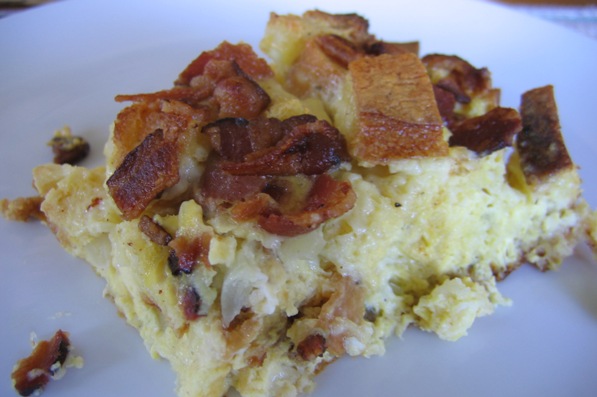
I no longer drink and therefore no longer need to deal with hangovers, but plenty of revelers do have to manage that problem on New Year’s Day. A dish you’ve made ahead will be a welcome sight.
If you were like me you could barely make the coffee, let alone a breakfast that your fat-seeking taste buds believed was your hangover salvation. There always was a solution lurking in the back of your mind, but unfortunately you needed to have prepared it before New Year’s Eve.
I’m referring to the modern American miracle known as the breakfast casserole. It’s simple enough: You basically get everything compiled the day before and then bake it in the morning. It’s as easy as pie or as casserole.
Egg and Bacon Breakfast Casserole
This strata casserole is a delight for a Sunday brunch with a few friends or a New Year’s Day breakfast. The first time you make it you will immediately start dreaming up alternative fillings. No problem, it’s a versatile casserole.
After you make this version with bacon you can start replacing the bacon with, let’s say, a cup of diced ham and a half cup of sautéed sliced mushrooms. Or you could use Swiss cheese and diced cooked chicken, or cooked broccoli and Gruyère cheese, tomatoes and cooked pork sausage, or, well, you get the idea.
Serves 6
Ingredients
Butter for greasing dish
4 cups ½ -inch cubes hearty white bread or French bread, with or without crust
2 cups (about 6 ounces) shredded mild or sharp cheddar cheese
½ cup finely chopped onion
8 large eggs
¾ cup half and half
2 teaspoons Dijon mustard
1 teaspoon salt
¼ teaspoon freshly ground black pepper
6 thick-cut bacon slices, cooked and crumbled
Directions
1. Heat the oven to 350 F. Butter a 10-by-12-by-2-inch or similarly sized baking casserole.
2. In a large bowl, toss the bread cubes, cheese and onion together, then arrange this mixture evenly over the casserole.
3. In the same bowl, beat the eggs, half and half, mustard, salt and black pepper to blend. Pour this egg mixture over the bread cubes.
4. Sprinkle the bacon over.
5. Bake until a knife inserted into the center of the strata comes out clean, about 25 minutes. Serve hot.
Top photo: Breakfast casserole with eggs, bacon, French bread and cheese. Credit: Clifford A. Wright
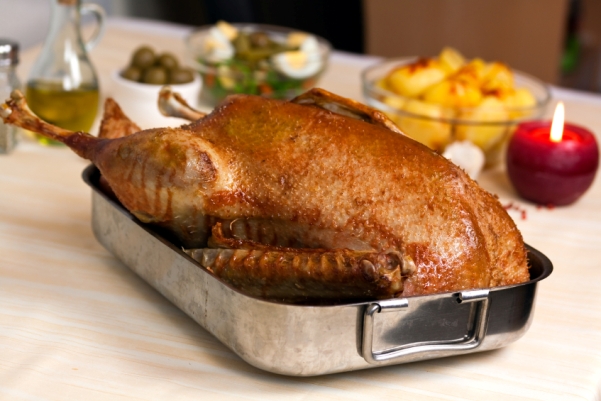
Classic holiday dishes are often associated with a specific religious holiday or cultural tradition. Sometimes this is so much so that meals get a bit typecast, like pumpkin pie that shows up only at Thanksgiving. But if you’re looking for that special dish that shakes up tradition or even suits a family with multiple religions or no religious tradition, consider serving goose.
More from Zester Daily:
» A bird to cook for every occasion
» How the French made roast turkey their own
Goose is a marvelous choice. There is, after all, the Christmas goose. And in the Middle Ages goose became popular among Jews and Muslims who either lived in Christian lands or who had converted, because goose meat can often be substituted for pork.
Because it is the holidays after all, the goose should be done up a bit special and I think this recipe from the region of Calabria at the toe of Italy’s boot would fit the bill for atheists and agnostics. If you’re anything else, adjust the recipe accordingly.
A Gorgeous Goose
Typically, this preparation called oca ripiena all’acqua di mare would be made with capon or chicken, but it works quite nicely with goose. The final result is a gorgeous mahogany-colored bird with crisp skin, succulent meat and a scrumptious stuffing. It’s perfect accompanied by asparagus with cream sauce.
If you don’t actually have access to clean seawater — and I can’t imagine anyone reading this will — then use bottled water salted with sea salt.
Stuffed Goose Cooked With Seawater
Serves 6
Ingredients
One 10-pound young goose (save the goose innards)
2 cups water
1 pound mild Italian sausage, casings removed, meat crumbled
¼ pound chicken liver, chopped
½ pound stale or lightly toasted French or Italian bread, diced
2 large eggs, beaten
Freshly ground black pepper to taste
2 teaspoons fennel seeds
1 teaspoon fresh rosemary, chopped
3 ounces pancetta, chopped
1 garlic clove, finely chopped
2 tablespoons dry Marsala wine
1 tablespoon extra virgin olive oil
Clean seawater or bottled water salted with sea salt as needed
Directions
1. Preheat the oven to 350 F.
2. Clean the goose, removing and saving the fat at the opening to the body cavity for another use. Tuck the wings close to the body and tie off tightly with kitchen twine. Do not salt the goose or stuffing because there will be enough salt in the sausage and the seawater basting.
3. Place the goose neck, gizzards and heart in a saucepan with 2 cups water and bring to a boil. Boil for 30 minutes, remove the gizzards and heart and chop. Set aside. Continue cooking the neck if desired with more water and save the broth for another use. Chop the goose liver.
4. Place the goose liver, sausage and chicken liver in a mixing bowl and mush together with your hands. Transfer to a saucepan and turn the heat to high and brown the sausage, about 5 minutes. Transfer the sausage mixture to a mixing bowl and mix it with the bread, eggs, black pepper, fennel seeds, rosemary, pancetta, garlic and Marsala. Stuff the goose and truss the legs. Brush the bird with the olive oil.
5. Place the bird on a rack in a roasting pan and cook until golden and the internal temperature reaches 170 F, 1¾ to 2½ hours, basting occasionally with seawater, which will have the effect of salting the bird too.
The goose is done when a skewer stuck into the meat below the leg releases juice that runs white. Make your final decision on doneness by using the meat thermometer stuck in the breast. Remove from the oven and let rest 15 minutes, then carve and serve.
Top photo: Roasted goose. Credit: Monica-photo / iStockphoto