Articles in Politics

Except for unseasonably dreary weather, the Cultivate Festival — held by burrito giant Chipotle Mexican Grill to promote its much-praised, large-scale sustainability efforts — went off without a hitch Oct. 6 in Denver, the company’s home base.
However, things could have been very different. Just two days earlier, Chipotle finally agreed to work with the Coalition of Immokalee Workers (CIW), an advocacy group for Florida’s farmworkers — particularly immigrants enduring conditions of wage slavery — by signing the Fair Food Agreement, which commits the nation’s major tomato purchasers and growers to uphold human rights in the field. Participating supermarket chains and food-service conglomerates pay an extra penny per pound for their tomatoes, which goes to workers of member farms that are in turn required to abide by a code of conduct covering all manner of once-rampant abuses, from forced labor to sexual harassment. In coming on board, Chipotle avoided a massive protest that threatened to undermine its feel-good message at the festival.
Seeds of the Coalition of Immokalee Workers
It’s just one piece of a puzzle that has been falling into place since the CIW formed in 1993 — though the rate of completion was arguably accelerated by the 2011 publication of James Beard Award-winning journalist Barry Estabrook’s groundbreaking exposé, “Tomatoland.” In June 2011, Estabrook penned a Soapbox column for Zester Daily about the CIW’s struggle to persuade Trader Joe’s to join Whole Foods Market and fast-food companies including McDonald’s, Burger King, Subway and Taco Bell in signing the Fair Food Agreement. Last February, it finally did, much to Estabrook’s shock: “They were so adamantly opposed, and now they’re a cooperative partner. … They resist and resist, and use the same excuses over and over like a broken record, and then, through the media attention on the CIW’s petitions and demonstrations, they get a horrible backlash, the pressure builds up, and they say, ‘We’re spending hundreds of thousands of dollars trying to make this problem go away, but it’s not going to cost us anything to pay the penny per pound.’”
Exploitation, discrimination of farmworkers
I spoke to Estabrook on Oct. 3, the day before Chipotle’s announcement and the day after he joined CIW spokesman Gerardo Reyes-Chavez and a longtime acquaintance of mine, Chef Jose Duarte of Boston restaurant Taranta, on a panel at StarChefs’ seventh annual International Chefs Congress titled “The Human Cost of Food: Chefs Supporting Farmworkers’ Rights.” As a Denverite myself, I’d been watching the news about the Cultivate Festival and the controversy surrounding it ever since Duarte alerted me to the cause after his trip to Florida, where he learned of “people who were locked into their trucks at night, up to 10 people in one trailer. People working with crops while they’re being fumigated. Discrimination by gender and age.”
Deciding that chefs need to demand fairly traded products, Duarte organized the panel — and sure enough, said Estabrook, “At the end of it, a chef at a restaurant in Tampa came up to me and said, ‘We had no idea that this was going on in our backyard; we are now aboard.’ That alone is why I went: Because chefs are extremely influential. … If one chef says, ‘I’d rather not buy tomatoes grown by a slave,’ nothing might happen, but if two or three do, a trend has begun.”
Of course, independent restaurateurs don’t have an ounce of the buying power of chains. It’s the latter whose cooperation has ensured the Fair Food Program is working, says Estabrook. Once cut off from any channel of negotiation, many Florida tomato workers now “get told about their rights, about how to file grievances. Human resource managers are passing out cards with a 24-hour hotline number. Crew bosses were once the workers’ entire world; now it extends all the way up to the chairman of McDonald’s.”
Making change before the Cultivate Festival
So when I told Estabrook that the Denver Post, reporting Sept. 27 on the upcoming Cultivate Festival, quoted Chipotle communications director Chris Arnold as saying, “For the last three years, all of the Florida tomatoes we have used have come from growers who have signed the Fair Food Agreement, which creates the same result as if we had signed ourselves,” Estabrook begged to differ.
“What Chipotle is doing is essentially freeloading on the backs of the people who are involved in the agreement,” he said. “First of all, it’s the end buyer, not the grower, who pays the extra penny per pound.” Estabrook calculated that to the difference between making $50 and $80 per day. Then he added: “But it’s about more than the money. Take one of the sexual harassment cases I heard about. This particular labor contractor was very good at his job, besides his inability to keep his paws off women, so the company that employed him was reluctant to take action against him. It finally took the big buyer to step up and say, ‘Zero tolerance is zero tolerance.’ Chipotle’s trying to get the PR advantage of saying, ‘We’re aboard,’ when they’re not. My ultimate answer to them is ‘Guys, if Taco Bell, which makes no pretense of being a conscientious steward of anything, can sign, so can you.’ ”
Clearly, the groundswell of protest — not only on the ground but also in the form of a petition signed by such heavyweights as “Fast Food Nation” author Eric Schlosser, “Stuffed and Starved” scholar Raj Patel, and Estabrook — persuaded Chipotle CEO Steve Ells to rethink his position in the nick of time. As Reyes-Chavez put it, “This is a really important moment for food-service corporations. The landscape is changing. We have the most powerful representatives of the fast-food industry on board already, and we only need a few more from the supermarket segment to arrive at the day when business as usual is not a race to the bottom. The 21st-century supermarket no longer has the luxury of distancing itself from labor conditions. If you want to succeed, you’ve got to do the right thing and treat workers right. If you don’t, then the market consequences will apply. It’s just a matter of time.” Look out, Kroger’s.
Top photo: Jose Duarte (from left), Gerardo Reyes-Chavez and Barry Estabrook at the panel discussion on “The Human Cost of Food” at the International Chefs Congress.
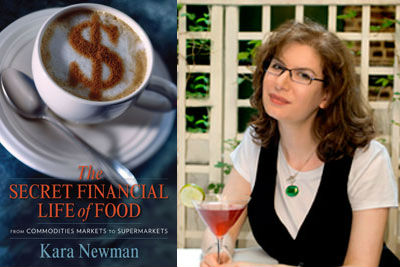
As a former vice president of strategic research at Thomson Reuters, Kara Newman knows a thing or two about the business sector. As spirits editor for Wine Enthusiast and the author of “Cocktails for a Crowd” and “Spice & Ice,“ she also knows her way around a bottle. (Full disclosure: I have come to know her as a contributor to Sommelier Journal, where I am assistant editor.) And in the upcoming “The Secret Financial Life of Food: From Commodities Markets to Supermarkets” (Columbia University Press), she uses her expertise in both areas to explore “where, how, and why our food is traded — a critical but nearly invisible connection between the farm and plate.”
As her book shows, futures trading impacts the very contents of your pantry — not to mention the prices you pay at grocery stores and restaurants — in myriad cyclical ways. It’s an eye-opening read even for finance-challenged foodies like me, with far-reaching implications for those who aim to put their money where their mouths are. I asked Newman to elaborate on a few especially timely points.
The complexities of the economics of food
BOOK LINK
“The Secret Financial Life of Food: From Commodities Markets to Supermarkets”
By Kara Newman
Columbia University Press, 2012, 208 pages
Although futures-market prices don’t affect grocery prices on a second-by-second or day-by-day basis, their impact does show up over the long term. It would be tremendously annoying if prices rode the roller coaster that futures prices do! But over months and years, we do see prices rise or fall, following the prices set for underlying agricultural commodities.
What’s important about shopping at farmers markets is that, to a degree, it allows people to “opt out” of the pricing set by commodities markets. Buying directly from a farmer, butcher or other primary producer means there’s a significantly shorter path from producer to end buyer. The transaction is based on immediate supply and demand, and it cuts out the middleman. It’s the processors, importers and so on who are taking on risk when they bring vast quantities of foodstuffs to the market — and they’re often the ones attempting to hedge that long-term risk though futures trades.
Given the recent scare over a bacon shortage, I found the chapter on pork bellies quite enlightening. Can you elaborate on why pork bellies are no longer traded, and what it means for the average consumer and the ethically conscious consumer?
Pork bellies stopped trading in July 2011, just as the contract had reached a 50-year milestone on the Chicago Mercantile Exchange. It’s amusing how far we’ve come from the days when no one even knew what a pork belly was. Originally they wanted to call the contract “uncured bacon!”
Pork bellies started trading because they store well when frozen. To traders, this was valued because the hog business used to be seasonal; the potential for scarcity, therefore, meant higher prices for those bellies in storage. At the most basic level, traders buy and sell based on scarcity and anticipated demand. When that scarcity diminished thanks to better technologies in agriculture and refrigeration, as well as improved bacon-making techniques, trading eventually stopped. It’s now a more stable market. That’s great news for people who like to eat bacon year round, but it doesn’t make for profitable trading. Traders and speculators thrive on buying and selling as prices in a volatile market pingpong.
I’ve asked economists: What does it mean for consumers that we don’t have pork-belly futures to kick around anymore? And the answer across the board is: “Not much.” Pork-belly contracts were a vehicle that outlived their usefulness, like egg futures and onion futures and many other contracts before them. Without the pricing mechanism that the futures market provides, prices might edge slightly higher at supermarkets — and for a little while, that might make pork from smaller producers a bit more attractive. But the average bacon lover probably hasn’t noticed even a blip at the checkout counter.
Since I know you best as a wine-and-spirits writer, your sidebars on wine and whiskey futures also caught my attention. How is soaring Asian, specifically Chinese, interest in high-end French wines affecting futures and the industry there?
Although coffee beans have a long history of formal trade in the U.S., potables such as wine and whiskey are still in their trading infancy. Bordeaux futures are nothing new, but wine funds certainly are, and we’re starting to hear rumblings about the nascent “whiskey-investment” industry, although it doesn’t seem to have developed much traction yet.
Growing interest in both products from newly affluent drinkers in China and elsewhere surely have created a market that’s ripe for trading. Particularly where wine is concerned, it has all the elements of uncertain supply and fluctuating demand. That includes the investment manager’s observation that many Chinese drinkers are purchasing wine to consume now, rather than to age — a trend that has the potential to impact supply down the road for older vintages, which could lead to higher prices — if what’s in the bottle is good, of course! Regardless of what’s being traded or how, though, it still comes down to basic supply and demand.
In the introduction, you credit as inspiration for this book an article in which a trader advised clients to “Buy breakfast.” Assuming those who advocate the locavore lifestyle might wish to invest in a socially responsible manner, do you have any concrete advice for them? For instance, per your appendix, non-GMO soybeans are traded on the Tokyo Grain Exchange. Is this a rising trend?
I don’t give investment advice, but socially minded investors can always buy stock in companies that share their personal philosophy. Another option is to donate to or get involved with organizations such as Slow Money, a national nonprofit that works for investment in sustainable foods and farms.
Top photo composite:
Author Kara Newman. Credit: Daryl-Ann Saunders
Book cover of “The Secret Financial Life of Food.” Credit: Courtesy of Columbia University Press
“Every 30 minutes a farmer in India kills himself.” This frightening fact is pointed out in “Bitter Seeds,” the third documentary in “The Globalization Trilogy” directed by Micha Peled. The 12-year project aims to generate debate about public policy and consumer choices in some complex issues relevant to all of us. Peled is the founder of the nonprofit Teddy Bear Films, which he created to make issue-oriented films such as “Will My Mother Go Back to Berlin?” and “Store Wars: When Wal-Mart Comes to Town.”
“Bitter Seeds” follows a season in a village in India from planting to harvest. There are three important stories in this film, each revolving around the multinational corporate takeover of India’s seed market and the effect it has on farmers and farming all over India and the world.
Like most of his neighbors, the protagonist in the film, Ram Krishna, must engage a money-lender to pay for the mounting costs of modern farming; he puts his land up as collateral.
The only seeds available in India now are GMOs (genetically modified organisms), which require farmers to pay an annual royalty each time they are replanted. The GMOs need additional fertilizers, and as the seasons move forward, more insecticides and pesticides. The soil in which these seeds are planted requires more water. All of which means more and more money for the farmer to lay out.
As Krishna’s story moves forward, his cotton is attacked by mealy worms, which threaten to destroy his entire crop. His daughter has reached marrying age and Krishna must find money for her dowry.
Farmers devastated by GMO seeds
Another story weaving in and out of the film is that of a neighboring girl in college who has recently lost her father to suicide, an end claiming lives all over India’s farmlands. She wants to tell his story, along with the stories of all the other suicide victims in the area. Her research and intuition have shown her that at the root of these suicides are GMO seeds. Her family is not behind her desire to become a journalist or to expose the family story, but this young woman moves ahead, interviewing her neighbors.
In the film we also meet a seed salesman who argues that GMO seeds are better than the seeds the farmers previously used, and Vandana Shiva, an activist who speaks strongly about the damage the GMO seeds have done to the agricultural system throughout India and the world.
“Bitter Seeds,” like “Food, Inc.,” shows how much we don’t know about genetically modified seeds, their hidden costs and health effects. The GMO industry vigorously fights in the United States as well as in other countries to prevent mandatory listing of GMO foods on product ingredient labels. This should at the very least raise our concern.
The recent announcement by BASF (the world’s leading chemical company) that it is abandoning its production of GMO crops in Europe because of a lack of acceptance “from the majority of consumers, farmers and politicians” was an acknowledgement of a reality many biotechnology companies have been hesitant to countenance: Europe does not like genetically modified crops.
The GMO labeling debate
Although there is a strong and organized movement pushing for labeling in the United States, why does the U.S. Food and Drug Administration think it’s OK to consider genetically modified seeds harmless until proven otherwise? Why isn’t it the other way around? Why is our health not being protected unless and until GMO seeds can be shown to be totally safe?
Earth Open Source is a nonprofit organization dedicated to assuring the sustainability, security and safety of the global system. In June 2012, it published “GMO Myths and Truths: An Evidence-Based Examination of the Claims Made for the Safety and Efficacy of Genetically Modified Crops” by Michael Antoniou of Kings College London School of Medicine in the U.K.; Claire Robinson, research director of Earth Open Source; and John Fagan, an early voice in the scientific debate on genetic engineering. In the report, the authors explain how genetic engineering poses special risks, claiming that GMO foods can be toxic or allergenic; how GMO feed affects the health of animals; how GMO seeds do not increase crop yield potential; how studies claiming the safety of GMO crops are generally industry-linked and therefore biased. Anyone interested in the “other side of the story” from that fed to citizens by the industry should read this report.
The number of farmers markets in this country has more than doubled in the last three years. Locavorism has become more than a buzzword, it’s an accepted way of eating. People want to know who their farmers are and how they are growing the food. Is it sustainable, organic and/or biodynamic? What seeds were used? People throughout the world are demanding that anything grown with GMO seeds at the very least be labeled. Until there is word that crops grown from GMO seeds are as good for us as their unmodified counterparts, perhaps it is best to avoid them.
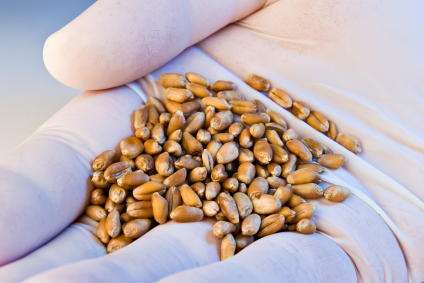
Photo: Wheat seeds. Credit: mishooo / iStockphoto.com
For consumers who want to fuse their purchasing decisions with their social consciousness, buying green and righteous just got a whole lot more confusing. There’s a skirmish going on within the fair trade community, between the good guys and, well, the good guys. When every organization involved in the controversy has a word like “fair” or “equal” in their mission statements, you know you have a problem.
Fair trade certification was born out of the concept that there is a route out of rural poverty that doesn’t require aid from donors, just better access to the marketplace by paying farmers directly and avoiding the middleman. For decades, the fair trade designation has been granted to individual rural farmers and small farmers’ co-ops that grow commodity goods such as coffee, tea, sugar, chocolate, bananas and spices and provide direct access to the marketplace. Larger estates and plantations could not be certified as fair trade, a core principle that is now beginning to change. On Jan. 1, Fair Trade USA, the largest independent certifying organization in the U.S. — with an annual reach of more than 30 million consumers — announced that it was leaving FLO-CERT, the leading international fair trade organization, and would certify products grown on plantations and estates in addition to small farmers farming co-ops.
It’s a mess in the making. Twenty-plus Fair Trade USA members resigned. Petitions were flying back and forth over the blogosphere, representatives of the Latin American and Caribbean Network of Small Fair Trade Producers (CLAC) wrote protest letters, international nonprofit membership rosters are still rattling, and globally responsible corporations such as Green Mountain Coffee Roasters, Equal Exchange coffee, Starbucks, Dunkin’ Donuts and Honest T all felt compelled to take sides.
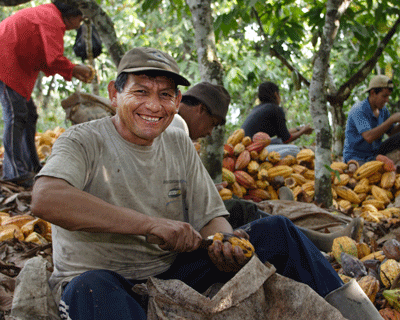
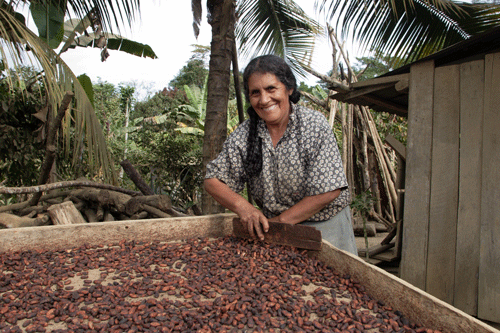
Organic cacao grower Eusebio Laron Torres belongs to an agrarian coffee cooperative in Peru. Credit: Courtesy of Equal Exchange
A rare good-guy CEO-to-CEO fight made it out into the public sphere with a full-color, full-page advertisement in the May 20 edition of the Burlington (Vt.) Free Press. The ad was signed by Bob Everts and Rink Dickinson, co-presidents of the Massachusetts-based Equal Exchange coffee company, and written to Larry Blanford (“& Friends”), CEO of Green Mountain Coffee Roasters, based in nearby Waterbury, Vt., urging Blanford (“& Friends”) to leave the American-based nonprofit Fair Trade USA and rejoin the international organization, FLO-CERT. “We ask you to open your eyes to the controversy raging around you,” the public letter concluded. Rodney North, spokesperson for Equal Exchange, explained the objective behind the open letter: “We’re not actually asking GMCR to do anything new. Rather we’re urging them to return to the international fair trade system that they had always been a part of until their certifier, FT USA, left it so as to unilaterally make up a new set of rules.” In 1986, Equal Exchange introduced the first fair trade coffee to American supermarkets and coffee shops. Today, the company is an employee-owned corporation that works with 40 small farmer cooperatives in 25 countries.
Understandably, Fair Trade USA founder and President Paul Rice has a different perspective. He characterizes the current back and forth not as a fissure in the fair trade community but as a “healthy” and necessary consequence of growth, in the tradition of the growth pains for the organic movement 10 years ago. “If fair trade stays small, its impact stays small. If we expand and adapt fair trade principles and take them mainstream to the Starbucks, the Trader Joe’s, Whole Foods, Costco, Dunkin’s — we can have a bigger impact and raise more people out of poverty.” Rice estimates that 2 billion people worldwide live in poverty, and fair trade is only affecting 10 million farmers. “It’s too tiny a fraction.” The pressure to expand and adapt the fair trade certification, Rice says, came from rural farmers, from NGOs and from his hundreds of farmers and trading partners worldwide. Rice founded his nonprofit 14 years ago after 11 years of working and living in rural Nicaragua. What began as a “scrappy little nonprofit with a total team of one” now has 800 partners, and the fair trade certification label is recognized by 34% of Americans consumers. “But that’s not enough.”
A certified fair trade product typically sells at a premium to the consumer, a differential hopefully netting a living wage for the farmer. U.S. sales of fair trade products topped $1.5 billion last year, which yielded a $250 million premium to the farmers. Coffee beans are one of the most successful fair trade crops, with mega giants like Starbucks regularly featuring a fair trade bean option. And yet only 5% of the coffee market in the U.S. is for fair trade coffee.
Fair trade began as a social justice movement in the 1940s and has become a player in the global commodities market. The fair trade movement is a large and very international coalition. As an example, FLO-CERT, the leading international fair trade certifying body, represents 70 countries and has its headquarters in Germany with offices in India, Costa Rica and South Africa. FLO-CERT employs 100 fully trained auditors in 50 countries. When Fair Trade USA resigned its membership in FLO-CERT, the resignation created shockwaves, Rodney North of Equal Exchange says. “FT USA sold out. One small peasant is a farmer. One thousand small farmers is an institution.” So far, Green Mountain Coffee Roasters has yet to respond to the open letter to its CEO asking him to withdraw his company from FT USA. Whole Foods, Starbucks and Coke’s Honest Tea brand have all reaffirmed their support of FT USA.
Fair Trade USA has just unveiled a new black and green logo to be displayed on the more than 100,000 food and personal-care products and ingredients it certifies in the United States. The takeaway to the socially conscious consumer? Stay tuned. It’s never easy being green. So many shades of gray get in the way.
Top photo: Organic cacao grower Julia Najarro la Rosa in a coffee cooperative in Peru. Credit: Courtesy of Equal Exchange
In a twist on turning lemons into lemonade, Mark Diacono comes close to saying that when the world hands us climate change, we should make Chilean guava gin.
In the introduction to his lushly photographed new book, “The Food Lover’s Garden: Amazing Edibles You Will Love to Grow and Eat,” Diacono writes: “What a sweetly virtuous circle that climate change should allow us the possibility of growing many of the foods we currently import, and that we can take advantage of that shift to help arrest its progress.”
Yes, Diacono is telling us to stop worrying and learn to love climate change. And there is a certain Strangelovian logic to it, because if we grow formerly exotic foods such as Carolina allspice, Sichuan pepper and Chilean guava in our own backyards, we will reduce our food carbon footprint by cutting back or eliminating packaging and overseas transportation.
Grow your own global produce
Diacono not only talks the talk, he walks the walk. As head gardener at Hugh Fearnley-Whittingstall’s River Cottage enterprises for many years, he grew edible plants of all sorts and taught others how to take them “from plot to plate” — or as we would say on this side of the pond, from farm to table. Diacono now devotes himself full time to his own Otter Farm in Devon, in southwest England.
Although Diacono’s introduction to “The Food Lover’s Garden” places gardening in the larger context of climate change, peak oil, peak phosphate and other global concerns, the book itself is not a treatise on food politics or the environment. Rather it is part gardening handbook and part cookbook — a chatty, often cheeky, user-friendly guide to choosing, growing and then cooking your own favorite foods.
Diacono believes that life is too short (and often gardens too small) to plant anything but what you are truly passionate about eating. At the outset, Diacono dismisses the “boring” vegetables that you can get easily and cheaply at any grocery store, such as potatoes and cabbage, and advises us to instead plant the exotic fruits, vegetables, nuts and spices he loves.
While I respectfully disagree with Diacono about potatoes and cabbage being boring, that is actually the point of this book: You read about what excites Diacono, then you decide what turns you on — in the garden and in the kitchen — and plant accordingly.
Let flavor be your guide
“The Food Lover’s Garden” starts at the endpoint, with whatever tastes you love, then takes you back to the beginning, to choosing and planting those foods in your garden. Diacono first recommends making a wish list, letting flavor alone be your guide. Then he suggests growing things you can’t find in the store, and choosing plants that will provide you with food in every season. Finally, he suggests balancing “certainties” (easy to grow even if you don’t have a green thumb or great soil) with “gambles.”
Scanning “The Food Lover’s Garden” table of contents, I saw that about half of the plants would be bad gambles in the Midwest where I live, and throughout most of the United States. Neither Diacono nor his publisher make mention of U.S. Department of Agriculture plant hardiness zones, but I did a little research and found what I suspected, that many of the plants Diacono raves about will survive only in Zone 8 and higher — the far southern states, and areas moderated by the Pacific in the western states.
Devon, where Diacono lives and farms, has always been known for its mild climate, even in pre-climate change centuries. That’s great for him, but his book is a bit of a cruel tease for the rest of us — unless, of course, climate change goes into very high gear in the very near future. But there are still a dozen or more hardy and delicious plants that Diacono recommends, such as sorrel, rhubarb, lovage, nasturtiums, mizuna and asparagus.
And no matter where you live and garden, even if you are only an armchair gardener, this book is a wonderful invitation to live adventurously and expand your gardening, cooking, and eating horizons. At the same time, by growing and eating more local foods, Diacono writes, “you’ll be casting your vote for a new way of feeding ourselves and for the future.”
Buy Mark Diacono’s “The Food Lover’s Garden” Now!
Terra Brockman is an author, a speaker and a fourth-generation farmer from central Illinois. Her latest book, “The Seasons on Henry’s Farm,” now out in paperback, was a finalist for a 2010 James Beard Award.
Top photo composite:
Mark Diacono. Credit: Jason Ingram
Book jacket for “The Food Lover’s Garden.” Credit: Courtesy of Timber Press
* * *
Shaun Rein, managing director of the China Market Research Group, is the author of the new release “The End of Cheap China,” which addresses, among other things, food safety and food supply issues in China.
Rein’s research shows that China is having an increasing impact on global food supply and that the Chinese taste for imported Western food is growing as is demand for a reliable and safe food system in that country.
Based in Shanghai, he writes for Forbes and Bloomberg Businessweek. I spoke recently to Rein about his book chapter dedicated to food safety issues in China.
How is the consumer power of the average Chinese changing?
The book is meant to dispel a lot of myths about China’s economy. The first is that Chinese consumers are price-sensitive and cheap. I have a chapter on food safety, where I explain that they’re willing to spend money on healthy and safe food, so if you’re a producer, it’s worth selling into China. For example, Yum! Brands makes over 40 percent of its global revenue in China. So the Chinese consumer is a great consumer for Yum!, McDonald’s, Kraft and any company trying to sell finished products into the country.
It’s also a great country for the agricultural sector: sales of pork and soy are going up 300 to 400 percent a year.
How is this affecting the way the Chinese eat? How has that changed in recent years?
Meat consumption was very low. Meat consumption in China is only about 35 percent that of the United States, So, Americans eat a lot more meat, but that is changing. Chinese doubled (their average per person) meat consumption in the last 30 years. As Chinese consumers are getting wealthier, they’re eating more meats, and (the country’s wealthiest consumers) are actually willing to spend more per capita on meat than (their counterparts do) in the United States.
Are they domestically producing different kinds of foods to meet those demands?
Yeah, what you’re seeing now is massive investment on the domestic side when it comes to beef, when it comes to wine … all kinds of things. But the reality is that China’s food system has a problem: There’s not enough arable land, and the water is heavily polluted. So China is actually going to have to rely on food imports, from the United States especially, and they’re becoming a massive importer of pork, chicken feet, soybeans, pistachios, all kinds of products. These consumers trust American-produced food products more than they do stuff from China. So it’s really a boom for all different industries involved in the food sector. On the lower end and higher end.
Arable land is only 7 percent (of that available around the world), so it’s a serious problem, and it’s only going to get worse going forward.
What are you noticing in terms of the impact on health in the way Chinese are changing their food consumption behaviors?
Right now, consumers are not worried that much about food when it comes to “is it healthy?” towards their overall diet. They’re eating meat, they’re eating fatty food, and they’re not overly concerned about long-term illnesses, which is why you’re seeing rates of heart disease and diabetes skyrocketing.
But people are worried about being healthy from a toxicity standpoint. We interviewed 2,000 consumers in eight cities last year, and the majority said they feel that KFC, for instance, is healthy. They know it’s not healthy in the traditional sense, but people are worried about eating cooking swill oil [that is old, used oil which is filtered of solids and then re-used for cooking] on the streets, and dying right away.
What are the food safety concerns Chinese have, beyond swill oil?
We interviewed 5,000 consumers in 15 cities last year, and their biggest concern in life, ahead of being able to pay for their kid’s education or for medical costs for the family, is actually food and product safety. People are really worried. That’s why brands like Mengniu Dairy are winning, because they’re positioned as higher priced over Nestlé, they’re about 20-30 percent more (expensive), and consumers are willing to fork out the money because they think it’s going to be safe. So Dannon and Nestlé had to shut their factories in Shanghai this year, because they were competing on price and consumers didn’t want their cheap stuff anymore. Consumers find a correlation between safety and price, and feel higher price will be safe. Now I’m not sure that’s necessarily true in reality, but that’s how they equate it.
In your opinion, how are China’s consumption trends affecting the world beyond?
[They are affecting the world] in a few areas. First, China’s become the market to sell into, so a lot of brands need to think about how they’re going to sell to Chinese consumers, especially women, because women are the decision-makers when it comes to food purchases, predominantly, in families.
It’s also going to mean that there’s going to be inflation. In the last three decades, China has really been a deflationary force on the global economy. But because everyone’s getting fat, and wanting to eat more, better quality foods, you’re going to see a pricing strain on global commodity markets. So the world needs to be prepared for global inflation. American consumers better get used to higher prices at Shaw’s, or Tesco or Carrefour or Walmart, around the world.
Will the Chinese agricultural and food production systems have to change?
They absolutely will have to change. It’s an absolute mess, it’s a disaster, and an embarrassment for China to have such a poor food supply system. Though it’s being changed by two things.
The first is, the government understands it needs to do a better job of oversight. So what they’ve done is shut 50 percent of the nation’s dairies last year, for example.
The real change is going to take place by people willing to spend money when they feel that they’re safe. So brands are going to fix their supply chain and cater to these consumers and make money. The scope of the problem is enormous.
Buy Shaun Rein’s “The End of Cheap China” Now!
Zester Daily contributor Manuela Zoninsein is a Brazilian-American reporting on sustainable food, travel and business from Shanghai. A former dining editor for Time Out Beijing, her work has appeared in Condé Nast Traveler, ClimateWire and Newsweek. She writes about her passion for healthy, interesting and sustainable food at manuelasweb.com.
Photo: Author Shaun Rein. Credit: Courtesy of Shaun Rein
When it comes to food, comments from the 2012 presidential campaign trail sound downright scary. Republican candidates imply they want to emasculate all federal programs directed at food safety. President Barack Obama has proposed cutting a $5-million research program at the Department of Agriculture, the Microbiological Data Program, which tests fruits and vegetables for disease, without first finding a new place in the system to put it, perhaps the Food and Drug Administration. Once cut, it will be so hard to reinstate.
And to hear the candidates talk about deportation and immigration is depressing. Many immigrants are taking jobs in the world of food that no one else wants, like planting and picking our fruit and vegetables, or washing them. But that doesn’t matter to those who want to create a homogeneous America.
Some of the candidates recommend self deportation for reducing immigration populations. This program is based on making life for immigrants as unbearable as possible to force them to leave. Police sweeps of neighborhoods in places like Arizona result in mass arrests, creating fear in all immigrants, legal as well as illegal, and are causing a civil rights emergency.
Rebirth of a neighborhood
That said, I have seen two food films this year, both documentaries, that in some way draw attention to other ways of dealing with immigration and food safety. “City Farmers” was produced and directed by Meryl Joseph. First released in 1998, it recently streamed on the Internet for 48 straight hours. It is a journey of hope down the most corrupted New York City streets where inner-city residents have transformed rubble and rat-infested abandoned land into burgeoning vegetable and flower gardens, according to the movie’s promotional materials. And while there are more than 500 community gardens all over New York City, one of my favorites is on West 89th and 90th streets between Columbus and Amsterdam avenues.
There are more than 20,000 city farmers volunteering their time and labor. This has been going on since 1978, with the support of Green Thumb, an organization that provides programming and materials for community gardens in New York City.
More than 750 abandoned city-owned lots have been transformed into green oases. And as they tend their rows, these farmers remember their earlier lives in Mexico, Puerto Rico, Italy and elsewhere. They are immigrants sharing their knowledge and experience with city folks who have known nothing but hard concrete under their feet.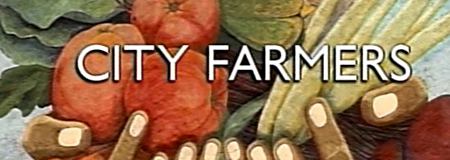
The gardens are shared sources of pride in these communities where there was none before. These neighborhood gardens are growing fruits and vegetables as well as respect from the wilder, younger generations, with school kids getting involved and sharing the plots. In these tough neighborhoods, from the oldest to the youngest and in-between, wherever there is a community garden there are miracles happening proving that everyone needs contact with nature. Some of the folks involved in these gardens have never before seen where the food they eat grows.
For immigrants, having a plot in a community garden is a way of entering into the community and growing foods that will feed one’s family along with the neighbors.
Food entrepreneurs on wheels
The other film is Mary Mazzio’s “The Apple Pushers,” narrated by Ed Norton. It chronicles the story of five immigrant micro-entrepreneurs addressing America’s obesity crisis by selling fruits and vegetables in green carts across the under-served (better known as food deserts) of New York City. The Laurie M. Tisch Illumination Fund provided money for the film as well as efforts to expand the number of “green carts” in New York City.
It’s an inspiring story that could ideally inform an immigrant looking for a creative, sustainable, entrepreneurial way to make a living while bringing fruits and vegetables to the very neighborhoods where they are needed most, often their own neighborhoods. This will not solve the entire problem of immigration, but it’s one of many viable possibilities.
All of this said, not every immigrant can either afford or is desirous of owning a push cart. And not all of those who get a cart will make it. But the ones who do are going to prosper.
Seeking real solutions
Deportation is not the only solution to immigration reform. And cutting money that would otherwise help to identify unsafe foods that will otherwise slip into the food system seems almost ridiculous. It would be like saying that consumers knowing their farmers will solve everything. Let’s not forget the outbreak last year of listeria in cantaloupe, as well as the alfalfa, tomatoes, lettuce, eggs and meat that sickened so many people. We need a diligent way to constantly monitor food safety. Knowing your farmer helps and knowing where the food on a green cart comes from also helps.
All over the United States, small farmers are taking to rooftops, back yards, and green carts. Let’s help these folks out by shopping at our corner green cart or nearby farmers market. And write to your congressperson to press the Department of Agriculture to formalize the new rules for the Food Safety Modernization Act, which are meant to bolster food safety and hold producers accountable. These measures were supposed to be issued in January.
Zester Daily contributor Katherine Leiner has published many award-winning books for children and young adults and, more recently, her first novel for adults, “Digging Out” (Penguin). Her most recent book, “Growing Roots: The New Sustainable Generation of Farmers, Cooks and Food Activists” won half a dozen awards, including the National Indie Excellence Gold Medal Award. Katherine’s next novel is due this year.
Photos, from top:
An urban farmer’s hands from the film “City Farmers.”
A promotional image from “City Farmers.”
Credits: Meryl Joseph
There is a shortage of food news, at least the kind that requires shoe leather, document searches and Freedom of Information Act requests. At a time when the American public is demanding more and better information about what they eat and drink, investigative reporting on food issues is dwindling — a casualty of the shrinking staffs at financially strapped newspapers and magazines.
It’s a crisis, says Samuel Fromartz, a former business editor with Reuters and author of “Organic Inc.: Natural Foods and How They Grew.” Important food and agriculture stories aren’t being told, he says, because the journalists who would have written those stories have lost their jobs.
The goal: fund more food news
As editor-in-chief of Food & Environment Reporting Network (FERN), Fromartz is working to build an alternative to old media — a nonprofit fund to support the work of journalists investigating food-related issues. With money from major funders such as The 11th Hour Project, The McKnight Foundation, Clarence E. Heller Charitable Foundation, Columbia Foundation, The David & Lucile Packard Foundation and The Nell Newman Foundation, during its first year of operation in 2011, FERN commissioned stories from seven journalists. The group continues to raise funds and is working on a second round of projects.
FERN Editorial Board
RUTH REICHL:
Editorial advisor Gilt Taste, former editor-in-chief Gourmet, author “Garlic and Sapphires” and producer of a film based on that food memoir.
KATRINA HERON:
Editor-at-large Newsweek/The Daily Beast, former editor-in-chief Wired.
BRIAN HALWEIL:
Co-publisher Edible Brooklyn and Edible Manhattan, author “Eat Here: Homegrown Pleasures in a Global Supermarket,” Worldwatch Institute fellow.
ELIZABETH ROYTE:
Freelance writer, author “Garbage Land: On the Secret Trail of Trash.”
CHARLES WILSON:
Freelance writer, co-author “Chew On This: Everything You Don’t Want to Know About Fast Food.”
SUSAN WEST:
Founder, West Gold Editorial and founding editor of Afar magazine.
“We aren’t reinventing the wheel,” Fromartz says. FERN is modeled after the groundbreaking nonprofit journalism organization ProPublica. FERN reaches out to reporters whose work is well-known to the group’s advisors and staff (see sidebar). “Stipends and expenses are worked out with the individual writer,” he says. “We’re not funding activists or involved in advocacy work.”
FERN posts the stories it supports on its website as well as partners with established print and online publications to give the work it supports the greatest possible exposure.
More funding means bigger stories
Partnering with FERN gave High Country News the additional resources staff writer Stephanie Paige Ogburn needed to report and write “Milk and Water Don’t Mix,” Nov. 28, 2011, one man’s successful campaign to hold the New Mexico dairy industry accountable for its dirty water, according to magazine publisher Paul Larmer.
“It allowed our writer to take more time to work on her story and gave us access to another editor [Susan West],” says Larmer. “We’re really happy with the result and with the working relationship.”
Fromartz is preaching to the choir when he appeals to environmental philanthropists for funding. “Certainly there is a lack of investigative journalism in this space, a lack of deep analysis on complex issues and a clear need for support,” says Sarah Bell, program manager for The 11th Hour Project of The Schmidt Family Foundation established by former Google CEO Eric Schmidt and his wife Wendy. Eleventh Hour is a longtime supporter of Grist, an online environmental news service, as well as an early supporter of FERN.
A recent 11th Hour-funded survey of 100 nonprofit food and environment advocacy organizations — The Good Food Movement — calls the lack of investigative journalism a “critical gap” in improving America’s food system. “We need investigative exposes, journalists to take on different slices of the issue. The story just isn’t out there,” according to the survey report.
The McKnight Foundation, for one, has committed $50,000 to FERN — enough, says program officer Aimee Witteman, to fund five investigative news stories. There is a void in food and environmental health investigative reporting at the same time there is a huge new appreciation for the importance of these issues.
“You think it might be a fad, but the interest is much broader than that,” says Witteman. People across the country are connecting food with health. “Moms and dads are concerned about their kids,” she says. “People are hungry for good food and good food information.”
A new interest in food safety reporting
Helena Bottemiller thought her fascination with food safety set her apart from her peers when she made the U.S. Food and Drug Administration the subject of her senior thesis at Claremont McKenna College. But it was the key to her future. She arrived in Washington, D.C. in 2009 with a job as a reporter with Food Safety News, an online news service founded and supported by Marler Clark, a law firm representing victims of food-borne illness.
Bottemiller has worked in overdrive ever since. “The news is never-ending, no lulls,” she says. First lady Michelle Obama elevated food issues the day she entered the White House with her “Let’s Move” campaign to fight childhood obesity. Last year, President Obama signed the Food Safety Modernization Act, a sweeping update of the nation’s food safety laws.
When FERN tapped her on the shoulder last year and gave her the financial support she needed to step off of the news treadmill for six weeks to report a story, it was a career-changer. “FERN mentored me,” says Bottemiller. The result was “Dispute Over Drug in Feed Limiting U.S. Meat Exports,” an expose on a controversial growth-inducing drug administered to pigs before slaughter. The story appeared on MSNBC’s Bottom Line on Jan. 25, 2012.
“FERN is one of the most exciting ag-media start-ups I’ve come across in many years,” says Bob Scowcroft, a longtime organic farming activist now working with the Nell Newman Foundation and on the advisory board to FERN. “There are so many stories in just the Farm Bill that require dedicated, thick-skinned reporters to cover. And they have the framework, the advisory board and the funds to kick it off.”
Bottemiller now finds herself on the forefront of a national food movement. Every day she fields calls and emails from people her age eager to get involved with food, who follow the issues and want to learn more about the food system. “There has been a shift,” she says. “Interest is growing.”
Corie Brown, the co-founder and general manager of Zester Daily, is an award-winning food writer at work on a book about climate change and wine.
Photo: We need more food news in our newspapers. Credit: Mike Bentley / istockphoto.com