Articles in Fishing
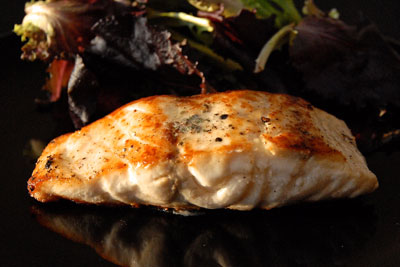
Like most cooks and food lovers, I’ve been eagerly anticipating spring’s bounty. Asparagus, morel mushrooms, ramps and rhubarb all return to markets and my dinner table. So, too, does the East Coast’s favorite sport fish, striped bass.
Found in ocean, rivers and estuaries from Canada to Louisiana, this long, silver, horizontally striped fish has been an American favorite since colonial times. In those days the fish could grow as long as 6 feet and weigh more than 100 pounds. In addition to being a big catch, it was a plentiful one. So great were its numbers that early settlers used striped bass for fertilizer as well as for food.
Unfortunately, popularity does not always translate into prosperity. By enriching their crops with striped bass, the colonists seriously depleted the striped bass population. In 1639, the Massachusetts Bay Colony had to ban this mulching practice to preserve the dwindling fish supply.
Centuries later, in the 1980s, overfishing brought another severe decline. Today, though, thanks to severe fishing restrictions and their strict management, this fish has largely rebounded. Although you won’t see those 100 pounders in markets — they primarily carry small, farmed striped bass — you can enjoy this fish from the wild once again.
Also called striper, greenhead and, in the Chesapeake Bay area, rockfish, striped bass is renowned for its spunky nature. In fact, its scrappiness and the resulting challenge of the catch are part of its great allure.
“This is not a fish for beginners or the faint of heart. It’s a very fast, hard fighting fish, a worthy opponent and delicious,” retired vintner and avid angler Frank Wilmer says. A native of southeastern Pennsylvania, Wilmer reels in striped bass off the surf on Long Beach Island, New Jersey.
With a feisty spirit comes a voracious appetite. This fish consumes plankton, shrimp, clams, crabs, eels and medium-sized fish such as menhaden. Its diverse diet undoubtedly contributes to its unique, sweet flavor and firm, moderately fat, moist flesh.
Its appealing texture and taste have earned striped bass many fans. Valley Forge Audubon naturalist Vince Smith considers it one of the best tasting fish. “I think of it as a cross between bluefish and weakfish. It has a dark, fat layer like bluefish, but not the heavy taste,” Smith says.
Striped bass any way you like it
What makes striped bass such a boon to fishermen and cooks is its versatility. After catching and cleaning it, you can prepare it in myriad ways.
More from Zester Daily:
For Smith, grilling is the best method. “I love to cook it on the grill with just a little salt. Leave it skin side down, then flip to finish,” he says.
Frank Wilmer concurs. “My buddies and I prepare striped bass by scaling them, slicing them laterally about 4-5 times on each side, sprinkling them with jerk seasoning and grilling them whole until well done. Never had fish done any better,” he says.
In addition to being grilled, its firm, oily flesh responds beautifully to baking, braising, broiling, deep- and pan-frying, poaching, roasting, sautéing, searing and steaming. The luscious, juicy meat goes well with ingredients such as artichoke, garlic, parsley, potatoes, scallions, shallots, thyme, tomatoes, white wine vinegar and port wine.
Because this fish possesses such a rich, lovely flavor, I tend to keep the preparations simple and the extra ingredients to a minimum. If I’m fortunate enough to have a whole striper, I stuff it with shallots or pearl onions, slices of lemon or orange and fresh thyme. I then roast it for 20 minutes or until done. Fillets I usually grill, sauté, sear or pan-fry. I then splash lemon juice, Tabasco or soy sauce on top and serve them alongside fresh cauliflower, corn, beets or greens.
Along with its vivaciousness, taste and versatility, striped bass has sustainability on its side. Hook-and-line caught striped bass from the U.S. Atlantic is considered a “best choice” by Monterey Bay Aquarium Seafood Watch. The milder, smaller, farmed striped bass also receives this coveted rating.
Among my angler friends optimism remains high for a good striped bass season. I hope they’re correct. For cooks like me who love the full-bodied flavor of the wild fish but rely upon others to catch it, it would be quite disappointing if their predictions turn out to be just another fish tale.
Pan-Seared Striped Bass with Lime-Basil Butter
Serves 4
Ingredients
5 tablespoons unsalted butter, at room temperature
Juice of ½ lime
Grated zest of 1 lime
1½ tablespoons fresh basil, minced
2 tablespoons olive oil
4 (4- to 6-ounce) striped bass fillets
Sea salt
Ground black pepper
Directions
1. In a small bowl, mix together the butter, juice, zest and basil. Set aside.
2. In a large, nonstick pan, heat the olive oil on medium-high heat. Season the striped bass fillets with salt and black pepper to taste.
3. Once the oil has heated, place the fillets in the pan and cook for 2 to 3 minutes, until the flesh has browned slightly. Turn the fillets over and cook for another 2 to 3 minutes, until the other side has browned and the center has turned opaque. During the last 30 seconds of cooking, dot the tops of the fillets with equal amounts of lime-basil butter. Remove the fillets from the pan and serve immediately.
Top photo: Pan-seared striped bass with lime-basil butter Credit: Kathy Hunt

Where do chefs eat? As culinary professionals have become celebrities, their favorite haunts have attracted more attention. Want to know where Ludo Lefebvre gets his favorite pancakes? Or where to find the best sushi, according to Danny Bowein (of Mission Chinese fame)? ChefsFeed has the answers, and a bit more. With thousands of high-end to hole-in-the-wall restaurant recommendations straight from the mouths of the country’s best chefs, you’ll learn where they love to go, and most important, what they like to order. There are currently 20 different cities on the app, with at least 20 chefs per city. The app is very user-friendly, with a little smiling face (usually) of the chef and photos of his or her recommended dishes. You can click on the dish and get details about the restaurant and also why the chef likes it. This has got to be one of the best ways to hunt down a meal. The icon is pretty cool, too.
Available for free on iTunes
Split the bill without pain
No, Splitsville is not an app that will supply you with text-message breakup lines. Rather, it is an app that will help you split a restaurant bill. Sure, when there’s just two of you it’s easy — excuse yourself to the restroom and hope the other person pays. But what to do if you have an odd number of people dining? Simply open up this little bad boy, enter the total amount (plus tip, of course) then enter the number of diners, and the app will do the rest. Of course, so will a calculator. Here’s the difference: If you arrived only in time for dessert whilst your friends feasted on steak and lobster, you will not have to pay for their surf and turf gluttony. Specify that your crème brûlée only cost you $15 and the app will adjust accordingly, charging your friends for their share while you pay for what you had. Never again will you feel cheated by a tab because your buddy ordered one more beer than you. It will be accounted for, and it will be fair — Splitsville will make sure of it.
Available for free on iTunes
Find sustainable fish choices
Seafood Watch has changed the way I buy fish. I refer to it for “ocean-friendly” advice every time I go out to buy seafood, especially at stores where I don’t have a friendly fishmonger to chat with. A bit of an admission as well: I sometimes purchase frozen seafood at Costco, and this app has kept me from many a fish-buying mistake. Made by the Monterey Bay Aquarium, the app brings you the most current recommendations for sustainable seafood and sushi, along with complete information about how each species should be fished or farmed. It is very simple to use and categorizes seafood as “best choice,” “good alternative” or “avoid,” with alternative options in the “avoid” section. When you delve into the app, you’ll notice the wealth of information available — everything from farming practices to where you can find a particular type of fish nearby. The sushi guide goes a bit further by providing the Japanese name as well as the English. This is an app worth downloading. All the information provided can also be found at www.seafoodwatch.org.
Available on iTunes and for Android for free
Drink wine by a biodynamic calendar
There is a growing opinion within the wine industry that wines taste better on certain days of the biodynamic calendar. Basically, with biodynamics, everything is dictated by the moon. The most common theory is, if the moon’s gravitational pull influences the ocean’s tide, it must also affect water in the soil and even sap within plants, which in turn can affect growth and flavor. There is a specific type of day depending on what phase the moon is in, they are: fruit, flower, leaf or root. For wine the best days to drink (and in fact transfer from tank to barrel) are said to be fruit and flower days. These days were originally used as guide for planting and sowing crops, but have more recently been extended into the wine world. Only a few blessed souls, however, have the ability to look at the moon and know what type of day it is. For the rest of us, there are two apps. BioGarden is a very cute biodynamic calendar app with little cartoon fruits and vegetables that tell you what type of day it is. You can scroll along from side to side quite easily and plan your biodynamic (drinking) calendar months in advance. When Wine Tastes Best is based off the biodynamic booklet of the same name. This is much more detailed, and actually tells you on the hour when the day type changes. It is set up a bit more seriously, and there is a free version that doesn’t allow you to look ahead in the week. Rest assured, neither app will ask you to bury your phone on the third full moon of the year.
Biogarden is $2.99 on iTunes
When Wine Taste Best is free or $2.99 on iTunes
Top image: BioGarden app. Courtesy of Summersun Corp
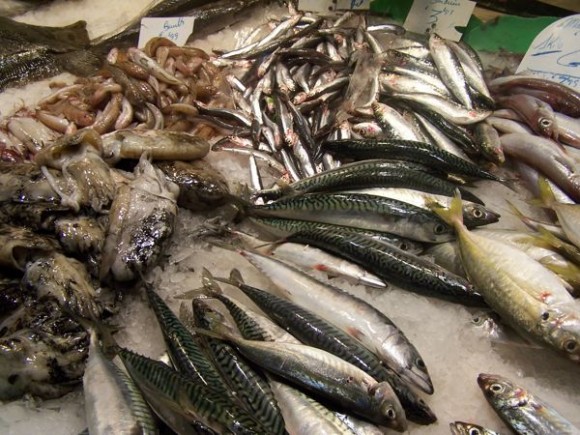
Eat more fish. That’s one of the prerequisites of the Mediterranean diet. We all know fish is good for us, yet Americans eat less than 16 pounds a year, man, woman and child. And for a lot of us, this sumptuous route to a healthy diet is simply unheard of. Astonishingly, there are people in this country who have never tasted fish.
Well, I was lucky. I grew up and learned to eat and cook in New England, on the coast of Maine where fish and seafood are considered a normal, customary part of each week’s menu. We weren’t Catholics, but we still ate fish on Fridays, possibly because there was a greater selection on that day. And of course we ate Maine lobster, scallops and crab. But the chef d’oeuvre of my mother’s kitchen was baked stuffed haddock, which I loved so much that later, when I went away to school, my mother always made it for that first welcome-home supper of vacation. She stuffed the whole fish with something like poultry stuffing — sagey, bread-crumby, oniony, thymey, peppery, and delicious — and then served it with a white sauce with sliced hard-boiled eggs in it. This doesn’t sound as enticing now as it was back then; tastes change with time, but I think if my mother were alive now and made that for me, I would tuck into it with just as much gusto as I did when I was 15.
More from Zester Daily:
» Mediterranean diet isn’t new, but it is healthy
» The ABCs of olive oil tasting and eight winnters
Explore beyond tuna and shrimp
I’ve always been perplexed at the indifference so many Americans, especially those away from the coasts, display toward seafood. Tuna is our favorite fish, but the greatest quantity we consume by far is canned. That’s a good thing, too, because canned tuna is mostly albacore and not the gravely endangered bluefin. Shrimp is our second favorite and that’s not good because, as delicious as some shrimp can be, most are raised on vast shrimp farms by environmentally destructive, highly questionable practices that yield a tasteless lump of rubbery resistant flesh, good as a foil for cocktail sauce and not much else. If you can get wild shrimp, fantastic! But most of us can’t.
Home cooks steer away from fish because it’s expensive and they don’t know how to prepare it, and then it stinks up the kitchen. Tasteless frozen pre-cooked shrimp and canned tuna require no preparation, which may be a large part of their appeal. Why bother with anything else?
Bother for these reasons: a) because any seafood made at home will be cheaper and probably tastier than in a restaurant; b) because it’s actually very easy to prepare; and c) because, the greatest selling point, it is unassailably good for you. Despite some popular beliefs that fish contains harmful amounts of mercury, researchers at the Harvard School of Public Health concluded in a meta-analysis back in 2006 (published in the Journal of the American Medical Assn., or JAMA) the health risks from consuming fish are unsubstantiated and have been greatly exaggerated. A much greater risk, said Dr. Eric Rimm, co-author of the study, “is in store for those who avoid fish entirely.”
Even the ultra-conservative American Heart Assn. suggests two seafood meals a week, and the Mediterranean diet recommends “at least” two or three servings weekly for everyone, including children.
“I could never get my kid to eat fish.” I hear you, loud and clear.
Fish for small-fry
Try this: Make fish fingers or nuggets by cutting up some halibut (or salmon grouper, mahi-mahi or the like). Kids love anything fried and crunchy, that they can eat with their hands. Set up three bowls, one with flour in it, one with a well-beaten egg or two, and one with good unflavored bread crumbs seasoned with a pinch of salt and, if your kids will tolerate greenery, some very finely minced parsley. Have a skillet with a skiff of olive oil in the bottom (2 tablespoons or so, depending on the size of the pan) ready to go on the stove.
Now dip each fish finger into the flour, rolling it to coat thoroughly, and shake off the excess. Dip the flour-coated fish into the beaten egg, letting the excess drip off. Put the egg-coated fish into the bowl with the breadcrumbs and roll it around, pressing on all sides so the breadcrumbs adhere. When all your fish fingers are done, set the skillet over medium heat and as soon as the oil is hot, add the fish fingers in a single layer—do it in two or more batches if you have to. Fry until crisp and brown on one side, then turn and fry on the other. By the time the bread-crumb coating is toasty brown, the inside will be cooked through. Serve with plenty of lemon wedges to squeeze on top.
Fish recipe with no fishy smell
Here’s another, only slightly more complicated treatment for those of you who worry about smelling the house up with fishy odors. For each serving, take a square sheet of heavy aluminum foil. Spread about a teaspoon of olive oil over the center, then set a piece of firm-textured fish (see the suggestions above) on it. Add a few disks of carrot and potato, blanched until just starting to tenderize, a slender ring of a smallish red onion, a few slices of zucchini, and perhaps a sliver of red pepper, green chili pepper or a couple of very small grape tomatoes. Fresh herbs are also nice with this—chives, thyme sprigs, or coarsely chopped flat-leaf parsley or basil. Sprinkle another teaspoon of oil over the top, add a genteel spritz of lemon juice, and then pull the corners of the foil up and twist them to seal, making a loose packet. Set the packets on a tray and transfer the tray to a preheated 400-degree oven. Bake for 10 to 15 minutes, or until the fish is done and the carrot and potato slices are tender. Serve in the packets — no fuss, no muss, no cleanup, and no fishy smell in the kitchen.
The message from the Mediterranean? Fish is good for you, it’s simple and easy to prepare, and, as those Harvard researchers determined, the health risks are minimal compared to the benefits. Farmed fish or wild (and the greatest percentage of our seafood consumption these days comes from aquaculture), it’s all to the good.
Top photo: Seafood display. Credit: Nancy Harmon Jenkins
As the Northeast struggles to get back on its feet after the roar of Sandy, so are the fishermen feeling the aftereffects of that wild storm. The hurricane blasted them. Fishermen up and down the coast lost their docks, their boats and their waterfront. Restaurants too paid a high price. So many of them are still digging out. Although Mary Cleaver, owner of The Green Table in New York City, lost power for several days, she managed to save at least 1,500 pounds of food to give to Saint John’s Bread and Life Soup Kitchen. Others did the same.
That said, as the fishermen get back to work and return to their boats, and the restaurants bail out their kitchens and reopen their doors, many chefs have made a commitment to help fishermen in the Northeast and New England by serving their fish. Fisherman and dock owner, Jared Auerbach encouraged people in a blog post to add Northeast and New England fish to their menus to support the effort. New York restaurants such as Cleaver’s The Green Table ABC Kitchen, Mark Murphy’s Ditch Plains and Fred’s at Barney’s were some of the first to offer Northeastern fish on their menus to help fishermen affected by Hurricane Sandy. They were joined by Michel Nischan and Jon Vaast at The Dressing Table in Connecticut, Lonnie Zoeller of Vinoteca in Washington, D.C., and Amos Watts of Jax Fish House in Denver.
These days we all want to know where the things we consume come from, including food. Fish is no different. The easiest way to know where your fish is sourced is to know your fishermen or at the least know the distributor who will know your fishermen and where your fish comes from.
Help finding local seafood, wherever you are
Sea to Table in Brooklyn, N.Y., is helping both fishermen and restaurants to get fresh local seafood from the dock to market and on the table the next day. This is an important job especially now in the immediate aftermath of Sandy.
In 1996 before the Dimin family started Sea to Table, they traveled to a small island at the end of the West Indian archipelago. While on vacation they had the opportunity to watch the local fishermen using the same traditional wooden pirogues, also known as dugout canoes, that had been used for thousands of years to fish their abundant waters. Those fishermen had more fish than they knew what to do with.
An idea was spawned during that vacation. And seven years later, in 2003, the Dimin family built what they’d seen in Tobago, by seeking out sustainably managed fisheries in Alaska; the Gulf Coast; from Florida through the Carolinas to the Chesapeake Bay; and from Montauk, N.Y., through the Gulf of Maine.
What kinds of fish should we be eating?
Fish, especially salmon, herring and sardines, are high in omega-3 fatty acids. So they’re good for us. But fish, like produce, can be full of pesticides, toxins and other sorts of unhealthy matter. Tuna and swordfish have more mercury than some other fishes. Tilefish, mackerel and shark are also high in mercury. So you might want to eat these fish on a less regular basis and look to monkfish, cod, striped bass and flounder as your go-to everyday fish.
Like any other food, it’s important to know if the fish you’re eating is being fished sustainably. This means the area where the fishermen are fishing is not being over-fished.
We’re told now that “wild” fish are the healthiest fish. Recent studies of wild salmon caught off the coast of British Columbia show those fish may be infected with a virus, however, which isn’t so great.
And what about farmed fish? A 2003 report from the Environmental Working Group showed that farmed salmon in the U.S. has the highest levels of PCBs, toxic man-made chemicals. And a widely publicized study in the journal Science in January 2004 suggested that farmed Atlantic salmon had higher levels of PCBs and other toxins than wild Pacific salmon. Subsequent research has found that the health benefits of both farmed and wild salmon exceed potential risks.
More and more customers want to know where their fish is coming from. I am convinced that fresh local wild fish from small-scale fisheries is healthy and delicious.
So this is a call to action for chefs and diners not only in the Northeast and New England, but also all over: Eat and buy local fish. Ask your purveyor what’s local and fresh when you’re cooking at home, and as diners ask your server where your fish was caught.
Consider Northeastern seafood for Thanksgiving
For Thanksgiving, why not consider a stuffed fillet of monkfish? Or a fish stew that includes local mussels, wild littleneck clams, oysters and Maine lobster? You can have all the Thanksgiving Day side dishes such as smashed potatoes, cornbread stuffing, sautéed green beans and a lovely kale and radicchio salad with local gorgonzola cheese. But you’d be helping the Northeast fishermen to recover after a brutal battle with Hurricane Sandy. At the very least, think fish for that special after-Thanksgiving Day party.
Sea to Table provides a direct connection with these fishermen. They know the local fishermen and the waters they fish in the Northeast and throughout the country. They are in constant communication with these fishermen and you can get more information about anything fish related from them.
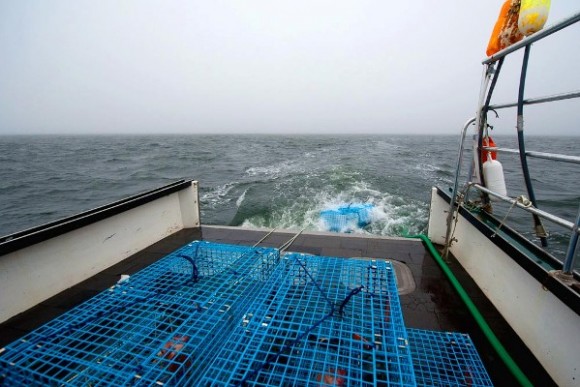
Top photo: Pots on the deck of the Fishing Vessel Hard Runnin’ Tide, which fishes for lobster in the North Atlantic off the coast of Maine. Credit: Andrea Trabucco-Campos
Daniel Pauly, marine biologist at the University of British Columbia, says we’re close to harvesting the last wild fish from the sea. If we do, we’ll have no choice but to eat farmed fish. Figuring out how to farm sustainably without bringing unbearable pressure on wild stock seems like a wise course. Perhaps we should save wild fish for special occasions, as we do wild meat, and the rest of the time eat what’s farmed by viable methods.
A good half of all seafood consumed by Americans comes from aquaculture of some kind — shrimp, oysters, branzino, Arctic char, and of course, Atlantic salmon. Seventy-five percent of the world’s fisheries are either fully fished or overfished, says the Monterey Bay Aquarium. It’s time to face up to the need to farm fish sustainably.
A lesson in how to do that is dramatically present in Chile’s far south where I was a guest recently of SOTA, Salmon of the Americas, an organization that promotes Chilean salmon aquaculture. The southern third of that long nation is a coastline of spectacularly indented fjords and islands washed by deep, chilly waters surging up from Antarctica. This nutrient-rich environment is prime salmon-raising territory, as ideal as the coasts of Norway or the lochs of northwest Scotland. Although not native to the Pacific, Atlantic salmon thrive on Chile’s clean cold water and strong currents.
Chile’s salmon saga
Salmon farming is relatively new in Chile, but in just a couple of decades the country surged to second place in salmon production, rivaling only Norway. Then, in 2007, a calamitous epidemic of Infectious Salmon Anemia (ISA) broke out, decimating farms and threatening Chile’s industry with complete collapse. By 2009, production had dropped by almost 60%, and Wal-Mart, a major buyer, turned to Norwegian suppliers. Chilean processors closed their doors, fish farms shut down and thousands of workers lost their jobs.
Such a scenario was predictable, observers said. Chile had become an international scandal, notorious throughout the tightly knit world of salmon aquaculture for crowded cages, polluted waters and abundant use of antibiotics and pesticides, including those banned by the United States and other countries. In 2005, the OECD (Organization for Economic Cooperation and Development) censured Chilean salmon operations. But producers were on a financial roll. “In the middle of a party, it’s difficult to communicate that something’s not right,” says Adolfo Avial, an industry consultant who sounded an early warning. “They didn’t want to see the problem.”
I was expecting the worst as I headed south from Santiago, Chile’s capital. I’ve visited salmon farms in the past, in Maine (a state that vaunts rigid environmental regulations for fish farming) and in Scotland’s extreme northwest. In both places I was impressed by the concern for environmental issues. Salmon farmers on both sides of the Atlantic have adopted more sustainable practices, combating disease through inoculation rather than medication, strengthening barriers between farms and the open ocean, and cutting back radically on the amount of wild fish necessary to provide meal and oil for salmon diets.
How Chile’s industry came back from the brink
What I found in Chile was an incredible story of the rebirth of a moribund industry. If it took disaster to bring Chilean salmon producers to their senses, the remarkable part of the story is the rapid recovery. On my weeklong visit to areas around Puerto Montt, I followed the salmon cycle, from the hatchery where eggs spawn, through the developing smolt stage, to sea cages and finally, two years after spawning, to the plant where mature fish are processed, filleted, thoroughly deboned, sometimes smoked and then flown to Miami where fish arrive within 18 hours.
Salmon quality, whether live fish leaping in cages or glistening rosy fillets on assembly lines, was impressive, as were the biosecurity measures employed. Everywhere, our group donned protective gear similar to that worn by plant workers, stepping through sanitizing pools, sometimes not daring to breathe to protect the atmosphere. This striking reform distinguishes Chile from more relaxed standards I’ve seen elsewhere. Other reforms were less visible: cage density, for instance, is reduced from 23 kilos per square meter to less than 14 kilos, so fish mortality has dropped from 15% to 0.2% per month, and growth rate has improved. Another important change: Fish are no longer transferred from cage to cage, mixing up different year classes and making it impossible to trace problems back to their source. Just as with humans, this kind of promiscuity is infectious.
ISA, which researchers compare to human influenza — omnipresent but seldom infectious — is no longer virulent in Chile in part because of biosecurity, and also because fish eggs, a suspected disease vector, are no longer imported, and the fish are inoculated against ISA and other diseases.
The end result is a bigger and better industry providing consumers with a product that is not just safe and inexpensive, but also delicious. The driving financial impetus, in other words, is product quality, and here Chile is clearly a leader. The salmon I saw and tasted was first-rate. If this keeps up, Chile’s salmon revival is guaranteed.
And if we fish-lovers hold the wild catch for truly special occasions, we’ll be a step closer to saving our oceans as well.
Chilean Salmon Fillets With Almond-Caper Sauce
Makes 6 to 8 servings
Ingredients
1 head garlic
4 boneless fillets (about 8 ounces each) of Chilean salmon
Sea salt and freshly ground black pepper
¼ cup extra virgin olive oil (Chilean, if available)
¾ cup dry white wine, preferably a Chilean viognier or sauvignon blanc
1 small onion, chopped
1/2 cup toasted almonds, chopped
4 tablespoons salt-packed capers, well rinsed and dried
Directions
1. Preheat the oven to 350 F.
2. Separate the individual cloves of garlic but do not peel them. Set the cloves on a baking sheet and roast for 15 minutes.
3. Sprinkle the fish fillets on both sides with salt and pepper.
4. Use a little of the oil to grease an ovenproof baking dish, then arrange the fish steaks side by side in the dish and pour the wine and remaining olive oil over them. Cover the dish and transfer to the oven to bake for 20 minutes.
5. Meanwhile, peel the garlic and chop the cloves. Combine the chopped garlic with the almonds and the onion in the bowl of a food processor. Add 3 tablespoons of the capers and pulse briefly, just to crush the ingredients and mix well — but do not make a paste.
6. When the salmon is done, remove the fish from the baking dish and keep warm on a platter. Bring the broth left in the baking dish to a boil, then reduce heat to low. Stir in the almond paste and simmer until the sauce is thick. Top the fish with the sauce and garnish with the remaining capers.
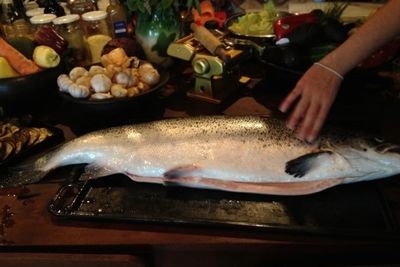
Photo: Chilean salmon. Credit: Nancy Harmon Jenkins
PUSH-PULL OVER SHARK FINS
A series on the controversy surrounding shark fins:
Part 1: Mock shark fins, an alternative to the delicacy
Part 2: Reaction to passage of California’s AB 376
Part 3: Shark fins and mercury
Late last week, California Gov. Jerry Brown signed AB376, a bill that outlaws the sale and posession of shark fins within the state. “Some shark populations have declined by more than 90 percent,” he said at the time, “portending grave threats to our environment and commercial fishing industries.” He signed the bill, he said, “in the interests of future generations.” Brown also signed a companion bill, AB853, that would give suppliers and restaurants another 18 months to exhaust their existing stock of shark fins, meaning that, practically speaking, AB376 will not go into effect until July 2013.
But that doesn’t mean the shark fin debate is closed. The 400-year-old “Compendium of Materia Medica,” one of the most respected manuals of Chinese traditional medicine, claims shark fins “can nourish the five organs [heart, liver, spleen, lungs and kidneys], increase kidney function, and are good both as a tonic and as an appetite stimulant.” The tradition continues. Chinese cookbook author Eileen Yin-Fei Lo claims that shark fins benefit the complexion as well. That, she says, “is why the Chinese regard the shark fin so highly.”
Not everyone concurs. Noted Harvard nutritionist Lilian Cheung, co-author with Zen master Thich Nhat Hanh of “Savor: Mindful Eating, Mindful Life,” says traditional medicine should be reevaluated. “I respect some of the claims,” she explains, “but it’s just like anything else with Chinese medicine: it’s sort of passed down through the centuries. We need to look at that together with the new scientific paradigm and see where they converge. It’s a good source of protein, there’s no question about it. But protein is something that Americans are not deficient in.”
Protein, water and ash
According to a recent report from the United Nations’ Food and Agricultural Organization, 97.5 percent of a dried shark fin is protein for the most part, with a bit of water; ash is the third-highest component at 2.2 percent. The rest of the fin consists of small amounts of fat, calcium, iron and phosphorus. Cheung laughs when asked about the nutritional value of shark fins. “From a nutritionist’s standpoint,” she says, “I don’t think it’s a good value! Nowadays, they are so expensive, and you’re not getting high quality.”
Chen Cunren, the late authority on Chinese cuisine and traditional medicine, wrote about shark fins and their nutritional value in his newspaper columns, which were collected under the title “Jinjin youwei tan” or “Talks on Eating With Gusto.” Chen pointed to a Shanghai study that found shark fins to be a concentrated source of protein, but he nonetheless promoted vegetarianism. “Eating shark fins every day is very detrimental to the digestive system,” he concluded, because they are so hard to assimilate.
Mercury counteracts potential benefits
Shark expert John McCosker of the California Academy of Sciences has often been asked whether shark fins are beneficial. “Absolutely not!” he says. “A bowl of vegetable soup is good for your health, but a bowl of shark fin soup can increase one’s impotence! It’s ironic, but consuming all of those toxins and that much mercury is bad for you.”
Does that mean that the benefits of eating shark fin soup don’t outweigh its potential harmful effects? “No one to my knowledge has been able to demonstrate any health value of consuming the soup,” McCosker says.
Large predatory ocean fish are likely to be high in mercury, McCosker says. But it’s almost impossible to measure the quantity. According to Peter Knights, the co-director of the conservation organization WildAid, “the only advice on mercury is the same pretty much for any fish: The lower down the food chain, the safer you are.”
Chinese consumers are becoming more aware of the dangers. A report on the Chinese-language television station KTSF in San Francisco’s Bay Area last May said pregnant women should avoid shark fin altogether because of the mercury. The amount of protein in dried shark fin is roughly the same, ounce for ounce, as that in dried egg whites.
The bottom line: Despite Chinese tradition, contemporary thought suggests that consuming shark meat and fins can be dangerous — and in California, Hawaii, Oregon and Washington — illegal too.
Zester Daily contributor Carolyn J. Phillips is a Chinese food wonk and illustrator who has a cookbook to be published by McSweeney’s in 2014. In addition to Zester Daily, you can find her on her blog and as @MadameHuang on Twitter; her food writing can be found in places as disparate as Lucky Peach and Pork Memoirs.
Illustration credit: Carolyn J. Phillips

Shop Indie Bookstores
California’s Senate passed a bill Sept. 6 by a vote of 25 to 9 to enact a full ban on the trade of shark fins in the state. If Gov. Jerry Brown signs the bill into law, the ban would take effect in 2013.
PUSH-PULL OVER SHARK FINS
A series on the controversy surrounding shark fins:
Part 1: Mock shark fins, an alternative to the delicacy
Part 2: Reaction to passage of California’s AB 376
Part 3: Shark fins and mercury
As was explained in my previous Zester article on mock shark fin soup, the proponents of Assembly Bill 376 (which passed in the Assembly in May on a 65-8 vote) appeared to have a reasonable argument: Since California is one of the largest markets for shark fins outside of Asia and is a main conduit for their distribution throughout the United States, this bill would reduce much of the pressure on what are being reported as rapidly diminishing shark populations all over the world.
Call to outlaw shark fishing, not just finning
However, not everyone sees it that way. Opponents of the bill, almost to a person, made an astounding argument that was rarely commented on during the debate running up to the vote: They would rather see shark fishing completely outlawed than allow Chinese-Americans, the main consumers of shark fins in California, to be demonized. Yes, outlawed. People such as State Sen. Ted Liu (D-Torrance); Pius Lee, the co-chair of the San Francisco Chinatown Neighborhood Association; and Cantonese Chef Kam Wo Au of the Kitchen in Millbrae, Calif., seemed to be agreeing to the impossible. “I would support just not killing sharks,” said Liu, “but if you’re going to kill a shark for a steak or for wallets, then I think you should use the same shark for soup.” And that was the main stance of just about everyone against the bill. As Au pointed out, “If no sharks can be caught, and you can’t eat them and you can’t sell them, I think this is more fair.”
Shark fin soup is Cantonese ‘heritage’
As for who is eating these California shark fins, Assemblyman Paul Fong (D-Sunnyvale) has a simple answer: Chinese-Americans who order shark fin soup. “I just know that my only opposition are the Cantonese … My people — I’m Cantonese too! The old-time Cantonese are the ones that are raising their voices, crying out ‘discrimination.’”
{igallery 146}
Fong is referring to opponents such as state Sen. Leland Yee (D-San Francisco), who thinks supporters of this bill “are trying to limit our heritage and our culture” by forbidding Chinese-Americans this traditional delicacy. Fong strongly disagrees: “It’s my culture too,” he says with a laugh. “You know, I’m Chinese-American too. I was born in China. I’m proud of the Chinese culture. The Chinese culture will survive without shark fin soup.”
The opposition to this bill centers on Lee and the business interests he represents, which according to the AB 376 bill analysis is a narrowly focused group of Chinese dried goods importers such as Chung Chou City and Stockton Seafood Center, and the Asian Nutrition and Health Association, a collective of Chinese product importers. Lee believes that AB 376 was not necessary because “the majority of shark fin is imported from other states, such as Florida and New York,” and so local fishermen, processors, importers, restaurateurs and diners should not be penalized.
Fear that shark fishing ban might lead to poaching
On the other side are the conservationists and scientists who realize that this wouldn’t work in reality. World-renowned shark expert John McCosker explained: “The attitude of conservationists and biologists is, [a complete ban] won’t work … if there’s any opportunity for illegal poaching, it will occur because the value of [the fins] is too much.”
As the chair of the California Academy of Sciences’ department of aquatic biology, McCosker has a ready answer for why Chinese-American consumers should not be allowed to remove the fins of sharks killed for sport or by commercial fishermen: “There’s no enforcement mechanism that can control it, so I don’t think that that’s possible.”
Peter Knights, executive director of WildAid, an international group intent on ending illegal wildlife trade, points out that “a small scale meat fishery in California is sustainable. There’s no big incentive there to cheat or take extra numbers or expand the catch. But if you put the fins in, there is. The fins are the most valuable part, and are driving the unsustainable fisheries of sharks around the world.”
Knights, who is working with Richard Branson and basketball star Yao Ming to publicize the shark fin dilemma in China and elsewhere, went on to add that “there isn’t a need to ban all shark fishing. I think recreational fishing is pretty well regulated within California, and I think that the commercial fisheries are sufficiently small scale at this point. They don’t pose a threat to shark populations, and they don’t impact shark populations beyond California waters. They are being governed by the Fish and Game Commission, so there is a venue if that becomes a problem, to address that. What there isn’t a venue for right now is anything to do with the shark fin trade, and that is what AB 376 is very specifically designed to do.”
Now that California appears to be banning shark fins for good, where will conservationists focus next? “New York,” says Knights, “would be the obvious next step.”
Zester Daily contributor Carolyn J. Phillips is a Chinese food wonk and illustrator who has a cookbook to be published by McSweeney’s in 2014. In addition to Zester Daily, you can find her on her blog and as @MadameHuang on Twitter; her food writing can be found in places as disparate as Lucky Peach and Pork Memoirs.
Photo: Dried shark fin for sale. Credit: Carolyn J. Phillips
Slide show credits:
Photos of Assemblyman Paul Fong, John McCosker, Sen. Ted Lieu and Pius Lee by J.H. Huang
Photo of jarred shark fins by Carolyn J. Phillips
Photo of Peter Knights courtesy of WildAid
It’s hard to get worked up over the plight of sharks. I admit it. They’re not as majestic as elephants, but they are disappearing faster than most of us realize. And just like the tusks of the elephant, only one part of the shark has any real value — its fins. The rest of the body is dumped back into the ocean as just another piece of garbage.
PUSH-PULL OVER SHARK FINS
A series on the controversy surrounding shark fins:
Part 1: Mock shark fins, an alternative to the delicacy
Part 2: Reaction to passage of California’s AB 376
Part 3: Shark fins and mercury
China’s shark fin soup is the culprit. The sad fact is that as China’s population has become more and more wealthy, its demand for shark fins has skyrocketed, directly resulting in the plummeting shark populations. The International Union for Conservation of Nature stated recently that a sixth of the world’s shark species are at high or very high rate of extinction, and as Jake Tilson noted last year on Zester, “Up to 73 million sharks are caught annually, many just for their fins.”
Ban on shark fin in the works
A pending California state bill would ban the sale, consumption or trade of shark fins, giving shark populations the opportunity to recover. Pulitzer Prize-winning food writer Jonathan Gold said it most succinctly not too long ago in the L. A. Times: “There is no third way with shark’s fin — we either stop eating it because we choose to preserve the species, or we stop eating it because soon there will be none left to eat.”
There’s still a chance that the tide will change, for this traditional Chinese ingredient is starting to lose its cachet, even among the Chinese themselves. Prominent celebrities such as basketball star Yao Ming and movie star Jackie Chan have become vocal about their support for the movement. This in turn is leading conscientious diners on both sides of the Pacific to protest rampant overfishing and the cruel practice of “shark finning,” where only the fins are lopped off live sharks before they are dumped back into the sea to either drown or be eaten alive.
A taste for the gelatinous
This all prompts the question, what is it about shark fin soup that is so appealing to the Chinese palate? The answer is simple: its gelatinous quality. Many of China’s exotic ingredients are savored for their texture rather than flavor. Sea cucumbers, deer tendons, swallow’s nest, jellyfish … in and of themselves have little or no flavor. But what they do have is a gentle chewiness that is loved by the Chinese almost as much as Americans adore anything crunchy.
Shark fin soup started in the southern province of Guangdong, where dried seafood has played an important part in the cuisine for centuries. Then, in the latter half of the 19th century, Beijing’s diners were gifted with a delicious influx of spectacular Cantonese dishes, courtesy of an imperial official and poet from Guangdong named Tan Zongjun, whose famous banquets rivaled any in the capital.
Tan had given his chef, Cao Jincheng, one directive: Make the best cuisine that anyone has ever tasted in the capital city. The results, which came to be known as Tan Family Cuisine, or Tanjiacai, were legendary, combining the most refined dishes of Guangdong with the familiar flavors of Beijing. Invariably elegant and richly sauced, Tan Family Cuisine soon became one of the great branches of Beijing’s culinary arts. More than 100 recipes make up this delectable Beijing-style cooking, the most famous of which are seafood dishes. Of these, the greatest are those that highlight shark fins.
Shark fin texture with a conscience
Fortunately, we can still dine like the Tans without endangering sharks; vegetarian shark fin is a remarkable substitute. Available frozen in 1-pound bags, the labels tend to translate the main ingredient for this alternative as gelatin, but my guess is that it is actually a combination of seaweed or agar-agar and starch, since veggie shark fin can be simmered without melting. As with the real deal, it is flavorless and provides a fragile gelatinous texture. (Some recipes suggest using cellophane noodles — also called mung bean noodles or fensi — in place of the mock shark fin, but they soften too quickly and turn gluey.)
This new version of the soup, which I’ve developed from the Tan original blueprint, concentrates on providing the same traditional delicate flavors, but punctuated with ersatz shark fin to satisfy that inimitable Chinese passion for texture. Here, as in Chef Cao’s original creation, everything but the stock ends up flying below your sensory radar — the dried scallops are practically undetectable in the final dish, providing only the barest suggestion that this soup is also about the sea. The green onions and ginger hover in the background, and the small piece of Chinese ham lends just a faint smoky saltiness.
Seek out a package of vegetarian shark fin in your Chinese grocer’s freezer and prepare a large tureen of a soup so good that it would have pleased even Tan Zongjun. And give the ocean’s sharks an opportunity to live another day.
(Carolyn J. Phillips’ most recent article, on Sichuan cuisine, includes a recipe for Sichuan wontons with red chili oil.)
Mock Shark Fin Soup, Tan Family Style
黃燜素魚翅 Huangmen suyuchi
Serves 6 to 8 as part of a multi-course meal
Ingredients
Directions
- Place the dried scallops in a heat-proof bowl and cover them with warm tap water. As soon as they have plumped up, use a paring knife to trim off any tough fibers or debris.
- Rinse the ham and trim off the skin. Cut a quarter of the ham against the grain into paper thin slices and then into a fine, even mince for your garnish. Chop the rest of the ham into about 6 pieces for the stock.
- Rinse the chicken breast and duck carcass, removing any organs or big pieces of fat, and trim as needed. Place the poultry in a stock pot and cover with cool tap water. Bring the water to a boil and simmer about a minute to remove any impurities, and then dump into a colander in the sink. Rinse the chicken and duck under cool tap water, being sure to wash off any scum.
- Return the chicken and duck to the rinsed out stock pot, cover with about 16 cups of filtered water, and add the scallops, ham chunks, ginger and green onions. Bring to a full boil, lower the heat to a gentle simmer, and cook the soup uncovered for about 3 hours to get every bit of flavor from the chicken parts. The liquid should be reduced to about 8 cups and the bones should have completely broken down at this point.
- While the stock is cooking, prepare the poached meat garnishes by placing the chicken breast and duck leg in a small saucepan and covering them with water by at least 2 inches. Bring the water to a boil, and then dump it out and rinse off the chicken and duck.
- Rinse the pan, return chicken and duck to it and add filtered water to cover. Bring to a boil again, cover, turn off the heat, and let the chicken and duck poach undisturbed for about 15 minutes. Check the meat by piercing with a chopstick; the juices should run clear.
- Strain the cooking liquid into the stock pot.
- When the chicken and duck pieces are cool enough to handle, remove and discard the skin and bones, and shred the meat with your hands into long strips.
- Place the minced ham in a heatproof bowl and steam for about 5 minutes; discard any juices. Taste, and if it is overtly salty, rinse the ham with boiling water. Drain in a small, fine sieve, and taste again; repeat as necessary.
- Place a large, fine sieve over a large (3- or 4-quart) saucepan and pour the stock into a covered 2-quart casserole, preferably a ceramic one with an unglazed exterior that the Chinese called a “sandpot” (shaguo). Use a heavy spoon to press all the juices from the solids before discarding them. You should have a nice bit of yellow chicken fat floating on the top, which is quite delicious, but most of it may be skimmed off if you must.
- Defrost the vegetarian shark fin by placing the package in a large bowl and covering it with hot water, adding more hot water as necessary. When it has completely defrosted, pour the contents into a sieve (don’t use a colander, as the holes are too big), and rinse under cool tap water. Drain well.
- Add the drained vegetarian shark fin to the stock in the casserole or sandpot and bring to a boil. Lower the heat to a simmer and slowly cook uncovered for about 20 to 30 minutes so that it absorbs these flavors and plumps up a bit.
- Gently stir in the shredded chicken and duck to heat through.
- Sprinkle the minced ham on top and serve at once, either in a tureen or in delicate soup bowls. This soup is best when eaten immediately while the vegetarian shark fin is still firm and the flavors are perfectly balanced.
Notes:
Vegetarian shark fin (suyuchi) can be found in the frozen section of some Chinese grocery stores. It is usually sold in 1-pound bricks. Keep it frozen until needed and defrost it either by placing it in a cool area on the counter overnight or by soaking the unopened package in hot water. Open the package into a sieve in the sink and work the pieces apart under warm tap water. Drain thoroughly before using.
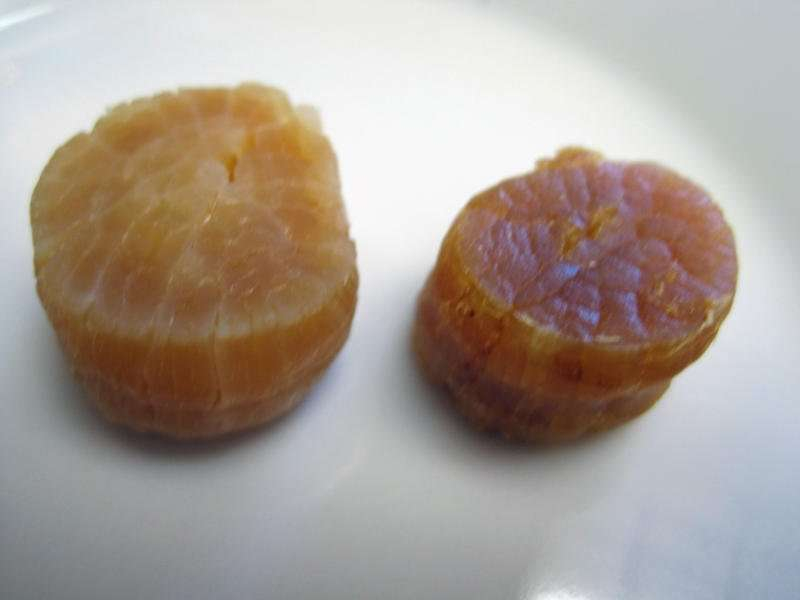
Dried scallops (ganbei) are best found at a Chinese herbalist’s or a specialty dried goods store, although some Chinese grocers will keep them behind the counter with other expensive goods like dried ginseng root. When using them to flavor stock, go for the cheaper small ones, which are just as tasty as the large ones. The dried scallops should have a slight “give” to them when pressed and should have a fresh scent of the sea. Keep dried scallops in a jar in a cool, dark place.
Chinese ham (Jinhua huotui) is a dried, pressed ham that is as often used as a seasoning as a main ingredient; brined or canned ham should not be used as substitutes, although country ham or Smithfield ham can be excellent. These hams are generally sold as slices in Chinese grocery stores with the bone and skin attached. Select a piece that is free of mold, is a nice rose color, feels slightly soft and not at all sticky when you press it, smells fresh and smoky, and has the smallest ratio of bone to meat; if you find any black mold on the skin, just scrape it off. Keep the ham completely dry and refrigerated in an air-tight bag; it will keep well for weeks this way. Just cut off the amount you wish to use and rinse it carefully under tap water, pat dry with a paper towel, and trim off any bones or skin; these can be tossed in soups for a wonderful boost of flavor.
Shaoxing rice wine (Shaoxing jiu or huangjiu) is a specialty of the eastern Chinese province of Zhejiang. Sometimes spelled Shao-hsing, this rice wine has a lovely aroma reminiscent of sherry and dried mushrooms. The best quality wine is not needed except for drinking, but neither should you go for the cheap “cooking” wine; something in the $3 to $5 range is usually good. Store the rice wine in a cool, dark place where it will keep pretty much indefinitely.
Top photo: Vegetarian shark fin soup. Credit: Carolyn J. Phillips