Articles in Editor’s Letter
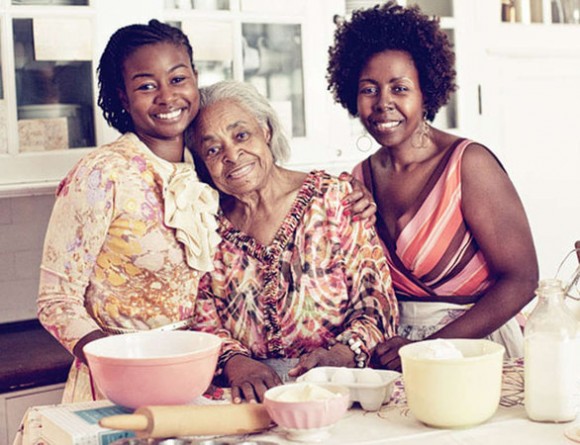
This Thanksgiving, welcome your family into your kitchen and let the adventure begin. This is the story of the Hinton-Brown family’s adventure.
* * *
Fresh from law school at the start of a promising legal career, Norrinda Brown longed for a creative outlet, a way to keep her pressure-filled professional life in balance.

More than anything, she wanted to bake cakes. Growing up in her grandmother’s kitchen, every day had been baking day, layers of fragrant pound cake cooling on the counter, bowls of fluffy frosting in the fridge, butter was the essential ingredient in everything. Mothers baked with daughters, grandmothers with grandchildren. Baking by yourself, for yourself? Who does that?
Talking with her mother Linda Brown and grandmother Betty Hinton, an idea took hold that grew into a plan that became an obsession. Together, they could bake to their hearts’ content if they opened a cake shop.
Crazy. It was crazier than it sounds. Norrinda Brown Hayat had a full-time job as a lawyer. Her mother was a public school teacher. And her grandmother had long ago sailed past her 70th birthday. None of them had been businesswomen or worked in commercial bakeries.
Faith. Norrinda was convinced this was a particularly good time to open a bakery in their hometown of Philadelphia. Most of the city’s bakeries were Italian cannoli cafés. Competition in her family’s Southern layer cake culture was limited, as many of the older stores had gone out of business. More encouraging, the traditional pace for these bakeries was leisurely. It was common for cake shops to close in the late afternoon and stay closed Sunday mornings and all day Monday.
Recipes. No one made cakes like Norrinda’s grandmother, who baked by instinct and memory as her mother had before her and her mother before her.
ZESTER DAILY
BOOK LINK

“The Brown Betty Cookbook”
By Linda Hinton Brown, Norrinda Brown Hayat
(Wiley, 2012, 192 pages)
Research. Together they were able to capture their family’s sense memory in recipe and for six months tested their creations on groups of friends, then groups of friends of friends, community gatherings, country club parties, women’s groups. They served their cakes with a chaser of questions. Sweet enough? More butter? How do you like the strawberry cake?
Brown Betty Bakery opened in 2004; its name is a play on her grandmother’s first name, her mother’s married name and a sly reference to Apply Brown Betty, a signature menu item.
Luck. “We stumbled into a really supportive community,” says Norrinda. An abandoned manufacturing area in the Northern Liberty area of Philadelphia was being revitalized with small shops and businesses. Spaces were small, rents were low and the tenants helped each other survive. “Almost all of our neighbors were first-time, one-off female-owned businesses.”
Oops. They needed all of the help they could get. Norrinda had misjudged Philadelphia’s bakery market. “A lot of the older bakeries had closed. And I didn’t fully appreciate why,” says Norrinda. Rather than retiring, as she had assumed, they’d collapsed, unable to keep up with the quickening pace of retail.
Customers patronized shops that were open early and late, every day of the week. “We weren’t ready for this,” says Norrinda. “I didn’t know how hard it would be. Baking had always been relaxing. I underestimated how successful we’d be and how demanding it was to serve the public.”
Sweat equity. For the first three years, Norrinda and her mom ran Brown Betty Bakery by themselves with only one extra employee. Betty came in every Friday night and left Saturday morning to test new recipes and oversee quality control. If that meant fewer cakes than buyers, so be it. “We did everything so we could keep overhead low,” she says.
It wasn’t until Norrinda Brown became Norrinda Brown Hayat that they broke down and hired more staff. “We knew we couldn’t continue to be the ones who took out the trash and swept the floor.” And, of course, as soon as they delegated more work to others, business grew quickly.
Success. There are two Brown Betty Bakeries in Philadelphia now operated by a staff of 25 with plans to open more shops as well as an online store. But what has them “traumatized,” says Norrinda, is the book. “Mom really didn’t want to do the cookbook and give out the recipes.” “The Brown Betty Cookbook” (Wiley), released last month, is the first time they’ve shared their family’s secrets.
“We’ve stayed close to what baking means to our family. It brings us together.” Though she is 89 years old, Betty still creates new cakes. Linda has yet to retire from teaching. And Norrinda never gave up her law practice.
And they’ve never stopped making time to bake together.
Top photo: Three generations of bakers, Norrinda Brown Hayat, Betty Hinton and Linda Hinton Brown
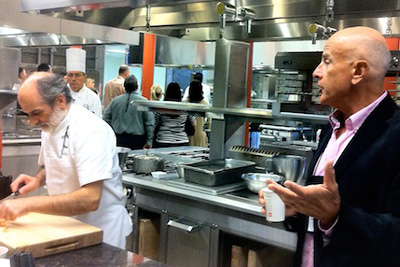
Food is a mirror of who we are, Zester Daily contributor Clifford A. Wright told the more than 700 food professionals attending the 15th annual Culinary Institute of America Worlds of Flavor conference last week. Rather than a single reflection, “food is a constantly changing picture of where we came from and where we are going.”
And with these words, Wright opened CIA’s annual international festival at its Napa Valley campus last week, a three-day event jam-packed with lectures, demonstrations and cooking lessons featuring more than 70 of the world’s leading food authorities, each illustrating a different aspect of the Eurasian migration of flavor.
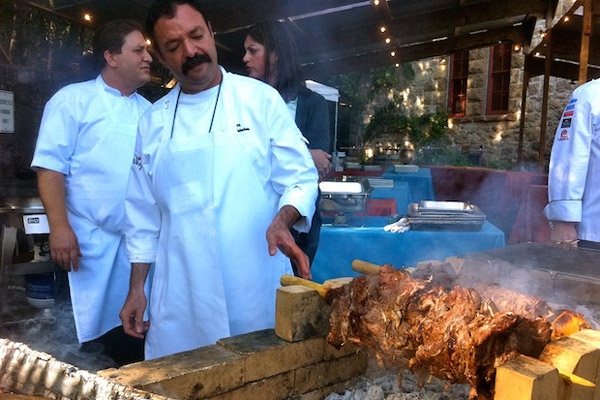
Musa Dagdeviren, chef/owner of the renowned Ciya Sofrasi in Istanbul, demonstrating his signature open-fire kebab cooking. Credit: Corie Brown
Wright was one of many speakers with a Zester connection. Zester contributor Jody Eddy moderated a cooking demonstration. Michael Krondl, Naomi Duguid, Joan Nathan, Skiz Fernando, Diane Kochilas and Hiroko Shimbo were among the guest authors who have written a Soapbox for Zester. (Shimbo’s Soapbox will appear later this month.)
A charming and gregarious raconteur, Wright spoke several times during the conference, entertained the crowd with his “Cliff’s notes” version of the history of the spice trade — a 1,000-year tale of rich people scouring the world for ways to improve the quality of their dining experience. The more wealth there was, the fiercer the trade in spices and other foods that could survive long journeys. One cuisine borrowed from another in a chain that continues today.
The highlight of the CIA event, however, was the dazzling collection of international chefs who rolled up their sleeves and share their kitchen secrets with the crowd.
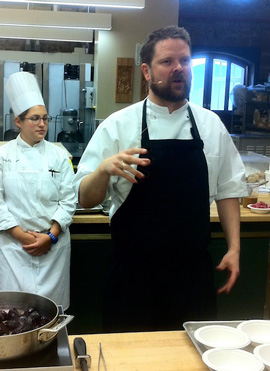
Gunnar Karl Gíslason, chef/owner of Dill restaurant in the Nordic House in Reykjavik, has roasted beets warming in a cooking demonstration while he explains his Icelandic cuisine. Credit: Corie Brown
- Italy’s Corrado Assenza, chef/owner of Caffé Sicilia, a cutting edge pastry-coffee-ice cream bar in the baroque town of Noto in southeastern Sicily.
- China’s Yu Bo, considered the Ferran Adrià of China, is the chef/owner of Yu’s Family Kitchen in Chengdu, capital of Sichuan province.
- Turkey’s Musa Dagdeviren, chef/owner of Ciya Sofrasi in Istanbul celebrating traditional Anatolian cuisine.
- Spain’s Ángel León, chef/owner of Aponiente in Puerto de Santa Maria in Cádiz developing plankton cuisine.
- England’s Yotam Ottolenghi, chef/owner of five London restaurants whose cookbook “Jerusalem” has been a smash hit around the world.
- San Francisco’s Mourad Lahlou, chef/owner of Aziza in San Francisco, known for modern interpretations of traditional Moroccan cuisine.
- American Maxime Bilet, co-author with Nathan Myhrvold of “Modernist Cuisine: The Art and Science of Cooking,” a technologist pushing the limits of kitchen science.
Iceland was represented by Gunnar Karl Gíslason, a young chef whose extraordinary take on his country’s local flavors has made Dill in the Nordic House in Reykjavik a leading light in a country searching for its culinary soul. Zester’s Eddy, co-author of the chef’s upcoming book, told the story of Iceland’s culinary struggles after the devastating economic crisis in 2008. Long dependent on imported food, the cold country has been forced to become self-sufficient for the first time in generations. Gíslason’s hyper-local cuisine using native sea salts, seaweed, livestock and root vegetables took off, creating a first-ever potential to export distinctive Icelandic flavors to other countries.
A satellite in the world of flavor
Malaysia-based Zester contributor Robyn Eckhardt wasn’t able to attend CIA’s event. She’s busy with a new assignment: writing a twice-a-month column on street food for Wall Street Journal Asia. Check it out at Wall Steet Journal Asia.
Top photo:
Clifford Wright leads a cooking demonstration at CIA’s Worlds of Flavor with Corrado Assenza, a leading Italian pastry chef and owner of Caffé Sicilia in Noto, Italy. Credit: Corie Brown
Kimbal Musk has an audacious plan to destroy America’s appetite for junk food.
His big idea? Plastic.
Musk wants to revolutionize Alice Waters‘ concept of school gardens as societal change agents by making the gardens easy to build and maintain. More gardens will be installed and more students will learn the joy of growing and eating healthy fruits and vegetables.
As it is, Musk says, school gardens are a laudable idea that is dying on the vine. Raised wooden beds that look pretty when they are first planted disintegrate in a few short years. The alternative — concrete beds — is an ugly, expensive and permanent albatross schools grow to hate. Tear up school-yard blacktop to create green space? No public school has that kind of money.
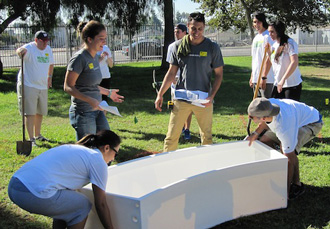
Volunteers from the Wasserman Foundation and Kimbal Musk’s Kitchen Community help assemble module units made of food-grade, indestructible plastic for school gardens in Los Angeles. Credit: Corie Brown
Musk made it a personal project to design a solution. His modular plastic garden containers snap together to create customizable outdoor classrooms that can sit on top of existing hard scape. His concept is so slap-your-head simple that less than a year after launching his nonprofit Learning Gardens, Musk has commitments for at least 60 gardens each from Chicago, Los Angeles and Colorado to be installed by the end of 2013.
“I want to make the school-garden movement work,” says Musk, who was in Los Angeles two weeks ago to witness the planting of two giant gardens, a total of 3,000 square feet dedicated to fruits and vegetables, at Samuel Gompers Middle School in South L.A.
The key to ensuring that the gardens flourish is local control. Musk partners with a local sponsor, who raises the funds and works with the individual schools to design the gardens. “I don’t make a dime from this,” says Musk, “which gives us credibility with the people raising money to build these gardens.”
The Wasserman Foundation, led by sports business entrepreneur Casey Wasserman, took the lead at Gompers providing all of the funding and 100 Wasserman employees for the planting.
If gardens increase student engagement, they are a good investment, says Wasserman. “The success of our kids in our schools is the leading issue for our city.”
High tech and an apron
Musk comes to the school garden party with a rare combination of technology expertise and kitchen cred. In 1995 at 23, he and his brother Elon founded Zip2, an early content management system that provided the first maps and door-to-door directions on the Internet. The company built online restaurant and city guides in partnership with 100 major media companies, including the New York Times. It was sold in 1999 to Compaq for a reported $307 million.
Among several investments in startup software and technology companies, Musk helped his brother launch the company that would become PayPal. That venture was acquired by eBay in 2002 for $1.5 billion in stock. Elon used his winnings to found SpaceX and Tesla Motors while Kimbal redirected his energies into his passion for food, attending the French Culinary Institute in New York City.
After traveling the country with his wife in search of a community to call their own, the Musk family settled in Boulder, Colo., and, in 2004, the couple opened The Kitchen. Its composting, wind-powered, recycle-everything culture earned immediate applause from Boulder’s environmental community. Food critics from across the country raved about Musk’s garden-fresh cuisine featuring ingredients harvested from the massive garden he planted near the restaurant.
Turning point for more than Kimbal Musk
From the earliest days, Musk’s vision included a modest nonprofit to support school gardens, an effort he named The Kitchen Community. The huge leap from supporting Boulder-area school gardens to today’s sweeping ambition to build gardens in every school in the country came after nearly dying in a tubing accident 2½ years ago.
“After my accident, the stuff that mattered was stuff that made a difference in the world, not the stuff that made money,” Musk says in his soft South African accent, a lingering artifact from his childhood in Pretoria. He moved to Canada when he was 18.
“After Kimbal broke his neck, it super-charged the giving philosophy,” says Travis Robinson, Kitchen Community managing director, who also traveled from Boulder to help with the Gompers planting. “Kimbal is a visionary, but he is pragmatic. It’s step by step, day by day to create communities and empower people.”

Finished gardens at homeless shelter for female veterans. The gardens at Samuel Gompers School will be 10 times this size. Credit: Corie Brown
Building school gardens costs a fraction of what it would cost to lobby Congress to change farm policy, says Musk. And in the long run, it is the more effective way to change society. “Start with the young, work with them until they are adults, and they will demand real food. When you have the demand, you can change the government policies that create McDonald’s and junk food.”
“I knew if I could make this work in the South Side of Chicago with $2 million, I could raise $2 billion and make it work everywhere,” he says. “We will have gardens in about 20% of Chicago’s schools. That’s a critical mass of students, enough for a movement that can change the food culture in that city. You do it child by child.”
Students aren’t the only people who can benefit from Musk’s novel approach. Last May, I asked Musk for help on a project to overhaul the outdoor space for a shelter for homeless female veterans. The backyard of the Venice, Calif., home was one giant cement slab, and they wanted a vegetable garden.
Musk came to the rescue with a “starter garden” that could sit on the cement. The lady vets loved how they could move the modules around to redesign their garden whenever they felt like a change.
Building the demand for fresh, wholesome food one person at a time.
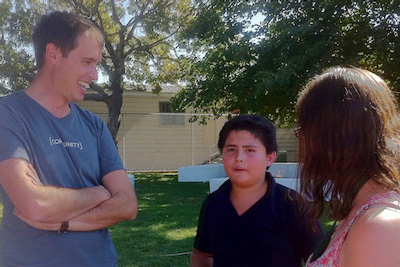
Photo: Kimbal Musk with a student and special education teacher Holly Driscoll at Gompers Middle School in South Los Angeles. Credit: Corie Brown
Chefs should be advocates for the environment. After all, if feeding people is your business, sustainable food is your responsibility.
This call to arms has guided the Chefs Collaborative since the Boston-based nonprofit was founded 19 years ago. And its appeal only grows.
Today, the Collaborative boasts more than 1,000 dues-paying members and a network of 12,000 supporters across the country. Last week, a standing-room-only crowd of 325 young chefs and cooks jammed the Seattle Culinary Academy for the Collective’s annual Sustainable Food Summit, evidence that a new generation is fully engaged in the cause.
As much as anyone, Collaborative executive director Melissa Kogut deserves credit for transforming the organization’s mission into a movement. While it is the chefs who instill the group with purpose, Kogut is in charge of raising the funds that allow cash-strapped kitchen junkies to organize local self-help networks across the country.
“I’m a community organizer at heart,” Kogut says. “This work is more than a job. It’s a cause.”
Kogut has enlisted food purveyors including Alaska Seafood Marketing Institute, Niman Ranch and the American Lamb Board along with food-service giants such as Sodexo to support Chefs Collaborative. Google was one of dozens of sponsors of the Seattle conference. The funds enabled many of the young chefs to make the journey to Seattle.
On a local level, chefs teach each other practical solutions to common challenges. Which fish are plentiful enough to serve? How do you use a whole pig and reduce waste? Is there a high quality local dairy near my town? A Chefs Collaborative member probably has the answer and is willing to share.
In Seattle, it was clear that these passionate earth-first chefs have been tempered by the challenge of financial survival. The emphasis was on helping their kitchen brethren start down the road toward sustainable practices. No one preached environmental orthodoxy.
Everyone starts by taking “baby steps,” one chef told the group.
Collaborative national board chair Michael Leviton, chef/owner of Boston-area’s Lumière, opened the meeting. “Small pricey restaurants are only going to reach a few people every night. So how are we going to reach the big corporations who serve most of the world?”
The answer, he said, is through building the sustainable community. “We need to shorten the distance between farm to table and scale that up. And we need to do that together.”
By the end of the three-day event, the group had butchered a goat, taste-tested frozen versus fresh beef, and debated the Farm Bill, immigration policy, minimum wage and foie gras bans. No topic was taboo. And every meal was a feast.
Before Kogut joined the Collaborative staff in 2007, she served for 11 years as executive director of NARAL Massachusetts, a statewide organization that advocates for women’s health. In 2006, she received the Abigail Adams Award from the Massachusetts Women’s Political Caucus, which recognizes and honors outstanding women leaders.
Zester Daily is proud to have Kogut as a member of our Advisory Board.
Top composite photo:
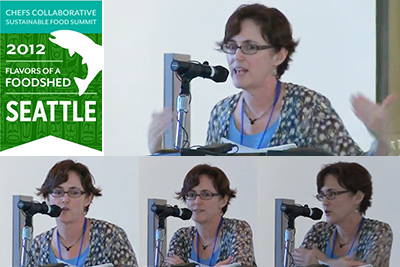
Melissa Kogut at 2012 Sustainable Food Summit in Seattle. Credit: Screen shots from video courtesy of Rival Marketing
Rarely do chef memoirs become New York Times bestsellers. But when Marcus Samuelsson asked Veronica Chambers to help him write “Yes, Chef: A Memoir,” he added the secret sauce to the telling of his story that is sending book sales soaring and making “the black Swede” a media darling.
Samuelsson credits Veronica in the acknowledgments — “The fine touch on the words is all hers” — which the New York Times says explains the unexpected “sparkle and grace” of the writing. It’s a rave review of a story told “simply and movingly.”
I first met Veronica 20 years ago when she was enjoying similar adulation for her own memoir “Mama’s Girl,” which the New Yorker called “a troubling testament to grit and mother love … one of the finest and most evenhanded in the genre in recent years.” She was a young star at Premiere magazine, where she was an editor and a writer while still in her early 20s. I was a columnist at the magazine writing about the business of Hollywood.
Veronica’s insights into what makes celebrities tick, as well as talk, gave her an edge as a profile writer. With an infectious love of life, everyone wanted to be near her. She is the person in the office who made hard days easier and the best days better.
We both left Premiere to join the staff of the features section of Newsweek, she in New York and me in Los Angeles. And she continued to write books. Veronica’s most recent nonfiction book is “Kickboxing Geishas: How Japanese Women are Changing Their Nation.” Her other nonfiction books include “The Joy of Doing Things Badly: A Girl’s Guide to Love, Life and Foolish Bravery.”
But, of course, Veronica has never done anything badly. After Newsweek, she spent two seasons as an executive story editor for CW’s hit series “Girlfriends” and earned a BET Comedy Award for her script work on that series. She has been a top editor at Conde Nast’s Glamour and Hearst’s Good Housekeeping magazine.
Books that open doors
Born in Panama and raised in Brooklyn, Chambers’ work often reflects her Afro-Latina heritage. This is particularly true for her dozen-plus children’s books, most recently “Celia Cruz, Queen of Salsa” and her teen series, “Amigas,” a collaboration between Chambers, producer Jane Startz and Jennifer Lopez.
A graduate of Bard College at Simon’s Rock in Massachusetts, Veronica and her husband have endowed three scholarships at the college in the fields of music and literature. She has been the recipient of several awards, including the Hodder fellowship for emerging novelists at Princeton and a National Endowment for the Arts fiction award.
I have long been honored to call Veronica my friend, and now I am honored to have her as a member of the Zester Daily Advisory Board.
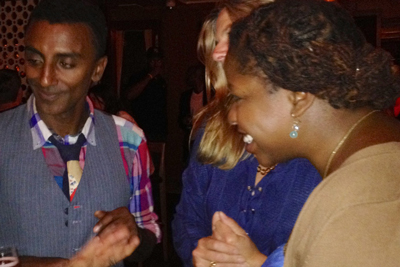
Top photo: Marcus Samuelsson, who enlisted the writing expertise of Veronica Chambers, right, for his memoir “Yes, Chef.” Credit: Jason Clampet
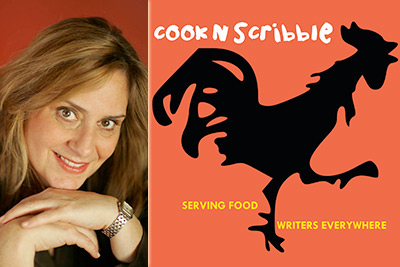
The moment I cracked the spine on “One Big Table,” I wanted to meet the writer, Molly O’Neill. Her 10-year journey into home kitchens across the country spoke to me as few other cookbooks have — perhaps because “One Big Table” is so much more than recipes.
In our hopelessly divided world, I believe food remains a common denominator. You can talk about what you like to eat with anyone, regardless of religion, politics or bank accounts. If I tell you about my favorite family recipe, you can share yours. It’s so simple, so human.
A graceful and gracious storyteller, O’Neill proved my theory. Her expansive collection of recipe tales captures the heart and soul of regional American home cooking, inspiring us to move forward with Zester Daily. Her e-mails of encouragement buoyed us during the hard work of making a food journalism website function properly.
A former food columnist for The New York Times Magazine and host of the PBS series “Great Food,” O’Neill’s work has appeared everywhere that counts. She has written a memoir “Mostly True,” four cookbooks, including the award-winning “New York Cookbook,” and edited the Library of America’s “American Food Writing.” “One Big Table” is an ongoing web-based project with new writers compiling even more recipes and stories.
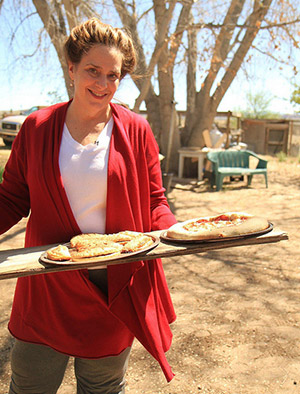
Molly O’Neill at Santa Fe retreat for writers. Credit: Jen Reynari
O’Neill’s current project is as ambitious and inspiring as her last. Cook N Scribble is a resource for food writers, providing support, education, mentoring and community in the wake of the collapse of conventional newsrooms and editorial offices. She offers virtual seminars and food-writing retreats.
As part of that effort, she recently launched the LongHouse Writers Revival — a series of one-day, single-subject conversations in the style of the 19th-century Chautauqua Movement. This year’s topic is the “false divide” between old media and new media. Distressed by a growing generation gap among food writers, O’Neill wants to bring back “the joy of writing about how people live their lives and cook their dinner.”
The first LongHouse Revival is Aug. 12 on Vashon Island, Wash. I will be there, joining Shauna Ahern, founder, glutenfreegirl.com; Tanya Steel, Epicurious; Debra and Rod Smith, founder of smithbites.com; Judith Dern, editor-in-chief, all-recipes.com; and Matthew Amster-Burton, founder of the Spilled Milk podcast; and no more than 50 food writers. The day will conclude with a Vietnamese pig roast. Both the conversation and the food promise to be delicious and worthwhile.
The next revival — and a pig roast illustrating the story of the Mexican diaspora in America’s northeast — is set for Sept. 15 near O’Neill’s home in Rensselaerville, N.Y. Ahern, the Smiths, Steel and I will be joined by Francis Lam, Gilt Taste; Katherine Alford, Food Network; Sara Kate Gillingham-Ryan founder, kitchn@apartmenttherapy; Dorie Greenspan, author, baker, blogger; Kathy Gunst, food correspondent, NPR’s “Here and Now”; and Brian Halweil, publisher, Edible Manhattan; and 50 food writers. Again, the feast and seminar will be a treat.
Zester Daily is honored to announce Molly O’Neill as a member of our Advisory Board, supporting our mission to connect people around the globe through respect for and love of food.
Our advisors are longtime supporters and friends who have increased our relevance and reach. With the creation of the advisory board, we recognize and honor these sustaining relationships.
Click here to meet all of the members of the Zester Daily Advisory Board.
Top composite image: Molly O’Neill. Credit: Fred Jordan. Logo courtesy of Cook N Scribble.
Legendary cooking teacher Anne Willan had recently settled in Santa Monica with husband Mark Cherniavsky, leaving her celebrated École de Cuisine la Varenne in France’s Burgundian countryside for a quieter life near family in California, when we first met. Over lunch at the Santa Monica Seafood Market, I shared with her the first flickers of our idea for a journalism collective centered on food. Her enthusiastic support at such an early stage in our development continues to inspire all of us at Zester Daily.
At the time, Willan was in the thick of researching and writing “The Cookbook Library: Four Centuries of the Cooks, Writers, and Recipes That Made the Modern Cookbook.” Written in collaboration with Mark, Willan’s book has now been published, prompting her to write the delightful Zester Daily Soapbox “Fancy a Bit of Stuffed Peacock?,” introducing the rest of us to the treasures in their beloved cookbook collection.
Critical raves
The Scotsman heralds her book as an “absorbing ragout of serious history, beautiful coffee-table book and practical kitchen guide.” Among the outpouring of critical praise, the Philadelphia Inquirer says, “Whether it was the medieval spice trade (when a pound of nutmeg was worth seven fat oxen) or the 16th-century sugar rush (coinciding with colonial expansion), Western history lies in these ancient recipes.”
Willan hasn’t stopped teaching and is re-creating a bit of La Varenne in Santa Monica, hosting classes with the area’s most inventive chefs. When she is not in the kitchen, she is working on a memoir.
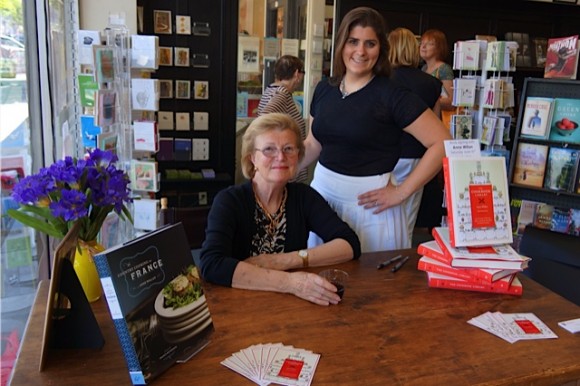
At a recent book signing at Chevalier’s Bookstore in my Los Angeles neighborhood of Hancock Park, it was a pleasure to see Anne surrounded by fans eagerly snapping up copies of “The Cookbook Library” for her to autograph. I felt more than a little pride in the fact that I introduced Anne to Elizabeth Weinstein, her assistant who helped manage the book through its final stages. In her other life, Elizabeth is Zester Daily’s marketing director.
Zester Daily is honored to announce Anne Willan as a member of our Advisory Board, supporting our mission to connect people around the globe through respect for and love of food.
Our advisers are longtime supporters and friends who have increased our relevance and reach. With the creation of the advisory board, we recognize and honor these sustaining relationships.
Click here to meet all of the members of the Zester Daily Advisory Board.
Top photo: Anne Willan and Elizabeth Weinstein at book signing for “The Cookbook Library.”
Corie Brown, the co-founder and general manager of Zester Daily, is an award-winning food writer at work on a book about climate change and wine.

Robert Kenner’s Oscar-nominated film “Food, Inc.” electrified audiences when it was released in theaters during the summer of 2009, raising critical questions about the safety and sustainability of the American food system. In the midst of the storm of publicity that followed, Kenner gave Zester Daily one of our first Soapbox pieces and established Zester’s weekly opinion feature as a serious forum for authors and activists willing to tackle important political and environmental issues.
Today, Kenner continues to challenge us to think about what we eat through Fix Food,  an ambitious effort to transform the American food system. Supported by progressive companies and nonprofit organizations including Chipotle Mexican Grill, Organic Valley, Environmental Working Group and Climate Counts, Fix Food uses videos and social media to educate and engage Americans about serious threats our food supply.
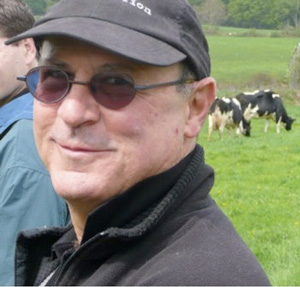
Robert Kenner
Fix Food recently released a new video in its Meat Without Drugs campaign produced in partnership with Consumers Union. Narrated by Bill Paxton, the video depicts “how the rampant overuse of antibiotics on factory farms is creating ‘super bugs’ that get into the air, water, and our food, making us vulnerable to once-treatable diseases.” We encourage everyone to check out Kenner’s latest Fix Food campaign and join the effort to end the overuse of drugs on factory farms.
Zester Daily is proud to announce that Robert Kenner is a member of our new advisory board and supports our mission to connect people around the globe through a mutual respect for and love of food.
All of Zester’s advisers are longtime supporters and friends who have increased and strengthen our relevance and reach. With the creation of the advisory board, we recognize and honor these sustaining relationships.
Click here to meet the other members of the Zester Daily Advisory Board.
Corie Brown, the co-founder and general manager of Zester Daily, is an award-winning food writer at work on a book about climate change and wine.