Articles in Environment
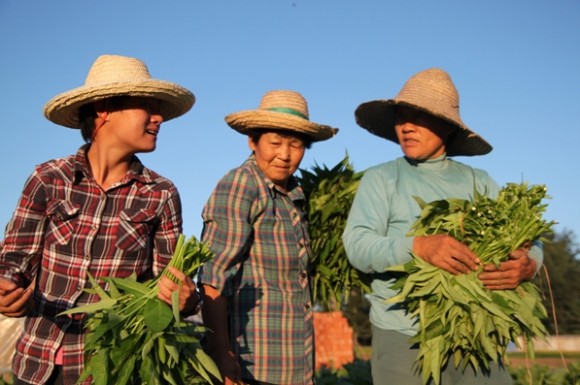
My friends abroad hear about the food safety crises that erupt either in China or from food products grown and manufactured in China, and they assume all food in China is toxic. So they’re always surprised when they learn it’s not all exploding watermelons, milk infused with melamine or dumplings stuffed with cardboard here in Beijing. I eat organic-grown and locally sourced food nearly every day. Brought to my door on a weekly basis, I have a Community Supported Agriculture (CSA) organization called Shared Harvest (or Fenxiang Shouhuo, in Chinese) to rely upon this fall season.
Organic food is growing in popularity in China, so it shouldn’t come as such a surprise that I can eat food grown without chemicals. According to the state-run China Daily, Lohao, a leading retailer of organic food, sales revenue increased by about 30% during 2011. A story in TriplePundit indicates that, “in 2010 alone, 345 companies obtained a certification from the China Organic Food Certification Center (COFCC),” which was an increase of 18% year on year. In June 2008, Greenpeace commissioned Ipsos Marketing to conduct a survey of consumers in Beijing. The study found that 68% of consumers buy organic food and 80% “state that they definitely would buy organic food in the future.”
Hurdles for China’s organic farmers
What is unique about Shared Harvest, the CSA I trust to deliver me 4 kilos (8.8 pounds) of fresh veggies every Wednesday afternoon, is that the organization is training farmers, on their own land, to cultivate crops using organic methods. This is unusual in Beijing, where organic food suppliers, like these 60 identified by Greenpeace in 2008, typically either purchase or rent private arable land and then hire farmhands to work the land with organic methods. With Shared Harvest, farmers retain control of their land, receive organic training, and then are assured a steady income through the community of Beijing-based consumers who commit to long-term delivery schemes.
Note that “organic” differs from “organic-grown.” These farmers do not yet meet the rigorous organic certification standards because the lands haven’t spent three years sans chemicals. As such, we CSA participants are not only educating the farmers and giving them reliable income; we are also helping them through the choppy learning and financial transition phase leading to organic farming.
During my master’s dissertation field research in Yunnan province in southern China, I learned that one of the biggest factors keeping farmers from turning away from the use of chemical pesticides during food production is the need for certainty. That is, “certainty” that crops will grow regularly, regardless of weather or pests; and “certainty,” therefore, that they will be able to make money when selling products on the market.
Farmers know that organic goods can fetch a higher price, which is an incentive to grow them, but the lack of reliable methods to ensure consistent yields means they can’t confidently sell every season. Moreover, as there is complete lack of trust that labels on products made in China are actually what they claim to be, organic produce often is overlooked by consumers who would rather not spend up to 300% the price of regular produce just to get duped. In turn, the organic market is only growing in fits and starts and won’t necessarily ensure steady income for farmers.
There are reliable organic methods for growing produce, but the Chinese government, for various reasons, doesn’t provide the training needed to help these farmers learn best practices nor to purchase or implement new sustainable technologies. Of course, it is a long, complicated and paperwork-laden process to attain any official organic certification (be it from the International Federation of Organic Agriculture Movement, or China’s homegrown bodies China Organic Food Certification Center and the China Green Food Development Center).
A personal connection with China’s organic farmers
While my 12-week package with Shared Harvest is two to three times more expensive than what I would pay at the local market, it is absolutely worth the cost. For one, I have the opportunity to support and build a relationship with local producers: I receive updates in Chinese and English on how things are going on the farm, and there are regular trips to work and cook with the farmers and to observe farming practices myself. Perhaps more important, at least to me as consumer, I am confident that what I’m getting is actually organic-grown, which can’t be overstated because mislabeling is rampant.
Last week, tucked alongside my produce I found a browned piece of paper, the weekly “Shared Harvest Newsletter” outlining the produce I received: “sweet potato, carrot, pumpkin [squash], beets, kohlrabi, lettuce, spinach, coriander, choy sum, bok choy, shallot, and a selection of green leaves.” The newsletter also provided useful tips on how to store vegetables and an explanation that the chickens are not laying eggs as regularly during the cold months and so customers who also order eggs might need to be patient.
The newsletter thanks readers for trusting in Shared Harvest as it develops, explaining, “It seems like we are families rather than just business and customers.” I can’t imagine a better message for Thanksgiving.
Top photo: Farmers learning organic techniques in Beijing. Credit: Shared Harvest
For me, there is nothing tastier than a bit of fine chocolate during a morning coffee break. Chocolate in the morning? Try it some time. But before you scarf down that tasty morsel, let me tell you something about where it came from and how precious and endangered it is.

Chocolate and its flavor begins with the work of farmers, not factories. All chocolate is made from cocoa beans — seeds from the fruit of the cacao tree, a species that flourishes only in areas 20 degrees north or south of the equator. Ninety-percent of cacao trees in this 20-20 zone in the developing world are grown on small family farms. Less than 5% of that crop is considered “fine flavor” by the industry — cacao destined for artisanal chocolatiers and fine chocolate manufacturers — and it’s sourced in such countries as Peru, Venezuela, Brazil, Sri Lanka and Madagascar, among others.
Sweet terroir
Think about chocolate as you would about wine. Like grapes, the flavor of cacao is determined by genetics and terroir. How the cacao is dried after picking, how it is fermented on the farm and processed by the manufacturer all contribute to its flavor profile. A fine flavor cacao bean, like a Cabernet Sauvignon grape, will produce different flavor depending on the year it is grown and harvested.
At the turn of the 20th century, the vast majority of the world’s cacao trees were what we consider today to be fine flavor. Our assumption is that in the 18th and 19th centuries, only the trees with the best-tasting cacao, native to Mesoamerica, were propagated in colonies all around the equator. But over time, the demand for cheaper beans and mass-produced chocolate increased, prompting a search for trees with higher yields and better disease resistance — flavor quality was sidelined in the interests of quantity. Traditional fine flavor cacao orchards and farms were rapidly replaced.
ZESTER DAILY
BOOK LINK
“Raising the Bar: The Future of Fine Chocolate”
By Pam Williams and Jim Eber
Wilmor Publishing, 2012, 288 pages
Even those beans destined for bulk or ordinary flavor chocolate are difficult to farm. Cacao trees are extremely labor intensive and difficult to raise. Compared to soy or bananas, crops that flourish in the 20-20 zone, cacao trees are significantly less prolific or profitable. The farmer must go through seven processes, each one of them time- and labor-consuming, to get the beans to market. When the cacao pod ripens, they must be individually harvested by hand. The pods are cracked open and their beans are then carefully removed. The beans then ferment in a box or pile for anywhere from two to eight days, after which they’re dried to a specific humidity level, sorted and bagged.
Few crops require even half the number of steps to get from field to market. Bananas, for example, which are handled in bunches rather than individually, need only be bagged (to deter pests), harvested and washed. It can be extremely tough to make money growing cacao trees, even with the increasing demand for cheaper chocolate.
Indulge your sweet tooth
Cheap chocolate should be an oxymoron — consumers don’t recognize the labor and expense behind it. That must change. Chocolate is in essence a luxury purchase; we don’t need it. For now, when we crave a piece of it, we can choose between a bonbon made by a passionate artisan and a candy bar from the corner store. While eating chocolate is an indulgence for us as consumers, for the cacao farmer our appetite for chocolate is a matter of survival. Given the present price structure, fine-flavor cacao producers may not be able to survive.
Ironically, as the demand for great-tasting chocolate increases across the globe, fine flavor cacao is in danger. Most farmers aren’t paid a premium for better beans, and the return on their investment may not, in the future, be enough. Traditional farms are already being replaced by high-yield hybrids with one-note flavor. For farmers in the 20-20 zone, it makes less and less sense to struggle with the more delicate fine-flavor cacao trees.
So if you want to continue to have the option to purchase fine chocolate, to enjoy the complex and subtle notes that are a result of painstaking farming and processing, vote with your wallet. By paying a little more for artisanal and other high-end chocolates, you’ll be helping to sustain the fine flavor cacao industry.
Top photo composite:
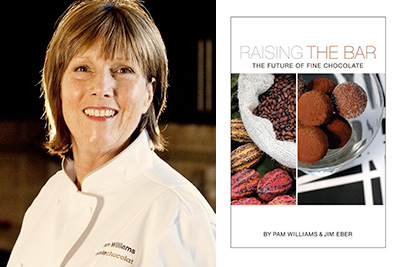
Author Pam Williams. Credit: Robert Ouimet
“Raising the Bar” book cover. Credit: Courtesy of Wilmor Publishing
Food-producing communities from 150 countries came to share ideas and experiences at the Slow Food joint Salone del Gusto and Terra Madre event this week in Turin, northern Italy. (Follow this link to my first report on it). Of the many food-related issues that were brought to the table at this extraordinary five-day event, one of the most pressing is land-grabbing.
TERRA MADRE AND
SALONE DEL GUSTO
Carla Capalbo reports from Slow Food’s joint event at Turin, Italy, this week.
Part 1: Terra Madre’s global fraternity of food producers
Part 2: Land-grabbing seizes the spotlight at Terra Madre
Land-grabbing is when private groups buy or gain control of vast areas of farmland in developing countries for producing food and biofuel crops for the first-world market. Africa, Asia and South America are particularly at risk in this modern land rush. Data compiled by the Land Matrix Project shows that 200 million hectares (772,000 square miles) — an area of land eight times the size of Great Britain — were sold or leased for foreign agricultural use between 2000 and 2010. Of these, 143 million hectares (552,000 square miles) are in Africa.
“Hungry for land,” a two-hour session on land-grabbing, brought together an international panel to discuss this serious and troubling trend that participants referred to as “neocolonialism,” before an equally international audience of farmers, students, journalists and other interested parties.
Stefano Liberti: ‘Just think of the so-called banana republics’
Stefano Liberti, who chaired the meeting and is the author of an Italian book on the subject (an English edition is on the way) explained: “There’s nothing new about the practice of using land in other parts of the world to facilitate food imports: Just think of the so-called banana republics of Central America.
“Two factors make the current situation very different: the speed at which it’s happening, and the type of people involved in the acquisitions. It’s no longer traditional agribusinesses or farmers who are buying up land in Africa, but speculative capitalists looking for quick returns: hedge funds, private equity, even pension funds now consider this type of action a safe investment. And they have been mushrooming at an alarming rate since 2008.”
In some cases, it is the governments of the African, Asian and South American countries that have enabled these acquisitions in an attempt to bring outside investment and capital into their countries’ coffers — at the cost of the local communities, which rarely see any of the benefits.
The attraction of lax laws, cheap labour and fertile land is proving irresistible in the run-up to the planet’s population boom and its growing search for food. Industrialised countries are increasingly supporting themselves from land outside their own geographical confines.
capalbosaloneafricanspeaker2-270007
Karin Ulmer: ‘A very inefficient use of land’
“Globally, 70% of all arable land is being used to grow feed for animals,” said Karin Ulmer, Senior Policy Officer on Trade, Food Security and Gender at APRODEV, in Brussels. With the intensive industrial farming methods that are prevalent in Europe and the U.S. today, it takes 12 to 14 calories of cereal to produce 1 calorie of meat. “This is a very inefficient use of land, as opposed to grass-fed animals, sustainable and integrated farming. We need to source less from other countries.”
Liliana Marcela Vargas Vásquez, of Asociación de Trabajo Interdisciplinario-ATI, Colombia, agreed. “There’s been a huge increase of soya being grown in Patagonia to satisfy the ever-increasing demand in India and China for animal feed. Latin America is prey to land looters from within its countries and without, and life is becoming increasingly violent for many rural farmers seeking to defend their land against those who want to steal it.”
“Land used by local communities is being leased or sold to outside investors, including corporations and governments,” said Anne Van Schaik of Friends of the Earth Europe. In Africa, much of the land used by herdsmen is “commons” land, with no specific ownership, yet swaths of that land are being fenced off and converted to monocultures by and for the developed countries. “Access to land and water is a human right,” she declared. “We don’t need corporate control to feed the world. Unlike what we are being led to believe, 70% of the world is currently being fed by peasants, with 30% being fed by industrially produced food. The traditional models can work.”
Mwanahamisi Salimu: ‘farmers who resist are being evicted and killed’
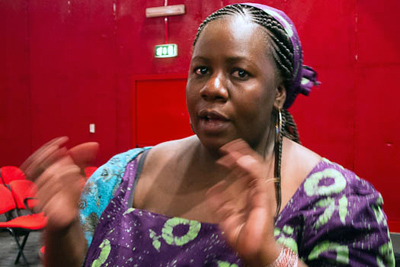
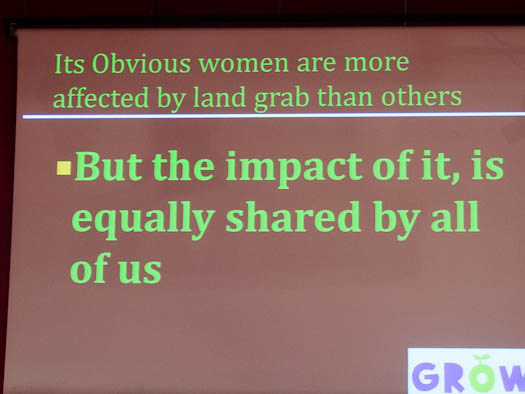
Mwanahamisi Salimu, Campaigns and Advocacy Manager for Economic Justice of Oxfam Tanzania, gave a stirring account of the situation in her country. “Agriculture is very risky in Africa, as people may grab your land, and farmers who resist are being evicted and killed.” She highlighted the role of women in this battle. “Women farmers are heroes in Africa. It is very difficult for them to own any land due to the patriarchal structure of society, and they are always at the bottom of the totem pole, with no access to credit and few rights. Yet they do the majority of the work.” When they do have land, it is often the worst, least fertile land, on the margins of their villages. “Yet many courageous heroines are working the land despite the risks of violence they face.”
So what can be done? Several speakers encouraged the audience not only to spread the word about land-grabbing, but specifically to put pressure on their banks, funds and other financial institutions to disclose where their investments are being made. Often, individual investors are unaware their money is being used for this purpose, and object when they discover it is.
Terre de Liens in France: buying and restructuring abandoned farms
A speaker in the audience from Terre de Liens, a civil society in France, recounted how a group of French farmers, worried about the buy-up of French farms by outside investors, had collected 26 million euros (nearly $34 million U.S.) to buy and restructure 100 abandoned farms, thereby ensuring they remained in local communities and were run sustainably and organically.
“In rural communities of the developing countries, more efficient agricultural models must be developed for Asia, Africa and South America,” Liberti said. “Foreign investment in agriculture was initially encouraged based on the misguided assumption that it would aid local communities. The result has been the opposite. Local farmers must be supported and helped towards sustainable methods of agriculture, using modern technology when necessary for irrigation, storage and transportation, so they can be self-sufficient and retain their rights to their own land.”
Main photo: Mwanahamisi Salimu of Oxfam Tanzania. Credit: Carla Capalbo
In 1996, a small food fair was staged in a corner of Turin’s Lingotto exhibition center. Organized by Carlo Petrini of Slow Food, the “eco-gastronomic” movement he had founded 10 years earlier as a positive counterpoint to fast food, it was a modest little market. But instead of the usual tired food fair formula (“half small retail, half folklore,” in Petrini’s words), its aim was ambitious and radically different. The fair would focus on the land, its products and its artisans, bringing them face to face with consumers.
Over the years, the exhibition’s surface area has increased exponentially and the number of visitors has soared from a few hundred to hundreds of thousands. Welcome to Slow Food’s Salone Internazionale del Gusto, a five-day extravaganza for chattering stomachs that is staged biennially in Turin, this year from Oct. 25 to 29. It’s an extraordinary event, a great gastronomic Tower of Babel that requires an open mind, a curious palate, boundless stamina and a belief that what Slow Food calls “good, clean, fair food” is a basic human right.
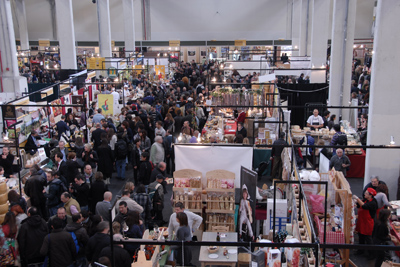
Stands in the Marketplace at Salone del Gusto. Credit: Slow Food International
In the vast marketplace, the beating heart of the Salone, pavilions the size of train stations are devoted to every conceivable kind of deliciousness, edible and potable, drawn from five continents. The air is perfumed with aromas of wild salmon oak-smoked in Ireland, Jabugo ham from Andalucia, American raw milk cheeses and olives and oils from Greece, all punctuated by invitations to taste. (“Un assaggio?” “Vous voulez goûter?” “Quiere probar un pedacito?” “Would you like a taste?”)
Salone del Gusto ‘a journey to the roots of food’
The producers — more than 1,000 this year from 100 different countries — staff the stands themselves, engaging in lively discussion about their products, their animals, their farms, their joys and their sorrows. (The latter generally related to red tape and the burdens of Brussels). “This is one of the things that sets the Salone apart,” observes Paolo di Croce, general secretary of Slow Food International. “At most food fairs, people are just selling. Here, the retailers are the producers — it’s a journey to the roots of food.”
On a lower floor, Salonistas will line up to have their taste buds tickled at a series of Taste Workshops. At the front of each classroom will be a panel of producers and experts who team up to present winning combinations of their products. The audience is seated at desks, each of them armed with a tasting sheet, a biodegradable cardboard plate stamped with the Slow Food snail logo, a wineglass and headphones for simultaneous translation into English and Italian.
Among this year’s countless events, cheese affineur Bernard Antony will select cheeses to go with wines from Alsace; Neal’s Yard Dairy cheeses will be paired with the best British beers; and wood-aged Swiss cheeses will be matched with regional wines from the Valais, Lavaux and Graubünden areas of Switzerland. Star chef Massimo Bottura will wax lyrical about traditional balsamic vinegar. Kiwi wine expert Jeffrey Chilcott will take tasters on a tour of the best New Zealand Pinot Noirs. Chef-sommelier Toni Bru of the Celler de l’Aspic in Priorat, Spain, will uncork top cavas from Catalonia, Spain.
In the Theater of Taste, stellar chefs like Fulvio Pierangelini and Davide Scabin from Italy, Magnus Nilsson from Fäviken in northern Sweden, Virgilio Martinez from Lima, Peru, and Enrique Olvera from Mexico City will dazzle Salonistas with their cutting-edge creations.
Finally, up on the famous ramp of this former Fiat building, which spirals snail-like to the rooftop racetrack, Slow Wine, one of the Salone’s most spectacular taste events, will take place. Here, the cream of Italian wines — which have been awarded top scores in the Slow Wine Guide — will be proudly presented by their makers. Tasters will make their way slowly and ever less steadily from table to table, nosing, tasting — but seldom spitting — Italy’s finest: Sassicaias and Ornellaias; Brunellos and super-Tuscans; superb whites from the northern Friuli-Venezia; rich, raisiny Amarones from the Veneto; Primitivos from Puglia; Aglianicos from Basilicata; and Barolos and Barbarescos from Piemonte.
The Salone has come a long way since its humble bake-sale beginnings. It’s both a showcase and a mouthpiece for Slow Food, which has developed into an international eco-gastronomic movement with credibility and measurable political clout. But what is it for? Is the whole crazy, inspiring, exhausting event just a glorified food-and-wine fair and a talking shop for chattering foodies? Or is there some serious purpose?
The idea that savoring raw milk cheeses and sipping Sassicaia will somehow make the world a better place is certainly seductive. But does a small-scale, local system of food production offer a genuine alternative to the large-scale, global model, as the Slow Food mantra seems to suggest? Or is this just a pastoral conceit designed to appeal to a wealthy, well-fed, urban elite while condemning these heroic producers to a medieval model of agriculture and meager returns? Could such a system feed our world?
Di Croce is a pragmatist. “We live in the real world, we can’t be too radical, and we’re not going to convert everyone to small-scale or organics. This is not the aim — and besides, we couldn’t feed everyone that way.” What we can do, he insists, is produce in a more sustainable way, focus on the local and the seasonal, reduce food miles, cut down on chemicals that destroy the soil — and stop wasting so much food.
“The idea behind the Salone is to create consciousness of the need for change,” continues di Croce, “and it’s working — people can see that something is possible. We’re no longer seen as a band of funny Italians wandering about speaking bad English and talking about changing the world. When we can relate our concept of good, clean, fair food to the maximum number of people, then we’ll really be achieving something!”
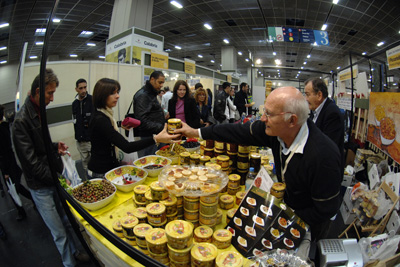
Photo: A vendor at Salone del Gusto displays his products and samples at the food fair. Credit: Slow Food International
People travel for all kinds of reasons, and they bring all kinds of expectations. But what is this thing called travel? I think of it as something very basic and accessible. You can go somewhere far away, but you can also travel in your own town or city.
For me the essence of travel is putting myself in another place — somewhere not-home or not-known — and figuring out how to be there, what goes on, how things work. Trying to gain some kind of understanding of people and the place and culture they inhabit is the most endlessly interesting pursuit I can imagine.
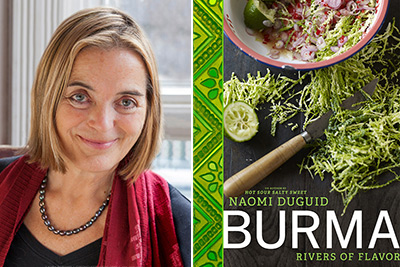
Researching my newly published book, “Burma: Rivers of Flavor,” I spent the last three and a half years making trips into Burma, traveling and eating in many different parts of the country. Food on the street, prepared as I watched, was always an education. Sometimes I had the good luck to be invited into someone’s kitchen to observe and learn — and there was always something to learn, from the way to mix and blend a salad or noodle dish to the technique for slicing shallots.
Food is a traveler’s foot in the door
I’ve been on a book tour the last few weeks and been asked to describe what I do and why. My shorthand answer is that I am interested in food as an entry point into an understanding of culture. But when I take that answer and pull it apart, it leads me to some fresh insights into what travel and food and culture can mean.
I’ve spent more than 25 years poking around in various parts of the world, from Central Asia to Senegal, from Japan to Brazil to Southeast Asia, trying to learn about basic everyday foods and home cooking. It’s been a privilege to indulge my curiosity and be a beginner in so many different cultures and situations.
As I think about that process of taking food as an entry point to gain insights into people and their culture, I realize that, consciously or not, we all do it, and we start at a very young age.
Foreign kitchen down the block
Do you remember when, as a kid, you were first invited to a friend’s house for lunch, or maybe for supper and a sleepover? That was serious travel, at least it was for me (though of course I didn’t think of it that way at the time). There was a little nervous anticipation beforehand and on arrival, just as there is with faraway travel.And once there I was in a different world. Apart from the setting (not-home but someone else’s house or apartment), the otherness was clearest in the food. Now that I reflect on it years later, in some ways that “local travel” held more of the unexpected and took more adjustment than any travel I’ve done as an adult.
I remember at age 7 or 8 eating lunch up the street at a new friend’s house. The sandwiches were made with soft white store-bought sliced bread. There was a tall glass of cold milk by my plate (a horrifying sight to me; milk has never been my thing). There were paper napkins. My friend’s mother came by to refill our glasses once the milk level went down (I hurried to cover the glass with my hand, “No thank-you” tumbling out of my mouth). It was all very foreign and new to me.
And the same must have been true for friends who came to my house, where the bread was homemade in juice tins, so the slices were round, and was brown and very good; there was no milk and there were no paper napkins; and we helped ourselves, made our own sandwiches and found our own drinks — water or diluted juice — rather than being waited on by my mother.
That insight about my childhood food travels to friends’ homes and kitchens takes the idea of “exotic travel” and turns it on its head in a way.
We don’t need to be on the other side of the world watching someone cook dal over a wood fire to be learning and understanding others through their food; whenever we’re in someone else’s kitchen, we’re getting a glimpse or more of their food culture. And when we have visitors to our kitchen, they’re getting to know us in the same way, consciously or subconsciously gaining a deeper understanding of how we think about food and what our cooking practices and tools are.
Benefits when you travel in your own kitchen
I find it exciting and energizing, this idea that being in the kitchen of a friend or a stranger, however close to home, is a form of culinary and cultural travel. And I love the fact that our personal culinary culture, while anchored in our past and present practices, is also potentially very dynamic. It can evolve as we take on new ideas (trying to support local agriculture, for example). And it also grows as we take the “risk” of traveling in our kitchens.
What do I mean by that? In the same way that we travel in our imaginations when we read about other places or see photographs of people far away, we also travel when we prepare food that is unfamiliar to us. We hope and trust (just as we do when we get on a plane to go to a new place), that we’ll like the result. For we’re on a culinary voyage as we prepare a dish that is new to us from Burma or Bangladesh or Mexico. When we then sit down with others to eat the meal we’ve made, we’ve taken ourselves to another place. And if the new dish or technique enters our weekly or monthly repertoire, it enriches and extends our personal culinary culture.
This idea is hugely rewarding to me and I imagine to anyone who writes cookbooks. When I write about the food of another country and give recipe instructions, I’m trying to transmit my understanding of what I’ve learned at the hearths of others And so, as with each book I’ve written, my main hope with my new Burma book is that it helps people travel in their kitchen and in their imagination, and that they find their travels enriching.
Top photo composite:
Author Naomi Duguid. Credit: Laura Berman
Cover of “Burma: Rivers of Flavor.” Credit: courtesy of publisher
Food markets are a joyful assault on the senses. Every one — from a petite, once-a-week, village market in the hills of northern Sumatra to the daily affair known as Merced that sprawls over a subway line in Mexico City — is a visual feast, an olfactory cornucopia, an aural bounty. Markets are where I go to find my bearings in a new destination and to get a heads-up on what to expect in the local cuisine. They’re where I find inspiration in towns and cities that I know well. Every market has endless stories to tell, and as a photographer who loves to eat as much as he loves to shoot, I never of tire of bringing it all to life in the images I make.
Markets are lively, so photographing them should be easy. But all that color, action and food can make the task of coming away with clean, bold images overwhelming. Capturing what is inimitable about the market that you want to shoot will make your photographs tell a compelling story. Here are some photo tips:
Make it bite-size
Initially a market is one big undifferentiated festival for the eyes. But walk around a bit and details will gradually come to the fore. You want anyone who views your photographs to feel that they’ve been there with you, faced the big picture and been immersed in the details. You can do that by aiming for four types of images:
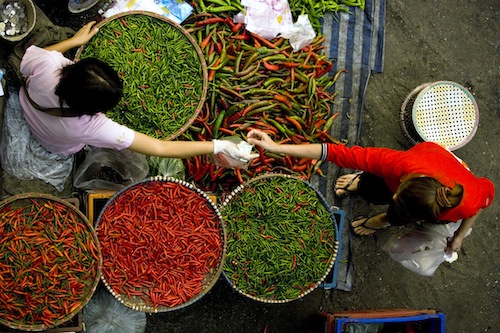
- Overall shots give the viewer a solid impression of the markets size, how many vendors it has and how active it is. Height is a great way to achieve an overall shot, so look for doorways, passageways or public balconies that place you above the vendors and shoppers. The overall shot is rarely the first photograph I make of a new market, because only after walking through once, twice, even three times does the ideal vantage point become clear to me.
- Mid-range shots give the viewer a closer look at the activity. Here’s where differences among markets begin to become evident. Turkish vendors, for instance, almost always men, arrange their produce meticulously, sometimes placing bows on top of carefully stacked watermelons or tomatoes. By contrast, on the east coast of Malaysia vendors are almost always women and the produce is simply jumbled in bins, as is the custom throughout Southeast Asian markets. Pay attention to how goods are moved around the market — Are they pulled in wheeled baskets by porters, as in Thailand, or carried on workers shoulders as at Mexico City’s Merced? These are the sort of mid-range details that will make your photographs say something more insightful than “this is a market.”
- Detail shots draw the viewer into the nitty-gritty of a market. Start to focus on produce. Look for interesting specimens — not just colors but texture, patterns and contrast — and clean backgrounds. Always ask vendors whether they mind your shooting. Most of the time they are happy to have you photograph, but asking is the right thing to do. Give a sense of place by asking a vendor or a passerby to hold a piece of fruit or cup a bunch of vegetables in his or her hands (Bonus: this will clean up your background too). Look for non-food details: How do sellers store their money? Is there a shrine or good-luck talisman in evidence? Are the vendors cooking or eating in their stalls?
- Moments — Focus on action and interactions between people: a fishmonger cleaning fish, the exchange of money, a subtle sales pitch or a round of contentious bargaining, a seller arranging his/her produce, friendly interactions between vendors, the hustle and bustle as a market sets up and the waning activity as it breaks down at the end of a business day. Learn to be a fly on the wall; find a quiet place to stand and wait for action to happen.
Light is your frienemy
Nothing is nicer than shooting in early morning and evening light, especially in markets, where side lighting adds color, richness and texture to produce, seafood, meats and dried goods. But as the sun gains height the light becomes harsh, washing out colors. If you are shooting a morning market, force yourself to get out of bed to arrive as early as possible.
If you are photographing a covered market, look for areas illuminated by natural light — skylights can provide excellent low-contrast light — and work on mid-range shots and details. Stake out pockets or shafts of light through which people might walk. Once you’ve spotted a place, take a meter reading and wait for something to happen in that space. Try to avoid shooting under awnings; they may let in light but will cast their color on your photos.
If light conditions present a great deal of contrast, then you must decide whether to meter for the bright parts or the shadows. Exposing for the highlights means you will have little detail in the shadow (it will go to almost black). Exposing for the shadows means that you might “blow out,” or lose, the detail in the bright areas. Used properly, both can work to your advantage, resulting in especially interesting images.
I often study the way the light moves through a market and note where it might work in my favor for future trips back.
Go with the flow
Plan to circle through a market several times. Light changes, new items appear on display, shoppers arrive and everyone gets more comfortable with you and your camera. Reverse your pattern a few times and you’ll see things you didn’t on previous passes.
It’s not your office
Markets are first and foremost places of business. Imagine someone sitting on your desk while you’re trying to write a memo and you can understand how vendors feel when a photographer hogs the space in front of their stall awaiting the “perfect” image. Before you ask a seller for permission to take a photo, make sure you are ready so that you can move fast once you get it. Have your exposure set and a composition in mind before you move in. Work quickly, then step back out of the way and thank the vendor.
Stop taking photos
Sometimes the best way to see and feel a market is to put the camera down for a while. Pick an out-of-the-way corner, or grab a cup of coffee and a piece of fruit and just hang out and watch. Look for interactions, moments and details and visualize how you might photograph them. Then when the camera is at your eye you’ll have a better idea of what to shoot and when to release the shutter.
Poke around
Tell a market’s back story by taking your viewer behind the scenes. Explore alleys, storage areas and back rooms. Again, be respectful, for in many non-western markets people rest and even live in these pockets. If you’re not sure about going into an area, find someone to ask.
And the last of the photo tips … travel light
Don’t try to carry too much and keep equipment handy so you can grab what you need quickly. I’ll carry a single camera with a medium wide (usually a 35mm) and a longer (usually 85mm) lens. I pack them in a waist belt (easier on my back, as I’ve learned the hard way) along with a screw-on close-up filter for detail shots. Extra memory cards fit in a pocket. Take a cloth for cleaning — if you’re going to get in close, you will probably get splashed with something unwanted at some point.
Markets the world over are similar in many respects, but by paying close attention you can create photographs that capture the defining characteristics that make each one a unique and culturally insightful phenomenon.
Top photo: An overhead shot of a chile vendor shows color, action and detail. Credit: David Hagerman
While it is often easy to oversimplify the unknown, or at least the unfamiliar — a place, a cuisine, not to mention a culture — the real pleasure in travel or eating comes from discovering the unexpected and exploring the complexities and contradictions that we unfailingly encounter. When we scratch beneath the obvious and accessible, those polished but rarely three-dimensional surfaces found in glossy magazines or mid-century travel books, we find the essential elements that profoundly inform on the place. We need to sift a bit through the layers to find its truer essence.
Like any number of countries and their magnificent kitchens — Turkey, Mexico and even Spain spring to mind — Morocco frequently suffers a simplified fate, considered by many to consist of a largely homogeneous landscape and handful of familiar (though generally misunderstood) dishes.
Moroccan cuisine reflects landscape
As elsewhere, the food of Morocco begins with the landscape, and the country’s geography is far richer and more diverse than most people imagine. The image of this North African country as a parched place with fortified earthen villages and oases of date palms is not wrong, just incomplete.
In a way, Morocco is an island, surrounded largely by water (the Mediterranean Sea, the Atlantic Ocean) and scrub (the pre-Sahara and Sahara). But within those ample confines, a wide variety of climates and features exists: four mountain ranges, river gorges, mesas, forests with cedars and cork oak, scrubby plains, olive groves (Morocco is the world’s second largest exporter of table olives) and vineyards. It has valleys with fruit orchards, meadows with wild flowers, farms producing excellent fresh goat cheeses, and, off its southern coastline, some of the richest fishing grounds in the world.
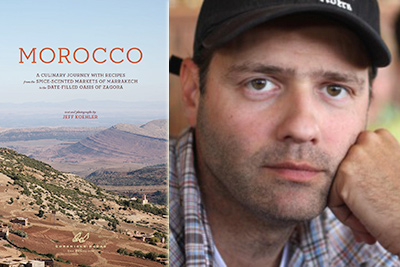
I have been traveling to Morocco for 15 years, but work on my recently-published cookbook, “Morocco: A Culinary Journey with Recipes,” took me to its many nooks and rural souqs. Although one can talk about a unified “Moroccan cuisine” with a common range of flavors and dishes found across the country, I was trying to get a sense of the regional differences. The more I traveled around Morocco in that search, the more impressed I became by the sheer diversity of the physical landscape and what it produces.
Surprise delicacies in the Middle Atlas
Driving through the Middle Atlas one day among fields of ripening barley with red-petaled flowers rising exuberantly among the silvery-green stalks, the pavement gave way to a gradually-worsening dirt track crossed with streams and strewn with boulders, the kind of chassis-thumping route best navigated in a 4×4 — or at least a rental car. Many roads appear grander on Michelin’s map #742 of Morocco than they are in reality, and this one was no exception. But I was rewarded by entering a valley splendid with cherry trees. A couple of white vans were parked here and there in the shade and extended families were quietly harvesting fruit from their own trees.
I backtracked to the Berber town of Azrou, where I managed to arrive in time for a late lunch at the Hôtel Panoramic, a stout Protectorate-era place opened in 1928. Trout farmed in a nearby river were a specialty and prepared in a handful of manners, including the way that I eventually included in my book: Stuffed with grated carrots, fresh bay leaves, and a generous grating of black pepper, the trout—netted that morning—were quickly pan fried. In the empty dining room, cool and dim under the high ceiling, the floors polished, the massive fireplace in the lobby not yet lit, the earthy flavors of the countryside—precisely this countryside, from the hills rising around the hotel—were fine rewards for my effort.
For all the lamb tagines, grilled chicken skewers, and vegetable-laden couscous I ate on my journeys, some of my most memorable moments working on the book were discovering such unexpected fare as these stuffed mountain trout.
Getting a new view of mushrooms
Another revelation was mushrooms. The High Atlas mountains, stretching some 450 miles northeast from coastal Agadir toward Algeria and rising to nearly 14,000 feet, are dramatic and foreboding, though quite barren; the Anti-Atlas range, to their south, are largely barren and rock strewn. But the Rif Mountains in the far north are damp, fecund, and home to dozens of varieties of edible wild mushrooms. In the hills not far from the isolated, blue-hued town of Chefchouen on a drizzly day, one of the last of the year, my wife, two girls, and I hunted for chanterelles and cèpes. (There were truffles, too, one of our local guides said, pointing to a nearby hill. “But those are for export.”) We returned to a rural auberge and had the spoils of our morning hunt prepared in the most divine and herb-laden omelets I have ever tasted.
Even more unexpected were oysters. South, down the Atlantic from Casablanca, the coastline becomes largely inaccessible, wild, and windswept, and the road meanders past rocky cliffs, great sweeps of undeveloped beach misty from the crashing surf, and a few fortified fishing villages where seagulls wheel above ancient ramparts and brightly painted sardine boats. One stop along here is the village of Oualidia, whose specialty is oysters. Just as I had not expected to feast on local trout in the Middle Atlas or wild mushrooms in the Rif, devouring a dozen Japanese oysters on the half-shell while looking out over the lagoon where they had just been harvested came as another stunning treat.
History of Morocco
Morocco’s rich, complex history — from the ancient Berbers to the Phoenicians and Romans, the Arabs, Muslim and Jewish exiles from Andalucía, trans-Saharan caravans, French and Spanish colonial rulers — has offered cooks plenty of inspiration. After driving thousands of backroad miles over the course of more than a year’s worth of near-monthly trips to Morocco, it was clear that, just as importantly, the country’s vast and varied landscape gave them the raw materials they needed to develop one of the world’s richest cuisines.
For the traveler to Morocco — or Turkey, Mexico, or Spain — pleasure lies in the unknown and the unexpected, in those tasty surprises that may be just around the next corner. The key is to get off the main road and keep pushing ahead to find them. Satisfaction, of course, goes beyond a delicious meal. It helps in understanding the land as well as the people. I found that learning about Morocco’s food was to learn about its culture—and it was this idea that spurred me on, corner after corner.
Top photo composite:
Author Jeff Koehler. Credit: Kirk Giloth
Inside title page from his book “Morocco: A Culinary Journey With Recipes From the Spice-Scented Markets of Marrakech to the Date-Filled Oasis of Zagora.” Credit: Jeff Koehler
I knew of Pascal Baudar as a fellow Master Food Preserver, so I was intrigued to hear about his workshop “End of the World Food Preservation Techniques.” He’s also a well-known expert wild food forager who runs Urban Outdoor Skills. I joined his workshop thinking it would be fun to forage for wild edible plants and learn a few historical food preservation techniques. I was not expecting to discover how to feed myself and my family entire meals made from local wild plants. Or how to use a roadside weed common in the Los Angeles area to create zombies.
The dry grass shattered under our feet as we scoured the sunburned terrain around Hansen Dam, a semi-wild park in the Lake View Terrace neighborhood of Los Angeles. Pascal is a good public speaker, and he led the hike with a mix of educational zeal and a wicked sense of humor that made the experience entertaining and slightly ominous. Pascal informed us that he’s a medal-winning marksman, and when he cautioned us not to pick all the olives off the trees in his favorite grove, we all took him seriously.
But far from being a bunker-dwelling doomer, Pascal is an upbeat guide to semi-urban food sources and pre-Industrial Revolution food preservation techniques.
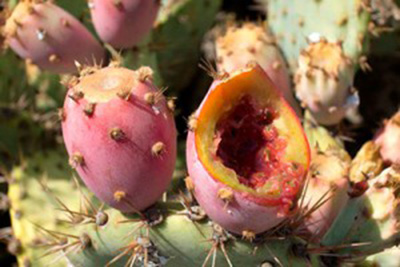
We discovered more edible plants than I’d ever realized existed in such a small and seemingly barren landscape, including prickly pear cactus, California sage, horehound, elderberry, curly dock and two kinds of mustard (yellow and black). The curly dock and mustard had already gone to seed, but Pascal assured us that the seeds and shaft could be ground into flour and used to make hard tack, a kind of primitive cracker. We tried a version of his homemade hard tack later that afternoon and it was a truly post-apocalyptic food — dense, portable, nutritious and disgusting. But after the apocalypse, you might not care how it tastes.
Make your own zombies
Perhaps the strangest of Pascal’s revelations during our hike came when we discovered a jagged-leaved plant that grows gorgeous white trumpet flowers: jimson weed, or the devil’s trumpet. Pascal pointed out that this deceptively pretty plant may be one source of the zombie legend.
Jimson weed grows throughout Southern California, and you can see it along freeways and in vacant lots. It was first described in 1705, when it was called “Jamestown weed” because colonial British soldiers in Jamestown ate it and went mad. In fact, jimson weed (Datura stramonium) contains the powerful hallucinogen scopolamine, which causes delirium in low doses and death in larger doses. It has become linked to the legend of zombies because of these hallucinogenic properties and is known in Haitian Creole as concombre zombi (the zombie’s cucumber). Pascal sternly cautioned us against ever eating any part of the plant. A nurse in our group chimed in, saying that she had treated a teenage boy who had eaten jimson weed to get high. He wound up violently ill in the emergency room and is lucky to be alive.
With a deadpan expression, Pascal pointed out that one possible safe use for jimson weed would be using it to make zombies who could then help us collect mustard and curly dock seeds after the apocalypse. We all laughed nervously, but as we finished our hike I mulled over the question of how I would feed my zombies in a post-apocalyptic world. Wouldn’t it be easier to just collect the curly dock myself?
I was ready for a break when we reached our camp, but the real work had only just begun. Over the next three hours, Pascal provided a grand tour through centuries of basic food-preservation techniques. He discussed simple techniques to lengthen the shelf life of vegetables and herbs without refrigeration, such as storing herbs in cups of water and putting greens in a wet canvas bag and hanging them in a cool, dark place.
lutz-foraging1
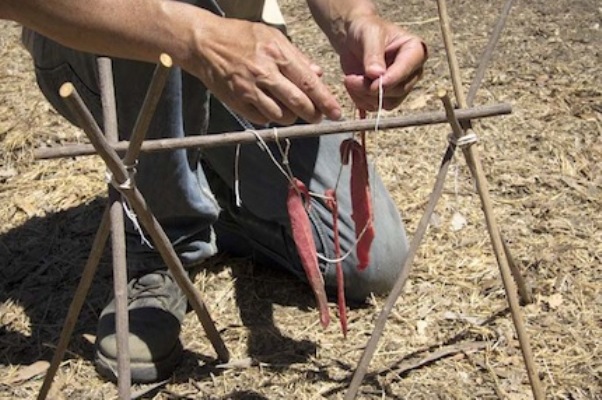
In a whirlwind of activity, Pascal demonstrated how to make salt pork and a dry salt brine for meat. He made hard tack and two versions of beef jerky (one good and one not so good). While the rest of us wilted in the shade, Pascal whipped up a brine for fermenting vegetables that could yield either sauerkraut or kimchi, depending on the vegetables you use.
Foraging for survival soup
The most complex dish Pascal concocted was a pot of “survival soup,” using his collection of dried wild plants that he’d harvested on previous hikes, including yucca shoots, wild radish pods, garlic and kelp. We sampled it near the end of the workshop and it was quite tasty, much to Pascal’s surprise. He told us that his partner Mia Wasilevich is usually in charge of making foods that actually taste good. She runs their companion organization Transitional Gastronomy, which they use to explore the idea of using locally sourced wild foods to create gourmet meals. Sadly, Mia wasn’t present at this hike, so we focused on food for the “Mad Max” world.
By the end of the workshop, I was exhausted from the hike, the heat and information overload, but I couldn’t wait to get home and share all I’d learned with my apocalypse-loving husband. I left wondering whether I could really sustain my family using only foods I found growing wild in my neighborhood, and how hard it would be to persuade mustard-seed collecting zombies to eat hard tack.
Hard Tack by Pascal Baudar
Ingredients
2 cups whole wheat flour (you may replace up to ⅔ cup whole wheat flour with curly dock flour)
Slightly less than 1 cup of water
2 tablespoons salt
Directions
1. Mix ingredients by hand, roll the dough and cut it into squares (2-by-2 or 3-by-3 inches). Using a fork, make about four rows of holes. Don’t push too hard, you’re not supposed to go through. Some people make holes on both sides, I only do one side.
2. Bake on ungreased cooking sheet at 375 F for 30 minutes, turn the tack over and bake for another 30 minutes.
3. Not a must, but I also dehydrate the hard tack for a couple of hours afterward, let it cool and preserve the pieces in vacuum-sealed bags.
Note: It’s not a gourmet cracker. It’s terribly hard and doesn’t taste good, but will probably preserve for years!
Top photo: Prickly pear. Credit: Susan Lutz