Articles in Politics
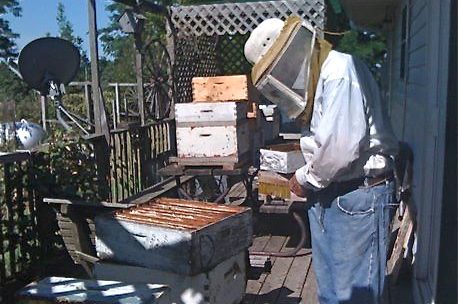
I was a teenage beekeeper. And a geeky one at that.
I knew that one bee, in her brief lifetime, collected nectar enough for only a half teaspoon of finished honey. I knew that she and her sisters together flew more than 50,000 miles, dropping in on about 2 million flowers to produce just one of the one-pound glass jars that I filled with glowing liquid amber at midsummer and again in late autumn. And I loved reading about bee behavior as much as I loved inhaling the distilled essence of summer in freshly extracted honey.
And so, even though I had long ago hung up my bee veil near a stack of old hive parts, I was distressed to learn that the tale of honey has recently become more sticky than sweet.
On the global front, there’s been a lot of buzz about “honey laundering.” This accurate neologism refers to the way in which millions of pounds of Chinese honey have been making their way into the United States labeled as originating from other countries, and often contaminated with the banned antibiotic chloramphenicol, which can cause fatal aplastic anemia.
Misrepresenting the country of origin is an illegal way around the high tariffs imposed on Chinese honey, and this past spring, after years of investigation, U.S. Attorney Patrick Fitzgerald issued a complaint alleging the fraudulent import of “Chinese honey falsely declared as originating in South Korea, Taiwan, and Thailand on behalf of and for the benefit of a German company and its worldwide affiliates, including an American subsidiary that operated in Chicago.”
In that half-sentence alone, you begin to get a notion of the hopelessly tangled global food web. Attempting to put a stop to the fraudulent imports, federal officials seized drums of honey at a Philadelphia distribution center and arrested a Taiwanese executive of a California-based honey import company for allegedly conspiring to evade U.S. import duties for the Chicago office of a German food distributor. This action and others, however, are but a drop in the honey supply. A report on honey by Andrew Schneider, an investigative journalist for the Seattle Post-Intelligencer, found that: “Tens of thousands of pounds of honey entering the U.S. each year come from countries that raise few bees and have no record of producing honey for export.” China is the world’s largest honey provider, producing some 660 million pounds each year. Much of that ends up mislabeled or unlabeled on U.S. store shelves, and one reason is price.
Schneider found that Chinese honey is often less than half the price of other honey. In the radio program “Living on Earth,” he explained that: “The going [wholesale] price for good honey, from Canada, for example, might be a buck sixty a pound … If all of a sudden, as a honey packer, you’re being offered 300,000 pounds of honey at 50 cents a pound, wouldn’t you think … a bit about why you’re getting such a great price.”
But the influx of cheap honey has made it easy for honey-packers not to “think,” and hard for local honey producers to compete. And there’s a double stinger for small-scale U.S. beekeepers wanting to bottle and sell their honey locally: state and local health departments and the laws they enforce.
The fight for local honey
In many states, including Illinois where I live, honey is defined as a processed food item and therefore must be extracted and bottled in a facility inspected by the local health department. Building and maintaining such a facility is prohibitively expensive for most small-scale beekeepers. They generally extract honey as I used to — in a driveway or on a porch — and they are breaking the law if they attempt to sell that honey to the public.
Wayne Field, who has been tending bees near Chenoa, Ill., for more than 50 years, said that the health department inspector who visited him didn’t even know that honey is a proven antibacterial and anti-fungal substance.
Mike Sabo, who with his 10-year-old daughter Astrid, keeps bees near Belleville, Ill., had heard complaints from beekeepers, consumers and market managers about the difficulty of buying or selling local honey legally. Because Astrid wanted to be able to sell her honey, Mike attended the annual meeting of the Illinois State Beekeepers Association (ISBA) last winter.
After listening to many beekeepers express their frustration with rules limiting their ability to sell honey, he decided to act. He moved that ISBA members work with legislators to craft a bill allowing small-scale beekeepers to bottle and sell their honey without interference. His motion got him appointed chairman of the ISBA legislative committee.
“Then,” he said, “I got hip deep in it.”
Prairie Fruits Farm, Champaign, IL.
Sabo and other beekeepers, like their bees, turned out to be a hard-working, tenacious and savvy group. They foraged over a wide territory, enlisting support from the Illinois Department of Agriculture, urban and rural legislators, local consumers, food businesses and market managers in a multi-pronged effort to pass what became known as “the honey bill.”
The beekeepers knew when to be calm and when to press their points. Every time a committee met on the legislation, Sabo was there with half a dozen other beekeepers from the state. Although they faced strong opposition from Illinois Department of Public Health officials, who warned that the honey bill would create a dangerous precedent, the beekeepers never backed down.
“At a time when consumers are looking for fresh, safe, locally produced products, we do not need unnecessary barriers between local producers and local consumers,” said Sabo’s wife, Sharon. “We do not need laws that make it easier to buy imported products of questionable safety than wholesome products that support the local economy.”
During testimony, Mike Sabo brought up the issue of tainted honey imports, pointing out that imported honey is not subject to health department inspection even though “that’s where all the problems are.” It seemed unfair that “it’s the local producers who have to jump through hoops an order of magnitude more difficult than the large producers or international importers.”
From January to June of this year, the beekeepers diligently pushed the honey bill forward, until this July when they tasted sweet success as Illinois Gov. Pat Quinn signed their bill into law.
Illinois is among the first states to take on this issue. Only Illinois and Mississippi have health-inspection exemptions for small-scale honey producers. A few other states, including Kansas, Iowa, Michigan, Ohio, Oklahoma and Wisconsin have other exemptions for honey producers who sell their honey directly to consumers.
But the problem of potentially tainted imported honey seems to be a long way from being solved without federal inspection standards or even a definition of what honey is. In most states, where there is no “pure honey” standard, producers can dilute honey with corn syrup or sugar water, and still call it honey.
And because the U.S. does not require honey labels to show a country of origin, shoppers have no way of knowing where a bottle of honey comes from. You may see a container of commercial honey labeled “processed in Iowa,” but that tells you nothing about where the honey came from before it was bottled in Iowa.
Working like bees, for bees
Mike Sabo was satisfied with the outcome of the ISBA effort he spearheaded — an exemption for Illinois beekeepers who produce or sell less than 500 gallons of honey a year in a local market — but not surprised. He already knew that people, like bees, can work effectively as a group to protect themselves. And he knew that they could extract honey safely, as humans have done for thousands of years without a health department looking over their shoulders.
Now he and others — honey producers and consumers alike — are ready to be part of the local solution to international honey-laundering. It’s easy to join them: Shop at stores that buy directly from beekeepers, or find local beekeepers (see localharvest.org), and you’ll be fighting international crime while supporting local beekeepers and relocalizing a piece of the global food system.
{igallery 99}
Terra Brockman is an author, a speaker and a fourth-generation farmer from central Illinois. Her latest book, “The Seasons on Henry’s Farm,” now out in paperback, was a finalist for a 2010 James Beard Award.
Photos, from top:
Wayne Field takes a break from tending his bees to sell some of his comb and extracted honey from his home near Chenoa, Ill.
Honey produced on a farm in Champaign, Ill.
Credits: Terra Brockman
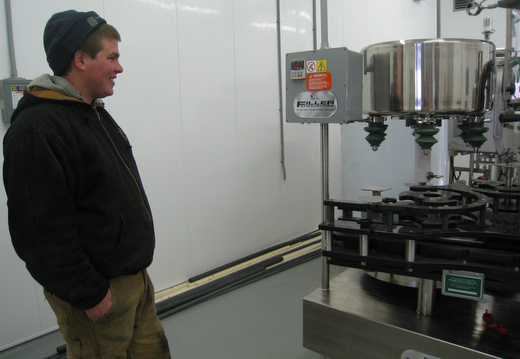
Over the past year, one of my central Illinois neighbors bet the farm on selling his milk directly to local consumers.
Matt Kilgus laughs a little nervously as he admits, “We’ve pretty much put — along with our hearts and souls — all of our finances into this, too. If this were to fail, we wouldn’t have a dairy here anymore.”
Striking out on their own and investing in on-farm infrastructure to filter, pasteurize, separate, blend and bottle milk from their 80 gentle, fawn-colored Jersey cows — 3,500 gallons of it every week — was, and is, a risky move for Kilgus Farmstead.
But Paul Kilgus, 41, and his nephew Matt, 29, saw no other way to survive as a small family-owned dairy within an industry characterized by ever-increasing concentration. They knew that more consumers, their rural neighbors as well as urbanites, wanted milk from someone they know and trust, someone whose values echo theirs. So they were willing to bet that serving this community with access to high quality local milk would enable their farm to not only survive, but be a thriving business for the next generation.
Consolidation squeezes out small farmers
Indeed, the dairy industry echoes the story of consolidation in American agriculture, which leapt into high gear following Nixon-era Agriculture Secretary Earl Butz’s ultimatum of the early 1970s: “Get big or get out.”
USDA statistics show that the policies Butz instituted devastated small farms. In 1960, when Paul’s parents Duane and Arlene Kilgus were in the dairy business, Illinois had 52,000 dairy farms. By 1970 that number was 16,000, and today there are a mere 1,200 farms that include dairy cows in Illinois.
Part of the reason small farms were squeezed out was the consolidation of milk processing. In 1972, as Butz’s policies were beginning to take effect, there were 2,507 dairy-processing facilities in the U.S. This meant that in the ’50s and ’60s, the Kilguses and their neighbors could choose any one of a number of local buyers to sell their milk to. The healthy competition created by many dairies and many processors kept prices high enough for farmers to make a living, and low enough for consumers to afford local milk.
But by 2002, there were only 524 processors — an 80 percent reduction in just three decades, according to the USDA’s Economic Research Service (ERS). Like commodity crop farmers, dairy farmers had been forced to become “price-takers, not price makers.” They were now at the mercy of price swings in the commodity milk market, which could reach historic highs or, more often, below-break-even lows.
A 2008 report from the ERS found that one of these processors, Dean Foods, “bottles 33 percent of U.S. fluid milk.” In some states, that figure is much higher. Senators Russ Feingold (D-Wis.); Bernie Sanders (I-Vt.); and Charles Schumer (D-N.Y.) reported to the Justice Department’s antitrust division that Dean Foods controls fully 80 percent of the fluid-milk market in Michigan, Massachusetts and Tennessee.
Numbers like these led to a class-action lawsuit against Dairy Farmers of America and Dean Foods last fall. The suit accused the companies of price-fixing and monopolizing fluid milk distribution. At the end of June, a panel of Wisconsin dairy farmers called on President Obama, the USDA, the Department of Justice and Congress to aggressively prosecute antitrust cases involving price collusion, racketeering and market manipulation by the dairy giants.
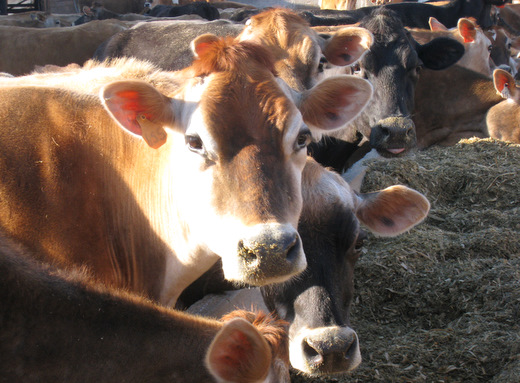 The plaintiffs responded that the lawsuit was without merit and claim that industry consolidation is good because it leads to cheaper milk. But cheap prices often come at high costs. As mega-dairies move in, small farmers are forced out of business by low prices, rural economies are devastated and chefs and ordinary people wanting high-quality milk from a known source are out of luck.
Large farms also pollute on a large scale. When you have thousands of cows living in close quarters, you get pollution. For instance, 1.5 million cows in a large farm operation can produce 30 million tons of manure. Even a “small” industrial-scale dairy with 2,000 cows produces the same sewage as a small city, but with no waste treatment.
The Kilgus family was well aware of these facts. Matt explains that it cost them about $18 to produce a “hundred-weight” (100 pounds, about 12 gallons) of milk. But that price fell to about $11 per hundred-weight in 2009, a little more than half than the cost of the production. [At the same time, Dean Food’s profits were up 147 percent in 2009 compared to 2008.]
It doesn’t take an economic genius to know that when the price you get for a gallon of milk is less than it costs you to produce it, getting out of the dairy business is the only way to survive. And sometimes even survival is not an option.
This past January, following months of record low milk prices, Dean Pierson, a third-generation dairy farmer in upstate New York, went out after the morning milking to shoot his 51 milk cows, one by one, before turning the rifle on himself. He left a note on the outside of the barn asking the reader not to come in and to call the police. While Pierson’s suicide undoubtedly had many causes, his neighbors assume that powerlessness in the face of falling milk prices contributed to his desperate act.
‘Respect for the price of butter and eggs’
Instead of continuing to be buffeted by forces and prices beyond their control, the Kilgus family decided to play David to the industry’s Goliath. The rock in their sling was the public — friends and neighbors, as well as urban consumers — people who wanted to know who produced their food and how.
“We noted a vacancy in Illinois — no one was bottling and selling their own milk,” Matt says. “We knew that, of all our options, this would be the hardest. But we also sensed that the time was right, and that this was something we could succeed at, with the help of local consumers.”
While the slow wheels of the Department of Justice turn in Washington, back on the Kilgus Farmstead the work of a small dairy farm continues. Paul and his son Trent roll out of bed at 3:30 a.m. every morning and do the milking from 4:30 to 6:30 a.m. By 8 a.m. they have cleaned the milking parlor and are busy with the outside chores — looking after the heifers and dry cows, breeding, birthing, shuffling young stock around, spreading manure and doing equipment maintenance. At the same time Matt and his aunt Carmen and wife Jenna are busy bottling milk that will head out to local stores before noon.
Watching the Kilgus family work reminds me of what William Vaughan wrote about growing up on a farm: ”There’s something about getting up at 5 a.m., feeding the stock and chickens, and milking a couple of cows before breakfast that gives you a lifelong respect for the price of butter and eggs.”
 More and more consumers, even those with no farm background, are respecting the price of butter and eggs, fruit and vegetables, meat and milk from local farmers.
“At first we thought that maybe people wouldn’t pay that extra dollar for quality, but that’s not been the case,” Matt said. “We just got out there and told our story — ‘That’s only our milk, from our Jersey cows, in those jugs. We have full control of this product — from the food the cow ate to how she was milked to the quality and timing of the bottling and distribution.’ ”
That quality, and that control, make the success of Kilgus Farmstead, and of local foods everywhere, a good bet.
Terra Brockman is an author, a speaker and a fourth-generation farmer from central Illinois. Her latest book, “The Seasons on Henry’s Farm,” now out in paperback, was a finalist for a 2010 James Beard Award.
Photos, from top:
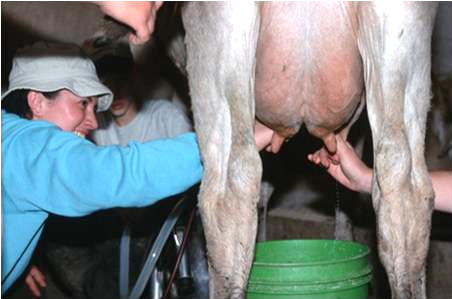
Natalie Mosteller Wolf tries her hand at milking one of the cows at Kilgus Farmstead.
Credit: Terra Brockman
Portland’s food philosophy prizes the sustainable, organic and seasonal in a way that makes other cities look like beginners. The International Assn. of Culinary Professionals convened Portland in late April for its 32nd annual conference. This year’s theme, “The New Culinary Order,” reflected a growing passion from food professionals who support eco-friendly values and oppose highly processed and relentlessly marketed corporate foods. For Portland, this approach is nothing new.
On a bike tour of North Portland’s artisan eateries, chef Bryan Steelman of Por Que No? taqueria explained how rainwater from his restaurant roof was captured and recycled onto local vegetables. Chefs Jason French and Ben Meyer of Nedd Ludd , a back-to-basics wood-fired cafe, explained the meaning they found in butchering the animals they serve and pickling the cucumbers they grow in their backyard organic garden. At Grand Central Bakery, chef Piper Davis stressed the importance of moving the new order values from upscale boutique levels to mass production. “Until the movement goes mainstream,” she argued, “we won’t change the way the world consumes.” Her warm strawberry rhubarb pie and piles of croissants made from locally sourced stone-ground wheat won the case that artisan values can transcend the challenges of large-scale production (she owns six bakery cafes in the Portland area — all with such luscious pies and pastries). Other stops on the tour arranged by cookbook author Ivy Manning (“Farm to Table Cookbook”; “The Adaptable Feast”) were Toro Bravo for tapas, lemon and olive asparagus, and sangria; The Meadow for chocolate and salt; Lincoln for sweetened rhubarb and cream.
In support of sustainable
The sustainable movement now has many faces nationwide: Jamie Oliver’s “Food Revolution” and Michelle Obama’s “Let’s Move” anti-obesity campaigns, the Academy Award-winning documentary “Food, Inc.,” Michael Pollan’s bestselling books “An Omnivore’s Dilemma” and “In Defense of Food,” Alice Waters’ decades of leadership and her pioneering restaurant, Chez Panisse, and the cultural initiatives of the Slow Food organization. The IACP’s keynote speaker, author Ruth Reichl, the final editor of Gourmet magazine, echoed the message that Portland and food-appreciating communities continue to serve up: food unites, enriches and sustains people, and sustainable values are more important for us than the industrial values of speed, efficiency and profitability. The new culinary order eschews fast, processed foods disconnected from their roots and celebrates local, artisan and authentic fare.
Spring seasonal dishes in Portland include sophisticated versions of rhubarb, delicate asparagus, lamb and dungeness crab. These, in addition to the year-round availability of salmon, microbrewed beers, food trucks and local spirits create a voluminous bounty in a city that prides itself on its resources. Restaurants that showcased spring foods at the Nines Hotel included Paley’s Place (serving local, sustainable and award-winning fare since 1995), Nostrana, Tabla, Moonstruck Chocolates and many more.
To bring the Portland spirit to your own culinary order, make this pie dough recipe adapted from Grand Central Bakery’s excellent cookbook and fill it with fruits from your local farmers market.
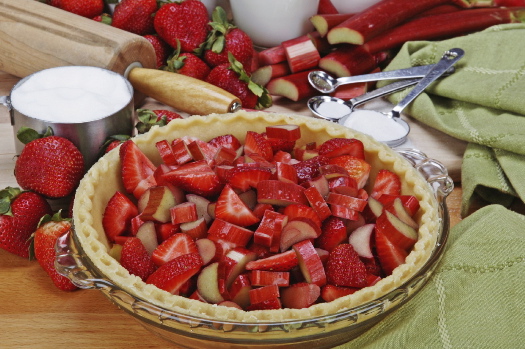
Fruit Pie With All-Butter Flaky Crust
Ingredients
For Grand Central Bakery’s pie crust:
2½ cups all purpose flour
2 tablespoons sugar
2 teaspoons salt
1 cup cold butter (2 sticks), cubed
3 tablespoons cold water
1 tablespoon lemon juice
1 egg for egg wash
1 tablespoon water
4-5 cups of fresh fruit (such as a mix of sliced strawberry and rhubarb, or fresh blueberries or sliced peaches)
3 tablespoons of arrowroot or cornstarch
3 tablespoons of sugar (white or brown)
1 tablespoon lemon juice
1 teaspoon vanilla extract
½ teaspoon kosher salt
Directions
- Make sure all your ingredients are cold. The best way to do this is to measure them all out, then place them on a large plate or tray and place the tray in the refrigerator for 20 minutes.
- After the ingredients have chilled, mix the water and lemon juice together and set aside. Place the flour in the bowl of an electric mixer fitted with the paddle attachment. Add the cold butter cubes and combine on the lowest speed for about a minute or two. The texture of the mixture will change to rough and mealy.
- Add ¾ of the water and lemon juice mixture and mix very briefly. You should still be able to see pea-size chunks of butter, and the dough should start to hold together. If it is still crumbly, mix a little longer, then finally add the rest of the water.
- Form the dough into 2 disks, flatten them and wrap in plastic wrap or tightly in a large Ziplock bag. Allow them to chill for 1 hour.
- Once the disks are chilled, unwrap them and sprinkle the work surface and the dough with a little flour. Roll the dough out with a rolling pin to about 10 inches in diameter and about ⅛-inch thick.
- Preheat the oven to 350 degrees
- Gently place the dough in a 9-inch pie plate, wrap with plastic wrap and allow it to rest in the refrigerator as you repeat the process with the other disk, which will be the upper crust. You can wrap the second disk in plastic wrap and place it over the covered pie plate to allow them both to chill and rest.
- In a medium bowl, toss the fruit slices or berries with the arrowroot, sugar, lemon juice, vanilla and salt.
- Fill the pie plate with the sliced fruit or berry mixture.
- Top with the other crust. Pinch the inch two crusts together to create a fluted edge. Cut a few decorative slices in the top of the crust to allow steam to escape.
- Finally, mix the egg with a tablespoon of water and brush the egg wash on the crust before baking. Bake until the pie crust is golden brown and the fruit is bubbling — about 35-40 minutes.
Susie Norris is a chocolatier, TV producer and author of the book “Chocolate Bliss.”
Photos from top:
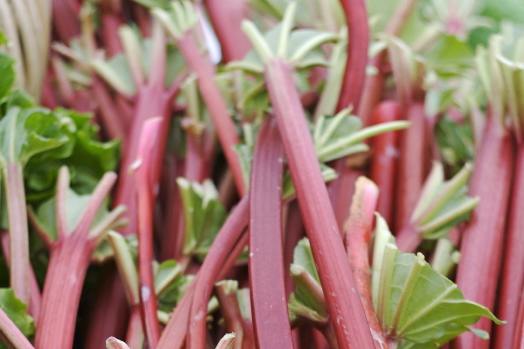
Portland rhubarb. Credit: Bruce Block
Strawberry-rhubarb pie. Credit: Courtesy of AdLife Marketing
The number of people on Earth is expected to shoot up from the current 6.7 billion to 9.2 billion by 2050. How will we feed them? If we continue with current farming practices, vast amounts of wilderness will be lost, millions of birds and billions of insects will die, and farm workers will be exposed to more and more chemicals. And still, we will not have enough food. Clearly, there must be a better way.
Some scientists and policymakers suggest that genetic engineering, a modern form of crop modification, will dramatically reduce our dependence on pesticides, enhance the health of our agricultural systems and increase the nutritional content of food. They believe these genetically engineered crops will help agriculture end decades of dangerous overuse of pesticides and toxic herbicides, leading us to a more ecological way of farming.
Will it? The organic farming community has been particularly vocal in its skepticism, viewing GE crops as unnatural, potentially unsafe to eat and environmentally disruptive. For these reasons, the National Organic Program standards currently do not permit their farmers to grow GE crops.
Last month the National Research Council weighed in, publishing a comprehensive overview of the environmental, economic and social impacts of GE crops — the three essential pillars of sustainable agriculture. Their report supports the growing consensus that GE crops and ecological farming practices can coexist — and if we are serious about building a future sustainable agriculture, they must.
The NRC found that the use of GE crops over the last 14 years has led to improved soil quality, reduced erosion, massive reduction in insecticide use, higher yields, lower production costs and increased worker safety due to reduced exposure to harsh chemicals. Previous reports have noted that GE crops have not caused instance of harm to human health or the environment.
So are GE crops enough to feed the world?
A premise basic to almost every agricultural system (e.g., conventional and organic) is that seed can only take us so far. The farming practices used to cultivate the seed are equally important. That is why NRC scientists also outlined some of the pitfalls encountered when ecological farming practices are not integrated into the production of GE crops. For instance, one of the most environmentally benign and highly valued herbicides, glyphosate (sold as Roundup), is no longer effective in controlling some weeds because of an over-reliance on that single herbicide. The herbicide resistance that the NRC report documents is not due to the GE crop; it’s due to repeated applications of glyphosate without integration of other weed-management tactics, a problem that has to be managed in all crops.
To understand how improved seeds and farming practices work together, you need only look at transgenic Bacillus thuringiensis (Bt) crops, which are genetically engineered to resist insect pests.
It has long been known that using just one resistant plant variety can spur natural selection for insects that overcome the resistance. Armed with this knowledge, Bt crops in the U.S. were deployed using a “refuge” strategy whereby farmers planted a certain percentage of their cotton acreage in non Bt-producing cultivars. This would provide pests a refuge where they could feed on plants lacking toxins, thereby maintaining Bt susceptible resistance alleles within the insect population.
It worked.
Today, Bt cotton farmers in Arizona spray half the insecticide as their neighbors who grow conventional crops yet harvest the same amount of cotton. Bt cotton is still an effective pest management tool. At the same time, these Bt croplands harbor a higher diversity of beneficial insects (as measured by ant and beetle biodiversity) compared to conventional farms because there are fewer insecticides sprayed that would kill them. In other parts of the world where an integrated approach was not implemented in Bt croplands, insect resistance has already evolved.
Another management problem associated with Bt crops has recently emerged in northern China where Bt cotton has been adopted by 95 percent of cotton growers. It controls the pest cotton boll worm so effectively that farmers dramatically reduced their insecticide applications. So much so, that other pests, called mirid bugs, normally controlled by these sprays, have emerged. As a consequence, farmers are again spraying some insecticides to control the mirids (although still a third less than before the introduction of Bt crops).
Ecologically based farming systems and GE crops alone won’t provide all the changes needed in agriculture. Other farming systems and technological changes, as well as modified government policies, undoubtedly are also required. Yet it is hard to avoid the sense that ecological farming practices using genetically engineered seed will play an increasingly important role.
We need the best science and technology to achieve sustainable agriculture that will feed the world. Accomplishing this task will require globally coordinated efforts to integrate ecologically sound, but highly productive, agricultural practices, including many of the ideas promoted by organic farmers, such as crop rotation and crop diversity to global agricultural production.
We also need improved seed. This includes not only conventional tools for seed improvement, such as pollination, tissue culture, mutagenesis and grafting (mixing two species to create a new variety), but also modern molecular tools such as marker-assisted breeding and genetic engineering.
It is by looking beyond the ideologies that we will approach the shared goal of a sustainable agriculture that will feed the world.
Pamela Ronald is a professor of plant pathology at the University of California at Davis where her lab grows genetically engineered rice for flood tolerance and disease resistance. She and her husband, organic farmer Raoul Adamchak, are co-authors of “Tomorrow’s Table: Organic Farming, Genetics and the Future of Food.”
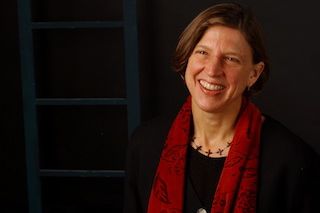
Photo: Pameia Ronald. Credit: Debbie Aldridge / University of California, Davis
Doctors get a pass for having terrible handwriting, but should they get a pass for being lousy cooks?
Dr. David Eisenberg doesn’t think so. He has spent the last 10 years trying to find a way to get doctors and medical students into the kitchen. In late March, Eisenberg wrapped up the sixth Healthy Kitchens/Healthy Lives conference, an academic partnership between Eisenberg’s home base, Harvard Medical School, and the Culinary Institute of America in Napa Valley. The goal is to turn doctors and nurses into born-again cooks who will use their own healthy behaviors to influence their patients.
Eisenberg’s ultimate vision is a teaching kitchen in every medical school and every hospital. “The only way to combat the obesity epidemic is to get people back in the kitchen,” he says. “Culinary literacy is at an all time low, and it shows in the choices we make about food. Physicians are no better than the general population. We learn next to nothing about nutrition in medical school, and as a profession, we have almost no time to cook. I believe that if we can give health professionals the most up-to-date research about nutrition and teach them healthy cooking skills, we have the elements of a novel strategy to combat childhood and adult obesity.”
Eisenberg is an associate professor of medicine and a board certified internist with three decades of ivy-crested academic credentials. But his passion for cooking dates even further back than his interest in medicine. Becoming a physician meant breaking a four-generation chain of professional bakers. His eyes mist over when he describes the aroma of his father’s bakery in Brooklyn. In 1979, Eisenberg became the first U.S. medical exchange student to China. He returned home with a healthy respect for traditional Chinese medicine,a belief in the idea of “food as medicine” and a huge Chinese cleaver. His favorite quote is from “The Yellow Emperor’s Classic of Internal Medicine,” circa 400 BCE.
“To administer medicines to diseases which have already developed and thereby suppress bodily chaos which has already occurred is comparable to the behavior of those who would begin to dig a well after they have grown thirsty, or those who would begin to cast weapons after they have already engaged in battle. Would these actions not be too late?”
Doctor’s orders, even in the kitchen
Eisenberg has the bow tie of a Harvard professor, the eyes of a public health zealot and the palate of a baker. On the second day of the conference, he tied on an apron with confidence, and, following a parade of professional chefs — including Joyce Goldstein, Suvir Saran, and Culinary Institute of America Executive Chef Bill Briwa — he led the 400-plus attendees through a cooking demo of a favorite stir-fry dish.
He sliced mounds of mushrooms and trimmed a stack of shrimp with great determination, if not the elegance of the pros. “I only use one pan and the same cleaver I’ve been using since I studied medicine in China,” he smiled, standing not far from a gleaming batterie of cuisine display of “essential pots, pans, gadgets and knives.” His dish, accompanied by whole grains and a simple Asian sauce, was an example of the kind of fast, healthy cooking repertoire he hopes to inspire in his colleagues. “The variations are endless, the technique — timeless,” Eisenberg said, positioning the plated dish for the conference cameras.
Set in the lusciousness of wine region in early spring, the Healthy Kitchens/Healthy Lives conference may be for health professionals the best-kept secret in America. Its three days are densely packed with nutrition science, clinical data, cooking demos by gifted chefs and an opportunity for each attendee to be hands-on in the kitchen. Not every attendee was convinced that the conference would deliver a serious learning experience. “A boondoggle! In the wine country. With CME [Continuing Medical Education] credits? What’s not to like?” one physician confided at the opening reception. That was Thursday.
By Sunday morning, the same skeptic was standing in the CIA’s grand teaching kitchen, wearing an apron and a white paper toque, struggling to master charring and skinning jalapeño peppers for a Romesco sauce and rapturously reciting all the nutrition nuggets absorbed over the last 72 hours. Across the room, a CIA chef demonstrated how to grind a spice mix for cardamom-roasted cauliflower. In the main conference room, a chef and a Harvard physician ran a joint session on “Nutritional Counseling in the Primary Care Setting.”
Food Pyramid is out, wine is in?
World-class faculty from Harvard Medical School kept the conference crackling,challenging the U.S. Department of Agriculture’s Food Pyramid and debunking the eat-no-fat-and-be-cancer-free diet and the notion that milk is necessary for bone health. On the other hand, wine and dark chocolate were elevated to health food status by epidemiologist Eric Rimm of the Harvard School of Public Health. The audience, plumped with internists, family practitioners and pediatricians drank in the pie charts, the regression analyses and the clinical data like chardonnay at an afternoon cocktail party. At the conference’s end, rather than heading out to sample some Napa Valley pinot noirs, the physicians were still inside eagerly taking notes, chopping onions and wondering how to take the lessons of the weekend home, for themselves and their patients.
Eisenberg and his Culinary Institute of America counterpart, Greg Drescher, the visionary director of education at the Napa school, have been working on this conference concept since 1997. It was not easy for Eisenberg to get the medical establishment to bless the idea that a conference focused on food could be good medicine. But as diabetes and obesity rates have tripled over the last few decades, Eisenberg made headway within his colleagues. Each year the conference has sold out, and the proportion of physicians has increased. This year, 66 percent of the attendees were MDs.
After attending last year’s conference, internist John R. Principe from Chicago started a group wellness program with his patients. He teaches cooking, leads them through mindfulness exercises and even takes them on grocery shopping excursions. By the end of the program, Principe’s patients showed measurable health improvements — even if they had not lost an ounce of weight. After sharing his results at the conference, he found himself fielding a flurry of questions from fellow physicians on everything from what to cook and how to bill.
Eisenberg flashes up a slide from a 2004 Journal of the American Medical Association article that summarizes research findings. Among them: MDs who wear seat belts, exercise and don’t smoke are more apt to advise their patients to follow their lead. “Practicing a healthful behavior was the most consistent and powerful predictor of physicians counseling patients about related prevention issues,” said Eisenberg.
Louisa Kasdonis a Boston-based food writer and former restaurant owner. She is a columnist for the Boston Phoenix, the food editor for Stuff Magazine and has contributed to Fortune, MORE, Cooking Light, the Boston Globe, Boston Magazine and The Christian Science Monitor, among others.
Photos, from top: Conference attendees in the kitchen
.
Dr. David Eisenberg at the podium. Credits: Louisa Kasdon
I did not know much about the American food industry when I began working on the documentary film “Food Inc.” I had no preconceived point of view. I thought I would talk with all of the people who produce our food and I would learn from them. Pretty simple. And pretty wrong.
This world, the world that feeds so many, was off-limits to a filmmaker like me. Walls went up everywhere. I would have had more access to my subject if I’d made a movie on nuclear terrorism. It took me a while to appreciate the totality of the stonewalling. Ultimately, I recognized what was going on: a focused effort to stop consumers from thinking about their food.
And yet, when we talk about food, we are talking about what we put into our bodies. And this is a subject where questions are off-limits? Americans operate and buy food in a free market. We have to be allowed to make our decisions based on information.
Before the film was released in June, Monsanto, the world’s largest seed producer, put up a Web site dedicated to discrediting “Food Inc.,” claiming we were “demonizing” farmers. We never equated Monsanto with the American farmer. But that still didn’t explain why corporate representatives were never willing to go on camera. If their products were so good, why were they so afraid? What were they hiding? I ended up spending more in legal fees to get this movie made than I did on all 15 of my other documentary films combined.
So, unlike my other films, “Food Inc.” was not about what I learned, but instead about what food consumers are not allowed to know. I hope that still opens people’s eyes to what goes into their mouths.
The film played into a movement that started with Eric Schlosser’s “Fast Food Nation” and was fed by Michael Pollan’s writings. It is a broad-based movement led by mothers who want to feed their kids healthy food. But it reaches, now, far into the halls of Washington as we move toward changing health care. How can you fix health care and ignore that a third of Americans born after the year 2000 will develop Type 2 diabetes while the federal government subsidizes the production of corn-based foodstuffs that are not good for us to eat?
We are far from alone in sounding the alarm. In his book, “The End of Overeating,” former Food and Drug Administration chief David Kessler talks about how corporations make food as addictive as possible. The same people who sell us tobacco are turning food into the equivalent of nicotine. And their mantra is “personal responsibility.”
When food companies compete only on price, the players just get bigger and bigger. Industrial farming has only existed for 40 to 50 years. We are only just realizing it isn’t working. In our university system, you cannot study Monsanto seeds without the company’s approval, and if you write anything negative, Monsanto will pull its research funding out of the university. Real food science is disappearing.
As we begin to appreciate the unsustainability of our current industrial food system, the question is whether the food industry will be forced to change. These food corporations are powerful. They are just as capable of making things better as making things worse. On one hand, I see a race to the bottom — food becoming cheaper and cheaper at the same time our system of agriculture becomes more and more abusive of the earth, of animals and of ourselves.
Yet, I have come to believe we have had more of an effect on our world than I thought we would. I was totally pessimistic when we finished the film, only to be shocked by the response to it. People were outraged. Food is a personal thing most people can relate to. It has real power.
There is something so universal about food. When I try to think of my next film subject, nothing is as all-encompassing. Other issues seem so abstract. People don’t care if we lose journalism or government. But none of us can do without food.
I was just invited to speak at The Center for Food Integrity, a food industry group led by Perdue, the chicken producer. I was invited because the group had commissioned a market survey showing its customers are concerned about food safety. If they want to stay in business, they have to address these issues. So they have begun reaching out to their critics. They know they have to start listening.
Now, because these companies feel forced to enter the conversation, I feel an obligation to not walk away. I may not have been able to ask questions of these companies while I was making “Food, Inc.,” but, whenever I can, I do so now. By holding the industrial food giants accountable, we will learn how to improve the system. We will find the common ground that allows us to feed the world responsibly.
Robert Kenner, the director, co-writer and co-producer of “Food, Inc.,” has received numerous awards for his work, most recently, the 2006 Peabody for Exceptional Merit in Non-fiction Film-making and the Greirson (British documentary award) for his film about the Vietnam War, “Two Days in October.”
There is a bit of lore about eggs that is misleading. For example, did you know that the only difference between white eggs and brown eggs is the color of the shell? Did you know that the small blood veins in the yolks of organic eggs are harmless? Did you know eating a raw egg presents less heath risk than consuming hamburger cooked from ground beef patties from the supermarket?
Raw eggs in particular got a bad rap. In the 1990s we suddenly were cautioned about eating real mayonnaise or Caesar salad or downing a prairie oyster. Eggs appeared endangered when some alarmist and irresponsible food and nutritional journalism suggested raw eggs carried a high risk of food-borne illness. I delved into the research on raw eggs at the time because, as a cookbook author, I faced concerned editors who insisted I address the egg-safety issue. I learned that the chance of getting a food-borne illness from raw eggs is very low and statistically nil. It is about the same as for spinach or any food that is mishandled.
Salmonella is found mostly in egg whites and to a lesser extent the yolk — but it’s exceedingly rare. A 2002 study by the U.S. Department of Agriculture showed that of the 69 billion eggs produced annually, only 2.3 million are contaminated with salmonella. That’s .003 percent of eggs, or 1 in every 30,000 raw eggs.
The average consumer might encounter a contaminated egg once every 84 years. Moreover, if you have a healthy constitution, salmonella at most will make you feel a little sick, a condition that will pass in a few hours to a day. Cases of salmonella that result in serious illness or death are very, very rare.
Furthermore, the eggs most likely to carry salmonella come from industrially raised, that is, conventionally raised, chickens. Only sick chickens lay salmonella-contaminated eggs. Cook with organic eggs and the risk virtually disappears.
However, once you buy freshly laid organic eggs you will probably never again buy supermarket eggs. The taste is just better. There is nothing wrong with supermarket eggs, mind you, but I tend to use them more for mixes than for egg dishes. Eggs should be stored in the refrigerator.
My conclusion: There is no reason to fear the raw egg in real mayonnaise, hollandaise sauce, Caesar salad, eggnog, pisco sours or a “Rocky”-like breakfast egg shake. One proviso: Individuals with particular heath problems, such as high cholesterol, should limit their intake of eggs. All should consult doctors about individual nutritional needs. However, if you can eat anything, then by all means eat raw eggs. How about a prairie oyster? Take one large organic egg, separate the yolk from the white into a spoon. Squeeze a few drops of fresh lemon juice on top, season with salt and pepper and let it slide down your gullet.
Last month, the House got around to updating food safety laws that have been in effect since 1938. The bill, which the Senate will take up in the fall, gives the Food and Drug Administration substantial new inspection powers and beefs up funding for food safety research. It also adds a new $500 fee per facility for anyone involved in the food business. But will 159 pages of shiny, new 2009 rules actually make our food safer than the old-timey1938 laws did?
When the bill passed the House, its author, Rep. John D. Dingell (D-Mich.), crowed to The Washington Post: “This will fundamentally change the way in which we ensure the safety of our food supply.” This is a very D.C. thing to get excited about. Bureaucratic change! Well, change in the FDA bureaucracy, anyway. The numerous additional rule makers and germ counters at the 15 other federal agencies also tasked with food supply supervision will continue with business as usual, unaffected by the new legislation.
Dingell has been riding the food safety hobbyhorse for more than 20 years, but he finally got some traction after the recent tainted peanut butter scandal, which probably scared peanut butter manufacturers a heck of a lot more than it did Dingell. Consider the speed of the recall (a few weeks) versus the speed of the new law (a couple of years).
Under the new rules, the power to issue recalls has been removed from the companies themselves and placed into the hands of a newly flush FDA—implementation of the new rules will cost federal taxpayers an additional $2.2 billion. A recall can be appallingly costly for a company, both in dollars and in reputation. But feeding a bunch of Americans unsafe food can be costlier still when the lawsuits start to stack up. (Dingell’s bill exempts small producers from most of the new requirements, so this entire discussion is about the safety of the food churned out by the big boys.)
Recall math is tricky. We’re not necessarily talking about the dreaded case of a company “putting a price on human life”—though that can and does happen in business and in government all of the time.
Instead, sometimes the causes of a case or two of food-borne illness simply aren’t immediately clear: Did someone leave a single case of spinach with a tiny puncture too close to a Port-a-Potty, or is there something seriously wrong with the green’s growth and distribution system? A nerve-wracking wait-and-see period follows the first case or two of food poisoning as bean makers’ bean counters try to figure out what’s going on.
Companies have lawyers and accountants who do this math for them, and the FDA will too. But the FDA’s formulas (and its political appointees) will put an awful lot more emphasis on the CYA variable, and a lot less on costs incurred by the companies. The result will be more frequent recalls for more marginal cases. That means more panic all around, in a country already obsessed with food safety—a self-perpetuating cycle. We may not wind up safer, just more worried.
Anyone who thinks corporate and public interests always match up is full of, well, tainted peanut butter. But the case of food safety does offer a closer-than-average alignment. A couple of high-profile incidents aside, this is why laws from the misty past were still working surprisingly well—news about food travels quickly in the era of panicky e-mail forwards and panicky-er cable television, and filing a class action lawsuit is easy as Hostess Cherry Pie. People don’t want to get sick for personal reasons and food companies really don’t want to make them sick for fiscal reasons. If and when a bunch of customers start feeling bilious, the CEO doesn’t need an FDA food safety officer around to inform him that he is in deep, deep peanut butter.
Photo illustration by Katherine Mangu-Ward
Katherine Mangu-Ward is a senior editor at Reason magazine in Washington, D.C.
Zester Giveaway
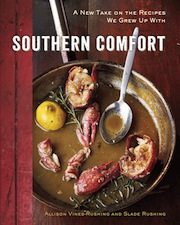 Fall in love with recipes, inspired by New Orleans. Enter here to win one of 5 copies!
Upcoming Events
-
see all of our
Upcoming Events
-
Vermont Brewers Festival July 19-20Took place on July 19, 2013Vermont Brewers Festival Welcome to the 21st Vermont Brewers Festival. An Artisan Craft Beer Festival celebrating Artisan Craft Beer and the Brewers who brew them….
-
Kirkland Uncorked July 19-21Took place on July 19, 2013Kirkland Uncorked Kirkland Uncorked is a regional showcase of art, food and wine of the picturesque shores of Lake Washington in Kirkland, WA taking place…
-
Food & Wine Conference July 19-21Took place on July 19, 2013Food & Wine Conference The Food and Wine Conference brings together bloggers, small business owners, winemakers, chefs, public relations professionals, traditional media, new media, authors…
SmartBrief