Articles in Gluten-free
If you like the circus act where a crowd of clowns emerges from a tiny car, then you’ll love spaghetti squash. It’s just plain fun to cook a vegetable the shape of a small watermelon, then open it up and pull out yards of crisp-tender golden strands.
Spaghetti squash is the delicious link between soft-skinned summer squashes and hard-skinned winter squashes. In the past decade, varieties have proliferated, leading to a broad array of sizes and shapes, and colors that range from pale ivory to deep yellow. These newer varieties also have richer tastes — look for tivoli, orangetti, stripetti, and, hasta la pasta.
But no matter what it looks like on the outside, spaghetti squash is defined by the flesh inside, which separates into long pasta-like strands when cooked. Unlike its namesake, however, this spaghetti is low in calories, free of gluten, and rich in folic acid, fiber, potassium and vitamin A.
And it’s super-easy to prepare. Simply bake, steam or microwave, then tease out the strands, and toss them with butter, cheese, pesto, tomato, garlic and herbs, soy sauce and sesame oil, or anything you like.
Choosing and storing squash
Along with butternut, acorn, delicata and pumpkins, spaghetti squash is part of the winter squash family, sometimes known as “keepers” because they will last for several months in cool storage, and often will keep well until spring.
Their hard rind protects them from moisture loss and from being attacked by mold or bacteria, an attribute that people have been taking advantage of for thousands of years. Parts of winter squash have even been found in pre-Columbian archeological sites in South America.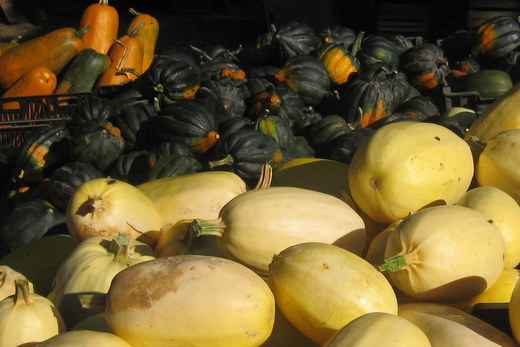
Look for spaghetti squash that feels heavy for its size, with no soft spots in the hard skin. Store at room temperature for one to two months, or in a cool, dry place for even longer.
To freeze, pack the cooked strands into freezer bags. Partially thaw before re-using, then steam until tender but still firm, about five minutes.
Baking your squash
To bake a spaghetti squash, prick the squash with a sharp knife in three or four places to prevent an explosion. Place in a pan in a 350 F oven and bake for about 60 minutes for a two- to three-pound squash.
Remove the dish from oven and halve the baked squash at once. Let cool briefly, then scoop out the seeds. With a fork, comb strands from each half until only the shell remains.
To steam, halve the raw squash lengthwise with a sharp, sturdy knife. Scoop out the seeds. Halve each piece lengthwise again, then place on a steamer rack above boiling water. Cover and steam 20 to 30 minutes. Gently pull strands from the shell.
To microwave, cut the squash in half and put the halves cut-side down in a glass baking dish. Pour ¼ cup water around them, and cover the dish tightly. Microwave at high power for 12 minutes, or until soft when pressed. Let stand, covered, for three minutes before teasing out the strands.
Herbed Spaghetti Squash With Cheese
Ingredients
Directions
Place the spaghetti squash strands in a large bowl. Add all the other ingredients and toss well.
Spicy Asian Spaghetti Squash
Ingredients
Directions
- Whisk the peanut butter, teriyaki sauce and pepper flakes in a small bowl until blended.
- Whisk in the hot water.
- Add the sauce and julienned vegetables to the bowl of spaghetti strands and toss.
- Serve warm or cold.
Terra Brockman is an author, a speaker and a fourth-generation farmer from central Illinois. Her latest book, “The Seasons on Henry’s Farm,” now out in paperback, was a finalist for a 2010 James Beard Award.
Photos: Squash. Credit: Terra Brockman