Articles in Drinking

Who speaks for the trees? Craft cider producers.
The third annual Cider Week, a beverage-promotional initiative to encourage restaurateurs, shop owners and consumers to try cider, came to New York last month, and it is being celebrated in Virginia this week. I mean hard cider, the fermented juice of apples, which is an alcoholic beverage that has a long history in the United States. I am not referring to sweet cider, the non-alcoholic, cinnamon-laced apple juice often found with a doughnut for a sidekick. Cider Week is about hard cider. For apple growers across the country, that distinction makes all of the difference.
More from Zester Daily:
» The colonial roots of craft apple cider
» Apple cider gets dressed up for the holidays
» Save Sonoma’s Gravenstein apple
Over the last century, this beverage has so thoroughly lost its place at the American table that it’s impossible to write about it without a short history lesson. Before Prohibition, cider was as familiar a beverage as water. Often it was the more palatable and sanitary choice of the two. Thousands of apple varieties thrived across the U.S., and those most highly prized were the kinds that you would not necessarily pick up and eat raw. Bitter and astringent varieties were cherished for the complexity they could add to hard cider, the final destination for most apples grown at the time.
After a near century-long, Prohibition-induced dormancy, the hard cider industry is back with a bullet. Craft producers and sommeliers across the country are rediscovering that cider fermented from heirloom varieties of apple can express complexity and terroir, much as a fine wine. And just as wine presents vintners a more profitable product than selling fresh grapes, cider offers apple growers a much higher price than the highly seasonal sale of fresh apples.
According to Dan Wilson of Slyboro Cider House in Granville, N.Y., his farm’s you-pick operation accounts for about 80% of its yearly income. This business model is risky because his season for you-pick is only six weeks long, meaning a few rainy weekends could seriously damage earnings. For his operation and many like it, the benefits of cider production are manifold. Cider is a shelf-stable product, meaning it can provide income year round. It is an added-value product, selling at a higher price than the fresh ingredients used to create it.
Because apples pressed into cider do not need to be flawless, cider production allows farmers greater flexibility to spray fewer chemicals and to make use of imperfect apples.
Cider Week spotlights craft cider makers
Glynwood, the agricultural nonprofit in the Hudson Valley where I work, started Cider Week three years ago to aid New York craft cider producers in this resurgence. This year’s 10-day celebration of regional, craft cider included more than 200 locations in New York City and Hudson Valley that featured cider on their menus.
While that commitment meant a fun week of great events for consumers, it also meant exposure and new accounts for craft producers. By focusing on artisanal producers, Cider Week is meant to carve out a niche for small growers, help them expand their businesses, and increase viability for Northeast orchards.
The rapid resurgence of this beverage means that the big players — read multinational beer corporations — in the beverage world are out in force. These companies have a part to play by moving cider from niche to mainstream. With a massive clientele and considerable marketing power, they are poised to shake up the traditional beer/wine dichotomy and introduce cider to a huge subset of the American drinking population.
Look for small, local providers
However, for American orchards, for farm viability and rural development, and for increased biodiversity, the resurgence of craft cider is where the true opportunity lies. Small companies pressing whole, regional apples (as opposed to imported apple concentrate) are stewards to the land and keepers of the craft in a way the big boys categorically cannot be.
Craft cider makers are the guides on America’s journey back to a sophisticated, complex beverage, pulled directly from the annals of our own history. As the American palate co-evolves with this new wave of enterprising craftsmen and women, we also hone our tastes for a future that celebrates food and drinks as a passionate expression of place. It is a future that moves me.
And the best way to get there is to find craft cider producers near you. Ask about craft cider on beverage menus and in wine stores. Look at the directories of the many Cider Week events held around the country to discover regional producers (and if you don’t have local cider, many producers can ship). Feature cider at your Thanksgiving dinner this year. In doing so, you will be supporting a beverage, an industry and a tradition as deeply American as the holiday itself.
Top photo: Valerie Burchby. Credit: Caroline Kaye
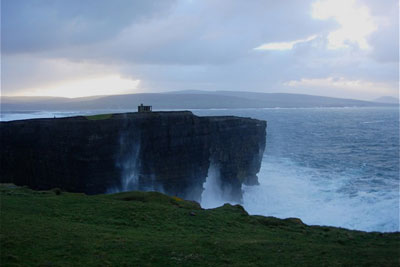
When my husband was invited to practice his art of painting in rural — the word was emphasized many times in the acceptance letter — Ireland, we jumped on it and decided to go right away rather than wait until summer. Our stay was from Halloween to Christmas, covering the major holidays, which were pretty much nonexistent for us that year.
Winter is perhaps not the most perfect time to be on the rough and wild Atlantic coast of the Emerald Island — which, as you quickly come to understand, has to do with the copious amount of rain that falls. It was cold. And damp. Our cottage was stone, and there were gaps in the ceiling that allowed a view of the sky. My husband’s studio was heated, but for me, getting warm and staying that way was the challenge of each day. The recipe called for lots of hot water and alcohol.
Finding warmth in Ireland
Here’s how it worked. First, we were told not to use hot water unless it came from the night storage, a concept we found hard to follow but eventually understood: Electricity is cheaper at night than during the day, so water heated at night is more economical than water heated during the day. So I started the day by submerging myself in water that was as hot as I could stand and staying there until I really couldn’t stand it anymore. Then I dressed in an infinite number of layers that padded me like the Michelin Man, but they kept me warm until noon, when I repeated the process.
More from Zester Daily:
» Good Food Ireland can guide your dining choices
About 3 p.m., when the light caved, I joined Patrick, my husband, in the pub across the street from his studio, where I had a hot whiskey with lemon and clove — divine because it warmed my hands as well as my insides. Then maybe I had a second one just to seal in the hint of warmth that I was sure was coming on. These drinks were pretty mild as alcohol goes. Even two weren’t nearly as strong as the real Irish coffee I had in a pub in a nearby town, where the combination of caffeine, sugar, booze and cream was simultaneously such an upper and downer that your day was done by the last sip. By comparison, the hot whiskey was like tea.
When we returned to our cottage, it was dark outside and cold inside. The first task was to light a peat fire in a fireplace that would never become hot it so dwarfed our expensive bundles of peat logs. There was a heater on one wall, which, if you leaned against it, could make a small portion of your bottom warm, but that was the sum total of its effectiveness.
ireland4
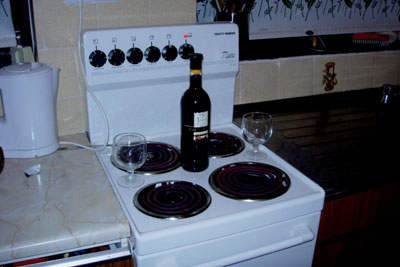
Because cooking dinner helped produce some warmth, we headed to the kitchen. When Patrick would get a bottle out, it wasn’t that nicely chilled red wine temperature we’ve come to appreciate, nor was it frozen. But it was so frigid you might want to wear mittens to handle it. The wine glasses, too, were like bowls of ice. So we lit the burners on the stove, placed the bottle and glasses among them, and waited until the bottle felt right. By then the glasses would be, too, and dinner would be nearly prepared. We ate it huddled against the big metal fireplace that at least suggested coziness.
Finally, I’m ashamed to say, the best part of each day came, and that was getting into bed and lying on the enormous heating pad that worked like a reverse electric blanket: warming the bed rather than lying on top of you. Finally, here was warmth, and it stayed — regardless of the wind and the rain, which sounded like it was shot from nail guns. While in bed I read a lot about the famine years and tried to comprehend how people could be this cold and starving and yet continue on, while I was being such a wimp about it all.
Christmas in Dublin
By Christmas we were in Dublin, which felt very far from County Mayo in every way. The hotel room was warm; people were festive and jolly; the food was varied and good; there were amazing cheeses to be found; and a farmers market was filled with treats. The pubs were bustling, and there were warm cobblers with cream or mushrooms on toast for breakfast. I’ve never loved Christmas that much, but in Dublin it felt like a real celebration, with music on the streets and a big feeling of happiness in those around us. Of course, that’s when the Celtic Tiger was a big glossy cat, but it was last year, too, when we were there and the economics were quite reversed.
By far, the best holiday scene was one I had the good fortune to happen upon, and it had nothing to do with food. I was walking down a street when I noticed at least a 100 Santas standing together in front of a rather grand building. They were talking and smoking in their Santa outfits. That alone was quite something to see, and I would have been utterly content if it went no further. But then all at once the door of the building opened, and the president of Ireland, Mary McAleese, stepped out, and all the Santas burst into boisterous song: “We wish you a merry Christmas, we wish you a merry Christmas, we wish you a merry Christmas and a happy new year!” And they cheered the president in her red dress, and I think they might have tossed hats into the air.
Top photo: County Mayo, Ireland. Credit: Deborah Madison
There’s no shortage of wineries in Piedmont, Italy. Some, especially those that make blockbuster Barolos and Barbarescos, are grand and world-famous. Their wines feature on top restaurant wine lists and take pride of place in the cellars of wine collectors the world over. Securing an appointment to visit requires a personal introduction and/or a certain chutzpah, with fluent Italian a distinct advantage.
On the other hand, for every grand and famous estate, there are a half-dozen pocket-sized domaines, known only to a few cognoscenti. They specialize in gem-like wines made in tiny quantities, which they nurse to maturity with tender loving care. Many of these smaller, lesser-known wineries welcome visitors — including English-speaking ones — by appointment, receiving them with simplicity and rare generosity of spirit.
Cascina Fontana in the village of Perno, perched on a ridge in the misty Langhe hills just south of Alba, falls neatly into this gem-like category. It is headed by Mario Fontana, the sixth generation of his family to make wine here, together with his wife, Luisa, with help from mamma Elda and occasional aid from sons Edoardo and Vasco. With just 4 hectares (9.8 acres), Mario makes the four classic red wines of the Langhe region: Barolo and Langhe Nebbiolo, both from the Nebbiolo grape, as well as Barbera d’Alba and Dolcetto d’Alba. He describes his wines as “genuine, natural, true expressions of nostro territorio — our land and our culture.”
Weather makes or breaks Italian winery owner’s spirits
I visited in May this year and found the usually cheerful Mario looking uncharacteristically glum. “It was a long winter, followed by a miserably cold, wet spring,” he admitted.
More from Zester Daily:
» Discovering Nebbiolo and Barolo wines in Italy’s Piedmont
They finished harvesting at the end of October and a delighted Mario was able to report by mail that after all those anxious moments earlier in the year, he was overall quite satisfied with the vintage. But it’s early, he admitted. “I always remember what my nonno (grandfather) Saverio, my greatest teacher, used to say to me: ‘The grapes are harvested in fall, but the race is not over till the final lap is completed.’ ”
On that May visit, gathered around the huge oak table in Mario’s newly converted tasting room with a group of wine-loving friends, we tasted the results of earlier vintages that had completed their final lap.
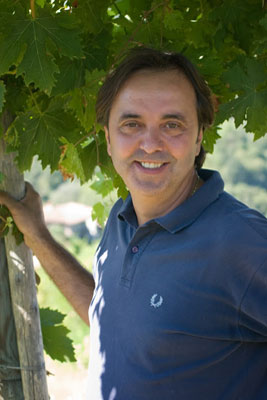
Cascina Fontana vintner Mario Fontana. Credit: Kim Million
First came Dolcetto, bright, pretty, thirst-quenching and (at 12.5% alcohol by volume) relatively low in alcohol — perfect with a simple salad of vine-ripened tomatoes and local mozzarella with home-made grissini. Next came Barbera d’Alba, a blooming delight, deliciously fruit-driven and just right with slivers of air-dried sausage from the local butcher.
Mario’s Langhe Nebbiolo, which (like his Barbera) spends a year in small oak barrels, some of them new, is a proper wine, not just (as is too often the case) a poor relation of Barolo that didn’t quite make the cut. Finally, with a steaming plate of manzo brasato al Barolo (beef braised in Barolo) made with love by Mario’s mamma, we worked our way around several vintages of the eponymous wine, each one elegantly structured, beautifully balanced, understated and oozing with class.
Cascina Fontana wines are imported into the United Kingdom by Berry Bros. and Rudd, wine merchants by appointment of the Queen and the Prince of Wales. Check Wine Searcher for stockists in the U.S.
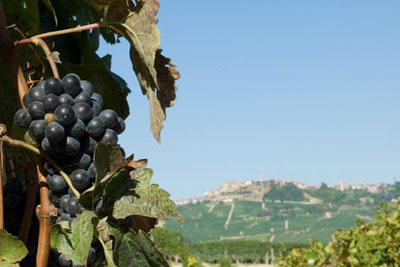
Top photo: Grapes growing at Cascina Fontana. Credit: Kim Millon
I usually pour American wines on Thanksgiving, but after recently tasting this northern Italian white at New York’s Nougatine restaurant, I changed my mind. I’ll be serving this fragrant 2012 Abbazia di Novacella Kerner from the Alto Adige region that’s crisp and generous, balancing bright fruit with notes of flowers and fennel. It’s also amazingly food-friendly.
The combination of tart, savory and sweet tastes in the typical Thanksgiving feast is one reason selecting wines for this all-American holiday is so difficult. At Nougatine, the café section of the more famous restaurant Jean-Georges, the wine not only made a fine aperitif, but also went well with everything from a gently sweet butternut squash soup to a rich tuna tartare to a savory organic roast chicken. I have no doubt the Abbazia di Novacella Kerner will enhance my turkey as well as my rich oyster stuffing.
Elin McCoy’s Wine of the Week
2012 Abbazia di Novacella Kerner
Price: $20
Region: Alto Adige, Italy
Grape: 100% Kerner
Alcohol: 13.8%
Serve: As an aperitif, with turkey and rich oyster stuffing
More of Elin McCoy’s wine picks:
» A perfect white wine for parties
This exuberant white also answers another of my problems: finding a wine that will appeal to the wine novices as well as the geeks who’ll be gracing my table. A family holiday dinner, I’ve discovered, is not the time to serve some controversial, unusual tasting cuvée you’ve been dying to try, nor that super-expensive collectible you’ve been saving for a special occasion. Instead, I look for easy-drinking, reasonably-priced reds and whites that can please everyone from my aunt who loves Chardonnay to wine-knowledgeable friends who would be disappointed if I didn’t come up with something unexpected.
The Kerner grape is a fascinating cross between Riesling and Schiava, a light red. Named after a German doctor and composer of drinking songs, it originated in Germany in 1929, but wasn’t released for planting until 1969. Now widely grown in Germany as well as in Austria and parts of northern Italy, it shares Riesling’s tangy acidity and apple and citrus character, but has a rounder, softer, more opulent texture.
Abbazia di Novacella Kerner thrives in the Isarco valley
The Isarco valley, in the shadow of the southern Alps, is one of the places this grape seems to excel, especially in the high vineyards planted on granitic schist around the Abbey in the quiet town of Novacella. (Italian and German are spoken in the valley, also known as Eisacktal.) The historic monastery, founded in 1142 by monks in the Augustinian Canons Regular, is one of the oldest wineries in the world, noted for its exuberant whites.
I always savor Thanksgiving leftovers, so I’ve ordered a case of the 2012 Abbazia di Novacella Kerner, and am hoping my guests don’t drink it all. Naturally, I’ll serve a red, too. Look for that pick next week.
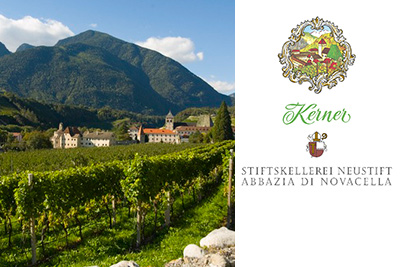
Top composite photo: 2012 Abbazia di Novacella Kerner label, with its vineyard in the shadow of the southern Alps. Credit: Courtesy of Abbazia di Novacella
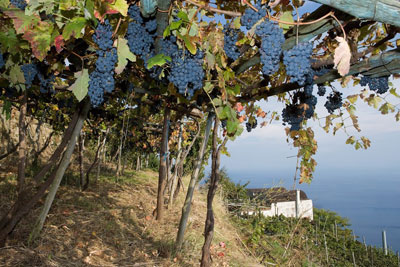
You’ve heard of Positano, of course; Amalfi and Ravello, too, no doubt. How about Furore? Maybe not. Don’t worry; you’re not alone. Furore, Italy, is a just a little bit of a place, a random collection of houses, vineyards and lemon groves strung out across a series of near-vertical terraced slopes perched precariously above the shimmering Amalfi Coast.
Even residents describe it as “un paese che non c’è” — a village that’s not really a village. So why mention it? Because Furore is home to the Marisa Cuomo boutique winery, which, as Carla Capalbo observes in her vade mecum “Food and Wine Guide to Naples and Campania,” has become “synonymous with the rise in quality of — and interest in — the Costa d’Amalfi DOC wines.”
More from Zester Daily:
» The Cube Projects tests American terroir
Wine has been made for centuries up in this rugged hinterland of the Amalfi Coast, but it was of inferior quality, sold in bulk and never destined to stray far from its homeland. Marisa Cuomo and her husband, Andrea Ferraioli, both from local winegrowing families, recognized the potential of the terroir and also of the indigenous grape varieties planted here, some of them unique to the area. About 20 years ago they resolved to take the village’s winegrowing in a new direction. “They put Furore on the map,” confirms their daughter Dorotea Ferraioli, who is responsible for marketing and also for tours and tastings. “They wanted our little paese to be known worldwide.”
Why it works in Furore
Realizing that the only way to go was up, they decided to focus relentlessly on quality. They improved practices in the vineyard, invested steadily in the winery, carved a breathtaking cellar straight out of the rock face behind the house and hired an enologist to oversee winemaking. They began to bottle all their own wines and to age some of them in small oak barrels and proceeded to market them with flair to an eager public — Italians first, swiftly followed by an international audience thirsty for wines from the much-loved, much-visited Amalfi Coast.
Today the winery works with 20 hectares (50 acres) of vines, planted on vertiginous slopes all the way from Furore round to Vietri. The vineyards in and around Furore are wholly owned; the rest are worked by the winery in a cooperative arrangement.
You need to see the vineyards above Furore to understand the extreme challenges involved in working this terrain. The vines, almost all pre-phylloxera and ungrafted, are planted at the foot of the walls that prop up the steeply stacked terraces, at altitudes ranging from 100 to 750 meters (328 to 2,460 feet) above sea level. Their branches sprawl out horizontally along pergolas made from long, tapering poles, which are cut from the chestnut trees that proliferate high in the Monte Lattari way above the village.
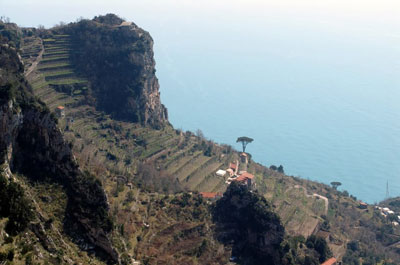
An overview of the Marisa Cuomo winery. Credit: Cantine Marisa Cuomo
Training the vines along pergolas in this way, explains Dorotea, is not just a picturesque regional tradition; it’s also the most convenient solution, perfectly suited to the rigors of the terrain while making the most of the limited space available. The branches provide a dense canopy of leaves beneath which the grapes dangle, protected from the relentless sun. On the ground below, zucchini, pumpkins and other vegetables flourish gratefully in the shade. Two crops are thus grown in one tiny, precious, precarious space.
The winery makes white, rosé and red wine from a whole bunch of little-known, indigenous vine varieties that are still part of Italy’s precious heritage. Top of the white range is the barrel-fermented Fiorduva (“flower of the grape”), a fragrant blend of Fenile, Ginestra and Ripoli, three varieties unique to the Amalfi Coast. Furore Bianco, described by the sommelier at the Casa Angelina restaurant in nearby Praiano as “semplice ma non banale” (“simple but by no means ordinary”), comes from Falanghina and Biancolella grapes, both typical of Campania. Rosé and reds are made from Piedirosso (“red-foot”) and Aglianico in varying proportions.
Next time you’re on vacation in Positano or Amalfi, look out for Marisa Cuomo wines. They’re are widely available in restaurants, bars and shops along the coast. Best of all, find your way up the winding road to Furore and pay the winery a visit (from January to August only). Then look out for the wines when you get back home. (Wines are exported to the U.S., Canada, Japan and Switzerland). When you’ve tracked down a bottle of Fiorduva or Furore Rosso Riserva, uncork it, close your eyes, picture those dizzying slopes and sun-baked terraces, take a gentle sniff, breathe in the scents of the Amalfi Coast and remember the sheer back-breaking labor of love that has gone into the bottle.
Top photo: Grapes growing at the Marisa Cuomo winery in Furore, Italy. Credit: Cantine Marisa Cuomo
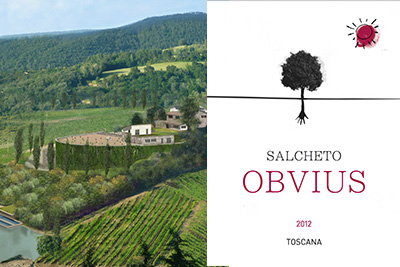
Italy’s less well-known wine appellations provide a continuing supply of truly interesting wines at very reasonable prices, like the fresh, juicy 2012 Salcheto Obvius Rosso di Montepulciano. It’s the first vintage of this dark, intense red with a taste of pure fruit from an organic winery in the district of Montepulciano, southeast of Siena in Tuscany. It was a perfect partner to rich pasta Bolognese at a weeknight dinner.
Elin McCoy’s Wine of the Week
» 2012 Salcheto Obvius Rosso di Montepulciano
Price: $19
Region: Tuscany, Italy
Grape: 100% Prugnolo Gentile Sangiovese
Alcohol: 13.5%
Serve with: Pasta Bolognese, roasted turkey
More from Zester Daily:
Salcheto is the brainchild of winemaker Michele Manelli, who purchased the property in 1997 and added two partners about a decade ago. Together they began exploring ways to improve wine quality while creating a more sustainable, energy-efficient cellar with a low environmental impact.
In 2011, they built what they call Italy’s first “off-grid” winery, which uses no traditional power sources and generates its own energy with solar photovoltaic panels. And it gets by on less than half the energy conventional wineries require, thanks to using only natural lighting, recycled water and gravity. The cellar is built into the side of a hill, with plants on the exposed wall to absorb the sun and help keep the interior cool, and an automated system of opening and closing windows to circulate cooler night air.
The trio also commissioned a research study to document the carbon footprint of a bottle of wine. Including the carbon emissions from vineyard to packaging, it “costs” the equivalent of three and a half pounds of CO2 to produce a bottle of this wine. Last summer they completed the first certification of a water footprint and are working on establishing a biodiversity footprint.
Montepulciano developing its red wines
In Tuscany, wines like Chianti Classico and Brunello di Montalcino get most of the attention, but the Montepulciano zone is working hard to catch up by reinventing itself. Over the past 25 years, the wines have gone from a blend of several varieties to reds based almost totally on a local clone of Sangiovese, as this Salcheto is.
Vino Nobile di Montepulciano is the grand wine of the region, aged longer and in wood. The Rosso is fresher, brighter and easy-drinking. The Salcheto Obvius, released in September, uses grapes from young vines and Manelli ferments and ages the wine in stainless steel, without any cultured yeast or added sulfur. He calls this a “from grapes only” wine.
The Latin name of the wine, Obvius, doesn’t mean obvious, as you might think. It has many meanings, including open and accessible, which the 2012 Salcheto Obvius certainly is.
Top composite image: 2012 Salcheto Obvius Rosso di Montepulciano label and vineyards. Credit: Courtesy of Salcheto Winery
Several years ago, while visiting my family in Michigan for the Christmas holiday, my dad told me about a mysterious collection of wines stashed in his basement. The wines had been passed down to him by an old Italian judge, who had died before he had a chance to drink them.
Naturally, I was curious about what sort of wines they were. My dad hadn’t bothered to go through the couple of cases he was given, instead leaving them for me to pick through when I arrived. I was practically rubbing my hands together in anticipation of the treasures I might find in Dad’s basement.
More from Zester Daily:
» Rosé Champagne for the holidays
When I went downstairs on Christmas morning, what I found was mostly disappointing — white wines from the ’70s that had turned brown, unremarkable reds never meant to be aged, cork-tainted wines that had to be poured down the sink. But there was one bottle that made my heart palpitate: a 1967 Antinori Chianti Classico Riserva from Tuscany.
I brought it upstairs and popped the cork, and found that the wine had held up beautifully over the years. It had lovely mature character, and managed to retain much of its fruitiness. I poured glasses for our little gathering — my dad, stepmom, husband, sister and brother-in-law — and we all agreed that the wine was something special. Truth be told, it was a little past its prime, but that didn’t stop us from finishing the bottle.
While we waited for the rest of the family to arrive for dinner, my husband searched the Internet to find out more about the wine we’d just polished off. “Wow, that wine is selling at auction for $200!” he announced. My frugal father, a man who drinks wine daily but rarely spends more than $10 on a bottle, was thunderstuck. “If I’d known that,” he said, “I would never have opened it.”
He was only half joking. But what better time could there be to open a special bottle of wine than the holidays, when you’re surrounded by family and friends — the people you love most?
Holiday-worthy wines
Even if you don’t have a 1967 Chianti hiding in your cellar, chances are you have a bottle or two stashed away from a winery visit or vacation. What are you waiting for? My dad’s Italian judge was waiting for the right occasion to open his wines, too. If you don’t already have a special bottle set aside, why not make this the year to splurge on a memorable wine to share with your favorite people?
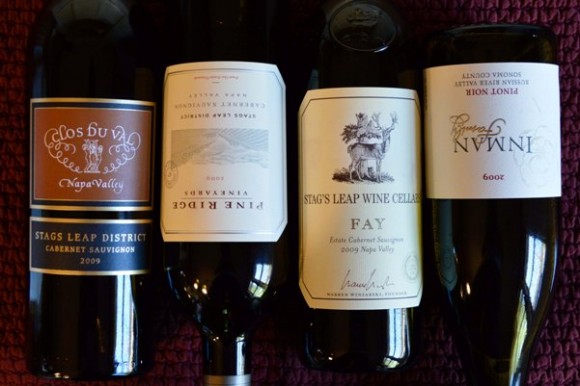
Here are five wines that fit that description nicely. These Napa Valley and Sonoma stunners taste great now and will improve with age, so you’ll be able to enjoy them at future holiday celebrations too. The wines are balanced and food friendly — none containing more than 14.1% alcohol — so they’ll pair wonderfully with your holiday brisket or standing rib roast.
Pine Ridge Vineyards Stags Leap District Cabernet Sauvignon 2009 ($85): This gorgeous wine has an enticing aroma of red fruit, along with cherry and berry flavors accented with baking spices. It’s elegant and balanced, with soft tannins.
Stag’s Leap Wine Cellars Napa Valley Fay Cabernet Sauvignon 2009 ($95): With aromas of raspberries and cedar, this is a beautifully balanced wine with bright red cherry flavor, silky texture and well-integrated tannins.
Clos Du Val Stags Leap District Cabernet Sauvignon 2009 ($80): Here’s a classic, age-worthy Napa Valley Cabernet with rich aromas of leather and black fruit. It has black cherry and chocolate flavors, along with good structure and moderate tannins.
Cobb Wines Sonoma Coast Jack Hill Vineyard Pinot Noir 2009 ($70): This lovely cool-climate Pinot smells of ripe raspberries and cherries, and has delicious red fruit flavors to match. The wine’s fruit-forwardness is balanced by a good bit of acidity.
Inman Family Russian River Valley Pinot Noir 2009 ($35): With its aromas of red fruit and cinnamon spice, this wine was made for Thanksgiving dinner. It’s medium bodied and elegant, with soft tannins and flavors of red fruit and cola.
Top photo: A selection of holiday wine. Credit: Tina Caputo
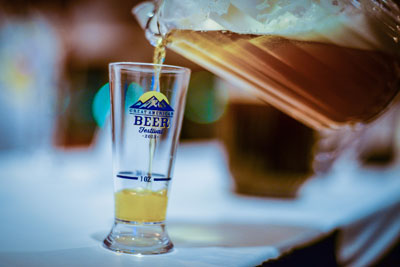
Entering the Great American Beer Festival with a plan of attack is like going to Eataly with a three-item shopping list: Good luck sticking to it. This year, the exhibition hall at the Colorado Convention Center in downtown Denver was packed with more than 600 brewers showcasing more than 3,100 products. Though my editor and I had discussed the recent resurgence of true Pilsners, I realized the second I walked in the door that I could no more limit myself to crisp Bohemian- and German-style lagers than I could pass up white truffles because I need button mushrooms.
Yet a general focus on lighter, low-to-moderate-alcohol styles was not only doable, but prudent if I hoped to leave the festival in one piece. Beyond that, I asked myself, which samples would cut through the palate fatigue with enough panache to warrant further investigation? Now that the fog has cleared, I stand by the following list in all its arbitrariness.
Cambridge Brewing Co. Shadows and Light
More from Zester Daily:
» Raise your glass: Colorado spirits are top-notch
At 10% alcohol by volume, this was an exception to my rule of sticking to more sessionable beers. Described as a “Maderized and Blended Experimental Very Old Ale,” it presents a mesmerizing port-like profile, showing raisins, baking spices and a touch of soy sauce. As brewmaster Will Meyers explains, “Shadows and Light was inspired by the techniques of oxidation and exposure to sunlight as well as extremes of heat and cold. All of these are things you are specifically instructed not to do when brewing beer (or wine, sake, cider, etc.) because ordinarily they’d destroy it, and yet beverages such as Madeira, sherry and Banyuls, not to mention some spirits, are treated in this specific way. I decided to find out if I could incorporate these techniques successfully — and after eight years of considerable effort, I was lucky enough to have achieved my goals.”
Sadly, only those within commuting distance of Kendall Square in Cambridge, Mass., will have opportunity to try it; first released in May of this year, it will be tapped just once more, at the brewpub’s 25th anniversary party the first weekend of May 2014. Boston beer buffs, mark the date.
Elevation Beer Co. Engel Weisse
From a newcomer in Poncha Springs, Colo., this oak-fermented and -aged Berliner Weisse would, as my friend Amy observed, make a fine alternative to lemonade on a hot day, throwing shades of gingerbread and yogurt into the citrusy mix (4% ABV). According to sales manager Alexander Bustamante, it’s named for a snow-pack formation called the Angel of Mount Shavano “that looks over us here at Elevation,” it’s currently available seasonally only in Colorado.
For the record, I also appreciated two other refreshingly straightforward variations on the theme: one from Crabtree Brewing Co. in Greeley, Colo. (4.3% ABV), which garnered a gold medal in 2011, and one from Nodding Head Brewery in Philadelphia, which proved a pioneer when it debuted the gracefully fruity Ich Bin Eine Berliner Weisse (3.5% ABV) in 2000. Brewer Gordon Grubb observes that while the style’s reputation as “the Champagne of the North” might be overstated, “it does have some white wine characteristics, more tart than truly sour.”
Elysian Brewing Co. Great Pumpkin Ale
Sampling this Seattle brewer’s take on the predominant fall favorite at this year’s beer festival media luncheon was a revelation. So many of its peers come across as muddy or cloying; this was anything but. Crisp and sparklingly clean, it showcased its namesake ingredient not by letting it run rampant but by treating it and its baking-spice trappings with restraint. 8.1% ABV.
Logsdon Organic Farmhouse Ales Seizoen Bretta
This haunting saison, which nabbed a gold for its Hood River, Ore. , producer at last year’s festival, spoke to me in fleeting, delicately effervescent tones of musty cider houses, honeypots and savory herb gardens. Bottle conditioned with pear juice to 8% ABV, it stood up remarkably well to the milk chocolate-pumpkin mousse cake it was served with.
The Lost Abbey Framboise de Amorosa
By the time we cut through the crush surrounding the booth, this San Marcos, Calif.-based cult leader was fresh out of the Red Poppy Ale that had just scored a medal in the American-Style Brett Beer category for the second year running. But the barrel-aged sour we settled on instead was hardly sloppy seconds. (Indeed it took a silver back in 2011.) Despite whiffs of its own bretty funk, its raspberry juiciness remained breathtakingly pure from start to long finish. 7% ABV.
New Belgium Coconut Curry Hefeweizen
The name of this brew, released in July as part of the Fort Collins, Colo., giant’s Lips of Faith series, says it all. Creamy touches of coconut and banana combine with spikier, more savory hints of garam masala, yet the effect is surprisingly smooth and relatively subtle. 8% ABV.
Scratch Brewing Co. Carrot-Ginger Saison
Specializing in the use of locally farmed and foraged ingredients, this Ava, Ill., brewer impressed me with the easy balance it struck between warm, earthy sweetness and a cool, clean bite. Of the inspiration for the farmhouse ale, first released in July at 6% ABV (but available only locally), co-founder Marika Josephson says, “Squash and sweet potatoes have obviously been done in a lot of fall beers, and we figured that roasting carrots would give a similar flavor. But we wanted to spice up the carrot a little, so we decided to use wild ginger and a small amount of peppercorns.”
Smuttynose Straw-Barb Short Weisse
If, as my friend Mark suggested, the name of this fruited Berliner Weisse out of Portsmouth, N.H., alludes to shortcake, it does itself a disservice. Rather than conveying any sugary, baked-dessert message, it delivers the floral perfumes of strawberry and rhubarb to back its tartness. Smuttynose enjoys fairly wide distribution on the East Coast, so keep your eyes peeled for the recent release. 3.5% ABV.
Weyerbacher Eighteen Weizenbock
Forgive me for including this dark, malty wheat beer. Not only does it break my style rule at 11.1% ABV, but as a one-off made in honor of its Easton, Pa., producer’s 18th anniversary in June 2013, it will soon be sold out across Weyerbacher’s distribution network if it isn’t already. Should you track it down, though, you’ll be treated to a veritable chocolate-banana milkshake of a pour.
Top photo: A beer being poured at the Great American Beer Festival. Credit: Brewers Association