Articles in Drinking
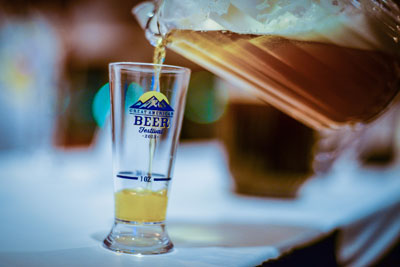
Entering the Great American Beer Festival with a plan of attack is like going to Eataly with a three-item shopping list: Good luck sticking to it. This year, the exhibition hall at the Colorado Convention Center in downtown Denver was packed with more than 600 brewers showcasing more than 3,100 products. Though my editor and I had discussed the recent resurgence of true Pilsners, I realized the second I walked in the door that I could no more limit myself to crisp Bohemian- and German-style lagers than I could pass up white truffles because I need button mushrooms.
Yet a general focus on lighter, low-to-moderate-alcohol styles was not only doable, but prudent if I hoped to leave the festival in one piece. Beyond that, I asked myself, which samples would cut through the palate fatigue with enough panache to warrant further investigation? Now that the fog has cleared, I stand by the following list in all its arbitrariness.
Cambridge Brewing Co. Shadows and Light
More from Zester Daily:
» Raise your glass: Colorado spirits are top-notch
At 10% alcohol by volume, this was an exception to my rule of sticking to more sessionable beers. Described as a “Maderized and Blended Experimental Very Old Ale,” it presents a mesmerizing port-like profile, showing raisins, baking spices and a touch of soy sauce. As brewmaster Will Meyers explains, “Shadows and Light was inspired by the techniques of oxidation and exposure to sunlight as well as extremes of heat and cold. All of these are things you are specifically instructed not to do when brewing beer (or wine, sake, cider, etc.) because ordinarily they’d destroy it, and yet beverages such as Madeira, sherry and Banyuls, not to mention some spirits, are treated in this specific way. I decided to find out if I could incorporate these techniques successfully — and after eight years of considerable effort, I was lucky enough to have achieved my goals.”
Sadly, only those within commuting distance of Kendall Square in Cambridge, Mass., will have opportunity to try it; first released in May of this year, it will be tapped just once more, at the brewpub’s 25th anniversary party the first weekend of May 2014. Boston beer buffs, mark the date.
Elevation Beer Co. Engel Weisse
From a newcomer in Poncha Springs, Colo., this oak-fermented and -aged Berliner Weisse would, as my friend Amy observed, make a fine alternative to lemonade on a hot day, throwing shades of gingerbread and yogurt into the citrusy mix (4% ABV). According to sales manager Alexander Bustamante, it’s named for a snow-pack formation called the Angel of Mount Shavano “that looks over us here at Elevation,” it’s currently available seasonally only in Colorado.
For the record, I also appreciated two other refreshingly straightforward variations on the theme: one from Crabtree Brewing Co. in Greeley, Colo. (4.3% ABV), which garnered a gold medal in 2011, and one from Nodding Head Brewery in Philadelphia, which proved a pioneer when it debuted the gracefully fruity Ich Bin Eine Berliner Weisse (3.5% ABV) in 2000. Brewer Gordon Grubb observes that while the style’s reputation as “the Champagne of the North” might be overstated, “it does have some white wine characteristics, more tart than truly sour.”
Elysian Brewing Co. Great Pumpkin Ale
Sampling this Seattle brewer’s take on the predominant fall favorite at this year’s beer festival media luncheon was a revelation. So many of its peers come across as muddy or cloying; this was anything but. Crisp and sparklingly clean, it showcased its namesake ingredient not by letting it run rampant but by treating it and its baking-spice trappings with restraint. 8.1% ABV.
Logsdon Organic Farmhouse Ales Seizoen Bretta
This haunting saison, which nabbed a gold for its Hood River, Ore. , producer at last year’s festival, spoke to me in fleeting, delicately effervescent tones of musty cider houses, honeypots and savory herb gardens. Bottle conditioned with pear juice to 8% ABV, it stood up remarkably well to the milk chocolate-pumpkin mousse cake it was served with.
The Lost Abbey Framboise de Amorosa
By the time we cut through the crush surrounding the booth, this San Marcos, Calif.-based cult leader was fresh out of the Red Poppy Ale that had just scored a medal in the American-Style Brett Beer category for the second year running. But the barrel-aged sour we settled on instead was hardly sloppy seconds. (Indeed it took a silver back in 2011.) Despite whiffs of its own bretty funk, its raspberry juiciness remained breathtakingly pure from start to long finish. 7% ABV.
New Belgium Coconut Curry Hefeweizen
The name of this brew, released in July as part of the Fort Collins, Colo., giant’s Lips of Faith series, says it all. Creamy touches of coconut and banana combine with spikier, more savory hints of garam masala, yet the effect is surprisingly smooth and relatively subtle. 8% ABV.
Scratch Brewing Co. Carrot-Ginger Saison
Specializing in the use of locally farmed and foraged ingredients, this Ava, Ill., brewer impressed me with the easy balance it struck between warm, earthy sweetness and a cool, clean bite. Of the inspiration for the farmhouse ale, first released in July at 6% ABV (but available only locally), co-founder Marika Josephson says, “Squash and sweet potatoes have obviously been done in a lot of fall beers, and we figured that roasting carrots would give a similar flavor. But we wanted to spice up the carrot a little, so we decided to use wild ginger and a small amount of peppercorns.”
Smuttynose Straw-Barb Short Weisse
If, as my friend Mark suggested, the name of this fruited Berliner Weisse out of Portsmouth, N.H., alludes to shortcake, it does itself a disservice. Rather than conveying any sugary, baked-dessert message, it delivers the floral perfumes of strawberry and rhubarb to back its tartness. Smuttynose enjoys fairly wide distribution on the East Coast, so keep your eyes peeled for the recent release. 3.5% ABV.
Weyerbacher Eighteen Weizenbock
Forgive me for including this dark, malty wheat beer. Not only does it break my style rule at 11.1% ABV, but as a one-off made in honor of its Easton, Pa., producer’s 18th anniversary in June 2013, it will soon be sold out across Weyerbacher’s distribution network if it isn’t already. Should you track it down, though, you’ll be treated to a veritable chocolate-banana milkshake of a pour.
Top photo: A beer being poured at the Great American Beer Festival. Credit: Brewers Association
Discrimination is a strange thing. On the one hand, no one likes being its victim, and hardly anyone confesses to being its practitioner. On the other, connoisseurs and critics discriminate all the time. That’s because the primary Oxford English Dictionary definition of the verb “to discriminate” is “to make or constitute a difference … to distinguish [or] differentiate.”
We generally consider discrimination to be a bad thing when we think the standard being used is inadequate for the distinction in question. For instance, we disapprove of employers using skin color, ethnic origin or gender as a basis for hiring (or not hiring) someone. At the same time, though, we value discrimination — indeed, we rely upon it — when we judge the standard to be legitimate. We do so, for example, when we trust a critic to help us decide whether to read a particular book or watch a particular movie. Much the same happens with food and drink.
A website like Zester Daily helps us choose what to eat and drink. It thus is chock-full of discrimination, as privileging one object (say, Mennonite tomatoes, to cite a delightful recent article by Susan Lutz) over another (cold storage tomatoes) is itself an act of discrimination.
Even though I live fairly close to Lancaster, Pa., the heart of Mennonite country, I have not tasted the tomatoes that Susan loves so much. And although I enjoy cooking and (even more) eating, I cannot honestly say that my food standards are sufficiently well defined to allow for more than personal judgments. But as a professional wine writer, I rely on certain non-personal criteria to distinguish between a good and a bad wine, or between an exceptional and an average one.
Unfortunately, few of my wine writing colleagues seem to think that specifying standards is important. Perhaps because serious wine criticism is relatively new, it lags far behind criticism in other areas — in the arts, for example, in literature and, yes, in food. Wine writing lacks a rich history; we have no Brillat-Savarin, Grimod de la Reynière or M. F. K. Fisher to inspire us. And although we are fortunate to be able to read the work of some superb stylists (Gerald Asher, for example, and Hugh Johnson), contemporary critics tend to offer little more than sterile scores, numbers that suggest objectivity but in actuality do little more than mask subjective opinions.
Pick up any introductory guide to wine and you almost always will read that you should ignore the critics and trust your own judgment — nonsensical advice, since people wouldn’t buy such guides if they already felt confident in their ability to judge. The world of wine is getting bigger and more complicated every year. It desperately needs what the 18th-century Scottish philosopher David Hume called a well-defined “standard of taste.”
Any such standard has to be based upon what actually is in the bottle. It also must reflect an awareness of the past, the wines that can serve as benchmarks or models for current ones made with specific grape varieties or coming from specific regions. As Hume, who was thinking about both aesthetic and gustatory taste, wrote, we cannot ignore “the consent and experience of nations and ages.”
Wine lover’s standards
So what criteria other than “it tastes good to me” or “it got 95 points” can we use to discriminate between a truly fine wine and an ordinary one? Let me suggest five:
1. Balance. A top wine works as a whole, with no single element (e.g., acidity, tannin, sugar, etc.) dominating over the others. When those elements are in balance, the whole becomes harmonious.
2. Depth. The same wine also needs to have substance and presence. Even if it’s light-bodied, it demands that you pay attention to it.
3. Length. The best wines invariably have long, lingering flavors and so leave lasting impressions. You can taste them long after you have swallowed them.
4. Complexity. A great wine never leaves a single impression. It instead is multilayered, conveying many different flavors and sensations.
5. Typicity. Finally, a truly fine wine will taste as it should taste, meaning that it will be true to its many origins — the varieties with which it is made, the place where those grapes were grown, even the vision that inspired it.
There may well be other criteria to include in any standard of taste for wine lovers, and a full understanding of these five certainly calls for more than the simplistic explanations I have provided here. But at least for me, this is a good start, an initial step toward more informed, honest criticism. That’s because I’m convinced the world of wine today needs more discrimination, not less.
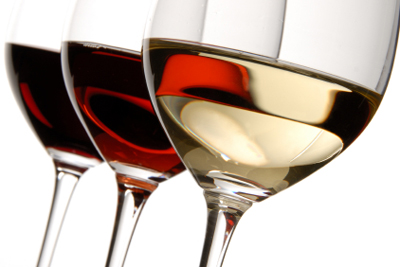
Top photo: Glasses of red and white wine. Credit: iStockphoto
Back in 2011, in a piece on mountain rums, I briefly provided some context to explain how Colorado had managed to become such a liquor mecca — not just the beer capital it’s best known as, but also a distilling hub. (Granted, my state’s wine industry is still fledgling, but it’s got potential.)
That discussion really hit home just the other day, when I attended the fourth annual Breckenridge Craft Spirits Festival. It surely will again when I hit the Great American Beer Festival — more on that in another story. As a mining settlement turned ski resort, Breckenridge was born to be a hard-drinking town. There were already 18 saloons here in the late 19th century, including the Gold Pan, established in 1879 and still going strong. The city’s Heritage Alliance even conducts a tour on the subject. No wonder, then, that it’s proving the perfect place to showcase local distilleries, welcoming more than 20 of them, along with 600 guests, to the Riverwalk Center this year (compared with eight producers and 100 attendees at its inauguration, according to Ken Nelson, president of the Breckenridge Restaurant Association).
Some of the names may already be familiar to outsiders, including Peach Street Distillers in Palisade, which sources from neighboring orchards and wineries to make fruit brandies, eaux-de-vie and grappa, among other things; the pioneering Denver-based Stranahan’s Colorado Whiskey; and Montanya Distillers, whose rums are available far beyond its home base of Crested Butte. Others were new even to me — but if quality alone guaranteed distribution, products like the following would be everywhere.
Golden Moon Crème de Violette
Many present-day spirits producers talk the talk of ancient recipes and Old World methods, but few walk the walk quite so boldly as Stephen Gould’s Golden Moon Distillery (based, of course, in Golden). A “trained saucier” and former brewer, he got interested in collecting old, rare bottles a decade ago. Upon “stumbling across a case of 1950 Spanish absenta and really enjoying it,” he says, “I started doing a little digging — and now I own, I’m told, one of the largest collections in private hands of books on distilling in North America.”
More from Zester Daily:
» Rye whiskey, once classis, rises again
His wonderfully evocative crème de violette, for instance, is a true distillate of the namesake flower. He hit upon the recipe for it after “studying how French perfumers worked with violet to keep it stable.” The result is higher in alcohol (at 30% ABV) and lower in sugar than any that I could find. Sadly, I couldn’t sample his take on the legendary orange bitters Amer Picon, which he calls Amer Dit Picon, because he’s awaiting label approval. In any case, his version replicates not the current but the original recipe, “with the exception of one ingredient, calamus root, that the FDA has forbidden.” Although there are substitutes on the domestic market for the otherwise unavailable French liqueur, Gould says they’re much less complex than the 100-year-old bottles he’s had occasion to try, compared to which “ours is a little more peppery and a little harder — but then, after a century of aging, it’s natural that they’d have mellowed. I think we’ve come about as close as possible.”
Feisty Spirits Elementals
Unless it’s specified as bourbon, rye, etc., “whiskey can technically be made from any grain. Only four or five are generally used, but there are hundreds out there; why not try them?”
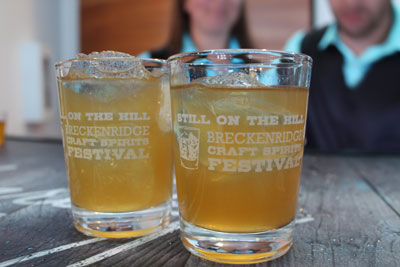
Drinks ready for imbibers at the Breckenridge Craft Spirits Festival. Credit: Jessie Unruh
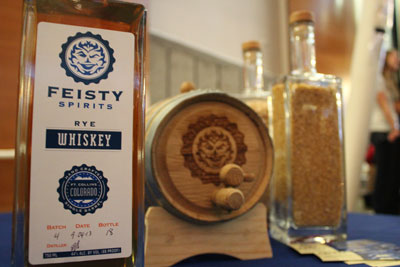
So wondered Jamie Gulden, co-founder of Feisty Spirits in Fort Collins, when he and his partner, head distiller David Monahan, set about experimenting with cereals beyond the blue corn, oats and rye they use for their single-barrel bottlings. Not all of them worked, he admits — amaranth, for one, “isn’t something you’d want to drink straight” — but four others now compose Feisty’s single-grain line, Elementals: Kamut (aka Khorasan wheat), Millet, Triticale and Quinoa. I liked the roasty, toasty qualities of the Kamut; as for the Quinoa, which wasn’t on offer at the festival, Gulden calls it “a polarizing whiskey: some people really love its grassiness mixed with nuttiness, some don’t.” It may be awhile before non-Coloradans can judge it for themselves; Feisty’s distribution, after only a year in business, remains limited to the Front Range.
Santa Fe Single-Malt Whiskey
Speaking of whiskey, I have to give a nod to one of the festival’s few non-local exhibitors. Santa Fe Spirits is rolling out a single malt in which the barley is smoked not over peat à la Islay Scotch, but rather mesquite. Perhaps I’m swayed by fond memories of Christmas in New Mexico, but its tangy notes of wood smoke yet surprisingly mellow character immediately won me over. (Availability is slowly expanding from the Southwest to the West Coast.)
Dancing Pines Black Walnut Bourbon Liqueur
I first met ex-paramedic firefighter Kristian Naslund a couple of years ago, not long after he’d launched Dancing Pines Distillery in Loveland. Offered samples of his chai, caramel and cherry liqueurs, I was thoroughly skeptical — they sounded like just so much commercial cough syrup. But boy, I was wrong; though certainly sweet, they lacked any trace of sharp artificiality, their profiles warm yet clear. So it is with this newer release, which begs for a fireside armchair; Naslund and crew do distribute out of state.
Breckenridge Bitters
Billed as the world’s highest-altitude spirits producer (the facility sits at 9,600 feet), Breckenridge Distillery likewise enjoys some presence on the national market, primarily thanks to its well-received bourbon. Its strikingly heather-honeyed small-batch bitters are built on the discovery by master distiller Jordan Via, while hiking close to home, of some plants that turned out to be related to those used in génépi, an Alpine liqueur. Along with the brand’s own vodka, they serve as the foundation for a blend whose 10 other proprietary botanicals make for a smoother, gentler, more rounded variation of the European model — neither quite as bitter nor quite so intensely sweet.
Top photo: Feisty Spirits was one of several Colorado distilleries to showcase its products at the Breckenridge Craft Spirits Festival. Credit: Jessie Unruh
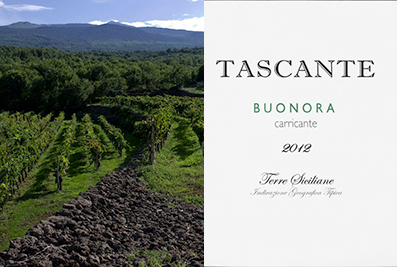
Sicilian wines made from vines planted on the slopes of the famous Mount Etna, one of the world’s most active volcanoes, have been getting well-deserved buzz for the past few years. The fresh, savory 2012 Tascante Buonora Carricante, a white with aromas of flowers and flint, bright acidity, and an intense taste of green apple and slightly smoky rocks, really reflects Etna’s distinctive terroir and has plenty of personality for its very reasonable price.
Elin McCoy’s Wine of the Week
2012 Tascante Buonora Carricante
Price: $20
Region: Sicily, Italy
Grape: 100% Carricante
Alcohol: 13.5%
Serve with: Rich fish with lemon sauce, pasta and truffles
Try these Italian wine picks:
» 2010 Vietti Barbera d’Asti Tre Vigne offers charming value
» 2011 Inama Soave Classico climbs the Soave ladder
» 2011 Masseria Li Veli Verdeca is more expressive than the price suggests
Tascante is one of five Sicilian estates operated by Tasca d’Almerita, founded in 1830 and now run by the Count Lucio Tasca and his two sons, Giuseppe and Alberto. On my first visit to the island, I spent a day at their 500-hectare (1,235-acre) Regaleali estate in Sicily’s center, where Anna Tasca Lanza presides over a stellar cooking school. Eight generations of the family have been intertwined with Sicily’s history. In the late 1990s, Giuseppe became fascinated by Mount Etna, and eventually bought 21 hectares (51 acres) of land in the best zone on the northern side of the volcano, where vines are planted on steep terraces. The name Tascante combines the family name and “Etna” spelled backward.
This is a wine area of extremes, with an unpredictable brooding volcano, often covered with snow, dictating unpredictable weather, rough, steep slopes, lava-and-rock-laced soil. Costs to grow grapes and produce wines here are high, which is one reason vineyards were mostly abandoned. About 30 years ago, there were only a handful of producers; now there are more than 80. Old gnarled vines and the diversity of terroirs at elevations from about 1,000 to 3,000 feet were a draw for the new producers who’ve made Mount Etna one of Italy‘s most exciting wine regions.
Tascante Buonora ‘extremely special’
Though Etna’s reds seem to get the most attention, the whites, like this one, are also extremely special. The Tascante Buonora is made from the ancient, rediscovered variety Carricante, which people say has grown on Mount Etna for a thousand years. It’s aged in stainless steel tanks, which keeps its flavors very pure.
Back in 2010, Tasca d’Almerita began working with Italian scientific research institutes on a project of sustainable agricultural development and is to be commended for using more solar energy, reducing the company’s carbon footprint, managing water resources, reducing chemicals in their vineyards.
Sicily, like all of Italy, is a source of fascinating wines made from unusual grapes with highly individual flavors. This 2012 Tascante Buonora is one of them.
Top photo: 2012 Tascante Buonora label and the vineyards in the shadow of Mount Etna. Credit: Courtesy Tasca d’Almerita
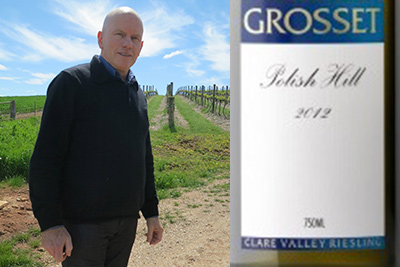
I’m just back from more than two weeks in Australia, where I spoke at Savour, the first wine conference put on by Wine Australia, which was held in Adelaide. I tasted dozens of stunning wines during my visit, though many of the best, sadly, are not available in the U.S. — at least not yet. This intensely limey 2012 Grosset Polish Hill Riesling, with its chalky, slatey finish, is great and available here. It — and the 2013 arriving later this year or early next year — are pricey but worth it, and will age brilliantly. (A recent survey conducted by Wine Ark, an Australian storage provider, listed Grosset’s Polish Hill Riesling as the ninth most collected wine in Australia for 2013.)
Elin McCoy’s Wine of the Week
2012 Grosset Polish Hill Riesling
Price: $35
Region: Clare Valley, South Australia
Grape: 100% Riesling
Alcohol: 12.7%
Serve with: Seafood curry, baked oysters
Three more Riesling picks from Elin McCoy:
» Riesling for an Obama state dinner
On a tour of the hilly Clare Valley, a two-hour drive north from Adelaide, I stopped by the winery to talk and taste with owner-winemaker Jeffrey Grosset and his partner Stephanie Toole, owner of Mount Horrocks winery, whose wines I’ll write about at another time. Thanks to recent rain, the picturesque Clare, which I discovered isn’t a valley after all, was very green and magical, like an English shire, except that you see lines of gum trees and spot the occasional kangaroo. Thanks to Adelaide traffic, I was late.
The Clare has a long history as a wine region, going back to the 1840s, and is noted for its dry Rieslings. An enjoyable way to sample some of them is to bike or hike the 36-kilometer-long Riesling Trail, which passes near a dozen wineries, including Grosset, at the region’s southern end.
A top Aussie Riesling maker
One of the most celebrated Riesling makers in Australia, Grosset founded his winery in an old milk depot in 1981 and now makes three different Rieslings, including the lovely off-dry Alea bottling. The first vintage of the bone-dry Polish Hill, which comes from an organic vineyard planted on gravel, shale and blue slate at an elevation of 1,500 feet, was the 1980. The flavors are tightly wound, intense, steely and focused, with lemon-lime notes, zingy acidity and an elegant purity. Quality is surprisingly consistent from year to year. Older vintages we sipped and spit, 2005 and 2001, have developed more complexity and are filled with power and precision.
Grosset advises either drinking this wine right away or keeping it for at least six years. No worries about finding a corked wine when you finally open it, since Grosset pioneered using screw cap closures instead of corks. He was a driving force behind a group of 14 Clare Valley winemakers who collectively launched their Rieslings under screw cap in 2000.
Top photo: Owner-winemaker Jeffrey Grosset and the label of his 2012 Polish Hill Riesling. Credit: Courtesy of Grosset winery
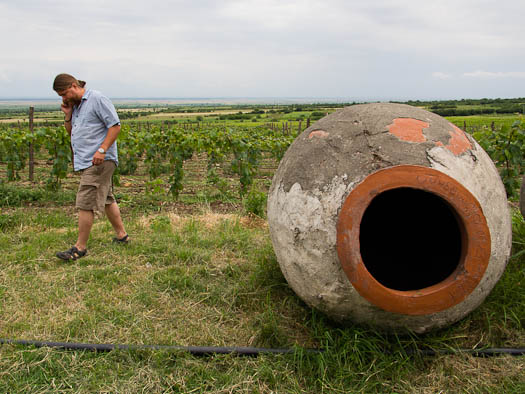
Throughout the winemaking areas of the republic of Georgia, the qvevri — large clay vessels like giant amphors — are being readied for the new grape harvest. This fascinating country, nestled between the Black Sea and the Caucasus mountains, has the world’s oldest winemaking tradition: Wine has been made there for 8,000 years. And it’s always been made in clay pots buried in the ground. (Versions of it were adopted in ancient Rome and Greece.)
What’s exciting, too, is that the Georgian method is now being used in several countries in Europe and beyond by a few passionate organic and biodynamic winemakers wanting to make what are being called “natural” wines. Indeed, I was first introduced to these huge clay pots in northeastern Italy, in the cellars of Josko Gravner. Gravner was the first non-Georgian winemaker to bring both the method and the Georgian qvevris to Italy. (He calls them anfore, or amphors, though strictly speaking amphors were used in the ancient world to transport wine, whereas the large immobile qvevri are used to make it in.)
More on Zester Daily:
Recently, I attended the International Qvevri Symposium in the handsome Georgian capital city, Tbilisi. The symposium showcases Georgia’s top wineries, including those that make wine in European-style barrels using international varieties. I was keen to learn more about the qvevri and their wines. A few are available in Europe, but this was a rare opportunity to find almost 20 professional qvevri producers — including two monasteries — gathered under one roof.
One of them was John Wurdeman, an American who has long been based in Georgia. As well as being an enthusiastic expert about all things Georgian — he sings in a marvelous polyphonic choir there — Wurdeman has set up one of the country’s most dynamic wineries, Pheasant’s Tears. I spoke to him on his stand at the symposium, and again a few days later as we toured his vineyards near his home in Sighnaghi, in the Khaketi region of eastern Georgia.
capalboqvevri1atthepottery-6080244
“Qvevri are like large coil pots with conical bottoms that are made by hand and fired in walk-in kilns by one of only five master potters who now remain,” he explains. “They are then buried in the ground — usually inside a cellar, but sometimes outside, too — and can range in size from 100 to 4,000 litres (26 to 1,056 gallons) in capacity.”
Cellars containing qvevri are disconcerting at first for those of us used to visiting rooms filled with vats and barrels. They seem empty, with just the qvevris’ round “necks” protruding from below. Yet the volumes of liquid being stored in the vessels underground give these cellars a very special atmosphere. They may seem empty, but one senses the presence of the wine below.
“Packing the qvevri in sand gives the wines stability, but the winemaking method differs, too,” he continues as we stand in his cellar overlooking the vineyards. “Clay is porous, so before the qvevri can receive the grapes, they need to be treated inside with hot beeswax. This goes deeply into the pores but does not completely seal the inside surface: a tiny bit of air needs to be able to breathe as the wines are being made.
“We crush our grapes lightly and put them into the qvevri, stems and all,” Wurdeman says. “This applies to both red and white grapes. The alcoholic fermentation gets underway within a few days, spontaneously, without the need for added yeasts.” Indeed, the qvevri cellars host wild yeasts in the same way that some caves help to ripen cheeses.
“That fermentation lasts for between two to four weeks. We punch the cap down twice a day during this period until it falls. Then, if the grapes are white, we leave the wine on its skins and stems. The red wines are handled differently: they’re taken off the skins and stems and transferred to another qvevri. Both types of wine are then loosely covered with a stone — again, to allow a tiny bit of air to enter. The malolactic, or secondary, fermentation begins spontaneously within a few weeks. When the malolactic is finished, the qvevri are sealed more tightly using a wooden lid and more beeswax, and a heavy stone is placed on top.
“That’s it until spring, when the earth’s temperature begins to warm. At that point the wines are racked: pumped out into bottles or into a clean qvevri, leaving behind the lees and any other sediment that has fallen into the vessels’ narrow, pointed bottoms.”
Georgian wine’s natural development
The qvevri’s stable temperature allows for a very slow, steady fermentation. Once the wine has been sealed into its home, the winemakers can’t — and don’t want to — interfere with its natural development.
“Everything depends on the quality of the grapes,” he adds. “We don’t use any of the chemical ‘correctors’ that many wineries resort to if problems occur during winemaking. This is how it’s always been done in Georgia, and the results are proof of how successful the method is. The white wines are particularly impressive: Deep amber in colour, they acquire as many tannins and polyphenols as red wines.
“The whites do acquire fragrance and an earthy body that makes them a perfect match for the diversity of Georgian food,” Wurdeman says as we sample a glass of his remarkable Rkatsiteli, an amber wine that hints at spice and honey in the nose, yet leaves the palate refreshed and dry.
This red-stemmed white grape is just one of dozens of native grape varieties the Georgians are working with that offer an exciting future for those wanting to discover winemaking’s ancient past.
Top photo: John Wurdeman at Pheasant’s Tears winery with a large qvevri. Credit: Carla Capalbo
When I was young and broke, one of the first dishes I learned to cook was risotto. I’d just moved into my own studio apartment after graduating from college, and was excited at the possibility of making myself whatever I wanted for dinner on a nightly basis.
My pitiful earnings waiting tables didn’t normally afford me the luxury of buying cookbooks, but as fate would have it, I stumbled across a bargain while combing the sale tables at Macy’s that week.
The book wasn’t authored by anyone famous, but it promised a variety of good, straightforward recipes. I don’t recall the title, but I do remember some of the dishes that became part of my regular rotation in those days: the Greek egg-lemon soup called avgolemono, lasagna roll-ups and my favorite, risotto.
Simple and seasonally adaptable
Before making it in my own little kitchen, the only risotto I’d ever tried came from restaurants. Despite the humble ingredients used to make it — rice, vegetables, stock — I thought of the dish as somewhat exotic. There was just something about its rich flavor and creamy texture that tasted like magic. When I cooked it for the first time, I couldn’t believe how easy it was: Just chop a few ingredients, throw them into a pot, sauté, add liquid and stir.
More on Zester Daily:
» No-stir risotto makes kid-friendly dinner
» Pumpkin risotto gives Thanksgiving a boost
Before long, I could make risotto without the recipe. I quickly discovered that pretty much anything I happened to have in the fridge, from squash to sausage, could be transformed into a velvety dish of heaven.
Although I no longer have the cookbook, the risotto has stayed with me for more than two decades. In the spring I make it with asparagus, shrimp and leeks and in the summer I add freshly shucked corn and ripe cherry tomatoes. But my favorite risotto is the autumn version, made with earthy mushrooms, crisp pancetta, gorgonzola and a drizzle of aged balsamic vinegar.
You can make it with pretty much any type of mushroom, from dried porcini to fresh cremini, but I prefer the heartiness of the portabella. Although you could substitute bacon for the pancetta, I find that pancetta adds a delicious depth of flavor that bacon can’t quite match. Chicken is my stock of choice, because it adds intensity to the dish, but you could easily substitute mushroom or vegetable stock if that’s your preference.
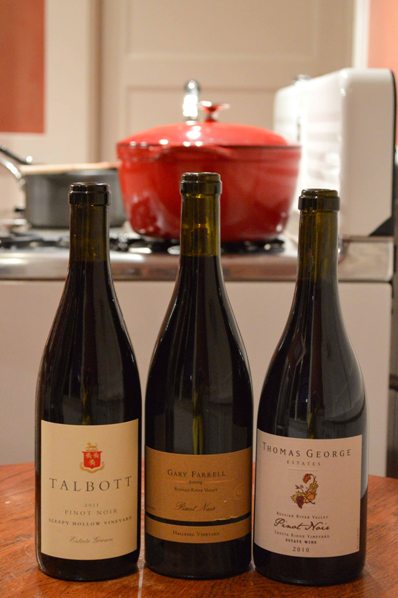
Pinot Noir to pair with risotto. Credit: Tina Caputo
Pinot Noir for the perfect pairing
A special dish like this deserves a wonderful wine, and I find that Pinot Noir, especially one with a bit of earthiness, is a great complement to the mushroomy richness of the risotto.
I recently paired the dish with three different Pinots: the Gary Farrell 2009 Hallberg Vineyard from Russian River Valley, the Talbott 2011 Sleepy Hollow Vineyard from the Santa Lucia Highlands and the Thomas George 2010 Cresta Ridge Vineyard from Russian River Valley.
The Gary Farrell was my favorite match, with its spiced black cherry flavor and bright acidity. The earthy notes in the Thomas George Pinot also worked well, and the Talbott’s ripe red fruit flavors and richness mimicked the lushness of the risotto.
Mushroom-Pancetta Risotto
Serves 4 (without leftovers) as a main dish
Ingredients
6 cups chicken stock (may substitute mushroom or vegetable stock)
1 tablespoon olive oil
2 ounces pancetta, roughly chopped
1 small onion, minced
2½ cups fresh mushrooms (portabella or cremini), cleaned and sliced
1½ cups arborio rice
1 teaspoon dried thyme
¼ cup dry white wine
1 ounce gorgonzola cheese, crumbled
½ cup Parmesan cheese, finely grated
2 tablespoons aged or *reduced balsamic vinegar
Fresh ground pepper to taste
* To reduce, add ¼ cup medium-quality balsamic vinegar to a small saucepan over medium-high heat and cook 2-4 minutes, until reduced by half. This gives it a thicker consistency and concentrates its flavor.
Directions
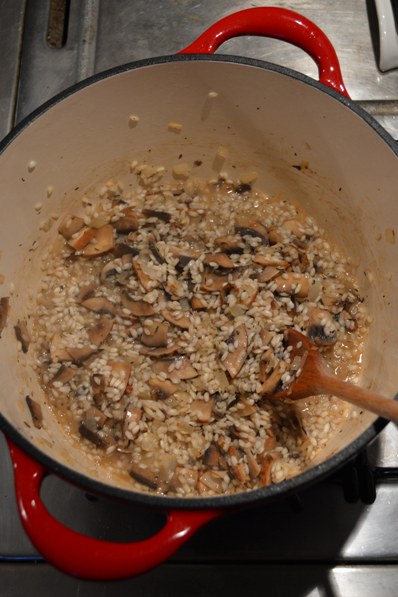
Risotto coming together on the stove. Credit: Tina Caputo
1. Heat stock in a saucepan and maintain at a low simmer on the stove.
2. Heat oil over medium heat in a wide, heavy saucepan (I like to use enameled cast iron). Add pancetta and stir until crisp. Remove it with a slotted spoon and let drain on a paper towel.
3. Add onion and stir until translucent. Add mushrooms and stir 2-3 minutes until they begin to soften. Add rice and thyme, and stir until rice is coated with oil. Add wine and stir until liquid is mostly absorbed.
4. Add ½ cup of stock and stir every minute or so until the liquid has nearly evaporated.
5. Repeat this process, adding ½ cup stock at a time, until the rice is al dente, about 20-25 minutes (you may not use all the stock).
6. Remove pan from heat. Stir in cheeses, cover and let stand five minutes. Add pepper to taste. (You can add a bit more hot stock if risotto seems too thick.) Chop cooled pancetta into smaller pieces. Just before serving, sprinkle risotto with pancetta and drizzle with balsamic vinegar.
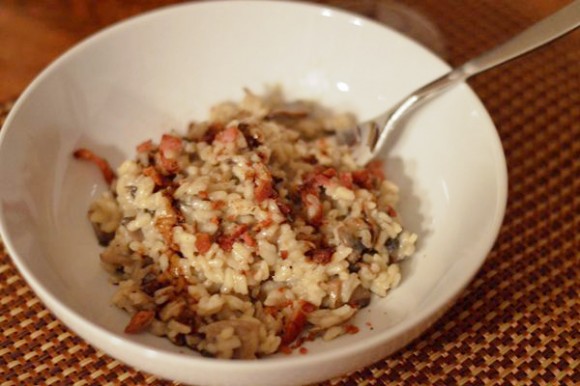
Top photo: Mushroom-Pancetta Risotto. Credit: Tina Caputo

The Greek island of Santorini is one of the world’s mysteries. Maybe it was the Atlantis of ancient civilizations; maybe it had an impact on the demise of the Minoan civilization. But there is no doubt about its breathtaking beauty. A dramatic volcanic eruption in about 1530 B.C. blew a great big hole in the middle of the island, forming a sea-filled crater, or caldera. On our first evening, we dined at the Santorini cooperative, Santo, and looked out on the sun setting over the caldera. Words could not do justice to the view.
More on Zester Daily:
» In Greece, a treasure trove of indigenous grapes
The next morning we saw our first vineyards, which are quite unlike any vineyards I have seen anywhere else in the world. The viticulture is so extreme that it has to be seen to be believed. The vines need protection from fierce wind and harsh sunshine, and so they are pruned in the shape of protective baskets in a small hollow. The soil is volcanic ash, with some pumice and other stones, but there is no organic matter, and it is astonishing that anything grows at all. There is no irrigation — the vines depend on sea mist for moisture and can also tap some water retained by the pumice stones after occasional rains. Inevitably, yields are tiny. The island is immune to the destructive insect phylloxera, for if there is no clay, there can be no phylloxera. Actual replanting is rare. When a vine needs replacing, it is “decapitated” and will regenerate from the existing deep root system. This can be done about every 80 years. When it is finally dying, after about 400 years, growers practice the system of provinage, taking a shoot and placing it in the ground so that it will grow roots.
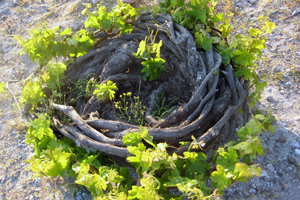
The traditional style of pruning grapevines on Santorini.
Credit: Rosemary George
There are very few conventional vineyards. The key exception is Sigalas, where the winemakers argue the case for more traditional viticulture, giving each vine a pole to help it withstand the wind. More leaves also help shade the grapes from the intense sunlight. In the 1980s, many vines were pulled up in favor of building accommodations for tourists, who provide the island’s main source of revenue. But in recent years, although the vineyard area has not changed, the average age of the winegrowers has decreased significantly, so the future of Santorini wine is more secure.
Assyrtiko elevates on Santorini
The principal white grape variety of Santorini is Assyrtiko, which is also found in northern Greece, but on the island it takes on a fabulously original mineral character.
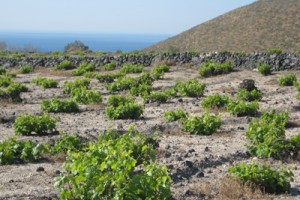
A vineyard in the Greek island of Santorini. Credit: Rosemary George
We tasted the wines of the eight main makers, including the cooperative that accounts for two-thirds of the production. The most typical were the mineral flavors of Assyrtiko, from producers such as Gaia, Hatzidakis and Argyros, with a wonderful depth of flavor. But there are also other grape varieties, white Athiri and Aidani, which can be blended with Assyrtiko and make for riper flavors, and gutsy red Mavrotragano, with some peppery fruit.
Santorini also produces dessert wine, vinsanto, a naturally sweet wine from dried grapes. Drying in the sun would be too brutal, so they are dried under cover and then the juice is put in a barrel and ignored for 10 years or so. Rediscovered, the result is something absolutely delicious, rich and concentrated with the flavors of dates and figs.
Top photo: Island of Santorini. Credit: Wikimedia Commons