Articles in Editor’s Letter
With great joy, and more than a little pride, we are thrilled to introduce our new Zester Daily website. After six months of design and development work, we hope you will find our new site to be more engaging and easier to use.
The new Zester Daily takes its authoritative voice on all things food and drink to the next level, providing more opinion pieces from food professionals as well as its team of talented national and international journalists. Coverage of the chefs and restaurants that define great food around the world will also expand. In addition, the site has a continually refreshed calendar of events in the food and beverage world, including festivals, conferences and competitions.
With the re-launch, Zester Daily is announcing a partnership with SmartBrief, the leading email news publisher, which will highlight Zester content in its daily food-oriented publications, including the Culinary Institute of America’s ProChef SmartBrief.
The heart of Zester Daily continues to beat to the rhythm of its 50 independent contributors, who follow their interests around the globe in search of stories that matter to our food-obsessed culture. The new site enables us to do an even better job of delivering on that core mission.
We appreciate your support for Zester Daily and hope you enjoy our new site — and please leave any comments, questions or suggestions.
Corie Brown, the co-founder and general manager of Zester Daily, is an award-winning food writer at work on a book about climate change and wine.
Equating junk food to tobacco, HBO is cruising for a food fight. “The Weight of the Nation,” the cable network’s special report on obesity in America, pummels the food industry with the statistics and science necessary to justify an overhaul of a food system the producers call “hostile to healthy eating.”
The unanswered question is whether America has the political will to tackle what the series points to as the root of the crisis: outdated federal supports for cheap junk food that keep the fresh, unprocessed foods vital to good health relatively expensive and out of reach.
When an average of $9 billion in federal subsidies has been doled out each of the last five years to growers of commodity crops, sugary sodas end up cheaper than bottled water yet provide manufacturers with an average 90 percent profit margin. The price of fresh fruits and vegetables, in contrast, soars as farmers struggle to sustain 10 percent margins, according to the series.
HBO, the Centers for Disease Control and Prevention, and the National Institutes of Health fight bare-knuckled. Don’t expect the entertaining storytelling and colorful characters that made Robert Kenner’s “Food, Inc.” a box-office hit. A nearly overwhelming body of fresh research and scientific understanding support HBO’s call for changing not only what Americans eat, but also how we live. Doctors, public health officials and progressive politicians complete each other’s sentences as they detail the causes and consequences of America’s obesity crisis.
- More than two-thirds of U.S. adults and one-third of American children are overweight or obese, a weight-gain trend that started in the early 1980s.
- By 2030, half of the nation’s adults are projected to be obese.
- Obesity is now the most serious threat to the health of American people.
- Obesity-related health care costs about $147 billion annually.
- Soaring obesity rates among children will probably make this generation the first in history to have a shorter life span than their parents.
The disconnect between people suffering from failed governmental programs and the powerful financial incentives to maintain the status quo makes the four-part “Weight of the Nation,” debuting on HBO on May 14, a slap in the face to complacency about the true cost of cheap food.
“This is preventable,” says Jack Shonkoff, director of Harvard University’s Center on the Developing Child. “This is not one of those unfortunate acts of nature that we just have to accept as reality.”
But it is not a fight the average consumer can win alone. Obesity is not, as commonly thought, simply a matter of lifestyle and personal choice. “We need companies to step up, to reformulate their products, to change their marketing practices and to make healthy options available in restaurants,” says Margo Wootan, director of nutrition policy at the Center for Science in the Public Interest.
The lone food industry representative in the series states the obvious. “Food companies are trying to sell more today than they did yesterday. And if they don’t, then they’re not considered successful,” says Philip Marineau, former president of the Quaker Oats Company, Pepsi-Cola North America. “If we are going to be successful in reducing obesity, people are going to consume less. And that’s the conundrum.”
In a glaring failure, HBO neglects to include or explain the absence of representatives from Cargill, Archer Daniels Midland, ConAgra and Monsanto — the outsized giants of the American food system — or McDonald’s, Burger King and the rest of the fast-food pyramid.
After the Los Angeles premiere of “Weight of the Nation,” I moderated a panel discussion of the film. Social justice was the uppermost concern of the participants. The problem, they said, is not just the lack of access to and the high cost of healthy, fresh food. Rather it is the glorification of over-consumption even as the people who succumb to the incessant marketing of junk food become marginalized as obese. How can people ignore $4 billion in fast-food industry ads a year?
Members of the panel included Dr. Jonathan E. Fielding, director of Los Angeles County Department of Public Health; Lark Galloway-Gilliam, executive director for Community Health Councils, Inc., a Los Angeles-based health promotion, advocacy and policy organization; Dr. America Bracho, executive director and founder of Latino Health Access, a center for health promotion and disease prevention in Santa Ana, Calif.; and Kimberly Reece, a family medicine physician with Kaiser Permanente, one of the documentary’s sponsoring organizations.
Edited highlights of that discussion can be viewed in the attached video.
* * *
Two of the one-hour special reports debut Monday, May 14 (8 p.m. Eastern and Pacific time, 7 p.m. Central), followed Tuesday, May 15, by the last two special reports, airing those same hours.
Corie Brown, the co-founder and general manager of Zester Daily, is an award-winning food writer at work on a book about climate change and wine.
Image: Illustration for HBO’s “Weight of the Nation” documentary series on obesity. Credit: Screen capture via NIH.gov
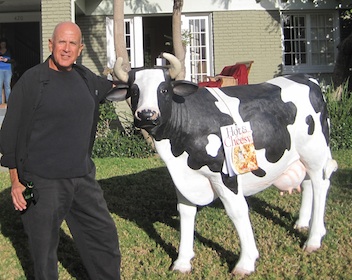
Congratulations to Clifford A. Wright on the publication of his new cookbook, the fun and fabulous “Hot and Cheesy” (Wiley). In honor of his twelfth recipe collection, Zester Daily hosted a cheesy extravaganza where we feasted on delicious dishes from his book while swaying to the jazz sounds of Steve Goldun. The over-flow crowd devoured stacks of grilled cheese sandwiches, trays of Jalapeno peppers stuffed with cream cheese and chorizo, bowls of lasagne with three cheese and ground walnut sauce, and squares of Syrian cheese pie, finishing the evening with bite-sized cheese cakes. While that may sound like cheese overload, it is a tribute to Clifford’s cooking — and liberal pours of bright French wine — that the dancing continued into the night. The soiree’s mascot — our “udderly” delightful bovine friend Lucy — provided the gravitas the event so richly deserved.
Back in 2006, I wrote a Page One profile of Rudy Kurniawan for the Los Angeles Times. The baby-faced 29-year-old from Indonesia was spending millions of dollars a month — yes, a month — on old wine at auctions in New York and Los Angeles. The wine world embraced him as the brother from another planet. No one knew where his money came from. No one knew his family or friends. It was all a mystery. But, at least then, his checks didn’t bounce. He was everyone’s best friend.
Last week, in what appears to be the largest wine fraud case in history, the FBI arrested Kurniawan, 35, for attempting to sell counterfeit wine. If convicted, Kurniawan faces decades in prison. At the very least, he is likely to be deported. An Indonesian citizen, Kurniawan’s application for asylum in the U.S. was denied in 2001. Considered a flight risk, he is being
held without bail.
Here is my story from 2006. It is only available in shortened form in the Los Angeles Times archives.
From the Los Angeles Times “Main News” Section
(December 1, 2006, Page A1ff):
“Young wine fanatic ups the ante.
Rudy Kurniawan inhabits a high-rolling club of aficionados
where cases go for $75,000.
His passion has driven up prices — but don’t call him a collector.”
[Link: http://articles.latimes.com/2006/dec/01/entertainment/et-rudy1]
By Corie Brown
Times Staff Writer
Dressed in scruffy jeans, a tight, gray T-shirt and cowboy boots, Rudy Kurniawan slid into a front-row seat at a Christie’s Beverly Hills auction room. He didn’t blend with the cashmere and Cole Haan crowd hoping to pick up a few bottles of rare and old wine. And it wasn’t just his wardrobe.
In a few short hours that Saturday afternoon, the then-29-year-old Indonesian-born Kurniawan spent an estimated $500,000. For one case of 24 half-bottles of 1947 Chateau Cheval Blanc, the famed St. Emilion premier cru, he dropped $75,000. Then he bought a second case of the same wine for nearly as much.
A week later, he went on another spending spree at a Zachys auction at the Peninsula Hotel in Beverly Hills. Then came buying binges in New York at Sotheby’s and at an Acker Merrall & Condit auction. During the last several years, Kurniawan has spent an estimated $1 million a month bidding at nearly every auction of old and rare wine in the country.
He spoke heavily accented English when he came to Los Angeles to attend Cal State Northridge 11 years ago, had his first taste of fine wine only six years ago, and makes his home in Arcadia. But Kurniawan has enough family money to have amassed one of the world’s premier wine collections, estimated at its peak to be more than 50,000 bottles of the most celebrated Bordeaux and Burgundy wines of the last century.
And he’s still buying. Though he’s culled his old wine collection, selling off duplicates in two recent Acker Merrall sales that grossed $35.4 million, he continues to buy entire cellars directly from other collectors as well as at auction, and he’s investing heavily in young wine as it is released from Europe’s top producers.
Simple passion is his explanation. “I’m not a collector. I’m a drinker,” Kurniawan says, his eyes smiling behind black-framed glasses sporting the silver dagger insignia of rocker-chic jeweler Chrome Hearts. Now 30, he gels his straight black hair off his soft-featured face. “People who know me and come to see my cellar know that they can drink whatever they want. Wine is something you open and you share.”
A slight man whose unconscious self-confidence is the only tip-off that he’s old enough to drink, Kurniawan would rather the world didn’t know much about him. He won’t disclose the identify of his family or the source of their fortune. His father, he says, gave him an Indonesian surname that is different from the family’s Chinese name to allow him to maintain his autonomy.
Kurniawan’s outsize taste for old wine, however, has changed the market, say auction house insiders. Since he started buying, prices for rare wine have skyrocketed. As he stepped up his acquisitions in 2004, a dozen other ultra-rich buyers emerged to compete with him for the best bottles. And the market for old wine exploded.
The average price of a bottle of wine sold at auction has increased 62% from the first quarter of 2001 through the end of the third quarter of 2006, according to Wine Market Journal, an online service that tracks wine auctions around the world. Last year, the dollar value of the old wine market rose 31%, with a total of $166 million spent at auction worldwide.
The rise has been much steeper for the rare wines Kurniawan favors. One example: At the start of 2001, bottles of Bordeaux’s famed 1945 Mouton Rothschild, on average, sold for $3,759. At a recent auction, a bottle sold for $10,337, according to Wine Market Journal.
“The market has changed radically,” says Allen Meadows, editor of Burghound, a leading international publication tracking Burgundy wine, who believes that Kurniawan’s heavy buying has been a significant factor. “I used to go out and buy old Burgundy whenever I wanted to. It was cheaper than the new stuff. Now, older wines are selling for 20 times what I used to pay only a couple of years ago.”
Chinese by heritage but born in Jakarta, Indonesia, Kurniawan is the youngest son of a family that, he says, owns businesses in China and Indonesia. His father died six years ago, and his oldest brother is now in charge of the family’s affairs, he says. “My family is very private,” he notes.
The family also is close-knit. Kurniawan settled in Arcadia because his mother, a frequent houseguest, felt at home in the Chinese-language community. “I’m Chinese,” Kurniawan says. “If my family comes over — they don’t speak English — it’s easier for them there. My family is very traditional, strict. I’m the rebel of the family, doing my own thing.”
Rebellion, to Kurniawan, means embracing Western culture and making Los Angeles his home. Although his brothers and cousins attended college in the United States, he says he is the only one who stayed. And soon he will move out of Arcadia. For the last year, Kurniawan has been renovating a mansion in Bel Air Crest that will bring him closer to his network of wine friends. He drives a limited-edition black Continental Flying Spur Bentley, one of several cars, including a black Ferrari, in his garage. While gray T-shirts and jeans are his preferred wardrobe, he flashes a Patek Philippe Nautilus 5712 on his wrist.
Kurniawan plans to go into the retail wine business. With partner Paul Wasserman, a local specialist in Burgundy wines, he says he will open a wine store near the Grove shopping center in the Fairfax district. The plan is to specialize in the expensive wines he loves to drink but also to offer wines that will appeal to more cost-conscious shoppers. With a bit of his own collection in the mix, the shop will give Kurniawan a public presence in the Los Angeles wine community.
It was at a birthday dinner honoring his father at a restaurant on San Francisco’s Fisherman’s Wharf just before he died that Kurniawan took his first sip of fine wine — a 1995 Opus One, the most expensive wine on the list at $150 a bottle. The restaurant is long forgotten, he says, but after that first taste, wine became a consuming passion.
Over a recent lunch at Patina, Kurniawan tried to describe the intense pleasure he says he experiences when he tastes a great wine. “It’s the balance, the perfect combination of New World extraction and Old World finesse and elegance,” he said. Though he now speaks flawless English, Kurniawan was frustrated as he searched for the right words. Finally, he said, “I don’t think I can describe it.”
Like most young wine collectors, Kurniawan started out buying high-priced California Cabernet Sauvignons — including Screaming Eagle, Harlan Estate and Colgin Cellars. He’s moved on to Bordeaux and Burgundy wines; Domaine de la Romanée-Conti, the legendary Burgundy domaine that produces some of the world’s most expensive wines, is his current favorite.
He says he has tasted enough French wines from the 1800s to say the best wines ever made were produced before the devastating phylloxera infestation in the 1860s. “I prefer mature, fully integrated wines,” he says. “You can talk about those bottles for the rest of your life.”
After 140 years in the bottle, these pre-phylloxera wines still taste “fresh” to Kurniawan. The outrageous claim is difficult to challenge. Only a handful of people in the world can say they’ve tasted enough of these wines to argue the point.
For this lunch, he’s brought along a 1962 Domaine Roumier Bonnes-Mares, a vintage of grand cru Burgundy that recently sold for $6,912 at auction. This bottle, Kurniawan says, is “still young” by his standards.
While the sommelier carefully opens the rare wine, Kurniawan turns his attention to the 2-month-old Chihuahua, Chloe, he has cradled inside his white leather jacket. No one says a word when he offers his dog a sip of water from his water glass.
Kurniawan is an important guest at Patina. Among his wine friends, the young connoisseur is known to be an extremely generous host, throwing frequent dinner parties there and at other haute cuisine restaurants.
The dinner parties are a chance for Kurniawan to taste several of his wines at once, he says. Though he has read a few wine books, he says tasting is the best way to learn about wine. It’s an extremely expensive approach to wine education. And while “it’s not an overly intellectual approach,” says Burghound’s Meadows, a frequent guest at those dinners, “we’d all learn by tasting if we could afford to do it.”
These lavish dinners are Kurniawan’s calling card into a rarefied social circle. “Wine is a vehicle that connects people,” he says. Among his Los Angeles wine friends are Univision Chief Financial Officer Andrew W. Hobson and investment banker Joe Wender, husband of California vintner Ann Colgin, as well as music industry executives and movie producers.
Kurniawan’s social circle also includes the dozen bankers, real estate tycoons and venture capitalists who bid against him at auctions. “We all know each other,” says Eric Greenberg, 41, chief executive of Innovation Investments, a San Francisco dot-com investor. “We compete against each other, and then we drink together.”
Last year, Kurniawan flew Julian Serrano, executive chef at Picasso in Las Vegas’ Bellagio hotel, and his kitchen staff to Los Angeles for a dinner party for 20 of his friends. His prerenovation Bel Air house, he realized too late, wasn’t equipped to handle the elaborate meal Serrano planned to create. So Kurniawan paid Josiah Citrin, chef-owner of Mélisse in Santa Monica, to allow Serrano to clear out part of the restaurant’s kitchen so he could make the dinner there.
There was 1962 Moët & Chandon brut Champagne to go with a wild rice cake topped with caviar. Magnums of 1978 Henri Jayer Vosne-Romanée Cros Parantoux were paired with roasted pigeon. Magnums of 1947 Pommery & Greno Champagne accompanied mascarpone gnocchi with Alba truffles. Double-magnums of 1959 Chateau Lafite Rothschild were opened to drink with the Kobe beef. The final flourish: the 1947 Chateau Cheval Blanc that Kurniawan bought at Christie’s for $75,000 a case.
The wines for that dinner were worth hundreds of thousands of dollars. But the evening was no more spectacular than most of Kurniawan’s dinner parties. “It’s like this every time,” says one frequent guest. “No one is as generous as Rudy.”
As usual, he turned wine appreciation into a guessing game. After a team of eight sommeliers appeared around the table to pour each wine from crystal decanters, there was a pause to allow everyone to swirl and sniff, then sip. One by one, Kurniawan asked each guest to name the producer, the vintage, even the vineyard.
A potentially humiliating experience became a genteel parlor game in Kurniawan’s hands. The guesses were wild and only occasionally near the mark. And it was with evident joy that Kurniawan revealed the identity of the wines, each more spectacular than anyone had guessed.
John Kapon, the 36-year-old son of Acker Merrall owner Michael Kapon, created the wine retailer’s auction division in the mid-1990s. He quickly realized that he could use private dinners to create an insiders club for high-rolling collectors such as Kurniawan. His annual “Wines of the Century” weekend costs $20,000 to $25,000 a person, and that’s just for three meals and a total of 90 2-ounce tastings of rare and old wine.
Currently the youngest president of an auction house, Kapon is the only auctioneer who works with a gavel in one hand and a glass of wine in the other. And he was the first to notice Kurniawan’s appetite for wine.
“He got me into wine,” Kurniawan says of Kapon. “He would tell me what to do, what to buy. Now it’s a disease. There’s always something I want to try, something I don’t know.”
If you are spending freely, it doesn’t take long to be noticed. “In the wine world, you can be somebody quickly,” says Rob Rosania, a 35-year-old principal in Stellar Management, a New York City real estate concern. His cellar isn’t as large as Kurniawan’s, he says. But he’s catching up. Nothing in the world, according to Rosania, creates the instant credibility that you get from pulling the cork on a rare bottle of Burgundy.
There is a lot of “reckless” spending, says American wine critic Robert M. Parker Jr. “These guys have to have it. It’s a sign of status.” Price, he says, is irrelevant to them.
There are serious pitfalls to buying old wine, Kurniawan says. Counterfeit wines and wines damaged during shipment or poor storage are common. Only after he’d tasted hundreds of bottles did Kurniawan learn how to spot the fakes, he says. He studies the corks for signs of tampering, knows the telling details of the labels for all of the top wines, and can spot bottle markings that don’t match that bottle’s label.
But identifying wines that have been damaged during handling can be more difficult. As rare wine changes hands more frequently, it’s nearly impossible to track a bottle’s history, Kurniawan says. Did it sit on a loading dock in the hot sun, even for a day, back in the 1970s? Then chances are it’s cooked, ruined. And with rare wine, there are no returns, according to the auction houses.
For longtime collectors, today’s high prices mean it’s time to sell. “I have 4,000 to 5,000 bottles in my cellar,” says Joe Smith, the former chief executive of Capitol-EMI records. Bottles of Henri Jayer Burgundy that he bought for $40 are now worth thousands of dollars each. “I’m selling,” Smith says. “Let these guys have their bragging rights.”
In the time that Kurniawan has been a force in the wine market, the nature of wine auctions has changed radically. Zachys was the first auction house to serve food and encourage bidders to drink during the auction. Though Sotheby’s and Christie’s haven’t totally abandoned their button-down culture, they’ve begun serving lunches.
At a recent Zachys auction at the Peninsula Hotel in Beverly Hills, nine guys at the back of the room were partying as they bid. Their table was littered with wine bottles: a 1991 Sassicaia super-Tuscan, Williams Selyem Pinot Noirs and a Paul Hobbs Cabernet Sauvignon. Laptop computers were wedged between wine glasses; paddles were thrust high in the air as the men bid aggressively for the big names in California wines.
At other tables, clothing magnate Georges Marciano, film director James L. Brooks, celebrity photographer Phil Ramey, entertainment attorney Howard Weitzman and movie producer Arthur Sarkissian nibbled the free sushi and truffle-oil-flavored popcorn while they sipped the free Champagne.
Conspicuous by his absence was Kurniawan. “Rudy has been a huge force in the market,” says Brian Orcutt, a consultant who buys wine at auction for wealthy collectors. “But it’s difficult to continue at that pace. There isn’t that much reason to buy the sixth case of 1961 Latour.”
True enough, says Kurniawan, who recently began pursuing a new passion: art collecting. Lately he has purchased paintings by Edward Ruscha, Andy Warhol and Damien Hirst. “Art makes wine look cheap,” he says.
-endit
There is a shortage of food news, at least the kind that requires shoe leather, document searches and Freedom of Information Act requests. At a time when the American public is demanding more and better information about what they eat and drink, investigative reporting on food issues is dwindling — a casualty of the shrinking staffs at financially strapped newspapers and magazines.
It’s a crisis, says Samuel Fromartz, a former business editor with Reuters and author of “Organic Inc.: Natural Foods and How They Grew.” Important food and agriculture stories aren’t being told, he says, because the journalists who would have written those stories have lost their jobs.
The goal: fund more food news
As editor-in-chief of Food & Environment Reporting Network (FERN), Fromartz is working to build an alternative to old media — a nonprofit fund to support the work of journalists investigating food-related issues. With money from major funders such as The 11th Hour Project, The McKnight Foundation, Clarence E. Heller Charitable Foundation, Columbia Foundation, The David & Lucile Packard Foundation and The Nell Newman Foundation, during its first year of operation in 2011, FERN commissioned stories from seven journalists. The group continues to raise funds and is working on a second round of projects.
FERN Editorial Board
RUTH REICHL:
Editorial advisor Gilt Taste, former editor-in-chief Gourmet, author “Garlic and Sapphires” and producer of a film based on that food memoir.
KATRINA HERON:
Editor-at-large Newsweek/The Daily Beast, former editor-in-chief Wired.
BRIAN HALWEIL:
Co-publisher Edible Brooklyn and Edible Manhattan, author “Eat Here: Homegrown Pleasures in a Global Supermarket,” Worldwatch Institute fellow.
ELIZABETH ROYTE:
Freelance writer, author “Garbage Land: On the Secret Trail of Trash.”
CHARLES WILSON:
Freelance writer, co-author “Chew On This: Everything You Don’t Want to Know About Fast Food.”
SUSAN WEST:
Founder, West Gold Editorial and founding editor of Afar magazine.
“We aren’t reinventing the wheel,” Fromartz says. FERN is modeled after the groundbreaking nonprofit journalism organization ProPublica. FERN reaches out to reporters whose work is well-known to the group’s advisors and staff (see sidebar). “Stipends and expenses are worked out with the individual writer,” he says. “We’re not funding activists or involved in advocacy work.”
FERN posts the stories it supports on its website as well as partners with established print and online publications to give the work it supports the greatest possible exposure.
More funding means bigger stories
Partnering with FERN gave High Country News the additional resources staff writer Stephanie Paige Ogburn needed to report and write “Milk and Water Don’t Mix,” Nov. 28, 2011, one man’s successful campaign to hold the New Mexico dairy industry accountable for its dirty water, according to magazine publisher Paul Larmer.
“It allowed our writer to take more time to work on her story and gave us access to another editor [Susan West],” says Larmer. “We’re really happy with the result and with the working relationship.”
Fromartz is preaching to the choir when he appeals to environmental philanthropists for funding. “Certainly there is a lack of investigative journalism in this space, a lack of deep analysis on complex issues and a clear need for support,” says Sarah Bell, program manager for The 11th Hour Project of The Schmidt Family Foundation established by former Google CEO Eric Schmidt and his wife Wendy. Eleventh Hour is a longtime supporter of Grist, an online environmental news service, as well as an early supporter of FERN.
A recent 11th Hour-funded survey of 100 nonprofit food and environment advocacy organizations — The Good Food Movement — calls the lack of investigative journalism a “critical gap” in improving America’s food system. “We need investigative exposes, journalists to take on different slices of the issue. The story just isn’t out there,” according to the survey report.
The McKnight Foundation, for one, has committed $50,000 to FERN — enough, says program officer Aimee Witteman, to fund five investigative news stories. There is a void in food and environmental health investigative reporting at the same time there is a huge new appreciation for the importance of these issues.
“You think it might be a fad, but the interest is much broader than that,” says Witteman. People across the country are connecting food with health. “Moms and dads are concerned about their kids,” she says. “People are hungry for good food and good food information.”
A new interest in food safety reporting
Helena Bottemiller thought her fascination with food safety set her apart from her peers when she made the U.S. Food and Drug Administration the subject of her senior thesis at Claremont McKenna College. But it was the key to her future. She arrived in Washington, D.C. in 2009 with a job as a reporter with Food Safety News, an online news service founded and supported by Marler Clark, a law firm representing victims of food-borne illness.
Bottemiller has worked in overdrive ever since. “The news is never-ending, no lulls,” she says. First lady Michelle Obama elevated food issues the day she entered the White House with her “Let’s Move” campaign to fight childhood obesity. Last year, President Obama signed the Food Safety Modernization Act, a sweeping update of the nation’s food safety laws.
When FERN tapped her on the shoulder last year and gave her the financial support she needed to step off of the news treadmill for six weeks to report a story, it was a career-changer. “FERN mentored me,” says Bottemiller. The result was “Dispute Over Drug in Feed Limiting U.S. Meat Exports,” an expose on a controversial growth-inducing drug administered to pigs before slaughter. The story appeared on MSNBC’s Bottom Line on Jan. 25, 2012.
“FERN is one of the most exciting ag-media start-ups I’ve come across in many years,” says Bob Scowcroft, a longtime organic farming activist now working with the Nell Newman Foundation and on the advisory board to FERN. “There are so many stories in just the Farm Bill that require dedicated, thick-skinned reporters to cover. And they have the framework, the advisory board and the funds to kick it off.”
Bottemiller now finds herself on the forefront of a national food movement. Every day she fields calls and emails from people her age eager to get involved with food, who follow the issues and want to learn more about the food system. “There has been a shift,” she says. “Interest is growing.”
Corie Brown, the co-founder and general manager of Zester Daily, is an award-winning food writer at work on a book about climate change and wine.
Photo: We need more food news in our newspapers. Credit: Mike Bentley / istockphoto.com

I was prepared to be awed by Christina Kim’s exquisite clothing when I arrived at her Dosa showroom in a downtown Los Angeles penthouse loft to join, perhaps, one hundred guests attending a fundraiser for Chez Panisse Foundation’s Edible Schoolyards last Sunday. The chic crowd of stick thin Westsiders lined up, first, to have Alice Waters sign her book commemorating the 40thanniversary of her iconic Berkeley restaurant. Later they joined the queue at the cash register to buy armloads of clothing made from scraps of recycled materials priced to emphasize the high cost of piecework. $500 was not too much for this crowd to pay for a recycled fabric shawl.
Forty percent of the day’s receipts went to support school gardens. Everyone was thrilled to be there. The only thing missing was Larry David and the cast and crew from “Curb Your Enthusiasm.”
Then I noticed a guy with a scraggly blond goatee, a slight paunch and dirty jeans. He was dripping water across the polished cement floors as he pulled flowers from dozens of plastic buckets and made bouquets he tied together with rubber bands. A mess of discarded stems and clippings were piling up at his feet as he worked furiously to make certain that everyone left with a free bouquet.
Meet Mud Baron. The flowers are the result of his tireless work at the Los Angeles Unified School District’s garden in San Pedro. A former policy deputy for the LAUSD, he was fired earlier this year after sounding off one too many times about the nasty food in school cafeterias. Since then he has devoted himself to raising support for school gardens. By his estimation, he’s distributed $5 million worth of seeds, seedlings and equipment to school gardens across the L.A. basin. Among the people in the know at the Edible Gardens fundraiser, Mud was every bit as big a celebrity as Alice.
“I should have been fired long ago,” he said with a big grin. He writes about school food for the blog LAist and otherwise lives to be a thorn in the side of Los Angeles County school officials who think students should be thrilled to eat whatever the district dishes up.
I went searching for some of his writing and found this description of the LAUSD’s response to the criticisms levied against the district in the Season Two Premiere of the Emmy-award winning “Jamie Oliver’s Food Revolution.” In addition to providing a much needed grace note to the highfalutin Alice Waters event, Mud has a wicked pen. Bravo Mud!

To run an environmentally and socially responsible restaurant focused on serving delicious food AND still make money, you need to…. The 300 chefs and food purveyors in New Orleans for the Chefs Collaborative National Summit don’t have a pat answer for how to finish that sentence. But through this non-profit community, chefs are helping each other achieve that perfect balance.
The group’s leaders are an impressive collection of people at the top of their craft – Susan Spicer of New Orleans’ Bayona, Michael Leviton of Boston’s Lumiere, Donald Link of New Orleans’ Cochon, Sean Brock of Charleston’s Husk and Andrea Reusing of Chapel Hill’s Lantern, to name just a few. And most claim they aren’t trying to save the world. “We’ve learned that a commitment to make and serve the best food,” says Leviton, “inevitably comes back around to accomplish the same thing.”
No one starts out in the same place, however. “Depending on where you are in the food chain, your view of sustainability is different,” he says. “What to do to be sustainable is not always clear or easy. It is about getting on the path, taking baby steps that hopefully will lead to the great leap forward.”
The first day of the two-day conference was a packed schedule of small group sessions. One group debated the definition of sustainable seafood. Down the hall, the topic was climate change and farming. Another group learned about new native grains that have recently become available. How-to sessions on butchering hogs at Domenica restaurant and lambs at Cochon were crowd pleasers.
But before Leviton dispersed the crowd, he paused to read Chefs Collaborative statement of principles:
1) Food is fundamental to life, nourishing us in body and soul. The preparation of food strengthens our connection to nature. And the sharing of food immeasurably enriches out sense of community.
2) Good food begins with unpolluted land, air and water, environmentally sustainable farming and fishing, and humane animal husbandry.
3) Food choices that emphasize delicious, locally grown, seasonally fresh and whole or minimally processed ingredients are good for us, for local farming communities and for the planet.
4) Cultural and biological diversity are essential for the health of the earth and its inhabitants. Preserving and revitalizing sustainable food, fishing and agricultural traditions strengthens that diversity.
5) By continually educating themselves about sustainable choices, chefs can serve as models to the culinary community and the general public through their purchases of seasonal, sustainable ingredients and their transformation of these ingredients into delicious food.
6) The greater culinary community can be a catalyst for positive change by creating a market for good food and helping preserve local farming and fishing communities.
Tomorrow, I lead a panel on how to do all of this and still keep the lights on. Zester Daily is proud to be a sponsor of the Chefs Collaborative National Summit.
The Bordelais measure time in centuries and follow their ancestors’ footsteps with pride. And that is a big problem, says Christian Mabille, owner of Domaine de Cantemerle, an estate in Saint-Gervais producing Bordeaux Supérieur wines.
The recent decade of hot, erratic weather in this Atlantic coast region of France has convinced Mabille that Bordeaux’s climate is deteriorating. To protect his estate, he says, it is his responsibility to prepare for change.
When the vigneron and his sons selected white grape varieties to plant on their currently all red wine estate, they rejected the sauvignon blanc, sémillon and muscadelle grapes dictated by Bordeaux’s strict AOC rules. Instead, they will be planting chardonnay, marsannay and other white wine grape varieties he is selecting from the Corbières region in the south of France.
“It is an experiment,” he says. Corbières offers a reasonable idea of what Bordeaux will be like in the future, according to Mabille’s consultants and the vigneron’s gut instincts. But this is just the beginning of the search for the right white wine grape for Bordeaux’s future.
It is a radical and risky step and Mabille and his sons are taking it alone. The chances of his entire estate losing its AOC distinction are very real. The financial loss would be ruinous.
“My friends think I am crazy,” says Mabille. “I think I am only a little ahead of the curve.” When the reality of climate change sinks in, the rules and traditions will change. “Oh my goodness, it will be like the explosion of a bomb.”
Mabille bought his estate in 1998 after a career as a medical doctor and he says his work in science along with his family’s long history making wine give him “fresh eyes.” He is dedicating at least three hectares of his 60 hectares of vines to his experiment.
Climate change researchers have been raising questions in Bordeaux for a decade. But the work, says Mabille, has focused on adapting currently grown grape varieties so that they might better withstand the new erratic weather cycles and temperature extremes.
“We don’t know of anyone as advanced with their plans as we are,” says Mabille. “But we do know is that people are thinking about the need to adapt.”