Articles in Breakfast
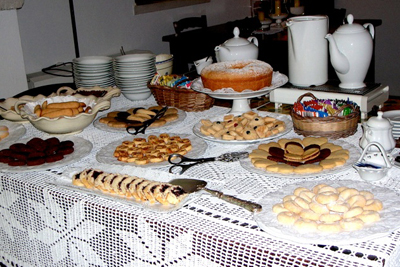
Imagine being 7 years old and being offered an array of cookies and cakes for breakfast every morning. For my son Liam, that was one of the highlights of accompanying me on a six-week long research trip through the European Mediterranean the summer after he finished first grade. I also took my best friend’s 20-year old daughter Rachel, Liam’s beloved babysitter, so he would have somebody to play with. Nonetheless, it was sometimes not very much fun for him to be dragged from one place to another just so his mom could find and eat great food. Liam has always loved great food too, but constant traveling can be hard for a 7-year-old.
It was all worth it for him, though, when we arrived at Il Frantoio, an old olive oil farm that is also an azienda agrituristica, or farmhouse hotel, in the southern Italian region of Apulia. Il Frantoio is one of the most beautiful places on earth. Every room in the elegant house has been lovingly restored by the owners, Rosalba and Armando Ciannamea. Wherever your eye turns, it falls on something pleasing to see. Olive groves, some of them more than 500 years old, with beautiful, huge trees, stretch for miles within the whitewashed walls of the property. Armando produces several different olive oils, and the farm also produces wheat, fruit and vegetables, everything organic.
More from Zester Daily:
» Review: ‘Dolci: Italy’s Sweets’
The beauty of the place and the unforgettable dinners may or may not have been lost on Liam. What he will always remember about Il Frantoio is that they served cookies for breakfast. Every morning, when you cross the quiet courtyard and enter the dining room, you encounter a lace-covered buffet with bowls of fruit from the farm’s orchards — plums and peaches, apricots and nectarines in summer, apples and pears in the late fall — and baked goods from the kitchen — several varieties of cookies and cakes, breads and pastries made with flour ground from Il Frantoio’s own heirloom wheat; homemade jams and honeys. Pitchers of fresh orange and grapefruit juice are covered with handmade lace doilies to protect them from flies. Needless to say, Liam woke up early every day and couldn’t wait to get to breakfast. He always went straight for the cookies.
Italian Butter Cookies with Anise and Lemon Zest
Makes about 4 dozen cookies
Ingredients
180 grams (6 ounces) unsalted butter, preferably French style such as Plugrà, at room temperature
125 grams (⅔ cup) sugar
55 grams (1 large) egg
1 teaspoon finely chopped lemon zest
1 teaspoon vanilla extract
2 teaspoons aniseeds, crushed in a mortar and pestle
275 grams (2¼ cups) unbleached all-purpose flour
5 grams (1 rounded teaspoon) baking powder
1 gram (¼ teaspoon) salt
Directions
1. In a standing mixer fitted with the paddle attachment, cream the butter with the sugar until fluffy and pale, about 4 minutes. Scrape down the bowl and beaters. Add the egg, lemon zest, vanilla and aniseeds, and beat together.
2. Sift together the flour, baking powder and salt. On low speed, beat into the butter mixture, just until combined. Gather the dough into a ball, then press down to a 1-inch thickness. Wrap tightly in plastic and refrigerate overnight or for up to 3 days, or place in the freezer for 1 to 2 hours. Alternatively (if you don’t want to roll out the dough), remove spoonfuls of half of the dough and plop them down the middle of a piece of parchment paper to create a log about 2 inches in diameter. Fold the parchment up around the log to and refrigerate for 2 hours or longer. Repeat with the remaining dough.
3. Preheat the oven to 350 F with the rack adjusted to the lowest setting. Line baking sheets with parchment.
4. Cut the dough into 2 or 4 pieces, and roll out one piece at a time on a lightly dusted work surface, or preferably on a Silpat, to about ¼-inch thick. Cut into circles or shapes, dipping the cutter into flour between each cut, and place 1 inch apart on the baking sheet. Keep the remaining pieces of dough in the refrigerator or freezer.
5. Bake for 10 to 12 minutes, turning the baking sheets front to back halfway through. Remove from the oven and cool on a rack.
Note: You can brush the cookies before baking with a little egg wash if you want them to look shiny.
Chocolate Walnut Biscotti
Makes about 4 dozen biscotti
Ingredients
125 grams (1 cup, approximately) unbleached all purpose flour
120 grams (approximately 1 cup, tightly packed) almond flour
60 grams (approximately ½ cup) unsweetened cocoa
10 grams (2 teaspoons) instant espresso powder or coffee extract
10 grams (2 teaspoons) baking powder
4 grams (1/2 teaspoon) salt
55 grams (2 ounces) unsalted butter
150 grams (approximately ¾ cup, tightly packed) brown sugar, preferably organic
110 grams (2 large) eggs
10 grams (2 teaspoons) vanilla extract
100 grams (1 cup) walnuts, chopped
Directions
1. Preheat the oven to 300 F. Line 2 baking sheets with parchment. In a medium bowl, mix together the flour, almond flour, cocoa, instant espresso powder if using, baking powder and salt.
2. In the bowl of an electric mixer, cream the butter and sugar for 2 minutes on medium speed. Scrape down the sides of the bowl and the beater with a rubber spatula and add the eggs, coffee extract if using and vanilla extract. Beat together for 1 to 2 minutes, until well blended. Scrape down the sides of the bowl and the beater. Add the flour mixture and beat at low speed until well blended. Add the walnuts and beat at low speed until mixed evenly through the dough. The dough will be moist and sticky.
3. Divide the dough in two and shape 2 wide, flat logs, about 10 to 12 inches long by 2 ½ inches wide. The logs may spread while you bake, so it’s best to place them on two parchment-covered sheets. Place in the oven on the middle rack and bake 40 to 45 minutes, until dry, beginning to crack in the middle, and firm. Remove from the oven and allow to cool for 20 minutes or longer.
4. Place the logs on a baking sheet and carefully cut into ½-inch thick slices. Place on two parchment-covered baking sheets and bake one sheet at a time in the middle of the oven until the slices are dry, 30 to 35 minutes, flipping the biscotti over after 15 minutes. Remove from the oven and allow to cool.
Top photo: The breakfast table at Il Frantoio. Credit: Martha Rose Shulman
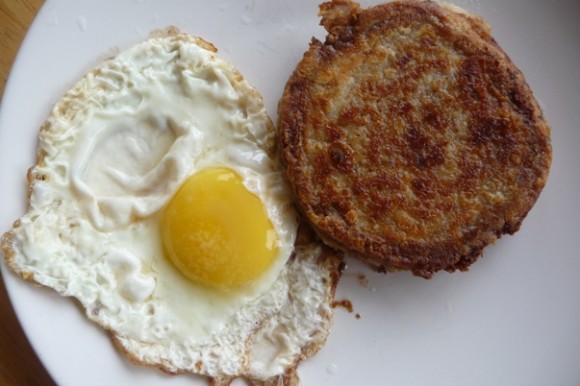
Scrapple is one of those regional American favorites that remain a mystery to outsiders. You’ll find it in the mid-Atlantic states. Scrapple is a hog-parts mush formed into solid blocks, or logs, sliced, floured lightly and fried in fat. I first had it in Maryland in the early 1970s and have been wild about it since.
More from Zester Daily:
» How to cook with the odd bits of the animal
One of the great regional foods of America, you’ll find it also in northern Virginia, eastern Pennsylvania, Delaware and southern New Jersey. Scrapple is made from leftover parts of hog processing, including offal such as the head, heart, liver and other innards that are boiled, bones and all, for the extraction of any gelatin. The edible matter is separated from the inedible and the meat is mixed with cornmeal and made into a mush with seasonings such as sage, thyme, savory, black pepper and salt. It is then solidified and stored.
It’s often described as Pennsylvania Dutch, but this is a misnomer. In fact, the expression is incorrect as the Dutch never settled in Pennsylvania but rather in New York. It began as a misunderstanding of the original German settlers who were the Pennsylvania Deutsch (Pennsylvania Germans). The earliest record of German settlement in Pennsylvania is in 1683 when a group of Quakers and Mennonites from the Rhineland founded the hamlet of Germantown.
These were mostly poor farmers seeking refuge from the Thirty Years’ War in America and afforded passage as indentured servants for the most part.
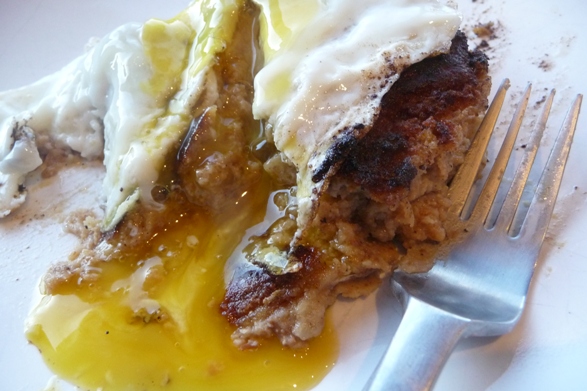
A fried egg with scrapple. Credit: Clifford A. Wright
Their hardscrabble lives in 17th-century Pennsylvania meant everything had to be used including the scraps of the pig slaughter, probably giving scrapple its name.
Scrapple is related to its German precursor, panhas, a kind of pudding-wurst, but probably got its English name, scrapple, in the mid-19th century from the word scraps. It’s usually dredged in flour so it will hold together when frying and develop a crispy brown crust. Scrapple is fried in butter or pork lard and eaten for breakfast with eggs. All kinds of things can accompany it, such as applesauce, grape jelly, ketchup, horseradish or mustard. Scrapple is hard to find outside of the mid-Atlantic, but both the Rapa Scrapple company and Habbersett scrapple company provide store locators, and it can be bought on Amazon too, although in amounts that might last you years.
Scrapple
Serves 4
Ingredients
¼ cup unsalted butter or pork lard
½ pound scrapple, cut into slices about ½-inch thick
All-purpose flour for dredging
Directions
1. In a skillet, melt the butter over medium heat.
2. Dredge the scrapple slices in flour, tapping off any excess.
3. Lay the scrapple in the skillet and cook, turning once, until both sides are crispy brown in about 5 minutes. Serve hot.
Top photo: Scrapple and an egg. Credit: Clifford A. Wright
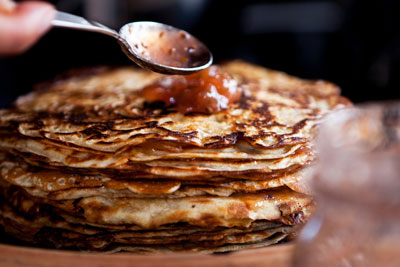
Summer in Scandinavia is a season of berries, and they are enjoyed in many different ways, both sweet and savory. The abundance of daylight hours combined with the not-too-warm weather make the berries thrive. They do not grow big but instead stay small and very tasty.
Strawberries can be in season all summer if the weather allows it, or they can be available for only three weeks. Therefore, as soon as the season starts, you become greedy and eat them every day for breakfast, lunch and dinner: in the mornings on yogurt, for lunch on rye bread and in the evening with cream or boiled with sugar as fruit porridge.
More from Zester Daily:
» Danish dessert: Say rød grød med fløde!
» Preserving and pickling adds flavor to winter
Raspberries are in season in Scandinavia in July. Pick them when they are warm, dark and ruby red and eat them straight away or save some for a morning treat on raw grain flakes with cold milk. I also like to make jam and save some for Christmas, serving them in December with small doughnuts known as æbleskiver. Both raspberries and strawberries are also often accompanied by cold custard in the traditional Danish summer layer cake.
Other summer favorites are red currants shaken in sugar — a classic recipe in Scandinavia. Take 2 pounds of red currants, rinse and take off the sprigs, then mix gently with 1 pound of sugar; leave for three days at room temperature and shake now and then until the sugar has dissolved. It will keep for weeks in the refrigerator. Serve in the mornings on porridge or yogurt and also for dinner with roast chicken or lamb as well as with butter pan-fried fish or on vanilla ice cream.
Black currants are ideal for sorbet, cordial and jam. Jam is eaten in Scandinavia in the morning with cheese, butter and bread. Therefore, it really makes sense to stock up with jam so you have enough to last through the winter.
In addition to strawberries and raspberries, Scandinavians also enjoy their famous blueberries. They are picked in late July and all through August. Blueberries are best plucked wild, when they are smaller and tastier. The wild berries are also the really healthy superberries. If traveling to Sweden, where the blueberries grow, I definitely recommend packing a lunch box and spending a day in the calm, shadowy pine woods picking blueberries, then finding a spot at a small freshwater lake to take a lovely lunch break. Blueberries should be eaten soon after picking; blueberry tarts and pancakes are excellent ways to use them.
Growing up in Scandinavia, berry season was a treat as a child, primarily because the grown-ups would take us to pick them and while we were doing so, we were allowed to eat as many as our stomachs could handle. This was before candy and sodas became part of the 24/7 offerings.
Summer berries bring back sweet memories
All through the summer my grandmother would use berries in cooking and baking. A lot of preserving would be going on in her kitchen. Later on, my mother kept the tradition alive, and over the years I have together with my mother developed a range of recipes for jam, jellies, vinegars and cordials.
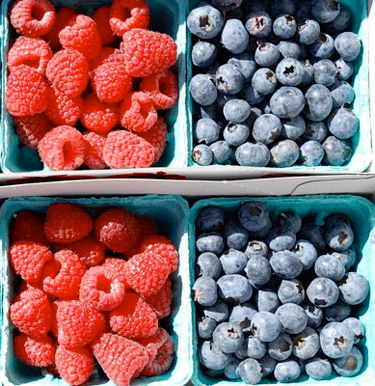
Raspberries and blueberries. Credit: Chris Fager
We did not pick most of the berries wild but rather in fruit orchards or private gardens, where people grow more berries than they can eat themselves. In my childhood we were always invited to Mrs. Carlsen’s garden to pick red currants, black currants and gooseberries. In exchange, my grandmother would give Mrs. Carlsen jars of jam from our summer production.
There are still plenty of fruit bushes around in private gardens. They were planted many years ago to guarantee supplies. But times have changed, and homemade jams and cordials are not part of people’s busy, everyday lives. Birds probably eat the majority of the berries instead. Denmark’s land is highly cultivated and, therefore, does not have vast forests with a lot of wild blueberries. To find that, you’ll have to go to Sweden, Norway and Finland.
Gooseberry time is late July and August. There are green and red varieties; the green one — the more tart of the two — is perfect for gooseberry compote.
Scandinavia’s seasons can vary month to month. Awareness about the region’s turbulent weather patterns is growing, and preserving is becoming popular even in the urban environment. You do not need to preserve 10 pounds of berries to make a cordial or a jam. Just 1 pound and a cup of sugar will do, and you can make one jar at a time. It’s actually easy and can be done while cooking dinner.
Crêpes With Gooseberry Compote
Serves 4 to 6
Ingredients
For the compote:
1 vanilla bean
1 pound unripe gooseberries, trimmed
1 cup superfine sugar
For the crêpes:
4 eggs
1 cup buttermilk
½ cup light beer
1¾ cups all-purpose flour
1 teaspoon caster sugar
1 teaspoon salt
1 vanilla bean
1¼ cups whole milk
Butter for cooking
Directions
1. Make the compote by halving the vanilla bean lengthwise and placing it in a pan with the gooseberries and sugar. Bring to a boil, then reduce the heat and simmer for 30 minutes. Pour the hot compote into sterilized preserving jars and seal tightly. When cool, store in the refrigerator.
2. Start making the crêpe batter by beating the eggs together in a large mixing bowl. Add the buttermilk and the beer and beat again.
3. Sift the flour, sugar and salt together, then add to the egg mixture and beat until smooth.
4. Slit the vanilla bean in half lengthwise and scrape out the seeds with the tip of a knife. Stir in the milk and vanilla seeds.
5. Let the batter rest for 30 minutes before cooking the crêpes.
6. Melt a little butter in a skillet. When hot, add 5 tablespoons of batter to the skillet, twisting the handle gently to make a large, thin crêpe. Cook until golden on each side — it takes about 2 minutes. Set aside and repeat with the remaining batter. Stack the crêpes on a plate; they will stay warm like this for some time but if you prefer, you can put them in an oven set on low heat.
7. When the crêpes are all done, serve with the gooseberry compote.
Top photo: Crêpes with gooseberry compote. Credit: Columbus Leth
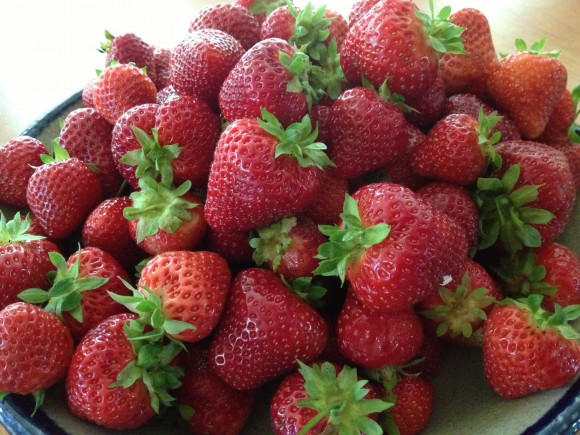
Strawberries! How do I love ye? Let me count the ways: strawberry shortcake, strawberry jam, strawberry pie, strawberry ice cream, strawberries and cream, strawberries and prosecco, strawberries and genuine aceto balsamico tradizionale di Modena, or just a little handful of fresh-from-the-garden strawberries sliced over the morning granola
More from Zester Daily:
» Cloudberries: A Scandinavian treasure
There are so many reasons to love a strawberry, do you really need more? If so, turn to nutritionist Rosie Schwartz, who points out the health impact of strawberries on her Enlightened Eater blog:
- They have a powerful anti-inflammatory impact
- They improve insulin sensitivity
- They offer a whole range of heart healthy benefits
- They guard against cancer
- They protect against cognitive decline.
Swartz offers state-of-the-art scientific evidence for these advantages.
Aside from their evident nutritional benefits, who could deny the sheer pleasure of this most remarkable fruit? When experts talk about fruity flavors in olive oil or in wine, the fruit that comes to mind, at least for me, is almost always strawberries. To me, the intense, pervasive flavor and aroma of ripe strawberries is the very definition of fruitiness, and it is irresistible.
We have strawberries in the supermarket produce section almost all year round, but they come from industrial farms in California and they are often raised with an eye to their visual impact rather than flavor. For taste, however, nothing beats strawberries grown in a cool northern climate, where the intensity of sunlight around the solstice ripens them quickly and the cool temperatures give them an intensity southern-grown berries lack. Best of all, of course, are the wild strawberries found on the forest floor, but they are so few and so difficult to transport that they are best consumed sitting right down by a woodland path and eating them by the handful.
Competition from the critters
I have strawberries in my garden in Maine, but it’s an annual contest with the local chipmunks as to who gets there first. Most mornings I find a few discards lying on the garden path, a bite taken out and then the berry tossed aside. Why? I hate to think the chipmunk is more discriminating than I am. Perhaps he was disturbed by the neighbor’s cat.
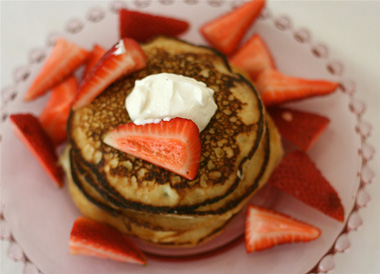
Strawberries with ricotta pancakes. Credit: Flickr / MyDailyMorsel
So I rely on a farmstand nearby. Mrs. Beveridge’s strawberries are dark red, big, luscious, full of flavor. And aroma — just passing the stand in the car, with the windows down, I am drawn into their seductive web.
Strawberry shortcake is an all-time American favorite, of course. Who doesn’t love it? Here in New England, the shortcake comes as a baking powder biscuit, with more than the usual sugar added, that is split in half, buttered, piled with strawberries, dolloped with sweetened whipped cream, and topped with a final garnish of the most perfect strawberry from the bunch. That’s all well and good, but I’ve also discovered that ricotta pancakes, perhaps sweetened slightly more than you would want at breakfast, make an equally grand dessert when mounded with deep red strawberries and a fluff of white whipped cream with just a drop or two of vanilla added.
Here’s the recipe, and I’m guessing it’s going to be handy in a few weeks when blueberry season rolls around again:
Ricotta Pancakes
Makes about 12 pancakes, 6 servings
Ingredients
¾ cup whole wheat flour
¼ cup unbleached all-purpose flour
3 to 4 tablespoons sugar
1¼ teaspoons baking powder
Pinch of fine sea salt
1 cup well-drained ricotta
3 large eggs, separated
¾ cup whole milk
Grated zest of 1 lemon
¾ teaspoon vanilla extract
Vegetable oil or unsalted butter for the griddle
2 cups partially crushed strawberries, plus whole berries for garnish
Whipped cream flavored with a little sugar and ¼ teaspoon vanilla
Instructions
1. Toss together with a fork the flours, 2 to 3 of the tablespoons of sugar, the baking powder and the salt.
2. In a separate bowl, combine the ricotta, egg yolks, milk, lemon zest and vanilla, and beat to mix thoroughly. Fold into the flour mixture.
3. In a separate bowl, using clean beaters, beat the egg whites until stiff, adding 1 tablespoon of sugar about halfway through. Using a rubber spatula, fold the egg whites into the batter.
4. Heat the griddle or skillet and smear with about a teaspoon of oil or butter. Drop the pancake batter by ⅓-cup measures onto the hot griddle. Cook until done and golden brown on each side, turning once.
5. Serve each pancake topped with crushed berries and a dollop of whipped cream plus a couple of whole berries on top.
Top photo: Fresh strawberries. Credit: Nancy Harmon Jenkins
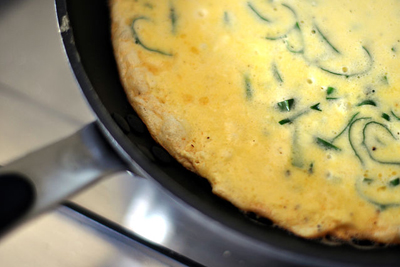
“You must have the courage to be rough or the eggs will not loosen themselves from the bottom of the pan.” — Julia Child, “Mastering the Art of French Cooking”
One August weekend, when I was still teaching myself to cook but was accomplished enough to have a vegetarian catering service, I got a call while I was in Los Angeles, visiting my parents and escaping the summer heat of my home in Austin. There was a big rock concert coming up at Willie Nelson’s ranch on the Blanco River in the Texas Hill Country, and did I want to cater breakfast on a houseboat for all of the talent and the press, who would be whisked up to the houseboat by motorboat, fed breakfast, then whisked on to the ranch? It would be about 200 covers.
More on Zester Daily:
» The breakfast chef: Omelets made to order
I organized my troops from afar and began writing shopping lists. I would make omelets to order as the speedboats pulled up. I’d make the fillings in advance: ratatouille, salsa ranchera, cheese.
The only challenge was that I hadn’t quite perfected my omelet yet. So I went to the store, bought 10 dozen eggs, and didn’t stop practicing making two-egg omelets on my mother’s stove until I’d used them all.
If you were serious about cooking in the 1970s, mastering the French omelet was a rite of passage. Julia Child was my mentor, and I also read every other French cookbook I could find for tips on how to manipulate the pan and the eggs. Of course everybody I read had a slightly different technique, but they were all clear about a few things: The pan had to be hot when you added the butter, the butter had to be hot when you added the eggs, and the eggs shouldn’t be in the pan, which was in constant motion, for much longer than a minute. We didn’t have heavy nonstick omelet pans at that time, so if you didn’t get the temperature right you could count on your omelet sticking to your pan. Today, learning to make an omelet isn’t as challenging because we have those pans, though it still takes a tour de main to get it fluffy and right. You could flip the omelet with a quick jerk of the pan or take a gentler approach, folding the eggs over with a spatula. That weekend I lost a lot of eggs to the stove and the floor, but by Monday morning I was pretty confident about feeding the crowd.
I went back to Austin, 100 wicker paper plate liners in my suitcase, and got to work. I had five days to pull this together. I arrived at the dock at Lake Austin at 5:30 a.m. on the day of the concert to load my food and equipment: a 5-gallon container for beaten eggs that we would ladle into the hot pans, gallons of ratatouille and salsa ranchera, pounds of grated cheese, vats of fruit salad, coolers filled with ice, a dozen loaves of homemade bread.
We also loaded a couple of kegs of beer and 5 gallons of bloody Mary fixings — the mix not from a bottle but my father’s delicious recipe (V8, Worcestershire, Tabasco, garlic salt and pepper is what I’m remembering now); and therein lay my downfall. Not exactly downfall, for I had no trouble with the omelets, but drink a bloody Mary (or two, just to make sure they’re good) not too long after sunrise on an August morning in Central Texas and work outside for the next seven hours straight as the temperature climbs into the triple digits, and you will feel hung over before you even experience the pleasure of being inebriated. Our houseboat chugged along from the Lake Austin dock toward Willie Nelson’s ranch; I so wanted to take a nap, but my co-workers and I persevered despite my crushing headache, turning out one omelet after another. I hardly had time to look up, but I do remember when The Band arrived. They came, they ate, they left.
As I (sort of) remember, we got backstage passes to the concert, and it took us quite a while to get back to the Lake Austin dock. When I got home at around 7 that evening I picked up a message on my machine from a friend, inviting me to come over for a potluck. Great, I thought, I can bring some of these leftovers. I’ll just lie down and have a little rest before I go over. I lay down on my bed, closed my eyes, and woke up the next morning.
How to make an omelet
Serves 1
This is how I do it. I’m sure, readers, that many of you will have your own way that works and it may be different from mine. In the days before nonstick you had to use about twice as much butter. Olive oil was strictly a Mediterranean thing, but I like it and often use it; it depends on the filling. I always use two eggs for my single-serving omelets. Restaurants often use 3, but I never sit down and eat three eggs at one sitting.
Break 2 eggs into a bowl and beat with a fork or a whisk until frothy. Whisk in salt and pepper to taste and 2 to 3 teaspoons milk.
Heat a heavy 8-inch nonstick omelet pan over medium-high heat. Add 2 teaspoons butter or olive oil. When the butter stops foaming or the oil feels hot when you hold your hand above it, pour the eggs right into the middle of the pan, scraping every last bit into the pan with a rubber spatula. Swirl the pan to distribute the eggs evenly over the surface. Shake the pan gently, tilting it slightly with one hand while lifting up the edges of the omelet with the spatula in your other hand, to let the eggs run underneath during the first few seconds of cooking.
As soon as the eggs are set on the bottom, sprinkle the filling over the middle of the egg “pancake,” then move the pan away from you and quickly jerk it back toward you so that the omelet folds over on itself. If you don’t like your omelet runny in the middle (I do), jerk the pan again so that the omelet folds over once more. Cook until set, shaking the pan the entire time. Tilt the pan and roll out onto a plate.
Another way to make a 2-egg omelet is to flip it over before adding the filling. Do this with the same motion, moving the pan away then quickly jerking it back toward you, but lift your hand slightly as you begin to jerk the pan back toward you. The omelet will flip over onto the other side, like a pancake. Place the filling in the middle, then use your spatula to fold one side over, then the other side, and roll the omelet out of the pan. Serve at once.
Top photo: Making an omelet. Credit: Wikimedia / cyclonebill
Last summer we spent a memorable couple of nights as guests of Alpine farmers Ernst and Margrit Kübli in their Chalet Horneggli high above Saanenmöser, in Switzerland’s Bernese Oberland.
During our short stay, we observed with respect as they worked from dawn to dusk, milking the cows, making the cheese, mucking out the cows’ stable, cutting and gathering the hay — and then doing it all again next day.
More from Zester Daily:
» Sorbet’s magic ingredient: Rhubarb compote
» How to make (mostly) homemade grape jelly
I confess I’m not much of a preserve person, but this one really hit the spot for me. Not only does it taste amazingly fresh and fruity, it’s also far less sweet than most jams. Two reasons for this, explained Margrit: First, she adds commercial pectin (especially useful for rhubarb, which has little of its own), which means the setting point is reached much faster than with most jams, so the fruit keeps all its natural character and flavor. Second, where generally the ratio of sugar to fruit is 1 to 1, Margrit cuts it back to half this amount — to 2 pounds of fruit she adds only 1 pound of sugar. This means the jam will not keep for long and you should store it in the fridge and use it up fairly promptly. This, I promise, is no hardship.
Rhubarb and Orange Preserve
Makes four to five 1-pound jars
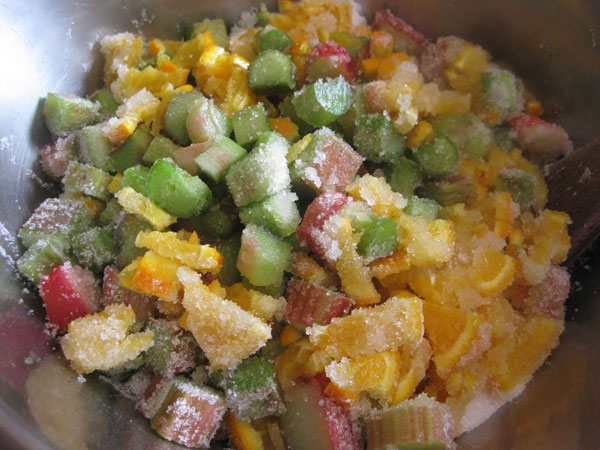
The joy of this jam recipe is it’s so quick and easy — who wants to be trapped in the kitchen boiling up preserves for hours in hot weather? You can tackle the task in two easy steps. First, trim and slice the rhubarb, chop the oranges very finely and put in a large bowl with the sugar. Next day, tip the fruit into a preserving pan, bring to a boil, simmer gently, then add pectin and boil very briefly till it reaches setting point.
Ingredients
2.2 pounds (1 kilogram) rhubarb
2 thin-skinned oranges, untreated at harvest
1 pound (500 grams) plus 2 tablespoons sugar
1½ ounces (40 grams, or 4 tablespoons) powdered commercial pectin
2-3 sprigs of fresh mint (optional)
Directions
1. Wash the rhubarb, trim away the ends and cut in ½-inch slices.
2. Scrub the oranges but do not peel. Cut away a slice of peel from the stalk end and from the opposite end.
3. Slice the fruit very thinly, remove all pips and cut slices in tiny dice.
4. Put rhubarb and oranges in a large bowl, add 1 pound sugar, mix well, cover the bowl and leave to macerate for a few hours or overnight, stirring occasionally — the fruit will make lots of juice and the sugar will dissolve.
5. Tip the fruit into a preserving pan, adding any sugar lurking at the bottom of the bowl.
6. Add the mint sprigs (if using), bring the fruit and sugar to a boil, stirring, then turn down the heat and allow to cook at the barest simmer for 10 minutes till the fruit is just soft.
7. Mix the pectin with 2 tablespoons sugar and stir it into the fruit, raise the heat and boil hard for 3 minutes or until setting point is reached — test by tipping a little jam into a chilled saucer and draw a finger through it. It should leave a distinct channel and the surface will wrinkle slightly. If not, continue to boil a few minutes more.
8. Once the setting point is reached, pour jam into clean, warm jars and cover while still hot.
9. Keep the jam in the fridge and use within two to three months.
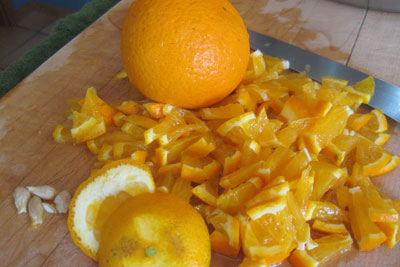
Top photo: Oranges for use in the rhubarb and orange preserve. Credit: Sue Style
Easter is a moveable feast in both Eastern and Western church traditions — quite literally, since the date can vary by several weeks whether celebrated according to the Western (Roman Catholic) or Eastern (Orthodox Catholic) calendar: This year’s Roman Catholic Easter is March 31, and the Orthodox date is May 5. This can make for some confusion where the two groups intersect, as they often do in central Europe. Traditions in both camps, however, feature eggs as the universal symbol of rebirth.
A Russian Orthodox Easter as celebrated in the early 1990s by a self-sufficient farming family of Ruthenes living in Slovakia’s Tatras mountains on the borders of the Ukraine provided me with a lesson in maintaining national identity through festive traditions in a situation where church festivals were not officially celebrated at all.
The Ruthenes, Russian-speaking Ukrainians marooned in Slovakia in the aftermath of World War II, maintained their language and religion throughout the years of communism thanks, in all probability, to their minority status and the inaccessibility of their steep ravines and dense forest. Through the long winters, while the city dwellers of Eastern Europe endured shortages and bread queues, the peasant communities of the Tatras survived as they always had, through self-sufficiency and a well-stocked store cupboard. And at Easter, the most important festival of the Christian year, those who had moved to the cities to find work returned home to be with their families and enjoy the last of the stores, providing extra hands to plant the potato crop, the most important and labor-intensive task of the year.
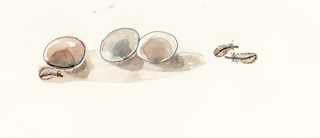
Eggs. Credit: Elisabeth Luard
At the time of my visit, my hostess, Anna Ludomirova — matriarch of a peasant farming family in the High Tatras — was preparing the Easter basket to be taken to the churchyard. Packed with good things — a tall round babka enriched with eggs and butter, decorated eggs, salt (a very important item in any self-sufficient household), the last of the ham from the brine pot — the basket was taken to be blessed with a sprinkling of holy water by the monks at the Russian Orthodox church on Easter Saturday. Once this ritual had been observed and the basket shown to the family ancestors buried in the churchyard, everyone returned home to unpack and share the contents.
Easter egg cheese part of traditional holiday meal
This picnic-style meal freed the ladies of the household to enjoy the company of visitors. But before the feast could begin, certain rituals had to be observed. A bowl of decorated Easter eggs painted with wax and dipped in colored dyes was set on the table and a ceremonial candle lit. Then Mama Anna sliced the top off a raw egg, mixed the contents with a little spoon and passed it round the table for everyone to take a little sip — a unifying gesture shared by all.
More from Zester Daily:
These important rituals concluded, the company tucked into sliced ham and wind-cured sausage, spiced beetroot and gherkins in sweetened vinegar, grated horseradish in cream, eggs hard-boiled and saved in obedience to the prohibitions of Lent, thick slices of the buttery babka spread with more butter. Most unusual, however, was the centerpiece of the feast, egg cheese, a magnificent yellow globe as large and round as a soccer ball made by scrambling the first of the year’s eggs with the first of the year’s milk, tipping the result in a cloth and leaving it to drip overnight till firm and dry — a technique that mirrors the preparation of rennetted cheese later in the year, when the calves are weaned and the cows put out to grass. The eggshells did not go to waste, as they were emptied through pinholes to keep the shells intact and saved for the children to decorate with melted candle wax for the patterned Easter eggs sent to the churchyard in the basket.
After the collapse of the Russian empire and the splitting of Slovakia from the Czechs, the Ruthene communities returned to the Ukraine carrying with them traditions forgotten in their native land but preserved in all their ancient symbolism by a stroke of the politicians’ pencil all those years ago.
Wax-patterned Easter eggs
You need white rather than brown eggs for the patterns to be effective. You can use ready-blown eggshells from making egg cheese or cooled hard-boiled eggs. You’ll also need candle ends — plain, colored or both — food coloring and a pin with a large head.
Directions
1. Stick the pin in a cork to make a pen.
2. Melt the wax, keeping the colors separate.
3. Hold the egg firmly in one hand, big end upward. Dip the pen in the wax, and, starting half an inch below the apex of the egg, dab with the wax and drag it up toward the top to give a tadpole-shaped tick. Continue around the egg to make a sunburst pattern. If you use alternate lengths of stroke and different colored waxes, the pattern will be even prettier.
4. Repeat on the other end of the egg. (Hold it carefully or place in an egg cup so the warmth of your hand doesn’t melt the wax). Make more sunburst patterns around the sides.
5. Dip the eggs in diluted food coloring, as for batik.
6. Pile the eggs in a pretty bowl.
Easter egg cheese
This is a very unusual dish, a solid sphere of scrambled egg. It looks decorative, slices up neatly and goes very well with ham, the traditional Easter meat in northern and Eastern Europe.
Serves 6
Ingredients
1 liter of milk
12 free-range eggs
1 teaspoon salt
Directions
1. Bring the milk to a boil. Meanwhile, whisk all but one of the eggs with the salt.
2. When the milk boils, whisk in the egg. Keep whisking until the resulting custard is thoroughly scrambled.
3. Tip the mixture into a clean pudding cloth. Hang it in a warm place to drain with a bowl underneath to catch the whey, exactly as you would fresh cheese.
4. When it’s quite drained, tip it out onto a clean dish, paint it with the remaining egg, forked to blend, and place it into an oven preheated to 350 F (180 C/Gas 4) for 10 minutes to glaze. The result should look like a large, shiny, yellow Easter egg.
5. Slice thickly and serve with ham, butter and bread.
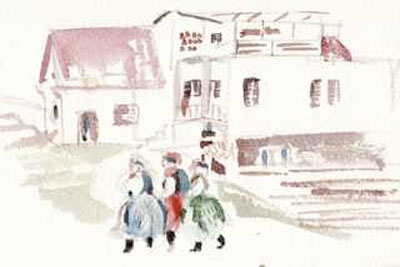
Illustration: Ruthene women. Credit: Elisabeth Luard

Traditional Valentine’s Day gifts are chocolates or flowers, and there’s nothing wrong with that, especially if the chocolates aren’t from a drugstore. But it seems to me that lovers with a little more imagination could come up with their own traditions and, to start with, might find some inspiring ideas in the literature on aphrodisiacs.
More from Zester Daily:
» A Valentine’s Day menu for romance
» The perfect wine for your Valentine
It should come as no surprise that this literature is vast, going back to ancient times, for, clearly, humans have always been interested in anything that can enhance their sexuality. The lore of aphrodisiacs is filled with examples of potions thought to have magical properties. One of them, yohimbe, derived from the bark of African evergreen trees, has a bit of science to back it up and is thought to be nature’s version of Viagra.
But the aphrodisiac qualities of most foods or other substances once believed to enhance desire are now seen as folklore. New World foods such as tomatoes, once called “love apples” were scarce and exotic-seeming when they first came to Europe, and the humble potato was likewise designated as having aphrodisiac properties just because it too was at first hard to get.
But the foods that have had the most sustained reputation as sexual enhancers derive from what is known as the “doctrine of signatures,” which are foods that resemble human genitalia. Carrots and bananas come to mind and, of course, oysters. My favorite, however, is the mandrake root. This plant, when mature, has roots that resemble people, prompting the ancients to assign it all kinds of medicinal and magical properties. It was used as an analgesic and anesthetic, treating everything from toothaches to hemorrhoids, but people also used it as an aphrodisiac.
Because the root of the plant resembled a human, it was thought that whenever unearthed, the root would scream, killing any person who heard it. When Harry Potter and his classmates studied the mandrake in herbology class, students were instructed to wear earmuffs as protection. As for its effectiveness as an aphrodisiac, people in the know have been forced to conclude that, as with most aphrodisiacs, its sexual-enhancing properties are more in the imagination than in fact, but, for the curious, I hasten to point out that packets of mandrake are available on Amazon for $3.99.
Food writers, food porn and aphrodisiacs
Connections between food and sex are so ordinary that they have come to be a cliché. How many times have we stumbled across the term “food pornography,” which usually refers to photographs of such tempting and caloric foods as profiteroles dripping with chocolate, guilty pleasures the figure-conscious prefer to gaze at instead of eat.
Food writers have had a continuing presence in the realm of food and sex. In 1963, Mimi Sheraton came out with “The Seducer’s Cookbook,” a pre-feminist, sexually-liberated romp connecting the human appetite for food with sex. And the intrepid Gael Greene has for years amused and enticed her readers with such titles as “Delicious Sex” and “Insatiable: Tales from a Life of Delicious Excess.”
But, the classic tome on the subject, having a cult-like following, is “Venus in the Kitchen or Love’s Cookery Book,” British novelist Norman Douglas’ ode to food and love. By the time it was published in 1952, the writer was at the end of his sexually adventurous life, and the old reprobate produced this book more for the amusement of his aging friends than for its efficacy in the bedroom. Commenting on recipes he had researched, Douglas mentions in his preface his “retaining a few delectable absurdities to show the length to which humanity will go in its search for the lost vigour of youth.” He offers, for instance, a recipe for skink, an African lizard he batters in egg and fries in olive oil. But most of his recipes use familiar ingredients, and can be characterized as being full of such Mediterranean deep flavors as garlic, anchovy, olives and wine.
This makes me acknowledge that foods filled with earthy flavors and aromas arouse the senses and are conducive to romantic dinners. One could do worse than look to Douglas for inspiration, and his influence on Elizabeth David came at a formative moment in her life. They met on Capri when she was 26 and he was 72. They struck up a friendship that involved long walks and Mediterranean lunches filled with sophisticated talk about food, conversations most other British found unseemly. Douglas carried around a lump of Parmesan cheese that he would hand over to waiters for grating, and he cautioned cooks to tear rather than chop the basil going into his dishes, details that did not escape David’s eagle-eye.
Set the mood with good food
M.F.K. Fisher is another writer who expressed the sensuality of food, often with the simplest of recipes. I still make her unusual rice pudding, topped with meringue and filled with plump raisins and fragrant spices that permeate the kitchen while cooking and after. And her description of peeling and eating a juicy tangerine is so sexy that it could serve as the perfect shared dessert after a hearty Mediterranean meal.
So to set the mood for a romantic Valentine’s dinner, choose favorite foods that may already have some stored memory between you and your partner. In other words, come up with your own traditions for pleasure, and if stuck for ideas, you could do worse than turn to the likes of Douglas, David and Fisher for inspiration.
Caviar Omelet (adapted from Norman Douglas’ “Venus in the Kitchen”)
Ingredients
4 eggs, well-beaten
1 teaspoon dried bread crumbs
2 teaspoons of caviar
½ teaspoon chopped chives
½ teaspoon chopped parsley
¼ teaspoon grated lemon peel
1 tablespoon butter
Directions
1. Mix together all ingredients except the butter in a bowl.
2. Warm butter in a frying pan. When hot and bubbly, pour in the egg mixture and make sure it covers the bottom of the pan. When cooked on one side, flip over and cook on the other side. Serve.
Photo: Chocolates for Valentine’s Day. Credit: Barbara Haber