Articles in Meat
“Just let it melt on your tongue,” Jose Martinez-Valero instructed. “It will dissolve into pure flavor.” I placed the tiniest sliver of jamón Ibérico de bellota in my mouth and waited. The finely marbled fat melted like silk, but the finish was remarkably pure, strangely akin to a classic palate cleanser.
As I positioned myself to snare another sample in the elbow-room frenzy of the Culinary Institute of America’s Worlds of Flavor conference at Napa, California, Martinez-Valero hit me with an even bigger surprise. “This fat is just like the very best olive oil, it’s monounsaturated. It comes from a breed of Spanish pig we call the four-legged olive tree,” he said.
And suddenly I understood why the mouthfeel was so familiar. With years of olive oil tasting under my belt, it was easy to recognize the difference between greasy, mouth-coating fat and this high-quality clean finish.
Jamón Ibérico de bellota is familiar to food cognoscenti as the cured form of this extraordinary animal. At prices north of $1,000 for a single ham, it is not widely available in restaurants or markets. But those who can afford it will go to great lengths to find a reputable source, because it is considered one of the finest foods in the world. At the heart of its difference is that purebred Ibérico pork represents a very old-world approach to one of the tenets of today’s cuisine: a sustainable, simple focus on pure flavor.But like high-quality extra virgin olive oil, purebred Ibérico pork is under siege from unscrupulous distributors who pass off crossbred meats as purebred, elitist pricing and a disappearing ecosystem (needed to support the swine’s unusual eating habits). The species has been on endangered or at-risk lists for years, a dwindling breed supported by a handful of dedicated producers on a lifelong mission to avoid extinction — of the pig, its pastureland and their very livelihoods.
Martinez-Valero represents Ibérico Fresco, one of few Spanish distributors of 100% purebred, acorn-fed fresh Ibérico meat in the United States. Over the din of pork belly- and backfat-crazed chefs at the CIA‘s annual event, he spoke passionately about the plight of this pig and its unique grazing land, the dehesa (forest) of the Iberian peninsula in Spain.
“It is the very definition of sustainable agriculture. The man takes care of the forest, the forest takes care of the pig, and the pig takes care of the man,” explained Martinez-Valero.
Raising Ibérico pigs is an expensive labor of love
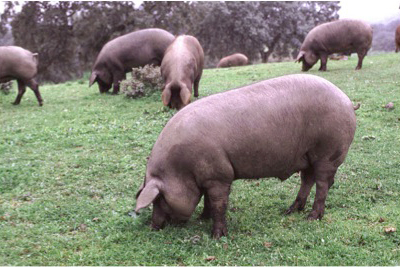
Ibérico pigs are not particularly pretty, galloping along with long legs supporting a chunky body. They are best identified by their distinctive black hooves, hence the Spanish name, pata negra. There are many different breeds of Ibérico pigs, ranging from the productive, big Torbiscal to the delicate Entrepelado, but they all have certain traits in common that strain any producer’s pocketbook. Those include litters half the size of crossbreds, production cycles that are three times as long, and particularly expensive eating habits.
In contrast to the ordeals of pigs jammed into cramped pens and pumped full of antibiotics seen in television news reports on the pork industry, the lives of purebred Ibérico pigs seem like a scene straight out of a fairy tale.
Watch a video about Ibérico pigs and the farmers who raise them, below:
By Spanish law, truly purebred (genetically 100%) Ibérico pigs are required to attain at least 40% of their weight grazing exclusively on holm oak acorns during the montanera, or period of fattening between October and January. Each pig is provided 2 hectares (about 5 acres) of personal space to reach its best weight. The high oleic acid content of the acorns and the genetic makeup of the Ibérico help convert the pig’s fat into its distinctive monounsaturated marbling.
“It’s a marvel, a machine for making healthy meat. It’s perfection,” said Lucia Maesso Corral, president of Aeceriber, the Iberian Pig Breeders Association. She represents purebred producers who are fighting an uphill battle against lesser quality, far less expensive crossbred options that are allowed to take the name “Ibérico.” But their passion for truth-in-labeling and authentic, quality production is palpable.
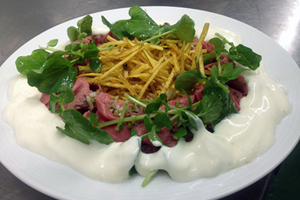
Fresh Ibérico pork with Manchego and saffron. Credit: Courtesy of Monastrell restaurant in Alicante, Spain
Without question, the better-known cured ham version is amazing. But one taste of the fresh meat they now call “the other red meat” and you will understand the depth of these producers’ dedication. For a dinner party of two, I sautéed a secreto of carne de cerdo ibérico de bellota (acorn-fed Iberico pork shoulder skirt) for no more than two minutes per side, classically medium rare with a deep pink in the center, and sliced it like flank steak. Without exaggeration, it may well be the best meat I’ve ever eaten: succulent, sweet, almost nutty. Good enough that we didn’t have the discipline to stop, finishing off the entire cut with no regrets.
Monastrell’s Ibérico Pork with Manchego Cheese and Saffron
I went straight to the best source I know in Spain for a professional’s opinion of the meat. Chef María José San Román of Monastrell in Alicante, Spain, heralds the pig on her Michelin-starred menu with a simple appetizer that showcases the meat by surrounding it with gentle flavors: a foam of Manchego cheese crowned with spring-fresh watercress.
“Many people only know Ibérico ham in its cured form, but fresh cuts of the pig are extraordinary examples of the best pork Spain has to offer,” San Román said. “Like the Manchego cheese it is paired with, Ibérico pork is quintessential Spanish cuisine.”
Serves 6 to 8 as an appetizer
Ingredients
8 teaspoons (40 ml) extra virgin olive oil (preferably Picual variety), plus more for frying
1 pound (500 g) piece acorn-fed purebred Ibérico shoulder loin (presa) (see note below)
1.7 ounces (50 g) salt
100 mg saffron powder (see note below)
1½ ounces (40 g) each of capers, small gherkins, and finely chopped spring onions
2 teaspoons (10 ml) sherry vinegar
¼ pound (100 g) watercress
7 ounces (200 g) Manchego cheese
6 ounces (175 g) fresh cream
5 ounces (150 g) fresh milk
1 pound (500 g) potatoes, cut into matchsticks with a mandoline
Olive oil for frying
Foam maker, such as the iSi Gourmet Whip Plus
Directions
1. Marinate the pork for 3 hours in 2 cups (500 ml) of water with salt and saffron powder. Pork should be room temperature before cooking. Do not trim excess fat. Pat meat dry to remove excess moisture.
2. Place a frying pan with a little extra virgin olive oil over high heat. Place meat fat side down and sear for three minutes. Turn over and sear for two minutes on the other side until meat is just pink. Let rest for 5 minutes, slice angled strips against the grain and set aside.
3. Prepare vinaigrette by mixing capers, gherkins, spring onions, sherry vinegar and 8 teaspoons of extra virgin olive oil. Add to watercress and toss to coat.
4. Heat cheese, cream and milk until the cheese is melted, but do not boil. Put through a sieve and into the siphon and keep hot.
5. Deep fry the matchstick potatoes in olive oil and drain on tissue paper.
6. Put the potatoes in the center of the plate, layer slices of pork around it and place the dressed watercress salad on top.
7. Surround with the hot cheese foam.
Note
Fresh, acorn-fed 100% Ibérico pork and saffron powder can be found at tienda.com.
Top photo: Ibérico pigs. Credit: Courtesy of Aeceriber

Potstickers have become commonplace at Asian and fusion restaurants in the States, but most patrons of such establishments have no idea that the dumplings they’re scarfing down are pale shadows of the little masterpieces made in places like Tianjin.
More on Zester Daily:
A city on the Bohai Sea, Tianjin serves as Beijing’s seaport. Cooks in this seaport do fantastic spins on northern Chinese foods, borrowing many ideas from such sources as its large Muslim population and turning them into delicacies like these filled pasta that are beloved by China’s cognoscenti.
Potstickers in Tianjin are amazingly good partially because the ethereally light wrappers are handmade and also because the filling is so juicy and flavorful that only a touch of dipping sauce is needed. Contrast this with the potstickers served up in most Chinese joints outside of China, which are usually little more than previously frozen pork dumplings with boring fillings and leaden skins. These commercially made things have little to recommend them, and I avoid them like the plague.
Once you’ve eaten handmade guotie (or wor tip as they’re called in Cantonese), you will fall in love, too, with thin pasta that melts in your mouth, acting as little more than a gossamer hankie on three sides for the juicy, flavor-packed pork hiding within. But, as with all great potstickers, the greatest draw are its bottoms crusted a golden crunchy brown.
tianjin-potstickers-1
In China, potstickers are long and thin, with both ends open so that the juices can run out and join in forming the crispy crust. These are perfect either for breakfast with a hot bowl of congee, or as an afternoon snack, or as part of a dim sum feast. They even can be made ahead of time up to the last step, which means they are great for entertaining.
You may have noticed that these are called “lacy.” That is because there is one other thing that sends these potstickers into the culinary stratosphere: a crispy filigree surrounds them, making them look magical and even more enticing than you probably thought possible.
Lacy potstickers — 冰花鍋貼 Bīnghuā guōtiē
Makes 24 potstickers and serves about 4
Ingredients
For the wrappers:
2 cups regular Korean flour or all-purpose flour (see Tips)
½ teaspoon sea salt
4 teaspoons rendered lard or shortening
½ cup boiling filtered water
Extra flour for rolling out the dough
Small bowl of cool filtered water
Spray oil
For the filling:
1 pound ground pork (30% fat recommended), preferably a heritage breed such as Berkshire
1 teaspoon Chinese mushroom seasoning or sea salt (see Tips)
½ teaspoon sugar
1 teaspoon regular soy sauce
2 tablespoons Shaoxing rice wine
2 tablespoons chopped cilantro
1 green onion, trimmed and finely chopped
2 tablespoons peeled fresh minced ginger
For the lace:
1½ tablespoons flour
1½ tablespoons wheat starch (see Tips)
¾ cup cool filtered water
¾ cup fresh peanut or vegetable oil for frying
Directions
1. First, make the wrappers: Pour the flour into a medium work bowl and toss in the salt. Cut up the lard and toss it with the flour. Pour all of the boiling water into the flour mixture and mix with chopsticks until the dough becomes flaky. Use your hand to knead the now cooler dough inside the bowl until it sticks together, and then turn it out on a flat surface. Knead the dough without adding any more flour; it will take about 5 minutes to form a smooth, gentle dough. Place the ball of dough in a clean plastic bag and let it rest for at least 15 minutes to relax the gluten.
2. Turn the pork out onto a clean chopping board and use a heavy cleaver or knife to chop it until it is fine and a bit sticky; turn the meat over every once in a while and fold it in on itself so that every morsel gets whacked completely. Place the meat in a medium work bowl and add the rest of the filling ingredients. Use your hand to stir them around in one direction to fully incorporate them, and then pick the meat up and slam it back into the bowl around 10 times to make the meat bouncy and resilient. Divide the filling into 24 pieces and roll these into small balls or cylindrical shapes.
3. Mix together the lace ingredients until smooth and then pour them through a fine sieve into a measuring cup.
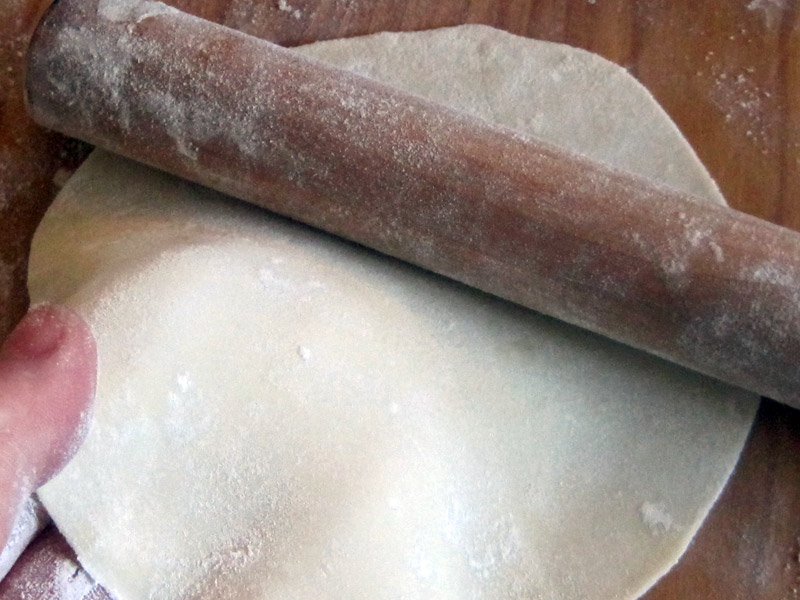
4. Shape the rested dough — it should be as soft as an earlobe — into a rope 24 inches long and cut the rope into 24 one-inch pieces. Roll each piece into a small ball and dust it lightly with some flour. Cover the balls with a clean tea towel as you go. Working on one piece at a time, flatten a ball on a lightly floured board with your palm to form an even circle about 2 inches in diameter. Then (if you are right-handed), hold this circle near the center between the thumb and forefinger of your left hand while you wield a Chinese rolling pin (which is like an inch-thick, 12-inch dowel) with your right hand. Roll the circle out gently and evenly, pressing down in the center of the circle with the rolling pin and rolling in and out 2 times before turning the dough 45 degrees. Keep rolling and turning the dough this way to form a circle 5 inches in diameter. The wrapper should be smooth, elastic, and even. Lightly dust it with some flour and cover it with the towel. Repeat with the rest of the dough until you have 24 wrappers.
5. Now, wrap the potstickers one at a time by placing a wrapper flat on your left hand while smearing one of the meatballs down the center to form an even layer of meat about ¾ of an inch wide. Wet the edges of the wrapper with some cool water and pinch the edges together, leaving a ¾-inch opening at both ends. Lightly crimp the edges in a wavy pattern, if you like. Cover the filled potsticker with a tea towel and repeat with the rest of the wrappers and filling until all are filled. (The potstickers can be frozen at this point in a single layer on a baking sheet lined with plastic wrap. Place them in a freezer bag once they are hard. They can be used without defrosting — either steamed as directed in Step 6 or pan-fried as in the directions below for regular potstickers.)
6. Prepare a two-layer bamboo or (preferably) stainless steel steamer by spraying the bottom with oil and bring the water underneath it to a boil. Place the potstickers inside the steamer baskets so that they do not touch each other and steam the potstickers until done, about 7 minutes. Remove the potstickers from the steamer. (The potstickers can be prepared ahead of time up to this point and then reheated in Step 7 right before serving.)
7. Fry the potstickers just before serving: Heat a flat-bottomed frying pan (preferably nonstick) over medium heat until the edges of the pan are very hot. Depending upon the size of the pan, pour in some oil (about 1½ tablespoons per potsticker) and swirl it around. Arrange as many potstickers in the pan as will fit without squeezing, but they should touch each other. Then, pour the lace batter (about ½ tablespoon per potsticker) into the pan; immediately start swirling the pan around nonstop so that the batter forms a thin layer all around and between the potstickers. Once the lace has formed, loosen the edges of the lace with a thin spatula and turn the potstickers out upside-down onto a serving plate. Repeat with the rest of the potstickers, oil, and batter until done. Serve immediately with a dipping sauce of your choice (see Tips).
Regular potstickers: You can make regular potstickers easily with this recipe: just omit the lace and the steaming. Instead, pour some oil (about 1½ tablespoons per potsticker) into a hot, flat frying pan sitting over medium heat. Arrange as many potstickers in the pan as will fit without squeezing, but they should touch each other. Then, pour filtered water (again, about 1½ tablespoons per potsticker) into the pan and immediately cover it with a tight-fitting lid. Fry-steam the potstickers for around 5 minutes, or until you can hear by the popping oil that the water has been absorbed. Remove the lid and continue to fry the potstickers until their bottoms are a golden, crispy brown. Loosen them with a thin spatula and turn them out onto a serving plate with the brown bottoms on top. Serve hot.
Tips
— Regular Korean flour works best here, as it has the right amount of gluten to make soft, supple wrappers with good texture.
— Wheat starch is available in Chinese grocery stores in the flour aisle under the name 澄粉chéngfěn.
— Mushroom powder is optional, but it adds a nice layer of seasoning.
— I buy organic white shortening by Spectrum that is non-hydrogenated, and so much healthier. It’s a good substitute for lard because it doesn’t taste of butter.
Top photo: Lacy Tianjin potstickers. Credit: Carolyn Phillips
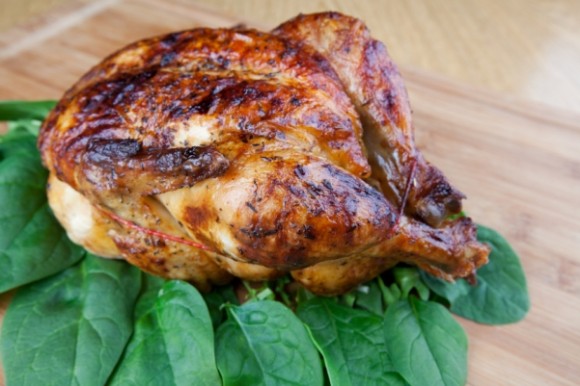
One thing foodies never do is buy any of those pre-roasted chickens from the hot display at the supermarket. Never, never, never! (Well, just that once, I swear it!)
They’re definitely pre-fab food, but you can easily doctor them. In fact, medieval recipes often called for chicken to be roasted or baked and then stewed in a sauce. The first stage browned the meat desirably while the stewing stage was a necessity, because before the 20th century most chickens were tough old hens past their egg-laying days who needed a good course of moist heat to become tender.
More stories from Zester Daily:
» The secret to medieval eggplant
» Chicken and quince in medieval Baghdad
» Chinese-Arab fusion food from the Middle Ages
It’s actually hard to find an elderly stewing hen these days, so we have to make do anyway. I say why not accept a compromise with the times and let the supermarket do part of the work? The pre-roasted chickens are generally what used to be considered frying size (often far smaller than any chickens you can find in the butcher section) so they’re naturally tender and don’t really need any stewing at all. You only need to make the sauce part of the recipe and warm the chicken up in it.
A royal recipe with pre-roasted chickens
So here’s a quick, 21st-century way of making Chekyns in Musc, from “Ancient Cookery,” a collection of 14th- and 15th- century royal recipes written down during the reigns of various English monarchs beginning with Edward III.
Inevitably, earlier stages of a language look quaint and rustic. This recipe begins, “Take smale chekyns and make hom clene, and choppe hom, and do hom in a pot, and put therto gode brothe of fressh flesh and wyn, and let hom seethe.” Among the flavorings you should “do therto” were “raisynges of corance” and “zolkes (sic) of raw eggus,” and finally you were supposed to boil everything “togedur” and “serve hit forthe.”
It may look bizarre on the page, but this was a royal recipe, and it aimed at the sophisticated effect of its time: rich and sweet-sour, with an intoxicating jumble of aromas. I presume “musc” was musk, and perhaps there is something musky about the combination of sage, clove, mace, saffron and raisins.
The recipe actually calls for currants. These are the “raisynges of corance,” that is, raisins of Corinth, called for in the recipe. But currants are hard to find outside the holiday season, when they get enough play for the rest of the year in mincemeat and fruitcake. If you can find them, currants are actually nicer than raisins for this dish, but the difference is not huge. Personally, I would toast the pine nuts because I happen to find raw pine nuts insipid, while toasted pine nuts are everything popcorn promised but didn’t deliver.
The recipe calls for verjuice (verjus), which is sour grape juice. You can sometimes find it in import stores, particularly Middle Eastern ones. In Arabic it’s called ‘asir hisrim and in Farsi it’s ab ghureh. You can substitute lemon juice. In fact, the Italians have done so quite systematically, as their medieval word for verjuice, agresto, is now just a term for lemon juice.
Anyway, this is a fine cool-weather dish for two people, or one medieval-style glutton.
Chekyns in Musc
Serves 2 to 3
Ingredients
1 (1½- to 2-pound) chicken, roasted or baked
½ cup strong chicken stock or 1 teaspoon chicken concentrate mixed with ½ cup water
1 cup white wine
6-8 leaves fresh sage
2 tablespoons minced parsley
1 clove, freshly ground
¼ teaspoon mace, freshly ground
¼ cup pine nuts
½ cup currants or raisins
10 threads saffron, ground
2 egg yolks
Salt and pepper to taste
1 tablespoon verjuice or lemon juice
Directions
1. If the chicken is not already separated, divide it into drumsticks, thighs, wings and breast. Dismantle the breast into 6 to 8 pieces. Remove the skin and the bones if you like.
2. Put the stock and wine in a saucepan and boil until the smell of alcohol goes away. Reduce the heat to a simmer, add the sage, parsley clove, mace, pine nuts, currants and saffron and cook until the currants are plumped, 5 minutes. Add the chicken parts and heat through.
3. Remove the chicken parts. Beat the egg yolks with 1 or 2 tablespoons of hot cooking liquid, then stir the eggs into sauce to thicken it. There will not be much sauce. Taste and add salt and pepper if needed. Stir in the verjuice or lemon juice, add the chicken parts and warm up again before serving.
Pre-roasted chicken. Credit: iStockphoto

Jan. 25 is Burns Night, as anyone with even the most tenuous connection with the land of haggis and whisky (no “e” in Scottish whisky) will scarcely need reminding.
There’s nothing mysterious about the great chieftain o’ the pudding race: The haggis is really just a large fat sausage prepared by thrifty Highland housewives to stock the store cupboard through the winter. The main ingredients are those widely available in the region: mutton and oatmeal. Just the same, liver and lights stuffed into a sheep’s stomach with onions and porridge might not be everyone’s idea of a dainty dinner, but when properly prepared and well-seasoned with pepper and thyme, it’s surprisingly delicious.
Robert Burns, poet of beauty and romance, would have been surprised by the manly shenanigans attached to his annual birthday celebration. As for the tartan dress code, I have it on good authority that those who fought the Battle of Culloden wore khaki-colored blankets round their nether parts, preserving modesty with a leather strap. Chilly but practical.
No Burns Night complete without haggis
No matter. The shenanigans are here to stay, and there’s no reason to let authenticity spoil the fun. The only essential is the haggis (and the whisky of course). To stuff your own, full instruction can be found in F. Marian McNeill’s “The Scots Kitchen” (Edinburgh, 1929), including emptying out the lungs by hanging the windpipe over the edge of the boiling pot and letting it drain. Much of Ms. McNeill’s more esoteric information is credited to Mistress Meg Dodds’ “The Cook and Housewife’s Manual” (Edinburgh, 1826). Mistress Meg is feisty fictional landlady of the Cleikum Inn in Sir Walter Scott’s novel “St. Ronan’s Well”; the author is really Edinburgh housewife Isabella Johnston and a close friend of Sir Walter Scott.
Confused? That’ll be the whisky.
Far better to save your energies for reciting poetry and get your haggis from the butcher, and so much better if it comes in natural casing — ox bung these days, I’m told. Trenching the gushing entrails through a plastic bag doesn’t really cut the mustard.
How to heat a haggis
A ready-made haggis is already fully cooked but needs careful reheating. To serve four natives or six sassenachs (anyone not born and bred in Scotland), you’ll need a 2-pound (1 kilogram) haggis. Allow the haggis to come up to room temperature, then place it gently in a roomy pot of boiling water. Return the water gently to a boil, allowing a single belch, and then cover it loosely and turn the heat right down till the water is barely trembling. Leave to simmer for half an hour then give it a squeeze — when it’s ready it’ll feel squidgy and hot. You can also wrap it securely in foil and heat for 30 to 40 minutes in a oven heated to 250 F (150 C or Gas 2).
The larger the haggis the longer it needs to heat. Once hot (and unpunctured) it can be held in simmering water for at least an hour. Accompany with clapshot — mashed potato and swede in equal volumes — or serve the two vegetables separately as neeps and tatties. On no account waste good whisky by pouring it over the haggis, whatever anyone says. Just smile politely and drink it yourself.
Pan haggis
If your butcher has failed in his duty, a haggis mix can be cooked in a pan in much same way as a risotto. The pinhead oatmeal is important — it won’t work with ground or porridge oats. If you can’t find pinhead, give whole-grain oats a quick whiz in a spice grinder — don’t crush to a powder, you’re aiming for pinheads.
Serves 4 to 6
Ingredients:
1 pound (500 grams) lamb’s liver or heart
3 cups (1 liter) water
1 pound (500 grams) onions, quartered
Salt to taste and plenty of freshly ground white pepper
4 ounces (100 grams) pinhead oatmeal
4 ounces (150 grams) grated suet (kidney fat, ask the butcher)
1 tablespoon dried thyme
Directions:
1. Tidy up the meat — liver or heart — by removing visible tubes or veins. Rinse and pat dry.
2. Place the whole piece in a roomy pan with 3 cups (1 liter) of water and quartered onions. Season with salt and pepper, heat gently and simmer, loosely covered, for 30 to 40 minutes, until perfectly firm.
3. Meanwhile, toast the oatmeal in a low oven until lightly browned or stir over gentle heat in a heavy pan.
4. Remove the meat from the broth with a draining spoon, discarding the onion and reserving the liquid. Grate the meat and remaining onions through the large holes of a grater, or pulse in the processor. Stir the grated meat and onion with the toasted oatmeal, suet, thyme, salt and pepper.
5. Now you have a choice: You can either pack the mixture into a bowl (it should come about a third of the way up), moisten it with 2 cups of the reserved stock and cover the bowl with a cloth tied on with string, with the ends knotted over to give a handle (or cover with foil). Place the bowl on an upturned saucer in a roomy saucepan, add enough boiling water to come two-thirds of the way up, lid the pan and leave it to simmer for 2 hours. Check and add more boiling water as necessary. Alternately, you can cook the mixture in a heavy saucepan, adding hot stock and stirring throughout as you would a risotto.
6. Serve with clapshot.
Top photo: Haggis and whisky, the staples of any Burns Night supper. Credit: Elisabeth Luard
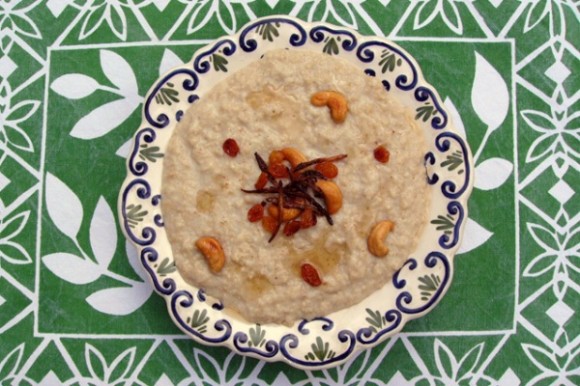
The cooking of Kerala Muslims owes as much to the Yemeni Arab traders as it does to the culinary traditions of its native Kerala, India. Consider alissa, a wholesome wheat and meat porridge, hand-rolled wafer-thin ari pathiri (rice bread), or muttamala served over pinnanathappam, (delicate thin strings of egg yolks cooked in sugar syrup served over steam-cooked cardamom-scented egg white pudding).
Centuries before Mahmud of Ghazni attacked northern India in A.D. 1000, the southwestern coastal region of the Indian Ocean between India, the Persian Gulf and East Africa was an area of active commercial exchange. People along these coasts excelled in maritime trade with distant lands, and by the early Christian period South India was transformed into a commercial hub linking the West and the East through coastal and inland routes. A flourishing spice trade between southwestern India and the Arabs of coastal Yemen and Oman flourished.
More about Kerala on Zester Daily:
Arab traders left their shores in July, at the height of the southwestern monsoon season, to go to Kerala, the heart of the pepper country. They returned carrying their precious cargo of many spices as the northwest monsoons arrived in November.
When the relentless monsoons prompted several Arab merchants to stay back until favorable travel weather returned, many settled down and married local women. The alliance was solemnized with the payment of a token bride price, and the local brides and their children were initiated into Islam. Muslims of Kerala, known as Mappilas, account for nearly a quarter of the state’s population.
Creative fusion
Influenced by the culinary traditions of traders from the Persian Gulf and leaning heavily on the Kerala spice combinations, Mappila cuisine is known for its distinct taste. It is unlike the Muslim-influenced, rich Mughlai cuisine of North India. In Mappila cuisine, rice, coconut, coconut milk and coconut oil are liberally used. Black pepper is a predominant spice, followed by cinnamon, cloves and cardamom. Rice is the staple grain of Kerala. But because their Arab husbands preferred bread, the ingenious Mappila women created breads made with rice — pathiri.
More than any other Mappila dish, alissa is most strongly rooted to Arab cuisine. Unlike any other Kerala preparation, its main ingredient is wheat and traditionally cinnamon is the only spice used.
This thick porridge is made with wheat from which bran is removed along with meat or chicken. The dish is garnished with thinly sliced shallots, raisins and cashews fried in ghee. It is one of the dishes served as a starter before ghee rice or biryani at north Kerala Muslim weddings.
Many variations around the world
Alissa is quite similar to harisa, a recipe preserved over centuries by the people of the Middle East. Recipes for this dish are found in 10th-century Baghdadi cookbook “Annals of the Caliph’s Kitchen,” “Sufi Cuisine” and the Iraqi cookbook “Delights from the Garden of Eden.”
It was called hareesa in medieval Baghdad, and it’s called herise in many parts of Turkey, where it is served at weddings. In Lebanon, hreessey is a comfort food in the villages when the weather turns cold. Various versions of this porridge made with wheat, barley or semolina were prevalent wherever Arab traders traveled, from Morocco to Muslim Andalusia.
“From the 7th century until today, harisa was a kind of porridge made from pounded wheat, butter, meat, and spices” writes Clifford A.Wright in his article “Gruel, Porridge, and the ‘First Foods’ of Tunisia.” As they break the fast during Ramadan in the Middle East, there are certain dishes that are always served, h’riss being one of them. In her article “Breaking the Fast” in Saveur, Anissa Helou writes: “This deeply satisfying dish of spiced meat and creamy wheat berries is most often made with lamb, but it’s particularly delicious when made with chicken. The version we ate was drizzled with ghee blended with bzar, which gave the h’riss a warm, toasty flavor.”
And harisa of the Middle East became alissa in Kerala. A more elaborate version, called haleem, is popular in north India.
Alissa
The following recipe for alissa is adapted from Malabar Muslim cookery by Ummi Abdulla.
For the alissa:
1½ cups skinless wheat
1 large onion cut into slices
Salt to taste
2 pounds of chicken or mutton cut into pieces
1½ inch piece of cinnamon stick
For the garnish:
2 tablespoons ghee, plus extra for serving
½ shallot thinly sliced
1 tablespoon raisins
8 to 10 cashew nuts
Directions
1. Soak wheat in water for an hour and drain.
2. In a stock pot, combine wheat, chicken or mutton, sliced onion, cinnamon and salt along with 10 to 12 cups water and bring to a boil. Reduce heat to medium and cook until the wheat is very tender and broken down.
3. Remove from the stove and mash well until it reaches porridge-like consistency.
4. Heat ghee in a small skillet and add cashews. As the cashews begin to change color, add the raisins. Toast until cashews are golden brown and raisins have plumped up. Remove the fried cashews and raisins from the skillet and set aside.
5. In the same ghee, fry shallot slices until golden. Combine with fried nuts and raisins.
To serve, ladle alissa into serving bowls and top with fried onions, raisins and cashews. Drizzle more ghee over the top and serve hot.
Photo: Alissa. Credit: R.V. Ramachandran
Although everyone in my family loves crown roast of pork, and baked ham, and everything else one is suppose to eat at Christmas, we do have a go-to menu every year simply because after many discussions we can never decide and we’re all too exhausted from Thanksgiving anyway. And this is no time to experiment. So we opt for a delicious but simple classic prime rib for Christmas dinner with Yorkshire pudding and creamed spinach. Appetizers, punches, desserts and guests may change every year, but these three dishes get made over and over again and we never regret it.
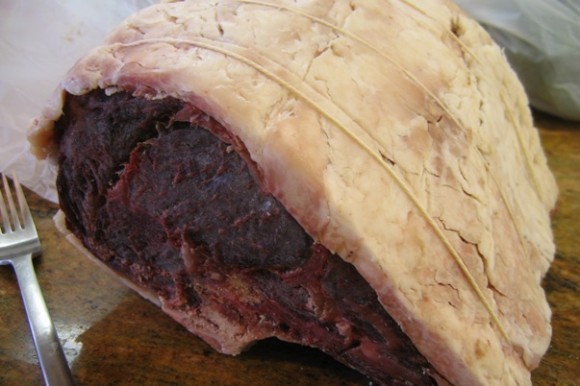
A prime standing rib roast is a given. It’s very expensive, but well worth the splurge, and you don’t have to do a thing to it. If prime rib is prohibitively expensive, you can always use USDA choice rib, which is what you’re likely to be offered in the supermarket anyway.
Also from our contributors:
Traditional Christmas in Provence
Remember that one rib feeds two people, so a three-rib standing rib roast will feed six or seven people generously. Ask the butcher for a standing rib roast cut from the loin end and not the fattier shoulder end. Ask them to “French” the roast, which means to cut the fat away from one end of the rib bone to expose it.
Prime rib should always be cooked rare to medium rare. If you cook it beyond this point you are destroying the reason you bought such a tender — and expensive — piece of meat in the first place. If you like beef cooked medium to well then buy the appropriate kind of cut, which will benefit from longer cooking, such as round or chuck steak.
Prime Rib Roast With Horseradish Sauce
Serves 6-8
For the roast:
One 3-rib (7- to 8-pound) prime or choice standing rib roast
Directions
1. Preheat the oven to 325 F.
2. Place the roast, fat side up, in a roasting pan in the middle of the oven. Check the roast after 30 minutes to make sure things look OK. Baste the ends with the accumulated juices. Once the internal temperature reaches 110 F, after about an hour, you need to be very attentive as the cooking can quickly finish. At some point remove ½ cup pan drippings for the Yorkshire pudding. Test the rib’s doneness by putting an instant-read thermometer into the meat (not touching a bone) in two places, leaving it there for 15 seconds. It should be 120 F. Immediately remove the roast from the oven.
3. Remove the roast to a carving platter and let rest 20 minutes. Serve with horseradish sauce.
For the horseradish sauce:
This is the simplest way to do it, the traditional accompaniment to prime rib.
5 tablespoons bottled horseradish
2 tablespoons Dijon mustard
1½ cups whipped cream
½ teaspoon white wine vinegar
Salt and freshly ground white pepper to taste
In a bowl, vigorously stir together all the ingredients.
Creamed spinach. Credit: Clifford A. Wright
Creamed Spinach
Serves 6
4 pounds fresh spinach, heaviest stems removed, washed well
3 tablespoons unsalted butter
3 tablespoons all-purpose flour
¾ cup heavy cream
¾ cup milk
1 large garlic clove, very finely chopped
Salt and freshly ground white pepper to taste
Pinch of nutmeg
Directions
1. Put the spinach leaves in a large pot with only the water adhering to them from their last rinsing, then cook, covered, over high heat until the leaves begin to wilt, about 4 minutes, stirring occasionally. Drain very well in a colander, pressing out the liquid with the back of a wooden spoon, saving 1 cup of the spinach water you press out. Finely chop the spinach using a mezzaluna or a chef’s knife.
2. In a saucepan, melt the butter over medium heat, then stir in the flour to form a roux, cooking for 2 minutes while stirring constantly. Reduce the heat to low and slowly add the cream and milk. Whisk until smooth, then add the garlic, salt, and pepper and cook for 5 minutes. As it thickens add some of the reserved spinach water and stir and continue cooking until it is like a very thick pancake batter.
3. Add the spinach, stir, and cook until it is heated through, about 2 minutes. Add the nutmeg, stir, correct the seasoning and serve.
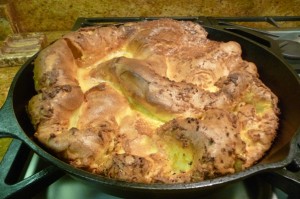
Yorkshire pudding. Credit: Clifford A. Wright
Yorkshire Pudding
Serves 6
Ingredients
1½ cups whole milk, at room temperature
3 large eggs, at room temperature
1 teaspoon salt
½ cups all-purpose flour
½ cup reserved prime rib roast pan-drippings
Directions
1. In a blender, blend the milk, eggs and salt for 15 seconds. With the blender running add the flour, a little at a time and blend the mixture at high speed for 2 minutes. Let the batter stand at room temperature, in the blender, covered, for 3 hours.
2. Preheat the oven to 450 F.
3. In a 12-inch cast iron skillet, heat the reserved pan drippings in the oven for 8 to 10 minutes, or until it is just smoking. Blend the batter at high speed for 10 seconds and pour it into the skillet.
4. Bake the pudding in the middle of the oven for 20 minutes, reduce the heat to 350 F and bake the pudding 10 minutes more or until the top is all puffed up and a deep golden brown. Transfer the pudding to a platter and serve immediately.
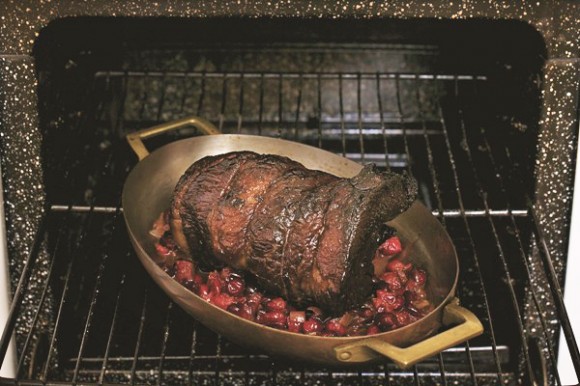
Photo: Prime rib. Credit: Clifford A. Wright
If you’re thinking of serving beef this Christmas or New Year’s, you’re probably counting your quarters to see if you can afford a tenderloin or prime rib. Like many people looking for good beef cuts for holiday roasts, you might think that these are the only options. That’s certainly what anyone would assume after shopping the supermarket meat counter or reading the circulars.
Truth be told, there are many more succulent beef cuts for roasting. I discovered this while researching my cookbook “Pure Beef.” Through my recipe testing with an eye toward tenderness, flavor and value, I found many excellent roasts that are overlooked or undervalued, especially those from the sirloin (hip), round (upper leg) and even the chuck (shoulder).
Along with a variety of cuts to choose from, you can now also select the type of beef you buy and serve this holiday. The three main categories to know are natural, organic and grass-fed. Natural brands are generally hormone- and antibiotic-free. Organic meats are raised and processed in accordance with strict USDA organic standards, including feed and animal welfare. Grass-fed beef is growing in popularity due to its higher levels of Omega 3, CLA and other healthy fats and nutrients compared to beef from cattle raised in feedlots.
More stories from Zester Daily:
» Homegrown Wagyu brings the best Japanese beef to the U.S.
» How about Tuscan-style roast pork loin?
After you select your roast cut and type, the only tool you’ll need for stress-free roasting is a reliable instant-read thermometer. There are many styles on the market, and I recommend a digital one from the mid-price range. A modest investment in a good thermometer will safeguard overcooking your roast.
For each roast on my list, I’ve included a general time-frame for cooking, but this will vary depending on your oven, the size and shape of the roast, and other factors. So let the thermometer be your guide. Then let the roast rest (it will continue to rise in temperature from 5 to 10 degrees) while you finish your dinner preparations. To serve these roasts, slice them ¼-inch thick against the grain using a sharp carving knife to preserve all the meat juices.
The very best part of roasting is that once the meat is simply seasoned with salt and pepper and in the oven, you are free to mingle and enjoy the occasion. The roast itself is the centerpiece of your holiday table, and it will bring you the gift of leftovers to enjoy in the days to follow.
My cut list
The roasts on my holiday list are a fraction of the cost of the luxurious tenderloin and prime rib. They are also widely available, but you may need to put in a request to the butcher wherever you buy your beef.
Most tender roast (after tenderloin): top blade roast
This cut is the second most tender cut on the entire beef carcass, but it comes from the chuck (shoulder), which is one of the toughest parts. Request a whole top blade roast, which is suitable for high-heat roasting (450 to 500 F). Plan to roast if for about 8 to 10 minutes per pound until an instant-read thermometer reaches 120 F for rare, 125 F for medium-rare or 130 F for medium.
Most flavorful roast: top sirloin roast
Also known as American chateaubriand, this cut from the top sirloin butt muscle of the hip is renowned for its deep beef flavors, just like sirloin steaks are. Request a center cut portion to roast at high heat (450 to 500 F) for about 8 to 10 minutes per pound until an instant-read thermometer reaches 120 degrees F for rare, 125 F for medium-rare or 130 F for medium.
Most undervalued roast: top round roast
Butchers prize this cut from the round (leg) for its flavor and versatility. This ultra-lean cut is best cooked at medium heat (300 to 350 F) for maximum tenderness and juiciness. Roast it for roughly 18 to 20 minutes per pound until an instant-read thermometer reaches 120 degrees F for rare, 125 degrees F for medium-rare or 130 F for medium.
Most unfamiliar roast: sirloin tip roast
Not to be confused with tri-tip, sirloin tip roast is cut from where the sirloin (hip) and round (leg) meet. It is very lean with fairly tender. Roast it at medium heat (300 to 350 F) roughly 18 to 20 minutes per pound until an instant-read thermometer reaches 120 F for rare, 125 F for medium-rare or 130 F for medium.
Most unexpected roast: beef brisket
The wild card in this list, beef brisket is typically smoked but it can also be roasted at very low temperatures (200 to 250 F) for one to two hours per pound until it registers 185 degrees F on an instant-read thermometer or you can shred it easily with a fork. This versatile cut can also be made into a roast using a combination of high-heat roasting and braising, or pot roasting, as in the recipe for rolled cranberry-glazed beef brisket.
Rolled Cranberry-Glazed Beef Brisket
This recipe transforms a standard beef brisket into a festive garnet-glazed roast worthy of a holiday celebration. The flat cut is the leaner, thinner part of a whole brisket. The technique of rolling and tying allows you to serve handsome round slices of the brisket with sides of butternut squash and wild rice.
Serves 6 with leftovers
Ingredients
1 (3½- to 4-pound) flat cut brisket
Kosher salt
1 (12-ounce) bag fresh or frozen cranberries
1 medium onion, chopped
¾ cup packed light brown sugar
1 teaspoon ground ginger
½ teaspoon black pepper
¼ teaspoon ground cloves
1 cup low-sodium beef stock or water
1 cup orange juice
1 bay leaf
Directions
1. Preheat the oven to 500 F. Cut 5 (14-inch) strands of butcher’s twine on hand. Trim any fat from the underside of the brisket, pat it dry, and season it liberally on both sides with the kosher salt. Roll it up tightly the long way with the fat on the outside and tie it with the butcher’s twine. Put the roast in a Dutch oven or other deep and heavy pot just large enough to contain it. Roast it uncovered in the hot oven until dark walnut brown, about 20 minutes.
2. Meanwhile, mix the cranberries, onion, brown sugar, ginger, pepper, cloves, stock, orange juice and bay leaf in a medium saucepan and bring it to a boil over medium-high heat.
3. Reduce the oven temperature to 325 F and pour the cranberry mixture over the beef. Cover the pot and cook the beef until you can shred the meat easily with a fork, 2 to 2½ hours.
4. Raise the oven temperature to 400 F. Transfer the beef to a clean oven-safe serving dish and remove the twine or bands. Strain the sauce, reserving the cranberry mixture and pour the sauce over the beef.
5. Discard the bay leaf. Roast the beef uncovered in the oven until it forms a shiny glaze and the sauce is syrupy, 12 to 15 minutes. Slice the beef ½-inch thick and spoon the cranberries all around it before serving.
Recipe reprinted with permission from “Pure Beef: An Essential Guide to Artisan Meat with Recipes for Every Cut” © 2012 by Lynne Curry, Running Press, a member of the Perseus Book Group.
Holiday roast. Credit: David L. Reamer
Alsace, on the eastern edge of France, has plenty of robust, rib-sticking, flavor-packed dishes that are just right for winter days. Uncomplicated to prepare and good-natured in the cooking, they provide the perfect rescue remedy for the harassed holiday cook. Baeckeoffe, a one-pot meal that combines pork, beef, lamb and vegetables marinated in the region’s famously fragrant white wine, is one of the best.
The name of this traditional Alsatian specialty refers to both the bakery (baecke) and the oven (offe). In former times, ovens in private homes were an undreamed-of luxury — not to mention an unwelcome fire hazard. Small, simple dishes were cooked in a pan on the top of the stove, but larger items requiring all-round heat were prepped at home, then taken round to the village baker’s to be cooked in the wood-fired oven after the bread had its turn.
Origins of Baeckeoffe up for debate
The story most commonly related is that Baeckeoffe was a Monday morning wash-day dish, outsourced to the village baker so the housewife-cook could get on with the household chores. But this seems an unlikely story. (Monday lunch would surely be an occasion for recycling the remains of a Sunday lunch feast — leftover choucroute and bacon or ham for a choucroute quiche, for example.)
More from Zester Daily on Alsatian cuisine:
Picture the scene, in a small, cozy, wood-paneled inn somewhere on the Route des Vins. The tables are decked with rich red-patterned tablecloths decorated with vine leaf motifs. On the sideboard is a collection of classic, decorated pottery terrines and Baeckeoffe dishes. Napkins are unfurled, orders are taken and a small jug of refreshing Sylvaner or Pinot Blanc is brought to sharpen the appetite and ease the pain of waiting.
In due course, the stout chef-patron, clad in his whites, emerges backward through the swinging doors, swirls around in a neat pirouette and sets the immense decorated pottery dish down on the table with a satisfying thud. Carefully he chips and pries away at the band of dough that seals the gap between lid and dish. The whole table leans forward in eager anticipation, the lid comes off and there’s a collective intake of breath as some of the finest flavors and fragrances of Alsace are released: pork, lamb, beef, root vegetables, juniper berries and Riesling, all marinated together for days and baked to a state of gentle perfection.
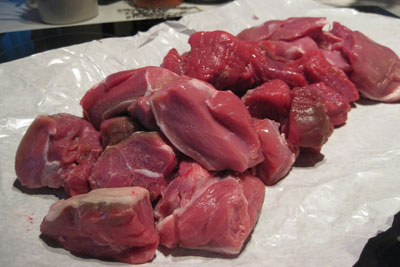
Baeckeoffe
This is a perfect dish for the holidays, which you can time to your convenience. It benefits from 1 to 3 days’ marinating, and then it needs several hours left to its own devices in the oven. Choose a fatty cut of pork, like neck, which will stay nice and moist, and cut all the meat in quite large pieces so they don’t dry out in the long, slow cooking. Any Alsace Riesling will do as long as it’s a dry one and preferably not outrageously expensive — an entry-level wine from one of the grand domaines like Trimbach, Hugel or Beyer would be perfect. (Keep the expensive one for drinking with the meal.) The ideal container is a large, lidded ovenproof ceramic pot. When you’ve assembled the dish and put it in the oven, you can set out for a long walk to work up an appetite. On your return the kitchen will be filled with wondrous aromas of Alsace. Serve the Baeckeoffe with green salad and plenty of bread to mop up the (unthickened) juices. Any leftovers can be reheated.
Serves 6 hungry people
Ingredients
For the marinade:
1 clove garlic, finely chopped
1 large carrot, finely chopped
1 medium onion, finely chopped
1 tablespoon juniper berries
6 cloves
6 bay leaves, crumbled
2 generous pinches mixed dried herbs
1 bottle dry Alsace Riesling (or other dry white wine)
For the Baeckoffe:
1 pound (500 grams) boneless neck pork
1 pound (500 grams) boneless shoulder of lamb
1 pound (500 grams) boneless stewing beef (skirt, for example)
3 to 4 pounds (1½ to 2 kilograms) firm, waxy potatoes, peeled and thickly sliced
2 large carrots, diced
2 medium onions, finely chopped
4 cloves garlic, finely chopped
1 leek, finely diced
Salt and pepper
1 tablespoon butter, cut in small dice
Directions
1. Prepare the marinade by combining in a bowl the chopped garlic, carrot, onion, juniper berries, cloves, bay leaves, herbs and wine.
2. Cut the meat in fairly large pieces and put them in a bowl with the marinade.
3. Cover the bowl and refrigerate for at least 12 hours and up to three days.
4. Tip the meat into a colander placed over a second bowl, drain the meat and reserve the marinade.
5. Lightly butter a large, deep ovenproof dish with a well-fitting lid. [Mine is oval, measuring 14 inches by 9 inches by 4 inches deep (36 centimeters by 23 centimeters by 10 centimeters deep) with a 24-cup (6-liter) capacity.]
6. Place a thick layer of potatoes in the bottom of the dish, then follow with successive layers of meat and the remaining vegetables (carrots, onions, garlic and leek), seasoning with salt and pepper as you go and finishing with a thick layer of potatoes.
7. Pour on the reserved marinade. It should come about three-quarters of the way up the meat and vegetables. If not, add a little water.
8. Scatter the diced butter on top of the potatoes and cover the dish with a double thickness of foil and the lid.
9. Bake in an oven at 300 F (150 C) for about two hours or until the meat is fork tender. (Fish out a piece and taste it to check, then prolong the cooking if necessary.)
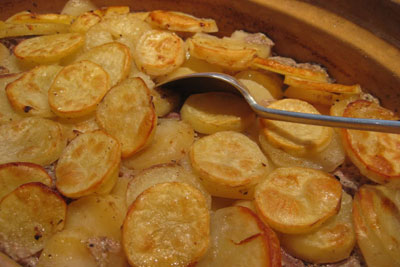
10. Remove the lid from the Baeckeoffe and bake uncovered for another 30 minutes or so, or until the potatoes on top are nicely browned
Photo: Alsatian Baeckeoffe ready for serving. Credit: Sue Style