Articles in Environment

As the farmers market season gets under way in the U.S., more shoppers than ever will be supporting local growers and producers. (According to a 2010 Department of Agriculture survey, at least 6,132 markets exist nationally, a 16 percent increase from 2009). While there has never been a more popular time for extolling the nutritional and culinary value of local food in the mainstream media, not everyone is convinced of the economic benefits of local food systems.
In a widely circulated article earlier this year, economists Jayson Lusk and F. Bailey Norwood argue that local food is a poor economic model and liken it to a fad diet that destroys community wealth. They emphasize that local food is more expensive than non-local and suggest that government policies and programs (such as those supporting Farm to School) should not encourage widespread purchasing of local food. But their argument misses the mark regarding both costs and benefits.
The Cost of Local
There are three important things to keep in mind when we consider costs. First, early research suggests that many locally grown items at farmers markets — even organic items! — are comparable to or even less expensive than those same items (which may not be locally grown) in conventional grocery stores. Researchers from Bard College and the Northeast Organic Farming Association released a report on this issue in 2011 and the Leopold Center for Sustainable Agriculture conducted a similar study in Iowa in 2009.
Second, one of the biggest challenges — and therefore opportunities — in our broken food system is the loss of processing and distribution infrastructure. The lack of slaughterhouses has received a fair bit of recent press, but canneries, warehouses and cutting shops also have shut their doors over the years. With fewer options for getting their products to market, small and mid-sized farmers and ranchers have taken on many of the post-production expenses themselves, and some of these costs are passed down to the consumer.
The good news is that organizations such as Boston’s Red Tomato, Farm Fresh Rhode Island and Detroit Eastern Market are addressing this gap in infrastructure by working as food hubs to aggregate, market and distribute locally produced food. Their efforts free up time, labor and cost for the farmers, while streamlining the distribution of local food to consumers and institutions such as schools, restaurants, hospitals and even grocery stores.
The third point when considering the advantages of local food is that innovative programs to help low-income consumers afford locally grown products are springing up across the country. Michigan’s Double Up Food Bucks program provides families receiving SNAP (food assistance) benefits the opportunity to double their food budget dollars if they purchase locally grown fruits and vegetables at area farmers markets. Other cities around the country are following suit — this kind of project is a perfect example of one that benefits consumers and growers alike, lowering the cost of produce while ensuring a fair income for farmers.
The Economic Benefits of Local
Those who focus solely on the cost of local food ignore a major benefit of local food economies: the multiplier effect. This term refers to the economic phenomenon of initial spending (by the government or individuals) leading to increased consumer spending in a community, resulting in greater income for that community. Studies show that the multiplier effect of a locally owned business is two or three times higher than that of a non-local business.
Consider this: When you buy a non-local head of lettuce or piece of fruit in a national chain supermarket, the majority of that dollar goes to the corporation that owns the store. When you buy that head of lettuce at a farmers market, the farmer takes home 100 percent of that dollar. Of course, farmers have expenses too, but one of the reasons for an increased multiplier is that local owners tend to spend more on local employees, who in turn spend their money with area merchants, who tend to provide greater support for local organizations and activities.
When we talk about “buying local food,” we are not just talking about supporting our farmers; in fact, the economic health of our communities is at stake. Economist Michael Shuman determined that shifting just 20 percent of food spending in the city of Detroit would result in a boost of nearly half a billion dollars, including more than 4,700 new jobs and an additional $20 million in business taxes to the city each year. In today’s economic climate, we cannot afford to ignore the power of the local food economy.
Beyond the Farmers Market
So what can you do to support local food economies? The farmers market is a great place to start, but we need to advocate for local food in our stores, schools, restaurants, hospitals and government offices. We need to harness the purchasing power of these institutions as drivers of local economic development.
Another way to make the shift from conscious consumer in your own home to engaged food citizen in your community is to get involved in policy. From local food policy councils to advocating for local and regional food in the upcoming federal Farm Bill, take this opportunity to learn about the issues and the stakeholders involved. The National Sustainable Agriculture Coalition and the Community Food Security Coalition are two organizations with plenty of suggestions for ways to get active in the policy arena. In my book, “Fair Food: Growing a Healthy Sustainable Food System for All,” you will find an extensive list of organizations that are ready to help you deepen your engagement as a fair food citizen.
We should do everything we can to foster local food economies — nothing short of the health and well-being of our communities is at stake.
Oran B. Hesterman is president and CEO of Fair Food Network, a national nonprofit organization working at the intersection of food systems, sustainability and social equality to guarantee access to healthy, fresh and sustainably grown food, especially in underserved communities. He lives in Ann Arbor, Mich.
Photo: Oran B. Hesterman. Credit: Douglas Elbinger
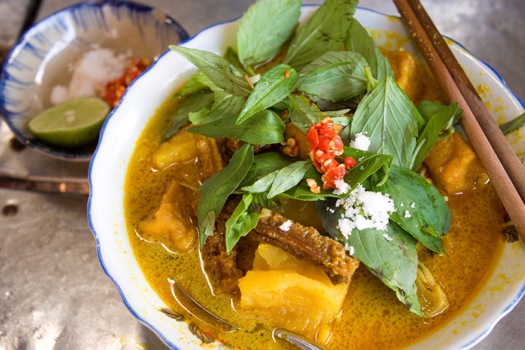
Smoky chicken sate plucked from a grill and dipped in sweet-spicy peanut sauce in a Jakarta alley. Steamed ground rice and jaggery cakes eaten from a banana leaf on a street corner in Penang. A mound of sticky rice drizzled with coconut cream and topped with juicy mango slices spooned up at a stall in a Chiang Mai market. For the Asia-bound traveler keen to know the region’s diverse culinary cultures, these are essential experiences.
In this part of the world the term “street food” (or “hawker food,” as it’s referred to in Malaysia and Singapore) denotes not just a cheap and quick way to fill one’s belly. It also describes a repertoire of dishes prepared by experienced specialists, dishes rarely duplicated successfully in restaurant kitchens. Eating on the Asian street offers the opportunity to observe cooking techniques up close and to engage with strangers over a meal in a way that would be difficult in a proper brick and mortar eatery.
There’s just one problem: Asian street food makes a lot of travelers ill. The World Health Organization has designated the developing countries of Asia as among the most high-risk destinations for “traveler’s diarrhea,” which means that more than 50 percent of visitors to most countries in the region have a chance of getting ill from what they eat.
So what’s the intrepid foodie to do?
Recent studies suggest that travelers who ingest one of two types of prophylaxis prior to and during travel may be able to increase their resistance to food poisoning. Some pro-biotics or “friendly germs” — such as those found in cultured milk products like yogurt — secrete antimicrobial substances that inhibit harmful bacteria. And bismuth subsalicylate or pink bismuth, the active ingredient in popular stomach medications such as Pepto-Bismol, has been shown to decrease the incidence of traveler’s diarrhea when ingested four times daily. But the latter has potential side effects, and pro-biotics doubters point out that our intestines already maintain an equilibrium of beneficial bacteria. “Anything above the equilibrium is likely to just be flushed from your system,” says Wilaiwan Petsophonsakul, a medical researcher at Chiang Mai University in Thailand.
The U.S. Centers for Disease Control and Prevention (CDC) advises avoiding street food altogether, as well as raw or undercooked meat and seafood, cooked foods served at room temperature, raw fruits and vegetables that you haven’t washed and peeled yourself, and beverages made with water or containing ice. That would mean missing out on hundreds of local specialties, including dandan noodles in Sichuan; Malaysia’s strong, milky iced coffee, green papaya and other salads in Thailand; shrimp and herb-stuffed rice paper rolls in Vietnam and curries — which in Southeast Asia are often cooked in the morning and then served at room temperature — just about everywhere.
Eating on the street in Asia isn’t always more dangerous than eating at home. Food safety website Barf Blog chronicles weekly outbreaks of hepatitis A and other food-borne illness in the United States and links to food safety-related news from overseas.
Barf Blog publisher Douglas Powell, a professor of food safety at Kansas State University, advises that the best way to avoid illness –- at home or on the road — is to put yourself in the place of whatever it is that’s going to make you sick in the first place: “Be the bug, whether virus, bacteria, or parasite. Imagine how they get into your food and how they move around.”
Produce is often contaminated at the farm, from human or animal feces, and then carries its bugs to the street stall. Heat kills them. “You shouldn’t eat poop,” is Powell’s blunt advice. “But if you’re going to eat it, make sure it’s cooked.” Street food vendors have a particular challenge because they work in small spaces, facilitating cross-contamination between “clean” and “dirty” foods.
But street stalls also boast an advantage over restaurants: transparency. At a street stall everything is prepared right in front of the consumer, which makes it easier to gauge food safety.
The risks involved in grazing at Asia’s street food smorgasbord are real. But the rewards are great, and if one treads smartly dangers can be minimized. As Powell notes, in the long run, “the biggest risk is not eating at all, or eating too much.”
Tips for smart street eating
- Use your eyes. Refrigeration, temperature control and good personal hygiene on the vendor’s part reduce the likelihood of your contracting a food-borne illness. Does the vendor keep hot foods hot and cold foods cold? Are raw foods kept separate from cooked foods? Does he keep his hands clean? Raw garnishes on cooked dishes aren’t necessarily worrisome, as long as the garnish is kept away from raw meats, for instance.
- Locals get sick, too, and won’t return to stalls suspected of serving unsafe food. When surveying the street food scene in any location, look for crowds.
- Be aware of local meal times. It’s common — and generally safe — to eat curries, stir-fried vegetables and other dishes at room temperature from buffet-style displays in many Asian countries, but you’re asking for trouble by showing up after what’s offered has been picked over. Arrive a bit before meal time, when foods are not long off the burner and before they’ve been attacked and even handled by other customers.
- “There are traditional cooking and food preparation methods that eliminate microbes,” says Powell. Fermented foods, for instance, are generally thought to be safe. Acidic foods (made with vinegar, lime juice and other souring agents) are rarely associated with outbreaks. Dishes such as Indonesian/Malaysian rendang and northern Thai muu kem (salted “confit” pork) are made with techniques that allowed them to be kept for months before the advent of refrigeration. Don’t be taken aback to encounter them served at room temperature.
- Become familiar with spices, such as chilies and turmeric, that are known to have anti-bacterial properties and seek out dishes that include them.
- Exercise extra caution on the street if eating with children younger than 10 years of age who have yet to fully develop an adult’s natural immunities to harmful bacteria. Note that at age 55, adults begin to lose T cells (a group of white blood cells that play a role in immunity) and are thus less able to stave off the effects of ingesting harmful bacteria.
- You needn’t shy completely away from peeled fresh fruit, but those with porous exteriors that grow on the ground (such as cantaloupe) are more prone to contamination prior to and during harvesting. Acidic fruits, such as citrus fruits and pineapple, are safer bets.
- Ice is generally safer in countries where iced drinks are widely consumed and made on a large scale in central facilities. Few travelers get sick from consuming iced coffee, tea or beer in Vietnam, Thailand, and Malaysia for instance.
Robyn Eckhardt is a food and travel journalist based in Kuala Lumpur, Malaysia. She is a contributor to Travel+Leisure Southeast Asia and also has been published in Saveur, the New York Times and Wall Street Journal Asia.
Top photo: Vegetarian mi quang (a thick noodle common to Central Vietnam) served in a Ho Chi Minh City street stall. Credit: David Hagerman

Even this late in the northern Virginia growing season, I’m clipping the last of my herbs from our modest little home garden. I loved my garden this year, for its sanctuary, for its relative abundance (don’t ask about the bell peppers), and for its economy. Those vegetables and herbs saved me much needed money at the grocery store.
In fact, a lot of people seem to have taken that route to being both economically and environmentally conscious. Plenty of statistics show that home food gardening is on the rise. According to the Garden Writers Assn. Foundation, more than 41 million U.S. households grew a vegetable garden in 2009, a significant increase over past years. The National Gardening Assn. supports that increase in their 2010 report, indicating a 19 percent increase in home food gardening.
Unexpectedly, this trend makes my day job a bit difficult. As president and CEO of Seed Programs International, I work to help ensure that impoverished and undernourished people around the world have access to quality seed.
SPI works with organizations like the Peace Corps, UMCOR, the Watson Children’s Foundation, and other humanitarian groups, to create family, community and school gardens. The goal is to combat world hunger with a long-term solution — teaching people to farm and sustain themselves — rather than crisis-driven food aid. Since its founding in 1999, SPI has distributed almost 13 million packets of vegetable seed in 72 countries.
But when the U.S. economy lags and home gardening increases, good seed becomes more difficult to get from the major seed producers. There’s simply less seed to go around, particularly from the more popular crops (not coincidentally, the crops that are easiest to grow and that produce most abundantly).
While not quite crisis proportions, the increased demand for seeds in the U.S. puts significant pressure on us to find appropriate seeds for the climates and conditions in the many places to which we send assistance.
As a small nonprofit that spends less than 5 percent of our revenues on general management, our energies must shift from serving the end-user of the seed to creating new partnerships to acquire the seed. Most of our seeds are donated, so we gratefully take what we can get. Additional cash donations from individuals, corporations and foundations will help us develop grant programs so we can more easily obtain the appropriate seeds for the people who need them most.
What you or I might pay for a package or two of seeds represents an entire month’s income to some impoverished families. And, even if they have access to seed locally, there’s no guarantee it will grow. At SPI we test seed to make sure that nothing is shipped with a germination rate of less than 80 percent (and usually much higher).
Seeds are sensitive things. They need to be cared for with much the same diligence we pay to the plants they’ll produce. We face challenges in many countries where hot, humid weather prevails, simply ensuring that the seeds will be stored properly prior to planting.
But there are many, many success stories. Just imagine for a moment how many millions of vegetables have been harvested from 13 million packages of seed.
One of our most enduring partners is the Lucress Watson and Dick Watson Children’s Foundation, with whom we’ve worked on projects in Haiti, Nicaragua, Liberia, Cote D’Ivorie, DR Congo, Uganda, Madagascar, and the Central African Republic. Since 2006, our combined organizations have distributed almost 1 million packets of seed, including about 250,000 packets in 2010 alone.
In 2007 and 2008, SPI shipped more than 40,000 packets of seed to Liberia. There, the benefits were not only nutritional, there were economic and social successes, as well. Local families were able to produce modest additional income by selling vegetables they grew. People there learned to save some seeds, reproducing the successes in following years.
Perhaps most amazing, the status of women in the community improved as they were empowered to work together toward common goals and were then able bring home extra income for their families.
Early last spring, as I dug my fingers into the rich Virginia soil of my yard to plant the first of this year’s crops, I admit to a momentary pang of guilt. Maybe I was taking something away from the very people I had signed on to help.
But something dawned on me, something I hope home gardeners will remember when they sow their spring beds. Each seed is a reminder of the challenges of feeding the many millions of hungry people around the world. Each seed also represents the potential in each of us to cultivate a world without hunger.
If I can simply plant that idea in other people’s minds.
Martin A. Bartels is president & CEO of Seed Programs International, (which distributes quality seed to impoverished and undernourished people around the world, an avid home gardener, and recognized leader in nonprofit transformation.
Photos:
Martin A. Bartels
The group leader at a small cabbage farm in Kalonge (DR Congo) holds two robust heads of cabbage heads harvested from seeds provided by Seed Programs International.
Credit: Seed Programs International

As a New Orleans chef committed to preserving my region’s unique and robust food culture, I am eager for a complete recovery of the Gulf’s magnificent fishery in the wake of the BP oil spill. Yet I see it under pressure from something potentially even more damaging than BP’s millions of gallons of rogue oil: an ongoing panic over the safety of Gulf seafood.
Let me be clear: I am as concerned about contamination as anyone — especially since my livelihood depends on our surrounding foodshed. But state and federal officials are monitoring the waters and will close any fishing grounds that show signs of contamination. So far, 96 percent of federal waters have been declared safe and reopened to fishing. The U.S. Food and Drug Administration also just announced the results of an extensive study, which tested 1,735 samples of fish, oysters, crabs and shrimp. Only 13 showed even trace amounts — still far below any safety threshold — of residue from the chemicals used to disperse the oil. I wouldn’t be serving Gulf seafood at my restaurant — nor would I be eating it, which I am — if I weren’t completely confident it was safe.
Gulf fishermen need consumers’ support
Yet media reports suggest some consumers are avoiding these products. Harlon Pearce, chairman of the Louisiana Seafood Promotion and Marketing Board, recently told the Wall Street Journal that grocery stores and restaurants around the U.S. have canceled orders. Cliff R. Hall, a fish supplier, told the Associated Press that national demand is down 50 to 75 percent. This adds bitter insult to the injury inflicted by the Deepwater Horizon disaster.
The BP oil spill was a devastating, manmade environmental disaster, among the worst in U.S. history. But food consumers will compound the spill’s damage if they don’t support the Gulf’s fishermen. If the individual fishers, shrimpers and oystermen — with generations of experience and expertise — are forced out of business, a centuries-old food tradition will perish. Reviving it will be next to impossible. This will be a loss not only to the Gulf communities, but also to the whole country.
Since the opening of Cochon in 2006, we have emphasized Gulf seafood on our menu. That hasn’t changed. I believe chefs like me have a responsibility to strengthen our regional food systems by supporting local farmers who are growing food responsibly, by purchasing meat from conscientious producers and by buying seafood that is sustainably harvested. At this moment, that ethos calls for serving safe, delicious, domestic, Louisiana Gulf shrimp, crabs, oysters and fish purchased from people whose way of life is endangered.
Gulf seafood isn’t just safe, it’s delicious
While the BP oil well has been killed, the Gulf’s future, both environmentally and economically, is uncertain. Though offshore waters have been deemed safe for fishing, vast swaths of our coastline are still undergoing cleanup. The way Louisianans carry on also will serve to either preserve or bury traditional ways of life here. If we want to continue the traditional fishing and aquaculture that has long characterized Louisiana coastal living, we must work to save our coastline.
I urge consumers and my peers in the restaurant industry nationwide to remember that Gulf seafood isn’t just safe — it’s delicious. Participating in events and supporting organizations focused on fishermen and the oil spill recovery are a place to start. But eating and serving seafood from the Gulf of Mexico is the only way to save a truly American way of life. Let’s not allow fear to magnify the financial hit the Gulf has already sustained. Together, we can ensure a vibrant future for healthy fisheries in the Gulf — and for one of our nation’s most vital and beloved foodways.
Stephen Stryjewski is the chef/partner of Cochon restaurant in New Orleans and board member of Chefs Collaborative, one of the founding voices steering the conversation in the local, sustainable food movement.
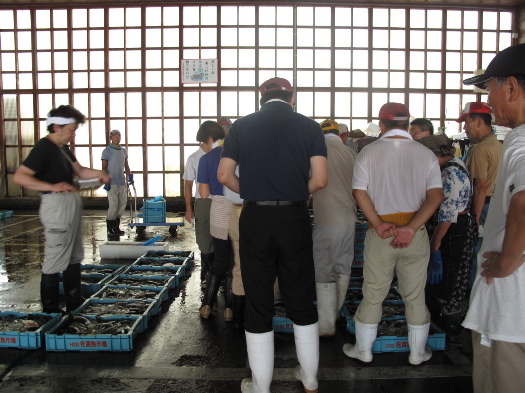
7 a.m., Japan time. A storm system is moving into Sado Island, Niigata, making the skies gray and heavy. By noon, the islanders anticipate heavy rains and winds; some worry that the ferry to the mainland will be canceled. The Sea of Japan can be volatile at times, but for the Sadoan fishermen it is business as usual. The auction is underway at the fish market.
There are rows of fish — sardines, snapper, sole, mackerel and a variety of shellfish sorted in plastic boxes. Fish dealers, men and women, have gathered to scrutinize the offerings from the sea. “The catch is small today because of bad weather,” Tadashi Hirahara, my guide from the Sado Tourism Association warned me as we joined the scene. The Ishiharas, the husband and wife wholesale fish traders, are in full auction mode, talking on their cell phones to the various dealers nationwide. A majestic 47 kilograms (103 pounds) swordfish, too large to fit in a box, lies bare on the concrete floor. “It cannot always be about making a profit. We try to keep the price of fish stable,” says Kazuko Ishihara, “We don’t want to hurt the fisherman.”
{igallery 108}
Sado’s population of approximately 60,000, nearly 40 percent of whom are over age 60, has been slowly dwindling, and many young people are leaving to find work in the big cities. The shrinkage in population is particularly felt in the fishing industry, which employs nearly 2,000 Sadoans. The majority of these workers are older and must derive income from other sources to make ends meet. There are also fewer fish in the waters. “In the old days, we had so much fish, we didn’t know what to do with it,” says Ishihara. Tadashi Ishihara’s father was a letter carrier who gave free fish to people who lived in the hillsides. Then he drove a taxi, but continued to deliver fish. Later he went into the fish business, which is still in the family.
Sustainable fishing practices
Despite the ups and downs of the fishing industry, the sea surrounding Sado is still blessed with one of Japan’s richest selection of seafood -– tuna, yellowtail, mackerel, sardines, octopus, squid, shrimp. In winter, schools of yellowtail travel south from Hokkaido. Fall and winter storms can drive the yellowtail into the calmer and warmer inland waters of Ryotsu Bay, where the big fish forage on smaller fish.
“Most Sadoan fishermen do not own large fishing boats or go trawling through the deep seas in Viking mode,” says Hirahara. “Instead, they stake nets in the bay and let nature run its course.” In high season, between November and December, as much as 500 tons of yellowtail may be caught. A specimen weighing 10 kilograms (22 pounds) with a fat content of 15 percent is branded “Ichiban Kan Buri” or Number One Winter Yellowtail and commands a hefty price at the Tsukiji market in Tokyo. For the Sadoan fishermen, a good catch is a cause for great celebration, but they all seem to agree on one thing. “We have to respect the fish. It is our livelihood,” says Ishihara. “Sometimes a whale gets caught in the net. If it is alive, we let it go.”
Fishermen planting trees
In order to improve the fishing conditions in the Sea of Japan, temporary bans are sometimes placed on certain types of seafood, including shrimp and abalone. One popular environmental movement in the greater Niigata prefecture, which includes Sado, is for fishermen to plant trees in the forest. The trees help prevent erosion, which can cause pollution in the streams and rivers that flow into the waters where the Japanese ibis and oysters live. Environmental pollution has affected both species, driving the Japanese ibis toward extinction and depleting the population of the oysters. The locals adopted the Ibis from China, and it has turned into a symbol for the protection of the natural habitat.
‘Blue-eyed’ seafood
Hirahara also wanted to show me what life on the island was like. He took me to Sado Central Station, a shopping mall off the main highway in Sawada. There was a different reality with an ironic twist. Powers Fujimi is a large supermarket chain headquartered in the City of Niigata on the main island. As its name suggests, it is a “one-stop shopping” kind of place. The marine products section is like the United Nations of fish.
About half of the fish sold are what some of the locals refer to as “blue-eyed” or foreign fish. The labels tell the country of origin and how each is processed: Smoked salmon fillet from Canada, minced tuna from Fiji, chopped toro from India, salted mackerel from Norway, marinated trout roe from Russia, pickled cod roe from the U.S. The blue-eyed fish may not be as fresh as the local fish, as most come frozen, but they are cheaper.
The people of Sado have not been totally receptive about a big supermarket moving onto the island. When Powers Fujimi applied for permits a few yeas ago, Sadoans knew the impact it could have on the local farmers, fishermen and artisans, so they combined their efforts to have a local voice. As a result, a private shop called Kiemon moved into the mall to sell local vegetables, fruit, fish, meat and sake. Kiemon occupies a good space at the entrance of the mall directly across from Powers Fujimi.
Emphasis on local catch at Maruishi, a kaiten sushi bar
Kazuko Ishihara, who is the mother of four and a grandmother, voices her concern about the current state of fish. “Our children are growing up on the island eating less fish, not seeing what a whole fish looks like or knowing where the fish comes from,” she says. In an effort to make local fish available to the islanders and vistors, the Ishiharas have opened Maruishi, a kaiten sushi bar.
While most conveyor belt sushi bars are associated with cheap, low-grade sushi, Maruishi offers the freshest local fish at darn good prices. Eighty kinds of sushi, with half of them at 120 yen per piece, about $1.50. The Ishiharas can do it because they can deliver the fish direct from the market. The sushi bar has turned out to be a big hit on the island. The yellowtail or local tuna or snapper sushi are as good or better than what you’d taste at the Tsukiji fish market. You can also special order if you don’t see what you want, and there is no extra charge.
I learned that some of the sushi chefs who work at the restaurant are also truck drivers at the fish market. “It’s good to see bright young people stay on the island,” says Ishihara smiling. Her commitment with her husband to sustain the community goes beyond fish.
The fish market is now closing. The Ishiharas make a few more phone calls and wrap up the deal making. The storm has landed on the island, but the locals are saying that by tomorrow the skies will clear up. The Ishiharas have purchased the big swordfish that has been lying on the concrete all this time. They ask the young men to load it onto the truck.
Sonoko Sakai is a Japanese freelance writer and film producer who divides her time between Tokyo and Santa Monica. She has contributed stories and recipes to the Los Angeles Times, the former Los Angeles Herald Examiner, Saveur and Bungei Shunju (Japan). She is passionate about making soba by hand, and with master chef Akila Inouye of the Tsukiji Soba Academy, has created MazuMizu to teach Japanese home-cooking in Japan and abroad.
Top photo: The auction at the Sado fish market.
Photo and slideshow credits: Sonoko Sakai
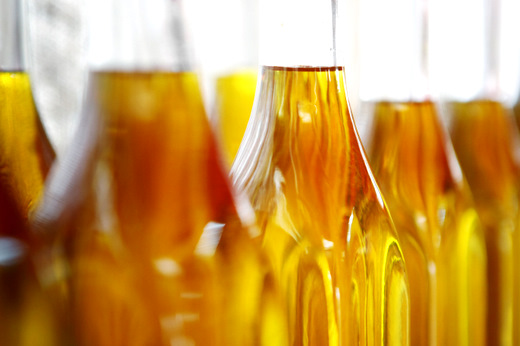
SACRAMENTO, Calif. — Paul Vossen remembers the typical Italian olive oil junket of 30 years ago. Visiting olive oil professionals witnessed vats of fresh olive oil pressed from olives taken straight from nearby Tuscan olive groves. But the tour also went to another area of the facility, says Vossen, which was shown to them proudly and without secrecy. Here, olive oil of lesser quality was refined — stripped of off-odors and aromas — and added like standard equipment to the fresh oil.
What ended up in retail containers was definitely olive oil. But don’t call it extra-virgin. And have no illusions that it’s got much in the way of healthful properties, like antioxidants.
Vossen, based in Santa Rosa, Calif., and a long-time olive oil expert with the University of California, Davis, says time’s run out for unscrupulous blenders to manipulate olive oil for profit.
To be extra-virgin, olive oil can’t be rancid, adulterated with cheap refined olive oil, or diluted with lesser oils. “We’ve known for years there’s been outright fraud,” Vossen says. Common adulterations pad olive oil with hazelnut oil, or seed oils such as canola oil, or refined olive oil. Slap on an extra-virgin label, and such products can fetch a premium price.
Study reveals mislabeling
But a study released last month by UC Davis puts this practice on notice, even if fraud is attempted in infinitesimal amounts. The study rocked the olive oil industry and prompted chefs to sue importers who were cited in the university’s research as selling inferior oil mislabeled as high-quality extra-virgin olive oil.
While the companies called out in the UC-Davis findings haven’t individually denied that they routinely sell blended or adulterated oil, their importers have claimed the study is unfair because it applies new testing standards.
New international grading standards may not have been the UC-Davis researchers’ goal, but their use of new forensics on olive oil purity can reveal the age of the oil, nail the percentage of PPPs and DAGs (more on those later) and indicate if some non-olive oil sneaked in.
“We have our own ‘CSI: Olive Oil’ here,” says Dr. Charles Shoemaker, the chemist who manages the Olive Oil Chemistry Lab at the Robert Mondavi Institute for Food and Wine Science on the UC Davis campus. “It’s become a very sophisticated practice, the adulteration of olive oil throughout the world.”
The windows in Shoemaker’s lab overlook the Davis campus’ 2,000 olive trees. Inside, the decor is cement bunker with beakers, test tubes and chemistry toys.
“We have lots of magnetic stirring bars because there’s a lot of mixing that goes on in a chemistry lab,” Shoemaker says, tapping a few small stirrers on a metal surface and waving one like a pointer.
The lab’s equipment uncovers defects, degradation and dilution in extra-virgin olive oil. Spectroscopic studies look for oxidation. That means the oil’s old or rancid. To be fair, any oil could suffer indignities during shipping, like a slow boat through the Panama Canal or storage in a hot warehouse.
But other tests go deeper. A key test for DAGs (three kinds of diacylglycerols) profiles certain fatty acids. It’s so specific that if profiles don’t match up, it could mean an olive oil is doctored with seed or nut oil, such as soybean, sunflower or canola.
Another test employed by the UC Davis study measures PPPs, which is a breakdown of chlorophylls. All olive oils have chlorophyll, particularly oil made from early harvest green olives. But chlorophyll degrades significantly and rapidly when olive oil is refined.
Shoemaker uses a pricey gizmo that makes a giant sucking sound as it vacuums solvents and isolates the chlorophyll. “It takes about 25 minutes per sample for just this one step,” Shoemaker says.
For the study, Davis did some of the tests. A lab in Australia did others. In all, 104 bottles of olive oil were purchased in Los Angeles, Sacramento and San Francisco — same brands, same lots — during the first week in March 2010. These included 14 imported brands and five labels from California. All were labeled extra-virgin.
Most of the California oils came out clean. But many big-name imports did not fare well. Testing revealed Bertolli, Filippo Berio, Pompeian, Colavita, Star and Carapelli samples labeled extra-virgin olive oil did not pass tests to qualify for the extra-virgin grade.
Critical reaction
The study came immediately under fire for several reasons.
First, it was funded by the California Olive Oil Council and a pair of California olive oil producers, giving the impression of bias in favor of the California samples. Second, the UC Davis tests included measures for DAGs and PPPs, as yet unrecognized by standards of the International Olive Council headquartered in Spain.
Bob Bauer of the North American Olive Oil Assn., which represents importers, called the study irresponsible. “These results directly contradict our 20 years of more extensive sampling than what those results show,” Bauer says.
But Vossen and Shoemaker say the IOC tests don’t go far enough and should one day analyze for PPPs and DAGs. “Everybody holds the IOC as some divine standard,” Vossen says. “But that standard is a minimum standard.”
The U.S. is not a member of the IOC. But growing concern over truth-in-olive-oil-labeling has drawn in the U.S.Department of Agriculture, which recently announced revised standards for olive oil sold in the United States, the first since 1948.
“We’re taking the snake oil out of olive oil,” says Mike Jarvis, acting director of the USDA’s Agriculture Marketing Service.
Beginning Oct. 25, olive oil from every olive oil-producing country, including the United States, could be subject to random sampling off retail shelves, using a lab in Blakely, Ga.
Zester Daily contributor Elaine Corn is a James Beard Award-winning cookbook author and food editor. A former editor at the Louisville Courier-Journal and the Sacramento Bee, Corn has written six cookbooks and contributed food stories to National Public Radio.

Bluefin are having a bad year. It started in January on a rough winter sea on Japan’s Tsugaru Strait, where the Sea of Japan touches the Pacific. Small fish are drawn to these fertile waters, which in turn feed huge tuna, making them rich and fatty.
A small boat expertly lands one particular bluefin using live bait and a single-hook hand-line technique called ippon zuri. This huge tuna dragged out of the cold waters weighed 511 pounds. And because it was taken ashore at the port in Omamachi, the bluefin will bear the coveted label of Oma Maguro.
This mixture of how, where and when this fish is caught dictates what happens next and illustrates why bluefin face extinction from chopsticks.
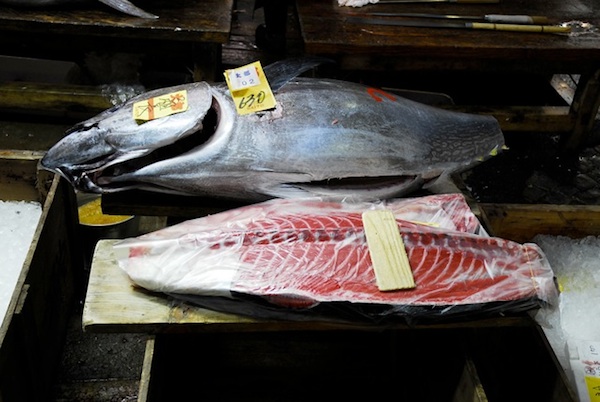
The majestic fish is freighted to the Tsukiji fish market in Tokyo. In the central auction shed next to the Sumida River, the first tuna auction of the new year begins surrounded by dozens of press photographers and film crews. Our Oma Maguro — alongside other tuna from Mexico and Indonesia — sits on a wooden pallet bearing a gold-rimmed label telling of its auspicious origins. Bluefin are known in Japan as black diamonds of the sea; even when dead, they’re extraordinarily beautiful. Under ceremonial banners, the bidding begins by a Daito Gyorui Co. house auctioneer. The Oma Maguro sells for 16.28 million Yen ($175,000) and becomes one of the most valuable fish ever sold.
The bluefin is bought by joint bidders, a Hong Kong sushi chain, and the Michelin-starred Kyubei restaurant near the auction hall. For Kyubei, the first Oma Maguro will be a New Year talisman bringing good luck. But the outrageous price isn’t passed on to customers; later they will eat the exquisitely marbled fatty underbelly called toro at the normal price. But this is more than a PR coup. It’s difficult for an onlooker to grasp the status of this fish and how it has become so entwined into Japanese culture. It is as if Buffalo Bill shot the first Thanksgiving turkey in Yellowstone Park on July 4 and then offered it up for sale. But tuna are wild, and, sadly, most Japanese consumers aren’t aware of the fate that awaits this fish. Many Japanese would rather give up breathing than not eat fish.
Toro reaches cult status
I once assumed toro has been celebrated as a gourmet specialty since Edo times. Not true. It’s a relatively new addiction. As late as the 1950s, toro was called neko-matagi, so bad a cat would pass over it, and worthless. Only after better refrigeration techniques were developed and the country’s postwar diet shifted towards fattier foods did the Japanese find toro palatable.
When any species achieves culinary-icon status, it’s days seem to be numbered. To compound the problem, sushi – and tuna with it — became a global craze. Although Japan imports 80% of every bluefin caught, the rest of the world consumes what’s left. Industrial commercial fishing has decimated bluefin tuna stocks in the Atlantic, Mediterranean and the Pacific. Bluefin have declined to about 15 percent of historic levels and have been placed on the Red List of Threatened Species by the International Union for Conservation of Nature, or IUCN.
In March, the fate of bluefin was sealed at the U.N.’s Convention on the International Trade in Endangered Species in Doha, Qatar. CITES, as it’s known, can offer species some protection in the form of a trading ban. As the British writer Charles Clover reported: “It was an ambush.” The proposed trading ban was defeated decisively and quickly. Nations that voted against the ban included not just Japan, but Canada, Indonesia, Tunisia, United Arab Emirates, Venezuela, Chile, Grenada, Korea, Senegal, Morocco and others. The Japanese arrogantly threw a bluefin tuna buffet the night before as part of their lobbying strategy.
The result of this defeat, which goes against all scientific advice, is that the fate of bluefin is thrown back to the International Commission for the Conservation of Atlantic Tunas whose sole role is to manage the bluefin fishery. However, the group is so weak-willed in the face of the fishing industry that’s it’s cynically referred to as the International Conspiracy to Catch All Tuna. (Perhaps CITES can likewise be referred to as the Convention on the Indiscriminate Trade in Endangered Seafood.)
In truth, though, most governments can be added to this body of weak-willed, ineffective and short-sighted organizations. As Sue Lieberman, director of international policy with the Pew Environment Group told the BBC, “The market for this fish is just too lucrative, and the pressure from fishing interests too great, for enough governments to support a truly sustainable future for the fish.”
Can consumers save the tuna?
So is there anything we can do? In February at Seaweb’s Seafood Summit in Paris, I interviewed the eminent marine biologist Daniel Pauly from Canada’s University of British Columbia. One of the benefits of talking to someone concerned with the overall biodiversity of our oceans is that he takes a long-term view on the subject. I asked him whether consumers could help change the fate of certain species by shopping for seafood with care. He said such an approach was sanctimonious, and that consumer pressure alone, while useful, would not be enough.
To effect real change requires moving up the chain of command, to large-scale fish buyers and to governments and organizations, Pauly said. To create pressure effectively, people need to not consume bluefin but also to keep lobbying governments and join protest groups with the aim of securing a trading ban at the next CITES meeting in two or three years. I wonder if it will take the extinction of such a high-profile species like bluefin tuna before further action is taken to safeguard marine creatures.
Which species could come next? Eels without doubt — the catch is down by 98% and they are on the IUCN Red List- soon to be followed by several shark species. Up to 73 million sharks are caught annually, many just for their fins.
I wonder if we’ll learn from the bluefin’s potential extinction. Or whether I’ll be writing an article titled “Who Will Eat the Last Shark?” next.
Jake Tilson is a U.K.-based artist, writer and designer, and author of the award-wining cookbook “A Tale of 12 Kitchens.“ He is currently writing a book about fish. The Tate Gallery recently acquired a piece of his depicting images of eel restaurants in Japan and London.
Photos, from top: Author Jake Tilson. Credit: Jennifer Lee
A bluefin tuna for sale at the Tsukiji fish market in Tokyo. Credit: Jake Tilson
As oil continues to flow from the leaking well off the coast of Louisiana, the fear and anxiety of New Orleans’ fishermen ebbs and flows as well. Though most seafood restaurants and markets have yet to see a decrease in production, employees of the Gulf Coast’s vital fishing industry are worried about their jobs and their livelihood. Still, they are keeping faith that something, anything, will be done to stop the oil from reaching prime fishing areas.
Sal Sunseri of P&J Oyster Company, New Orleans’ oldest and most respected oyster house, said he has not yet seen production slip, and his company’s oyster beds remain untainted, because his oysters come from the west side of the river.
“First and foremost, our concern is to make sure the oil is not getting into the marshlands and the oyster-growing areas,” Sunseri said. “We have seen no change in oysters so far. There is a shortage of oysters right now, but that’s due to weather, currents, etc. The main thing is to cap (the oil leak), contain it and get it out of here. Keep it away from our seafood.”
The April 20 Deepwater Horizon oil rig explosion and resulting spill has left a 50-mile-wide oil slick in the Gulf of Mexico, forcing fishermen to sit idle. The spill occurred just a week before the official start of shrimping season, and the floating oil has forced the National Oceanic and Atmospheric Association to put a moratorium on fishing and shrimping of any and all species.
Last weekend’s failed attempt to install a giant box over the oil rig that would have pumped out the oil to a tanker has left everyone involved uneasy over what comes next.
The fishing restrictions come in the form of state and federal closures of a wide swath of popular fishing and shrimping areas, all east of the Mississippi River. State and federal waters to the west of the river remain open to fishermen and oystermen.
Oil has already started washing up on Louisiana’s Chandeleur Islands, which are uninhabited but part of the Breton National Wildlife Refuge. The refuge has since been closed to the public.
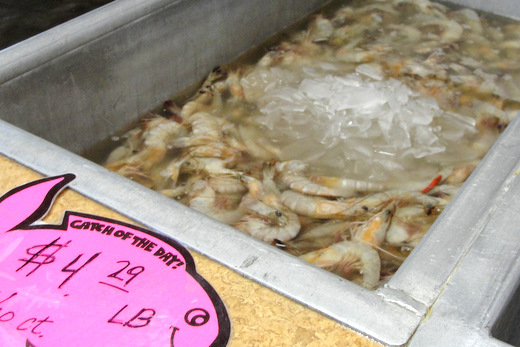
Today’s Ketch restaurant and market of St. Bernard Parish, home to many fishermen and a large section of Louisiana’s seafood industry, reported it has yet to see a decline in product. Instead, the supplier has been busier than ever as people buy seafood in bulk, afraid that soon it will become more expensive or tainted by oil.
“We get our crabs from Lake Ponchartrain and our crawfish from the Bell River — neither of those areas have been affected,” said employee June Lemoine. “As for our shrimp, we buy it in bulk when it’s in season, so it can last us through the next season. But if shrimping doesn’t get started soon, we might run out.”
Lemoine said she’s been hearing from many of their suppliers and other local fishermen that they are out of work and worried about the low prospects of returning to the seas anytime soon.
“Shrimping is a very big industry in the parish. They are just getting their boats back and in use from Katrina, and now this happens. It’s affecting them in a big way, and it is affecting the national supply, since they ship everywhere.”
She suspected that more than 5,000 people in St. Bernard Parish work in the seafood industry. The Louisiana Department of Social Services estimates that 47,000 households in the 14 coastal parishes will need food assistance due to unemployment caused by the oil spill.
There is no telling where the oil will go and whether it will affect the rest of Louisiana’s untainted fishing grounds, but Sunseri doesn’t want to think about it. He won’t consider what his next move might be if the oil contaminates his oyster beds.
“I’m an optimist,” Sunseri said. “I feel confident that God and Mother Nature are going to take over the situation.”
{igallery 84}
Catherine Lyons is a writer living in New Orleans.
Photo: Shrimp for sale at Today’s Ketch seafood in St. Bernard Parish in New Orleans. Credit: Catherine Lyons
Upcoming Events
-
see all of our
Upcoming Events
-
The Park City Food & Wine Classic July 10-14Takes place on July 10, 2013The Park City Food & Wine Classic THE PARK CITY FOOD & WINE CLASSIC is a premier destination event where master winemakers, culinary greats, and…
-
Taste of Chicago 2013 July 10-14Takes place on July 10, 2013Taste of Chicago 2013 Taste of Chicago 2013 is Chicago’s biggest event. Getting its start as a modest food festival on the Fourth of July…
-
The Little Paris Kitchen Book Signing and Cooking Demonstration July 11thTakes place on July 11, 2013Rachel Khoo’s The Little Paris Kitchen Book Signing and Cooking Demonstration Join us at your local Williams-Sonoma store for a special book signing and cooking…
SmartBrief