
Articles by Author
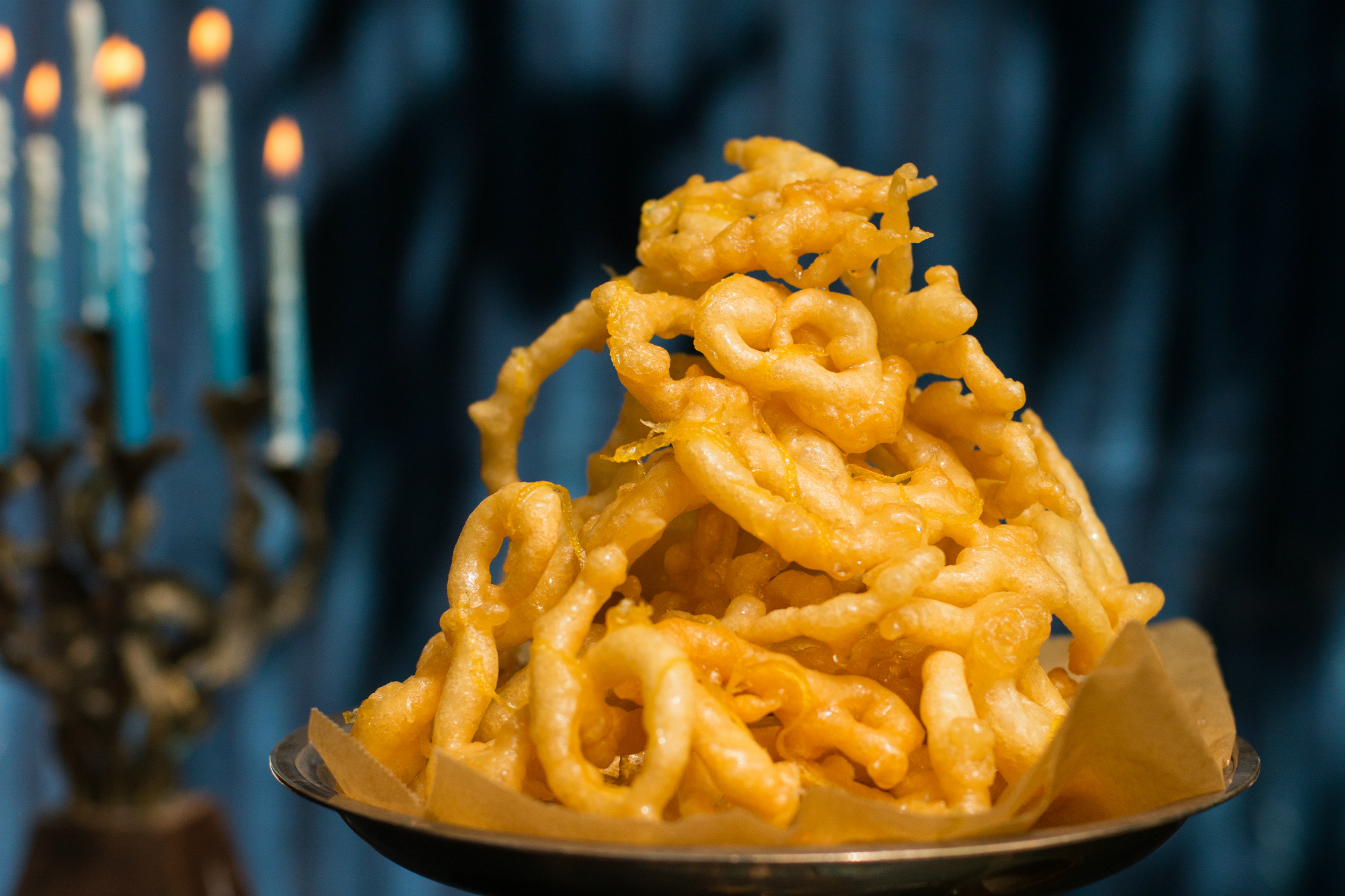
When it comes to Hanukkah, are you of the latke persuasion or are you in the fried pastry camp: sufganiyot, buñuelos, zengoula?
“The Seasonal Jewish Kitchen”
By Amelia Saltsman,
Sterling Epicure, 2015, 320 pages
» Click here to buy the book
Before we jump in, I should tell you that Hanukkah is my favorite holiday. And that I’m the daughter of an Iraqi father and a Romanian mother, whose families immigrated to Palestine in the early 1930s. My parents met in the Israeli army, came to Los Angeles a few months before I was born to further their education and stayed.
You should also know that I’m devoted to the farmers who grow my food. All of which make fertile ground for what comes next. As the young child of busy students, my affection for Hanukkah didn’t stem from elaborate presents, large parties or even alluring aromas from the kitchen. Far from extended family and time-honored traditions, we drew to the glowing candles of the Hanukkah menorah (hanukiyah) as though to a cozy fireplace. The sense of warmth and togetherness fed my soul long before I could have articulated the concept. Little did I know that I was tapping into Hanukkah’s very heart.
A child’s favorite holiday
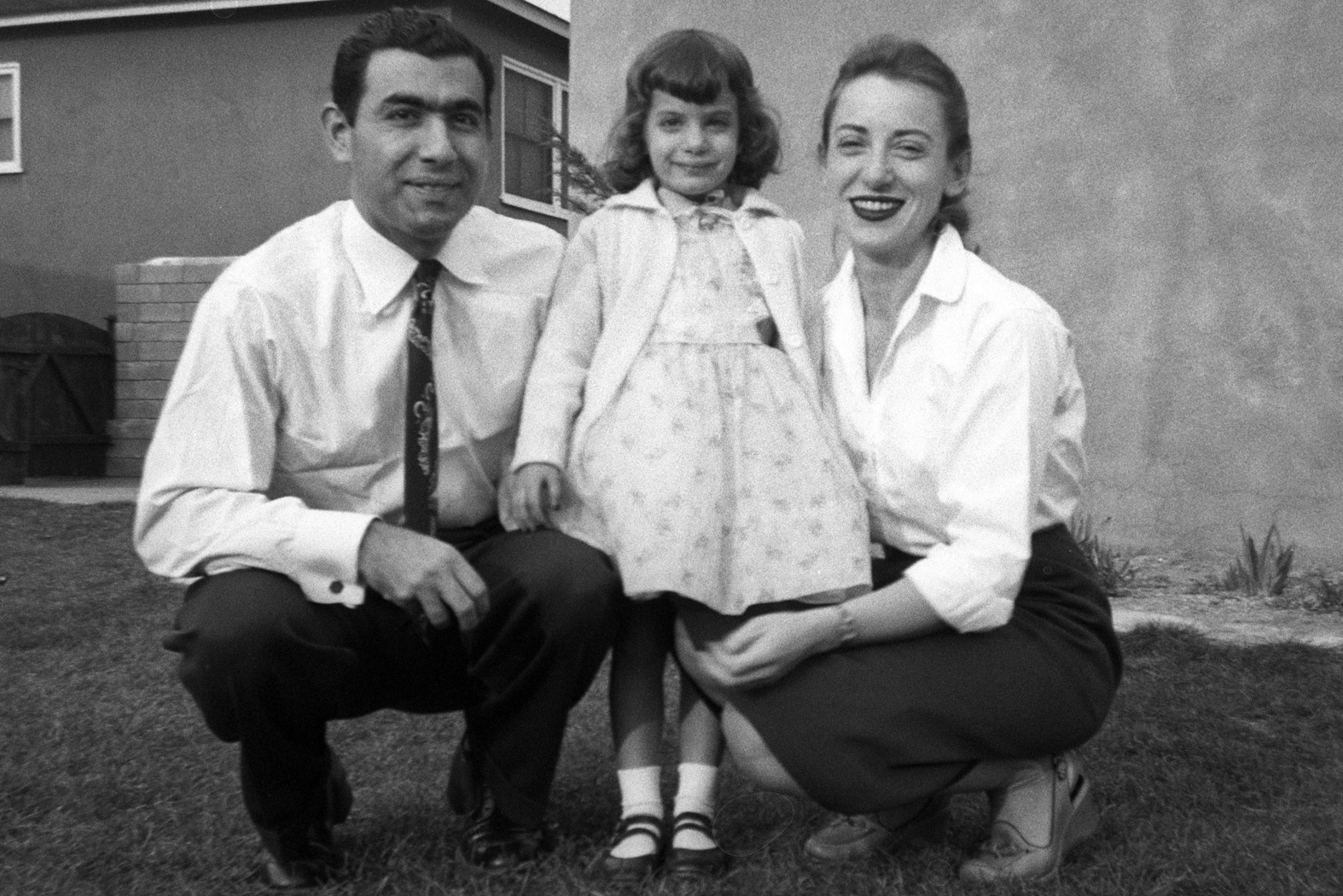
Amelia Saltsman with her parents, Benjamin and Serilla Ben-Aziz, in 1955. Credit: Photo courtesy of Amelia Saltsman
Much of the Hanukkah story is common Sunday school stuff. The Festival of Lights, a minor holiday in the Jewish calendar, commemorates the triumph of Judah and his band of Maccabees over Syrian-Greek rule and forced assimilation, the rededication of the temple and the miraculous bit of oil that lasted eight days, which is why we eat fried foods.
The holiday offers no obvious seasonal or agricultural connections, as do the great holy festivals such as Passover that are mandated in the Torah. (Hanukkah is “minor” because during the Roman occupation when the sages were choosing which stories to include in the Bible, the tale of a successful rebellion did not, for obvious political reasons, make the cut. But that’s no reason to skip a party.)So far, so familiar. But here’s the thing: Hanukkah begins on the dark moon closest to the winter solstice, the shortest day and longest night of the year, when the pre-electric world would have most craved light and warmth. With autumn crops tucked away and the rebirth of spring far off, a festival of light to cheer a dark winter would have been just the ticket. Aha! The seasonal touchstone is the absence of growing things, the hiatus that drives us all indoors. However did I channel that at the age of 6? Funny how one’s life passions are present before we ever understand their implications. For me, this little marvel is on a par with the eight days of oil. (For the record, Hanukkah is thought to be a reenactment of Sukkot for the fighters who had missed the autumn harvest pilgrimage festival.)
Doughnuts and latkes
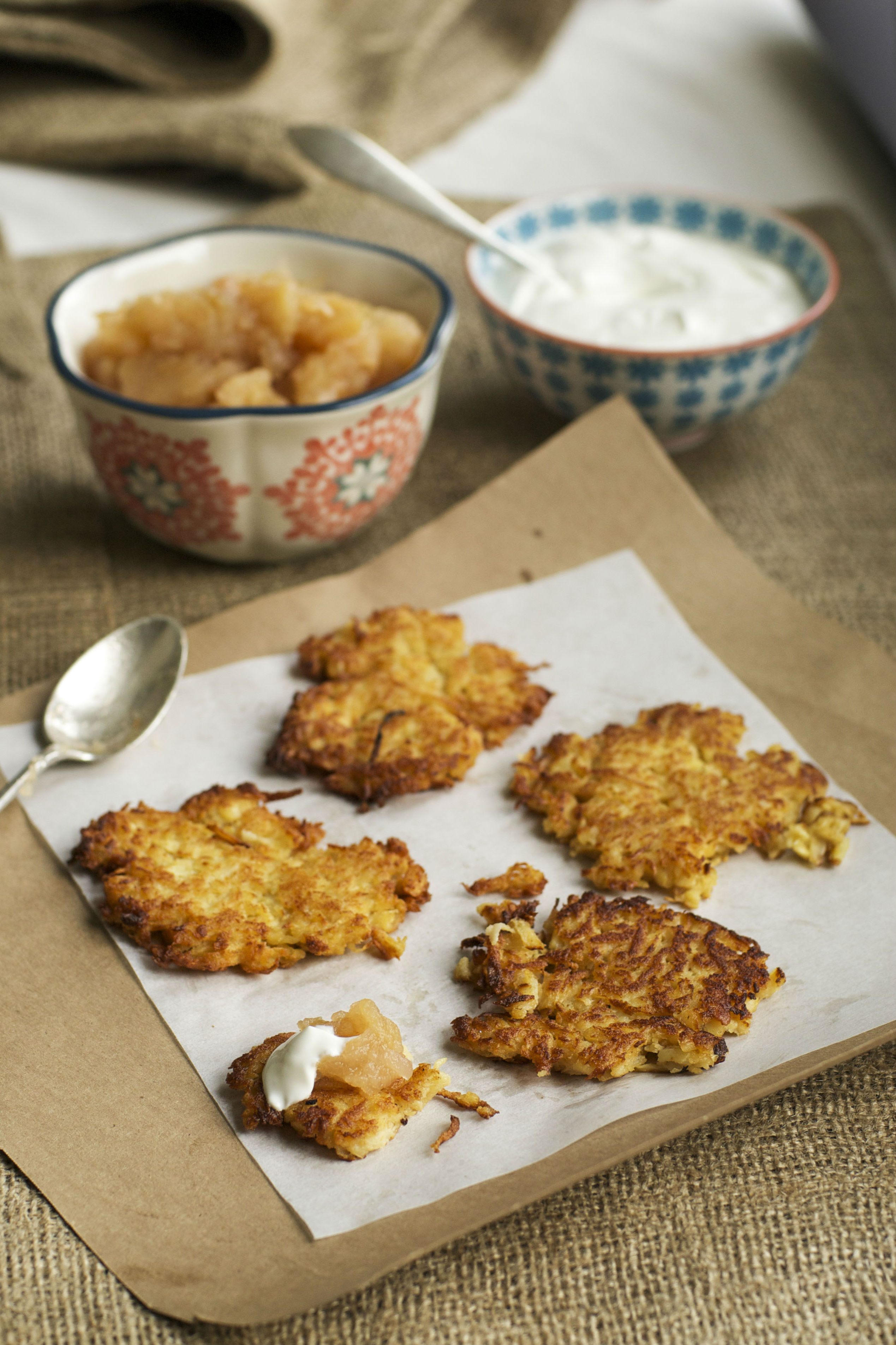
The author’s family makes latkes that are thin, crisp and made from grated potatoes. Credit: Copyright 2015 Staci Valentine; reprinted with permission from “The Seasonal Jewish Kitchen”
My Hanukkah food memories from those years are pretty sketchy, other than the Israeli holiday favorite, sufganiyot (doughnuts) that my father would bring home from the bakery where he worked evenings after class.
Latkes entered the scene when I was 9 and my sister was a baby. My mother received a gift of Sara Kasden’s “Love and Knishes,” a popular Jewish cookbook filled with Yiddish schtick. Although Hanukkah latkes are a European Jewish (Ashkenazic) custom to symbolize the oil, my mom considered them a New World treat and embraced them with gusto.
Kasden’s book defined our latke approach: thin, crisp and made from grated — not pureed — potatoes as the secret to great potato pancakes instead of ones that are raw, burnt and greasy all at the same time (a sort of negative miracle of its own). Over the years, three generations (my mother, me, my children) have perfected our skills into a zen-like rhythm, three abreast at the stove, to produce enough delicious latkes to satisfy our now-large family gatherings. (More hot tips: heat oil — no more than 1/4 inch deep — over medium heat, get oil hot enough that batter sizzles on contact, keep latkes thin — one generous tablespoonful of batter flattened with a spoon makes a three-inch pancake.)
A grandmother’s legacy
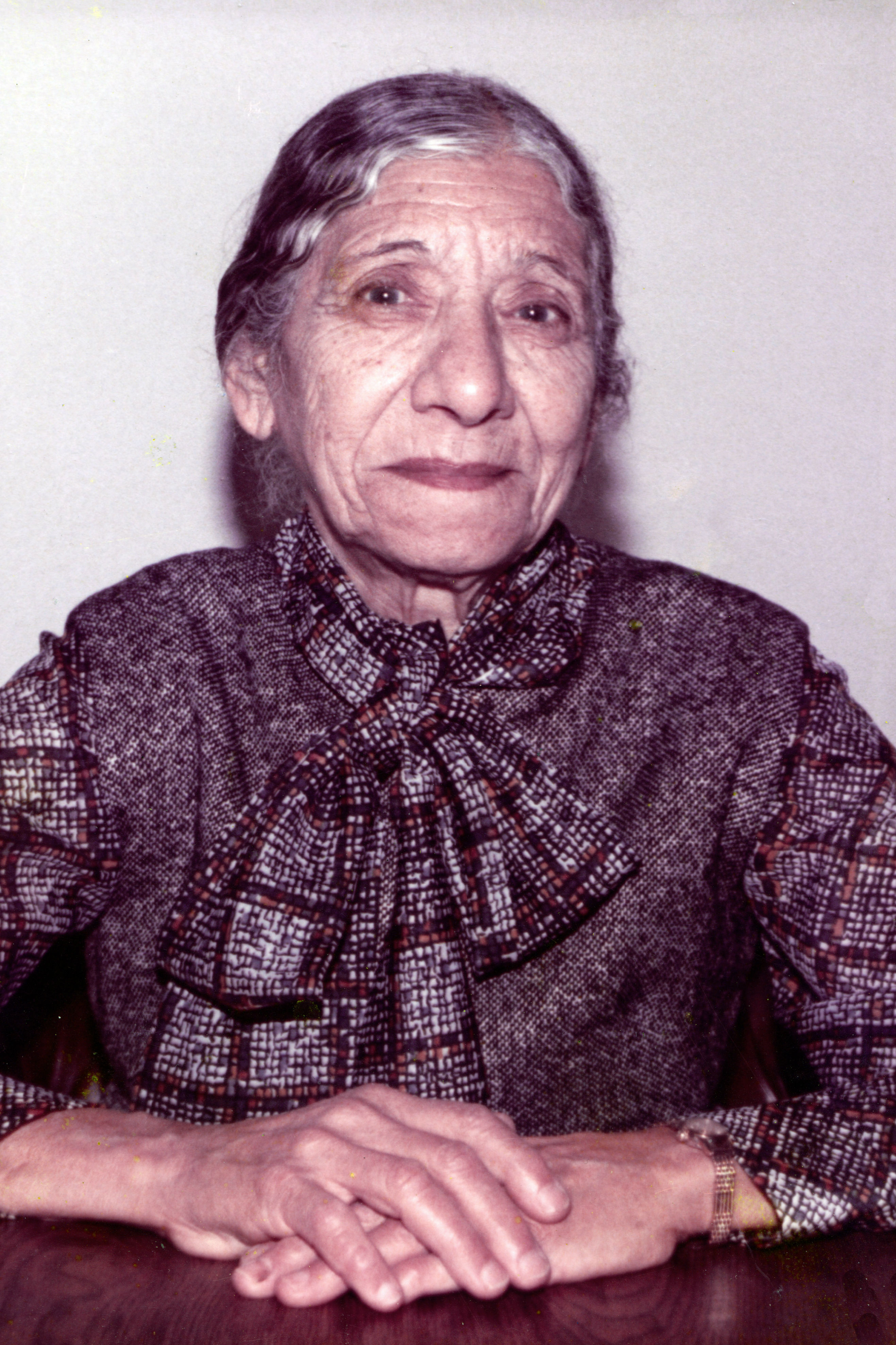
Amelia Saltsman’s paternal grandmother, Rachel Ben-Aziz, would cook the Iraqi fried funnel cakes known as zengoula. Credit: Photo courtesy of Amelia Saltsman
It wasn’t until many years later that I discovered another Hanukkah miracle: my Iraqi grandmother’s recipe for zengoula — crisp fried funnel cakes drenched in simple syrup. The coiled pastries are a centuries-old favorite in the Middle East, North Africa, and South Asia (where they are called jalebi), and were adopted by Iraqi Jews for Hanukkah.
The Sephardic treats are addictive, each crunchy bite shattering to a burst of sweet syrup. How had I missed the fun all these years? Although our family began transatlantic visits back and forth in 1961 and I had vivid memories of the dishes my Safta Rachel cooked for us, this one had escaped me.
But my cousin Elan Garonzik remembered them. Whenever our Safta visited his family in Lancaster, Pennsylvania, before heading west to us, Elan took careful notes as he cooked with our grandmother and still has his handwritten zengoula notes from the 1960s. I needed his help to work up a proper recipe.
Relearning a recipe
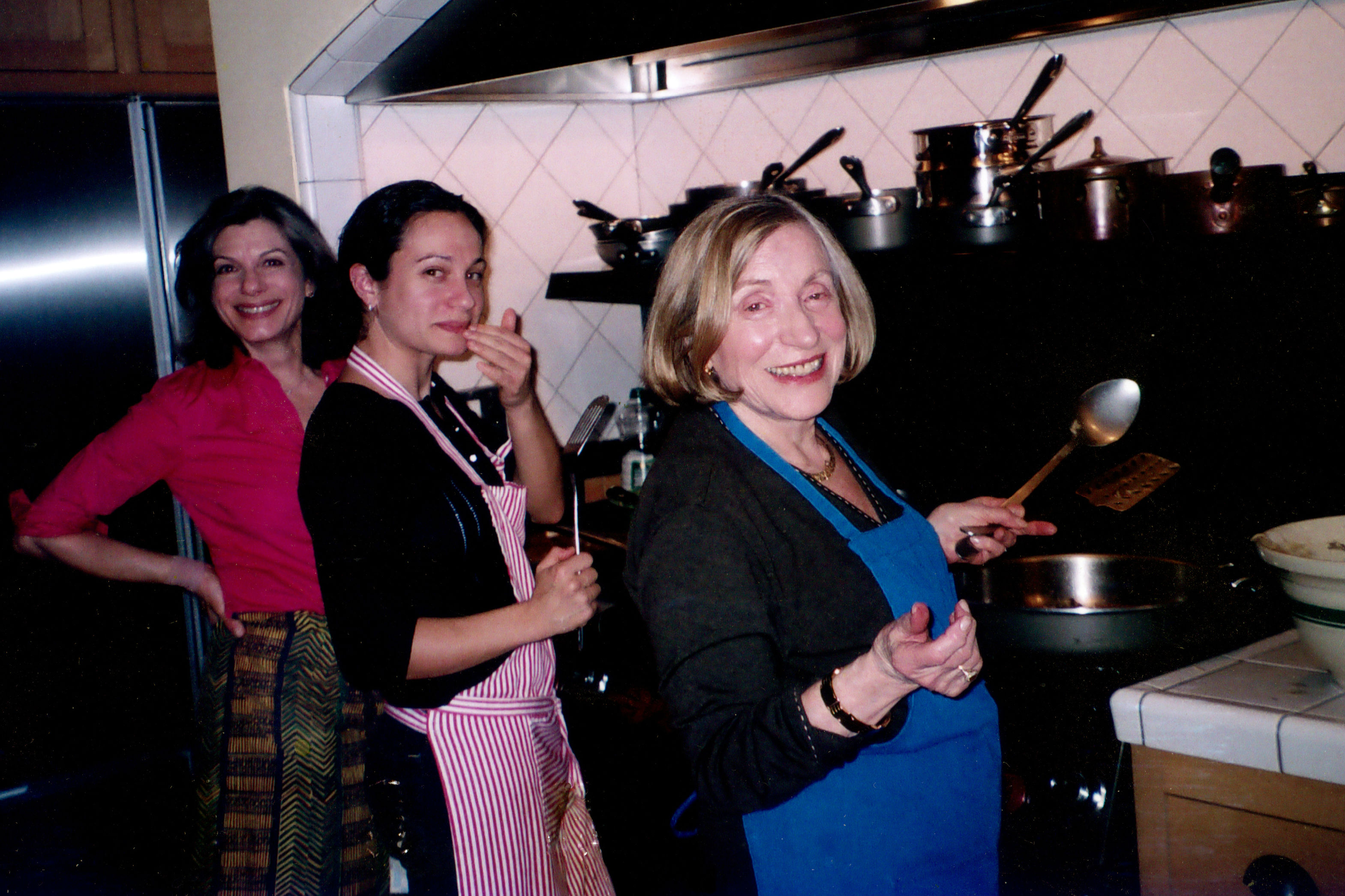
Three generations make latkes. From left: Amelia Saltsman; her daughter, Rebecca Saltsman; and Saltsman’s mother, Serilla Ben-Aziz. Credit: Photo courtesy of Amelia Saltsman
As luck, or miracle, would have it, I visited Elan, now a New Yorker, when the Museum of Jewish Heritage was showing “Iraqi Jewish Archives.” The exhibit depicts the discovery by a U.S. army team of thousands of books, Torah fragments, shopping lists and other ephemera that tell the 2,500-year story of Jews in Iraq, instead of the WMD they were seeking in that Baghdad basement. Go figure.
Elan and I whisked up the simple batter, set it to proof and headed to the museum. We wandered the exhibit, gazing at photos of youngsters who reminded us of his mother and my father. We came around a corner to a display about Hanukkah, which described local holiday customs including zengoula, the only dish mentioned in the show. It was, as they say in Yiddish, beshert (meant to be).
Today, we’re four generations celebrating together. Over eight days, our latkes, zengoula and sufganiyot pay tribute to “free to be you and me” diversity and remind us that it is indeed about the oil — not too much and hot enough. And in the spirit of our forefathers, we bask in the warmth of candlelight as we embrace a “minor” holiday to its fullest measure.
Zengoula With Lemon Syrup: Iraqi funnel cakes (Pareve)
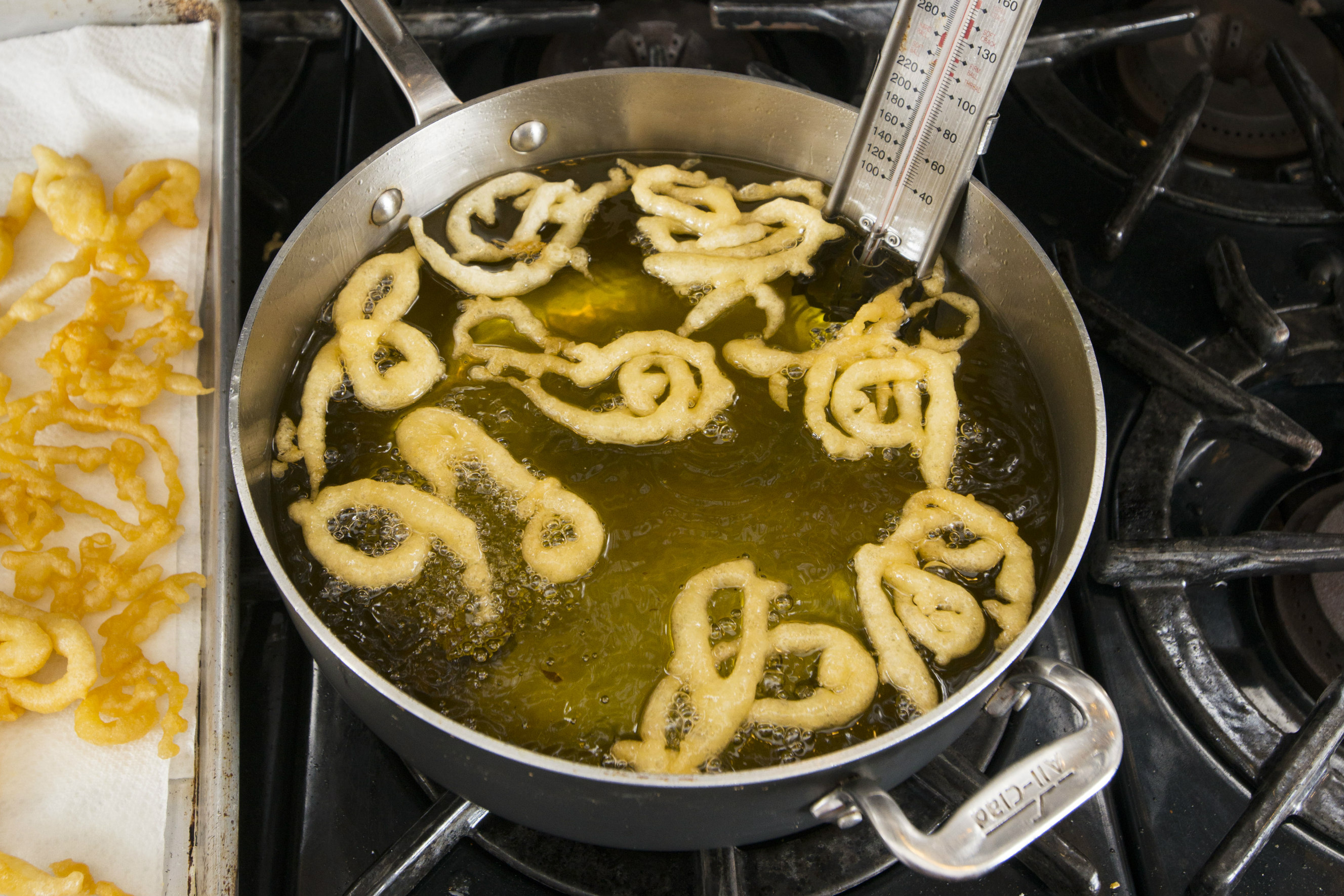
Zengoula should be fried the day they are to be eaten, although the batter must be made ahead. Credit: Copyright 2015 Staci Valentine; reprinted with permission from “The Seasonal Jewish Kitchen”
Prep time: 30 minutes, plus 6 to 24 hours to proof
Cook time: 45 minutes
Yield: 8 servings
Traditionally soaked in sugar syrup, zengoula are infinitely more wonderful when infused with a tangy lemon syrup. It takes only a few minutes to whisk together the forgiving batter the night before you want to serve zengoula, and the pastries can be fried early in the day you want to serve them. You will need to begin this recipe at least six hours before you want to serve zengoula.
Ingredients
For the dough:
1 1⁄8 teaspoons (half package) active dry yeast
1 1/4 cups warm water (100 to 110 degrees)
1 cup unbleached all-purpose flour
3/4 cup cornstarch
Scant 1/2 teaspoon salt
For the syrup:
2 to 3 lemons
1/2 cup water
1 cup sugar
2 quarts mild oil for frying, such as grapeseed, sunflower or avocado
Directions
To make the dough:
1. In a small bowl, stir together the yeast and 1/4 cup of the warm water and let stand in a warm place until the mixture bubbles, about 10 minutes.
2. In a medium bowl, using a fork, stir together the flour, cornstarch and salt. Stir in 1/2 cup of the warm water and the yeast mixture. Slowly stir in enough of the remaining 1/2 cup warm water until the dough is lump-free and the consistency of thick pancake batter.
3. Cover the bowl with plastic wrap and refrigerate until doubled in bulk, at least 6 hours or up to 24 hours.
To make the lemon syrup:
Using a five-hole zester, remove the zest from 1 of the lemons in long strands. Halve and squeeze enough lemons to yield 1/3 cup juice. In a small pot, stir together the lemon juice and zest, water and sugar over medium heat. Bring to a boil and cook, stirring frequently, until the sugar is completely dissolved and clear, about 1 minute. Pour into a pie pan and let cool. (The syrup can be made 1 day ahead, covered and refrigerated.)
To make the fritters:
1. Scrape the dough into a 1-gallon resealable plastic bag or large pastry bag fitted with a 1/4-inch plain pastry tip and set the bag in a bowl for support. Let the dough stand at room temperature for about 30 minutes.
2. Pour the oil to a depth of 3 1/2 inches into a 4- or 5-quart pot, wok or electric fryer and heat to 375°F. If using a plastic bag for the dough, snip 1/4 inch off one of the bottom corners, cutting on the diagonal, to create a piping tip. Roll the top of the pastry bag closed to move the batter toward the opening.
3. Pipe a bit of the batter into the hot oil. The oil should bubble around the batter immediately. If it doesn’t, continue heating. Pipe the dough into the hot oil, creating 3- to 4-inch coils or squiggles. Be careful not to crowd the pan. Fry the dough, turning once at the halfway point, until bubbled, golden and crisp, 4 to 5 minutes total.
4. Use a slotted spoon to fish the fritters out of the oil, drain them briefly on a towel-lined plate, and then drop them into the syrup for a moment or two, turning them to coat evenly. Lift them out of the syrup and transfer them to a tray in a single layer to cool. Repeat with remaining batter, skimming any loose bits of dough from the hot oil between batches to prevent burning.
5. The cooled pastries can be piled on a platter. Pour any remaining syrup over the top. The fritters taste best served the same day they are made, although they will hold their crispness overnight. Store loosely covered at room temperature.
Adapted with permission from “The Seasonal Jewish Kitchen: A Fresh Take on Tradition” © 2015 by Amelia Saltsman, Sterling Epicure, an imprint of Sterling Publishing Co., Inc.
Main photo: Zengoula are infinitely more wonderful when infused with a tangy lemon syrup. Credit: Copyright 2015 Staci Valentine; reprinted with permission from “The Seasonal Jewish Kitchen”
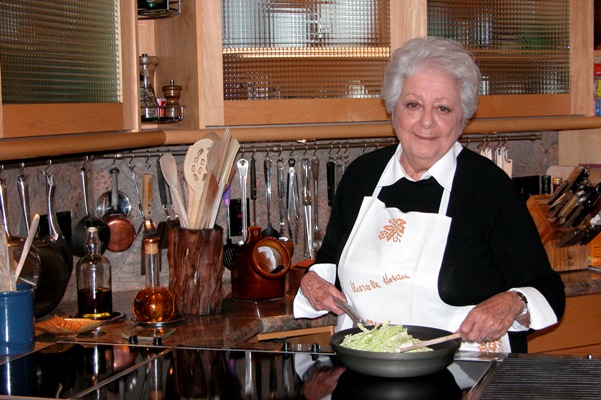
Marcella Hazan, the great Italian cooking teacher and cookbook author, passed away Sept. 29. That evening, as I prepared a simple tomato sauce for dinner, I realized I routinely hear her husky voice in my head whenever I stir a pot of risotto or sauce a pasta (“careful, not too much!”).
Known simply as Marcella, she was the acknowledged game-changer on how Americans think about Italian food, the first to give us careful recipes for such classical dishes as tortelloni di biete (Swiss chard) and artichokes Roman-style. Long after her fame settled about her like a mantle, journalists began to focus instead on her prickly, brusque, curmudgeonly personality — choose your adjective, they’ve all been applied — her smoking, and her preference for Gentleman Jack whiskey.
A first encounter
More from Zester Daily:
» When Life Swallows the Family Meal by Giuliano Hazan
Selected books by Marcella Hazan:
» “Amarcord: Marcella Remembers”
» The Classic Italian Cook Book: The Art of Italian Cooking and the Italian Art of Eating
» “Marcella Says … : Italian Cooking Wisdom from the Legendary Teacher’s Master Classes, with 120 of Her Irresistible New Recipes”
» “Marcella Cucina”
I came to know a different Marcella. Our friendship began with my fortuitous purchase of fresh scallops with their roe attached. I’d been hired as the food stylist/media escort for Marcella’s Los Angeles book tour for “Marcella Cucina.”
A flurry of faxes from the office of culinary publicist Lisa Ekus (full disclosure, now my agent) preceded the Hazans’ arrival: Be sure to hold her book face-out at the airport gate. Don’t even think about taking them to an Italian restaurant. They like Chinese food and American hot dogs. I was suitably unnerved.
Marcella was brusque all right. She acknowledged me with a nod and a grunt, slid into the back seat, and proceeded to speak only to her husband, Victor, and only in Italian. At our first stop, Marcella met with the food editor, and Victor hovered as I readied shrimp and scallop salad with orange sections for the shoot. In the recipe’s headnote, Marcella waxed poetic about using scallops with their roe attached but lamented their nonexistence in the United States. Enter the aforementioned scallops. First lesson: Close reading of an author’s work, especially the extra matter, garners undying gratitude. At the end of that first day, I was invited up to their suite to get better acquainted with the inseparable team.
A love of home cooking
That I was a home cook and eager student endeared me to the Hazans. Marcella’s life’s work was the Italian family meal, and she saw in me a kindred spirit she could entrust to liaise between her food and restaurant cookery. Second lesson: Home cooking is the backbone of family life, il sacro desco (the sacred table), and a career-worthy subject.
The Hazans and I kept in touch, and two years later I was hired to assist Marcella at a series of cooking demonstrations at the Mondavi Winery in the Napa Valley. My job was to keep her food from getting “cheffed up” by the pros preparing the finished meals. I can just imagine what then-resident-chefs Gary Jenanyan and Sarah Scott must have thought about the need for a “food translator.”
marcella2
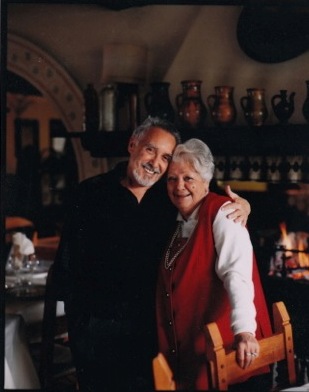
At “home” in the Mondavi’s luxurious three-bedroom guest house, with a fire going against the November rain, the Hazans and I became an ersatz family. Over morning coffee and cigarettes (hers), Marcella told me stories about their early years together, dished about the celebrities she taught, and talked about the dynamics of teaching. It was essentially a rehearsal for her memoir, “Amarcord.”
We scavenged ingredients from the winery larder to make home-cooked comfort food: stovetop veal tenderloin; tomato salad; and an Italian sort of Potatoes Anna, lush with olive oil, garlic and rosemary. Marcella cooked generously and fearlessly over high heat. There were splatters everywhere, but the resulting sauce for the veal was a deeply flavored rich brown, the potatoes were roasted to crisped perfection. Instead of adding notches to my culinary belt with lavish meals at the French Laundry, I had a one-on-one kitchen tutorial with one of the great teachers of our time.
At home in Florida
I saw Marcella at her most relaxed when I visited the Hazans at their condominium in Longboat Key, Fla. As though she was still a young girl in her native Cesanatico, she’d whistle to me from her first-floor balcony as I approached from the white-sand beach. She laughed easily, flirted with waiters, enjoyed living near son Giuliano and his family. Of course, leaving Venice meant having to buy shrink-wrapped food at Florida supermarkets instead of fresh, live ingredients along the Rialto. I heard a lot about that too.
The Hazans taught me to be on the lookout for the simplest site-specific gustatory pleasures when I traveled to Italy — the incomparably fresh mozzarella di bufala in Naples, the aroma of white truffles in Alba — and how those trump the air-shipped versions we get here, a sensibility I apply to my writing on seasonal, local foods. Ever the teachers, they were happy to impart their knowledge to a willing student who would pass it along.
If I could give Marcella something in return for all these lessons, it would be this: She sometimes felt discouraged that Americans’ obsession with food porn had become the new barrier to honest cooking. I’d like her to know how much she really did change our culinary landscape.
Top photo: Marcella Hazan cooking in Florida. Credit: Courtesy of the Hazan family