
Articles by Author
My husband and I spent our first year of marriage in Stockholm. As newlyweds we were deliriously happy, but as grad students we were broke. Our best entertainment consisted of visiting the city’s beautiful food hall, where we longingly eyed all the seafood we couldn’t afford. After a while, a kindly fishmonger named Tommy Henriksson took pity on us and introduced us to some local fish within our budget. Tommy taught us to make magic with fresh herring and cod — fish so inexpensive they were taken for granted. We learned how to pan-fry herring and to sear cod in a blazing hot cast-iron skillet with plenty of salt. It cooked up into beautiful, moist flakes.
But times have changed, and we can no longer take cod for granted. By 1994, the once-bounteous stock of cod in Georges Bank, a continental shelf off the coast of New England, had been depleted from overfishing. And although strict quotas were put into place, these protective measures came too late. Our native fish stocks still haven’t recovered.
Wandering skrei
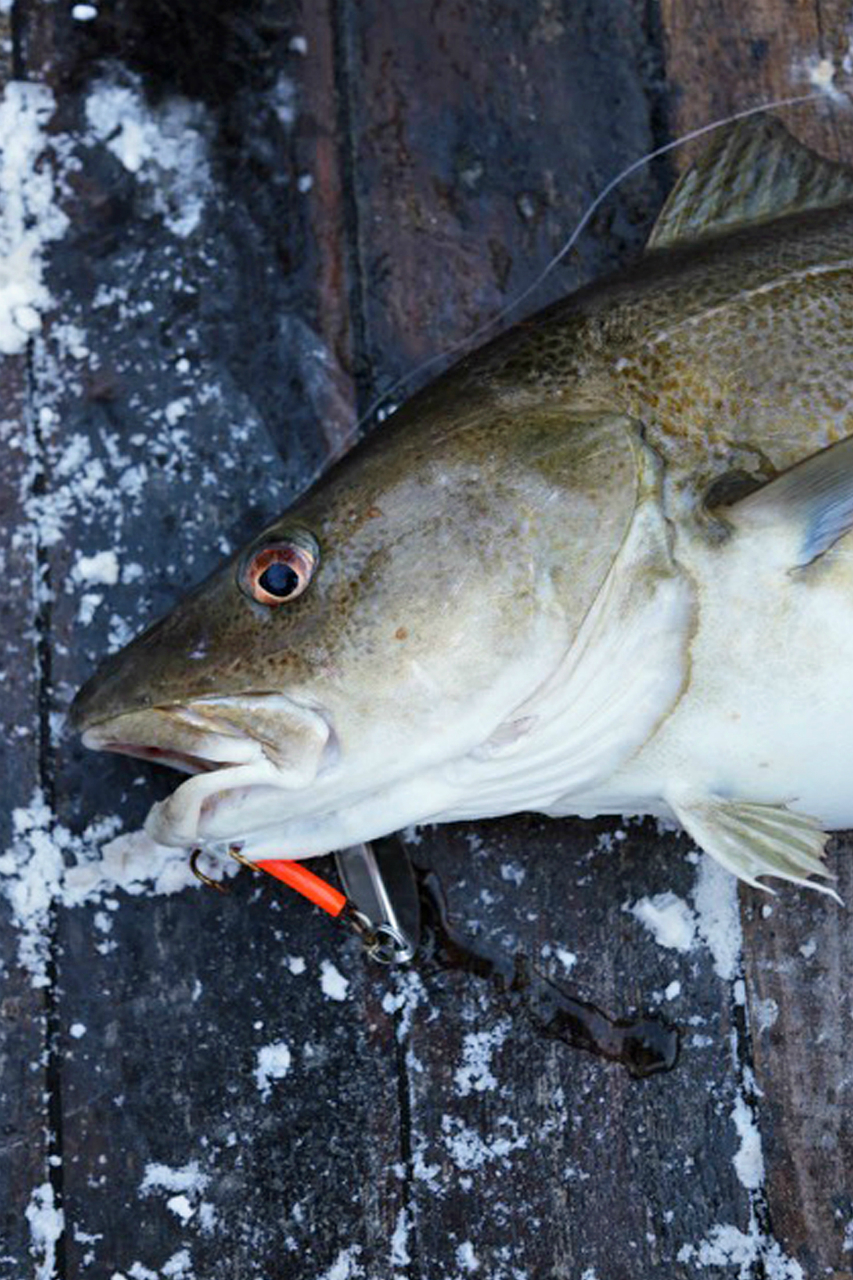
A freshly caught skrei. The fish is now threatened by industrial development. Credit: Copyright 2014 Stefan Wettainen
The world’s largest population of native cod now swims in the Barents Sea, which washes the far northern coasts of Norway and Russia.
More from Zester Daily:
» Skrei: A sweet, supple cod from Norway
These cod are called skrei, from an Old Norse word meaning “to wander.” And wander they do. The skrei live for five years in the Barents’ nutrient-rich waters, where they acquire exceptional flavor. They then migrate to spawn in the Lofoten Islands, an archipelago off Norway’s northern coast.
Until the 1980s, when wet-fish and factory trawlers began to proliferate, small-boat fishing was the islanders’ lifeblood. They lived by the annual rhythms of the fisheries and revered all parts of the cod. By simmering the cod with its liver, roe and a little whey, they made a traditional one-pot meal called mølje. Besides adding depth of flavor, the liver’s high content of vitamin D kept people healthy during the dark, sun-starved winters.
The importance of cod
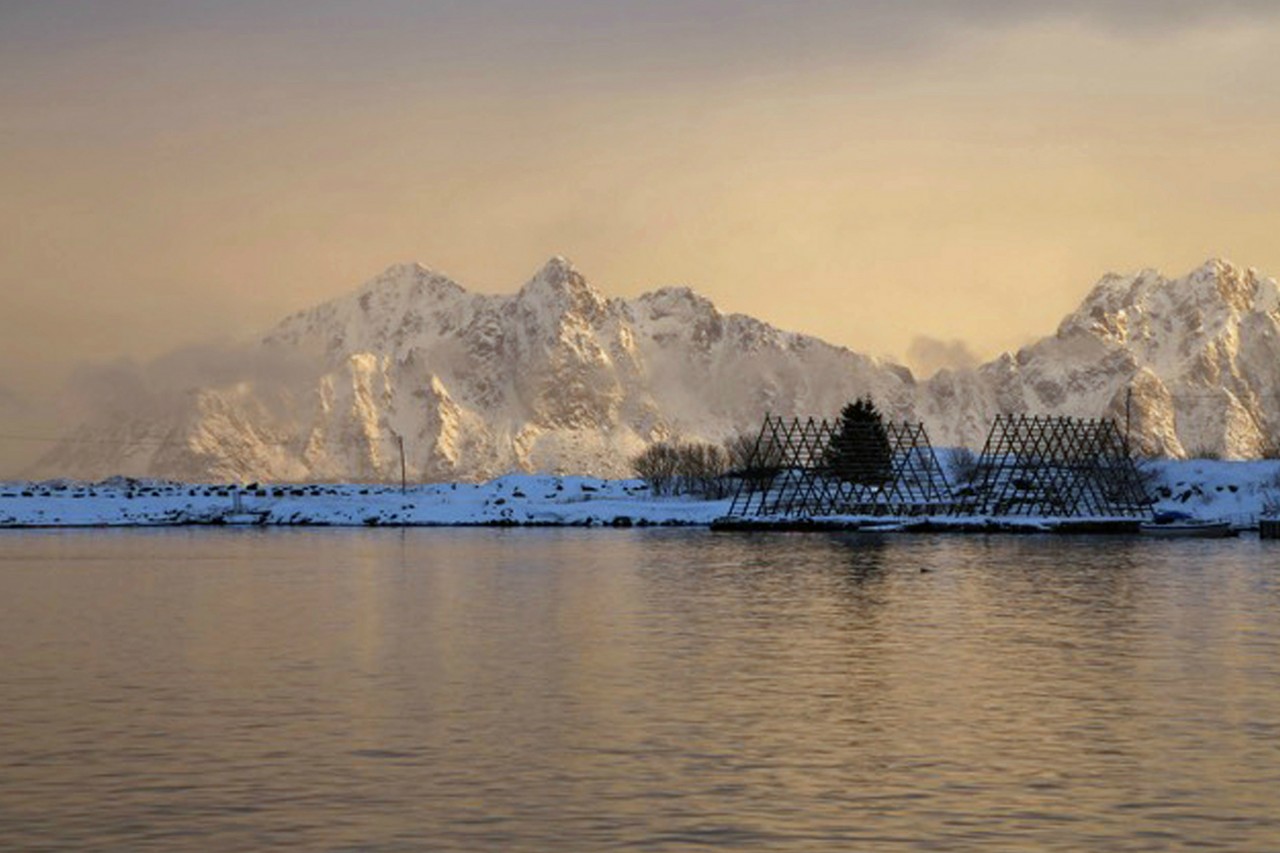
Cod drying racks stand empty in the Lofoten Islands in Norway. Credit: Copyright 2014 Stefan Wettainen
Book links
“Fire and Ice: Classic Nordic Cooking”
By Darra Goldstein
Ten Speed Press, 2015
304 pages
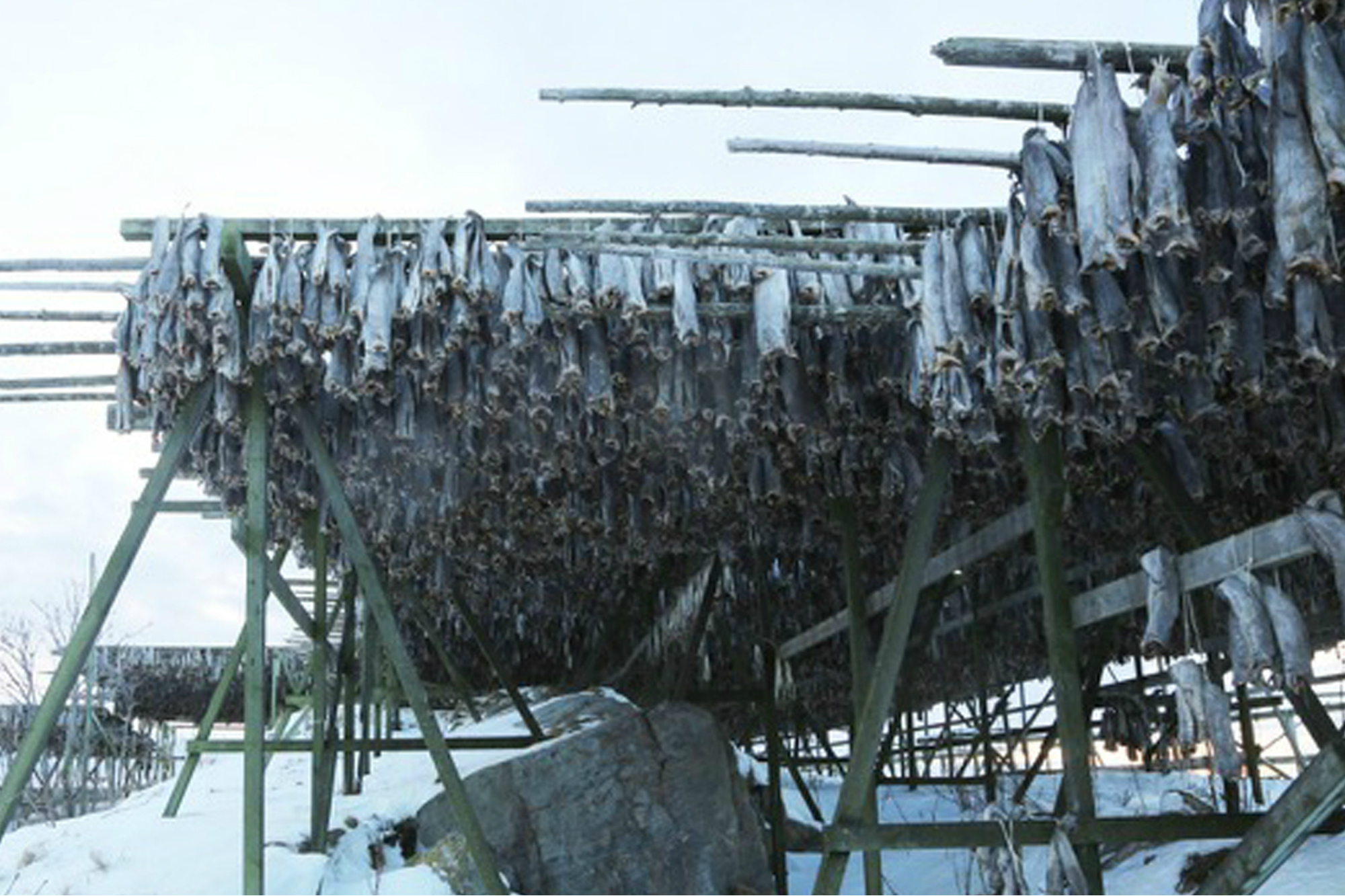
Cod’s importance to the North dates from the earliest recorded times, both for its nutritional and commercial values. The Vikings were trading dried skrei by the 10th century. Today, the fish continues to be dried in various traditional ways, two of which are recognized by Slow Food’s Ark of Taste, an international effort to identify and catalog unique regional food items.
For tørrfisk (stockfish), the cod is line-caught, then quickly gutted and beheaded before being brought to shore. Two fish of similar size are bound together by their tails and draped on wooden racks to dry for two or three months in the salt air. Klippfisk (salt cod) is prepared farther south on Norway’s coast where large, flat rocks rise at the edge of the sea. The rocks are cleaned and spread with salt before split cod is laid out on them to dry into a delicacy that is less hard and brittle than tørrfisk. My personal favorite is boknafisk, cod that has been only partially dried in the salt air. When poached, its texture turns silken.
Population is threatened
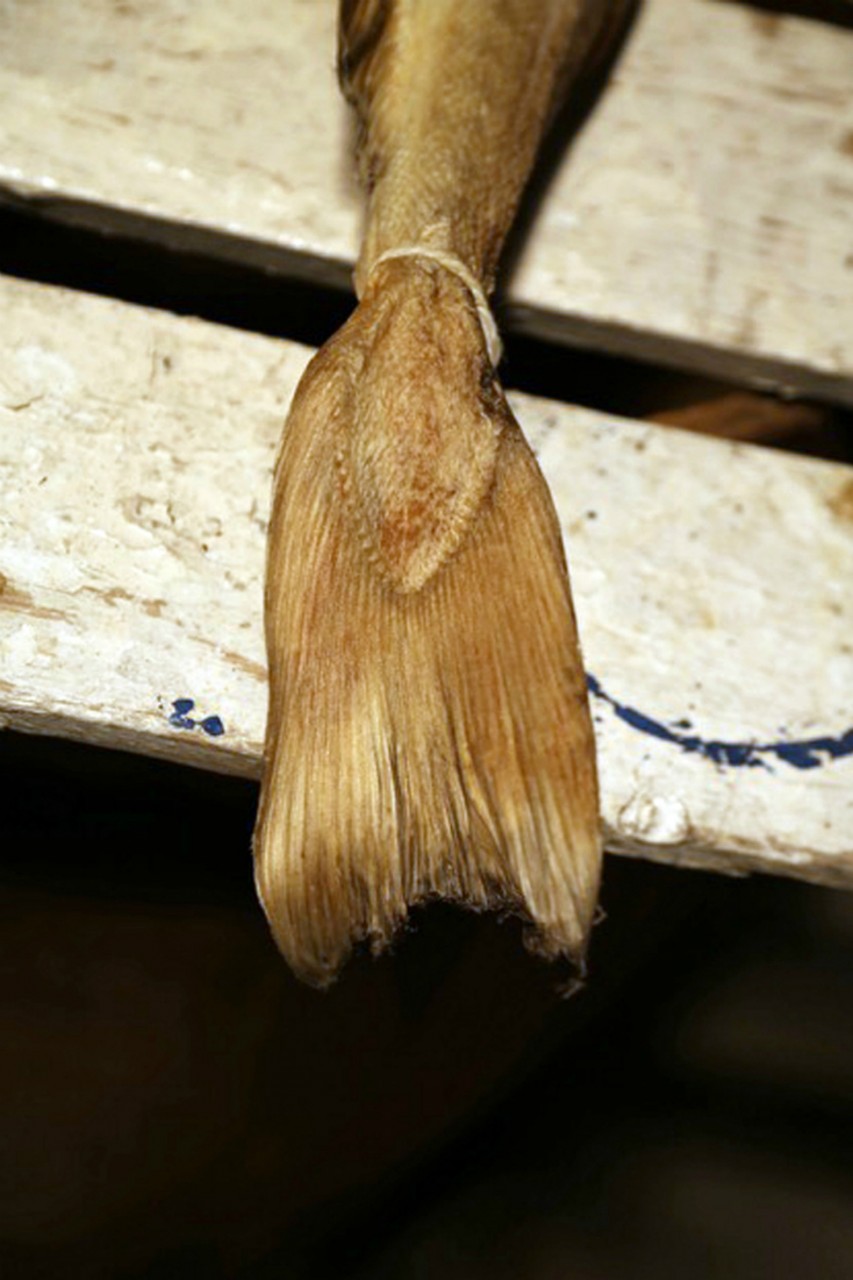
A dried cod tail in Norway. The Barents Sea population faces depletion. Credit: Copyright 2014 Stefan Wettainen
The Barents fisheries have been generally well regulated. Norwegians recognize that a healthy population of cod also means rich populations of valuable groundfish like haddock and pollock. But this piscatorial treasure is now threatened. In 2010, after years of negotiation, Norway and Russia ratified the Barents Sea and Arctic Ocean Maritime Delimitation Treaty, which opened the waters to commercial interests.
The sea contains rich oil and natural gas deposits, and corporations on both sides of the border are eager to begin exploiting them. And although Norway is highly sensitive to environmental concerns, Russia is not. Pressure is increasing to drill for oil and gas in one of the last truly pristine places on earth.
Preservation is vital

As the annual catch has declined, the Lofoten Islands in Norway have become less a working fishing community than a holiday destination. Credit: Copyright 2014 Stefan Wettainen
Undamaged ecosystems are essential for fish to thrive. Unless carefully regulated, the oil and gas extraction industries will deplete the Barents Sea’s resources and then move on, leaving behind oil boom debris and polluted seabeds. The World Wildlife Fund expressed concern as far back as 2004, well before the international treaty was signed, over the potential loss of the Barents Sea habitat to overfishing and industrial development.
Because of the decline in the annual catch, the Lofotens are already less a working fishing community than a holiday destination. Rows of wooden drying racks now stand empty on some island beaches, like so many looming sculptures memorializing a once-crucial livelihood and tradition. Cod encapsulates the collective history of the Barents region and the Lofoten Islands. It is vital that we preserve the last healthy population of wild cod and protect these waters that nourish not only the body but the soul.
Main photo: Cod are hung out to dry in Norway. Credit: Copyright 2014 Stefan Wettainen
St. Patrick’s Day used to mean corned beef and cabbage, but with Ireland’s culinary renaissance, cooks are exploring other traditional Irish foods. I’m thinking not only of Irish lamb stew and crubeens, golden-crusted pigs’ feet turned meltingly tender inside a crisp breaded crust. I’m also thinking of the Irish blaas. On a recent visit to Ireland I discovered a bakery that honors this delicious relic of the past.
Barron’s Bakery, in the small town of Cappoquin, County Waterford, is one of Ireland’s last traditional bakeries, with brick ovens dating to 1887. Because these ovens have never been modernized, they still operate without thermostats. Each firing yields a slightly different batch of bread, a variability prized by the townsfolk who flock to Barron’s.
The bakery is most famous for their “blaas” — light, plump yeast rolls with a subtle malty taste and a heavy dusting of flour. The rolls’ origins lie with the thrifty French Huguenots who immigrated to Waterford in the 17th century — blaa is likely a corruption of the French blanc (white) or blé (wheat) — and who are said to have introduced rolls made from leftover pieces of dough.
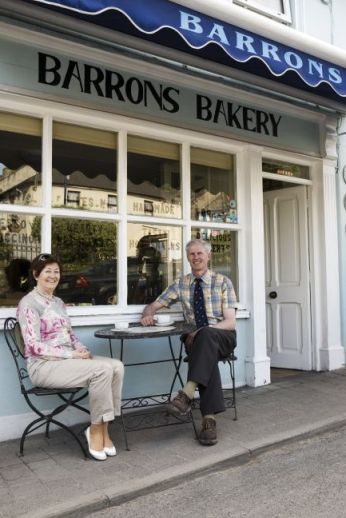
Esther Barron and Joe Prendergast at Barron’s Bakery. Credit: Arna Run Runarsdottir
In 1802, blaas entered the Irish mainstream thanks to Brother Edmund Ignatius Rice, the founder of the Christian Brothers, who began baking them at Mount Sion Monastery in Waterford City. Made only of flour, water, yeast and salt, these rolls were inexpensive to prepare and thus affordable to the city’s poor.
Ireland recently submitted an application to the European Union to grant the rolls Protected Geographical Indication, PGI, status as a distinctive regional food. This move is significant, as Ireland has generally been slow to request special status for its food products. Only four are currently registered: Connemara Hill lamb; Timoleague Brown Pudding; Clare Island Salmon; and Imokilly Regato, a cow’s milk cheese from County Cork that has Protected Designation of Origin, PDO, status.
The application detailing blaas’ place of origin makes County Waterford sound like a magical realm: “The river Blackwater runs through the area and includes the town-lands of Dangan, Narabawn, Moolum, Newtown, Skeard, Greenville and Ullid.” The actual production of blaas looks a bit more prosaic. The 3-inch rolls are shaped by hand into rounds or squares, with the dough hand-floured at least three times in the process. This heavy dusting of flour both protects the dough from the oven’s intense heat and gives the blaas a distinctive top. Like American pan rolls, the pieces of unbaked dough are set side by side to merge as they rise. When the rolls are ready to eat, they are pulled apart, yielding a crusty top and soft interior and sides.
Irish blaas through the generations
Today, blaas are eaten either for breakfast (the local radio station’s morning program is called “The Big Blaa Breakfast Show”) or for lunch, when they’re often filled with fried potatoes or dilisk, a local seaweed. I was lucky enough to arrive in Cappoquin just as a tray of blaas was emerging from the oven, and the bakery owners, Esther Barron and Joe Prendergast, insisted that I have a taste. A first crisp bite immediately gave way to a tender and aromatic crumb. I was hooked.
Established in 1887, Barron’s remains at the heart of Cappoquin — so much so that last year a book commemorating its 125th anniversary was published with tributes from the bakery’s customers and staff. Esther is the fourth-generation Barron to run the bakery. She’s a remarkable woman, the youngest of five daughters who took over the business on her father’s death in 1980. Even though baking was very much a man’s profession, she made a success of it.
Through her work she tries to honor the memory of her grandfather John, who spent time in New York in the 1880s and dreamed of emigrating to the United States. But his wife and new baby called him back to Cappoquin, where he eventually took over his father’s bakery and sired 11 more kids!
Adding new traditions
Esther and Joe are reviving other traditional Irish baked goods like spotted dog, which is a white soda bread with fruit, and Chester cake, a spice cake originally devised to use up stale bread. And they’re experimenting with the use of locally grown organic wheat to improve their bread and support local farmers. Barron’s is so devoted to the Cappoquin community that they fire their ovens on Christmas Day so that the villagers can roast their turkeys communally.
For St. Patrick’s Day, Barron’s bakes a special cake in the shape of a shamrock, though it’s far from the kind of plain sheet cake you might expect. Theirs is an extravagant madeira cake with lemon curd and buttercream, covered in white fondant and decorated with piped green roses and the Gaelic greeting “La Fheile Padraig.”
For the past three years Barron’s has also organized a big St. Patrick’s Day parade, another aspect of their community involvement. In April, Waterford will be host to its sixth annual Festival of Food, and Barron’s is one of the sponsors. Esther Barron stands ready to welcome guests from near and afar with a taste of her special blaas.
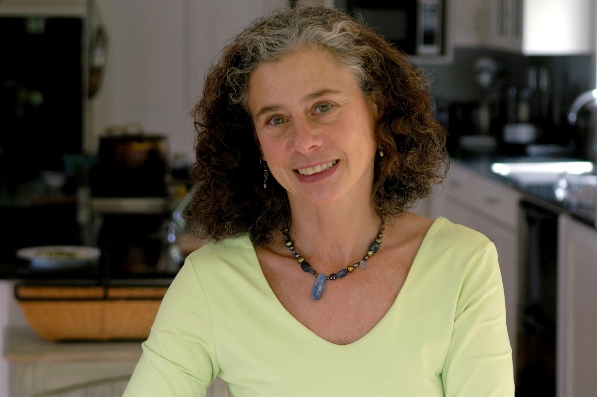
Darra Goldstein. Credit: Courtesy of Darra Goldstein
A computer whiz asked me out to dinner many years ago, back when Silicon Valley was just bursting into being. The guy lived in East Palo Alto in a funky, hand-built house. I was charmed. But the minute I walked through the door I sensed something amiss. No smell of onions or garlic greeted me; my date obviously was more interested in bytes than bites. The meal proved my nose right. Dinner consisted of righteously unseasoned brown rice with bean sprouts and sunflower seeds. I declined to date him again.
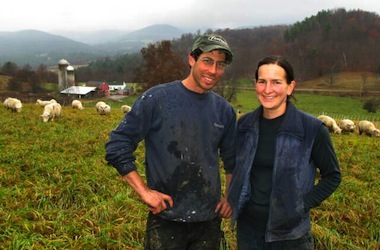
Healthy food in the ’60s and ’70s (“health food,” we called it) too often meant tasteless food. Sure, it was pure, both in terms of ingredients and ideology, but most people weren’t after exquisite taste. Now things are different. Every couple of weeks I go with my husband (who wooed me on paella and cheesecake not long after that brown rice encounter) to pick up our share of chicken at Hidden Pasture Farm, a small holding in the hills of southwestern Vermont run by young farmers Fiona Harrar and Seth Hanauer. We buy these chickens for several reasons: We want to support Fiona and Seth, and the chickens are genuinely free-range. But these worthy reasons remain secondary to what counts most for me. These chickens taste fabulous!
The Community Supported Agriculture movement in America began nearby here 25 years ago, yet the recent changes in this isolated corner of New England still surprise me. It’s the return of small farms. Dozens of smart, well-educated young people have chosen to move here, to devote themselves to farming. These young people have gone “back to the land,” as many of us dreamed of — and did — in the ’60s. But it’s very different now. Back then, embracing the land and eating whole foods meant a different kind of political statement. It was an act of rebellion, of dropping out. The 20-somethings involved in today’s Youth Food Movement are idealistic, to be sure, but also driven by a desire to engage rather than retreat. Instead of distrusting anyone over 30, they welcome the older generation as necessary partners in their quest to make the world whole again through food and farming. Their movement is consciously “glocal,” a neologism that grates on the ear but reflects the young people’s commitment to local food systems in the context of global communities. Or, as the Slow Food website explains, “We harness the potential of international fluidity and communication to positively affect local food communities and economies.”
Of course, every movement involves a degree of posturing, and food has certainly become a fad. The 1960s’ “back to the land” movement extolled Thoreauvian meditation. Today’s back-to-the-landers are more practical, and less starry-eyed. They use tractors and harvesters, not just shovels and hoes. Even the name — the Youth Food Movement — reflects their pragmatism, embracing not only the new generation of farmers, but also high school and college students. If this is a generation unsure of its place in a world that no longer feels safe, in the soil they discover a literal grounding.
 There is something deeply appealing, if old-fashioned, about relying on land for security. (I still remember my parents’ tattered copy of the small-farm handbook “Five Acres and Independence” in our suburban home.) Yet investing one’s savings in land is a very risky thing to do. Neither income nor yield can be assured. But the farmers, community activists and other participants in the Youth Food Movement believe that the nation can be saved by a commitment to the land. Row by row they will restore the soil and grow wholesome food to make people healthy again. For some, the social justice component is high; for others, it is a matter of individual or public health. For all, it represents a new American dream.
In the ’60s, you were either with us or against us; there was no middle ground. Today’s youth movement welcomes all types: brainy idealists, timid eaters, outraged activists. All are welcome; it is food that creates the community. Thus sit-ins are replaced by communal eat-ins, protest by positive action. If the Peace Corps was once the young idealist’s organization of choice, now that role may be filled by the Food Corps, a fledgling organization that hopes to send young people out into the fields and school cafeterias. College campuses nationwide are organizing their own Slow Food chapters; students at the University of California at Berkeley, ever ahead of the pack, have gone a step further to create CoFed, the Cooperative Food Empowerment Directive, intended to “electrify” college campuses around issues of food. The endorsements on CoFed’s website reveal a generation that has absorbed the lessons of self-esteem and individual agency. As one student writes, “I feel so empowered, so loved, so much a part of something and I am so motivated within this group to finally bring about change — something I have wanted to do for I couldn’t tell you how long. CoFed is the start of the food REVOLUTION! We are the food revolution!”
What does it mean when college kids would rather spend spring break WWOOFing in Europe than partying in Fort Lauderdale? Will the Youth Food Movement last? If so, how will it develop? Will its very popularity institutionalize (and therefore destroy) it? This is a wondrous cultural moment, in which everything is open-ended, utopian and potentially all-inclusive. Sowing, reaping, nourishing — the whole project is laden with metaphors that mask the hard physical labor involved. Yet even if the Youth Food Movement’s grand visions aren’t fully realized, there are worse places to look for enlightenment than the farm. Soil is surely healthier than drugs. And in the end, it might just prove more revelatory.
Darra Goldstein is the Francis Christopher Oakley Third Century Professor of Russian at Williams College, and the founding editor of Gastronomica: the Journal of Food and Culture. She is the author of four cookbooks — “A Taste of Russia,” “The Georgian Feast,” “The Winter Vegetarian” and “Baking Boot Camp at the CIA” — and has organized several exhibitions, including “Feeding Desire: Design and the Tools of the Table, 1500-2005,” at the Cooper-Hewitt, National Design Museum.
Photos, from top:
Darra Goldstein. Credit: Caleb Kenna
Young farmers Fiona Harrar and Seth Hanauer of Hidden Pasture Farm in Vermont. Credit: Carl Villanueva