Articles in Book Reviews
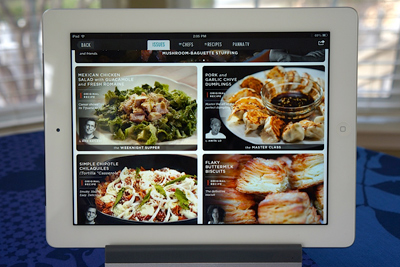
Gift shopping for gourmands is usually pretty easy. There is always a hot new cookbook or an expensive, must-have kitchen gadget (although these usually end up in the cupboard by the beginning of February, never to be seen again). But you don’t have to look far or spend much on a great gift for a tech-loving foodie. This season, there is an array of multimedia culinary iBooks, e-books and apps in the food and wine category. Plus, by going digital, you’ll avoid the shipping mayhem of the holidays (to say nothing of in-store shopping).
Most of these recommendations are more for the home cook or kitchen novice who wants some hand-holding, but others would also appeal to seasoned culinarians, like Julia Child’s “Mastering the Art of French Cooking: Selected Recipes.” This app includes charming recipe videos plucked from the PBS archives and current commentary from famed editor Judith Jones. And the pricey, professionally-geared industry bible from The Culinary Institute of America, “The Professional Chef” app, is an essential resource for any serious cook.
Here’s my take on some of the best titles out there. They are multimedia-rich and engaging at every level, with personalized video lessons from some of the best chefs and best-loved cooks in the country, people like Rick Bayless, Ree Drummond, Steven Raichlen, Amanda Hesser and Evan Kleiman. I’ve picked some old-school grand masters like James Beard and Julia Child, and some decidedly new school chefs like the Sussman brothers. You could even give a gift card and this list of suggestions, and let the recipient pick and choose whatever whets their appetite.
- “The Pioneer Woman Cooks: Food From My Frontier” by Ree Drummond
It’s almost impossible not to love Drummond, whose popular blog, The Pioneer Woman Cooks, has grown into a sprawling lifestyle website. She’s a natural: Her writing makes you laugh, and her recipes, while not fancy, will appeal to most everyone willing to admit that we don’t all eat “gourmet” every night. I’m a huge fan of any cookbook published with Apple’s iBooks authoring software because of its intuitive, flexible interface. Embedded slide shows, videos, pop-up definitions and photo-enhanced navigation take cookbooks like this to a whole new level. $11.99
- “A Girl and Her Pig” by April Bloomfield
Chef Bloomfield of The Spotted Pig, The Breslin and The John Dory, offers a behind-the-scenes view of her Michelin-starred style. By the time you are into the first few pages of this iBook, she will have thoroughly charmed you with her British brogue and impressed you with her focus on perfection. Quirky illustrations and great food photography support her casual writing style. $12.99
- “Appetite’s Easy as Pie” featuring Evan Kleiman
If you are a pie-making beginner, you won’t be after you follow Kleiman’s master class techniques one video at a time. Each video screen features slide-out sidebars of step-by-step instructions and ingredient details. On-screen links to core crust recipes make the basics a single touch away. Kleiman, a former restaurant owner and the host of the radio show “Good Food” on Los Angeles’ KCRW (88.9 FM), takes the fear out of crafting the perfect pie crust. This app’s interface, however, is not as intuitive as most. $2.99
- “The Essential James Beard Cookbook” by James Beard, Rick Rodgers and John Ferrone
If this new Beard cookbook is not already on your shelf, it belongs on your tablet. A compilation of 450 of Beard’s best recipes with updated details from editor Rodgers, this e-book provides a window into the beginning of the culinary movement in the United States as seen through the eyes of the pioneer himself. Each chapter is enhanced with an interactive recipe index, note taking, bookmarking and enhanced search functions. $16.99
- “Holiday Recipes & Party Planning Guide by Food 52″ by Amanda Hesser and Merrill Stubbs
Stumped for what to serve for the holidays? Award-winning authors Hesser and Stubbs, who run the website Food 52, have assembled a wonderful assortment of party suggestions. Sprinkled with an occasional video, lots of instructional slide shows and links to shopping options, this app should be your go-to holiday cooking resource. The intuitive iPad-only interface from inkling is one of my favorites. $2.99
- “Gilt Taste” by Gilt Groupe
Curated by Ruth Reichl, former editor in chief of Gourmet, this app provides a seamless interface between well-vetted recipes, interesting articles and shopping for gourmet supplies on Gilt Taste, the food-and-wine branch of the Gilt designer flash sale site. Best of all, it’s first to offer the magic of hands-free technology. Wave your hand over the screen and it moves back and forth between recipe pages. No more sticky, flour-covered screen. Free
- “Panna” Best Chefs Best Recipes
One of the newest subscription video magazines features master chefs Rick Bayless, Jonathan Waxman, Anita Lo and Nancy Silverton. The premiere issue of this classy quarterly publication features 12 original Thanksgiving recipes totaling 198 minutes of high-def video. The video presentation is so well done, it makes the viewer feel as if they are getting a private one-on-one cooking class from each master chef. $4.95/single or $14.95/year
- “Mastering the Art of French Cooking – Selected Recipes” — by Julia Child
Lifted from the pages of culinary history, this is one of the first apps I felt like sitting down and enjoying with a cup of tea. With vintage clips from Child’s PBS show, photos capturing her early life and commentary by her editor, it’s not a grand undertaking, it’s just charming. $4.99
- “Martha Stewart Makes Cookies” and “Martha Stewart Makes Cocktails” by Martha Stewart Living Omnimedia
You just have to give props to the M.S. machine. Both titles are well-designed, easy to follow, inspirational in depth and plenty functional. Although the apps are free, all those advantages still come at a price: Both apps are memory hogs. Free
- “The Professional Chef” by The Culinary Institute of America
Produced by the top cooking school in the nation, this powerhouse app includes 1,200 pages and more than 100 instructional videos. If you need more reasons to check this out, read my earlier review in Zester Daily. $49.99
- “Secrets of the World’s Best Grilling” by Steven Raichlen
Raichlen has taken his bestselling book on grilling and gone digital with an iBook version, all for the better. There may not be as many recipes as in the printed version, but that doesn’t matter when you have well-produced videos and slide shows to guide your instruction. I just wonder if the grazing cows in the background know what he’s firing up on the grill? $6.99
- “This Is a Cookbook” by Max Sussman & Eli Sussman
This iBook is proof that digital cookbooks are meant to be ripped into and used, because tablets don’t look all that cool on a coffee table. Chefs and brothers Max and Eli capture their Brooklyn-based food-consuming lifestyle using plenty of digital tricks in a fun, graphical style, including embedded audio interviews, “back story” pop-ups and slide shows. They even serve up their favorite food-inspired iTunes playlists if you want to go really deep and match the mood. It’s cookbook-cum-entertainment. $12.99
Photo: Panna, a subscription food magazine. Credit: Caroline J. Beck, with permission from Panna
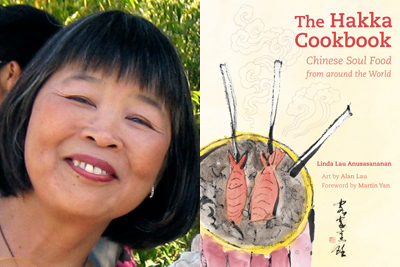
Good cookbooks that delve into a single area of China’s vast culinary culture are rarities. Fuchsia Dunlop’s “Land of Plenty,” the chronicle of how the author became the first Westerner to study full time at a cooking school in Sichuan province, comes first to mind; its combination of integrity, comprehensiveness and good writing made it an instant classic. Linda Lau Anusasananan’s “The Hakka Cookbook” easily vaults into this exclusive club.
Like Dunlop, Anusasananan weaves a tale around these foods, drawing us in and helping us not only understand what these foods taste and look like, but more important, why she loves them so.
All of the Hakka classics are here for the first time in an English cookbook, as well as local specialties from the diaspora that flung Hakka descendants to the far corners of the world. It’s a rich tapestry of stories, savory flavors and rich broths.
What is Hakka food? As Anusasananan’s little brother Gene described it, Hakka dishes are nothing less than “honest, earthy and rustic — the simple comforting soul food of the peasant.” Dishes born out of poverty and thriftiness seasoned with ingenuity and an eye to satisfy all of the senses — this is the essence of Hakka food.
These recipes were carried to China’s southern provinces when war and famine drove the ancestors of the Hakka from the central plains, starting almost 1,700 years ago. Left with few choices but to farm where others disdained to plow, these immigrants settled in the mountains of such provinces as Guangdong, Jiangxi and southern Fujian, where their newly-arrived status was enshrined in the name Hakka, or “guest families.”
Much like in-laws who are never quite absorbed into a close-knit family, the Hakka remained outsiders with their own language and cooking styles, marrying among themselves and creating a unique culture where women were expected to be strong and work in the fields, meaning that foot-binding was forbidden. This set them apart from their neighbors, and little ever changed since it was rare for anything new to ever find its way into their world. Thus, when the Hakka left China to make their way in other countries, they brought the ways of their ancestors with them.
‘Hakka Cookbook’ has generational appeal
An ethnic Hakka of an American-born mother and a father who emigrated from China, Anusasananan grew up in a small Northern California town, but as hers was the only non-white family, she did as just about every child in the same situation does and attempted to assimilate herself and erase the obvious differences. Fortunately, her maternal grandmother moved in and brought the old Hakka ways with her, as she had left the old country in 1921 to join her husband in California.
Popo, as she was called, “soon became the matriarch of our family. At 4 feet 10, she was a small woman with a big presence.” She taught her grandchildren about the flavors of her homeland and encouraged them to hold their heads up high. “You should be proud to be Hakka,” she admonished her grandchildren, and with her food she showed them why.
I admit, I am a bit biased. My late father-in-law, the best cook in the family, was Hakka, and we reveled in his New Year dishes: stuffed bean curd, salt-baked chicken, pork belly slices stuffed with preserved mustard greens … this was pure comfort.
And thanks to Popo and her food-loving granddaughter, we can eat these dishes as they were meant to be enjoyed because the recipes are clear. A longtime writer and editor for Sunset magazine, Anusasananan knows her way around a recipe, and her experience shows.
Even more wonderful for me, at least, was the glimpse into the lives of Hakka all over China, from Sichuan in the central regions to Taiwan and even Beijing. I had wondered as I opened this book, how has the food survived the onslaughts of history and the 21st century? With surprise and gratitude, I discovered, very well indeed.
Top photo composite:
Author Linda Lau Anusasananan and the cover of “The Hakka Cookbook.” Author photo credit: Therdphong Anusasananan. Book cover image courtesy of University of California Press.
I’ll admit it: before kids, the only things in my freezer were ice cubes, vodka and a pint of gelato. Oh how the mighty have fallen. With kids, I use my freezer for everything: homemade baby food, meat, vegetables, ice cream, chicken stock, shrimp shells, fruit and yes, ice cream. Forget making 30-minute meals every night; with two kids, I want to be able to pull a meal out of my freezer.
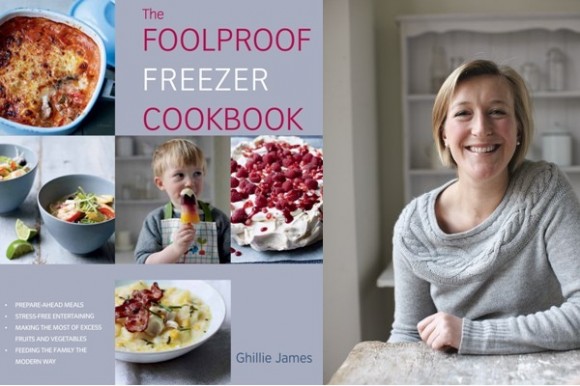
So I welcomed the addition of “The Foolproof Freezer Cookbook“ to my kitchen. I needed more inspiration (and more instruction) about what is (and isn’t) freezer-friendly. British cookbook author Ghillie James gives recipes and detailed instructions for stocking the freezer with weeknight meals and party food. And parents of young children, take note: There’s an entire chapter devoted to homemade baby and toddler food.
BOOK LINKS
“The Foolproof Freezer Cookbook: Prepare-ahead meals, Stress-free entertaining, Making the Most of Excess Fruits and Vegetables, Feeding the Family the Modern Way”
By Ghillie James
Kyle Books, 2012, 176 pp.
What I love most about James’ approach is her no-nonsense tone and factual information. She gives her many “reasons to freeze,” with guidelines on freezing and thawing. You don’t need a microwave to thaw frozen food, by the way. I don’t use one, I just use the refrigerator.
Freezer cookbook has adventurous side
I’m crazy about the idea of freezing as way of preserving the fruit of the season. Who doesn’t love the taste of a juicy summer peach on a cold winter morning? And James tells you how to freeze things you might otherwise have thrown out, such as excess egg yolks and white wine. There are flavorful recipes for everything from the more familiar (gazpacho, beef and spinach lasagna, sausage rolls with mustard and poppyseed, and quick double chocolate sheet cake) to the more adventurous (lamb and prune tagine, smoked fish, crab and watercress tart, and mojito sherbet). There are some decidedly British recipes — mincemeat, and orangy syrup tart that won’t be on the top of my must-try list — but there are plenty of others that are now in permanent rotation.
I was skeptical about losing flavor and any icicle freezer burn, but recipe after recipe thaws perfectly and you would never know it came from the freezer. The gorgeous photos and cheerful design add to the appeal.
Here’s a comforting recipe to transition into fall that the whole family will eat. And it’s the perfect way to try out your new freezer skills because the leftovers freeze beautifully. Note: Flageolet beans are immature kidney beans and can be hard to find in the United States; Great Northern beans are a good substitute. The recipe doesn’t call for a specific cut of meat, but I used pork shoulder, which worked well.
Pork and Flageolet Bean Stew
Serves 4
Ingredients
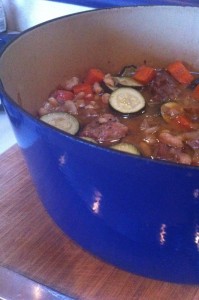
Pork and Flageolet Bean Stew. Credit: Laura Holmes Haddad
1 tablespoon vegetable oil
1 large onion, cut into wedges, or 3 good handfuls of frozen chopped onion
1 pound frozen cubes of pork leg, or fresh pork, cut into bite-size pieces
1½ inch piece fresh ginger, peeled and chopped
1 large garlic clove, chopped
3 carrots, peeled and chopped
1 medium baking apple, peeled, cored, and sliced, or a handful of frozen apple slices
heaping ⅓ cup white wine
1 tablespoon Worcestershire sauce
3 tablespoons honey
1 tablespoon soy sauce
1¼ cups vegetable stock
6 mushrooms, sliced, or 2 handfuls frozen mushroom slices
1 (14-ounce) can flageolet beans, drained and rinsed
1 medium zucchini, trimmed and sliced
Directions
1. Preheat the oven to 300 F.
2. In a heavy-bottomed casserole dish, heat the oil and add the onion. Soften over medium heat for 5 minutes.
3. Increase the heat and add the pork. Cook, stirring, for 5 minutes, then add the ginger, garlic, carrot, and apple and cook, stirring, for an additional 5 minutes.
4. Add the wine, Worcestershire sauce, honey, soy sauce, and vegetable stock. Season, stir, bring to a boil, and then cover and cook in the oven for an hour.
5. Remove the casserole from the oven and add the mushrooms, beans, and zucchini. Stir, cover the casserole, and return to the oven for an additional 30 minutes, or until the pork is tender.
6.Taste for seasoning and sweetness, then serve.
Top composite image:
“The Foolproof Freezer Cookbook” cover. Credit: Courtesy of Kyle Books
Author Ghillie James. Credit: Tara Fisher
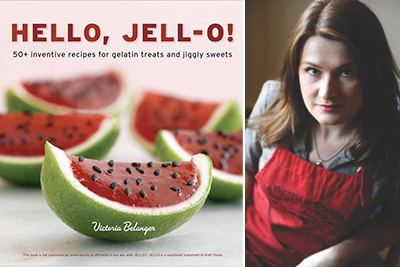
I picked up a copy of “Hello, Jell-O,” a new cookbook by Victoria Belanger (Ten Speed Press, 2012), with my 9-year-old daughter in mind. Jell-O, I thought, would be a fun food to make together this summer. She looked at the book’s cover of “petite watermelons,” red gelatin in lime rinds, and a big smile appeared. She went through every page of the book and quickly picked out several recipes to try.
I flipped through the book, not expecting much. I snobbishly avoid the Jell-O mold my mother sometimes serves at family gatherings. Something holds me back. I don’t know if it’s the obviously artificial coloring that turns me off or the fact that it’s sweet and served with our main (savory) course, but I never touch it.
‘Hello Jell-O’ has lineage
Oeufs en gelée, however, the French traîteur staple of a soft-boiled egg suspended in gelatin, often with a flourish of ham or smoked salmon and a fleck of parsley, is totally acceptable. I love it, in fact. And rectangular “cakes” of meats and vegetables, held together with aspic, are quite lovely. Cooks have used aspic since the Middle Ages (as a way of preserving foods) and Marie-Antoine Carême, the great French chef, embellished many dishes with aspic glazes in the 18th century. When food, fish, chicken or meat is covered with aspic mixed with a white or brown sauce, it’s a chaud-froid — something prepared hot (chaud) and served cold (froid). In the 1800s, French chef Jules Gouffé fiddled around with subjecting fruit to the chaud-froid treatment.
So Jell-O has its beginnings in fine French cuisine. Some of Belanger’s recipes are downright chic. Take, for instance, “sparkling Champagne and strawberries.” What a lovely way to end a meal. (Or begin one!) The sliced strawberries and bubbles suspended in golden individual molds were beautiful. The other eight “boozy molds,” as Belanger calls these adult concoctions, sound good too. The minty mojito might be up next.
Kitchen laboratory for kid-friendly recipes
The Fourth of July seemed to be the perfect occasion to try my daughter’s all-American selection of “root beer float squares.” Making the treat was like undertaking a science experiment (my daughter poking it with her finger throughout the process). We watched the powdered gelatin soak up the water and get puffy. Then we poured boiling water over it, stirred, and mixed some root beer into our potion. A white foam appeared which we skimmed off.
We chilled the mixture until it set, then cut the wobbly stuff into cubes. Part two of the recipe had us transforming vanilla ice cream into soup on the stove (what fun for a kid!) then mixing it with more gelatin. We poured that over the root beer cubes, chilled it and cut it into more cubes — now brown and white. They were a hit, but the real highlight was making them.
The tone of the Belanger’s book is just right. In the “Tips, Tricks, Tools and Techniques” section, for example, a heading reads: “How the %&@# do you get it out of the mold?”
While the author is having fun with her subject (and how could she not), she delivers helpful information. There are some nice photographs by Angie Cao and plenty of great recipes.
Belanger, who writes a blog called The Jello Mold Mistress of Brooklyn, offers recipes for layered molds, creamy molds, seasonal molds and even molds made with agar rather than gelatin, for vegans. There’s a strawberry-Nutella mold, and one made with green tea and milk. Peaches and cream, too. All require very few ingredients and seem easy to whip up. And so my daughter and I will. All summer long.
Top photo composite:
Cover of “Hello, Jell-O” and author Victoria Belanger. Credits: Courtesy of Ten Speed Press.
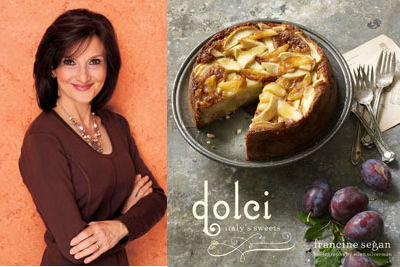
Spend any time with me and you’ll quickly learn that I love travel and I love sweets. Thus you can imagine my delight with Francine Segan’s latest cookbook “Dolci: Italy’s Sweets” (Stewart, Tabori & Chang, 2011). Here, the food historian, author and lecturer combines these two favorites, leading readers on a culinary tour of Italy’s extraordinary confections.
In “Dolci,” Segan shares the origins of and inspirations behind such classics as amaretti cookies, panna cotta and granita. She also looks at more contemporary creations, including yogurt semifreddo with radicchio marmalade and egg-less tiramisu. Throughout the book, she provides delectable recipes and fascinating insights into Italian culture and food.
Segan kicks off the journey by exploring the essential ingredients of this country’s sweets. These include candied fruit and fruit peel, grated vanilla bean and grape must syrup, or mosto cotto. She offers handy tips for grinding your own nut flour and substituting problematic ingredients such as raw eggs. Everything that readers need to create “Dolci” desserts can be found in the early pages of the book.
Basics in place, the author leads readers through beautifully photographed chapters on cookies, cakes and sweet breads; pies; refrigerator cakes; frozen desserts; and spoon sweets. Traditionally, spoon sweets refer to honeyed preserves served on a spoon. Yet Segan goes beyond this definition to include such treasures as Sicilian watermelon pudding, ricotta sundae and the velvety yet crisp coffee on a fork.
The creativity doesn’t end with spoons sweets. In the following chapter, “Weird and Wonderful, Unique and Unusual Desserts,” Segan highlights such inventive and toothsome gems as sweet chickpea baked ravioli, chocolate eggplant and pasta cake. Of the 11 desserts featured in this section, I am particularly smitten with the delicate mounds of pan-fried angel hair pasta known as Sicilian pasta crisps. Drizzled with orange-infused honey and then dusted with ground cinnamon and pistachios, these crisps are a snap to make and a joy to eat.
Holiday recipes from ‘Dolci’
Equally pleasurable are the offerings in the “Holiday Tradition” chapter. Once again, pasta makes a memorable appearance, this time in honey-drenched roses and the chocolaty Christmas walnut macaroni. Thanks to these inspiring treats, I no longer relegate pasta to savory dishes. Instead I do as cooks in Piedmont do — slather my vermicelli with creamy gianduia and present it as a surprising and sumptuous last course.
“Dolci” winds down its culinary trek with after-dinner drinks. Here Segan delves into homemade liqueurs such as cherry red alchermes and tart limoncello. She also explores such non-alcoholic beverages as hot chocolate and caffe shakerato — espresso sweetened, tumbled in a cocktail shaker and poured into chilled glasses. Glossaries on espresso, dessert wine and liqueur types are also provided.
The 10th and final chapter returns to essential ingredients. It features recipes for such fundamental dessert components as pie crust, sponge cake and pastry cream. Additionally, it covers jams, marmalade and candied orange peel. No need to waste time rummaging through gourmet shops searching for preserves or candied fruit. You can make these ingredients at home with minimal time or effort.
Recipes direct from Italy
The recipes in “Dolci” are unquestionably authentic. They originate not with New York-based Segan but with home bakers, pastry chefs, commercial producers and food writers throughout Italy. For each dish, Segan notes the region from which it came, for example sweet ricotta crepes from Puglia and “ugly but delicious” cookies, which are a specialty of Piedmont but are found throughout northern Italy. She likewise attributes the sweets to the locals who crafted or aided her in creating them.
Whether you adore travel and sweet treats or merely crave a new way to cap off your evening meal, take a peek at “Dolci: Italy’s Sweets” This comprehensive and clever cookbook is bound to inspire you.
Top photo composite:
Author Francine Segan. Credit: Daniela Stallinger; cover of “Dolci: Italy’s Sweets” courtesy of the publisher
Last fall, an article about cooking apps in the New York Times posed the question, “Are Cookbooks Obsolete?” It got me thinking about all the pleasure I derive from reading cookbook authors who are also great writers, and all that I would have missed over the years if apps had supplanted their books.
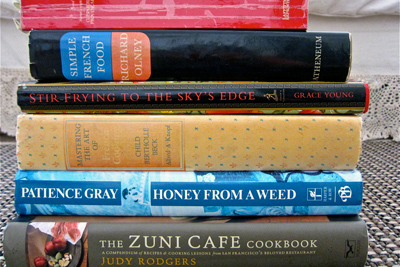
I’m not talking about memoirs or food writing without recipes, à la M.F.K. Fisher; I’m talking about wonderful writing in recipe books, many of which are written by unknown cooks who would have a difficult time finding a publisher today. Patience Gray’s “Honey From a Weed” is one of the most delectable cookbooks in my library.
Gray could show us how she makes her preserve of ripe peaches on YouTube, but would she say this?
“The sugar quickly melts and raising the heat you go on stirring, marveling at the changing colour of the fruit reminding one of Modigliani’s paintings. In 10 minutes or so, the jam is an intense gold, the fruit transparent … ”
* * *
One cookbook that I still read in bed is “Simple French Food,” by Richard Olney. I learned much about French country cooking, and specifically the cooking of Provence, from Olney’s book. I also learned something about him. Olney is opinionated and ornery, thoughtful and eloquent, passionate and poetic, even when discussing something as simple as the role of a hard-boiled egg in a salad:
“The hard-boiled egg is not simply another salad ingredient that may or may not find its place depending on the demands of décor or supplementary flavor. Its function, residing largely in the yolk, is, like that of salt, fundamental. It is a dulcifying agent, suavely veiling the bitterness of acerbity native to numerous leafy vegetables or bitter salads. With a vinaigrette or, more rarely, with cream and lemon, alone or in combination, chicory, endive, escarole, dandelion, par-boiled spinach (rinsed in cold water, squeezed, and coarsely chopped), lamb’s lettuce, or cress expands in its presence, mollified or flattered by the union … ”
***
Judy Rodgers’ “The Zuni Café Cookbook” is thick with prose but not weighty. You begin to thumb through looking for a recipe for your upcoming dinner party, but you end up just reading. Like the salt she uses to season her meats at just the right time, Judy Rodgers’ prose is purposeful. It tells her story (“My education in cooking began unassumingly in 1973 with a delicious ham sandwich on chewy, day-old pain de campagne, a spoonful of very spicy mustard, tarragon-laced cornichons, and a few sweet, tender crayfish as an hors d’oeuvre”) and the story of her restaurant, Zuni Café, but in the end what you get is a point of view, a philosophy of cooking. You can get lost in her three full pages on The Practice of Salting Early and come out the other side understanding what salting does and why you will do exactly what she tells you to do when you get to the recipes. It’s relaxing to read this big book; there’s nothing in it you’d want to miss.
There are cookbook authors who write about and teach technique, and yes, apps are fantastic for this. I hope that my stir-fry guru Grace Young does an app, but I would never want to trade in her wonderful book “Stir-Frying to the Sky’s Edge” for an abbreviated tablet version. Grace could show me how to make her friend Pepei’s stir-fried eggplant, but would that evoke the notion of alchemy that she senses when she watches the Shanghai native bring stir-fried eggplant to life in a New York apartment kitchen with “one meatball’s worth of pork,” a tiny pinch of minced ginger, and two crushed cloves of garlic “added just before she covers the wok and lets it sit off the heat long enough to coax the essence of fresh garlic into the eggplant”?
Sometimes great cookbook writing is just a memorable phrase, a laugh evoked by a one-liner that I’m grateful for. I am forever quoting this line from Russ Parsons’ “How to Pick a Peach”: “Let’s get one thing straight: Most eggplants are not bitter (even though they have every right to be after everything that has been said about them).”
***
Julia Child, who would have turned 100 today, was a living prototype for the app, so successfully did she fuse her talent for televised teaching with her tremendous ability to convey information on the page.
She and I corresponded in the 1970s after I wrote her a gushing fan letter. In one of her letters, she gave me a piece of advice about doing television that I cherish: “Do remember, when you are planning [recipes] for a TV presentation, that you should choose dishes that are visually interesting. Something like a Gaspacho [sic], where everything is dumped into a blender has no excitement at all! If you could blend, then do something fascinating, fine. In other words, if you can read it and do it, it’s not for TV. You want something that needs visual explanation.”
The thing about Julia Child’s recipes, though, is that they are so well written that you could read them and do them all.
Photo: Some of the author’s favorite cookbooks for reading. Credit: Martha Rose Shulman
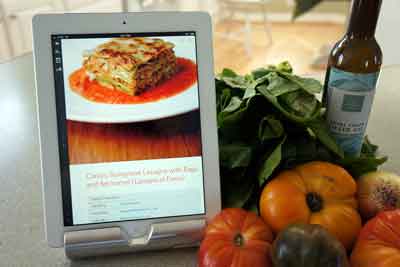
Today’s latest generation of chefs have never known a world without the Internet. They grew up with instant access to almost everything — from text messages with foodie friends to the smallest details about obscure ingredients that spark their culinary imagination. They might have a whisk or a chef’s knife in one hand, but they always have a smartphone in their pocket or an iPad in their bag.
With the ninth edition of “The Professional Chef,” a book long acknowledged as the bible for trained chefs and chefs-in-training, the Culinary Institute of America (CIA) embarked on an entirely new way to spread the word among its digitally-savvy student body. The CIA turned its 1,212-page, seven-pound, latest edition of “The Professional Chef” into a digital version capable of going viral.
BOOK AND APP REVIEW
TITLE: “The Professional Chef”
AUTHOR: The Culinary Institute of America
This is the first edition of the core textbook to fully embrace the next paradigm of publishing. A comparison between the hardbound classic and its new digital edition, an app created for Apple’s iPad, reveals just how much digital publishing can add to an education in the kitchen. Design-wise, it looks like the app led the way. The printed book includes sidebars, like “Method at a Glance” and “Method in Detail,” that mirror the app in content and style, but lack the interactive advantages of the electronic version. Unlike many e-books, this app is not just a digital replica of the printed page. It is an incredibly-packed kitchen reference for professionals and home chefs that takes learning to a new level.
‘The Professional Chef’ App has added features
What makes this zero-ounce offspring so much weightier than its seven-pound parent? First off, “The Professional Chef” was never designed to be a cookbook that you would curl up with to pore over recipes, inspiring photos and witty repartee. Like Escoffier’s Le Guide Culinaire, it was conceived and created as an encyclopedic tool providing detailed explanations of cooking methods, so employing the newest training techniques to inform the student just makes good sense. Second, there is nothing in the original that isn’t in the digital version, but there is plenty in the app that isn’t in the printed book.
The app follows the logical, progressive structure of its parent, with a chapter-by-chapter explanation of basic culinary techniques supported by hundreds of recipes showcasing the international world of cuisine. But this is where the commonalities end. As soon as you start to tap and swipe your way around the menus, you discover how easy it is to navigate through 1,200 pages of information, and how much more content and functionality is built into this interactive publishing platform.
The app version becomes the ultimate cross-reference tool for any chef, anywhere. Core recipes are embedded in derivative recipes — a pop-up box explains how to make Pastry Cream when it’s called for in the Diplomat Cream ingredient list. Don’t remember what mise-en-place means? No bother — tap the word and the definition is revealed. Like a particular recipe well enough to bookmark it for the future? One tap. Want to embellish a classic with some changes of your own? Make a note of it right on the recipe card. You can even test your culinary mettle with an interactive quiz at the end of every chapter. In the unlikely event that you find any errors in any of these incredibly well-vetted recipes, you can make notes of those too.
Video training on chefs’ technique, recipes
Then there is the big plus: 105 video training segments on everything from the proper way to trim a strip loin to the technique for preparing fish en papillote. They are well-filmed shorts embedded in chapters on technique, in recipes and in their own compiled index. It’s as close as you can come to having a world-class chef instructor from the CIA at your beck and call.
Finally, the appendix covers every essential piece of information from weight, volume and temperature conversions to details like cooking ratios and times for legumes, pasta and grains. And the omnipresent search engine icon covers the rest. In other words, if there is a culinary question you have, the search engine will find the answer. Even if it has to go to the web with automatic links to Google and Wikipedia.
The Culinary Institute of America, based in Hyde Park, N.Y., is the industry’s top culinary school in the United States. It brought in Inkling, a creator of electronic textbooks, to manage the transition of its definitive reference text to 21st-century training.
Attention, chefs: A digital requirement
As the authors pointed out in the book’s introduction, “The new look in this new edition reflects the way we think about teaching cooking. We learn best when we understand not only how to do something, but why we should do it that way.” Nowhere is that credo more apparent than with the new iPad app. In fact, the CIA will make this tool as much a classroom requirement for its students in the future as a basic set of chef’s knives.
So, could this $50 app replace the CIA’s $115,000 tuition? Of course not, but in its digital ink, its search engine and its videos, it contains the backbone of the school’s curriculum. It moves a classic into its rightful place in the next generation of kitchens.
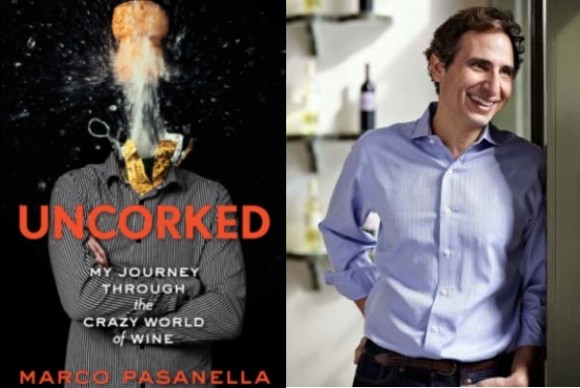
It’s hard to make wine come alive on the page (with a few notable exceptions; see Jay McInerney and Randall Grahm), but in “Uncorked: My Journey Through the Crazy World of Wine,” all it takes is one midlife crisis by an Italian-American to get you hooked. Marco Pasanella manages to create a page-turning look at the life of a wine store owner in Lower Manhattan and teach you a thing or two about wine along the way.
In 2002, Pasanella, a designer, and his wife decided to buy a five-story building in Lower Manhattan and open a wine store called Pasanella and Son. Watching a wine novice work his way through the bureaucracy and politics that make up the wine retail world is nothing short of amusing.
Highs and lows of owning a business
Marco and his wife Becky, who live on the floors above the store, work tirelessly to make their venture a success. (Becky works for Martha Stewart Living, and the description of getting the store ready for Martha Stewart’s private event is not to be missed.) Marco’s descriptions are nail-biting and hilarious, starting with the shop’s fishermen neighbors, one of whom is named Carmine, no less. The highs and lows of owning a business include enduring visits from New York state special agents who want to investigate alleged alcohol license violations, surviving a winemaker dinner that featured an exploding barbecue, managing employees of varying quality, and delivering wine in Manhattan in a 15-year-old Volvo station wagon.
You’re rooting for them the whole way. (And they do succeed; the shop is still going strong.) What keeps the book fresh is the organization. Each chapter starts with an element of winemaking (Prune, Harvest, Ferment, Crush) that sets the stage for another adventure at the store.
This isn’t a “wine book” per se; rather, little bits of information are sprinkled throughout the book (the sections on wine ratings and biodynamic wines are particularly informative). And the appendix is a compact guide to wine, including “Five Tips on Tasting Wine,” “Ten Ways to Taste Without Feeling Like a Snob” and a very helpful section on toasts. This is definitely a beach read for the wine lover or foodie in your life. My one quibble: There’s no index, so you have to search around to find your favorite passages or topics.
Having spent his holidays and summers in Lucca, Italy, Pasanella includes a handful of authentic Italian recipes. Here’s one of my favorites, a fish pasta dish from the renowned Italian chef Lorenzo Viani. Pasanella advises to “use the freshest fish.”
Bavette Sul Pesce Da Lorenzo (Lorenzos Fish Linguini)
Serves 4
Ingredients
4 tablespoons extra virgin olive oil
1 garlic clove
1 hot pepper
6½ ounces chopped mixed squid, cuttlefish and crayfish, cleaned
⅓ cup dry white wine
10 ounces bavette pasta (linguini may be substituted, although it lacks bavette’s sauce-cupping convex curves)
2 cups warm water
parsley (to garnish)
salt
Directions
1. Sauté the oil, garlic and pepper in a medium-hot large cast iron pan. Add the seafood.
2. Bathe everything in the white wine and reduce the heat to low.
3. Cook for a few minutes until the seafood has lots its translucency.
4. Add the bavette to the mixture, adding the warm water and constantly stirring with a wooden spoon until the bavette is al dente (8 to 10 minutes). Salt to taste.
Top photo composite:
“Uncorked: My Journey Through the Crazy World of Wine” book cover. Credit: Henrik Bostrom
Author Marco Pasanella. Credit: Lucas Allen