Articles in Drinking
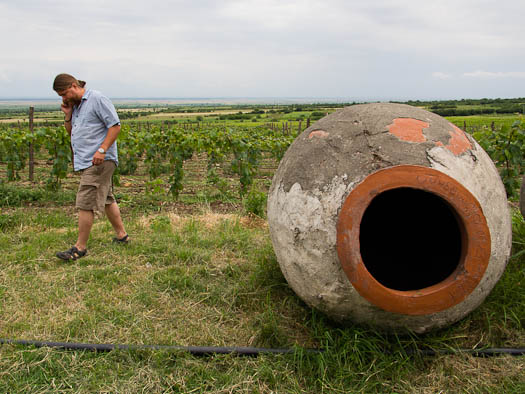
Throughout the winemaking areas of the republic of Georgia, the qvevri — large clay vessels like giant amphors — are being readied for the new grape harvest. This fascinating country, nestled between the Black Sea and the Caucasus mountains, has the world’s oldest winemaking tradition: Wine has been made there for 8,000 years. And it’s always been made in clay pots buried in the ground. (Versions of it were adopted in ancient Rome and Greece.)
What’s exciting, too, is that the Georgian method is now being used in several countries in Europe and beyond by a few passionate organic and biodynamic winemakers wanting to make what are being called “natural” wines. Indeed, I was first introduced to these huge clay pots in northeastern Italy, in the cellars of Josko Gravner. Gravner was the first non-Georgian winemaker to bring both the method and the Georgian qvevris to Italy. (He calls them anfore, or amphors, though strictly speaking amphors were used in the ancient world to transport wine, whereas the large immobile qvevri are used to make it in.)
More on Zester Daily:
Recently, I attended the International Qvevri Symposium in the handsome Georgian capital city, Tbilisi. The symposium showcases Georgia’s top wineries, including those that make wine in European-style barrels using international varieties. I was keen to learn more about the qvevri and their wines. A few are available in Europe, but this was a rare opportunity to find almost 20 professional qvevri producers — including two monasteries — gathered under one roof.
One of them was John Wurdeman, an American who has long been based in Georgia. As well as being an enthusiastic expert about all things Georgian — he sings in a marvelous polyphonic choir there — Wurdeman has set up one of the country’s most dynamic wineries, Pheasant’s Tears. I spoke to him on his stand at the symposium, and again a few days later as we toured his vineyards near his home in Sighnaghi, in the Khaketi region of eastern Georgia.
capalboqvevri1atthepottery-6080244
“Qvevri are like large coil pots with conical bottoms that are made by hand and fired in walk-in kilns by one of only five master potters who now remain,” he explains. “They are then buried in the ground — usually inside a cellar, but sometimes outside, too — and can range in size from 100 to 4,000 litres (26 to 1,056 gallons) in capacity.”
Cellars containing qvevri are disconcerting at first for those of us used to visiting rooms filled with vats and barrels. They seem empty, with just the qvevris’ round “necks” protruding from below. Yet the volumes of liquid being stored in the vessels underground give these cellars a very special atmosphere. They may seem empty, but one senses the presence of the wine below.
“Packing the qvevri in sand gives the wines stability, but the winemaking method differs, too,” he continues as we stand in his cellar overlooking the vineyards. “Clay is porous, so before the qvevri can receive the grapes, they need to be treated inside with hot beeswax. This goes deeply into the pores but does not completely seal the inside surface: a tiny bit of air needs to be able to breathe as the wines are being made.
“We crush our grapes lightly and put them into the qvevri, stems and all,” Wurdeman says. “This applies to both red and white grapes. The alcoholic fermentation gets underway within a few days, spontaneously, without the need for added yeasts.” Indeed, the qvevri cellars host wild yeasts in the same way that some caves help to ripen cheeses.
“That fermentation lasts for between two to four weeks. We punch the cap down twice a day during this period until it falls. Then, if the grapes are white, we leave the wine on its skins and stems. The red wines are handled differently: they’re taken off the skins and stems and transferred to another qvevri. Both types of wine are then loosely covered with a stone — again, to allow a tiny bit of air to enter. The malolactic, or secondary, fermentation begins spontaneously within a few weeks. When the malolactic is finished, the qvevri are sealed more tightly using a wooden lid and more beeswax, and a heavy stone is placed on top.
“That’s it until spring, when the earth’s temperature begins to warm. At that point the wines are racked: pumped out into bottles or into a clean qvevri, leaving behind the lees and any other sediment that has fallen into the vessels’ narrow, pointed bottoms.”
Georgian wine’s natural development
The qvevri’s stable temperature allows for a very slow, steady fermentation. Once the wine has been sealed into its home, the winemakers can’t — and don’t want to — interfere with its natural development.
“Everything depends on the quality of the grapes,” he adds. “We don’t use any of the chemical ‘correctors’ that many wineries resort to if problems occur during winemaking. This is how it’s always been done in Georgia, and the results are proof of how successful the method is. The white wines are particularly impressive: Deep amber in colour, they acquire as many tannins and polyphenols as red wines.
“The whites do acquire fragrance and an earthy body that makes them a perfect match for the diversity of Georgian food,” Wurdeman says as we sample a glass of his remarkable Rkatsiteli, an amber wine that hints at spice and honey in the nose, yet leaves the palate refreshed and dry.
This red-stemmed white grape is just one of dozens of native grape varieties the Georgians are working with that offer an exciting future for those wanting to discover winemaking’s ancient past.
Top photo: John Wurdeman at Pheasant’s Tears winery with a large qvevri. Credit: Carla Capalbo
When I was young and broke, one of the first dishes I learned to cook was risotto. I’d just moved into my own studio apartment after graduating from college, and was excited at the possibility of making myself whatever I wanted for dinner on a nightly basis.
My pitiful earnings waiting tables didn’t normally afford me the luxury of buying cookbooks, but as fate would have it, I stumbled across a bargain while combing the sale tables at Macy’s that week.
The book wasn’t authored by anyone famous, but it promised a variety of good, straightforward recipes. I don’t recall the title, but I do remember some of the dishes that became part of my regular rotation in those days: the Greek egg-lemon soup called avgolemono, lasagna roll-ups and my favorite, risotto.
Simple and seasonally adaptable
Before making it in my own little kitchen, the only risotto I’d ever tried came from restaurants. Despite the humble ingredients used to make it — rice, vegetables, stock — I thought of the dish as somewhat exotic. There was just something about its rich flavor and creamy texture that tasted like magic. When I cooked it for the first time, I couldn’t believe how easy it was: Just chop a few ingredients, throw them into a pot, sauté, add liquid and stir.
More on Zester Daily:
» No-stir risotto makes kid-friendly dinner
» Pumpkin risotto gives Thanksgiving a boost
Before long, I could make risotto without the recipe. I quickly discovered that pretty much anything I happened to have in the fridge, from squash to sausage, could be transformed into a velvety dish of heaven.
Although I no longer have the cookbook, the risotto has stayed with me for more than two decades. In the spring I make it with asparagus, shrimp and leeks and in the summer I add freshly shucked corn and ripe cherry tomatoes. But my favorite risotto is the autumn version, made with earthy mushrooms, crisp pancetta, gorgonzola and a drizzle of aged balsamic vinegar.
You can make it with pretty much any type of mushroom, from dried porcini to fresh cremini, but I prefer the heartiness of the portabella. Although you could substitute bacon for the pancetta, I find that pancetta adds a delicious depth of flavor that bacon can’t quite match. Chicken is my stock of choice, because it adds intensity to the dish, but you could easily substitute mushroom or vegetable stock if that’s your preference.
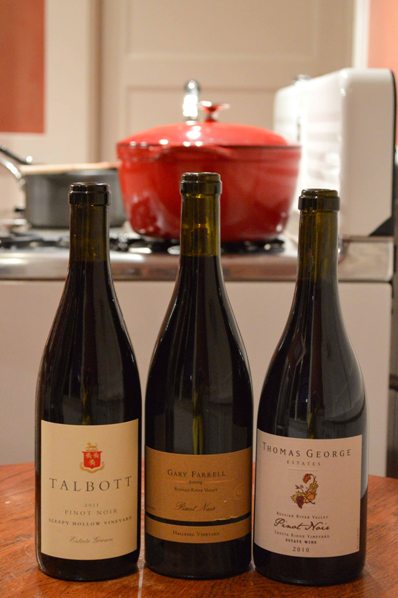
Pinot Noir to pair with risotto. Credit: Tina Caputo
Pinot Noir for the perfect pairing
A special dish like this deserves a wonderful wine, and I find that Pinot Noir, especially one with a bit of earthiness, is a great complement to the mushroomy richness of the risotto.
I recently paired the dish with three different Pinots: the Gary Farrell 2009 Hallberg Vineyard from Russian River Valley, the Talbott 2011 Sleepy Hollow Vineyard from the Santa Lucia Highlands and the Thomas George 2010 Cresta Ridge Vineyard from Russian River Valley.
The Gary Farrell was my favorite match, with its spiced black cherry flavor and bright acidity. The earthy notes in the Thomas George Pinot also worked well, and the Talbott’s ripe red fruit flavors and richness mimicked the lushness of the risotto.
Mushroom-Pancetta Risotto
Serves 4 (without leftovers) as a main dish
Ingredients
6 cups chicken stock (may substitute mushroom or vegetable stock)
1 tablespoon olive oil
2 ounces pancetta, roughly chopped
1 small onion, minced
2½ cups fresh mushrooms (portabella or cremini), cleaned and sliced
1½ cups arborio rice
1 teaspoon dried thyme
¼ cup dry white wine
1 ounce gorgonzola cheese, crumbled
½ cup Parmesan cheese, finely grated
2 tablespoons aged or *reduced balsamic vinegar
Fresh ground pepper to taste
* To reduce, add ¼ cup medium-quality balsamic vinegar to a small saucepan over medium-high heat and cook 2-4 minutes, until reduced by half. This gives it a thicker consistency and concentrates its flavor.
Directions
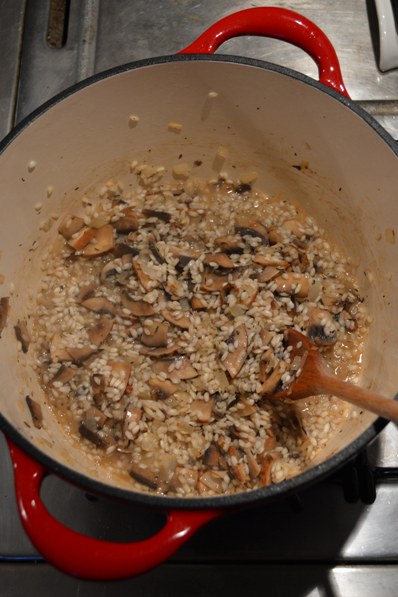
Risotto coming together on the stove. Credit: Tina Caputo
1. Heat stock in a saucepan and maintain at a low simmer on the stove.
2. Heat oil over medium heat in a wide, heavy saucepan (I like to use enameled cast iron). Add pancetta and stir until crisp. Remove it with a slotted spoon and let drain on a paper towel.
3. Add onion and stir until translucent. Add mushrooms and stir 2-3 minutes until they begin to soften. Add rice and thyme, and stir until rice is coated with oil. Add wine and stir until liquid is mostly absorbed.
4. Add ½ cup of stock and stir every minute or so until the liquid has nearly evaporated.
5. Repeat this process, adding ½ cup stock at a time, until the rice is al dente, about 20-25 minutes (you may not use all the stock).
6. Remove pan from heat. Stir in cheeses, cover and let stand five minutes. Add pepper to taste. (You can add a bit more hot stock if risotto seems too thick.) Chop cooled pancetta into smaller pieces. Just before serving, sprinkle risotto with pancetta and drizzle with balsamic vinegar.
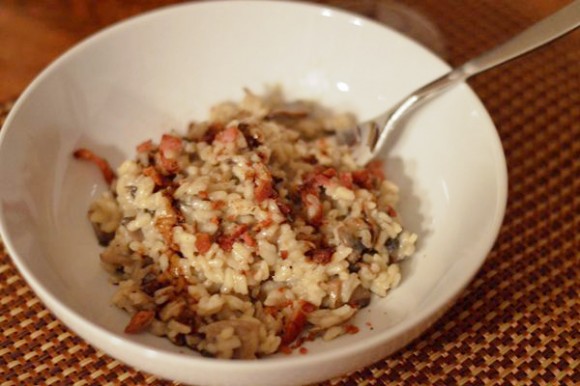
Top photo: Mushroom-Pancetta Risotto. Credit: Tina Caputo

The Greek island of Santorini is one of the world’s mysteries. Maybe it was the Atlantis of ancient civilizations; maybe it had an impact on the demise of the Minoan civilization. But there is no doubt about its breathtaking beauty. A dramatic volcanic eruption in about 1530 B.C. blew a great big hole in the middle of the island, forming a sea-filled crater, or caldera. On our first evening, we dined at the Santorini cooperative, Santo, and looked out on the sun setting over the caldera. Words could not do justice to the view.
More on Zester Daily:
» In Greece, a treasure trove of indigenous grapes
The next morning we saw our first vineyards, which are quite unlike any vineyards I have seen anywhere else in the world. The viticulture is so extreme that it has to be seen to be believed. The vines need protection from fierce wind and harsh sunshine, and so they are pruned in the shape of protective baskets in a small hollow. The soil is volcanic ash, with some pumice and other stones, but there is no organic matter, and it is astonishing that anything grows at all. There is no irrigation — the vines depend on sea mist for moisture and can also tap some water retained by the pumice stones after occasional rains. Inevitably, yields are tiny. The island is immune to the destructive insect phylloxera, for if there is no clay, there can be no phylloxera. Actual replanting is rare. When a vine needs replacing, it is “decapitated” and will regenerate from the existing deep root system. This can be done about every 80 years. When it is finally dying, after about 400 years, growers practice the system of provinage, taking a shoot and placing it in the ground so that it will grow roots.
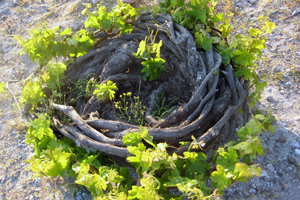
The traditional style of pruning grapevines on Santorini.
Credit: Rosemary George
There are very few conventional vineyards. The key exception is Sigalas, where the winemakers argue the case for more traditional viticulture, giving each vine a pole to help it withstand the wind. More leaves also help shade the grapes from the intense sunlight. In the 1980s, many vines were pulled up in favor of building accommodations for tourists, who provide the island’s main source of revenue. But in recent years, although the vineyard area has not changed, the average age of the winegrowers has decreased significantly, so the future of Santorini wine is more secure.
Assyrtiko elevates on Santorini
The principal white grape variety of Santorini is Assyrtiko, which is also found in northern Greece, but on the island it takes on a fabulously original mineral character.
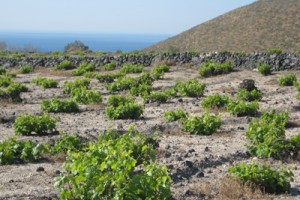
A vineyard in the Greek island of Santorini. Credit: Rosemary George
We tasted the wines of the eight main makers, including the cooperative that accounts for two-thirds of the production. The most typical were the mineral flavors of Assyrtiko, from producers such as Gaia, Hatzidakis and Argyros, with a wonderful depth of flavor. But there are also other grape varieties, white Athiri and Aidani, which can be blended with Assyrtiko and make for riper flavors, and gutsy red Mavrotragano, with some peppery fruit.
Santorini also produces dessert wine, vinsanto, a naturally sweet wine from dried grapes. Drying in the sun would be too brutal, so they are dried under cover and then the juice is put in a barrel and ignored for 10 years or so. Rediscovered, the result is something absolutely delicious, rich and concentrated with the flavors of dates and figs.
Top photo: Island of Santorini. Credit: Wikimedia Commons
Gone are the days when Greek wine was synonymous with the pine resin-flavoured retsina. Today, Greece is in the process of developing its true potential. In the course of a whirlwind week in Greece with 19 other Masters of wine, we found an enormous amount to explore and discover.
Greece has over 500 indigenous grape varieties, so a day did not go past without meeting a new one. International varieties such as Sauvignon, Chardonnay, Cabernet Sauvignon and Syrah have a much greater hold in the north of the country, whereas on the islands they only represent 5% of the production.
While most of the indigenous grapes will never gain international recognition, there are a few that are worth remembering, such as Moschofilero, with its lightly muscaty flavours, and Robola from Cephalonia, with delicate sappy flavours.
More on Zester Daily:
We tasted some 390 wines from 92 estates, and Alpha Estate really stood out for its excellence and innovative work. In some ways, Alpha is very typical of something that is happening all over Greece, one man with a broader vision developing his own estate.
Angelos Iatrides bought his first vineyards in 1995. He had studied in Bordeaux and worked in Madiran, and then back in Greece he helped create Ampelooiniki, a highly successful research station and consultancy business.

Angelos Iatrides of Alpha Estate.
Credit: Rosemary George
But Angelos really wanted to do his own thing, and with two other partners, chose a region that he felt was ripe for regeneration. This was the appellation of Amyndeon, not too far from the city of Thessaloniki. The Vitsi and Voros mountains are close by, and Bulgaria is in the near distance. Amyndeon, which has had vineyards since 300 B.C., is quite a small appellation, with seven producers, of whom Boutari and the cooperative are the biggest. Altogether, Angelos has 65 hectares of vineyards, including four hectares of old bush vines, which were planted in 1921. The vineyards lie on a plateau, between 570 and 700 meters (1,870 to 2,296 feet) to in altitude and the soil is sandy with limestone bedrock. The summers are so dry that irrigation is essential in August.
Angelos presented his wines with fluency and perception. As the tasting demonstrated, his methods encapsulate the best of modern Greek wine making, representing a break with the traditional and, it has to be said, the pretty primitive methods of the past. Work in the vineyard is paramount to quality and in the cellar oak aging is vital to the quality of the wines and meticulous attention is paid to detail.
Tasting notes
2009 Axia Red is 50% Syrah and 50% Xinomavro, so a blend of Greece and the international world, with 12 months aging in oak. The bordelais influence is inevitably strong in Angelos’ winemaking. Quite a smoky peppery nose, with rounded ripe fruit, balanced by both tannin and acidity. The Syrah was planted in 1995, an experimental vineyard in conjunction with the university of Suze la Rousse in the Rhone Valley. Angelos considers that it goes well with Xinomavro, and I couldn’t disagree.
2008 Xinomavro, PDO Amyndeon, from a single vineyard called Hedgehog
Medium colour. Hints of aniseed on the nose. Quite firm dry fruit with a touch of sweetness on the finish, demonstrating the suggestion that Xinomavro is a cross of flavours between Nebbiolo and Pinot Noir. Medium weight. 2008 was a riper vintage than 2009.
2009 Xinomavro, PDO Amynteon single vineyard Hedgehog
Quite a deep young colour. A smoky, chocolaty nose, and again with a hint of aniseed. Some dry fruit, with the elegance of a fine Nebbiolo. Quite smoky with intriguing nuances and textured layers. A lovely glass of wine.
2006 Xinomavro Reserve Old Vines
From the vineyard planted in 1921. Deep colour, showing very little age. Quite ripe chocolate notes on the nose and a supple rounded, ripe palate, with a balancing tannic streak. Good depth of flavour and finely crafted. Angelos explained that there is no risk of phylloxera as the soil is predominantly sandy. He uses horizontal fermenters which avoid extracting phenolics from the grape pips, and he observed that canopy management is important for ripening the grapes, saying, “You can’t just assume that with a warm climate, the grapes will ripen automatically.”
2007 Xinomavro Reserve Old Vines
“Reserve” for Angelos usually implies two years aging in wood, but this was only given 12 months. It depends on the vintage. And he uses steamed rather than toasted barrels. The colour was beginning to evolve. Rounded nose with a hint of aniseed. An elegant palate with supple tannins and ripe perfumed fruit. A lovely balance and a long finish.
2008 Xinomavro Reserve Old Vines
Medium colour, but not showing any age. Quite a firm dry palate, with some fruit. Still very youthful, with a certain freshness and some acidity on the finish, as well as tannin.
2006 Alpha Estate Red Blend
60% Syrah, 20% Merlot and 20% Xinomavro. Deep young colour, not showing any signs of age. Quite a dense ripe chocolaty nose, and on the palate, ripe and rounded, with some dense fruit, youthful tannin and an edge of acidity. Syrah provides the structure; Xinomavro the power and the aromatic complexity, and Merlot rounds out the palate. Angelos has Syrah, “because I like it” and Merlot is the link between Syrah and Xinomavro.
2007 Alpha Estate Red Blend
Deep colour. Quite a rounded smoky nose, and on the palate rounded, dense and ripe with some firm tannins. Youthful with plenty of potential. Yields are pretty low, with 28-35 hl/ha for red grapes and 42-45 hl/ha for whites.
2008 Alpha Estate Red Blend
The same blend Syrah, Merlot and Xinomavro. Deep colour. A certain earthy smokiness; a slightly sweet palate, with an earthy note and some cassis and a tannic streak. Not as harmonious as the two previous vintages, but probably needs some bottle age. One third was aged in new barrels.
2009 Utopia 95% Tannat, 5% Xinomavro. PGI Florina
It was a surprise to find Tannat in northern Greece, but there is a very simple explanation. After studying in Bordeaux, Angelos spent a vintage with Alain Brumont, at Château Montus, the leading Madiran estate, where Tannat is at its most typical. Deep young colour. The nose and palate were firm and structured, with some black fruit. Very characteristic of the grape variety.
2006 Alpha One, PGI Florina
A pure Tannat. Angelos was evidently very impressed by his stay in Madiran. Very deep young colour. Smokey chocolaty nose. Quite youthful, dense and intense. Firm black fruit on the palate, with a tannic edge. Youthful with plenty of potential to develop.
And we finished our tasting with a couple of white wines:
2012 Sauvignon blanc
Angelos wrote his thesis on the aromatic profile of Sauvignon and has worked with Denis Dubordieu, one of the leading proponents of the grape variety in Bordeaux. This wine had some lovely varietal character, with pithy notes on the nose, and mineral fruit with some texture and weight on the palate.
2012 Axia, PGI Florina Malagouzia
Light colour; quite delicate nose, with rounded fruit, acidity and balance. Elegant with some texture, and some intriguing nuances. It was a lovely glass of wine to finish a tasting that really illustrated the enormous potential of Greece for both indigenous and international grape varieties and showed just what can be achieved with a combination of energy and talent.
Top photo: A small fortress on an islet in the city of Nafplio. Credit: Rosemary George
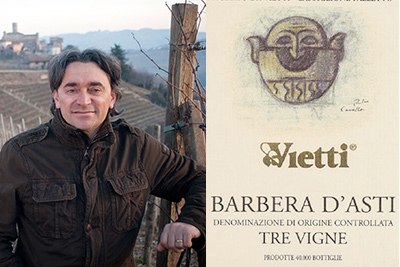
Italy is a huge source of reasonably-priced, food-friendly wines. This juicy, delicious 2010 Vietti Barbera d’Asti Tre Vigne, with its tangy taste of smoke, licorice and sour cherries is one of them. So it’s no surprise that it was one of the most-poured-wines-by-the-glass listed in Wine & Spirits Magazine’s 2013 restaurant poll.
Elin McCoy’s Wine of the Week
2010 Vietti Barbera d’Asti Tre Vigne
Price: $18
Region: Piedmont, Italy
Grape: 100% Barbera
Alcohol: 14%
Serve with: Pork medallions with onions, braised beef stew with Barbera, pasta Bologna
More of Elin’s wine picks:
» Smoothly rich, ruby red and intriguing 2008 Cascina Gilli Vigna del Forno Freisa d’Asti
» A striking, aromatic 2011 Masseria Li Veli Verdeca from Puglia
» An exciting Puglian red, 2005 “Puteus” Salice Salentino
Vietti is one of the top producers in Piedmont, where the star grape is Nebbiolo, which makes the region’s great, complex, long-lived and definitely pricey Barolos and Barbarescos. But as everywhere, hanging out with the star grape is rarely the way to get the region’s best buys. Barbera is less grand, but it’s also softer and more approachable than Nebbiolo, with charm, wonderful berry-like flavors, and the bright acidity that’s the key to its easy partnership with food. It’s the third most-planted red grape variety in Italy, and accounts for about half the grape plantings in Piedmont.
Founded in 1919, the Vietti winery is in a tiny village, Castiglione Falletto, and has about 90 acres of vineyards in various appellations. The late Alfredo Currado, who married the daughter of the winery’s founder, was one of the first to vinify grapes from single vineyards, then a revolutionary concept, and essentially rescued nearly extinct white grape Arneis from oblivion.
Their talented son Luca spent time in California at Opus One, and in Bordeaux at Mouton Rothschild before taking over as winemaker. His approach is to focus on organic viticulture and expressing the terroir or sense of place in the wines. The wines are clean and modern, but with a very traditional undertone. They’re rich but not heavy or extracted.
The winery makes five Barberas. This entry level Barbera d’Asti Tre Vigne is a blend of three vineyards in a designated region around the town of Asti. It’s usually released a year later. The Barbera d’Alba Tre Vigne comes from three vineyards in a neighboring area overlapping that of Barolo. The Barbera d’Alba is richer, bolder, more powerful, with more elegance, and costs a bit more. The three others come from special single vineyards; one is a cuvée of old vines.
Today, there’s a Barbera renaissance in Italy, but until fairly recently it was considered a rustic, peasant wine. Alfredo Currado was one of the pioneers who believed that growing it on top sites and keeping yields low was key to quality.
His son Luca carries on that idea, which is why this 2010 Barbera d’Asti Tre Vigne is so good.
Top composite photo: Winemaker Luca Currado and the label for 2010 Vietti Barbera d’Asti Tre Vigne. Credit: Vietti Winery

An arranged marriage between vodka and tomato juice, infinitely customizable with an assortment of stalk-like accoutrements, the Bloody Mary is thought to have been created shortly after World War I. An unknown American bartender in Paris usually gets the credit for creatively availing himself of some of the first tins of tomato juice imported from the United States.
The original recipe did not contain booze. Bartender Fernand Petiot at The St. Regis New York’s King Cole Bar in 1934 added vodka to tomato juice and came up with the name. It was apparently inspired by a bar regular named Mary, left waiting for her man while nursing one of Petiot’s tomato cocktails. Bar Mary’s plight was likened to that of England’s Queen Mary I, and thus the Bloody Mary was born.
The name was considered a little racy, so Petiot improvised a new version of the Bloody Mary with gin and called it a Red Snapper. But once Smirnoff vodka took America by storm in the 1960s, making vodka more mainstream, the Bloody Mary roared again.
It has a reputation as a hangover remedy, and the Bloody Mary is abidingly good after a big night out thanks to the richness of the tomato juice, which also provides acidity. Spice comes from the traditional Tabasco, though some bartenders prefer Louisiana hot sauce, horseradish or other concoctions of their own.
Themes on the classic Bloody Mary abound, and in honor of its history, each St. Regis hotel has its own signature Bloody Mary. The luxurious Lanesborough Hotel in London, part of the St. Regis family, makes one with fresh yellow tomato juice and rosemary-infused vodka. In Kauai, the Aloha Mary is a blend of organic Hawaiian vodka, Clamato juice, wasabi, Sriracha and local guava wood-smoked sea salt, garnished with sea asparagus. For this week’s recipe, master barman Tony Abou-Ganim provides a very spicy take on the old classic, the Bloody Bull, thought to have originated in New Orleans.
Bloody Bull
Courtesy Tony Abou-Ganim, “Vodka Distilled”
Serves 1
Ingredients
2 ounces vodka, preferably one made from rye or mixed grain
2 ounces tomato juice
2 ounces beef bouillon
½ ounce freshly squeezed lemon juice
3 dashes Worcestershire sauce
2 dashes Tabasco sauce
Pinch of kosher salt
Pinch of coarsely ground black pepper
Directions
1. Place all ingredients into a mixing glass.
2. Add ice and roll contents between mixing glass and shaker tin until well mixed.
3. Strain into an ice-filled Collins glass.
4. Garnish with a wedge of lemon.
Top photo: The Bloody Bull. Credit: The Lanesborough Hotel, London
The mood was a bit somber at this summer’s Riesling Rendezvous in Seattle. This three-day event, sponsored by Germany’s Weingut Dr. Loosen and Washington’s Chateau Ste. Michelle, features tastings and seminars designed to promote what many connoisseurs consider the world’s greatest white wine grape. In the past, the combination of great wine and a shared sense of purpose made for an unabashedly joyful atmosphere. This time, there was a hint of suspicion, if not fear, in the air.
The reason wasn’t hard to identify. Even before the first tasting, Ted Basler, Ste. Michelle’s CEO, greeted attendees with the news that sales were down. In the United States, the dip in last year’s numbers came after five years of growth. Enthusiasm elsewhere seemed to wane too. The grape’s image among wine’s cognoscenti remains strong, but as Ernst Loosen asked plaintively, “What about the general consumer?” Even in Riesling’s historic homeland of Germany, he lamented, more people buy Pinot Grigio.
More on Zester Daily:
Speakers at the event fingered plenty of suspects over the next couple of days. In addition to Pinot Grigio, there was Moscato, sweet and sappy and apparently taking the wine world by storm these days. And Chardonnay, a favorite whipping boy of anyone trying to promote almost any other white wine. And even Sauvignon Blanc, which British writer Tim Atkin confessed to finding “rather simple, after all.”
The tastings revealed a different culprit — Riesling itself. Or to be more precise, the remarkable range of styles it comes in these days. While that range delighted devotees in Seattle, it also can confuse, if not intimidate, less confident wine drinkers. Put simply, many people find it difficult to know what they’re going to get when they buy a bottle of Riesling.
Other classic varietal wines come in two or three styles, but Riesling yields rich wines alongside austere ones, wines that are ethereally light and those that taste sumptuously honeyed. Some Rieslings are bracingly dry, others decadently sweet; some offer a fruit cocktail’s mélange of flavors, while still others taste steely and mineral-laden. The grape’s diversity defines its character.
Sweetness is certainly one source of consumer confusion. Some vintners try to help by including a “taste profile” on their wines’ back labels. This sliding scale helps wary drinkers predict how sweet a wine might be. Yet wine styles involve more than just sugar. Flavor and texture prove equally important, and no scale exists to measure those. Wines made with Riesling run the gamut from lush to lean, and fruit-filled to stony. Attempts to pigeonhole them invariably fail.
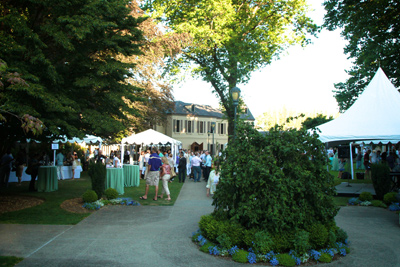
Guests arrive for the Riesling Rendezvous at Chateau Ste. Michelle in Seattle. Credit: Chateau Ste. Michelle
It became clear over the course of the three days in Seattle that people need to embrace rather than shun Riesling’s stylistic range if it ever is to become more than a wine for aficionados. For general consumers, whether in the United States or abroad, doing so will signal a maturing appreciation, as one of the great joys of wine comes from diversity. After all, if every wine tasted much the same as every other, the thrill of discovery would be just a one-time phenomenon. And no grape provides more ongoing thrills than Riesling.
To even begin to comprehend the myriad delights that Riesling can provide, one needs to approach wines made from it with an open mind, even if doing so sometimes means being unsure of exactly how they will taste. Just as the experience of the concert hall would be diminished if only one type of music were played, Riesling would not merit a “Rendezvous” of celebration were it stylistically monolithic. Its remarkable diversity explains why, despite the note of gloom in some of the presentations, the wines being poured in Seattle promised brighter days to come.
Riesling tasting notes
I tasted nearly 2oo wines at the “Riesling Rendezvous,” the vast majority of which were extremely compelling. Space prohibits identifying all of them, but here are 10, listed alphabetically, that especially impressed me. Taken together, they illustrate how wonderfully wide-ranging this singular grape can be.
Battenfeld-Spanier, “Frauenberg” Rheinhessen Germany 2008
A rich, complex bouquet suggests sweetness, but the wine finishes deliciously dry.
Chateau Ste. Michelle, “Ethos Late Harvest” Columbia Valley Washington 2011
Very sweet but elegant. Drink it as (not with) dessert.
Chehalem, “Coral Creek” Willamette Valley Oregon 2011
Beautifully balanced, with a subtle sweetness and a sumptuous texture.
Domäne Wachau, Smargard Achleiten Wachau Austria 2009
Slightly honeyed aromatics, but dry on the palate with a creamy feel.
Flat Rock Cellars, Ontario Canada 2012
Delicate, almost lacy, with a superior bouquet and an ever-evolving finish.
Framingham, “F-Series” Spätlese Marlborough New Zealand 2012
An exotic fruit character augmented by a deep minerality, all in exquisite balance.
Frankland Estate, “Smith Cullam” Frankland River Western Australia 2011
Richly perfumed with a hint of seductive sweetness and a firm acidic backbone.
Leitz, “Rüdesheimer Berg Roseneck” Spätlese Rheingau Germany 2004
Riesling can age spectacularly well, as this succulent, almost creamy 9-year-old demonstrates.
Maximin Grünhaus, “Grunhauser Abstsberg Superior” Mosel Germany 2011
An evocative bouquet leads to slightly sweet flavors and a lacy texture.
Red Newt Cellars, “Bullhorn Creek Vineyard” Seneca Lake New York 2011
Fully dry, with a complex assortment of herb and mineral flavors in the finish.
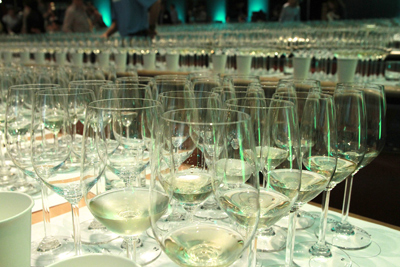
Top photo: Glasses of wine at the Riesling Rendezvous at Chateau Ste. Michelle in Seattle. Credit: Chateau Ste. Michelle
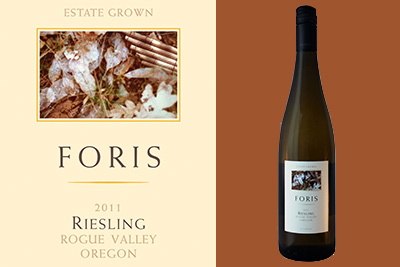
Riesling spent years on the unfashionable grape list, but that’s over, thankfully, and the varietal has been experiencing a serious comeback. This light, fruity-tart 2011 Foris Riesling from Oregon’s Rogue Valley, with its flavors of bright citrus and green apple flavors and only 11% alcohol (!), is one of the many fine and inexpensive ones available. It’s a bit in the Alsace style, and like many Rieslings, it’s exceptionally food-friendly. It was the perfect choice with scallops and bok choy laced with lemon slices at a recent dinner. And it was another reminder that Oregon wine country is about a lot more than Pinot Noir.
Elin McCoy’s Wine of the Week
2011 Foris Riesling
Price: $13.50
Region: Rogue Valley, Oregon
Grape: 100% Riesling
Alcohol: 11%
Serve with: Ham, smoked salmon and trout with horseradish cream sauce, sautéed scallops
More from Zester Daily:
» Looking back at the Summer of Riesling
» An Oregon Riesling served at Obama state dinner
Riesling’s revival in the U.S. owes much to sommelier and self-described “acid freak” Paul Grieco, co-owner of New York’s Terroir wine bars and Hearth restaurant. He initiated the Summer of Riesling movement back in 2008, when he decided the only white wines he’d pour by the glass in his wine bars and restaurant from June to September would be Riesling. Now the idea has gone national and a www.summerofriesling.com page lists hundreds of participants and events. There’s still time to join in, as these continue through Sept. 21.
It’s not surprising that Oregon has become a source of interesting Rieslings. The state’s cool climate and ancient volcanic soils give the wines a unique character. It was one of the first varietals planted, and in the 1980s, nearly 25% of the state’s vines were Riesling. Then Pinot Noir started grabbing everyone’s attention. Today, only about 50 wineries (of 450) produce Riesling.
The Foris winery goes back to 1971, when Ted Gerber and his first wife Meri bought vineyard land in remote Illinois Valley in southwest Oregon. In 1974 they planted Pinot Noir and Alsace varietals — Pinot Blanc, Pinot Gris, Gewurztraminer and, of course, Riesling. At first they sold grapes, but in 1986, they founded their boutique winery, which now produces wines from about 180 acres divided among four vineyards in the Rogue Valley appellation. Like Alsace, their vineyards experience a wide diurnal shift — warm days, cool nights — that gives the wines roundness and crisp acidity.
This 2011 Foris Riesling has both, which is why it’s so delicious with food.
Try it and see.
Top photo composite: Label and bottle for the 2011 Foris Riesling. Credit: foriswine.com