Articles in Fruit
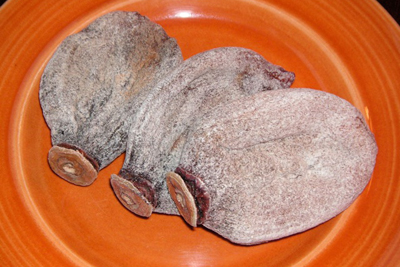
Every December for the past 40 years, my parents in Tokyo have received a package of hoshigaki, dried Hachiya persimmons, in the mail from my old Japanese language tutor who lives in Ogaki, Gifu prefecture in the center of Japan. Eight acorn-shaped hoshigakis – perfectly uniform in size, their skin soft and smooth, with an earthy orange hue and dusted in a powdery white sugar — lay in a bed of straw.
As a girl, each time I opened the package, I was astonished by the beautiful presentation and the floral scent of the hoshigakis. My mother would brew some green tea and cut up a couple of hoshigakis into several pieces. We kids were never allowed a whole. The sweet-tasting fruit with a sip from a mildly bitter cup of tea made us feel momentarily like grown-ups. The artisanal hoshigaki, which the Tsuchiyas have been producing for more than 250 years, are called Gozen Shirogaki, or Imperial White Persimmons — named in honor of Emperor Meiji, who loved them. Gozen Shirogakis are highly sought after, commanding more than $10 apiece. I can’t recall being a particularly good student, but my family considers themselves lucky to be on Tsuchiya’s perennial hoshigaki list.
Discovering local hoshigaki in Southern California
I never imagined in my dreams that I could get artisanal hoshigakis locally in Los Angeles, where I have lived for most of my life. But a few years ago, I was at the Santa Monica Farmers Market and happened on the stand of Penryn Orchards, where I came upon boxes of hoshigaki made with Hachiya persimmons. Their earthy orange hue, dusty white surface and aesthetic presentation immediately brought me back to Tsuchiya’s hoshigakis. I bought a box and tasted one. The fruit was sweet and delicately chewy, with a lovely floral scent. I was absolutely delighted by the discovery.
Jeff Rieger, the owner of Penryn Orchards, a mustached man in a baseball cap wearing a sunburnt flannel shirt, described the flavor of hoshigakis as reminiscent of gingerbread. I smiled at his description because it sounded so American to me, but it rang true. It was also at the farmers market that I met his French girlfriend, Laurence Hauben, who explained to me that they made their hoshigakis entirely by hand, following the traditional Japanese method.
The history of Penryn Orchard goes back to 2002, when Jeff, a builder by trade, bought the 4.5-acre orchard in Auburn in Placer Country in the foothills of the Sierras from a Japanese-American couple, George and Micky Oki. Jeff was going to develop the land and sell it but fell in love with the old trees, including the nine varieties of persimmon trees; he resolved to become a farmer. With help from Laurence, Jeff grows 56 varieties of fruit — among them O’Henry peaches; Satsuma mandarins; Kousui Asian pears; Mutsu apples; and Hachiya, Fuyu, Chocolate, Maru and Gosho persimmons, to name a few — on about 300 trees in total and produces 400 pounds of hoshigakis.
The hoshigaki workshop
After being Penryn’s eager hoshigaki customer for several years, I asked Laurence, who gives regular cooking workshops at her house in Santa Barbara, to teach me how to make them .
I got 10 friends from Los Angeles, and we carpooled to Santa Barbara on a Sunday that couldn’t have been more beautiful and fall-like to be outdoors, to make hoshigakis. Unlike the commercially dried fruits that get sliced up and shriveled in dehydrators, hoshigakis are dried whole in open air. The drying involves a laborious, 40-day process. Laurence said that hoshigaki making is great for children because they learn to follow through with a project from beginning to end. I say many adults, including myself, could benefit from this practice.
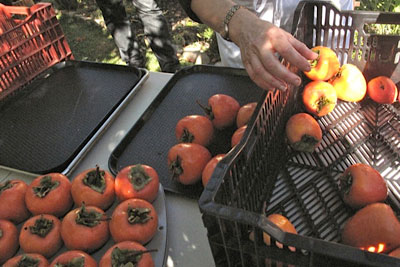
We washed the persimmons; paired up the fruits that were more or less the same size; pared the tops off, careful not to cut off the stems; peeled the skin and strung the fruit using 21-inch-long twine. Some fruit came stemless, but Laurence had a solution for that. She drilled a non-corrosive nail into them and — voila! — they were good to go.
We hung the persimmons on bamboo poles to dry in a sunny room. Traditionally, hoshigakis are dried outdoors and brought indoors at night, but Laurence recommended drying them indoors in a sunny room to keep them away from dust, dirt and critters. Good circulation is important to prevent the fruit from molding. The white coat you can see on hoshigakis forms from natural sugar crystals that have been exuded from the persimmons by gentle and daily massaging, which also softens the inner pulp and holds their acorn shape. The white sugar crystals of persimmons are used in Chinese medicine for their beneficial cooling properties. Laurence showed us how to massage the persimmons by applying pressure on our hands.
The workshop included a lovely lunch of homemade Thai curry soup; a kale salad garnished with pomegranates, Fuyu persimmons, and walnuts; and a persimmon cake. Also, there were artisanal breads made by a local baker named Lily, who later brought over another batch of breads, fresh out of the oven, for us to take home. There was homemade cider, called Apicius, made by Remi Lauvand, a French chef who concocted the fruit-less cider from his mother’s recipe. He said the recipe was a secret. It was amazingly refreshing and tasted like herbs. Laurence’s hoshigaki workshop offered the best possible combination of Japanese, French and California cultures coming together elegantly in one place.
Back in Los Angeles, my persimmons are hanging in the sunny den in a place my kitten cannot reach. I have detected no mold so far, and the persimmons are beginning to soften with my daily massage. Progress is slow but solid. If I remain patient and thorough, which is my goal, I may just get rewarded with a light coat of white on my hoshigakis.
Photo: Hoshigakis, with their white covering of dried sugar crystals. Credit: Laurence Hauben
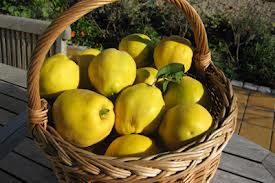
If you’ve not yet met a quince, you have a treat in store. These fragrant, downy, golden globes, distant relatives of the apple family, are not so much forbidden fruits as forgotten fruits. They ripen in late fall, and by Christmas they’ve all but vanished. If you’re lucky enough to find some, swoop on them and set them on a beautiful plate in the kitchen while you consider what to do with them. While you deliberate, the air will be filled with their delicate, faintly lemony scent, likened by 10th century Arab-Andalusian poet Shafer ben Utman al-Mushafi to the perfume of a loved woman.

A quince tree. Credit: Sue Style
One idea is to peel and core them and bake them whole in the oven, bathed in a syrup of honey, sugar, lemon juice and water. Done this way, they turn magically from a brilliant daffodil yellow to a burnished coppery color. They’re amazingly good served warm with vanilla ice cream. Or chop them up and turn them into chutney, mixed with oranges, raisins, white wine vinegar, sugar and loads of ginger. For an original apple tart, substitute a quince for one of the apples, peel and grate the fruit together, mix with cream, eggs and sugar and bake in a fragile pastry case. Best of all, turn them into a shimmering jelly, which makes a delightful Christmas gift. Pour into pretty pots, cut fabric hats for the tops and label the jars with pride. Append a little note to each jar explaining to the lucky recipient that quince jelly is magic on toast or melted and brushed over an apple tart to give a glossy, totally professional French pastry shop finish.
Quince Jelly
Makes about 8 (1-pound) jars
Ingredients
8 quince
Sugar
Juice from 1 lemon
Directions
1. Take 8 fine, ripe, yellow quinces, scrub them well to remove any down and cut away any brown bits.
2. Cut the fruit in quarters and chop roughly (no need to remove the peel or cores). They’re very hard, so a good, stout knife will be necessary.
3. Put the chopped flesh in a preserving pan.
4. Add enough water to cover the chopped quinces (about 8 cups, depending on your pan and the size of the quinces).
5. Simmer quince very gently for about 45 minutes or until soft when pierced with a knife.
6. Tip the quince into a colander lined with a muslin or other fine cloth set over a large bowl.
7. Leave overnight to let the juice seep gently out – it’s permissible to give it a bit of a squeeze at the end to extract maximum juice, but don’t overdo this or the juice will be cloudy.
8. Discard all the pulp.
9. Pour juice into a measuring jug. For every 4 cups of liquid, allow 1½ pounds of sugar.
10. Put juice and sugar, plus the juice of 1 lemon, in the preserving pan.
11. Bring to a rolling boil, then boil for 20 to 30 minutes.
12. Start testing for a good set after about 25 minutes: Place a saucer in the freezer, spoon a little jelly onto it, leave for a few seconds, then pull your finger through it. The jelly should wrinkle and form a distinct channel.
13. Pour jelly into sterilized jars and cover while still warm.
14. Eat with a runcible spoon.
Top photo: Freshly picked quince in a basket. Credit: Sue Style
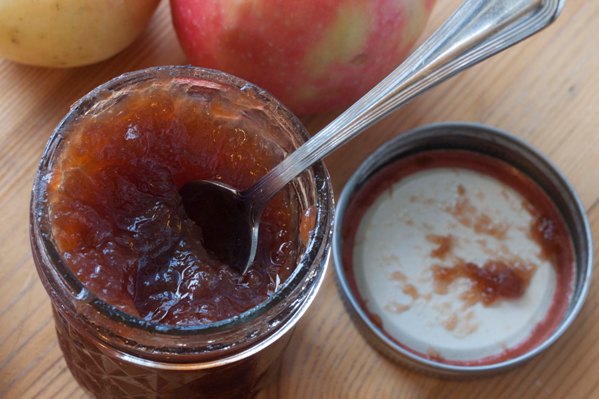
Apple butter might not seem like a traditional holiday food, but it holds a place of honor at my family’s Thanksgiving and Christmas table in Virginia. Stored in mason jars in the cellar or pantry until opened, then kept in the fridge, the apple butter gets its own special serving dish at my family’s holiday meals. Every few years we forget to put out the apple butter, but as soon as we start passing the homemade rolls, someone (usually my father) inevitably asks for it.
Because apple butter is traditionally made in the fall after apples are harvested, it also makes a great holiday gift.
In the Shenandoah Valley of Virginia, where I grew up, gallons and gallons of apple butter are made by groups of people who gather for an “apple butter boiling.” The results are then canned and sold as fundraisers for local churches, fire halls and civic organizations.
Not a hurried process
Making apple butter this way is a two-day process. It takes 15 to 18 bushels of apples to make a large kettle of apple butter, so preparing the apples is an event in itself. On the evening before the apple butter boiling, people gather to peel and core the apples and cut them into slices called “snits.”
The next day is devoted to cooking down the apples in a large copper kettle over an open fire. It takes hours to boil down the apples in a bath of apple cider and the pot must be stirred the entire time. It’s traditional to add 10 to 12 pennies to the bottom of the kettle as you start to boil the apples in the kettle. Nobody really knows why, but some people think it keeps the apples from sticking to the bottom and burning. There’s even a special way to stir the kettle and a rhyme to help remember how to do it.
Once around the side and twice through the middle,
Don’t you burn that apple butter ‘kittle.’
People in the community buy apple-butter from the communal “boiling” for themselves and to give as holiday gifts. I grew up in Winchester, the apple capitol of Virginia, so my perspective on apple butter may be slightly skewed, but it’s been my experience that you can find apple butter anywhere people grow apples, at least in this country.
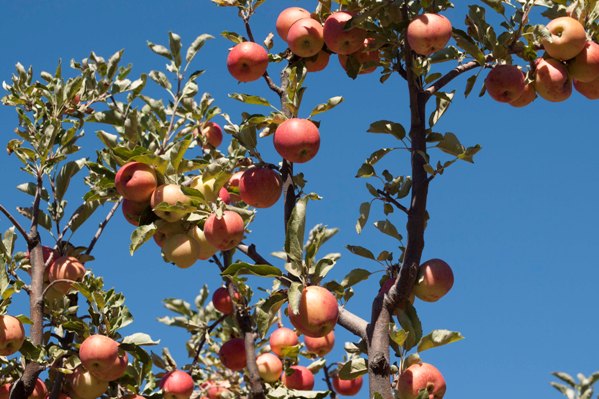
However, if you don’t have a local civic group that takes two days to make apple butter for you, you’ll probably have to do it yourself. I don’t mean to imply that you can’t buy apple butter at the grocery store. You can. But it’s not the same. So this year I embarked on a quest to create the kind of apple butter I grew up with.
A new generation
My husband and I took our daughters to pick apples in our local apple country at a place called Oak Glen, Calif., about an hour and a half east of Los Angeles. When I told my dad what we were planning, he said, “I always wondered who went to those places. Seems smarter to have someone else do the hard work and pick out the good apples for you.”
Clearly, he is a man who grew up picking his own apples from his family’s small orchard. I was embarrassed at first, but also defensive when I said, “So you WANT your granddaughters to grow up not knowing how to pick apples? The phone line was silent for a minute before he replied, “Yeah, I guess you’re right.” Point made.
My family happily harvested apples at Riley’s Farm (and enjoyed the hay ride and other “old-timey” events). A few days later we began to make our own apple butter. My father happened to be visiting when we made the second batch. I’m pleased to report that he sat at my stove dutifully stirring the pot of apple butter for an hour and a half one evening. Such is my father’s love of apple butter and family.
The apple butter we made is so thick that it will pile up on a spoon and melt in your mouth. It is dark brown in color, generously spiced with cinnamon and cloves and never gritty. My recipe makes about nine half-pint jars so if you go to the trouble of making it, you’ll have plenty to share. That is, unless you’re a part of my family, in which case you’ll have to make at least two batches of the stuff for your own family’s use. That’s what I did this year and I think I might make another batch or two before the holidays roll around so I have some to give away as presents.
Country-Style Apple Butter
Yield: 9 to 10 half-pints
I am grateful to Phyllis Shenk and Betty Sheetz for sharing their apple butter recipe with me and allowing me to attend their family’s joint apple butter boiling about 10 years ago.
Both of these amazing women have since passed away, and I often think of them as I stir my apple butter “kettle.” Although they’d probably get a good chuckle at the “tiny” quantity of apple butter this recipe makes, I think they’d like it. I’m sure it would please them both to know that I’m teaching my daughters to love apple butter and to learn their traditional apple butter stirring-rhyme.
Note: This is not the fastest or easiest way to make apple butter. It’s still a two-day process, even without the open fire and copper kettle.
My recipe calls for using a combination of a slow-cooker and stirring a pot on the stove for several hours. Using the slow-cooker allows me to cut down on stirring time by about 1½ hours, while still getting the rich, dark color I like.
Ingredients
8 pounds of apples (Phyllis and Betty recommend using Ben Davis or Rome apples. They say never use Staymen because they cook up “stringy.” I’ve used a combination of Jonathans and Senshus with great success. Avoid overripe, mealy apples of all varieties.)
2 cups apple cider vinegar (5% acidity)
1½ tablespoons whole cloves
1 cinnamon stick
½ teaspoon ground cinnamon (optional)
1 spice bag (or a piece of cheese cloth with a string to tie it shut)
4½ to 5 cups white sugar (The total amount of sugar used depends on sweetness of the apples. You can also substitute light brown sugar for white sugar.)
½ teaspoon ground cinnamon (optional)
2 cups apple cider or water (Sometimes I need to add a little extra water to the pot during the second cooking phase on the stove-top if I turn the heat up too high during the cooking process.)
Directions
1. Wash, peel, core, and slice apples into at least 8 pieces about ¼ to ½ inch thick. You should end up with approximately 6 to 6½ pounds of sliced apples from 8 pounds of whole apples.
2. Warm the apple cider vinegar and 1 cup of water or apple cider in a medium sauce pan.
3. Place apples, spice bag containing the cloves and cinnamon stick, and warmed liquid mixture in a slow cooker. Cook on high, with covered lid, for 8 hours. Don’t do this overnight because you want to watch the cooking process to make sure the apples don’t scorch. The cooking time will depend on the heat of your slow cooker. If you have a high-powered slow cooker, cook on low heat.
If all the apples won’t fit into your slow cooker, you can place the extra apples in a medium sauce pan with at least 1 cup of the original liquid mixture. Heat the pot of apples and liquid mixture slowly on the stove and keep the pot covered. When apples in the slow cooker have cooked down a bit, add the softened apples from the pot into the slow cooker.
4. After 5 hours, open the lid and taste the liquid. Remove the spice bag if you like the flavor. For a stronger flavor, leave the spice bag in the mixture until you achieve the desired spiciness. Continue cooking for a total of at least 8 hours.
5. After 8 hours, the apples should be very soft. They will also have produced a large quantity of liquid. Cool the apple mixture and put it into the refrigerator overnight.
6. The next day, put the apple and liquid mixture into a large non-reactive pot and heat slowly, stirring constantly. If you don’t like slightly lumpy apple butter (as I do), you can run the apple mixture through a food mill or use an immersion blender to get rid of some of the lumps before you begin heating it.
7. Cook on medium-low heat, stirring constantly, for approximately 1½ to 2 hours until the apples are dark brown in color and have the consistency of slightly lumpy applesauce. Add 1 cup of additional water (or apple cider) if the pot starts to get dry before the apples have thoroughly cooked. Be careful to keep heat low enough that the mixture does not bubble up and burn you while you’re stirring the pot.
8. When the apple butter has thickened, add 4 ½ cups sugar, continuing to stir the pot.
Taste for flavor. Add up to ½ cup of additional sugar and ½ teaspoon of ground cinnamon if needed.
9. Continue to cook, stirring constantly, until mixture reaches desired consistency. To test for doneness, remove a spoonful and see if it mounds on the spoon. You can also put a small spoonful of apple butter onto a plate and watch to see if a rim of liquid forms around the mound. If it does, continue cooking until a spoonful of apple butter mounds on the plate without creating a puddle of liquid around it.
10. While apple butter is cooking, sterilize half-pint jars.
When apple butter is done, pour it into hot half-pint jars, leaving ¼-inch headspace. Wipe the rims of the jars and put on lids and screw rings. Process for 5 minutes in a boiling water bath following USDA recommendations.
Photo: Apple butter. Credit: Susan Lutz
Like most Americans, I grew up equating Thanksgiving with turkey and pumpkin pie. To cap off the meal with any other dessert would have seemed un-American. Yet, after more than 30 years of eating pumpkin at the holidays, I started craving a new fruit. Enter the persimmon.
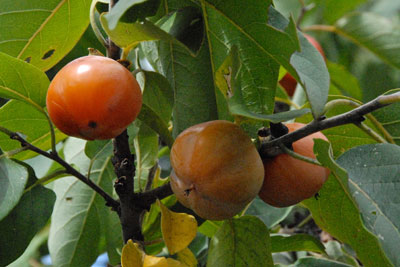
The Algonquin Indians called this squat, smooth-skinned, red-orange fruit putchamin. Found throughout eastern North America, the sweet persimmon was a favorite of Native Americans as well as European colonists who had learned from local tribes how to pick and consume it. In the 17th century, Virginia’s Capt. John Smith even boasted that, when ripe, this unique produce was as sweet and delicious as apricots.
By 1709, settlers had phonetically altered the fruit’s spelling to persimmon. They did not, though, radically change how they used it.
From the Native Americans the settlers learned to wait until a persimmon had ripened and fallen from the tree to eat it. Along with consuming it straight from the ground, they featured it in puddings, breads, preserves, cakes and pies. They turned it into “simmon” beer and wine, beverages that were particularly popular during Colonial times. They likewise dried it for later usage.
Ripe persimmons have sweet flavor
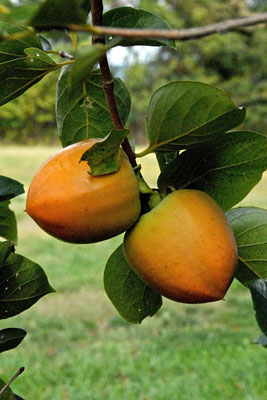
Hachiya persimmons. Credit: Kathy Hunt
What the settlers had understood is that, when green, a persimmon is more or less inedible. Its custardy flesh contains tannins that, unless the fruit has fully matured, make it pungently bitter. When ripe, though, it’s a creamy, honeyed treat.
My husband learned the ripeness rule firsthand when he plucked a hard, cherry-sized, yellowish-orange persimmon from a friend’s backyard tree. He bit into and immediately spat out the acrid flesh. It was, in a word, “horrible.” Only time and some culinary trickery could convince him to give persimmons another chance.
Although some gardeners insist it’s a myth, most believe that the fruit hits its prime after a good frost. Wives’ tale or not, I have popped immature, whole persimmons into the freezer overnight and then thawed them at room temperature. Defrosted, they became soft and delicious.
Persimmon season runs from September through December. Look for soft, deep reddish-orange fruit with all four papery leaves intact. Store at room temperature and consume within two days.
Before eating a persimmon, remove the leaves and seeds; I usually cut them out with a paring knife. You can then either scoop out the jellied flesh or slice the fruit and dig in.
While our ancestors enjoyed the petite American persimmon, today we mostly consume one of two larger, Japanese varieties, Hachiya or Fuyu. Similar to the American persimmon, the oblong Hachiya tastes best when fully ripened. The plump, tomato-shaped Fuyu can be eaten straight from the tree. No collecting of fallen fruit is necessary.
Fuyu and Hachiya possess a sweet, mildly pumpkin-like flavor. That’s why I consider persimmons a good substitute for the usual pumpkin pie. Similar to pumpkin, they go well with cinnamon, cream, ice cream and nutmeg. They also pair nicely with such common holiday ingredients as apples, cloves, ginger, pears, pecans, raisins, vanilla, walnuts, brandy and wine.
The beauty of persimmons is that they don’t require much effort to shine. After scooping out or slicing up the flesh, you can pulse it in a food processor or blender with a little vanilla, cinnamon and/or rum. Spoon the purée into dainty bowls and refrigerate until ready to serve.
In parts of the Southeast and Midwest, baked persimmon pudding remains a Thanksgiving favorite. Featuring puréed persimmons, buttermilk and spices, it’s a warm, tasty treat.
Puddings and purées may be nice, but I tend to prefer a more substantial dessert, such as a pie or tart. Easy to make, persimmon tart requires only four ingredients: puff pastry, sliced persimmons, butter and sugar. It’s a simple, sweet and delightful alternative to the old standby, pumpkin pie.
Persimmon Tart
Serves 6
Ingredients
4 tablespoons unsalted butter
⅔ cup sugar
½ teaspoon cinnamon
¼ teaspoon nutmeg
⅛ teaspoon ground ginger
3 to 4 ripe persimmons, trimmed, seeded and sliced (Use four if you are using smaller American persimmons or three if you use the larger Fuyu or Hachiya persimmons.)
1 sheet frozen puff pastry, defrosted
Directions
1. Preheat the oven to 400 F.
2. In a 9-inch, oven-safe pan melt the butter, sugar, cinnamon, nutmeg and ginger over medium heat, stirring to combine.
3. Once the sauce has thickened slightly and turned a light caramel color, place the persimmon slices in the pan. Overlap them slightly and neatly. Reduce the heat to medium-low and simmer for 3 to 5 minutes, until the persimmons begin to meld with the sauce.
4. Place the puff pastry over the persimmons and tuck in the edges of the dough. Poke a few holes in the top of the pastry and then bake until the tart is golden and puffed up, about 20 minutes.
5. Remove the tart from the oven and cool slightly. Invert the tart onto a serving platter.
6. Serve warm with an optional side of vanilla or cinnamon ice cream.
Photo: American persimmons. Credit: Kathy Hunt
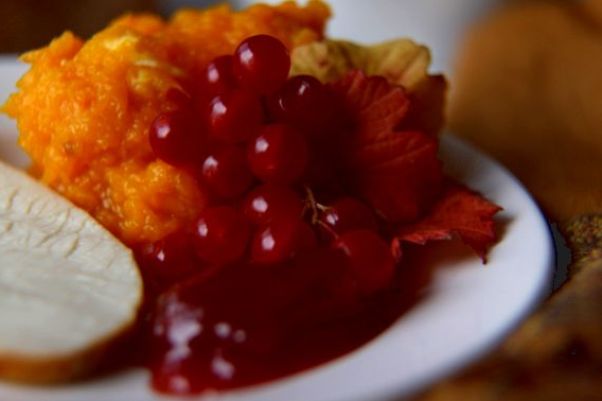
The first time I spotted a highbush cranberry bush (Viburnum opulus), I was riding my bike along a ditch in early December. Nestled up against the Rocky Mountains, it had been freezing hard for months by that time, and it was rare to see anything left to forage, let alone finding bright red berries. I had to stop my bike and investigate the fruit that had caught my eye.
There’s an old wives’ tale that if a bird won’t eat a fruit, it’s poisonous. It turns out that isn’t true for many fruits, including highbush cranberries. But nature has its own wisdom. While these cranberries are indeed edible, most creatures avoid them because they possess sourness and a scent verging on funk. As a forager desperate for material with which to play, I picked those highbush cranberries and have every year since.
Due to their musky scent, in my house, highbush cranberries have earned the nickname, “stinky sock berries.” The smell of them is so strong that I even go to the trouble to cook them outside, so that I don’t need to air out my home after making highbush cranberry sauce.
In North America, V. trilobum and V. edulis, are the preferred species because they are less bitter. The ones I have access to are the ones forager Sam Thayer has dubbed “bad” highbush cranberries, V. opulus. They are native to Europe, but here they are merely escaped ornamental plants.
Look for berries during frost season
True cranberries are a member of the Heath family. Highbush cranberries are in the Honeysuckle family, and are related to elderberries, which can also have a characteristic musk. Highbush cranberry fruit, or drupes, grow on a deciduous shrub that grows to about 12 feet to 15 feet hight. Its opposite, serrated, tri-lobed leaves resemble those of a maple tree.
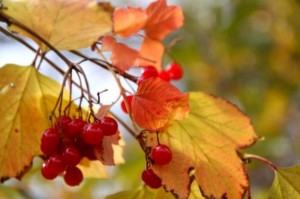
Highbush cranberries. Credit: Wendy Petty
Historically, the bark of the highbush cranberry has been used for menstrual cramps, accounting for one of its common names, crampbark. In the spring, the shrub blossoms with fireworks-like bursts of white flowers, somewhat resembling hydrangeas with smaller flowers in the center, and larger sterile flowers bordering them in a ring. Highbush cranberry shrubs fruit in late summer, at first green then turning red. Each individual red berry contains a single flat disk-shaped seed.
There is some conflict as to whether to harvest highbush cranberries before or after the frost. To my palate, the V. opulus taste about the same before and after a frost, although they are softer and easier to run through a food mill after a freeze. The good news is that highbush cranberries are relatively easy to pick. The drupes can quite easily be pulled from the shrubs without a mess.
Some good food comes with a little funk
Despite their detractors, stinky-sour “bad” highbush cranberries have their uses. Some of the world’s most sought-after foods have a distinctive funk. Can you imagine haute cuisine without pungent foods like cheese and truffles?
Long cold winters with few plants to forage force quite a bit of creativity. Highbush cranberries possess a strong flavor, to be sure. But used with a deft hand, they are a great pair with game meats, offal and other strong flavors. One of my favorite ways to serve highbush cranberry sauce is with liver.
Needless to say, highbush cranberries are a food for adventurous palates. However, for those who dare to walk on the wild side, they can bring an unusual new flavor to the Thanksgiving table. Highbush cranberries marry particularly well with the darker, gamier meat of heritage breed and wild turkeys.
Highbush Cranberry Sauce
Ingredients
3 cups highbush cranberries, stripped from stems
1 cup sugar
2 teaspoons orange zest
Juice of 1 orange
Pinch of salt
Directions
1. Pass the raw highbush cranberries through a food mill. Their disk-shaped seeds and skins should easily be left behind. You will be left with a pulpy red juice.
2. Pour the raw highbush cranberry juice into a heavy-bottomed pan and add the remaining ingredients.
3. Over medium heat, bring the ingredients to a low boil, so that large bubbles rise around the edge of the pot. Turn the heat down to medium-low so that the mixture remains at a low boil.
4. Continue to cook, skimming off and discarding any scum that rises to the top of the pan, for 20 to 30 minutes, or until the highbush cranberry sauce resembles the texture of jam. Test this by dropping 4 to 5 drops onto a metal spoon and placing the spoon in the freeze for a minute. If the sauce is ready, it will resemble the texture of jam after being in the freezer. If not, it will still be runny, and will need to be cooked down further and retested until it has become jam-like in consistency.
5. Pour the hot highbush cranberry sauce into a sterilized jar. Let cool to room temperature.
6. Refrigerate the highbush cranberry sauce until you are ready to use it. It may be eaten cold, or warmed.
Photo: Highbush cranberry sauce. Credit: Wendy Petty
Nordic countries have outstanding berries; sweet and tasty, often small. The most popular in Denmark is the strawberry. The season starts around our midsummer celebration, Sankt Hans Aften, or St. John’s Eve, on June 23, and sometimes before. As a child growing up, we always had the first strawberries on midsummer night.
In the first few weeks, the berries are expensive, but then prices start to slide down to normal. Many families serve strawberries every day in the season, which can last from three to eight weeks depending on the weather. It is a popular berry to grow in home gardens, especially varieties like Dybdahl and Senga Sengana. Freshly picked and served with sugar and crème, this is a national summer dessert.
A new look at Danish tradition
Right now Denmark is experiencing a food revolution with Noma as the leading star. We have new farmers and a bigger variety of produce than ever. A lot of chefs here say that the new Nordic movement started because we lacked an interesting food culture. It’s not so much that; we do have a strong food culture, but it was considered third tier, after French and Italian. Now Denmark is experiencing an evolution of its tradition with more variety and closer attention paid to the season.
We are also experiencing a restaurant boom. We prefer as a culture to cook and eat at home, but that is changing with the new generations. Still, it is very expensive to dine out here, given the 25% VAT tax and a minimum restaurant salary of $20 per hour.
Strawberries have always been part of the tradition, usually served simply, raw with milk or with the cold fruit porridge.
I’ve never tasted better strawberries than the Danish varieties. As a little girl I picked them with my granny. We would go home with our summer treasure, rinse and freeze one batch and use the other to make cordials, jams and preserves.
Danish strawberries are all about versatility
Strawberries are eaten with raw oat flakes and cold milk in the morning and cut in slices and served on rye bread, open sandwich style. They’re made into cold soups and drinks with fresh mint, preserved whole for dessert, added to ice cream and sorbet, mixed with rhubarb for marmalade, tossed in salads with watermelon and feta and fresh mint, mixed with a little good quality raspberry vinegar and served with blue cheese.
The Danish dessert equivalent to tiramisu is “rød grød med fløde,” a fruit porridge served cold with cream. Almost any American, who has visited Denmark has been ask to try to pronounce the name of this dessert (oej goej mej floeje), which is almost impossible, and for some reason it always makes Danes laugh! It is nonetheless easy to prepare.
Serve the fruit porridge with cream or whole milk, never low-fat milk. The porridge has an intense flavor and high acidity which the cream balances. This is an important part of the taste.
Rød grød med fløde (Danish strawberry porridge)
Serves 6
Ingredients
4 pounds strawberries, rinsed and halved
400 grams (14 ounces) sugar
1 vanilla pod, halved lengthwise
4 tablespoons cornstarch
¼ cup of water
2 to 3 tablespoons caster sugar to sprinkle
2 to 3 cups cream
Directions
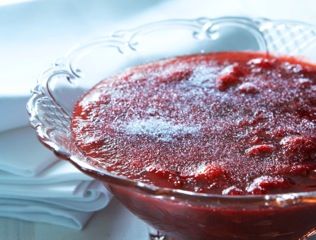
1. Place berries, sugar and vanilla bean in a pot and bring to a boil. Remove any white scum from the surface, lower the heat, and let simmer for 20 minutes.
2. Dissolve cornstarch in the water, and stir into porridge. Keep stirring as mixture returns to a boil. As soon as it starts thickening turn off the heat.
3. Pour into a serving bowl, sprinkle with a thin layer of caster sugar, and cool completely.
Serve with cold cream.
Photo: Danish strawberry dessert Rød grød med fløde. Credit: Trine Hahnemann

Nowadays most people hardly know what a quince looks like. Until the 19th century, it was a commonplace orchard fruit throughout North America and Europe; now it has become the lost fruit. Out of season, they are impossible to obtain, and even in season they are usually available only at the more inspired farmers markets and a few selective shops. This seems a sorry state of affairs for a fruit that is delicious in sweet and savory dishes, can easily be preserved and will enhance a room with an unmistakable yet delicate fragrance.
Apples stole the credit
Quinces originally came to America and Europe from Central Asia, where they grow wild in the foothills of the Caucasus Mountains in Turkestan and Iran. While apples tend to get the credit, quinces were quite possibly the Forbidden Fruit in the Garden of Eden, and the fruit Paris gave Aphrodite; it was said that quince trees grew up wherever she walked. Much later Edward Lear’s Owl and Pussycat dined on quinces at their wedding feast, echoing the Greek tradition of using quinces at weddings to ensure commitment and fertility.

Quinces have been used in Persian cooking for more than 2,500 years but probably reached Britain in the 13th century where they appear in recipes for pies sweetened with honey. They were one of the first fruits to be introduced to the colonies in North America by the British settlers, where they were widely cultivated by the 1720s. Many of the early American varieties were distinguished by shape: “apple” or “pear” type.
In the 1850s, Rev. William Meech discovered the “Pear-Shaped Orange Quince” in Connecticut. From 1888 onward, this variety has been known as Meech’s Prolific in recognition of its reliable high yields. A 19th-century French nursery catalog deemed it “Remarkable for its superior quality.” Yet today, Meech’s Prolific is comparatively rare in the U.S. and only grown by a few home fruit tree growers.
Sugar did the quince in
The decline of the quince can be dated to the turn of the 19th century when sugar became cheap and freely available. This led to a change in taste and the astringent flavor of the quince was no longer in demand. In the 20th century, the necessary labor-intensive preparation and cooking spelled its death. Quinces all but disappeared. Recently, though, interest has begun to revive, with a taste for sharper flavors, the growth of the slow food movement and a greater awareness and interest in our food’s provenance.
Quinces, a quintessential slow food, are wonderfully scented and delicious when cooked. Apart from certain “sweet” varieties, the fruit cannot be eaten raw. Poaching, roasting or baking will release the unique flavour, beautiful rosy color and delicate texture. Their high level of pectin makes them exquisitely suitable for jams and jellies. Originally marmalade, named for the Portuguese word for quince, marmelo, was made from the fruit.
A little quince goes a long way, and the addition of a few slices will transform sweet and savory dishes. The flavor combines particularly well with apples and pears but will also enhance almonds, oranges and even mulberries, if you can get them. Quince can be made into cakes, pies, shortbread and fools; stuffed with meat or cheese; and are used in many Mediterranean and Central Asian savory dishes including chicken, beef and all types of game.
It’s time to rediscover quince and return this remarkably versatile fruit to its place at the table. Ask for it at your grocer, and, if it’s not available, ask why. If you’re thinking of planting a tree, try a quince. They are easy to care for and the blossom is beautiful. And if we don’t all make an effort, they will simply die out.
This week’s Zester Soapbox contributors, Jane McMorland Hunter and Chris Kelly, are British gardening experts and coauthors of “Basic Gardening” and “For the Love of an Orchard.” McMorland Hunter has years of experience in creating and maintaining patio, balcony and roof gardens and is the author of “The Tiny Garden.” Kelly comes from a family of gardeners who founded and ran a major U.K. seed company; and he has designed, constructed and restored numerous private gardens.
Photos, from top:
Jane McMorland Hunter
Chris Kelly
Credits: Courtesy of Hunter and Kelly
* * *
Learn more about quinces and other orchard fruits: Enter now to win Jane McMorland Hunter and Chris Kelly’s book “For the Love of an Orchard.”
Shop Indie Bookstores

Shop Indie Bookstores
Thanks in large part to Noma, the 50-seat restaurant in Copenhagen, Nordic cuisine is being discovered by the world. Because of the focus and integrity of its chef, René Redzepi, Noma won this summer’s No. 1 spot in the prestigious Pellegrino-backed competition that declares the World’s 50 Best Restaurants and is now considered the standard-bearer of the New Nordic cuisine, one which explores the seasons more fully and showcases tradition in a modern context.
Redzepi uses local ingredients and encourages his chefs to forage three days a week. His menu includes seaweed, pine, berries, birch wood, elk, beaver, hare and rare herbs and plants like sweet cicely, sorrel, verbena, bulrush, angelica and wild mushrooms. The kitchen also employs the more traditional ingredients of oxtail, pork cheeks, radish, rye, lamb, nuts, smoked cheese and mussels. One entrée involves razor clams in a parsley gel served with horseradish-powder ice cream and mussel juice. It’s simple and beautiful; the gentle flavor of parsley explodes in your mouth with the pungent horseradish ice cream.
New Nordic home cooks also celebrate the seasons, emphasizing local products and showcasing their flavors by avoiding overcooking and over-saucing. The nose-to-tail idea, cooking as much of the animal as possible, is embraced, and all manner of fish, from garfish to pike and whiting, are finding their way to the kitchen. Potatoes are baked with herbs rather than boiled, cabbage is often eaten raw, and rye and rye bread are employed in innovative ways. Rye grows very well in the Nordic climate, and there is a long tradition of rye bread, buns and flat breads. In the new Nordic cuisine it’s also incorporated in salad and risotto-style recipes and made into flakes for bread and porridge.
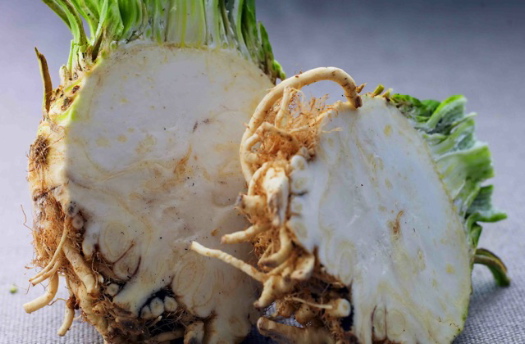
Celeriac is eaten mashed as well as in soups, burgers and salads; kale can be used in salads and treated more or less like spinach. Jerusalem artichokes are eaten both cooked and raw, and horseradish is a common accent. Blueberries, chanterelles and porcini mushrooms are Nordic culinary treasures – this past year was the best season for mushrooms in a long time.
At its heart, Nordic cuisine, new or traditional, is about cooking at home and eating with your family on an everyday basis, celebrating life around the table.
Baked Celeriac
Serve warm as a side, cold in a salad, or as the base for a canapé
Serves 4
Ingredients
Directions
Preheat oven to 225 F
- Cut the top off and wash the celeriac. Brush with oil and sprinkle with salt.
- Bake for 2 hours.
- Remove from oven and, when cool, in a plastic bag for 5 minutes than take out and peel the skin of. Cut celeriac into pieces and serve with other vegetables or meat or in a salad.
Kale Salad
Kale is wonderful raw in salads, especially in the wintertime.
For the salad
For the dressing
For the apple cider almonds
Directions
- Chop the kale super fine so it is easy to chew.
- Cut the apples in small cubes, mix with kale and cranberries in a bowl.
- Take a frying-pan and roast the almonds. When lightly roasted — do not allow them to burn — add the honey, and let it caramelize the almonds. Add the apple cider vinegar, and let it simmer until the liquid has evaporated.
- Let the almonds cool on parchment paper.
- While they cool down, make the dressing. Mix apple cider vinegar, Dijon mustard and honey, then gradually add walnut oil and whisk into a smooth dressing.
- When the almonds have cooled, chop and add to the kale salad together with the dressing. Season the salad with salt and pepper.
- Serve right away.
Apple Trifle
A tasty apple pudding that’s very refreshing and perfect for the apple season.
Serves 8
For the apples
For sweet rye bread crumbs
Directions
- Rinse the apples and core them, leaving the skin on.
- Cut into ½-inch cubes and place in pot with sugar.
- Slice vanilla pod and scrape seeds into pot. Add pod, too.
- Bring to boil, then turn down the heat and simmer for about 30 minutes. If the mixture gets too dry while cooking, add a little water. Stir until it looks like lumpy applesauce, then cool. Remove the vanilla pod.
- Cut the bread into very small cubes. Roast at low heat in a frying-pan until cubes begin coloring. Add the butter and sugar and continue cooking so the bread starts to caramelize but doesn’t burn. Let cool.
- Serve in a bowl or 1-cup size glasses. First one layer of applesauce, then a layer of bread crumbs, then a layer of applesauce, then bread crumbs and applesauce again. Whip the cream and decorate the top.
- Serve right away.
Tip: Both the applesauce and the bread crumbs can be made the day before and then put together before serving.
Trine Hahnemann is a Copenhagen-based chef and caterer and the author of six cookbooks, including “The Scandinavian Cookbook” and “The Nordic Diet.” She has catered for artists such as the Red Hot Chili Peppers, Soundgarden, Elton John, Pink Floyd, Tina Turner and the Rolling Stones. Her company, Hahnemann’s Køkken, which runs in-house canteens, counts the Danish House of Parliament among its clients. Trine writes a monthly column in Denmark’s leading women’s magazine, Alt for Damerne.