Articles in People
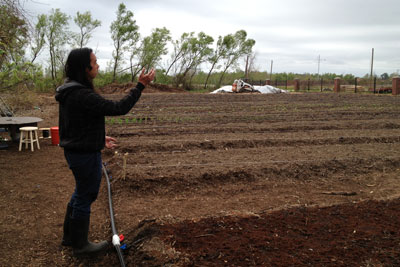
Daniel Nguyen is not your average farmer, and VEGGI Farmers’ Cooperative in eastern New Orleans is not your average farm. At a time when urban agriculture seems stuck between taking flight as a scalable and real solution to urban food supply and being written off as another harebrained and all-too-precious scheme of flannel-clad hipsters, an inspiring story of scrappy success couldn’t be more welcome.
VEGGI Farmers’ Cooperative’s current agricultural operation, previously known as Viet Village Urban Farm, is sandwiched between an old playing field, rows of tidy brick ranch-style homes and a ditch filled with debris leftover from Hurricane Katrina’s 2005 ambush on the neighborhood. In mid-March, its 3 acres accented with neat stripes of green — early signs of newly planted crops ready and waiting to take off in New Orleans’ early summer — seemed misplaced, or perhaps like peace offerings to some unruly god.
Nguyen, too, seems anomalous in the neighborhood. A tireless worker in the fields, he’s also a provocative thinker helping drive the farm’s cooperative organizing and marketing strategies as well as its agricultural inventiveness.
Young, toned, tanned and with a mane of dark hair that stretches most of the way down his back, Nguyen recently greeted a group of students and me to the farm. Clearly unaccustomed to speaking in front of crowds, he spoke quietly and waited to be prompted with questions, zigzagging and veering as he recounted the story of the farm.
“NOLA East is home to nearly 60% of the metro area’s population,” Nguyen explained, glancing down at his rubber boots. “But we’ve got only one supermarket.”
I let this sink in for a minute. After years of working with food-security measures, I couldn’t recall another area so underserved by retail food outlets.
As a result, VEGGI Farmers’ Cooperative operates with an eye toward production and efficiency. And they’ve gotten there remarkably quickly.
Urban farm a bright spot in struggling community
When the farm took hold, the community had been looking for innovative strategies to bolster economic resilience. At the time, things were looking bleak, even for a community that had been living on the fringes for years. Katrina struck in 2005, and when British Petroleum’s rig started leaking into the Gulf in 2010, the community’s strongest resource — both in terms of food and income — became off limits almost overnight.
More from Zester Daily:
“Before the spill, 1 in 3 people in the community were involved in the fishing industry,” Nguyen explained. The pressure was on. The cooperative needed a poverty-alleviation strategy, ideally one that would supply calories as well, and they needed it fast.
“We began in 2011 with funding from [the charity] Oxfam,” Nguyen continued. “And in 2011, we officially formed a co-op.” Meaning each of the farmer-members working the land — who range in age from their mid-20s to their late 70s, and half of whom are women — has partial ownership in the business. Nguyen, whose parents are Vietnamese immigrants who settled in San Diego, arrived in New Orleans after Katrina with verve, a green thumb honed in childhood and a head full of ideals inspired by union-organizing.
He worked as a bus boy in some of the city’s finest restaurants for a stretch, interested in the world of food, but itching to do something with a long-term impact. He began working to organize Vietnamese fishermen, and as he grew close to members of the community, he saw that many gardened at home. Some were even selling off surplus to neighbors. His first thought was to create a cooperative of backyard gardeners, but he quickly realized production would be too disparate to make marketing efficient. So the community began the search for land.
Today, VEGGI Farmers’ Cooperative is growing on the kind of acreage rarely seen in urban America. For what’s known as a “dollar lease,” the group has secured long-term use of the land for a minuscule fee, just enough so the land isn’t officially “gifted” to them in the eyes of the law. The plot we visited is 3 acres, plus another 1 to 2 acres in brambly wetlands, where the group has plans to raise ducks, expand its composting operations and experiment with aquaponics. Another 7 acres are in the works.
The farm doesn’t come without challenges. Space is a limiting factor, and even with sophisticated techniques like closed-system aquaponics, companion planting and heavy mulching, VEGGI Farmers’ Cooperative is, like any outdoor food operation, subject to weather, ever wary of another dramatic climatic (or man-made) event. Even more complex are the neighborhood politics: Many are wary of cooperatives, Nguyen explained, because of the economic devastation communism wrought in Vietnam.
Still, the farm has garnered a lot of attention. Today, there’s a wait list that includes African-Americans, Latinos and young adults. A youth training program is in the pipes, as are expansions into farmers markets, local gas stations and quick marts, a strategic way to intercept the stream of junk food locals consume based almost entirely on convenience.
For now, the farm regularly sells out of traditionally Vietnamese crops and more common vegetables. Nguyen’s connections in the restaurant industry have proved invaluable. Relationships between chefs and farmers can be tough to navigate, but cooperative members show up at approximately 15 restaurants several times a week with a van full of produce, making it easy for chefs to pick and choose what they want. Close to 70% of the farm’s produce goes to restaurants; a small percentage is sold at the local Vietnamese Saturday morning market, while the other 20% goes to member-owners.
When pressed about measures of success, Nguyen said a survey showed some members have used the farm to increase their income more than 100% since before the BP spill. Nguyen said the goal is to hold steady or increase that statistic for all member-owners.
But Nguyen, like most farmers, is still scraping by on what he makes from the farm. Still, he shows up every day, doggedly committed. “I have no social life,” he laughed. “But most days I get to drink a beer with these guys,” he said, gesturing to a slender older man bent over a newly tilled row, leveling out the soil with a piece of worn plank.
Top photo: VEGGI Farmers’ Cooperative founder Daniel Nguyen in fields at the farm. Credit: Sara Franklin
OK, maybe it’s because I’m a little under the weather as I write this but, dagnabbit I am more than a little bent right now.
What can it take, for the love of Mike, to get a decent, well-priced glass of wine at a restaurant? Time after time, meal after meal, I bring a bottle of wine with me to dinner, seeing as I am in the business. But I always take a look at the list, just in case there is a cool, reasonably-priced by-the-glass option to kick-start the evening. Alas, more often than not, I’m rippin’ out my bottle straight away and gladly paying the $25 corkage fee, realizing I might have to pay that twice knowing the crew I run around with.
How hard can it be? Why do restaurants consistently charge $10 (or more) a glass for a bottle that costs $6 (or less) wholesale? I understand the concept of getting your cost back on the first pour, but c’mon, this is getting silly.
Since I am a wine seller, life for me will go on. I have enough wine street smarts to navigate lists and find something decent or bust out my own bottle if it’s not happening. My concern, however, is for that group of wine drinkers that we fine wine merchants (and, we hope, progressive restaurateurs), are trying to transition over from Two (and a half) Buck Chuck and Yellowtail to another level of wine, one that, while not much more expensive ($10 to $12 a bottle retail instead of $2.49 or $8) delivers another dimension of flavor and styles.
Short-sighted proposition
If restaurants are going to be content with trying to squeeze as many dollars as they can out of a bottle, we will soon lose touch with this new wave of wine drinkers. We won’t be able to bridge the gap and continue to nurture their palates if these people are forced to pay $12 for a glass of mediocre “coastal” Cabernet, when they could be paying $6 for a fabulous Old Vine Grenache from Spain, or Picpoul from the Languedoc. At $12 for an OK glass of Cabernet, I would be reaching for beer provided I didn’t have that wine in my bag.
EXCLUSIVE ZESTER DAILY
WINE DISCOUNTS
For the next eight weeks, Kyle Meyer and Tristen Beamon of Best Wines Online will hand-select a wine they will make available to Zester subscribers at an exclusive 10% discount below the store’s already competitive prices.
» Sign up here to receive the wine discount code in the new Zester Daily Weekender newsletter.
And that’s the point. Merchants and restaurateurs have to work together to foster and educate this new generation of wine lovers. There are numerous studies showing that millennials are very curious about wine but, like many folks nowadays, do not have serious money burning a hole in their pockets. That said, these consumers are also curious about craft brews, so they often have a unique, artisan drinking experience for less — simply because there is some kind of archaic formula in place dictating the minimum price for a glass of wine.
What if restaurants charged $6 (the price of a 12-ounce beer, for the most part) for an interesting glass of wine? Not wicker basket Chianti, not corporate Cabernet, not private label Chardonnay sourced from Fresno, but a real, authentic, genuine bottle of wine that could open eyes. Would they lose money or sell more wine? Would they gain customers because they were offering cool wines at great prices? Granted, more restaurants have expanded their wine lists to include many offerings south of $50 a bottle. But let’s be honest, that was born out of necessity based on the economy, and was hardly a peace offering to those of us who couldn’t find a bottle less than $75 just a few short years ago. Why couldn’t restaurants apply that same philosophy to their by-the-glass programs?
Smaller dining establishment, more wine for a fair price
Trust me when I say the corporate wine world wants to keep everything just the way it is. There is a wealth of boring cheap wine tied into the spirits business. This wine is essentially sold for nothing to engage restaurants to purchase bar liquors from these large wine/spirits conglomerates. One thing I’ve noticed is that when the dining establishment is smaller, and has no spirits, the wine selection tends to be stronger. Coincidence? I think not. The “big boys” want the restaurants to do one-stop shopping since, to them, wine is merely a greaser to sell more gin. The problem is, more than a few restaurants are all too happy to comply.
I say to those restaurants, “fight the power!” and don’t let the man keep you down. Take a chance, engage your customers, and show them the world of wine is more than whatever the distributor is closing out that month. Find interesting, food-friendly wines and sell the wine for a fair price. I’ll help you out. Email me, or look at our list of sub-$10 wines on our website. Before you know it, I think your customers may be having a revelatory moment like Steve Martin’s character in “The Jerk”: “Well if this is out there just think how much more is out there!”
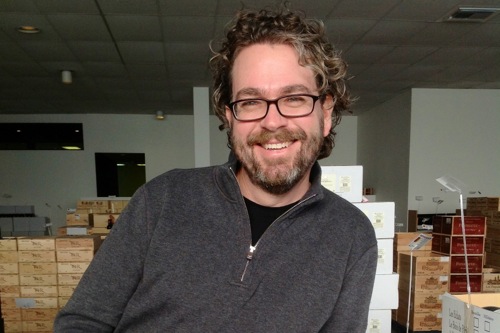
Top photo: Kyle Meyer. Credit: Mina Bahadarakhann
At Zester Daily, we scour the world for interesting food and drink stories to share with our fans. As luck would have it, we only had to drive an hour south to Orange County, California, to find our latest discovery: Best Wines Online, a new wine e-tailer we know you will enjoy.
We have trusted the talents of founders Kyle Meyer and Tristen Beamon since their years managing another wine store. Their well-earned reputations as wine sleuths able to sniff out values in the obscure corners of wine’s ever expanding universe are complemented by an encyclopedic knowledge of Bordeaux and Burgundy.
Their picks reflect a preference for balanced wines that shine on the dinner table. Kyle and Tris take the time to learn the backstories of the wines they sell. With their guidance, wine shopping is more treat than chore.
When we learned this dynamic duo was opening a store of their own, we jumped at the chance to introduce the venture to Zester fans.
Discounts for hand-selected wines
Today, we are proud to announce that Zester Daily and Best Wines Online have launched a marketing partnership. Each week, Kyle and Tris will hand-select a wine they will make available to Zester subscribers at an exclusive 10% discount below the store’s already competitive prices.
Zester newsletter subscribers will find a Best Wines Online promotion detailing the weekly wine offer in our new Weekender newsletter sent out toward the end of the workweek.
On bestwinesonline.com, you’ll find detailed wine descriptions and a growing library of videos both from Kyle and Tris’ travels as well as interviews with winemakers who visit their shop. Their personal touch extends to customer service. When you call their store during California office hours, you’ll get a living, breathing human being on the phone.
They are limiting their stock to 1,000 labels — enough variety to represent the wide world of top-shelf wines along with stacks of tantalizing under $20 treats. Rare among boutique e-tailers, the pair also feature hard-to-get older vintages straight from the wineries.
We know you will enjoy getting to know Kyle and Tris and their particularly delicious take on fine wine at bestwinesonline.com. Sign up now for Zester’s newsletter so you won’t miss out on any of these delicious deals.
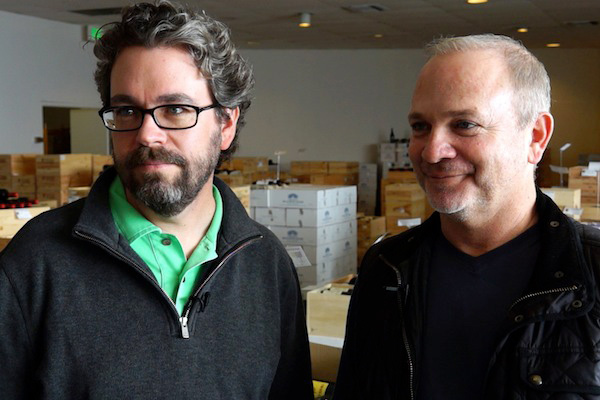
Top photo: Kyle Meyer and Tristen Beamon of Best Wines Online. Photo and video credits: Matthieu Silberstein
The Salon du Chocolat, founded in Paris by the aptly named Sylvie Douce and François Jeantet, has a mission that few right-minded people would quarrel with: to promote the understanding and enjoyment of chocolate. Since its first Paris manifestation 18 years ago, countless other editions have been staged in 21 different cities worldwide, from New York to Tokyo to Moscow to Shanghai. It’s a magnificent show, wherever it happens. Each one has its own indigenous flavor and character.
One of the venues for the Salon du Chocolat is Switzerland. This, remember, is the land of Rodolphe Lindt, inventor of the conching process, which involves patient heating and repeated rolling of the cocoa mass to smooth away the gritty particles naturally present. It was here, too, that Daniel Peter, together with his friend and colleague Henry Nestlé, produced the first solid milk chocolate bars that would keep without spoilage. And then, of course, the Swiss are the acknowledged world champion chocolate-scoffers, putting away an impressive 12 kilos (close to 27 pounds) per person per year.
Perhaps the only surprise about Switzerland’s Salon du Chocolat is that it took until 2012 for the first show to be staged in Zurich. The 2013 edition recently closed its doors after three exhausting, exhilarating days starring a cast of about 90 chocolatiers, pastry chefs and chocolate experts from all over the world. “This year’s Salon was another sweet success,” enthuses Kerrin Rousset, a chocolate and confectionery connoisseur based in Zurich and responsible for working with the Salon team in Paris to come up with the program of events for the Swiss show.
From fashion to food, Salon du Chocolat is all things chocolate
Stunning new chocolate creations were presented to (and enthusiastically sampled by) the public. Sylph-like models in chocolate-trimmed designer gowns paraded nonchalantly up and down the catwalk. Chocolatiers and pastry chefs from boutiques and top restaurant kitchens demonstrated in Choco Démo, including Swiss Chocolate Masters David Pasquiet and Claudia Schmid. Conferences in the chocosphere filled up quickly, with the public eager to learn about pairing chocolate with wine, whiskey or even with beer, or to debate issues such as the sourcing and sustainability of cacao.
Any Salon du Chocolat, wherever it takes place, provides an opportunity to apply a finger on the pulse of what’s happening in the chocolate world, so I was delighted to do my bit to find out what’s new. Among the many developments visible (and tastable), my favorite — speaking here more as a cook than a chocolatière/pastry chef — is the growing trend for salt in chocolate.
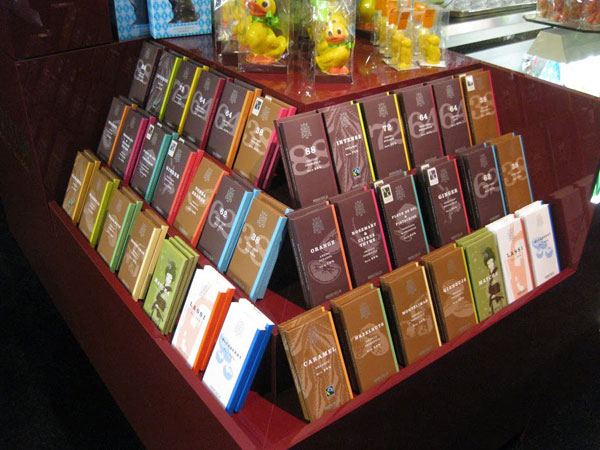
Of course, the salty-sweet dimension is hardly novel. The Bretons have used crunchy demi-sel butter in candy forever, and sweet Scottish shortbread is pleasingly seasoned with salt. Nowadays any self-respecting chocolatier seems to have a salt-speckled chocolate in his/her range. Even Toblerone has joined the game, with a sky-blue packaged bar whose familiar toasted almonds are tossed in crunchy salt crystals. Repeatedly at the salon, I was struck by the degree to which salt — provided it’s added with enormous care and in the right quantity — can enhance fine chocolate, allowing complex flavors to bloom while adding a piquant counterpoint to balance sweetness plus an element of crunch. Two stars for me were Beschle of Basel’s 64% dark chocolate with fleur de sel and pistachios, and their startlingly good Lassi, a white chocolate lifted by the addition of yogurt, lime and a whisper of salt.
Nibbling my way around the Salon, I made a few more discoveries. The first was there’s nothing quite like a chocolate bar (as opposed to truffles, pralines or other composite delights) for getting the full chocolate hit. Every one of the top chocolatiers present displayed positive libraries of bars — square, round, rectangular, large, medium or bite-sized, and all packaged to within an inch of their lives.
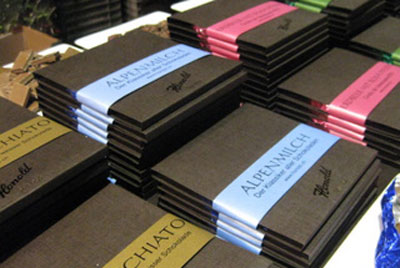
Another revelation was that milk chocolate should not be scorned. Chocolate snobs (I have to admit I’m probably one) generally favor the dark varieties and play one-upmanship games on cacao percentages, the higher the better. That was until I discovered Alpenmilch by celebrated Zurich chocolatier Honold — sinfully smooth and seriously chocolatey, amazing depth of flavor with marked toffee notes, a reminder that Switzerland is the Heimat of milk chocolate. (“High as the Alps in flavor” was the proud marketing slogan for Daniel Peter’s original Gala milk chocolate).
And for one who also has been know to purse lips at the very suggestion of flavored chocolates, I made short work of Honold’s dark (65%) Venezuelan Criollo, dusted with a discreet shower of strawberry flakes and crushed pink peppercorns. Not to mention anything from the newly established, Budapest-based ChocoMe, which makes big, bold, beautifully packaged bars bulging with fruit, nuts and spices.
Salon du Chocolat calendar for 2013
Salvador de Bahia: July 6-8
Paris (professional): Oct. 28-30
Paris (open to the public): Oct. 30-Nov. 3
Lyon, France: Nov. 8-11
Cannes, France: Nov. 22-24
More from Zester Daily:
» Paris’ Salon de l’Agriculture exhibits French food roots
» Salone del Gusto grows with slow-food movement
Final mention of another important trend in the choco-world: The increasing interest in where and how chocolate is sourced — “from bean to bar” is the buzz phrase. The same kind of thing that happened with Terra Madre and Slow Food’s Salone del Gusto is taking place within the Salon du Chocolat: Terra Madre, once a colorful sideshow representing grower-producers from the Third World, is now an integral part of the Salone del Gusto. In just the same way, the Salon is broadening its focus beyond the pure hedonistic pleasure of chocolate to embrace pressing themes like transparent sourcing, conservation, sustainability and equitable work practices.
Original Beans (Amsterdam) and Idilio Origins (Basel), present at the Zurich Salon, are widely admired for their ethical business model and emphasis on sustainability. Each sets up long-term contracts with individual cacao growers not only in traditional grower countries like Ecuador and Venezuela but also, in the case of Original Beans, in the war-torn Congo, which has no history as a cacao producer. They pay significantly above fair-trade rates and focus on single-origin chocolate, emphasizing not only on the cacao type (Criollo is king) but also the terroir in which it is grown.
The Salon du Chocolat provides a fabulous showcase not just for the finest chocolate but also for the latest trends. The good news is there’s one coming soon to a city near you.
Top photo: Alpenmilch chocolate bars. Credit: Sue Style

Where do chefs eat? As culinary professionals have become celebrities, their favorite haunts have attracted more attention. Want to know where Ludo Lefebvre gets his favorite pancakes? Or where to find the best sushi, according to Danny Bowein (of Mission Chinese fame)? ChefsFeed has the answers, and a bit more. With thousands of high-end to hole-in-the-wall restaurant recommendations straight from the mouths of the country’s best chefs, you’ll learn where they love to go, and most important, what they like to order. There are currently 20 different cities on the app, with at least 20 chefs per city. The app is very user-friendly, with a little smiling face (usually) of the chef and photos of his or her recommended dishes. You can click on the dish and get details about the restaurant and also why the chef likes it. This has got to be one of the best ways to hunt down a meal. The icon is pretty cool, too.
Available for free on iTunes
Split the bill without pain
No, Splitsville is not an app that will supply you with text-message breakup lines. Rather, it is an app that will help you split a restaurant bill. Sure, when there’s just two of you it’s easy — excuse yourself to the restroom and hope the other person pays. But what to do if you have an odd number of people dining? Simply open up this little bad boy, enter the total amount (plus tip, of course) then enter the number of diners, and the app will do the rest. Of course, so will a calculator. Here’s the difference: If you arrived only in time for dessert whilst your friends feasted on steak and lobster, you will not have to pay for their surf and turf gluttony. Specify that your crème brûlée only cost you $15 and the app will adjust accordingly, charging your friends for their share while you pay for what you had. Never again will you feel cheated by a tab because your buddy ordered one more beer than you. It will be accounted for, and it will be fair — Splitsville will make sure of it.
Available for free on iTunes
Find sustainable fish choices
Seafood Watch has changed the way I buy fish. I refer to it for “ocean-friendly” advice every time I go out to buy seafood, especially at stores where I don’t have a friendly fishmonger to chat with. A bit of an admission as well: I sometimes purchase frozen seafood at Costco, and this app has kept me from many a fish-buying mistake. Made by the Monterey Bay Aquarium, the app brings you the most current recommendations for sustainable seafood and sushi, along with complete information about how each species should be fished or farmed. It is very simple to use and categorizes seafood as “best choice,” “good alternative” or “avoid,” with alternative options in the “avoid” section. When you delve into the app, you’ll notice the wealth of information available — everything from farming practices to where you can find a particular type of fish nearby. The sushi guide goes a bit further by providing the Japanese name as well as the English. This is an app worth downloading. All the information provided can also be found at www.seafoodwatch.org.
Available on iTunes and for Android for free
Drink wine by a biodynamic calendar
There is a growing opinion within the wine industry that wines taste better on certain days of the biodynamic calendar. Basically, with biodynamics, everything is dictated by the moon. The most common theory is, if the moon’s gravitational pull influences the ocean’s tide, it must also affect water in the soil and even sap within plants, which in turn can affect growth and flavor. There is a specific type of day depending on what phase the moon is in, they are: fruit, flower, leaf or root. For wine the best days to drink (and in fact transfer from tank to barrel) are said to be fruit and flower days. These days were originally used as guide for planting and sowing crops, but have more recently been extended into the wine world. Only a few blessed souls, however, have the ability to look at the moon and know what type of day it is. For the rest of us, there are two apps. BioGarden is a very cute biodynamic calendar app with little cartoon fruits and vegetables that tell you what type of day it is. You can scroll along from side to side quite easily and plan your biodynamic (drinking) calendar months in advance. When Wine Tastes Best is based off the biodynamic booklet of the same name. This is much more detailed, and actually tells you on the hour when the day type changes. It is set up a bit more seriously, and there is a free version that doesn’t allow you to look ahead in the week. Rest assured, neither app will ask you to bury your phone on the third full moon of the year.
Biogarden is $2.99 on iTunes
When Wine Taste Best is free or $2.99 on iTunes
Top image: BioGarden app. Courtesy of Summersun Corp

Let’s take a poll. If I say the word “canning” what comes to mind? From my experience, your mental images would fall into one of three categories: grannies, a skull and cross bones levels of danger, or the sleeve tattoos and multiple piercings of hip DIYers. Canning and other forms of home food preservation have an image problem.
As for my basement? Don’t get me wrong, there’s some neat stuff down there (quarts of tomatoes, some tangy chutneys and pickles, a few fall squashes still hanging on), but “Hoarders” it is not.
Everyone should learn to preserve their own food
Teaching home cooks how to preserve food is often seen as folly, a luxury technique for those who have extra time on their hands. But we eaters are in a cooking crisis right now. There are segments of our population that cannot feed themselves for lack of basic kitchen skills. Expecting people to preserve might seem, initially, like asking the starving not just to eat cake, but to decorate it, too. But preserving foods is a reliable, economical and useful means of preparing seasonal ingredients. It has served the home cook for generations and can do so again.
When I was growing up, my grandmother canned, dried and fermented everything that came out of her garden. She put up her tomatoes, dried her herbs, made tremendous dill pickles and even her own wine. She didn’t do this because she was a gourmand. She did it because she was poor. For her, it was insurance; she was essentially building her own food bank every summer so that when things got tight in the winter, there was not only good food to eat, but some delight to be had as well.
In the early 1900s “Tomato Girl” clubs taught women how to can tomatoes and imparted the business skills needed to turn canned goods into profit-generating enterprises. The women of these clubs grew their own crops and processed, packaged and sold their produce to help support their families. The clubs were often the doorway to business and educational experiences unattainable to most women at the time.
In an era when economic pressures are driving more of our citizens toward food insecurity, and the increasing cost of fuel will limit our ability to ship food as widely as we do currently, preserving our own food could be part of the solution to a more stable, sustainable and equitable food system.
Benefits of preserving your own food
Preserving food is practical. It minimizes waste. Think of how much food is discarded at the farmers market, the grocery store and in our gardens because it went bad before it could be eaten. The famously prolific zucchini doesn’t have to wind up in the compost pile; you can turn it into pickles. Berries that are starting to fade make a terrific sauce when cooked down with a little sugar.
Preserving food at the peak of its season evens out uneven production, providing for eaters when fields are fallow.
Preserving saves energy. Canned, fermented and dried foods can be stored without refrigeration.
Preserved foods provide income. They can be sold as added-value products by farmers and community gardens. If this business model is out of reach, food swaps and barter exchanges transform preserved foods into a kind of currency that helps eaters stock up on great tasting home-crafted foods.
Preserving protects food sovereignty. Just as victory gardens fed our nation in wartime, community and school gardens can help build our individual and our national food independence.
Contrary to popular belief, you don’t need to be a deep DIY kind of a guy or gal to preserve your own food. (Though I can’t imagine you would earn your “Portlandia” badge without it.) It’s just a simple thing we can do to feed ourselves.
Photo: Sherri Brooks Vinton. Credit: Chris Bartlett
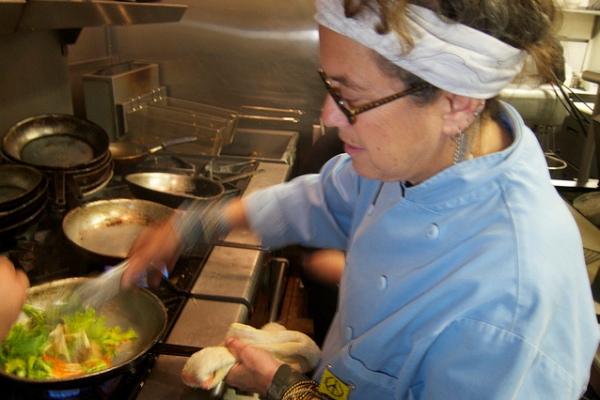
Susan Feniger, one of Los Angeles’ best-known restaurateurs, is always planning her next food trip, as soon as she comes home. Feniger’s restaurant Street, which opened in 2009, is inspired by the global street-food scene, but her explorations are as much about experiencing the lives people lead as they are about finding travel-inspired recipes.
More from Zester Daily:
» Light Brussels sprouts salad recipe
» The best ways to cook up brassica veggies
Talking about a trip to the Turkish countryside, her eyes brightened as she described going with a friend to meet a farmer he knew. A walk into the fields up from the river led them to a house made of sticks with a cow in front. Inside, the kitchen had a fire pit in the middle of the room.
Sitting on the floor for their meal, Feniger watched with pleasure as the farmer’s wife first made tahini by grinding sesame seeds and then baked the tahini into the bread for their midday meal. The bread was delicious as was the experience.
In her kitchen at Street, Feniger demonstrated one of the popular dishes on the menu, an easy-to-make dish with lots of flavor: Brussels sprouts flavored with goat cheese, apples and hazelnuts, topped with an Italian version of a picada without nuts.
When Feniger and Mary Sue Milliken, her longtime cookbook collaborator and fellow chef, were doing research for the dishes they would serve at their second restaurant, Border Grill, they traveled extensively in Mexico. She quickly discovered that the food she loved was the food cooked by street vendors and in people’s home.
As she explained, When you go into people’s homes “they’re so happy you’re there eating their food. People took us into their homes because they wanted us to taste their food. You didn’t get that if you go to restaurants. When you are on the street and you are in a culture that doesn’t usually see [outsiders], they really like that [you are willing to try their food].”
Travel-inspired recipes from around the world
To Feniger, eating the food prepared by people for their everyday lives is how you see the heart of a country. Over the years she has traveled around the world, pursuing her love of culture and eating.
“When I travel, if I don’t see a historical site, I’m OK. The much more rewarding experiences are the ones with people in their kitchens. My memories when I travel are ones with people, not with the monuments.”
On a 14-day trip, crisscrossing India from Delhi to Mumbai to Goa to Kerala (her favorite), Feniger ate on the street or in people’s homes every day. … When she was in Shanghai she was taken by a local on a food tour that began at 4 a.m. so she could watch a man make savory fresh soy milk sticky rice doughnuts cooked in a wok. By 8 a.m., he had finished his breakfast service so he cleaned up and left, allowing a shoe repairman to take over the stall.
Let the ingredients lead you
The menu at Street cherry-picks taste treats she ate during her travels over several decades.
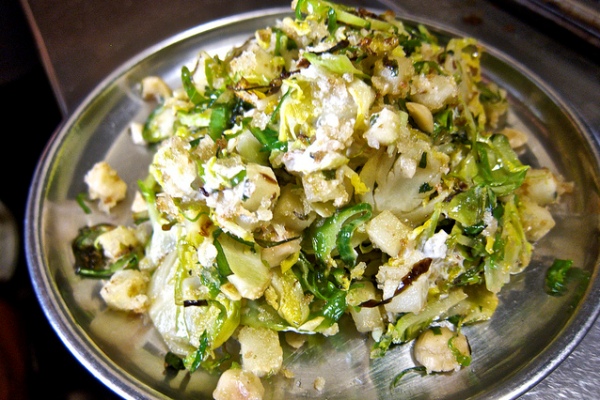
A featured dish at Susan Feniger’s Street: Brussels sprouts with goat cheese, apples and hazelnuts. Credit: David Latt
Recently, Feniger revamped the Street menu and gently moved in the direction of vegetarianism, not for policy reasons but because the street food she loves tends to feature produce over animal products.
Hence, the Brussels sprouts dish. Her picada is Italian and illustrates Feniger’s belief that keeping it simple is best. Take a run at flavor, she suggests, letting the ingredients lead you and everyone will be happy.
Brussels Sprouts with Goat Cheese, Apples and Hazelnuts
Cooked quickly, the Brussels sprouts should be crunchy so the dish tastes fresh and inviting. The contrast of savory Brussels sprouts, sweet apples and tart-creamy goat cheese, together with accents of the picada make the dish delicious on its own or as a side dish with a protein such as sautéed tofu, fried chicken, grilled steak or baked salmon.
Serves 4
Ingredients
For the sauté:
½ cup raw hazelnuts
1½ tablespoons olive oil
6 cups whole Brussels sprouts, shaved thinly on a mandolin or with a knife
2 medium sized Granny Smith apples, cored and cut into a small dice
Juice of 1 lemon
6 ounces soft goat cheese, broken into small pieces
1 teaspoon kosher salt
For the picada:
⅛ cup extra virgin olive oil
2 tablespoons minced raw garlic
2 cups bread crumbs
Salt to taste
zest of 3 lemons
1 bunch Italian parsley, finely chopped
Directions
For the sauté:
1. Preheat oven to 350 F.
2. Spread the hazelnuts out on a cookie sheet and toast them for 5 to 10 minutes until they are roasted and slightly browned.
3. Remove from heat and pour onto a clean dish towel.
4. Fold the dish towel over the toasted hazelnuts and roll lightly to remove the skins. Discard the skins.
5. Place the hazelnuts on a cutting board and chop into small pieces, or alternately pulse in a food processor for a brief period of time. Set aside.
6. In a large sauté pan, heat the oil on medium-high heat.
7. Add the Brussels sprouts, apples and salt, and cook, stirring occasionally, until the Brussels sprouts are slightly browned on the edges.
8. Add the hazelnuts, lemon juice and goat cheese.
9. Toss together and turn off heat.
For the picada:
10. In a large sauté pan heat the oil, but do not let it smoke.
11. Add the garlic and stir quickly to release its flavors, but do not brown.
12. As the garlic starts to color, add the bread crumbs and salt to taste.
13. Stir well to combine and toast in the oil (about 5 minutes).
14. When the bread crumbs are browned, remove from heat and place in a mixing bowl.
15. Add the lemon zest and the parsley while the bread is still slightly warm.
16. Toss and then spread out on a cookie sheet to cool to room temperature. Store in an airtight container before using.
17. Sprinkle on top of the Brussels sprouts before serving.
Top photo: Susan Feniger in her kitchen at Street, demonstrating making Brussels sprouts with goat cheese, apples and hazelnuts. Credit: David Latt
In a country that cooks European food notoriously poorly and has its own renowned cuisine, it might seem risky and even foolish to open a Western restaurant in a small northern Thailand town that is an hour and a half from a major city. But The Nest at Chiang Dao isn’t hurting for business, and owner Wicha Cavaliero’s commitment to quality cooking and ingredients is only part of the reason.
What makes a great chef and what, in turn, makes a great restaurant? The answers vary, but at the Nest, a few answers are clear: unpretentious surroundings and staff; locally-sourced, organic ingredients; and a commitment to quality, even if it means halting growth.
More from Zester Daily:
» Magic Alambic Thai rum comes with a French twist
» Nam Priks, the hot dips of Northern Thailand
Wicha, who was born in Bangkok and received her culinary training at Norwich City College and affiliated internships in the United Kingdom, speaks with an intensity and frankness that might lead you to believe she has been taking nips of sherry back in the kitchen. But this Michelin-trained chef is a serious professional who will not change her style to please diners.
Remote, rural and beautiful
A good example of Wicha’s unwillingness to compromise is The Nest’s location. At the foot of a massive mountain, tiny Chiang Dao is not the first place one might think of when opening a European restaurant. Only a small trickle of tourists makes its way up north to this quiet spot, but nearly all are here to dine at The Nest. She chose the location for its beautiful setting, as well as the opportunities for making an impact on a small Thai town. “I can do more here than anyone else, because they need it,” she said. “It doesn’t have to be me, it could be anyone.”
“I want to bring up my children in an appropriate natural place. That is why this place is called the Nest,” she said. She notes that being in a beautiful, rural location has helped maintain a happy marriage. Stuart Cavaliero, Wicha’s British husband, is an integral part of the restaurant.
“I manage the restaurant and he manages me. Without him I probably wouldn’t have opened. He is more Thai that I am; he knows all the traditions and is very caring,” she said.
Patrons listen to ‘the stars talking to each other’
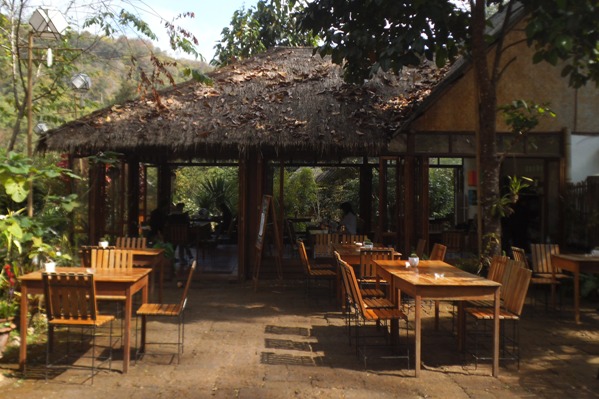
Though the restaurant has the business to support growth, Wicha prefers to keeps it small and simple. A tile-floored dining room with floor-to-ceiling windows looks out to the mountain, and Wicha notes that expanding the room would erase that view. “I want to see the view, I want to see the mountains,” she said. “I’d rather be happy and poor than rich and not happy.” Thus, the restaurant remains very intimate.
Keeping the operation small is just one tenet Wicha will not break. “The Nest is so popular because we have so many laws and unwritten rules,” she said with a laugh. “We don’t allow many things, such as music.” When I ask her why she doesn’t play music in the dining room, she nods her head towards the thunderstorm rumbling outside. “There is the rain, the bamboo, stars talking to each other,” she said. “I’d rather hear the sound of people laughing. And maybe the music I like, you don’t like. You can’t make it perfect for everyone. There’s only one kind of music that is perfect for everyone — it’s the sound of raindrops.”
Wicha treats her staff respectfully, and it is obvious that they in turn respect her. They move in comfort around her, asking questions during our interview or alerting her to any issues. Wicha is always quick to respond, jumping up to talk to a guest or check on something in the kitchen. “I don’t find my staff, they find me,” she said. She takes local residents, many of them Shan (from Shan state in Burma), under her wing and trains them, which is certainly a big time investment. “It’s easier to deal with people who have will,” she said, adding how proud she is of her staff.
As much of the food as possible is locally sourced. Wicha visits Chiang Dao’s Tuesday market and picks produce from vendors she trusts. She explained that much of the produce is not certified organic, but that local farmers do not have the money for pesticides (or expensive organic certificates). Vendors know her and what she likes.
The menu changes daily and is written on a chalkboard. Breakfast features classics such as farm-fresh eggs and homemade bread. One popular lunch feature is the grilled eggplant sandwich on homemade bun with green salad. Dinner entrees usually include a lamb, steak and duck option.
The Nest started small, with just six bungalows that had no showers or toilets. When a group of hoteliers arrived shortly after opening and had to eat steak under umbrellas, Wicha realized she needed to expand the dining room to its current size, as well as upgrade the bungalows. Today, there are more than a dozen huts, with soft mattresses and thick blankets, as well as a nearby Nest 2 location with a restaurant serving excellent Thai food.
The Nest has received international acclaim, though Wicha seems unaffected. She simply wants a business she can feel good about: “Even if I die tomorrow I can still feel proud,” she said.
The Nest at Chiang Dao, Northern Thailand. Credit: Catherine Bodry
Upcoming Events
-
see all of our
Upcoming Events
-
Nathan’s Famous International Hot Dog-Eating Contest July 4Takes place on July 4, 2013Nathan’s Famous International Hot Dog-Eating Contest The men and women will compete separately for the title of Men’s Hot Dog Eating World Champion and Women’s…
-
The Park City Food & Wine Classic July 10-14Takes place on July 10, 2013The Park City Food & Wine Classic THE PARK CITY FOOD & WINE CLASSIC is a premier destination event where master winemakers, culinary greats, and…
-
Taste of Chicago 2013 July 10-14Takes place on July 10, 2013Taste of Chicago 2013 Taste of Chicago 2013 is Chicago’s biggest event. Getting its start as a modest food festival on the Fourth of July…
SmartBrief