Articles in Holidays
Peek into my kitchen this holiday season and you’ll likely find me elbows high in pillowy bread dough. In my family, nothing says Christmas more than the warm scent of baking bread. From Belgian cougnou to Italian panettone and sundry treats in between, we bake, give and eat not iced sugar cookies or gingerbread men but aromatic loaves of fruit- and nut-filled yeast breads.
If you’ve ever shopped in a European-style bakery or holiday market, you know that my tradition is not unique. Across Europe people bake sweet, sumptuous yeast breads. Many of them have religious significance. Such is the case with the Christmas specialties of Belgium and Germany.
Yeast breads vary from nation to nation
In the French-speaking region of Belgium known as Wallonia, people consume cougnou or “the bread of Jesus.” To make cougnou, bakers join together three balls of sugar- , egg- and raisin-enriched dough; these pieces are said to represent the head, body and legs of the Christ child. Glazed with egg yolks and milk and then baked, the resulting bread resembles a swaddled baby.
In Belgium, cougnou is often given as a holiday or hostess gift. You’ll find this festive bread at bakeries and Christmas markets throughout the season.
I grew up eating a similar treat from Dresden, Germany. With its oblong shape, tapered ends, folded center and liberal dusting of confectioner’s sugar, stollen, like cougnou, resembles baby Jesus wrapped in swaddling clothing. No doubt this is why it’s sometimes referred to as Christstollen.
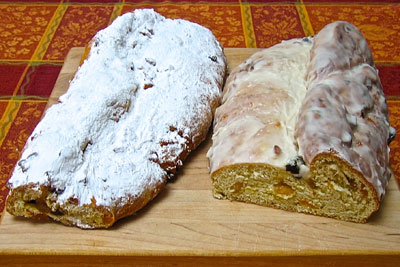
Loaves of stollen. Credit: Kathy Hunt
A favorite at German Advent markets, stollen includes plump raisins, currants, candied citron and chopped almonds. Bakers there usually add a splash of dark rum, brandy or lemon juice.
At Calico Restaurant and Patisserie in Rhinebeck, N.Y., pastry chef/owner Leslie Heinsohn-Balassone includes a few special steps for making moist, flavorful stollen. Along with soaking her raisins overnight, she runs a strip of marzipan down her bread, imbuing it with a luscious almond taste. She also uses both cream cheese and butter in her dough, giving it an even more velvety texture.
ZESTER DAILY
CONNECTION
Bread Links
» Artisan Bread Sweet Leftovers
Holiday Baking Links
» Nutmeg Flavors Old Family Sugar Cookies Recipe
For those first-time stollen bakers, the pastry chef offers some professional guidance. “Use a lot of flour on your surface — preferably wooden — and keep trying until you find the perfect recipe,” says Heinsohn-Balassone, whom Zagat rated as the “best pastry chef of the Hudson Valley.” Sage advice when it comes to making holiday breads.
Dark and pear-flecked hutzelbrot lacks the spiritual tie-in that stollen and cougnou possess. Favored in southern Germany, this dense bread has a standard loaf shape and a top crust that may be scored in the shape of a leaf. Beneath its dark crust lies an abundance of dried pears as well as dried apricots and figs, prunes, currants and almonds or hazelnuts. Spiced with cinnamon, cloves, ginger and cardamom or aniseed, it’s redolent with the scents of the season.
Custom dictates that you save your hutzelbrot until Dec. 24. You then slice it and consume it with a glass of wine or punch. That’s one tradition that I invariably break. With bread that bold, fruity and delicious in my house, you can bet that I’m cutting into it long before Christmas Eve.
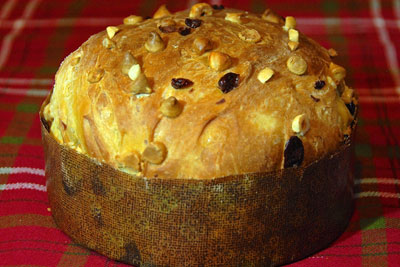
The temptation likewise exists with panettone. A specialty of Milan, Italy, the rich, high-rising bread varies in size from a convenient, individual serving to a loaf large enough to feed a dozen. Shaped like an oversized mushroom, this Italian treat usually contains raisins, candied citron and orange peels, lemon and orange zests, and generous amounts of butter, eggs and sugar.
Unlike the other breads, panettone shows up not only at Christmastime but also at Easter and other festive events. How it came to be associated with the holidays remains a mystery. So, too, does its origin. Some speculate that a nobleman fell in love with and invented this bread for a poor baker’s daughter. Depending upon the source, the nobleman dubbed it panettone, “Toni’s bread,” in honor of himself, the poor baker or the object of his affections.
In the Netherlands krentenbrood, or currant bread, is likewise consumed at Christmas and Easter. In a land where dark rye bread was once the norm, this white, spiced and fruit-studded bread was historically considered a luxury item saved for special occasions. In Finland, however, families opt for rye bread at their holiday tables. Their rich, rye joululimppu also contains molasses, orange zest and fennel, anise or caraway seeds.
Whether made with white or rye flour or baked in the shape of a swaddled infant, plump mushroom or an oblong loaf, these fragrant breads evoke the holiday season. They’ll bring a taste of Christmas to your kitchen every year.
Cherry-Almond-White Chocolate Panettone
Makes 1 loaf
Ingredients
½ cup plus 1 tablespoon dried cherries
¼ cup cranberry juice, warmed
1 package dry active yeast
½ cup milk, warmed
1 cup all-purpose flour
1 teaspoon sugar
2 large eggs
4 egg yolks
1 teaspoon vanilla
⅓ cup sugar
½ teaspoon salt
2 cups all-purpose flour plus a little extra for dusting the work surface
3 tablespoons butter, softened and cut into chunks
½ cup blanched almonds, toasted and chopped
⅔ cup white chocolate chips
Directions
1. In a small bowl, mix together the dried cherries and cranberry juice.
2. In another bowl add the milk to the yeast. Once the yeast has dissolved, add the flour and sugar. Stir together until well combined. Cover the starter with a sheet of plastic wrap and, placing it in a warm spot, allow it to rise until it doubles in size, about two hours.
3. Grease a large mixing bowl as well as a panettone mold or 24-ounce coffee can. (If you do not have either a mold or an empty coffee can, line a small, round, buttered baker with buttered parchment paper — the paper should be roughly 6 inches high.)
4. Whisk together the eggs, yolks, vanilla and sugar.
5. Add the starter, flour and salt to the liquids and mix together. Once the ingredients are incorporated, place the dough on a floured work surface and knead for five minutes. Add chunks of the butter to the dough and knead it to incorporate. Continue to knead the dough until the butter is well combined.
6. Form the dough into a ball.
7. Drain and pat the cherries dry.
8. Flatten the dough, then add a third of the cherries, almonds and white chocolate chips. Fold the dough over and knead the ingredients into the dough. Repeat the process until all the cherries, nuts and chips have been added.
9. Form the dough into a ball. Place it in the greased bowl, cover with plastic wrap and allow it to rise for 1½ hours.
10. Punch down the dough, place it in the buttered panettone mold or buttered coffee can and cover it with plastic wrap. Allow one final rise, about 1 hour.
11. Preheat the oven to 350 F.
12. Remove the plastic wrap and insert the panettone into the preheated oven. Bake for 45 minutes or until a toothpick inserted in the center comes out clean. Cool on a wire rack.
Top photo: Cherry-Almond-White Chocolate Panettone. Credit: Kathy Hunt
Most of us have a favorite literary classic we think about at Christmas. Charles Dickens’ “A Christmas Carol” comes to mind, well-loved for its colorful characters and uplifting tale that transforms Ebenezer Scrooge from a dismal miser to a generous and life-loving human being. “How the Grinch Stole Christmas” is another popular holiday story that tells how communities pull together in times of stress. But for me, Truman Capote’s “A Christmas Memory” has the strongest appeal because it is exquisitely told from the point of view of the 7-year-old Capote who had a unique and very touching relationship with his best friend, Sook, a child-like elderly female cousin living in rural Alabama. Capote had been dumped there in 1931 to live with a family of distant relatives after his parents divorced and went their separate ways. This quiet story explores the special relationship between Sook and Truman, and its most dramatic moment comes with their annual baking spree that yielded about 30 Christmas fruitcakes, one of the best food scenes in contemporary literature.
“It’s fruitcake weather,” Sook would say on a brisk late November day, and she and young Capote would set out for a neighbor’s pecan grove, pushing along a rickety baby buggy that served as their wagon. “It is made of wicker, rather unraveled,” Capote recalled, “and the wheels wobble like a drunkard’s legs.” They approached the field after harvest and searched the ground for windfall pecans until the buggy was full, then headed home to plan their shopping expeditions for the rest of the needed ingredients. “Cherries and citron, ginger and vanilla and canned Hawaiian pineapple, rinds and raisins and walnuts and whiskey and on, so much flour, butter, so many eggs, spices, flavorings.”
The baking gets off to a roaring start when the black stove is stoked with coal and firewood. Then, “eggbeaters whirl, spoons spin round in bowls of butter and sugar, vanilla sweetens the air, ginger spices it; melting, nose-tingling odors saturate the kitchen, suffuse the house, drift out to the world on puffs of chimney smoke.” After four days of baking, 30 cakes would take up residence on available window sills and shelves.
These Christmas gifts were not necessarily meant for friends and neighbors, but for people who had struck Sook and Truman’s fancy. President Roosevelt always got one, and so did the local bus driver who waved to them every day, the knife grinder who came through town twice a year and a couple from California who spent a pleasant hour chatting with them on the porch when their car broke down. Sook kept a scrapbook filled with thank-you notes from the White House and from others who appreciated her gifts.
Authors who make us crave literary dishes
Written by the adult Capote and recalling the best moments of his childhood, the story is yet another example of how food ignites memory, leading to the whole new genre of food memoirs. Until recently, Proust’s famous petite madeleine was the example everyone thought of to show how food sparks recollections of bygone days. But these days we can easily point to dozens of writers who use food to capture not only memories of childhood, but of other occasions — birthdays, weddings, divorces and recoveries. Food shows up at every critical moment in our lives and becomes a conduit for bringing back and redefining those moments.
Capote ends his story by telling us how Sook continued to bake her fruitcakes every year, well after he had grown up and moved to New York. Each December he would receive in the mail a package from her with a note telling him she was enclosing “the best of the batch.” And when the gifts tapered off, he knew that Sook was nearing the end of her life.
One of the impacts of this story on me is that I cannot think about fruitcakes without conjuring up that image of Sook and Truman pushing along their wobbly baby buggy in search of windfall pecans. Nor can I think about a Christmas goose without remembering the transformed Scrooge purchasing one for the Cratchit family. Even the simple image of cookies and milk has become an emblem of Santa Claus and his apparent endless appetite for sweets.
A fresh take to revive a tired classic
Fruitcakes are a holiday treat that has been much maligned. Comedian Johnny Carson famously said “there is only one fruitcake in the entire world, and people keep sending it to each other.”
It has been called a doorstop and referred to as a dangerous flying object when hurled. But, the fruitcake has a long and distinguished history, having shown up in most Western cultures, generally at Christmas. According to White House memoirists, President Roosevelt loved the cake so much that he always requested an iced version for his birthday celebrations as well as for Christmas.
As for my own reservations about this cake, I realize that it isn’t so much the entire cake that puts me off but only the presence of such neon-colored, overly sweet glazed fruits as maraschino cherries, pineapple and bright green bits I have never been able to identify. So one day I made a list of what I would enjoy in a fruitcake and went at it to come up with my own version. I like the idea of holiday-centered cakes, and here is the recipe I settled on:
Fruitcake Inspired by Truman Capote’s Cousin Sook
Ingredients
3 cups all purpose flour
1 tablespoon baking powder
½ teaspoon salt
½ cup chopped candied orange peel
½ cup chopped candied ginger
½ cup dark raisins
½ cup golden raisins
1 cup pecans that have been lightly roasted and coarsely chopped
1 cup walnuts that have been lightly roasted and coarsely chopped
1½ cups white sugar
½ cup light brown sugar
1 cup (2 sticks) unsalted butter, room temperature
4 large eggs
2 teaspoons vanilla extract
¼ teaspoon orange extract
Directions
1. Preheat oven to 325 F. Butter and flour a 10-inch tube pan.
2. Combine flour, baking powder and salt in a large bowl. Add orange peel, ginger, raisins, pecans and walnuts and toss to coat.
3. In electric mixer beat sugars and butter until light and fluffy. Add eggs, one at a time, beating well after each addition. Add extracts.
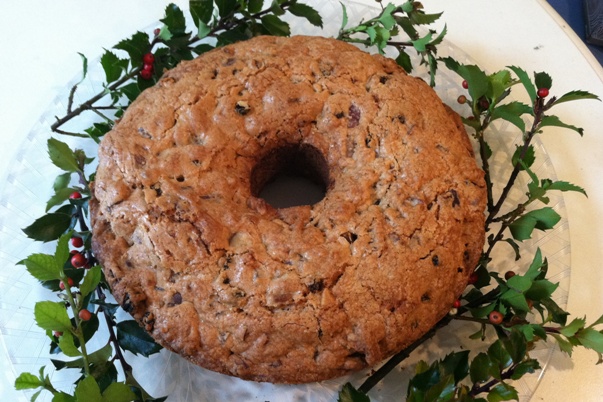
4. Add dry ingredients and fold until just combined. The batter will resemble chocolate chip cookie dough.
5. Spoon batter into pan. Smooth the top. Bake until cake is golden and tester – I use a long, very thin wooden skewer – comes out clean. Start testing after 1½ hours. Cool cake on rack for 10 minutes, then turn out of pan and cool completely.
NOTE: Use moist, not stale dried fruit. Hard fruit will bake up even harder and ruin the cake.
Photo: Christmas fruitcake inspired by Truman Capote. Credit: Barbara Haber
Some holidays have specific associations. Thanksgiving has turkey and stuffing. New Year’s Eve and eggnog go hand in hand. Chanukah isn’t Chanukah without potato latkes and, in our house, you can’t eat latkes without applesauce and sour cream. But as with everything we cherish, there are downsides. What to do with the turkey liver that comes so nicely packed inside the bird, why, make turkey liver pâté. And what to do with left over sour cream? Bake a delicious sour cream coffee cake, of course.
Once the menorah candles are lit, the latkes eaten and the kitchen cleaned, there is one lingering issue still to be addressed: What to do with the leftover sour cream?
Day after day, the sour cream container is pushed farther and farther to the back of the refrigerator, until months later the sorry container is discovered long past its expiration date.
Hating waste, for years I searched for a post-latke use for sour cream. On a summer visit to the Berkshires, innkeeper Ellen Chenaux at the Birchwood Inn in Lenox, Mass., presented the perfect solution.
What to do with post-latke sour cream
When she opened the Birchwood Inn as a second career, Chenaux knew she would need a good supply of recipes. Operating a bed and breakfast inn, Chenaux explained, is one part entertaining, one part cleaning up and one part cooking.
Traditionally, guests at B&Bs are served breakfast and afternoon tea, wine and cheese. Chenaux wanted to put a special stamp of her afternoon repast. For that she pulled out a collection of recipes she had started as a young girl and continued as she traveled in and out of the country.
One source stood out: Aunt Norma. Because her mother didn’t much care for cooking, Aunt Norma was Chenaux’s go-to source for reliable recipes. When she was putting together her menu for the Birchwood Inn, she definitely had to include her aunt’s sour cream coffee cake, a family favorite.
Sitting on the porch of her inn, happily eating forkfuls of the sour cream cake and sipping iced tea, my search was over. Now I knew exactly what to do with the leftover latke sour cream. Thank you Ellen Chenaux, and thank you Aunt Norma.
Aunt Norma’s Sour Cream Coffee Cake
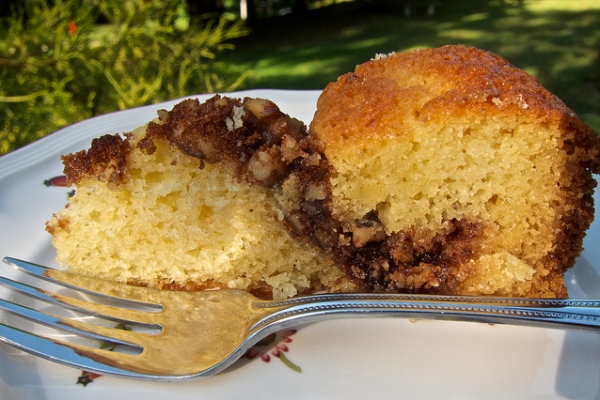
Having eaten many coffee cakes in my time, what sets Chenaux’s version of her aunt’s cake apart is the moistness. Too often coffee cakes are unpleasantly dry. Aunt Norma’s coffee cake was light, flaky and moist with flavor added by vanilla and the brown sugar, walnut and cinnamon streusel topping.
Ingredients
¾ pound unsalted butter, softened
1½ cups white sugar
3 eggs
1½ teaspoon vanilla (preferably, alcohol free)
1⅞ cups all purpose flour
½ teaspoon baking powder
1⅛ teaspoon baking soda
Pinch of salt
1 cup, plus 1 tablespoon sour cream
½ cup walnuts, raw, chopped
½ packed cup brown sugar
1½ teaspoon cinnamon
Directions
1. Preheat oven to 375 F.
2. Grease and flour a 10-inch spring form pan.
3. Beat the butter and white sugar together. Add the eggs and vanilla and mix thoroughly.
4. In a separate bowl, mix together the flour, baking powder, baking soda and salt.
5. Add half the flour mixture and half the sour cream to the batter. Combine well.
6. Add the rest of the flour mixture and the remaining sour cream to the batter. Stir well.
7. Mix together the walnuts, brown sugar and cinnamon to create a streusel topping.
8. Pour the batter into the prepared spring form pan.
9. Sprinkle the streusel topping on top of the batter.
10. Bake 45 minutes or until cake tester comes out clean.
11. Let cool on a wire rack.
12. Open the spring form pan and slide the cake onto a serving platter.
Photo: Aunt Norma’s sour cream coffee cake at Birchwood Inn, Lenox, Mass. Credit: David Latt
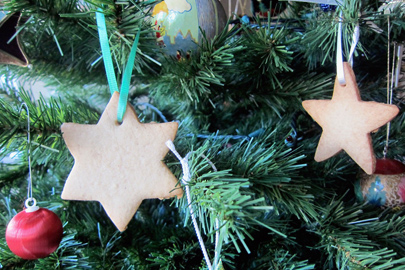
We kids from non-observant Jewish families were always the lucky ones at holiday time. We got presents for Chanukah and for Christmas. My son has it both ways too. We light the candles every night during the Jewish holiday (though the presents only appear at the beginning and the end) but we also love our Christmas tree, which goes up about a week before Christmas and stays there until the New Year. Santa never really cared that we were Jewish – he likes the cookies and milk we still leave for him on Christmas Eve too much — though my more observant friends have looked askance at the tree.
As for food, like everybody else celebrating Chanukah I’ll be making potato latkes. My recipe is based on one by Wolfgang Puck, that I tested and loved when I worked on his book “Wolfgang Puck Makes It Easy.” I’ll serve it with smoked salmon and a smoked trout purée, applesauce and sour cream.
Meanwhile, I’m already beginning my Christmas baking. Tart shells and sponge cake for my Christmas trifle are going into the freezer so that I can get a jump on Christmas dinner. Last year during this season I was busy testing pastry chef Jacquy Pfeiffer’s cookie recipes for his upcoming cookbook, “The Art of French Pastry,” so I had plenty to put on and under the tree. This year I’ll make his Christmas sablés and his coconut rochers, which are like mini coconut macaroons. I’ll eat Christmas dinner at the home of close friends, as I always do, and make Yorkshire pudding to go with their roast. I’ll use the recipe I grew up on, from the splattered page 591 of Mildred O. Knopf’s all-but-forgotten classic, “Cook, My Darling Daughter.”
Potato Latkes with Smoked Trout Purée
These latkes are based on Wolfgang Puck’s recipe. He serves his with whitefish. I serve mine with smoked salmon and with the smoked trout puree that follows.
Serves 4
Ingredients
1 pound russet potatoes, peeled
1 small onion, peeled
1 egg, beaten
2 tablespoons all-purpose flour
½ teaspoon baking powder
¾ teaspoon salt
¼ teaspoon freshly ground black pepper
Cooking oil, such as canola, peanut or safflower
Directions
1. Using the large holes of a box grater/shredder, or the medium grating disk on a food processor, shred the potatoes into a mixing bowl. Grate in the onion.
2. Line a large bowl with a clean kitchen towel. Transfer the mixture to the towel-lined bowl, twist the towel around it and squeeze out as much liquid as you can (alternatively you can pick the mixture up by handfuls and squeeze dry). Transfer to another bowl.
3. Add the egg, flour, baking powder, salt and pepper. Stir with a fork until well blended.
4. Line a baking sheet with parchment. Spoon about 2 tablespoons of the latke mixture into a ¼-cup measure and reverse onto the parchment. Repeat with the remaining mixture.
5. Meanwhile, heat about ¼ inch of oil in a large, heavy skillet or in an electric fryer set at 350 F, until it ripples and feels quite hot when you hold your hand over it. Carefully slide an offset spatula underneath a mound of latke mixture and place in the pan. Press down on the mixture with a spatula to form an evenly thick pancake about 3 inches in diameter. Add more latkes, taking care not to overcrowd the skillet. Cook the pancakes until golden brown, about 3 minutes per side, turning them over carefully with a slotted metal spatula. Transfer to a tray or platter lined with paper towels or a rack to drain. Continue with the remaining mixture. If not serving right away, allow to cool completely. When ready to serve, preheat the oven to 400 F. Place the potatoes on a baking sheet and heat in the oven until crisp, about 10 minutes.
6. Serve with sour cream, drained yogurt or crème fraîche and smoked salmon or the trout spread below. Also serve with applesauce.
Smoked Trout Spread
Makes about 1½ cups, serving 10
Ingredients
½ pound smoked trout (without bones or skin)
2 tablespoons crème fraîche or drained yogurt (more to taste)
1 tablespoon cream cheese (can use reduced fat)
1 to 3 teaspoons fresh lemon juice (more to taste)
Directions
1. Place the smoked trout in a food processor fitted with the steel blade and process until finely chopped. Add the remaining ingredients and process to a smooth purée. Refrigerate for 30 minutes. The mixture will stiffen up.
Mildred O. Knopf’s Yorkshire Pudding Chippendale
My stepmother always used this Yorkshire Pudding recipe, from Mildred O. Knopf’s “Cook My Darling Daughter.” I now have her book, and in the back she’s penciled 3 recipes with the page numbers, all of which are splattered from much use: Yorkshire, Roast Beef, and Pastry. The Yorkshire, which has the title Yorkshire Pudding Chippendale with no explanation of what the word “Chippendale” refers to (the dish it’s made in?), is not made in the classical English way with the drippings from the meat; it’s made with butter, lots of it. It’s like a big popover, and irresistible. Here is the recipe, exactly as Mildred O. Knopf wrote it in 1959, with some annotations by my stepmother and by me. Make it while your roast is resting.
[Preheat oven to 450º]
3 ounces butter (my stepmother has penciled in — 6 Tbl)
2 eggs
1 cup milk
1 cup flour
¼ teaspoon salt (I increase the salt by ¼ teaspoon or even a bit more; I think Mildred was using salted butter, which was the norm in those days)
FIRST Melt 3 ounces butter in a 10″ x 12″ pan in a preheated 450º oven.
SECOND While the butter is melting, beat 2 eggs with 1 cup milk. Sift 1 cup flour, measure, and resift with ¼ teaspoon salt (I suggest ½ teaspoon). Stir into milk, beating well to blend.
THIRD Remove pan from oven, pour in mixture on top of butter. Return to oven and bake until puffed up and brown for approximately ½ hour. Crisp, buttery and delicious! Serve cut in large squares with roast beef. Nothing better.
From “Cook, My Darling Daughter,” by Mildred O. Knopf, Alfred A, Knopf, New York, 1962
Top photo: The author’s Christmas tree decorations include a Star of David cookie. Credit: Martha Rose Shulman
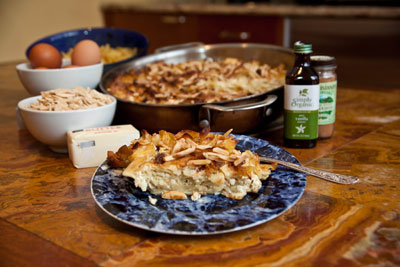
Confession: It isn’t even my recipe. It’s from my former stepdaughter. She was mostly nice to me, occasionally nasty, and always an excellent chef. Originally, I think she inherited the recipe from her grandmother, my former husband’s mother. So you can see that even with all the family drama that hinted I’ve at, I know this is the best noodle pudding in the universe. Topping even my Aunt Grace’s.
Noodle pudding. Credit: Bethany Versoy
More authentic American Jewish families call it lokshen kugel, which translates from German (with a few spelling corrections) right back to noodle pudding. Years back, I was surprised when a friend made “lokshen kugel” for an early school holiday potluck, and when I tasted it, it was just plain old noodle pudding. I hear that some Jewish families make a savory noodle pudding. In my world, that would be heresy. Or Italian.
Noodle pudding is a dessert disguised as a side dish. Buttery, crunchy, sweet and cream cheesey, and with all the blessed mouth-feel of baked noodles. I’ve made it for every Jewish holiday (save Passover) for 20 years and for countless other events when I want to contribute something substantial and wonderful that cements my reputation as a cooking hero.
Noodle Pudding
The noodle pudding freezes well, and the recipe can easily be doubled. And yes, you can make it with gluten-free noodles and/or with low-fat dairy products. But then it will simply be a very good noodle pudding, not the world’s best.
Ingredients
ZESTER DAILY
CONNECTION
Related Links
» Jamie Geller: Why You Should Explore Kosher Cooking
» Chanukah and Christmas: The Best of Both Worlds
Coming Soon
» Aunt Norma’s Sour Cream Coffee Cake
» Righteous Rugelach Jewish Holiday Cookies
1 pound of broad egg noodles
4 eggs, beaten
½ cup of sugar (add more to taste)
2 teaspoons vanilla
1 tablespoon salt
Cinnamon to taste
1 (16-ounce) container of cottage cheese
1 (16-ounce) container of sour cream
8 ounces of cream cheese
1 cup of raisins (blonde or dark)
2 tablespoons butter (more if desired)
1 (10- to 12-ounce) jar of apricot jam
1 cup of slivered almonds
Directions
1. Preheat oven to 350 F.
2. Cook egg noodles and drain.
3. Beat the eggs till they are lemon yellow, then add sugar, vanilla, salt and cinnamon.
4. Mix all the dairy products in a large bowl, then add the egg mixture, raisins and egg noodles. (The warmth of the noodles will make the entire mixture easy to combine.)
5. Dot the top with butter, then spread apricot jam on top with a pastry brush.
6. Sprinkle the top evenly with slivered almonds.
7. Bake for one hour at 350 F, or until golden brown.
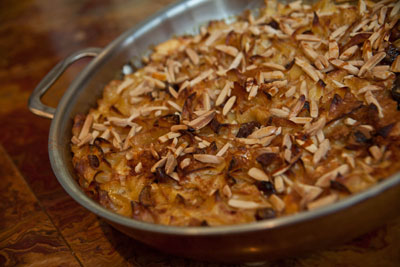
Top photo: A slice of the world’s best noodle pudding. Credit: Bethany Versoy
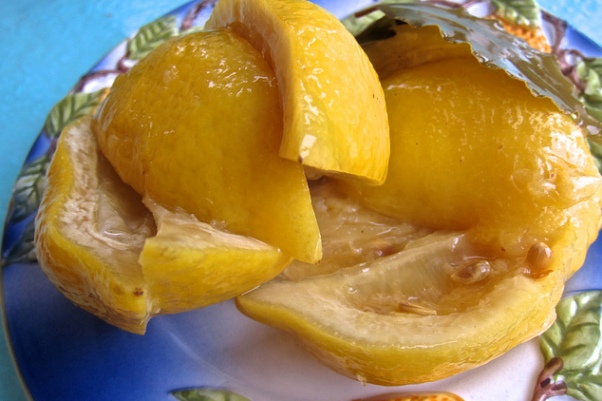
You love giving holiday gifts, but Black Friday and Cyber Monday made you nervous and you dread last-minute shopping. Crowded stores and overflowing parking lots add to the perils of gift giving. This year, instead of buying all your gifts, why not make baked goods, homemade sweets or preserved lemons. They make such welcome holiday gifts.
Make, don’t buy your gifts
Living in Rhode Island years ago, I learned that lesson from my friend Risa Gilpin. With snow sticking to the windows and the crackle of logs ablaze in the wood-burning stove, after work Risa would spend December evenings sitting in a comfortable, old easy chair knitting sweaters and crocheting soft sculptures. I still have the palm tree she made me to help cure my longing for sunny Southern California.
Risa loved holiday gift giving even as she pushed back against commercialism.
Her thought was simple and straightforward, “What you buy in a store isn’t personal. It might be nice, but it isn’t special.”
Homemade holiday gifts are more personal
With the holidays coming, that thought resonates with me. Knitting and crocheting aren’t my thing, but cooking comes naturally. A box of chocolates made in my kitchen and boxed up nicely is a perfect gift. The same goes for preserved lemons, an essential ingredient in Moroccan cooking.
After a recent trip to Morocco, making tagines and couscous at home was a high priority. All the ingredients were easy to find, except for preserved lemons. A local restaurant supply store stocked only frozen ones. An Italian specialty market sold two lemons in a jar for $10, which was expensive and, unfortunately, the lemons didn’t taste fresh.
Making preserved lemons is easy and inexpensive. All you need is half an hour, a sterilized jar, half a dozen lemons and pickling spices. Once preserved, the lemons keep in the refrigerator for months, although you’ll enjoy the flavor so much, they probably won’t last that long.
In the time it would take to drive to the mall and back you can spend a few peaceful hours listening to the radio and preparing a dozen or more jars of preserved lemons. Then all you need is a colorful ribbon on the jar and a card and you have a very special holiday gift.
Moroccan Preserved Lemons
Select unblemished, ripe lemons. At the market, gently squeeze each lemon to confirm they are juicy. Meyer lemons are good to use, although any medium-sized lemon will give you the perfumed result you want.
Use a lidded, glass quart jar. A recycled mayonnaise jar or canning jar works well. To eliminate bacteria, the glass jars should be sterilized with a cleaning in a dishwasher.
Most recipes call for only the rinsed peel of the preserved lemon. The pulp is scraped off and discarded; the peel rinsed in clean water. In a cooking class in Marrakech at La Maison Arabe, we were directed to finely chop the seeded pulp and to cut up the peel without rinsing. The resulting sauce was lemony and salty in a very good way.
Ingredients
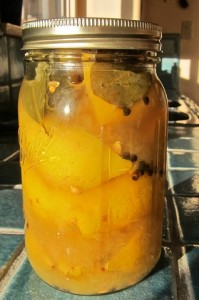
Preserved lemons in a jar. Credit: David Latt
1 teaspoon black peppercorns
4 bay leaves
¼ teaspoon pepper flakes or 1 dried Szechuan pepper, quartered
1 cinnamon stick (optional)
½ teaspoon coriander seeds (optional)
4 large, ripe lemons, washed
6 tablespoons kosher salt
1 cup freshly squeezed lemon juice
Directions
1. Place the peppercorns, bay leaves, dried pepper and other spices in the jar.
2. Prepare the lemons one at a time. Place a lemon on a cutting board with the stem side up.
3. Using a sharp paring knife, first halve, then quarter the lemon lengthwise, but do not cut all the way through. Stop cutting 1 inch from the bottom of the lemon.
4. After you cut each lemon, place it in the jar. Sprinkle one teaspoon kosher salt onto the flesh and press down to release the juice. Do this to each of the lemons until the jar is filled within 2 inches of the top.
5. Add the lemon juice to cover the lemons. To avoid spoiling, the lemons must be covered with liquid. Seal and place the jar in the refrigerator.
6. Every day shake the jar and turn it over so the lemons pickle evenly.
(After four weeks the lemons are ready to use.)
7. To keep the lemons submerged as you remove lemons from the jar, add fresh lemon juice and shake well or put the pulp removed from the peel back into the jar.
Top photo: Preserved lemons. Credit: David Latt
Two traditional things for New Year’s Eve: 1) drink eggnog and 2) sing “Auld Lang Syne.”
Eggnog is an English drink, the name coming from an English dialect word for strong beer. These days, as we know, it’s usually made with rum, sometimes with whiskey, and sometimes even with Scotch. But if you really want to lean on the Scottish angle for New Year’s, you might consider setting the eggnog aside and experiencing how people really drank auld lang syne Scotch (that’s “long ago,” as they say over on the English side of the border).
Distilling is a tricky business, and many things can go wrong. Over the centuries, distillers have figured out the science of it pretty well, but in earlier times whiskey was more of a gamble. One batch didn’t necessarily taste much like another, and there could be off-flavors, apparently sometimes very off.
These problems beset bourbon distillers in the United States even into the 19th century. Bourbon was sold out of the barrel, and customers filled up their jugs at “barrel houses,” where nobody but the owner knew what was really in that barrel (there was a lot of fake Old Crow being sold).
Merchants often doctored the bourbon with aromatic additions to create a more consistent house style and to cover up any bad flavors. This led to the development of the famous cordial called Southern Comfort, which is basically a doctored Bourbon that seems to be flavored at least partly with peaches.
Doctor it up with New Year’s style
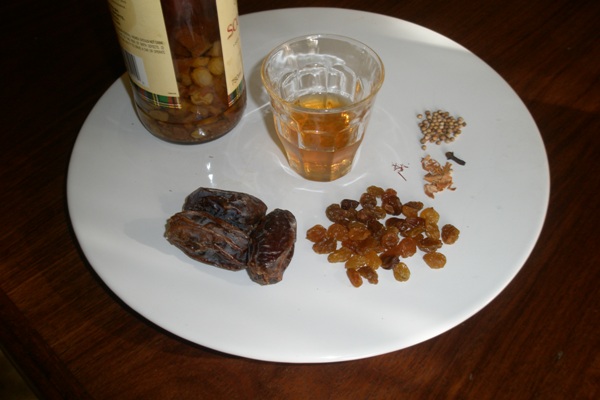
In Scotland, where whiskey was usually sold out of the barrel at pharmacies and grocery stores, doctoring was also common. One 1725 recipe said to mix the Scotch with rum, sugar, raisins, dates, licorice, cloves, mace, cinnamon, coriander, cubebs, saffron and nuts.
You see the lines along which they were thinking. First they wanted to sweeten the whiskey, which always puts the palate in a forgiving mood, and then they wanted to add fruits and spices to punch up the aroma. A product like this is still made – a Northern Comfort, as it were – under the brand name Drambuie.
Obviously, there was no such thing as a standard recipe. Doctoring whiskey was a do-whatever-feels-good proposition, like making barbecue sauce. I, for one, am usually plumb out of cubebs (I suppose I could throw in some peppercorns instead), and I happen to hate licorice, which in my book is just sweetened roof tar, so I haven’t tried out the 1725 recipe exactly as written.
But I have tried most of the rest of the ingredients in that list, and the result was very pleasing, sweet and fragrant, with a clear family resemblance to Drambuie. That resemblance could be underlined by adding some honey. You should use Highland heather honey, if you’ve got it.
I would say the dates add the most body to the flavor, so I think next time I’ll even try leaving the raisins out. Dates, cloves, mace and cinnamon alone would do nicely, though the saffron does add a sophisticated note, which is why saffron appears in one premium brand of gin.
But my experimentation has just begun. I didn’t add any sugar to my first batch, but I wonder what a little maple syrup would do, though I probably wouldn’t try it if I was getting around to adding rum.
Obviously, to do any this with a fine single malt would be a terrible indignity, not to mention a criminal lack of thrift. Any good inexpensive blended Scotch will do. But it’s worth it. You’ll have a fine homemade cordial to serve – in a whiskey glass or even a liqueur glass, of course — before or after, or even instead of, your eggnog.
Auld Lang Syne Scotch
Serves 12-15
Ingredients
¼ cup raisins
5 dates, minced fine
1 bottle blended Scotch
½ teaspoon coriander, freshly ground
½ teaspoon mace flakes, freshly ground
1 clove, freshly ground
5 threads saffron, ground fine (optional)
Directions
Put the raisins, and dates into the Scotch bottle (if they won’t fit, drain off a little of the whiskey). Add the coriander, mace, clove and optional saffron, shake well and leave overnight to blend.
Photo: Auld Lang Syne Scotch for New Year’s. Credit: Charles Perry

Christmas in Provence, that sunny wedge of southern France that runs along the edge of the Mediterranean from the Italian to the Spanish border, follows the Catholic tradition of observing fast before feast.
The traditional replacement for meat on a fast day is salt cod, a challenging ingredient at the best of times, let alone in the depths of winter in a region best suited to the heat of summer. The ingenious cooks of Provence, however, rose to the challenge, and the centerpiece of the souper maigre, the lean meal of the Reveillon, the vigil of the night before, is brandade de morue, a creamy salt cod dip flavored with garlic and rich with new season’s olive oil, one of most delectable dishes ever to grace a festive table.
In medieval times, the pre-Christmas period of abstinence imposed by the Mother Church ran for 40 days, matching the Lenten fast before Easter. These days, the tradition has shrunk to the Eve alone, but salt cod remains on the menu — a symbol of abstinence at a time of plenty. Abstinence has always been relative in Mediterranean lands: The rich always ate more than poor but not necessarily better — and none better than the independent peasantry of Provence, where the feasting of the holiday’s eve runs with scarcely a pause from dusk until dawn.
Christmas in Provence a celebration for all generations
Festivities start as soon as all members of the family, young and old, are gathered round the table. The first installment, souper maigre, a meatless meal washed down with water, is followed by a short pause for attendance at midnight Mass before returning home for the gros souper — roast partridge, pheasant, guinea fowl — after which the wine flows, memories are shared and merrymaking continues into the small hours of Christmas morning.
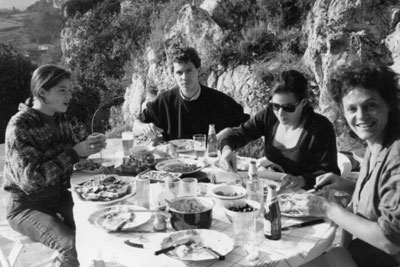
Elisabeth Luard and her children enjoying a Christmas lunch in the sunshine of Vaison-la-Romaine circa 1985.
Regions, towns and villages — even individual households — vary in the rituals and dishes considered proper for the feast. But the traditions I know best are those of Vaison-la-Romaine, a hilltop market town fortified by the Romans where I spent many a merry Reveillon with my young family in the days before my children acquired children of their own.
It goes without saying that a celebration marking the birth of a very important baby is for all the family: No one would dream of sending even the smallest child to bed before he falls asleep on someone’s lap. Which means if you turn up anywhere in the region before midday Christmas Day, you’ll find the shutters up and no one about, even when there’s sunshine to be enjoyed and there might be truffles to be found under the lime-tree walk along the riverbank. Children’s presents must wait till Jan. 6, when the Three Kings arrived in Bethlehem with their gifts.
In Vaison-la-Romaine, the traditional fasting supper is the brandade, often purchased ready-made from the local olive-oil merchant, followed by a thick vegetable soup with ribbon pasta, soupe de lasagnes. By the coast, in Marseilles or Nice, it might be a Grande Aioli, a steaming heap of plain-cooked winter vegetables to be eaten with sea snails and a garlicky golden mayo.
But before these good things can be enjoyed comes the setting out of the créche and its santons, a miniature crib surrounded by little figures of local tradesmen and dignitaries, often unflattering represented in various stages of ursury or gluttony, the work of specialist craftsmen with a new figure every year. Close by are laid out les treize desserts, 13 good things: 12 little bowls, one for each of the Disciples, filled with Christmas treats — fresh and dried fruits and local sweetmeats — surrounding a more substantial offering such as an apple tart or a fougasse, a sweetened bread scented with orange water. The selection varies according to local gastronomic strengths — you’ll find grapes in wine-making areas, melons in sandy regions beside the sea — though the number of dishes and the story they tell is common to all. Supplies are regularly renewed throughout the holiday to provide a kind of open larder, allowing the lady of the house to leave her kitchen and enjoy the company of family and guests.
In Vaison, an area that specializes in orchard fruits as well as the black Perigord truffle (another Christmas treat), no arrangement is complete without its little pyramid of William pears, their stalks tipped with scarlet sealing wax to keep them fresh. Sweet things for children include quince paste, crystallized plums, dried apricots, nougat and little boat-shaped marzipan cookies, callisons d‘Aix. The four begging orders of monks, any of whom might be expected to claim a place among the guests, are represented by bowls of blanched almonds for the white-robed Dominicans, rough-skinned figs for the Franciscans, smooth brown hazelnuts for the Carmelites and wrinkled little currants for the Augustines. And as a reminder of the land of the infant’s birth, imported fruits — oranges, tangerines, dates — are on sale in the Saturday market.
On Christmas Day, early-rising children are expected to creep out of the house to visit grandparents and elderly relatives, leaving exhausted parents to sleep off the festivities in peace and recover from the Christmas day hangover. (To cure, take an infusion of sage and garlic laced with olive oil.)
Brandade de morue (Provençale salt cod purée)
If you can buy salt cod ready-soaked, so much the better. If you buy it in dried form, choose 12 ounces middle-cut, chop into 3 to 4 pieces and set it to soak for 24 hours in a large bowl of cold water, changing the water as often as you remember (at least four times). The inclusion of potato is optional but advisable as it helps form the emulsion.
Serves 6-8
Ingredients
1 pound ready-soaked salt cod
To poach:
1 onion, chunked
2 bay leaves
Small bundle dried fennel stalks or 1 teaspoon fennel seeds
Short strip of dried or fresh orange peel
½ teaspoon peppercorns
For the brandade:
½ pint (1 cup) warm olive oil
2 to 3 tablespoons warm cream
1 medium potato, boiled, skinned and mashed (optional)
2 to 3 garlic cloves, crushed
To finish:
Black olives or a small black truffle
Directions
1. Place the fish in a roomy saucepan with the poaching aromatics, cover generously with water and bring gently to the boil. Remove the pan from the heat as soon as the water gives a good belch.
2. Add a glass of cold water to halt the cooking process, leave for 5 minutes to complete the softening process, then drain, skin and use tweezers and your fingertips to find and remove any bones.
3. Start with everything at more or less the same temperature — warmed to finger heat. In a mortar or the processor, pound the fish flesh to a paste with the optional potato, garlic and as much of the oil as you need to soften the mix or keep the processor blades moving. Work in the rest of the oil gradually as if making a mayonnaise, adding the warm cream toward the end, until you have a thick white puree. A processor puree will be smoother and whiter than if you make it by hand.
4. Spoon into individual bowls and finish with a single black olive (a symbol of the darkness to come) or, better still, a scraping of black truffle. Serve warm with toast or baguette, as for a paté. It’s deliciously rich, so you don’t need much. Follow, as they do in Vaison-la-Romaine, with a soupe de lasagnes, a chunky vegetable soup with pasta ribbons with frilled edges to remind the children of the Christ child’s curls.
Photo: Provençale Christmas crib figures called santons. Credit: Elisabeth Luard