Articles in Travel
Traveling through India on summer vacation, I had expected breathtaking sites, punishingly hot weather and fresh, flavorful food. What I didn’t anticipate was fine, locally produced wine. Yet, that’s exactly what I experienced — magnificent sites and food, excruciating heat and wonderful Indian wines — throughout my sultry journey.
Weeks after I returned home, I was even more surprised to find the very same wines served in the Indian restaurant in my New York neighborhood. India, I learned, has a burgeoning wine industry, one that creates and exports highly satisfying Syrahs, Cabernets, Zinfandels, Reislings, Viogniers, and Chenin and Sauvignon Blancs.
Statistics make case for India’s growing wine trade
While I may have been amazed by the surfeit of Indian-made wines, serious oenophiles would not be. According to a March 2012 report from the University of Pennsylvania’s Wharton School of Business, during the past decade India’s wine market grew at a rate of more than 20% each year. Concurrently, its number of wineries increased from less than 10 to more than 75. In 2012 alone, its retail wine sales jumped from 5 % to 30% of alcohol sold nationwide. Most of this purchased wine originated in India.
The country’s recent economic prosperity has, in part, propelled the wine craze. As more people gain disposable incomes, travel and become exposed to diverse cultures and customs, their interest in beverages other than locally brewed beer and spirits grows. Swayed by the much-touted health benefits of wine, more feel compelled to try a glass.
With the advent of wine bars and shops, opportunities to partake of this beverage are multiplying. This is good news for consumers, for imported wines tend to be pricey. Because of high tariffs, a bottle from Europe or South Africa averages about $38, whereas from India it falls between $3 and $14.
“Even 1,300 rupees, which is about 26 U.S. dollars, is way too expensive for middle-class Indians for wine,” says Ramakrishna Shastry, a university professor and IT professional from Mangalore. “When I go out for dinner with a group of people, most prefer beer or the 500 to 600 rupees — about 10 to 12 U.S. dollars — wine.”
Shastry confirms what studies indicate. When visiting bars, shops or restaurants, more Indian consumers reach for affordable local vintages.
India’s wine trade benefits from a climate suitable for grapes
Although I understood the passion and demand for homegrown wines, I was unaware that grapes could thrive in such a tropical, monsoon-rich climate. If I wilted in the humid, 115-degree August heat, surely grape vines would, too.
Outside the city of Nashik, in the western state of Maharashtra, an oasis for winemakers exists. Here, in what many call India’s Napa Valley, the weather is temperate and conducive to cultivating a wealth of grape varieties. Vineyards not only persevere but also flourish in this region.
Among the most famous from Nashik is Sula Vineyards. Founded by Stanford-educated engineer Rajeev Samant and California vintner Kerry Damskey, Sula planted its first Sauvignon and Chenin blancs in 1997 on Samant’s 30-acre family estate. It released its first wines in 2000. Today, the winery produces 20 different sustainable reds and whites, including three sparkling and the nation’s first dessert wine, the Late Harvest Chenin Blanc.
It was Sula that provided me with my first sip of Indian wine. Crisp and mildly herbaceous, its Sauvignon Blanc was light and refreshing — the perfect accompaniment to a plate of dal tadka or handful of puffed lotus seeds on a balmy Agra night.
No sooner had I fallen for Sula’s Sauvignon Blanc than I encountered its bold Dindori Reserve Shiraz. Aged for one year in new oak barrels, the Shiraz possessed a smooth, full-bodied flavor reminiscent of a fruity Cabernet. Although recommended for meat and seafood dishes, this versatile beverage paired beautifully with vegetarian lentil soup, the eggplant curry baingan bharta and chicken tikka korma.
My wine sampling didn’t end with Sula Vineyards. From the foothills of Nandi Hills, Grover Vineyards supplied me with a citrusy Sauvignon Blanc and rich yet clean-tasting Cabernet-Syrah blend. Based outside the city of Pune, the Four Seasons hotel offered a pleasantly sweet Viognier with hints of peaches and apricots.
Because Sula, Grover and Four Seasons export to the United States, I can continue to enjoy them at home. Whenever I feel nostalgic about my summer vacation, I make a spicy curry, uncork a bottle of chilled Indian white and start flipping through trip photos. Thanks to these wines, I get a full taste of India without ever packing a suitcase or stepping outside my front door.
Photo: The view of the Taj Mahal from the Oberoi Amarvilas hotel in Agra, India. Credit: Kathy Hunt

Not long ago, the famous, potty-mouthed New York Chef David Chang made the notorious comment: “F—ing every restaurant in San Francisco is just serving figs on a plate. Do something with your food.”
Oh, please.
New York chefs would probably trade their sous vide machines and Berkel slicers for the figs and other glorious ingredients that San Francisco chefs routinely have at their disposal, thanks to the temperate climate and the fortitude of so many local farmers.
Where to find food trends
In food circles, it seems that New York often gets the lion’s share of credit for starting trends. In reality, most food trends start on the West Coast.
The Bay Area is the region that gave legitimacy to farm-to-table cooking as far back as the ’70s, thanks to Alice Waters of Chez Panisse. Nowadays, San Francisco restaurants hold true to that mission, but in an even more ingrained way. Chefs forage for wild edibles on wayward hillsides. They cultivate their own farms to grow what they need. They even fashion their own pottery to showcase the food they create.
San Francisco’s best restaurants
The restaurants below represent the best of what San Francisco has to offer. For my money, there’s no better food city in the world.
AQ: At AQ, in a still-sketchy part of downtown, the décor changes along with the menu every season. Yes, this might sound gimmicky and contrived. But it works when the food by Executive Chef-Proprietor Mark Liberman, former chef de cuisine at La Folie in San Francisco, is this inspired. In summer, with a dining room as light and airy as a beachfront cafe, the menu features wild salmon, sweet yellow corn and romano beans with roasted lobster juices. In fall, the room morphs with the addition of a copper-topped bar and servers dressed in cozy plaid shirts. That’s when you don’t want to miss the Duck Aged on the Bone, a dish with meat the texture of a great steak and an impeccably crisp skin. AQ is worth the trek no matter the season. 1085 Mission St., San Francisco; (415) 341-9000.
Aziza: No one cooks Moroccan food like self-taught Chef Mourad Lahlou, who riffs on the flavors of his native Marrakech with sophisticated and daring flair. Combining organic, seasonal and sustainable ingredients with modern techniques, he boldly reinvents classics. Who else would think to smear creamy uni over halibut, then broil the filet until the flesh is succulent and the skin crackling crisp with a flavor akin to creamy-salty Parmigiano. Even lentil soup is reborn here with celery and dates, a complex and deeply satisfying rendition. 5800 Geary Blvd., San Francisco; (415) 752-2222.
Quince: A magnet for any visiting Hollywood star, Quince is nearly impossible to get into on a Saturday night. Nevertheless, find a way to get there. The fine-dining Italian establishment will envelope you in some of the most seamless service you’re likely to experience. Sit back and swoon over house-made pastas such as the dumpling-style cappellacci, their fragile skins filled with juicy ground spring lamb; or Maine lobster gnocchi that taste so intensely of the crustacean that the flavor will linger on your palate like a dream you don’t want to stir from. 470 Pacific Ave., San Francisco, (415) 775-8500.
Benu: This is the only restaurant that Chef Thomas Keller of the French Laundry has invested in that’s not one of his own. Then again, Benu is run by his former French Laundry chef de cuisine, Corey Lee, so Keller has every reason to believe in its success. He hasn’t been disappointed. The much-lauded restaurant serves Asian-influenced modernist cuisine. The tasting menu, which changes regularly, might include as many as 16 dishes, beginning with tiny one- or two-bite morsels and becoming more elaborate in size and scope through successive courses. A signature dish is the faux shark fin soup which evokes the pricey, Chinese-banquet staple that’s become an environmental pariah. But here, the soup is made from a seafood broth transformed into a very thick liquid, no shark involved. The liquid is squirted into cold water and sets into a politically correct version of the slippery strands beloved by shark fin fans. This version is tastier, too. 22 Hawthorne St., San Francisco; (415) 685-4860.
Dynamo Donuts: There are doughnuts. And then there are Dynamo Donuts — which pretty much put all others to shame. Handcrafted from a brioche-like dough, Dynamo’s confections come in such fantastical flavors as Chocolate Rose Geranium Hazlenut, Molasses Guinness Pear and Bacon Maple Apple. Glazed and decked out, they’re not achingly sweet, just incredibly flavorful. Don’t miss the Candied Orange Blossom variety, which is one happy explosion of citrus. 2760 24th St., San Francisco, (415) 920-1978.
Top photo: Carolyn Jung. Credit: Joanne Hoyoung-Lee
Every second year, Fromarte, the organization that defends the interests of Switzerland’s artisan cheese makers, stages the Swiss Cheese Awards. It’s a great show — inevitably dubbed the Swiss Cheese Oscars — and falls into two parts. First, there’s cheese judging, held behind closed doors. Separately, the public can taste and buy products at a spectacular well-furnished cheese market. The idea behind it all is to identify and reward the country’s finest cheese-makers and to raise awareness of the quality and variety of cheese being produced throughout the confederation today.
In true democratic fashion, the event moves around the country from year to year, taking place alternately in each of Switzerland’s three main linguistic regions. In 2008, the awards were held in German-speaking Unterwasser in the Toggenburg region in the east part of the country; 2010 was the turn of French-speaking Neuchâtel. This year, from Sept. 27 through 30, the competition will be staged in the city of Bellinzona, in Italian-speaking Ticino.
Four days of tasting at Swiss Cheese Awards
Cheese judging takes place on the first day of the four-day extravaganza. In 2010 I joined other jury members drawn from all over Switzerland and Europe and a handful of experts from the American cheese-making fraternity. We assembled to receive our marching orders and were issued full-length aprons, cheese knives and clipboards. At a given signal, we moved next door into an immense hall where all the cheeses were laid out on long trestle tables covered in white cloths.
The cheeses — divided into some 25 categories — ran the gamut of types, from extra-hard and hard to semi-hard, soft and fresh. Some had white bloomy rinds (think Brie), others were highly colored with stinky washed rinds. The flesh was rich and creamy, or crumbly, or shot through with blue veins. And the samples were made variously from cow, goat, sheep or buffalo milk — even, occasionally, from a mixture.
Along with four other judges, I was assigned to the innovations category: newly devised cheeses that don’t fall under the usual headings. Each product was anonymous, identified only by a number and a few succinct notes on type (hard, semi-hard, soft), age (from weeks to months or — rarely — years) and milk type. We were required to assess them, using a scale of 1 to 5, on appearance, flavor/aroma, innovation and marketability. A score of 5 would indicate a blameless cheese; a 1 condemned it to outer darkness.
In silence — chitchat or exchanging impressions was strenuously discouraged — we moved around our table, observing, slicing, sniffing, tasting, ruminating over and allotting scores to the 40 cheeses offered for our inspection. The standard was high — scores of 4 were common, 1 was rare. At the end we got into a huddle, averaged the scores and handed in the results.
Cheese judging — like wine tasting — is an absorbing and demanding exercise. It’s one thing to nibble away appreciatively at a piece of cheese in the context of a meal; it’s quite another to give it your undivided attention and to assign meaningful and considered scores for the different aspects under scrutiny.
Pine and wasabi accents
The range was dazzling. Some cheeses were genuinely innovative, others more sedate and conservative. Perhaps rather too many were the classic, semi-hard kind. As this is Switzerland’s most common category by far, it was hard to award many marks for originality, though at least one distinguished itself by sporting a burnished rind stamped with pine motifs. More adventurous was a bloomy rind cheese sandwiched with a wasabi/cream-cheese paste and resembling a small sponge cake with filling.
Chili flavorings were popular with the cheese makers, but less so with the judges. A soft, bloomy-rinded goat’s cheese was dwarfed by its too large wooden box, which gave it a somewhat pathetic and shrunken look. The prize for the strangest looking went to a vermilion red, heart-shaped cheese — designed with Valentine’s Day in mind, perhaps?
We hung up our aprons, stored our knives and took a break till the results were announced, and the cheeses and their makers’ names unveiled. To my delight, two old friends (both of them featured in my book “Cheese: Slices of Swiss Culture“) had scored well: Willi Schmid of Lichtensteig with his Trüffel Büffel, a truffle-infused buffalo milk beauty, and Michel Beroud with his Dzorette, a soft, bloomy rind unpasteurized cow’s milk cheese sprinkled with toasted pine needles which imparted a gently resinous flavor.
Honor was satisfied, the country’s most skilled cheese makers had been recognized and rewarded, and the quality and variety of Swiss cheese amply demonstrated.
The 2012 Swiss Cheese Awards will be held in Bellinzona, Ticino, Switzerland, from Sept. 27 through Sept. 30, www.cheese-awards.ch
Top photo: A soft rind contender at the 2010 Swiss Cheese Awards. Credit: Sue Style
Like most people anticipating a first ocean voyage on a cruise ship, I worried that I would come home carrying 10 extra pounds. This concern grew out of a lifetime of impressions taken from popular culture that depicted such ships offering endless spreads to gluttonous passengers.
I imagined that I would be bumping into lavish buffets at every turn so that a casual stroll around the deck would be rewarded instantly with a plate of lobster quiche, or perhaps a crabmeat sandwich or two. I also pictured midnight dessert tables laden with an array of éclairs, cream pies, frosted layer cakes and mounds of butter cookies, all surrounding one of those delectably vulgar chocolate fountains spewing torrents of melted chocolate meant to be caught with a hunk of pound cake or perhaps a strawberry.
But now that I find myself a frequent trans-Atlantic passenger on the Queen Mary 2 because of a job I have taken as a lecturer, reality has sunk in, at least on this ship that provides a measure of British restraint. Three-course lunches and dinners served in the formal dining room offer small portions, and salads are always available. Among the six menu options, one can find “the spa meal,” dishes such as grilled fish that are noticeably light in calories.
Romantic myths
This discrepancy between the sort of food I had expected to find on the ship and what I really found set me thinking about other misconceptions about ocean liners I had stored up over the years. The departure scene is one of them. Old movies had hundreds of passengers holding a bottle of champagne with one hand and waving goodbye with the other to loved ones far below while streamers and confetti floated through the air.
But the truth is that the docked ships are off-bounds to friends and families because security measures allow only passengers anywhere near the ships. I was struck by this when close friends wanted to drive from Vermont to the New York Cunard pier to see me off, and I had to disabuse them of the notion they would be able to send me off in style, all teary-eyed and waving.
Cruise ships have a romantic mystique, and I was not surprised to find myself thinking about Bette Davis as I did my morning two-mile walk around the deck. I love old Warner Bros. movies, and “Now, Voyager,” which stars Bette, is my favorite. That’s the one where she meets and falls in love with Paul Henreid during a sea voyage, and the film has what may well be the most imitated scene in moviedom. He puts two cigarettes to his mouth, lights them, and hands one to her, a gesture that once seemed sexy but now could be interpreted as a suicide pact. This plot is about lovers prevented from a complete relationship because the Paul Henreid character is married, thus causing Bette the heroine to utter my favorite movie line of all time, “Oh Jerry,” she says, “don’t let’s ask for the moon. We have the stars.”
Cruise food: the luxury of currant scones
So I am a bit of a romantic. I find I am a sucker for several of the ship’s alluring venues. There is a champagne lounge that serves nothing but Veuve Clicquot, and I have been known to spend the evening there with friends, half expecting to see the cinematic ghosts of Davis and Henreid huddled together in a corner. I love going to the rustic Golden Lion Pub and am transported to a Thomas Hardy novel as I enjoy a ploughman’s lunch or fish and chips with mushy peas.
Most of all, I love the ship’s afternoon teas served in a room that oozes luxury, a sparkling golden décor with crystal chandeliers and a chamber music quartet contributing to the chic atmosphere. Waiters float around the room, pouring tea and serving teatime delicacies that put me in mind of a scene from the PBS series “Downton Abbey.” Of the treats being passed, I go for the currant scones served with clotted cream and strawberry jam. Why wouldn’t I?
So I limit my shipboard indulgences to an occasional scone and try to order the spa meals as often as possible. Such admirable restraint means that I actually lost weight on my first trip, and established an eating routine I have followed on subsequent voyages. I had dreaded the thought of coming home bloated and full of self-recrimination, and instead found I had been miraculously saved when an impulse toward self-preservation kicked in. But this does not mean I swore off currant scones, for the minute I got home I tried to duplicate them, and here is the recipe.
Currant Scones a la Queen Mary 2
Ingredients
2 cups all-purpose flour
3 tablespoons sugar
2 teaspoons baking powder
¼ teaspoon baking soda
½ teaspoon salt
½ cup (1 stick) unsalted butter, cut into small pieces
¾ cup dried currants
½ cup buttermilk or whole milk or cream, depending on the richness you desire
1 egg lightly beaten
1 tablespoon milk
Directions
1. Heat oven to 425 F. Line baking sheet with parchment paper. In large bowl mix together flour, sugar, baking powder, baking soda, and salt.
2. With pastry blender, cut in butter until mixture looks like coarse meal. Stir in currants, and add buttermilk (or whole milk or cream) and egg, and stir just until ingredients are combined. Do not overmix or scones will be tough.
3. On a lightly-floured surface knead mixture until dough is smooth. Form into an 8-inch disk. Using a 2½ biscuit cutter, cut into rounds.
4. Place scones on a baking sheet about 2 inches apart. Brush with milk. Bake until golden brown — about 12 to 18 minutes. These are good served warm or at room temperature and should be accompanied by strawberry jam and cream that has been whipped and sweetened.
Top photo: Currant scones with jam and cream. Credit: Barbara Haber
When Westerners come to China, one of their first complaints is that nothing in Chinese cuisine serves the role of a simple salad. The argument generally proclaims that most Chinese food is overcooked or over-fried to the point of losing all traces of the healthy nutrients held in the original raw ingredient. What remains, they say, swims in a sea of oil or whimpers cloaked under a thick, crispy outer shell, when all that was desired is a bunch of cold vegetables that are also tasty.
It took me a couple years of living and traveling throughout China to learn what part of the meal fills this role. It’s called, appropriately, liang cai (pronounced “lyang-tsai”), which literally means “cold food.” Liang cai refers to a category of Chinese dishes made mostly of chopped vegetables, tofu and nuts. They’re served raw after being steeped in a simple sauce of garlic, rice vinegar, sesame oil and red pepper.

Customers at a cold dish stall in Beijing. Credit: Manuela Zoninsein
Beijingers eat liang cai a lot, especially during the sticky summer months when it is often picked up on-the-go from streetside stands and eaten either as a quick meal with chopsticks straight from the plastic bag, or taken home to snack on while waiting for lunch or dinner to be served. Every province has its own specialties and flavor iterations. Even though I’ve been sampling liang cai for years, only recently did I discover a consistent, and consistently delicious, source of liang cai here in Beijing.
Master Fan’s liang cai
It comes to me care of Fan Jin, who holds court over a small stand in a small market at the Geological Sciences University, a square block campus in the Wudaokou student district in northwest Beijing. Fan is a stocky and solid 56-year-old with a round belly, round face and square hands and a circular face. He’s losing his graying hair.
Everyday he uniformly wears a white button-up collared shirt over a white tank, both of which are tucked into black, belted pants. His appearance gives off the practical air of a worker going through his daily chores diligently, but without interest. Since he’s been doing this for 24 years at various universities in the neighborhood, I suppose I understood his boredom, but from watching clients gather around his stand daily it’s clear his food excites those who eat it.
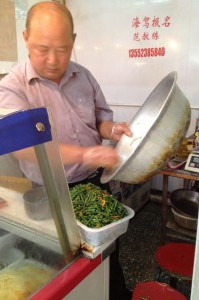
Fan Jin preparing a liang cai in Beijing. Credit: Manuela Zoninsein
So it was logical that he responded to my requests to show me how to prepare food by first wholly disregarding me, and then expressing varying degrees of surprise and skepticism that eventually morphed into humor. Only after I showed up daily over several weeks did he finally warm up to me. I began calling him “Master Fan,” explaining I wanted to be his diligent student and watching him prepare dishes whenever he refilled his wares.
Watch Fan Jin prepare liang cai.
Generally, Fan stands behind his refrigerated display stand, which holds between eight and 12 plastic containers, each with a different kind of liang cai, depending on the time of day and how much student foot traffic recently passed through. The container also holds some animal offal such as pigs’ feet, knees and ears, which can be chopped up and added to the mix, though as a vegetarian I haven’t sampled this option.
Chinese street food features simple, fresh dishes
Dishes are named by the central ingredient. For instance, doufusi entails thin threads of dried tofu, often accompanied by a bit of cilantro. Qincai, or celery, comes chopped into cubes and paired with boiled peanuts and bits of cooked carrot. My current favorite, jinzhengu, or gold-needle mushrooms, is mixed with pea shoots and a few strips of grated carrot.
Fan’s favorite is the songergu, which is chunky matsutake mushrooms interspersed with bok choy. He recently added a doujiao option of green beans that stand alone, which he’s been promoting to customers pretty regularly.
After indicating the weight of the product they want to buy, clients pick out the dishes they want, which are thrown together into a plastic bag nestled into a metal bowl. After the bag is weighed and priced, Fan tosses the goods into a larger bowl and mixes them together with more of the oil and vinegar, plus additional smashed garlic and hot pepper if requested.
For the marinade, after he has chopped and chilled the vegetables he liberally coats them with salt and MSG, and then douses them with sesame oil, rice vinegar and garlic-infused vegetable oil. He doesn’t measure, but the liquids are mostly one-to-one in proportion.
A main attraction
The flavor hits the tongue quickly, thanks to the sharp vinegar and spicy pepper; but it stays on long after swallowing, leaving a smoky flavor thanks to the oil and in part to the garlic. Because the dishes are raw and served cold, there’s also a nice crispness, and the textures of the two or three ingredients usually contrast between crunchy and soft.
Perhaps liang cai have slipped under the radar for this long because they are often placed on tables as small plates, either as appetizers to the main dishes, or as healthy side dishes that serve as afterthoughts alongside steamed buns or dumplings. More and more, however, they are the main attraction for me.
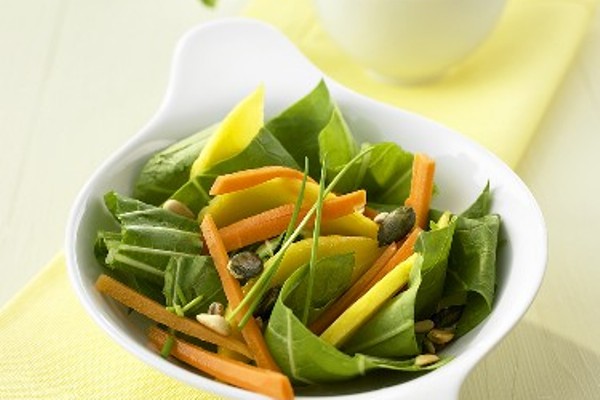
Photo: Pak choi salad with mango and carrot. Credit: StockFood

Imagine a tasty rosemary-scented, seven-hour lamb with tender flageolet beans while dining with a revered art hero at his regular table at his favorite restaurant. This summer in London I got my chance.
Yes, I imagined chowing down on this braised lamb classic in the company of the late, great painter Lucian Freud at the Wolseley, the popular eatery next door to the Ritz Hotel in the fashionable St. James neighborhood.
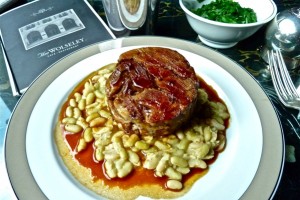
Seven-hour lamb with flageolet beans. Credit: L. John Harris
Freud, the grandson of Sigmund Freud, grew up in London after he and his family fled Hitler’s Germany in the early 1930s. He is acknowledged as the greatest realist painter of his generation, and perhaps one of the greatest of all time. Yet painting was only Freud’s day job. At night, he morphed into some version of a member of London’s smart set, and the Wolseley was his regular dinner venue for several years before his death in 2011.
Truthfully, after visiting the Wolseley nine times in six days, I started to believe that I was Lucian Freud. I even figured out how to secure Freud’s table No. 32, which was “booked,” according to the vigilant receptionist, even when not actually in use. In other words, reserved for VIP regulars.
There’s no name plaque in honor of Freud affixed to the massive black marble column that butts up against table No. 32, nothing like those tiny brass name plates on the banquettes at the two-centuries-old Le Grand Véfour in Paris. (I once sat in George Sand’s seat at that two-star Michelin icon.) But the Wolseley restaurant is only a decade old, albeit housed in a vintage British building with dramatic architectural bones and finely-crafted finishes. These things take time, like seven-hour lamb.
Sitting at Freud’s table
Facing the Wolseley’s theatrically-draped entrance doors, Freud’s table is front-row center. From this vantage point, anyone entering the Wolseley will see you seeing them. Freud, the obsessive portrait painter, must have loved that.
And how did I score Freud’s much-coveted table? Well, by making a nuisance of myself with one of the Wolseley’s hosts, Lucio, an elegant Sidney Poitier look-alike. After several visits, during which I always requested table No. 32, Lucio finally relented at lunch on my fifth day in London. I think he was as relieved as I was.
Seated now at Freud’s table, I wondered what he would have ordered. Perhaps the Wiener schnitzel or Austrian pork belly? I asked Lucio what Freud’s favorite dishes were, and followed up with the restaurant’s public relations firm and one of Freud’s galleries, Marlborough Fine Art. They all turned down my query with more or less the same line: “We wish to respect Mr. Freud’s privacy.” Fair enough, but I don’t really think there is an issue with privacy where Freud is currently “living.”
For my lunch that afternoon I picked the half salt beef sandwich (tender, flavorful corned beef) served alongside a bowl of golden and rather good chicken soup. The soup’s bland (under-salted) and defiant (dense) little dumplings (matzo balls) were what Jews back in the states refer to as “sinkers.”
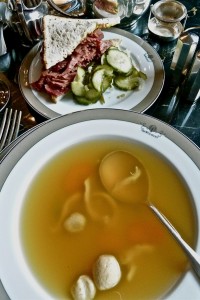
Half salt beef sandwich served with chicken soup and dumplings. Credit: L. John Harris
The principle of downward dining
A rather obscure 18th-century French philosopher named François-André-Adrien Pluquet once commented on the function of the restaurant at the historical moment when restaurants went from serving restorative broths (“restaurants”) to whole meals:
“The need to eat unites all men, and creates a sort of bond…all the guests form a single body, and have but a single life.”
In Lucian Freud’s case, I think the impulse to make the Wolseley his regular spot went deeper than social bonding. At the Freud retrospective in 2010 at Paris’ Centre Pompidou, where I first encountered Freud’s painfully graphic work, some of his quotes were mounted on the walls next to the paintings. One of them, à propos his views on travel, caught my attention:
“My idea of travel is a downward travel really. Getting to know where you are better, and exploring feelings that you know more deeply. I always think that thing ‘knowing something by heart’ gives you a depth of possibility which has more potential than seeing new sights, however marvelous and exciting they are.”
This was, I thought, not only a brilliant comment on travel, but also a view into Freud’s painstaking approach to portrait and figure painting, which would take him months in front of his models to complete. Freud’s paintings are like deep journeys into his subjects’ flesh and spirit.
And couldn’t Freud’s idea of downward travel also apply to food, as in, downward dining? I wrote in my journal that day: “Downward dining is going back over and over to the restaurants you love, connecting ever deeper to the place, the food, the staff, the crowd.”
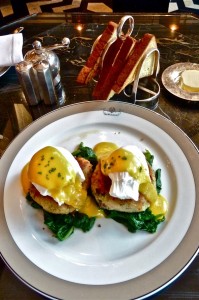
Wolseley fishcakes with poached eggs. Credit: L. John Harris.
My last meal at the Wolseley restaurant
Back at Freud’s table on my final day in London, this time for breakfast, I ordered the Wolseley fishcakes with poached eggs, topped with Hollandaise sauce and served on a bed of spinach. Well made, though a bit on the heavy side, the dish was more than enough for two people.
It would have been grand to share my breakfast with Lucian Freud, but I realized afterwards that I hadn’t really been thinking about him. After six days of downward dining at the Wolseley I was finally on my own.
I did, though, have the feeling that the Wolseley’s jolly breakfast crowd and I were, in the words of Pluquet, “a single body.” But was I now one of the Wolseley’s VIP regulars like my hero? No, not yet. These things take time.
Top illustration credit: L. John Harris
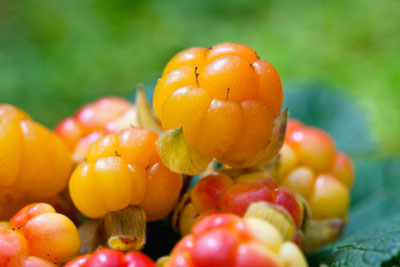
Cloudberries are shy little plants. They grow so low to the ground you might not even notice the juicy golden fruits balanced on delicate stalks half hidden in the spagnum moss when making your way, as I did, round the edge of a peat-stained lake rimmed with feathery silver birch just below the snowline of a Norwegian fjord. And even if you know what they are and where they grow, you’d have to be there in August when they’re ripe.

Cloudberry and Fjord watercolors by Elisabeth Luard
So valuable is the cloudberry crop of the Scandinavian uplands that laws are in place to protect it from unlicensed gatherers. Freedom of access is usual in northern lands where the population is sparse, and while lesser berries — blueberries, raspberries, rowanberries, lingonberries, cranberries, even the exquisite little Arctic bramble — are plentiful and free, cloudberry rights are bought and sold with the land.
The berry harvests of Scandinavia were — and remain — an important resource for self-sufficient farming communities, adding variety to the diet through the nine months of the year when the ground is frozen and nothing grows. Their value and variety was noted by Ethel B. Tweedie, intrepid lady traveler in the land of the midnight sun at the end of the 19th century. “Berries are quite a speciality,” she wrote in “Through Finland in Carts” (London, 1898). “They greet the traveller daily in soup — sweet soups being very general — or they are made into delicious syrups, or are served as compote with meat, or transformed into puddings.” She counted 10 varieties of berry fruits gathered by those on whose hospitality she depended. “Of all these,” she continues, “The most esteemed is the suomuurain or cloudberry: in appearance like a yellow raspberry, it grows in the extreme north in the morasses during August. It is a most delicious fruit with a pine tree flavour.”
The italics are hers, and she’s right.
Cloudberries at first glance on a fjord
I first encountered the cloudberry in its natural habitat (rather than as an unripe berry on the moors of northern Britain) when visiting friends, smallholders on a Norwegian fjord some 200 miles inside the Arctic Circle. Their land, as with all the farms on the steep slopes of the fjords, ran vertically from the high tops to the shore. Dairy farming and fishing provided a modest source of revenue in the old days, though the family met its needs from a single cow. The upper pastures above the snowline in winter provided summer grazing while the lower slopes were cropped for hay. Ownership of the shore included the rights for inshore fishing and to set traps for lobster and prawn. Potatoes were planted in a small patch of arable land alongside the sprawling wooden farmhouse and tall barns. But it was the uplands, the moorland just below the snowline, that provided the wild gatherings that made life in these frozen uplands pleasurable as well as possible.
Picking season
On the day of my visit, my hostess left a hand-drawn map on the kitchen table so I could follow the path uphill behind the house and join the family at the setor, a log cabin where, in the old days, butter and cheese were made. Sure enough the whole family — two children, parents and a pair of older cousins — were spread out across the moorland, baskets in hand. “You bring us good fortune,” called my hostess, straightening to greet me. “The cloudberries are plentiful this year. You can help us pick.”
It was hot work in the sunshine, though the berries were indeed plentiful and our baskets quickly filled. Rubus chamaemorus is, as its botanical name suggests, a member of the rose family. The blossom is white, five-petaled and rose-like. The leaves, flat and palmate, grow in pairs, making them easily visible in grass or moss. When first formed, the state it rarely moves beyond elsewhere, the cloudberry looks like a hard orange ball streaked with scarlet where the sepals have parted to expose the flesh to the sun. It becomes paler as it ripens. When perfectly ripe, the little globules that make up each berry swell with juice and turn gold. At this point, the flavor is neither sharp nor overly sweet but honeyed and a little medicinal. The juices are thick and almost jellied, a texture which lingers in the mouth and stays in the memory long after the fragrance has faded.
This recipe skips the sugar
For supper that evening, we ate small brown trout fried with chanterelles in home-churned butter and little almond-shaped potatoes cooked with dill-flowerheads. To follow, there were little birch bowls filled with the beautiful golden cloudberries folded with soured cream — thick and a little acidic and perfect with the slippery juices.
“No sugar,” said my hostess firmly. “Or the flavor will be spoiled.”
Cloudberries, she continued, are not only super-rich in vitamin C but are provided by nature with a preservative to keep them from spoiling. “My mother-in-law kept them fresh right through the winter under spring water in a big china bowl in the stabur.” This, a wooden storehouse on stilts with a turf roof, was visible through the window at some distance from the house. “As a child I hated the cold and being sent out in the snow to fetch whatever my mother needed. Which is why all the farmhouses are centrally heated and we all need fridges and freezers and keep our stores in the cellar where it’s warmer. Which is why we all put sugar in our preserves — even the cloudberries, though my mother would never approve. But I always pop some in the freezer to eat with the Christmas ham or for special days with cookies and cream. The cloudberries remind us of summer: There are times when we need to remember the sun will return.”
Cloudberry jam and liqueur
Anyone who can’t make it to Scandinavia’s Arctic uplands in August this year — maybe next? — might like to know that Ikea, the Swedish furniture-maker, stocks a cloudberry jam that has the proper jellied texture and tastes as it should. And for those who enjoy a digestif, Finland’s official distiller, Lapponia, produces a cloudberry liqueur, very sweet, in which the pine-needle flavor is still discernible. While both are no more than an echo of the real thing, you’ll get the general idea. Once tasted, never forgotten.
Top photo: Cloudberries. Credit: iStockPhoto
Mexico City is a pescavore’s paradise. This sprawling capital, set atop a central plateau — nowhere near any large body of water — is nonetheless within five or six hours from either coast. The Nuevo Mercado de la Viga, the huge central fish market, provides the populous with a cornucopia of creatures that swim. Mexican cooks work magic with their oceanic bounty in myriad ways: Spanish-style rice dishes, spicy soups and stews, lemony cocteles, and seafood quesadillas.
But it is ceviche, the quintessentially Latin tradition of marinating raw fish in an acidic bath, that is the pride and joy of Mexican chefs. It’s found at marisquerías — seafood restaurants ranging from street stalls to elegant venues, all over the country. Perhaps first imagined in Peru or Ecuador, ceviche usually contains lime juice to macerate the fish, and some combination of tomato, onion, chili, cilantro, and, in the “Acapulco” variety, even ketchup. Marinating time, which can vary from 15 minutes to overnight, is the most disputed element in its preparation.
The search for ceviche
So this landlocked food writer set out to find the best ceviche Mexico City has to offer, a daunting task in a metropolis of over 40,000 eating establishments. Here are the highlights:
– El Caguamo (slang for a liter-size beer bottle) is a humble street stall always packed with hipsters and old-timers chowing down on fried fillets, shrimp cocktails, tostadas and, of course, ceviches, which are served in a parfait glass or on a tostada. They can be made of pescado, jaiba, calamar or pulpo, (fish, crab, squid or octopus), with the addition of chopped tomato, chili, onion and cilantro. Ceviche here is marinated in lime juice and white herbal vinegar, then finished off with a little olive oil and a few slices of avocado — a perfect balance of salty, sour and fishy umami.
– Colonia Escandón is a solid middle-class neighborhood of single-family homes and small apartment buildings, built in the ’40s and ’50s. Its market has one big attraction, Marisquería Playa Escondida, where foodies make the pilgrimage for a sophisticated array of classic seafood. The young chef concocts a simple ceviche de pescado with strips of fresh snapper artfully seasoned in a strong, lemony vinaigrette. Its closer to the way they do it in Lima, more Peruvian than Mexican. Acerbic and briny, biting and vibrant, it was made muy Mexicanoby the lashings of green chilies that gave it heat.
– Tucked into a corner of an old house in trendy Colonia Roma, La Veracruzana, Fonda de Mariscos has a charming retro décor and sunny patio. It offers a bit of Veracruz, the city on the Caribbean Gulf Coast known for seafood influenced by the Spanish settlers and the African slaves they brought with them. (Huachinango a la Veracruzana, red snapper in tomato/caper sauce, is well known all over Mexico.) This pleasant lunch spot frequented by local artists serves an exemplary, if generic, ceviche de pescado. Sergio, the chef, explains that sea bass is marinated overnight in a light solution of white vinegar, onions and herbs such as oregano and bay leaf. Chopped tomato and chili are added later. Despite the long maceration, the fish tastes fresh and the texture holds its own. The dressing is light and zesty — a winner.
– In the fashionable art deco neighborhood, La Condesa, Mero Toro’s kitchen is in the capable hands of master chef Jair Téllez, formerly of Ensenada on the Pacific Coast. The California-influenced menu is small, unpretentious and creative. Ingredients are chosen strategically, with an eye to freshness, smart combinations and the occasional salute to cultural tradition. Chef Téllez offers a ceviche de jurel con pepino, limón y salicornia: Chunks of rosy yellowtail repose on a pool of tart aromatic dressing. The salicornia, a salt-water loving plant, is strewn about, imparting its briny bite. But the fish is barely macerated, if at all, and the result is more like a sauced sashimi. This preparation strayed far from the ceviche tradition — interesting, but in my mind a bit off the mark.
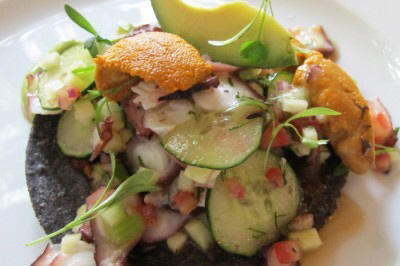
– Not far away, in the even trendier Colonia Roma, is Máximo Bistrot Local, a newcomer on everyone’s list. Chef Eduardo García worked at Le Bernardin in New York, and at Mexico City’s chichi food temple, Pujol, so he knows something about fish. A Mexican, he loves a traditional ceviche. His version, made with octopus and sea urchin, hits all the marks. The understated salsa tatemada, made with charred chilies, sets off the two distinctive ocean creatures in a thought-provoking whirl of heady aromas, like a Bach fugue. This is a ceviche for the 21st century — thumbs up.
– All of these ceviches, which range from the humbly noble to the gloriously creative, satisfied different parts of the gastronomic brain. There was no best. So I offer my own version, a compromise between the beach and Le Cordon Bleu. Perhaps, as Dorothy of “The Wizard of Oz” discovered, the answer was at home all along.
Ceviche de Pescado, Pacific Style
Ingredients
½ cup fresh orange juice
½ cup lime juice
½ cup tomato, seeds and pulp removed, in a ¼-inch dicer
¼ cup finely chopped sweet onion (such as Vidalia), or shallot
2 tablespoons good olive oil
2 tablespoons chopped cilantro
1 jalapeño (or to taste) finely chopped
1 teaspoon grated orange rind
a pinch each of sea salt, pepper and oregano
½ to ¾ pound fish (sea bass, snapper, or another firm white fish), cut in ½-inch cubes
1 avocado
Directions
1. Combine all ingredients except fish, in a glass or ceramic bowl; leave for at least 15 minutes for flavors to blend.
2. Add fish and let macerate for one hour. Serve in small bowls or on tostadas, preferably freshly fried (from yesterday’s tortillas). Top with thin slices of avocado.
Top photo: Octopus and sea urchin ceviche at Máximo Bistro. Credit: Nicholas Gilman
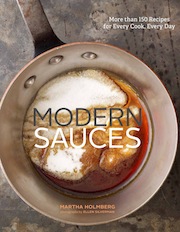 Proof that a well-made sauce can change the dish. Enter here to win one of 10 copies!

Upcoming Events
-
see all of our
Upcoming Events
-

Massachusetts Aquaculture 101, June 19Takes place on June 19, 2013Massachusetts Aquaculture 101: A Teach-In On Our Seafood Farms Did you know that oysters, scallops, fin fish, clams, and shrimp—all delicious and sustainable sources of…
-

Memphis Plant-Based Food Festival June 21-23Takes place on June 21, 2013Memphis Plant-Based Food Festival The Plant-Based Food Festival is a family event where you can explore a multitude of healthy eating options, all created without…
-
National Festival of Breads June 22ndTakes place on June 22, 2013National Festival of Breads After weeks of analyzing recipes, kneading, mixing, baking and testing, a panel of judges has selected the recipes that will be…
SmartBrief