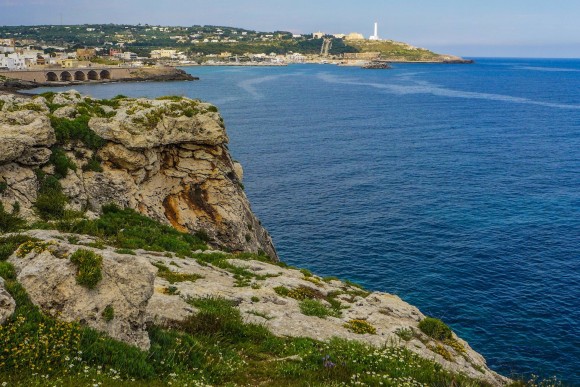
If the heel of the Boot, Apulia — Puglia in Italian — has long lagged behind other Italian regions in terms of modernization, parts of it have nonetheless become havens for the likes of royals, film stars and cognoscenti. How could it be otherwise for a peninsula surrounded by 500 miles of coastline and lapped by the pristine waters of two seas? Still, its heart beats to an ancient tempo, heedless of the increasing tourist invasions. This is Greek Italy, and it is steeped in its past. Nowhere is that more striking than at the Pugliese table.
Once upon a wine
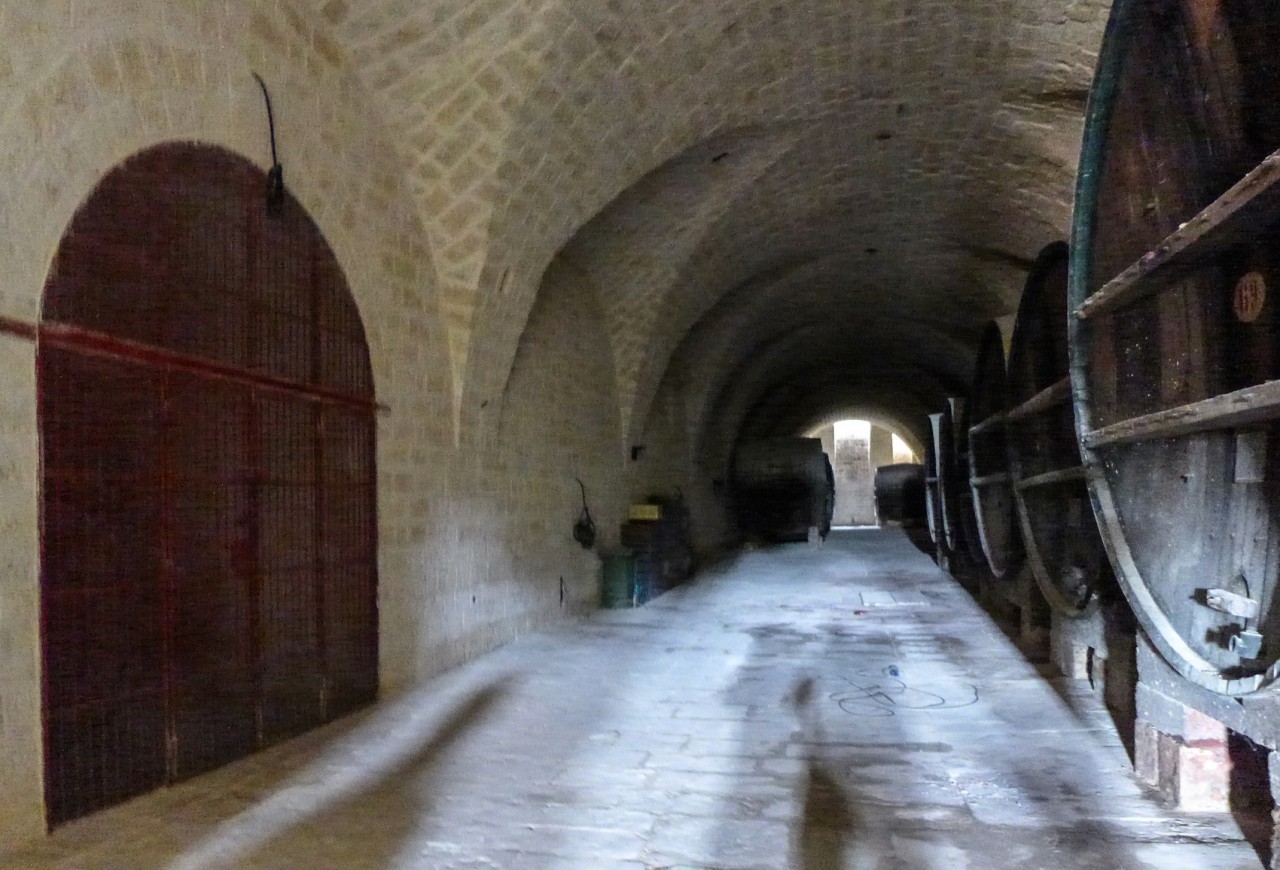
The historic casks in the monumental cellar at Torre Quattro date from the era when Puglia’s wines were exported in bulk. The casks are about 10 feet in diameter. Credit: Copyright 2015 Nathan Hoyt/Forktales
On a recent tour of the region’s wineries with an American delegation of importers eager to learn about the ambitious undertakings of a new breed of producers, I found vintners at once devoted to the preservation of their traditions and determined to make unique world-class wines. Whereas previous generations geared their production toward volume of output for foreign markets (mainly France as well as northern Italy) at the expense of quality — a practice that goes back to the Phoenicians — today’s winemakers tend relatively small vineyards and grow native grape varietals barely known outside the immediate area. The consensus among the dozen buyers in our midst was that the wines were good — some very, very good — while selling for less than other wines in their class.
Terroir, terroir, terroir
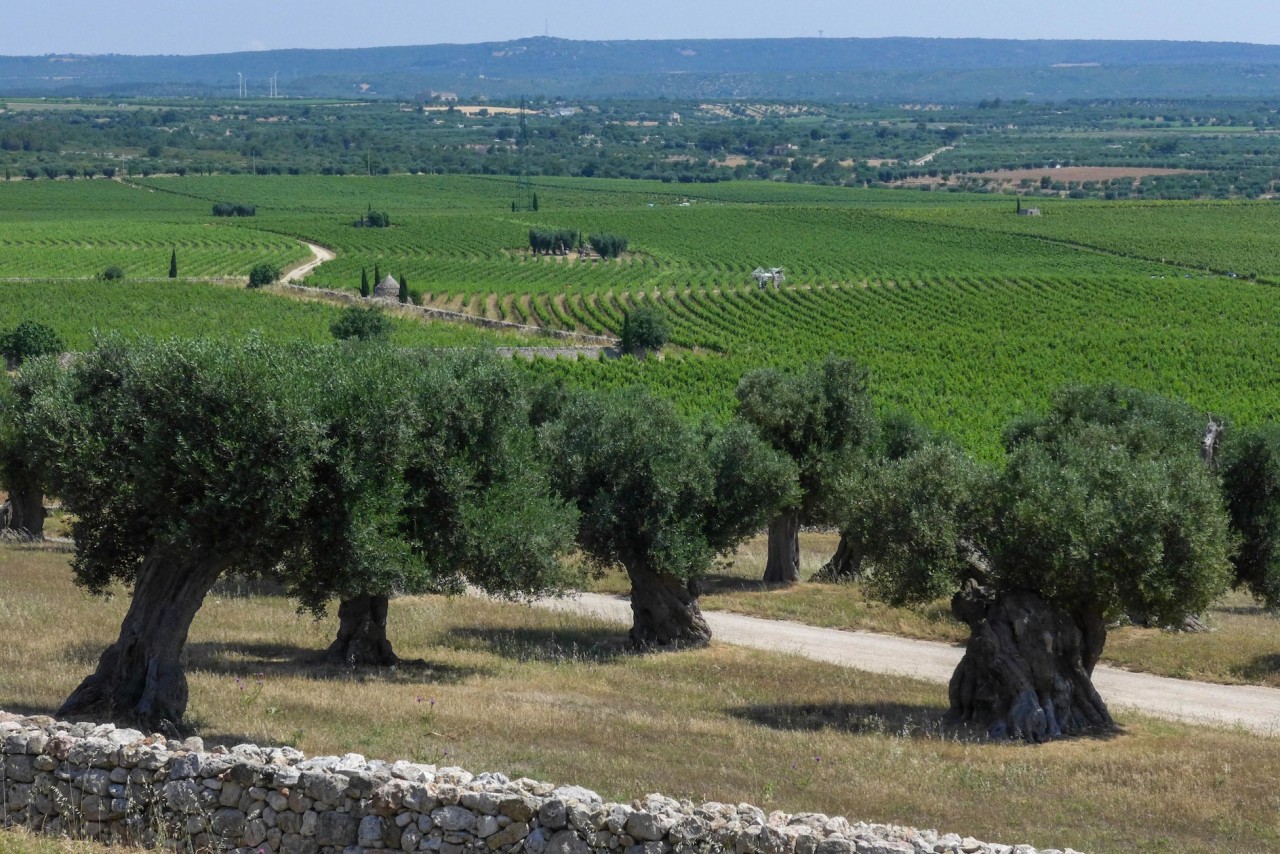
The organic vineyards and 800-year-old olive trees at Vigneto Amastuolo have been the focus of an ambitious restoration of Martina Franca, Taranto, an important 15th-century agricultural center on the Ionic side of the peninsula. Credit: Copyright 2015 Nathan Hoyt/Forktales
Climatic conditions vary throughout Puglia. On the northern plateaus, known collectively as the Murge, the winters are temperate and the temperatures cooler than they are in the Salento, the bottom of the heel, which can be convection-hot in summer, though cooled somewhat by the play of sea currents and breezes blowing across the Adriatic from the Balkans. But overall the region is perhaps the hottest in Italy, baked by the favugno, as the dry wind that blows in from Africa is called here.
More from Zester Daily:
» Mussels in Puglia
» Fried olives a surprisingly delicious Pugliese treat
» 9 fresh uses for ‘broccoli rabe,’ an Italian superstar
» Puglia’s contrasts
In step with their forebears, many of the vintners I met said that, by working with the natural conditions and the native grapes that thrive there — such as Primitivo, Negroamaro and Nero di Troia — they avoid the soil-punishing practices of modern growing techniques. “We are linked to the traditions of our area,” said Dr. Marina Saponari, sommelier at Valle dell’Asso in Santeramo in Colle, Bari, a limestone plateau in the Murge. “We don’t irrigate or add water at all, because too much humidity causes fungus; we work with the soil, not against it, (plowing) in a horizontal direction to retain the moisture naturally.” “Besides,” said Giuseppe Bino, an oenologist at Vigneto Amastuola in Martina Franca, “organic methods are so much better for your health. And when the wines are aged naturally, you taste real grapes.”
Filippo Montanaro of Vigneto Amastuola, on the Ionian side of the peninsula, described his family’s dedication to organic practices as a way to at once revitalize abandoned agricultural lands and recover an indigenous archeological site that dates to the Bronze Age. Subsequent civilizations inhabited the same high plateau, a strategic point overlooking the Gulf of Taranto from which, on a clear day, you can see all the way to Greece and Calabria. Amastuola’s vines and fruit orchards today carpet the soil in which the Greeks planted grapes and olive trees 2,000 years ago. On the estate, a 15th-century masseria — an ancient Apulian farmhouse where raw ingredients were processed into everything from wine and oil to dairy products, salumi, bread and preserves — is being restored to function as it once did, said Montanaro, whose father, Giuseppe, acquired the 100-hectare estate (almost 250 acres) in 2003. The family has launched an ambitious restoration, including the revitalization of long-neglected 800-year-old olive trees. “Family tradition is very important,” said Giuseppe Sportelli, commercial director and husband of Ilaria (one of three Montanaro siblings that help manage the property), explaining that the monumental project was not just work but a “passione.” Giuseppe Montanaro himself finds that explanation inadequate. “It goes beyond enthusiasm,” he explained, “It is the desperation that the man of the south feels that makes miracles like this happen.”
Food of the ancients
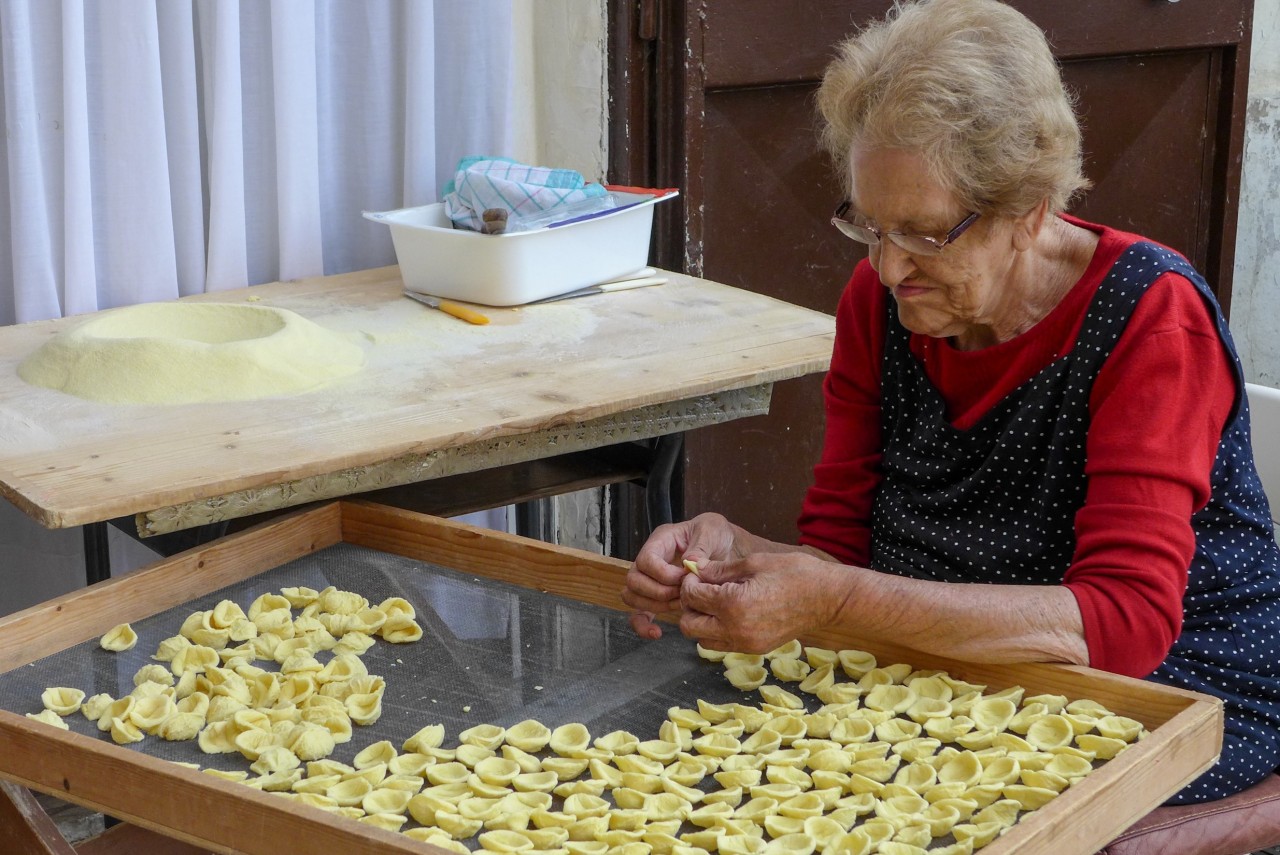
Making the traditional pasta of Puglia, orecchiette, on the street in Barivecchia. Pensioners like this woman sell their pasta from home to supplement their incomes. Credit: Copyright 2015 Nathan Hoyt/Forktales
Like these winemakers, local chefs also honor the past, looking to the ancestral cooking of their grandmothers for inspiration. I learned the Pugliese mantra of “homegrown and homemade” early, from my paternal grandparents — poor emigrants to America from the very landscape I have described. Some things have changed since they abandoned the fields of Toritto, in which they had toiled as sharecroppers, for lack of enough food for themselves. And some things have not. “Our cooking is based on a paisana (peasant) tradition,” said Anna Gennari of Conzorzio Produttori Vini Manduria, a 400-partner cooperative of Primitivo grape growers in Manduria. “The cooking was simple and not much different throughout the provinces because Puglia was poor,” said Saponari, who is not only a sommelier but also a well-known cooking teacher in Bari.
Cutting-edge Michelin-starred restaurants have been making headlines in recent years for pioneering menus sourced from their local terroir, but Pugliese chefs have always done so. They are weaned on the ancestral flavors and seductive bitterness of wild dandelion greens, mustards, hyacinth bulbs (Muscari racemosum or lampascioni) and other native plants. Unlike in other regions where the tourist routes are more deeply worn, the heritage foods of Puglia — what the Italians call piatti tipici — persist, whether in hotels, simple trattorie or private homes. These include durum-wheat pasta, either fresh or dried, characteristically flavored with cime di rapa (“turnip tops”), simple tomato sauce, or chickpeas; fava-bean purée eaten alongside cooked bitter greens; the ring-shaped breadsticks called taralli, sweet or savory; calzone-like panzerotti and a panoply of other breads and pastries, baked or fried; vegetables, vegetables, vegetables (but little meat); milky fresh cheeses; and fiery peppers — all dressed, naturally, with the numinous olive oil.
Chefs riding the trend for recycling “trash” food could learn something from these old ways: take the traditional pane arso of the cucina povera (“the poor kitchen”), a dark bread made by blending the flour of charred hard wheat with semolina. The custom of incorporating the two harks back to the feudal-estate system, when peasants collected the scorched grains that remained after the post-harvest burning of the fields. Rich-tasting, with a seductively bitter edge, the bread packs 4,000 years of the people’s history into one bite.
Pranzo della domenica: Sunday supper
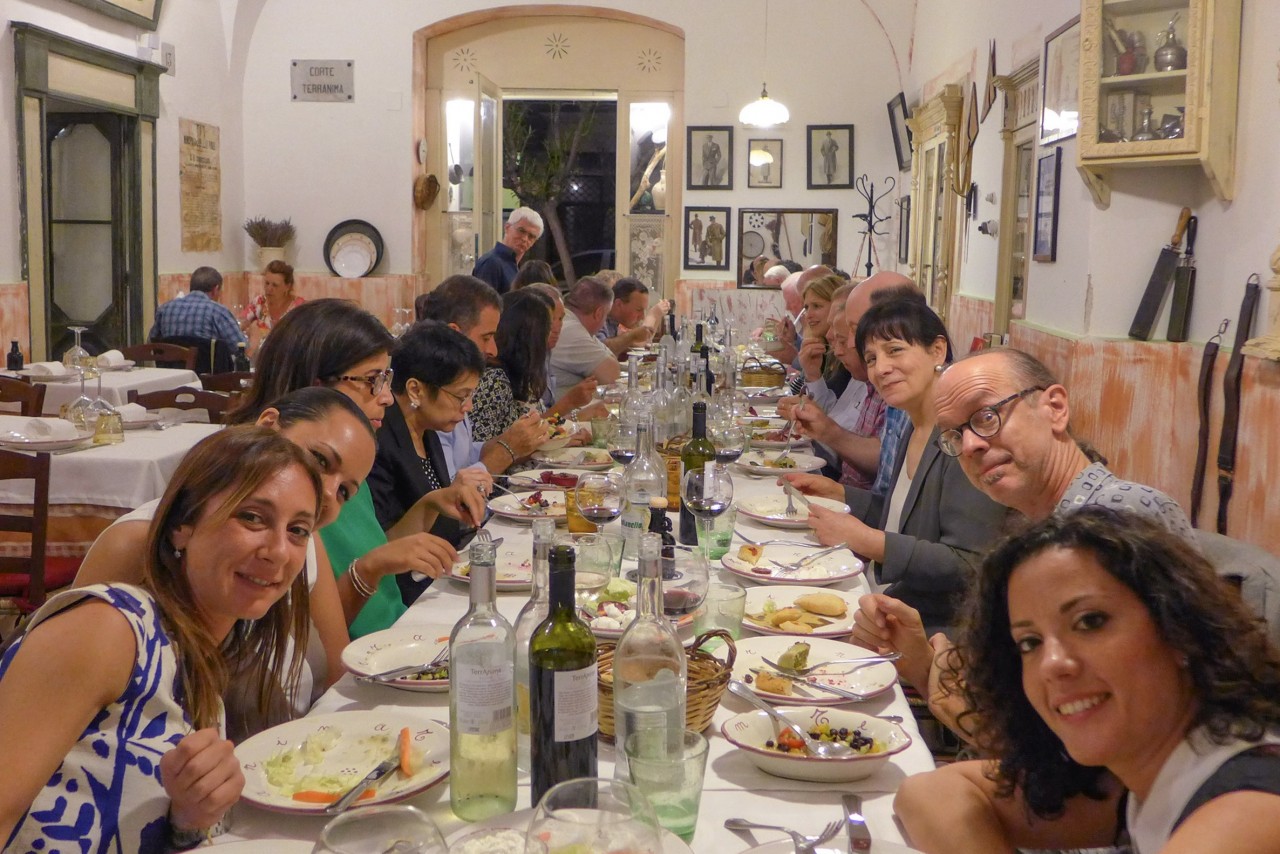
At a welcome dinner for American wine buyers, we cleaned our plates of traditional local fare. TerrAnima proprietor Piero Conte is standing in the back. Credit: Copyright 2015 Nathan Hoyt/Forktales
It’s on Sunday — a customary day of feasting — when Puglia’s cooks pull out all the stops. This is when the meat dishes come out, and the pasta is sauced with ragù, meatballs and braciole.
Gathering together in Bari with the wine buyers, I ate just these braciole — which the locals call bombette (“little bombs”) in the delightful TerrAnima, a Slow Food-endorsed restaurant dedicated to the dishes of the region (its name translates as “Earth and Soul”). If they sound heavy, perish the thought! They are delicate little rolls of meat, lined with pancetta inside and out and stuffed with cheese, garlic and parsley before they are bundled, tied and roasted.
Here’s to the spirit of the pranzo della domenica. Bring on the bombette and by all means, pour the Primitivo!
Bombette (Little Bombs): Stuffed Meat Rolls
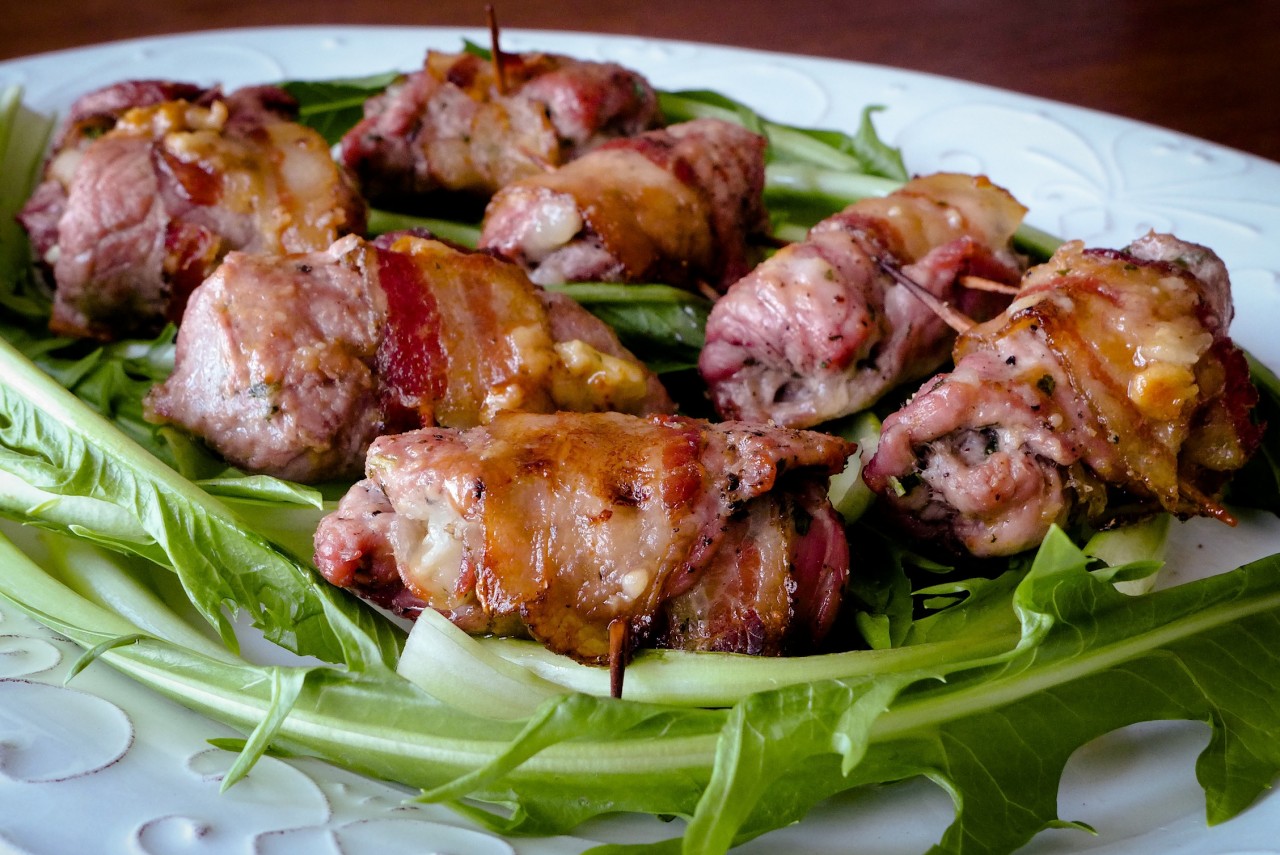
Bombette, a Pugliese obsession: strips of meat rolled with pancetta, parsley and caciocavallo cheese. Traditionally made with horsemeat, my version substitutes veal. Credit: Copyright 2015 Nathan Hoyt/Forktales
Prep time: 30 minutes
Cooking time: About 20 minutes
Total time: About 45 minutes
Yield: 4 servings
Note: These appetizers are traditionally made with horsemeat (not for the likes of former equestrians such as myself), but veal or beef are also used. Whichever you choose, ask the butcher to flatten the meat as thin as possible (1/8 inch is ideal) without tearing it — or pound it yourself if you know how.
Ingredients
1 pound cutlets (scaloppine) from top round of veal, cut into 4 thin slices about 4 inches by 8 inches and pounded to no more than 1/8-inch thick, or 2 half-pound pieces boneless beef top round, pounded to 1/8-inch from 1/4-inch thickness
Extra virgin olive oil
1 small garlic clove, peeled and bruised slightly
Fine sea salt
Freshly milled black pepper
16 thin slices of pancetta
2 tablespoons fresh minced parsley leaves
3 ounces fresh, semi-soft caciocavallo cheese, cut into 8 matchsticks
Toothpicks for serving
Directions
1. Preheat an oven to 400 F. Select a broiler-proof baking pan large enough to accommodate 8 meat rolls without crowding and grease it lightly with olive oil.
2. Use paper towels to blot the meat dry. Cut each piece horizontally into smaller pieces to yield 8 pieces of meat that are about the same shape and size (about 4 by 4 inches). Rub both sides with the garlic clove (which you can then discard) and sprinkle lightly with salt and pepper.
3. Sandwich 1 piece of meat between two slices of pancetta. Sprinkle one side with some of the parsley and arrange a matchstick of cheese crosswise on the center. Beginning at one end, roll it up, gathering the pancetta along with it as you make the roll and tucking in any meat edges that stick out. Secure the bundle with a toothpick and transfer it to the oiled baking pan. Repeat the procedure with the remaining 7 pieces of meat and place in the pan.
4. Slide the pan onto the middle rack of the oven. Roast for 15 minutes, then remove the pan from the oven and change the setting to broil. Turn the rolls over and place the pan under the broiler to color them lightly, about 2 minutes. Take care to keep the pan juices from flaming. Remove at once, pour any remaining pan juices over the rolls and serve immediately.
Main photo: Santa Maria di Leuca at Puglia’s southernmost point, where the Adriatic and Ionian seas meet. The lighthouse stands atop the Japigo promontory, described by Virgil in “The Aeneid.” Credit: Copyright 2015 Nathan Hoyt/Forktales


Comments