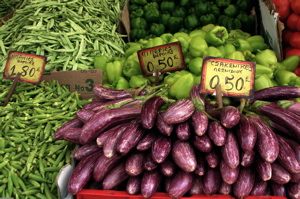
Photo by Martha Rose Shulman
and cooking what you grow.
For many years our idea of an eggplant was the great big American eggplant Mama Leone’s used in the wonderful Melazane alla Parmigiana. Then along came the sleek, deep-purple Japanese eggplant, the round, petite and orange Turkish eggplant, the long green Thai eggplant and the options for cooking — and growing — eggplants opened up.
For fantastic eggplant recipes, see Martha Rose Shulman’s An Aubergine Travel Diary.
Growing from seed
Growing the eggplant is a fairly straightforward business save one aspect: timing. They can be grown from seed once the chance of frost has passed. Sow indoors in temperatures of 75-80 F. A good quality seed starter mix — homemade or store bought — will get the seedlings off to a good start. Pre-soak for 12 hours beforehand. Germination is 7-14 days. Sow 1 inch apart in seed trays, then make sure to transfer up to individual pots and allow each to grow out before planting in the garden. They are ready to be planted out when the stem is a tad woody and resistant to bug attacks. Somewhat slow growing at first, eggplants quickly pick up pace once the summer heat arrives.
Soil preparation
Prepare the soil with rich compost and an organic vegetable fertilizer. Space 18 inches apart. Pinch out some of the flowers on larger fruit varieties, but let the small-fruit types set as many eggplants as possible. Staking with a small bamboo cane helps keep the fruit off the soil and allows the slender varietals to grow straight.
Pests
The flea beetle can wreak havoc early in the season by stripping the leaves in their entirety. (Oddly enough the plant will recover from this attack and go on to produce later in the season.) You have a number of choices to control this pest. The organic solution is to apply a pyrethrin spray. The downside is that this product, although organic, is a broad-spectrum spray and will kill beneficial insects also. Another solution is to grow the plants through a plastic mulch covering and foil the beetles as they emerge from the soil. Or simply tap the plants and shake off the beetles: Once displaced, they find it difficult to get back onto the plant.
Flea beetles are less prevalent slightly later in the hot season, so waiting a month into the summer also can help dodge the pest. A final possibility is to grow a trap crop of radish and mustard whose leaves they equally relish.
Aphids also can attack eggplants, but they rarely do too much damage. They are easily controlled by a vigorous spray of water from a garden hose.
Cultivating
As plants grow, mulch to help keep soil moist. Water well and feed midseason with a potash-rich liquid fertilizer. Again, remember to pinch off some flowers in the larger fruited varieties. Spraying with water can help with pollination.
Harvesting
In the past certain varieties were somewhat bitter — hence the need to purge with salt. This has been selectively bred out and you do not need to do this nowadays. Always use pruners or sharp scissors to cut from the stem. Pick off the fruit from smaller varieties to ensure a steady supply all season. Use them right away and never keep in the refrigerator.
Saving seeds
If you grow an interesting heirloom variety you can save the seeds by removing them from eggplants that are allowed to really ripen on the plant. Wash the seeds under water and dry on a towel. Store in a dark cool place until next season.
Varieties
Black Beauty
Listada de Gandia
Thai Long Green
Turkish Orange
Round Mauve
Casper
Lao Purple Stripe
Seed Companies
Seedsavers Exchange
Baker Creek Heirloom Seeds
Peaceful Valley Farms
Seeds of Change



Comments