Articles in Book Reviews
Soave is a victim of its own success. It’s one of the best known Italian white wines, a familiar name that features on every wine list and consequently is often taken for granted, without any real appreciation of its true quality. However, the best Soave is a wine of great character and individuality, whose quality has improved enormously over the past decade or so.
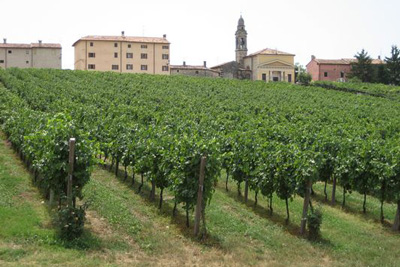
The village of Soave is a delight to visit. You fly into Verona, the magical city of Romeo and Juliet, and Soave is a short drive away. It is dominated by the ruins of a medieval castle and its old walls remain intact, with a gate on each side. There are cheerful cafes and restaurants and an enoteca with an extensive selection of bottles from the best wine growers. The vineyards, which lie to the north of the village, come almost up to its walls. They rise dramatically to some 400 meters (1,312 feet) on hillsides of limestone or basalt, on a row of extinct volcanoes.
The best vineyards are recognized as Soave Classico, and form the heart of the DOC (Denominazione di origine controllata, or controlled designation of origin), which was created in 1968. However, about 10 years ago, local bureaucracy decided that Soave would benefit from lower yields and higher alcohol levels, and the DOCG (which is “guaranteed” as well as controlled) of Soave Superiore was created, but it did not necessarily come from the Classico vineyards. This move caused friction among the wine growers, and confusion amongst wine drinkers, and these days Soave Superiore as a category is very much less significant than Soave Classico, despite being a DOCG.
The principal, and in most cases, only grape variety is Garganega, an intriguing variety that is related to Cataratto and Albana. It is not especially aromatic; it ripens late and can be quite temperamental in the vineyard, but it likes the cooler nights of higher altitude vineyards, which help retain the freshness in the grapes. And in the cellar, it responds well to variations in vinification techniques. Simple Soave enjoys a straightforward cool fermentation, but in the search for more depth of flavor for Soave Classico and the growing number of crus, or recognized single vineyards within Soave, the wine growers have experimented. The wines benefit from some skin contact, and some aging on the lees, with bâtonnage, the process of stirring up the lees. Further options include fermentation in wood and aging in oak, in small barrels or larger botti. The use of oak needs great care; Soave does not have the weight and body for the use of new oak in any quantity, but the subtle use of old oak certainly adds an extra dimension to the wine.
Garganega may be blended with up to 20% of other grape varieties, most commonly Trebbiano di Soave. This grape variety has nothing at all to do with the generally uninspiring Trebbiano di Toscana, but is akin to Verdicchio and Trebbiano di Lugana, with some attractive floral flavours.
Proliferation of crus
The other qualitative move has been the recognition of numerous crus or individual vineyards, which can feature on a label. Inspired by the use of crus in Burgundy, the very first appeared in the 1980s and these days there are well over 50 crus, which demonstrate the very best of Soave. Look for wines like Cà Visco from Coffele, Le Rive and Monte Carbonare from Suavia, Runcata from Dal Cero, Motto Piane from Fattori, and Il Casale from Vicentini, to name but a handful.
The versatility of Garganega also extends to its ability to create delicious sweet wines, in the form of Recioto di Soave. Italians are masters supreme of the art of appassimento, whereby ripe, healthy grapes are dried for several weeks, if not months, in a barn or warehouse where air flow and humidity are carefully controlled. The grapes are picked at the beginning of the harvest while they still retain a good level of acidity and are pressed in January or February, by which time they have lost 40% of their original weight. A slow fermentation, usually in an oak barrel, follows, and the result is a deliciously ripe and unctuous wine — but always with a refreshing streak of acidity, to avoid a cloying finish.
One of the problems of Soave for the consumer is the considerable range of price and quality. You can find Soave in an Italian supermarket for 2 euros ($2.60), while some of the finest Soave will reach 25 euros ($32) or more. And there is a world of difference between the two. The best Soave comes from the Classico heart of the region, from one of the crus, and from a reputable wine grower. The name on the label is the key to quality. And drinkability is a key characteristic. Often the best wines are refreshingly light in alcohol, rarely passing 13%. They have a firm acidity, with a striking volcanic minerality, fully justifying their reputation as among Italy’s best known and most enjoyable wines.
Top photo: Vineyards in Soave, Italy. Credit: jkk at nl.wikipedia

Professional food writers may know more than other people about searing duck breasts à point or detecting hints of locally sourced turpentine in some chef’s spruce-needle sorbet. But do we really understand cooking — the intrinsic humanity of the act — any better than anybody else? Not on your life. I’ve never seen a book that drove home the point more devastatingly than Alex Witchel’s “All Gone: A Memoir of My Mother’s Dementia. With Refreshments.”
For the benefit of the very young: Witchel is a longstanding New York Times fixture who at different times dished on the theater scene and became known for celebrity profiles that often reduced the subjects to chunks of shish kebab quivering over the fire. Subsequently the paper turned her loose on the dining beat in a monthly column titled “Feed Me.”
In a startling change of course, her new book relates the dreadful fallout from several unsuspected mini-strokes that her mother suffered in late middle age but that remained undiagnosed until crucial brain functions began disappearing. Over about a decade, the family would watch memory, reason and finally all but a bare shred of identity depart from the woman who used to hold up the sky. A blow-by-blow chronicle of Barbara Witchel’s advancing illness, and its effect on Alex, is one of the two main intertwined narrative threads of the book. The other, a stormy saga tracing aspects of Witchel family dynamics and Alex’s adult life, spans close to 50 years and includes a strong emphasis on food.
“All Gone” can be read as a quasi-sequel to “Girls Only,” Alex Witchel’s 1996 valentine to the loving but prickly mutual irritation society formed by her mother, herself and her much younger sister Phoebe. But it stands on its own as a far fiercer postcard from some unthinkable edge. A relatively mild sample is this theater-of-the-absurd exchange partway through the wrecking process, when Alex tries to bounce the terrible maternal plea “I want you to kill me” back into Barbara’s court:
“She was monumentally offended. ‘Committing suicide is against the Jewish religion!’ she declared.
“I was dumbfounded. ‘So is committing murder!’ ”
Family recipes in ‘All Gone’ not what you might expect
Though food becomes a unifying leitmotiv of the two interwoven stories, it’s emphatically not the kind of food you might expect from anyone with Witchel’s reputation as mistress of the lethally sophisticated putdown. It comes from a different quadrant of her universe, a space where she can hold a sort of mental conversation with a beloved parent no longer able to converse.
ZESTER DAILY LINKS
Buy the book:

“All Gone: A Memoir of My Mother’s Dementia. With Refreshments”
By Alex Witchel
Riverhead, 2012, 224 pages
More stories from Zester Daily:
» When life swallows the family meal
» The last fruitcake holds dear memories of Mom
And what a parent! Barbara Witchel diligently raised four children and kept a kosher kitchen for a demanding husband while (successively) teaching school, earning two graduate degrees and becoming a college professor. Nobody else’s mother was doing such things in 1960s and ’70s Passaic, N.J., or Scarsdale, N.Y. The woman had a tight ship to run, and her gallantry in running it made her the eternal heroine of Alex (the oldest child, and her deputized lieutenant).
Alex can still taste in memory the standbys and special treats of her mother’s (or occasionally her Witchel grandmother’s) culinary repertoire. She’s able to make the rest of us sense how meatloaf anchored the universe, how Chicken Polynesian hinted at voyages to its very margin. Thirteen selected recipes — the “refreshments” of the sardonic subtitle — appended to the book’s eight chapters document some of the dishes in question, and most will be quite a surprise to anybody expecting chic, sleek “foodie” food.
Alex has presented these pieces of the Witchel culinary heritage pretty much as she remembers them — the rough and ready, shortcut-bolstered labors of a resourceful Jewish wife, mother and career woman who, according to her daughter, treated cooking as a far from welcome duty but understood how to make dinner “the center of the day, its organizing principle.” The recipes are all meant to fit into kosher “meat meals” (ones from which dairy products are excluded). They’re also meant to deliver the fastest possible results with the least possible trouble. Hence the meatloaf bound with canned tomato soup (not cream of tomato) and cornflakes, the nondairy creamer in spinach kugel, the canned tomato combo in Frankfurter Goulash, the mixture of garlic powder and Lawry’s Seasoned Salt used to season a roasting chicken. No clever airbrushing of family snapshots here.
Two recipes stand as telling bookends for everything else, while also pointing to a kind of relay station between past and present generations. The first is the talismanic meatloaf, the Barbara Witchel perennial that Alex instinctively begins re-creating in her own kitchen while watching her mother’s memory and intellect disappear. It’s an attempt to salvage something permanent from chaos, the edible equivalent of T.S. Eliot’s “These fragments I have shored against my ruins.” The other formula, which concludes the book, is not Barbara’s recipe but one that came to serve the same purpose for Alex, her husband and her cherished stepsons: a mammoth dish of skillet-braised chicken breasts with 80 (yup, you read right) cloves of garlic and enough rosemary to fumigate a hospital ward; three cups of olive oil first go into the cooking and then do duty as a serving sauce.
Anyone who doubts that those two dishes, in unvarnished form, were and are the food of love needs remedial tutoring in family values.
My mother, like Alex’s, cooked the day’s meals not for pleasure or adventure but as an unromantic responsibility that maintained stable, loving order in our small bit of the cosmos. I read “All Gone” marveling that I could ever have looked down on, rather than up to, such an achievement. It’s an honor to meet Barbara Witchel as she was before her mind was ravaged, and celebrate the kind of cooking she stands for.
Top photo composite: “All Gone” book cover. Alex Witchel. Credit: Fred R. Conrad
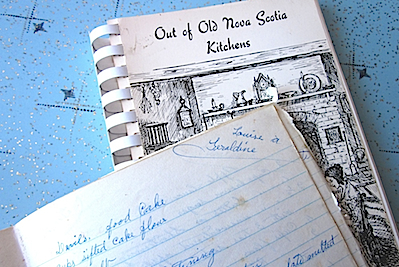
The cookbook “Out of Old Nova Scotia Kitchens,” first published in 1970 and still in print, documented the history of cooking in the Canadian province. The book, written by Marie Nightingale, is still celebrated today. This story is the second in a two-part series and will explore the cookbooks impact on cooks and chefs in Nova Scotia. The first story in the series examined Nightingale’s efforts to write the book.
Marie Nightingale’s “Out of Old Nova Scotia Kitchens” was first self-published in 1970. After its first few printings, however, Nightingale found a new printer with Nimbus Publishing. The book is still a top seller with the company, with more than 200,000 copies printed. “It speaks to the timelessness of the recipes,” says Patrick Murphy, the managing editor at Nimbus. He points out books like “Out of Old Nova Scotia Kitchens” help keep Nova Scotia’s culinary traditions alive. “The historical aspect to the book keeps it a favorite. They are classic recipes from this corner of the world, and so there has never really been a danger of them becoming ‘out of fashion’ just by the nature of what they represent.”
‘Out of Old Nova Scotia Kitchens’ serves as a useful tool
For some people, the book represents a culinary heritage that could have easily disappeared. Craig Flinn is a chef and cookbook author. “Out of Old Nova Scotia Kitchens” was the first cookbook his mother owned, and he still owns the very same copy. For him, the book is not just as a repository of information, but a tool to be used by home chefs. “‘Out of Old Nova Scotia Kitchens’ is about keeping those dishes alive and to the forefront,” he says. “We tend to be a busy culture and we don’t have mothers and granddaughters teaching their kids how to cook anymore. Cookbooks have become more important. ‘Out of Old Nova Scotia Kitchens’ made me understand that every region’s culture was greatly influenced and represented in the food we ate.”
ZESTER DAILY CONNECTIONS
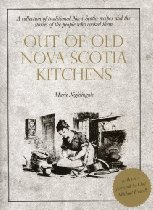
Buy the book:
“Out of Old Nova Scotia Kitchens”
By Marie Nightingale
Down East Books,
2011, 208 pages
Part 1 of series:
» Cookbook an exploration of Nova Scotia’s food history
More from Zester Daily:
Another big fan of Nightingale’s oeuvre is Michael Howell. He’s the president of Slow Food Nova Scotia and a former chef. Like Flinn, Michael remembers his mother owning a copy of the book, an edition he still owns. “It has some food stains that I can almost remember when they splattered the pages,” he says. Howell’s relationship with “Out of Old Nova Scotia Kitchens” is special. A few years ago, Nimbus publishing decided to prepare a 40th anniversary edition for 2010. He and Nightingale updated a few recipes, and Howell himself wrote a new foreword for the book. In it he describes the recipes that gave his copy its own distinctive spots and splatters, dishes of “colcannon, baked beans [and] blueberry grunt.” His copy may have lost its front and back covers, but that just speaks to how useful the book has been to him. “I learned that recipes did not have to be complicated to be delicious,” Howell says, “one of the central tenets that my cuisine has adhered to over the years.”
“In most cases, a cookbook has a market span of a year or two,” Nightingale writes in the preface to the 2010 edition of her book. But most cookbooks don’t give readers — as well as those who cook from it — such an immediate connection to their past. A past that could’ve been lost in a food world that values the modern and the contemporary. Not bad for a little book that was published with a plastic coil binding. “I think part of the charm of ‘Out of Old Nova Scotia Kitchens’ is that it is unassuming,” Flinn says. “It’s all about the content, not the glitz and the glam. I think she would be surprised that it’s been around this long. I don’t think she thought she was writing a classic when she started. You feel like you’re buying a piece of history.”
Here is one recipe from the book.
Hodge Podge
(A dinner of new vegetables)
The recipe below is written as is in “Out Of Old Nova Scotia Kitchens,” with very few measurements and relying on the home chef to know exactly how much they would have and want of each vegetable found in the dish. Hodge Podge is usually served in early summer, when the variety of vegetables is at its best in Nova Scotia.
Ingredients
String beans
Carrots
Potatoes
Peas
Cauliflower
1 cup diced salt pork
1 cup cream
1 cup vegetable stock
Chives
Directions
1. Prepare new vegetables. The string beans, carrots and potatoes may be cooked together in boiling salted water. Cook the peas and cauliflower separately.
2. Fry the salt pork to a golden brown and add the cream and an equal amount of vegetable stock. Season with chives.
3. Bring to a boil quickly and serve over the vegetables.
From “Out Of Old Nova Scotia Kitchens,” with permission from Nimbus Publishing
Top photo: A vintage copy of “Out of Old Nova Scotia Kitchens” by Marie Nightingale. Credit: Simon Thibault
Foraging is the best way I know to stay immersed in the landscape I love. Equally important, I forage because it stocks my kitchen with scrumptious, high-quality food. I live at the base of the Rocky Mountains, where there are booming growing seasons and long cold winters, so preserving my wild harvest is the ideal way to have access to foraged foods throughout the year. As someone who puts up wild goods regularly, I was very excited to read “Preserving Wild Foods,” which addresses how to take advantage of wild products through pickling, preserving, fermentation and curing.
ZESTER BOOK LINKS
“Preserving Wild Foods: A Modern Forager’s Recipes for Curing, Canning, Smoking, and Pickling”
By Raquel Pelzel, Matthew Weingarten
Storey Publishing, paperback, 2012, 265 pages
More from Zester Daily:
» Turn feral horseradish into roast beef sauce
» Spread fresh herb flavors with compound butter
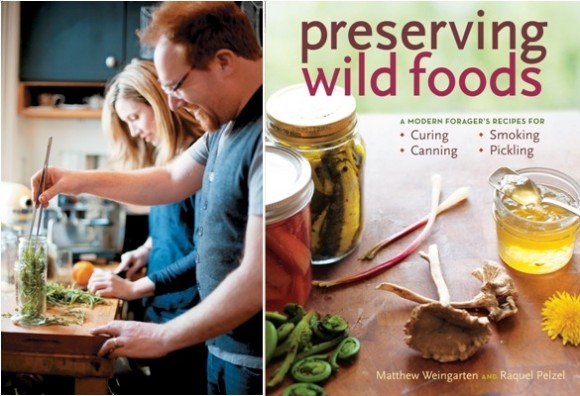
From the outset, it is apparent that author Matthew Weingarten not only forages, but enjoys it immensely. What is most intriguing about “Preserving Wild Foods” is the perspective the author brings to the subject as a chef working in New York City. He’s not someone who lives next to a remote stream in the woods. Rather, he’s a city dweller who still finds a valuable connection with the land through wild harvests. In this book, Weingarten and co-author Raquel Pelzel tackle products from environments ranging from ocean-side all the way to the countryside, transforming fruit, vegetables, nuts, mushrooms, fish and game, into tempting jams, chutneys, charcuterie and more.
Inventive wild food flavors
“Preserving Wild Foods” shines when Weingarten uses his sensibilities as a chef to both wake up standard recipes and introduce new flavor combinations. Take for example samphire pickles, in which he seasons the coastal plant also known as sea beans with chiles, coriander and garlic. Weingarten adds a slightly unexpected flavor twist in his old world rose hip jam by adding cardamom and grenadine. He also shares some recipes that may be new to the home cook, like crab apple mostarda, or frutti di bosco compote, which is made with wild mushrooms, blueberries and herbs.
Intrigued by the unusual flavor pairing, I tried my hand at a half batch of pecan and fennel seed brittle. I didn’t want to chance ruining the two cups of honey required by the full batch. The instructions were easy to follow, and even included a bit of advice I’d never before tried when making brittle: to put a second pan on top of the freshly poured candy, and press it with a rolling pin to made an evenly thick product. I found pecan and fennel seed brittle to be especially good crumbled over ice cream.
Foraged, feral and garden-grown
I was a bit surprised to find that one of the chapters in “Preserving Wild Foods” contains many recipes for agricultural or gardened food products. I appreciate the argument that feral foods, those that used to be kept but have since gone wild, bridge the gap between foraging and gardening. And I can also see that for a person operating in the heart of a major metropolitan area, visiting the farmers market feels a bit like foraging. But I found the appearance of a recipe for watermelon pickles in a book about wild foods to be a bit of an incongruity.
Instead of including recipes for dill cucumber pickles, pickled peppers and bacon, I would have preferred to see the chef share more recipes made with wild foods, perhaps with a focus on ways to preserve unloved weeds that thrive in the city. I’d love to see how the Weingarten would use his experienced palate to approach preserving lamb’s quarter, sow thistle, dock or the lemon clover he mentions in passing on a page dedicated to the joys of spring greens.
“Preserving Wild Foods” would benefit from a cleaner presentation. The mish-mash of recipe introductions, tips, drawings, formal photographs, and Polaroid-style snapshots seem to be an attempt at warmth, like reading the journal of a chef, but the overall effect is a bit jumbled. I would have loved to see this book broken into two volumes, one about plants, and the other with the focus on charcuterie. A full third of the recipes in “Preserving Wild Foods” are for meat or fish, so be aware if you are expecting all plant-based dishes or are vegetarian.
“Preserving Wild Foods” is a book packed with all manner of recipes for putting up wild products. I especially enjoyed the author’s clear delight in foraging. As someone who is adventurous in the kitchen, I was excited to see more unusual recipes like that for modern garum, a fermented fish sauce made from heads and guts. However, given the level of skill required to can and cure at home, this may not be the ideal book for home cooks who aren’t already fairly comfortable in the kitchen. Novices might be intimidated by some of the recipes, and it should be noted that this is a cookbook, not a field guide. While the author writes lovely introductions about the highlighted ingredients, there are no warnings to stay away from red elderberries or beware of angelica’s dangerous look-alikes. “Preserving Wild Foods” could potentially be a valuable book for aspirational foragers, preserving geeks, and people who forage regularly and serious about preserving their finds.
Chef Matthew Weingarten and “Preserving Wild Foods.” Credit: Storey Publishing
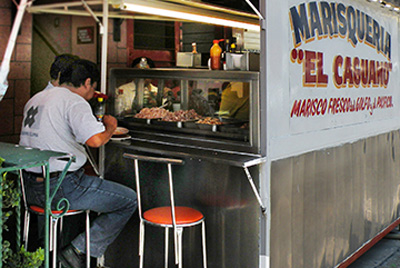
Suddenly street food is cool. Perhaps it’s a reaction to lofty trends like molecular gastronomy, vegetable foams and chefs in lab coats. People are ready for more accessible cooking. Some call it street food. Hugo Ortega, a home-schooled chef from Mexico, presents the most recent and best book on the topic in “Street Food of Mexico.”
ZESTER DAILY LINKS
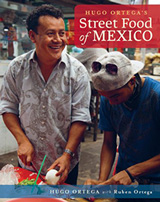
“Street Food of Mexico”
By Hugo Ortega
and Penny de los Santos
Bright Sky Press, 2012, 256 pages
Also on Zester Daily:
In my hometown of Mexico City, the phrase “street food” might connote a low-class, unsavory, health risk from which tourists and locals alike are warned to stay away. But foodies on the cutting edge are busy promoting this popular cooking. Restaurants with names such as Street in L.A., Fonda in N.Y. and Ortega’s own Hugo’s in Houston are pulling in crowds. Anthony Bourdain and the Los Angeles Times are touting street food as trendy, reminding us that the best cooking is often found in the most humble places. We fearless global eaters could have told them.
Writing about Mexican cooking in his heartfelt introduction, Ortega’s description could apply to the popular cooking of any culture:
“… street food is actually “slow food,” prepared in someone’s own kitchen with little to no shortcuts, from family recipes handed down through the ages. The food is cooked all through the night on the outskirts of the towns and villages, in kitchen ovens or in deep earthen pits, and brought into city and town centers each morning … Rich with tradition and heritage, street food is the purest form of true authentic … cuisine.”
While other cookbooks on the subject might employ “street food” as a catchphrase, an excuse for simple, plebeian cooking (“easy” usually shows up in the title of these books), this one is true to its subject. Recipes are for dishes really found at stalls on the street or in markets.
The book is divided into chapters delineating seven styles of foods by their Spanish titles: antojitos, tacos, salsas, tortas, ceviches y cocteles, dulces and bebidas. Thankfully, Spanish names come first with descriptions underneath in English — no condescension here.
Recipes reflecting the spirit of the street
Recipes are tweaked, updated but only minimally, without losing their true homey nature. For example, empanada de camarón (half-moon pie stuffed with shrimp) is commonly found at every seafood stand in Mexico. Here, the dough calls for butter and the filling for olive oil, two ingredients undoubtedly too expensive for market and street stalls to stock. But nothing else about this recipe is compromised. It’s just as grandma would want you to make it, with good old butter and olive oil instead of the cheaper versions thereof.
The section on tacos is especially informative, and again true to the streets of Mexico — the most interesting recipes have been culled from the author’s travels around the country and interpreted to re-create authentic flavors. Occasionally a cooking method is altered, but to good effect. Tacos al pastor, Mexico City’s famous spit-grilled marinated pork, is impossible to reproduce in the home kitchen. But Ortega’s oven-roasted version will approximate the flavor and texture of the original.
One of the most visually astounding features of street and market stalls is the rainbow of colorful fresh and cooked salsas. This chapter gathers the best multi-regional examples and explains the essentially Mexican techniques, such as dry-roasting chilies, in detail.
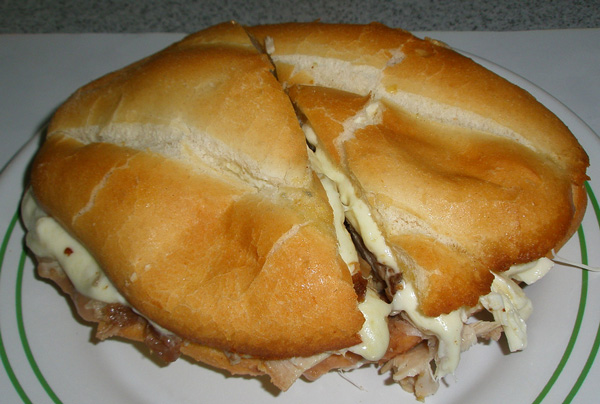
Torta, a Mexican specialty. Credit: Nicholas Gilman
Tortas get their due in ‘Street Food of Mexico’
The torta, Mexico’s version of the sandwich is not well known outside the country, but ubiquitous within. Ortega covers the topic thoroughly — even a recipe for the bread is given. He includes interesting regional items, like the capital’s guajolota (a tamal within a roll), a “gilded lily” to some, a divine treat to others.
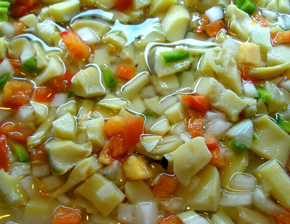
Ceviche is another staple of Mexican street food. Credit: Nicholas Gilman
Although essential beach food, ceviches are found in street stalls throughout Mexico. Ortega’s simple ceviche de huachinango (red snapper) is a textbook example that should be in any Mexican cook’s repertory. The caldo de camarón, a rich soup made with chilies and dried shrimp, is true to the stand, Mexico City’s El Caguamo, from which the recipe is gleaned.
This is a fine cookbook — user-friendly, well written, uncompromising in transposing recipes for the home cook, and beautifully illustrated by renowned food and travel photographer Penny de los Santos. “Street Food of Mexico” is an important addition to any library of Mexican or world cuisine.
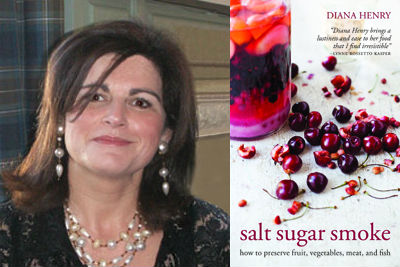
I love cookbooks, and although I’m inspired by them throughout the year, I particularly love them in winter when I can settle in a favorite chair with a new discovery. One of my recent finds is “Salt Sugar Smoke — How to Preserve Fruit, Vegetables, Meat, and Fish” (Mitchell Beazley, 2012). It contains a great selection of recipes that boosted my confidence as a novice preserver, as well as more challenging recipes that experienced preservers will appreciate. And for people who love reading cookbooks more than making the recipes in them, “Salt Sugar Smoke” offers great food writing. It’s a triple threat.
BOOK LINKS
“Salt Sugar Smoke — How to Preserve Fruit, Vegetables, Meat, and Fish”
By Diana Henry
Mitchell Beazley, 2012,
272 pages
More from Zester Daily:
» Preserving and pickling add flavors to winter
The book’s author is Diana Henry, a food columnist for Britain’s Sunday Telegraph magazine. She has won numerous awards and has written three other favorite cookbooks of mine: “Roast Figs, Sugar Snow: Food to Warm the Soul”; “Plenty” (in which she helps you make the most of the foods you have at hand); and “Crazy Water, Pickled Lemons: Enchanting Dishes from the Middle East, Mediterranean and North Africa.”
I loved this book on sight because of its burgundy spine and its portability — the lovely hold-in-your-hands size makes it easy to take to friends’ kitchens — but I felt some trepidation when I first opened it. After all, preserving food sounds difficult and fraught with possible disasters, but I trusted Henry’s thoroughness and her enthusiasm for her subject. She didn’t let me down.
Preserving food fell out of favor for a while; it was part of other generations. But thankfully it has experienced a renaissance in recent years. For three years, Henry “preserved food every day, often well into the night.” I now understand her enthusiasm. Once I processed my first batch of strawberry jam, I was hooked.
Sweet and savory in ‘Salt Sugar Smoke’
“Salt Sugar Smoke” offers much more than strawberry jam for those with a sweet tooth, as well as for those who prefer savory tastes. For others, like me, who prefer both, Henry covers a lot of ground, from jams to mustards, spoon sweets to chutneys.
Her recipes are well set out, with clear instructions. The photography, by Laura Edwards, will inspire you.
One of the things I loved about this book was the way Henry’s “how to use” tips helped me see how a recipe can expand my meal possibilities. For example, having Thai Sweet Chili Sauce on hand lets me make a simple breakfast omelet something special; it also adds great taste to a shrimp stir-fry for dinner. A little Hot Date and Preserved Lemon Relish on a chicken sandwich elevates lunchtime.
“Be careful about hygiene, which is essential,” Henry stresses, and adds that, “The recipes have been tested according to the sterilizing and potting practices followed in Great Britain, where jams and chutneys are not treated in water baths.” For North American readers, though, she provides guidelines for processing jars in a water bath. She also reminds you to label and date what you make so you won’t have to guess what is in a jar.
Tucked among the recipes are short pieces — such as “Sharbats and Mint Tea: Middle Eastern Pleasures”; “Perfect Partners: The Surprising Possibilities of the Cheese Board”; and my favorite, “Ash Helicopters and Mangoes on the Roof: Pickling in Britain and India” — that offer extra reading delight.
My favorite of her recipes to date includes Nearly Strawberry Jam. I love this because I can make just enough to keep in a bowl in the refrigerator for a few days. It’s fast, not as sweet as many jams and versatile. For a last-minute dessert, some of it spooned over good vanilla ice cream is just the thing. It’s also delicious on French toast or stirred into Greek yogurt.
Queen Henrietta Maria’s Marmalade of Cherries (adapted from a 17th century recipe Henry “stumbled across in Florence White’s ‘Good Things in England’”) is a recipe I love as much for its name as its intense cherry flavor. Purple Pickled Eggs, with beets providing their neon color, are just the thing to spice up a cold plate.
Home-Salted Cod (which is easy to make) brought back memories of my grandmother, for whom preserving food was once vital. With five children, a husband, two sisters-in-law, a mother-in-law and boarders to feed during the Depression, she couldn’t afford to allow any food to go bad. She lived on a small island in Newfoundland, Canada, where cod was a staple, and dried the salted fillets on large wooden racks. Later, she transformed them into filling and delicious meals, such as Fish and Brewis — cod, potatoes and scrunchions (rendered pork fat).
For me, her granddaughter, unburdened by the imperative to feed many mouths, preserving is a new adventure I am appreciating at my own leisurely pace. I also appreciate Henry’s focus on small details, such as a “good jam for your toast” or “chutney that is made from apples you gathered last fall” and how such details help add happiness to life.
Photo: “Salt Sugar Smoke: How to Preserve Fruit, Vegetables, Meat and Fish” by Diana Henry. Credit: Author photo and book cover courtesy of Mitchell Beazley Publishers Limited
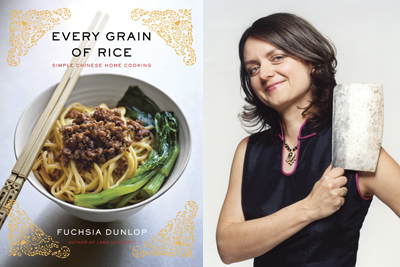
British food writer Fuchsia Dunlop focused tightly on single regions of China in her first two cookbooks, “Land of Plenty” (Sichuan) and “The Revolutionary Chinese Cookbook” (Hunan). But in her latest endeavor, “Every Grain of Rice,” she expands her scope to easy comfort foods from a wide swath of China.
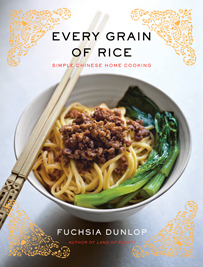
“Every Grain of Rice” is the perfect introduction to cooking the way Chinese people do at home, with simple, clear instructions opposite lovely full-color photographs of almost every dish. For those who are just beginning to admire Chinese food, this book could nudge them over the edge into hopeless devotion.
BOOK LINKS
“Every Grain of Rice: Simple Chinese Home Cooking”
By Fuchsia Dunlop
W.W. Norton & Co., 2013, 352 pages
More on Zester Daily:
» Chinese cuisine gets its closeup with “A Bite of China”
The beautiful photography is enticing, helpful and very welcome, for the lack of ample illustrations was one of the few quibbles I had with Dunlop’s first book, “Land of Plenty.” Drawing on her experience as the first foreign student at the acclaimed Sichuan Institute of Higher Cuisine, her debut became an instant classic, enticing readers to succumb to the spell of central China’s chili-laden foods.
Dunlop is a wonderful guide to the cuisines of China. Rather than shy away from unusual vegetables or distinctly Chinese sauces, she educates her readers while spreading the gospel of good food by introducing exotica that become delicious once you get to know them. Dried shrimp, fava beans, fermented tofu, garlic stems, silk gourd, yellow chives, sesame paste, winter melon … these all get their moment in the sun here.
She gives bean curd, for example, a chance to shake off its tiresome reputation as bland hippie food. Although we in the West “still seem to think of tofu as some sackcloth-and-ashes sustenance for vegans and a sad substitute for meat,” Dunlop notes that in China, bean curd “is one of the most ubiquitous foodstuffs and wonderful when you acquire a taste for it. In its most basic form it may be plain, but then so is ricotta cheese.”
Simple as the dishes are — and with few exceptions they are so basic that even neophyte cooks should be able to attack these recipes with ease — they remain authentic. Most of these are stir-fries; the remainder encompasses meats, vegetables, soups, rice dishes and pastas, and every one of them is a familiar feature on Chinese tables. (She mainly covers recipes from southern China, with a few northern dishes thrown in for good measure.) Clear, reliable recipes are a hallmark of Dunlop’s cookbooks, and this one is no exception. Desserts, beverages and sweets rarely appear in ordinary Chinese family meals, and so they are not covered in this book.
Treasuring distinctions in Chinese food
A few of the recipes were recycled from Dunlop’s previous cookbooks, but that fits with her approach of introducing everyday Chinese dishes to the West. The ones from Sichuan and Hunan that have appeared before benefit from the additional attention paid to them here.
Sichuanese wontons in chili oil sauce, for example — a Chengdu classic — were relegated to a single paragraph in “Land of Plenty”; here they get a full page and a photograph that is sure to cause intense hunger pangs.
To my mind, Dunlop’s attention to the roots of each dish is one of the most refreshing things about this book. She doesn’t speak generically about “Chinese food” — she tells you that a particular beef soup comes from Chongqing in Sichuan. Moreover, you get to experience her delight as she brings you along on a trip through her memories of Chinese dishes past and present, taking the time to explain why she loves them and how you should enjoy them as the Chinese do: with great enthusiasm.
It’s been close to five years since Dunlop’s last cookbook, and I’m happy to report that “Every Grain of Rice” is well worth the wait.
Top photo composite:
Fuchsia Dunlop by Colin Bell. Book cover courtesy of W. W. Norton.
Once in a great while, a little-known cuisine gets itself introduced to the English-speaking world via a well-written cookbook, and life for those who love to eat and cook changes for the better.
This usually has a lot to do with how sublime that cuisine is — a cookbook can crystallize whatever innate qualities make a particular food culture unique and unforgettable.
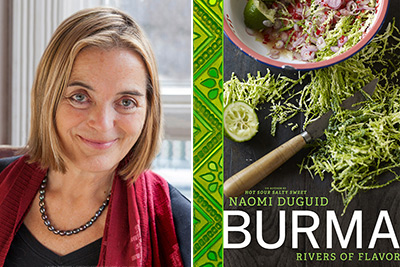
But what really matters is how much the writer loves that cuisine, how much she understands the people who make it and how much she is willing to submerge herself in this completely foreign approach to food. And no one does this better than Naomi Duguid, whose most recent book, “Burma: Rivers of Flavor,” opens the long-locked doors to Myanmar and allows us to partake of its exciting food.
ZESTER DAILY
BOOK LINKS
“Burma: Rivers of Flavor”
By Naomi Duguid
Artisan Books, Workman Publishing, 384 pages
» Buy the book
Much like the award-winning cookbooks Duguid co-authored with ex-husband Jeffrey Alford, this one moonlights with equal aplomb as a travel guide, a history book, an ethnographic study, a photographic essay and a guide to understanding a culture totally foreign to the West. Short chapters — often not more than a page in length — succinctly describe the intersection of Duguid’s personal experiences with the history and heritage of a remarkable people.
Several of Duguid’s cookbooks with Alford, such as “Seductions of Rice and Hot, Sour, Salty, Sweet,” also cover Southeast Asia. However, “Burma” is her first solo effort and the first one to concentrate on a single cuisine — to write it, Duguid lived in and traveled extensively through Myanmar — and she has managed to stick the mat here with a 10-point landing. And while the duo’s previous tomes are brilliant, cooking from them is seriously cumbersome because of their bulk. “Burma” is easier to handle and feels much more like a true cookbook, albeit one with beguiling pictures and stories about this secluded land. If Duguid’s photographs are to be believed, the Burmese are some of the most charming and beautiful individuals in the world. Their expressions are open and welcoming, and some are just flat-out endearing, such as the woman balancing a huge pumpkin on her head and a little girl shyly looking up at the camera with pale smears of thanaka paste on her face acting as a sunblock.
What’s stunning about this book is that the reader so easily gets sucked into another world, another time, another way of life. … even with the most cursory reading. And yet, the beautifully written essays and affectionate photos are just the superficial layers of this book, which is a cookbook, after all. Some of the dishes are glorious reinterpretations of what can only be interpreted as transmogrified newcomers to the land, such as an Indian-influenced semolina cake (page 276) and the very Chinese sticky-rice sweet buns with coconut (page 286); while others show startling originality, such as the herbed catfish laap (page 150), seasoned with a rainbow of aromatics and savory touches; or the banana flower salad (page 57) that cooks the mashed main ingredient to magnify its suggestion of artichokes and then balances that with crunchy seeds and nuts. Burma is clearly home to a cuisine so good that “delicious” seems like faint praise. Exquisite? Astonishing? Unforgettable? Words fail.
I write about Chinese food for a living, and I first picked up this book because Duguid and Alford have proved to be such consistently wonderful writers about the foods and culture of Asia. Once I cracked open the covers, though, something quickly struck me: The food of Burma was key to understanding heretofore hidden culinary treasures along China’s border with Southeast Asia. Whereas another one of their books, “Beyond the Great Wall,” looked at what is eaten by ethnic non-Chinese in the country’s landlocked regions, “Burma” takes us into a singular country that nevertheless shares many cultural and dietary roots with the minorities who live along China’s southern edge in the tropical highlands.
I lost count of the many “aha!” moments I had as I read this book with ever-increasing hunger and fascination. As Duguid described the taste and the method for preparing the Burmese fermented soybean discs called tua nao, I started to draw a connection over the long, snaking, mountainous border Burma shares with China’s Yunnan province, where they have similar dousu balls used to make a heavenly bean sauce full of crunch and chilies. I was stunned by the simplicity of this connection — the discs even appear in a photo in “Hot, Sour, Salty, Sweet.”
Whatever their points of origin, the foods in “Burma” are alive with sparkling flavors and pungent aromas, and suggest a subtle web of influences undulating throughout the region. A dish of Burmese rice noodles called khaut swe looks for all the world like a bowl of hefen as served in Guangxi, its touch of five-spice powder sending a sly salute to China, while the curry in a plate of chicken speaks of an Indian chef somewhere upstream who introduced a spectrum of warm aromatics to the local cuisine.
With a complex past interwoven with the tastes and history of its many neighbors, Myanmar has a cuisine worth knowing, and Duguid has written a book about it that is truly worth treasuring.
Top photo composite:
Author Naomi Duguid. Credit: Laura Berman
Cover of “Burma: Rivers of Flavor.” Credit: Courtesy of Artisan Books