Articles in Healthy Eating
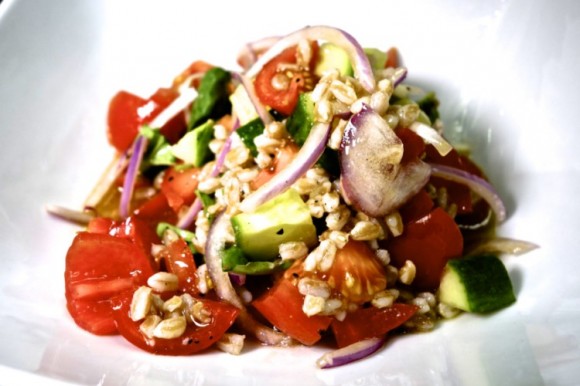
Chef Giacomino Drago smiles a lot. The youngest member of a family of cooks to immigrate from Sicily, Drago, along with his brothers, has opened a dozen restaurants in Los Angeles, many in Beverly Hills, over the past four decades.
A contributor to the “Beverly Hills Centennial Cookbook,” Drago declares that using the highest quality, freshest ingredients is the essence of Italian cooking. In his video he demonstrates an easy-to-prepare, classic Italian panzanella salad with diet-friendly spelt instead of bread.
Drago enjoys cooking. He smiles as he drops a handful of spaghetti into one of the half dozen pots of salted water on the stove and when he quickly renders a red onion into a mound of thin, pungent ribbons.
More from Zester Daily:
» Sweet panzanella with summer stone fruit
» Bread salad is the perfect summer cool-down
» Eating thrifty, Italian style
Come to Italy, he says, and one of the first salads you will eat is one made with vine-ripened tomatoes, basil, red onions, extra virgin olive oil, red wine vinegar, and salt and pepper. Simplicity, he says several times, is the essence of Italian cooking. Find the freshest, highest-quality ingredients and prepare them in what Drago calls the rustic way, roughly cut so the dish is not overly fussy. The result is delicious, healthy food that is easy and fun to make.
A panzanella salad is the perfect dish for summer. To pursue the “current fashion,” as he puts it, he has traded spelt for bread in a signature salad at Via Alloro in Beverly Hills. He chose spelt because it has a refreshing texture and nutty quality that contrasts well with the acid of the tomato and vinegar. A heritage grain and cousin to wheat, spelt was developed hundreds of years ago as a flour in bread making. High in protein and fiber, Drago says spelt is heart-healthy because it is high in niacin. Because “panzanella” refers to a bread (“pane”) salad, it might be more accurate to call chef’s creation a speltzanella.
Chef Drago loves all his restaurants. But he designed the kitchen at Via Alloro in a special way. The area where the line cooks work is a horseshoe space with stoves in the middle and counters running along the walls. There are no dead-ends in this kitchen. Moving efficiently Drago and Executive Chef Paolo Sicuro prepare dishes with an unhurried ease, transferring their love of cooking onto the plates.
Fresh tomatoes are key to the flavor and pleasures of the salad. To protect the tomatoes’ richness of flavor, Drago insists they must never be refrigerated. That is why buying tomatoes from farmers markets is so important. Supermarket tomatoes may have been refrigerated for days, even weeks during their journey from the field to your kitchen.
Drago is precise about his cooking but flexible in terms of ingredients and seasoning. When cooking at home, he encourages that you use only ingredients you enjoy. If you do not like onions, don’t use them in the salad. The same goes for cucumbers and ground black pepper.
To capture all the tomato juice, chef cuts the tomatoes over the bowl. Use a variety of tomatoes for contrasts in shape, color and flavor. For the demonstration, Drago and Siruro used vine ripened, cherry and grape tomatoes. Yellow and heirloom tomatoes could also be added for contrast. To make the onion slices more “friendly,” Drago suggests double rinsing in water. This will result in a more mild flavor. Not widely available, spelt berries can be purchased in specialty markets and ordered online from purveyors such as Bob’s Red Mill. Cooked like pasta in boiling salted water, kosher salt should be used for the cleanest taste. Chef Drago uses English or hothouse cucumbers for the dish. If those are not available, Persian cucumbers would be a good substitute because they have a lower water content than garden cucumbers. The spelt may be cooked ahead and refrigerated. The other ingredients should be prepared immediately before serving to preserve their freshness.
Ingredients
- 3 tablespoons spelt
- 2 medium-sized tomatoes, washed, stem removed, cut into a small dice, reserving the liquid
- 5 cherry tomatoes, washed, quartered
- 5 plum tomatoes, washed, quartered
- 1 small hothouse cucumber, washed, skin on, a small dice the same size as the tomatoes (optional)
- ¼ medium red onion, washed, root and stem removed, thin sliced (optional)
- 4 fresh basil leaves, washed, pat dried, roughly torn or chopped
- 1 tablespoon kosher salt
- Pinch of salt to taste
- Pinch of freshly ground black pepper to taste (optional)
- 4 tablespoons extra virgin olive oil
- 1 tablespoon red wine vinegar
Directions
- Add kosher salt to three quarts of water. Bring to a rapid boil. Add spelt. Boil uncovered 30-50 minutes or longer depending on the desired doneness. Taste at 30 minutes to determine what is al dente for you and then again at 10-minute intervals until you reach the texture you like. I prefer cooking the spelt 50 minutes. Drain and set aside to cool
- Using a sharp paring knife, cut the tomatoes over the salad bowl to capture all the juices.
- Cut the skin-on cucumber into pieces similar in size to the tomatoes and add to the bowl.
- Slice the red onion. Submerge in cold water, rinse, drain, submerge in fresh cold water, rinse and drain. Add to the tomatoes and cucumbers.
- Add the cooked spelt berries.
- Roughly chop the basil leaves or tear them with your hands. Add to the salad bowl.
- Toss the spelt, vegetables and aromatics with the extra virgin olive oil and red wine vinegar.
- Season with sea salt to taste and freshly ground black pepper, as desired.
- Serve as a salad or a side with grilled meats, fish and poultry.
Having been raised under the shade of a sweet cherry tree, I always took great pride in asserting Michigan’s cherry dominance. It was not until researching this piece that I made a shocking discovery: Most sweet cherries are grown in the West. To be specific, Utah, California and Oregon.
More from Zester Daily:
» Maraschino liqueur as well as cherries
Next, I discovered that Utah also supported its sweet cherry stronghold by designating the cherry as its state fruit back in 1997. Meanwhile, Michigan is still trying to make up its mind about that subject. Proposed legislation designating a state fruit has been stalled in committee for more than a year, with heavy opposition from the blueberry contingent. Not only was my state not among the Top 3, it couldn’t even muster sufficient political muscle behind its homegrown sweet cherries. I never would have guessed that a simple story about a spicy cherry salsa would cause me such emotional upheaval.
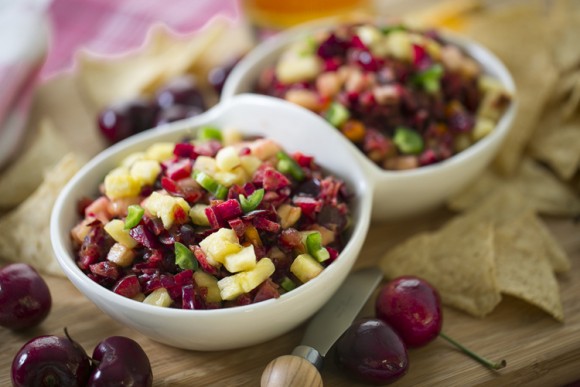
Despite my disappointment in this news, I still am crazy about sweet cherries in June and July. I like to throw them on waffles in the morning, salads in the afternoon and start any party with a simple, kicked-up cherry salsa, especially if it’s an impromptu gathering and I’ve only got 15 minutes before running out the door. This light, fruity salsa is sure to disappear as fast as guacamole on Cinco de Mayo or cherry pie on the fourth of July. But that’s another story with a happier ending, because cherry pie uses tart cherries, and Michigan wins that contest hands down.
Ingredients
- 1 pound sweet cherries, pitted
- ½ pound fresh or canned pineapple
- 1 jalapeño pepper
- Juice of 1 lime
- 1 teaspoon salt
- 1 teaspoon Aleppo chili pepper, or to taste
- ¼ cup parsley, minced
Directions
- Combine all ingredients in a blender or food processor and pulse until the mixture reaches a chunky sauce consistency.
- This can be served immediately, but it is best if allowed to marinate for up to three hours while the sweet and spicy flavors get to know each other. Serve with tortilla chips.
Main photo: Sweet cherry-pineapple salsa. Credit: Caroline J. Beck
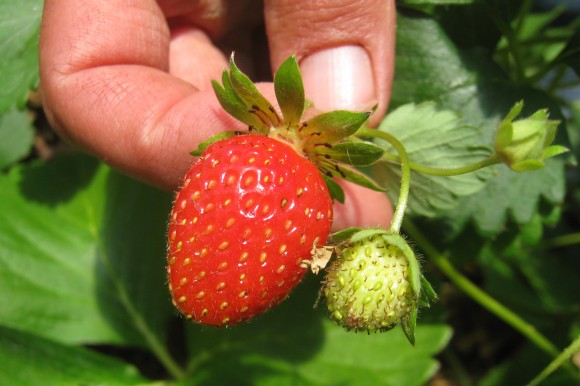
Superfood status aside, there is nothing more seductive than the sweet and spicy scent of the first gold-spangled ruby-red strawberries of the season. The uninitiated may wonder what on earth I’m talking about, since the fruit section of most grocery stores is as aroma-free as the canned goods section. But every Saturday in June, I watch a stream of savvy shoppers make a beeline to certain local farm stands where perfume still pervades the air.
More from Zester Daily:
» Cool berries and ricotta pancakes? Amen.
» Strawberry shortcake for dessert
The strawberries at a farmers market are generally not the largest, nor the longest-lasting, nor the most perfectly shaped. But there is a reason customers are standing six-deep, waiting their turn: When you bite into the soft flesh, juices and flavors ricochet around your mouth and your brain until you are in a delirium of pleasure. “This,” I hear people say again and again, “is what strawberries used to taste like!”
Indeed, this is how they tasted, before they were bred for color, size and shelf-life, before synthetic chemical fertilizers, fumigants, insecticides and herbicides. Contrary to industrial belief, there are simple ways to control pests in the strawberry patch, the most time-tested being organic straw mulch (hence the straw in strawberries), which obviates the need for a host of chemicals. Straw keeps the berries off the moist ground (no need for fungicides), prevents weed seeds from germinating (no need for herbicides), and adds nutrients to the soil as the straw decomposes (no need for chemical fertilizers) — all the while enhancing the diversity of soil microorganisms that keep the farm ecosystem on an even keel.
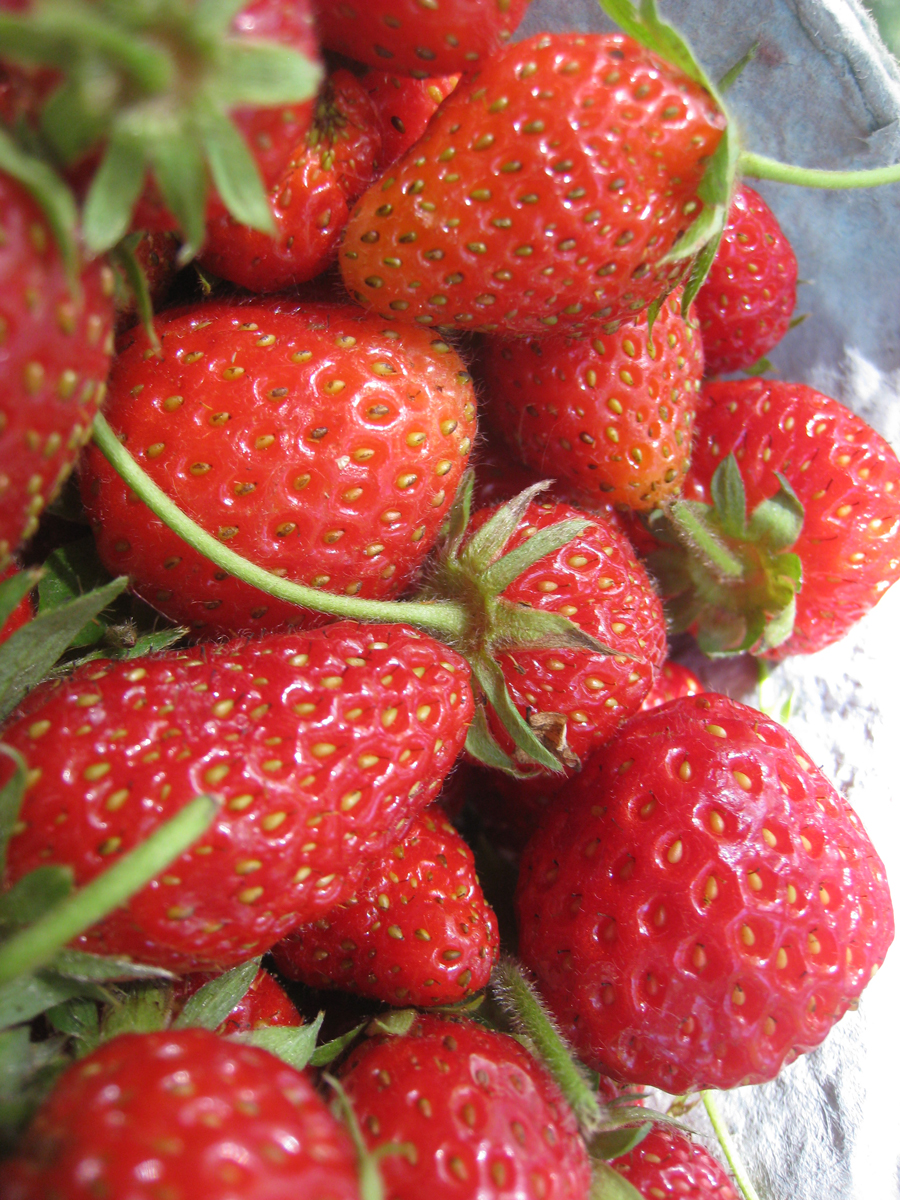
Mara des Bois strawberries are the result of cross-breeding four old European varieties, Korona, Red Gauntlet, Gento and Ostara. Credit: Terra Brockman
Even in our hot and humid Illinois summers, delicious strawberry varieties such as Jewel, Honey-oye, and Earliglo do very well. But my new favorite is Mara des Bois. It is a small, somewhat elongated berry, with an intoxicating fragrance, unusual red-orange color, and deep, complex and varied flavors. In fact, different berries, even from the same plant, can have remarkably different flavors. This may be because it is a combination of four heirloom varieties that the French strawberry breeder Jacques Marionnet crossed to get the Mara des Bois. Each variety contributes a layer of flavor and in some berries, one or another flavor predominates, with some sweeter, some more citrusy, some more perfumey.
I confirmed my suspicion of the berry-to-berry variations when I brought over a big bowl of them as a treat for friends, and each one brought a different accolade, from “tangerine!” to “Kool-Aid!” to “strawberry ice cream!” And so another and another disappeared until the bowl was empty.
And these bright bursts of flavor contain potent packages of nutrition. An average strawberry has only 4 calories, but packed in those few calories are 11% of your recommended daily allowance of vitamin C. This means that eight to 10 strawberries give you more vitamin C than an orange. In addition, strawberries are high in fiber and antioxidants, and a good source of potassium and manganese.
While nothing says “welcome to summer” like strawberry shortcake, there are many other ways to use strawberries — if you can manage to get them home without eating them all on the way. This easy salad combines the best of the rich flavors of early summer — spicy arugula with sweet/tart strawberries.
Ingredients
- ½ cup chopped walnuts
- 4 cups torn arugula leaves
- 2 cups sliced strawberries
- 2 ounces Parmesan cheese, shaved and crumbled into small pieces (½ cup)
- ¼ teaspoon freshly ground pepper
- ⅛ teaspoon salt
- 2 tablespoons balsamic vinegar
- 1 tablespoon extra virgin olive oil
Directions
- Toast walnuts in a small dry skillet over medium-low heat, stirring frequently, until lightly browned and aromatic, 3 to 5 minutes. Transfer to a large salad bowl; let cool for 5 minutes.
- Add arugula, strawberries, Parmesan, pepper and salt. Sprinkle vinegar and oil over the salad; toss gently and serve at once.
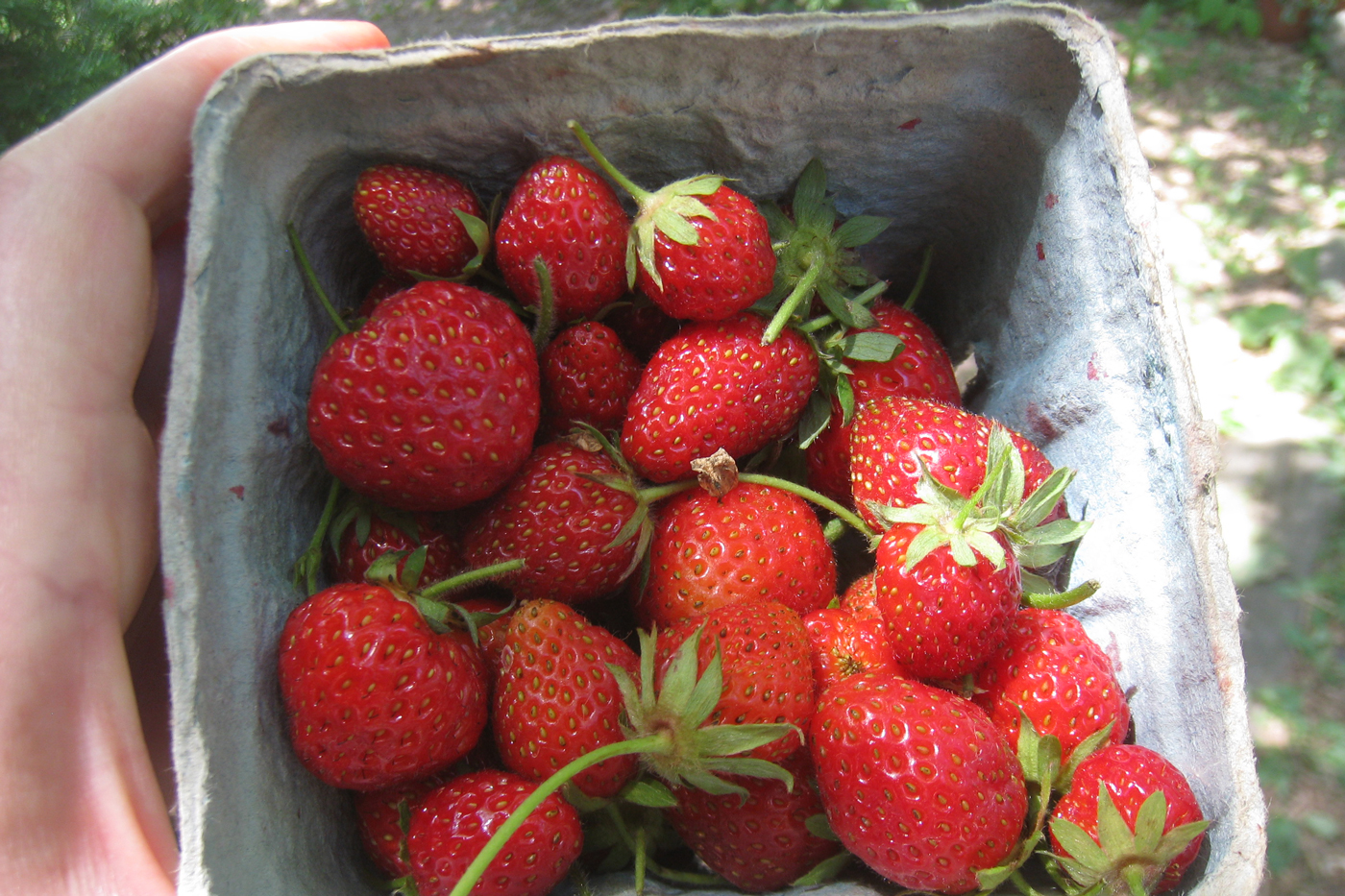
Smaller and softer than commercial strawberries, the Mara des Bois pack a flavor punch. Credit: Terra Brockman
Main photo: The carmine-orange color and alluring aroma of wild strawberries (fraises des bois) are clues that this is a Mara des Bois. Credit: Terra Brockman
In tropical south India, our pantry had shelves running the length of walls that stored all types of basic provisions. Large brass containers held various dried legumes and smaller containers held dried spices and nuts. But saffron was not among them. My mother kept it in a small jar inside a large locked metal cupboard along with her silver utensils used for special occasions. She called it kumkumapoo — flower of the kumkuma plant; kumkuma is saffron’s Sanskrit name. The precious bottle came out only when special treats were made at home.
Saffron in cooking
Saffron has been a classic ingredient in various cuisines since ancient times. It is a versatile spice that adds a new dimension to savory and sweet dishes. Saffron threads are soaked in water, broths or other liquids, which become infused with the flavor and orange-yellow coloring, and then added to a dish.
More from Zester Daily:
» How favorite Indian sweets changed dramatically
» Sweet Hindu offerings fit for the gods in India
Typically, the saffron threads are crushed or ground before soaking them. Saffron threads may also be ground or crushed into a powder and added to a dish. Good quality saffron develops to a bright golden yellow color, poorer quality saffron to either a pale straw color or bright orange.
From paella to risotto to biriyani, saffron is the main flavoring ingredient in various rice as well as meat dishes. There are numerous desserts that incorporate saffron for its color and flavor. It is widely featured in Spanish, Mediterranean, Persian, Iranian, Iraqi, Indian, Greek, Moroccan and Italian cuisines. Saffron from Iran, India and Spain are considered the best quality.
Where does it come from?
Saffron, the spice obtained from the gently dried stigmas of the purple saffron crocuses (Crocus sativus), has remained the world’s most expensive spice throughout history. Saffron’s unmistakable traits are its color and flavor. Since the strength of color determines its flavor, the higher the coloring strength, the higher its value. Saffron is sold as threads or as a ground powder. It is usually sold by the gram — just a small bunch of slender red threads. Fortunately, most recipes call for just a pinch, and a pinch of saffron goes a long way. It is grown primarily in Iran (more than 90% of the world production), followed by Spain, Greece, India (Kashmir) Egypt, Morocco and Turkey.
Why the high price?
An ounce of Spanish saffron costs about $54 and, when it is labeled pure, the price can go up to $77. The orange-red threads of saffron are very expensive for several reasons. Cultivation of saffron requires particular climate and soil conditions. The flowers have to be individually handpicked in the autumn when fully open. Saffron stigmas are harvested between dawn and 10 a.m., as they lose their color and aroma if left too long in the plant. Each crocus flower only produces three stigmas of saffron and thousands of blossoms are needed to produce even a small amount of spice. The stigmas have high moisture content and are gently dried for preservation.
Saffron’s history
The history of saffron goes back to ancient Egypt and Rome, where it was used as a dye, in perfumes, and as a drug, as well as for culinary purposes. It was known since antiquity in Persia, Mesopotamia and surrounding areas. Cultivation of saffron was also widespread in Asia Minor far before the birth of Christ. There are conflicting accounts about saffron’s arrival in South and East Asia. One theory is that when Persia conquered Kashmir, Persian saffron crocuses were transplanted to Kashmir. It is believed to have reached China in the 7th century. Arabs introduced saffron in Spain by 960. Cultivation spread to Italy, France and Germany when crusaders returned from Asia Minor with saffron corms.
Many uses of saffron
Saffron is used as an aromatic, and also used in perfumes and dyes. Saffron is often added to many food products simply as a coloring, such as cheese, soups and even various alcohols.
Saffron has very significant nutrients and chemical compounds that provide many health benefits. Saffron is an important ingredient in a number of Ayurvedic, Chinese, Unani and Tibetan medicines. According to Ayurvedic medicine, it is oily and light in properties, bitter in taste, and helps to pacify vata, pitta and kapha (air, fire and earth, the three fundamental body humors that make up one’s constitution, according to Ayurveda).
Saffron is used by Ayurvedic practitioners to treat asthma, arthritis, cold, cough and flu, acne and skin diseases, inflammation and indigestion. It is also a cooling spice and said to be an effective antidepressant. Some studies have shown that saffron contains antioxidants and other healthful properties that may help prevent cancer.
Saffron Almond Milk
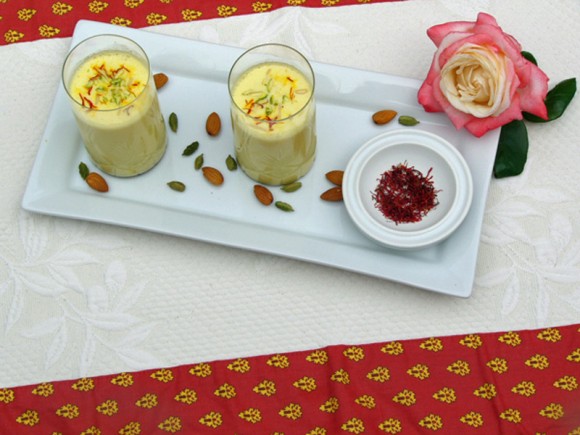
On a hot summer day a cool glass of soothing and wholesome almond milk flavored with saffron makes the perfect thirst quencher. Here is a recipe for this delicious cold drink made with almonds, saffron and milk.
Ingredients
½ cup slivered almonds and few extra for garnish
½ cup water
3½ cups low fat (2%) milk
⅓ cup sugar
5 cardamom pods crushed
10 to 15 strands saffron
Directions
1. In a blender, grind the almonds with half cup of water to a smooth paste.
2. Bring the milk to a boil in a heavy bottomed vessel. Take a tablespoon of hot milk and add to the saffron strands and set aside.
3. Add the sugar, saffron soaked in milk and cardamom to the milk and bring back to a boil. Reduce the heat and simmer for 5 minutes.
4. Stir in the almond paste and simmer at medium heat for another five minutes. Keep stirring the pot. Remove from the stove and keep it covered.
5. Chill in the refrigerator and garnish with silvered toasted almonds and a pinch of saffron before serving.
Main photo: Saffron almond milk. R.V. Ramachandran
Probiotics have been quite the hot topic for some time now. We are beginning to understand more about the importance of these beneficial bacteria, or microflora, in our guts — not only in maintaining digestive health, but also in boosting our immune systems. At a minimum, if you’ve seen Jamie Lee Curtis extolling the virtues of Activia yogurt in television commercials, you may have some vague idea that probiotics are the answer to undisclosed, unseemly tummy issues, especially if you are a middle-aged woman.
Some of the advertising claims for commercial yogurts can be a bit far-fetched or vague, but there is now a lot of good evidence in the scientific literature supporting the benefits of probiotics, including immunity enhancement, improvement of lactose digestion, treatment of diarrhea in infants and treatment of constipation, improved tolerance to antibiotic therapy and reduced symptoms of respiratory infections. Cultures around the world that eat fermented foods like yogurt, kefir and kimchi have been on to this for centuries.
The secret to probiotics
More from Zester Daily:
» Foods to soothe your stomach woes
» Fermentation brings out the best in kimchi
I thought I understood the concept of probiotics until I heard a talk by nutritionist and Stanford University dietitian Jo Ann Hattner. She coauthored, with Susan Anderes, “Gut Insight: Probiotics and Prebiotics For Digestive Health and Well-Being.” What I had not understood was that probiotics do not thrive on their own. They have to be replaced every few days, and they have to be nourished.
“Bacteria have to eat, too,” Hattner says, and it turns out there are certain foods they really love. These are foods that are high in specific nondigestible, fermentable carbohydrates (fibers), or prebiotics. The fibers are not digested in the stomach — they survive its acidity, and when they arrive in the colon they are fermented by the beneficial microflora that they encounter there. Scientists believe that the acids resulting from this fermentation decrease the pH levels in the colon, and this is detrimental to the survival of pathogenic bacteria. Probiotics and prebiotics have a synergistic relationship and the end result for us, the host, is increased gastrointestinal health and boosted immunity.
Prebiotic foods to consider
Scientists have begun to isolate some of these prebiotic elements. Measurable amounts of two of them, oligosaccharides and inulin, have been found in bananas, chicory root, burdock, dandelion greens, garlic, onions, leeks, globe artichokes, Jerusalem artichokes, jicama, mushrooms, green tea, wild blueberries, kiwis, salsify, whole wheat, barley, and rye. These are foods that Hattner designates as “prebiotic stars.” Other foods that scientists are studying because they think they have “prebiotic potential” include apples, berries, raisins, tomatoes, greens, legumes, oats, brown rice, whole grain corn, buckwheat, flaxseed, almonds and honey. However, they need more human studies before they can be assessed as “stars.”
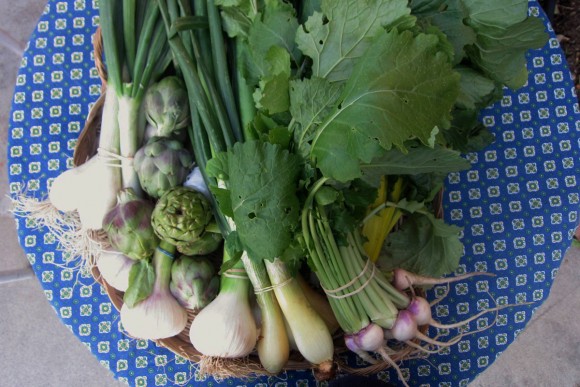
Spring is a great season to take advantage of many of the “prebiotic stars.” I’ve built a big bowl using six prebiotic stars and potentials, which I top with yogurt, so the synergistic relationship between these ingredients begins on the plate itself. Mind you, I am not one to create dishes because of health-related attributes in the ingredients — deliciousness is always my goal. The stew is a wonderful Mediterranean stew, and the big bowl makes a wonderfully hearty vegetarian meal. The prebiotic/probiotic attributes in the dish are a healthy and delightful coincidence.
In this dish, the prebiotic stars and potential stars are:
- Onion
- Garlic
- Artichokes
- Fava beans
- Greens
- Barley
The probiotic bonus is the garlic yogurt that garnishes the big bowl.
Big Bowl With Barley, Spring Vegetable Stew and Yogurt
Serves 4
Ingredients
For the stew:
Juice of 1 lemon
6 baby artichokes or small artichokes
2 tablespoons olive oil
½ pound spring onions, white and light green parts only, chopped (about 1½ cups)
½ cup chopped celery, preferably from the heart of the bunch
1 bulb green garlic, papery shells removed, chopped
1 large fennel bulb (1 to 1¼ pounds), trimmed, quartered, cored, and chopped (3 to 3½ cups chopped)
½ cup water
Salt and freshly ground black pepper to taste
1 bunch baby turnips, with greens, turnips scrubbed and quartered, greens stemmed and washed
1½ pounds fava beans, shelled
2 tablespoons chopped fennel fronds or chopped fresh mint (or a combination)
3 cups cooked barley
1⅓ cups Greek yogurt, with 1 mashed garlic clove stirred in if desired
Chopped fresh dill, parsley or mint (or a combination) for garnish
Directions
1. Fill a bowl with water and add lemon juice. Trim the artichokes, quarter them and place in the water as you go along.
2. Heat oil over medium heat in a large, heavy, lidded skillet or Dutch oven and add onions and celery. Cook, stirring, until tender, about 5 minutes. Add garlic, stir for about a minute, until you can smell the fragrance of the garlic, and add fennel and a generous pinch of salt. Cook, stirring often, for another 5 to 8 minutes, until the fennel has softened.
3. Drain artichoke hearts and add to the pan, along with the baby turnips. Cook, stirring often, for 5 minutes. Add ½ cup water and salt to taste and bring to a simmer. Cover, reduce heat to low, and simmer for 10 to 15 minutes.
4. Meanwhile, blanch the turnip greens in a pot of salted boiling water for 2 to 3 minutes, until tender. Using a skimmer or a slotted spoon, transfer to a bowl of cold water, then drain and squeeze out excess moisture. Chop medium-fine. Bring the pot of water from the greens back to a boil and drop in the shelled favas. Boil 1 minute, then transfer to a bowl or cold water. Drain and skin the favas. Set aside.
5. When the simmering vegetables are very tender and fragrant, stir in the blanched turnip greens, skinned favas, the chopped fennel fronds and/or mint and simmer for 5 more minutes. Taste and adjust salt and pepper.
6. Spoon a generous serving of cooked barley into each wide bowl. Top with the vegetables, making sure to spoon broth over the barley. Place a spoonful of yogurt on top, sprinkle with parsley, dill or mint, and serve.
Main photo: Prebiotic stars among spring vegetables. Credit: Martha Rose Shulman
Watercress is one of those greens that goes in and out of popularity with my friends, although I have been devoted to it for 20 years, after discovering a hummus, tomato and watercress sandwich in a cafe close to where I worked at the time.
The peppery taste of the watercress added a final, perfect note to the tanginess of the hummus and the freshness of the tomatoes. That sandwich became my workday treat, eaten religiously, Monday to Friday, for a couple of years.
Later, when I left the corporate world and returned to cooking for myself, I nibbled watercress while tossing it into salads, learned to make Potage Cressionniere (a soup of potatoes and watercress) in winter and a lighter soup (without the potatoes) in spring and summer, and used it in my own version of that long-gone sandwich.
Historically, watercress thought to fortify mind and body
Nasturtium officinale is the botanical name for watercress. The word Nasturtium comes from the Latin nasus tortus, meaning “twisted nose,” a warning about the effect watercress can have on your nasal passages.
More from Zester Daily
It may be a nose twister, but it is also one of the oldest green vegetables known to man. The ancient Greeks, Romans and Persians loved it. Persian children ate watercress to grow strong, while Persian and Greek soldiers ate it to remain so. Both the Greek general Xenophon and the Persian king Xerxes decreed their troops should eat it for the same reason, with Xenophon once recalling, “How pleasant it is to eat barley cake and some cress when one is hungry by a stream.”
A Greek proverb — “Eat cress and learn more wit” — gave an indication of the vegetable’s contribution to the brain, something Irish monks also understood. They spent months living on watercress and bread to stimulate their brains.
Watercress provides essential vitamins — in particular A and C — as well as calcium, magnesium, folic acid, iodine, sulfur and iron. It is believed to have wonderful cleansing powers and help in curing a variety of ills. (Romans and Anglo-Saxons used it as a treatment for baldness.) It was also eaten to provide courage and character, and as an aphrodisiac.
The Romans put watercress in salads, dressing it with oil and vinegar, much like we do today. When Hippocrates — the Greek physician known as the father of Western medicine — founded the first hospital on the island of Kos, Greece, about 400 B.C., he used watercress to treat blood disorders. Twelve centuries later, English herbalist John Gerard championed it as a cure for scurvy in the 1600s. Watercress may also have been eaten at the Pilgrims’ first Thanksgiving dinner.
A twist from Dickens
In more modern times, the English raised it to something of an institution in watercress sandwiches served at afternoon and high teas. No less than Charles Dickens wrote of it in “Great Expectations,” with Mr. Pumblechook, a corn merchant with a mouth “like a fish,” ordering watercress sandwiches for Pip, the book’s hero, as a supposed kindness although, in truth, Pip didn’t like them.
Others of that time did, though. Watercress was breakfast for the working classes in Victorian Britain, eaten with bread or alone.
“The first coster cry heard of a morning in the London streets is of ‘Fresh wo-orter-creases,’ ” English social researcher Henry Mayhew wrote in his 1851 survey “London Labour and the London Poor.” Surely one of those coster cries must have come from Eliza James. Nicknamed “The Watercress Queen,” James was a watercress seller in the late 1800s and early 1900s, hawking her wares in her Covent Garden stall for more than half a century. She started selling watercress when she was 5, first at factories in Birmingham, then eventually becoming the sole watercress supplier of most hotels and restaurants in London as well as, reputedly, the biggest owner of watercress farms in the world.
Wild watercress
Wild watercress grows in shallow rivers and streams, fading in the dog days of summer and the coldest months of winter. Picking it wild, however, requires great care to ensure the water it grows in is pollution free and the watercress is uncontaminated. Commercially, watercress is cultivated in carefully controlled tanks or water beds.
Although peppery in taste, watercress actually has a cooling effect on the mouth. This is something Taillevent, a 14th-century cook to the Court of France, understood. He included a course of “watercress, served alone, to refresh the mouth” in one of his famous banquet menus.
In North America, watercress is an ingredient in salads, soups and sandwiches. It is a lovely complement to oranges, apples and pears, and also works well with eggs.
When using watercress, leave the stems on because they have the strongest flavor. Try not to overcook it. The leaves are delicate, and long cooking robs them of their flavor. Watercress is best eaten soon after purchasing and should be kept immersed in cold water until it is used. So go ahead, let your nose twist as you enjoy this wonderful green.
A Light Watercress Soup
Serves 4
Ingredients
For the soup:
2½ tablespoons unsalted butter
2 shallots, finely chopped
1 tablespoon all-purpose flour
1 cup whole milk
1 cup low-sodium vegetable stock
¼ teaspoon salt
3 bunches (about 3 cups) watercress, washed, dried and chopped
¼ cup table cream (10%)
Optional garnishes:
Crème fraîche
Thinly sliced pear
Directions
1. Melt the butter in a large pot over medium heat. Add the shallots and cook until soft. Stir in the flour and cook for 1 minute.
2. Gradually stir in the milk and vegetable stock, then add the salt. When the soup is near boiling, reduce heat, cover and simmer for 5 minutes.
3. While the soup cooks, bring a large pot of water to boil. Add the watercress to blanch until wilted, but still retaining its bright color. Remove it from the water and place in a bowl of ice water.
4. Squeeze the water out of the cooled watercress and add the watercress to the soup.
5. Carefully purée with a hand blender or in a food processor, adding the cream.
6. Reheat if necessary.
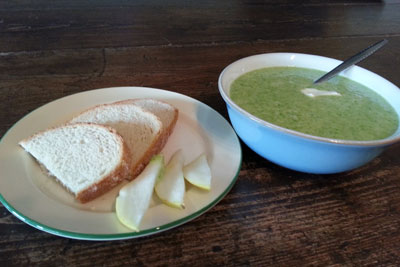
7. Garnish with a dollop of crème fraîche and a few slices of pear if you wish. This soup is delicious hot or cold.
Main photo: Watercress soup with bread and pear slices. Credit: Sharon Hunt
Don’t Buy The Myth: Here’s How Eggs Make A Healthy Diet
by: Nancy Harmon Jenkins
in: Mediterranean Diet
Sun, Sea & Olives: It’s the simplest, most basic of foods, the one cooks turn to when there’s nothing to eat in the house — because there’s almost always an egg or two or three available, ready to be scrambled into a quick supper, or tossed with hot pasta to make a rich carbonara or poached in chicken stock to turn that unassuming broth into chicken soup.
 And it has to be the easiest thing in a cook’s repertoire: You know what they say about a hapless cook — she can’t even boil an egg!
Spring and eggs go together. That’s because as the light begins to strengthen and the grass starts to green, the hens begin to lay once more, which is why eggs are so closely tied to the two great Mediterranean spring festivals, Passover and Easter. The egg on the Seder plate and the colored eggs in the Easter basket are there to announce that winter is over and new life has begun. (Yes, I know the Seder egg is supposedly a stand-in for the sacrifice in the Jerusalem Temple, but it’s hard to resist spring symbolism all the same.)
Fortunately, eggs are starting to creep out from under the dishonor in which they were held for decades, vilified for high cholesterol content and banned from the tables of anyone who feared heart disease. No longer! Modern researchers agree that dietary cholesterol is not a problem for most people. Dietary cholesterol does not make elevated serum or blood cholesterol, which is more likely to be attributed to a diet high in saturated fat, or to unhappy luck of the genes.
Eggs pack a protein punch — and are chock full of vitamins and minerals
Eggs, as traditional kitchen folklore has always held, are good for you, an excellent source of protein, of course, low in total fat and with zero carbs and just 71 calories in a large egg. They are good sources of iron, selenium, phosphorus and riboflavin, as well as vitamin B12. They’re also well supplied with the antioxidants lutein and zeaxanthin, which protect against macular degeneration, among other benefits. Did your mother tell you eggs are good for your eyes? Mine did, and she was right!
Sun, Sea & Olives
One in an occasional series on the Mediterranean diet.
More from Zester Daily
» The ABCs of the Mediterranean diet save lives in a new way
So get out the eggs and get to work.
But what kind of eggs will you buy? Cage free, free range, pastured, pasteurized, organic? The choice is confusing, but for the most and best flavor, my vote goes to eggs bought from the farmer who tends the chickens. Straight to the source, you’ll find out how those chickens are raised, what they’ve been fed and how long ago the eggs were laid.
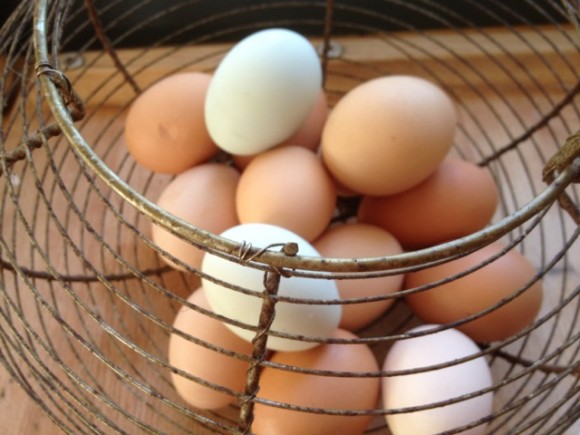
Although brown eggs are favored in New England and white eggs preferred elsewhere, the flavor and goodness are exactly the same. But here’s an interesting fact to put in your egg file: Eggs in North America must be washed before they can be sold. Not a bad idea, you’re thinking? Think again. Eggs come with a natural protective coating that gets dissolved in the wash water. In Italy, where I live part of the year, eggs don’t have to be refrigerated, while in the U.S., I’m told, it’s best to keep them, if not refrigerated, in a very cool place to make up for their lack of protection. (You may find that eggs bought from the farmer have not been washed.)
And what about salmonella? If you think eggs are risky, cook them thoroughly, either hard-boiling or baking in cakes or cookies. Hard cooked eggs can quickly become deviled eggs, a seriously delicious if old-fashioned treat. Do them up Mediterranean style, mixing the yolks with a little mustard, some capers and a few green olives chopped together with fresh green herbs, the whole bound with a dab of olive oil and another dab of mayonnaise. Or serve them plain, garnished with a black- or green-olive tapenade.
Take a tip from the Italian kitchen and drop eggs, one after the other, into a bean-and-pasta soup, then serve up a poached egg with each soup portion, perhaps with a little Parmigiano-Reggiano sprinkled on top. Another dazzling Mediterranean egg trick I learned from Maria Jose San Roman, a great chef from Alicante in southeast Spain: Use gently fried eggs as a sauce to top sautéed potatoes. Cook sliced potatoes (in olive oil, of course), then arrange on a platter, season generously, and top with eggs similarly fried, the yolks basted with hot oil so that when they break they make a rich, golden sauce for the potatoes. Nothing could be simpler — or better.
One of my favorite Mediterranean treats consists of eggs served atop the sumptuously tasty concoction called shakshouka in North Africa and sciakisciuki on the island of Pantelleria in Italy. There’s a place in the delightfully shabby old city of Jaffa, Israel, called Dr. Shakshouka, a huge favorite with tourists. If you overlook the visitors, you can get a delicious shakshouka, often served with eggs, for lunch.
I played around with the recipe for a while and here’s what came out — salt-cured lemons are my own personal touch, but they give such a North African flavor that I couldn’t resist stirring them in at the end. You can make this hotter or sweeter as you wish by increasing or decreasing the ratio of paprika to chili. Another virtue of the sauce: You can make it ahead of time, even several days, and refrigerate until you’re ready to reheat and serve.
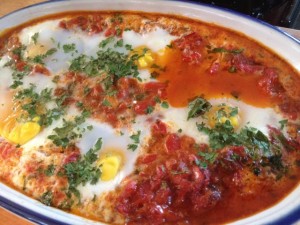
Shakshouka with eggs. Credit: Nancy Harmon Jenkins
Shakshouka
Makes enough for 2 to 3 main-course servings, 4 to 6 if part of a larger meal
Ingredients
1 teaspoon cumin seeds
1 teaspoon coriander seeds
6 tablespoons extra virgin olive oil plus a little more for garnish
3 or 4 sweet red (bell) peppers, cored and chopped, not too fine, to make 4 cups
4 to 6 garlic cloves, minced
1 large or 2 medium tomatoes, peeled and chopped not too fine
1 teaspoon sugar, if desired
2 tablespoons tomato concentrate dissolved in ¼ cup of hot water
1 tablespoon sweet paprika
1 or 2 teaspoons medium-hot ground or flaked chili pepper (Aleppo pepper if available), plus a little more for the garnish if you wish
Sea salt and freshly ground black pepper to taste
1 tablespoon capers, rinsed of excess salt
½ small salt-preserved lemon, slivered, if available
¼ cup finely chopped flat-leaf parsley
¼ cup finely chopped cilantro
4 or 6 large eggs
Directions
1. Roast the cumin and coriander seeds, stirring in a dry skillet on high heat, just until the fragrance starts to rise.
2. Remove the skillet from the heat and let it cool slightly before adding the oil, chopped peppers and garlic. Gently sauté the peppers and garlic in oil until the vegetables are very soft, 15 to 20 minutes.
3. Stir in the tomatoes, which will give off quite a lot of liquid. If the tomatoes are not fully mature, add a little sugar to bring out the flavor. Cook until most of the liquid has evaporated, then stir in the diluted tomato concentrate, along with the paprika and chili pepper.
4. Add the salt and black pepper. If the sauce is a little dry, add ¼ cup or more of water and cook down for another 15 minutes or so to bring all the flavors together and thicken the sauce slightly. The consistency should be that of a tomato sauce for pasta.
5. Taste and adjust the seasoning. When the sauce is ready, stir in the capers and the slivered salted lemon, if you have it (and if not, a good spritz of lemon juice will be fine). At this point, you can refrigerate the sauce if you’re not ready to make the eggs right away.
6. When you’re ready to continue, turn the oven on to 350 F.
7. Reheat the sauce over medium-low heat, then stir in the parsley and cilantro. Transfer the sauce to a lightly oiled baking dish.
8. Use a big serving spoon to make four to six large indentations in the sauce. Crack an egg and drop it into each indentation. Transfer the baking dish, uncovered, to the oven and cook the eggs just until the whites are set and the yolks are still a little runny, about 15 to 20 minutes. Do not overcook. If the eggs are not sufficiently set at this point, run the baking dish under the broiler for a minute or two just to firm up the eggs.
9. Remove from the oven and sprinkle each egg with a little more salt, black pepper and if you wish, ground chili pepper. Add a dribble of olive oil over all and serve immediately.
Note: It’s a good idea to serve crusty bread, toasted if you wish, for scooping up the sauce.
Top photo: Eggs in a basket. Credit: Nancy Harmon Jenkins
The first rumblings of spring have reached the Central Atlantic. The green tips of daffodils and jonquils are pushing through the still firm soil, and in some sunny spots, snowdrops and crocus are already starting to bloom. This means that the early crops of rhubarb should be out by month’s end. Fluorescent pink stems topped with deep green, chard-like leaves will soon fill the market shelves, so it seems a good time to tell some of the Silk Road history of this amazing plant.
More from Zester Daily
» Rhubarb compote does magic for sorbet
» Rhubarb-orange preserve that’s not too sweet
Genetic analysis of plant diversity tells us that rhubarb’s origins are probably on the Tibetan Plateau, but that it spread early into northwestern China and to some of the bordering areas of Central Asia and Mongolia.
The Chinese were the first to document the use rhubarb — as a medicine. The first mention of rhubarb use is in “The Divine Farmer’s Materia Medica,” which is part of a Chinese oral tradition that probably reaches back to the second century B.C. In this work, rhubarb is used to treat malaria, people who have delirious speech with fever, and constipation, among many other maladies.
Trade to the West for medicinal purposes started early. In Greco-Roman culture, rhubarb was used as a general purgative, and was considered useful in combating many diseases. The Greek physician, Pedanius Dioscorides wrote in his first-century work, “De Materia Medica,” that rhubarb came from, “beyond the Bosporus,” in Turkey while the later Roman writer, Ammianus Marcellinus believed it to come from the “lands of the northern Caucasus near the Volga River inhabited by the Amazons” (Scythians).
Rhubarb’s long road
The reason for this confusion about the origin of rhubarb is because of the patchwork nature of trade on the Silk Road. Only rarely were shipments carried long distances by a single merchant or carrier. Most of the time, goods traded hands many times as they traversed the Old World.
As rhubarb’s reputation as a cure-all spread across continents, so the price of the root rose precipitously, until the finest quality rhubarb was more expensive than cinnamon or saffron.
It is difficult to find European references for rhubarb beyond Byzantium, but medicinal use of the stems and roots is noted by 10th-century “Arab” physicians Yahya ibn Sarafyun (Serapion the Elder) of Syria and Ibn Sīnā (Avicenna) of Uzbekistan.
These writers use rhubarb as a purgative, but also use it for many urinary tract diseases, and to increase the flow of semen. Interestingly, Marco Polo identified it growing in the 13th century in the mountains of Qinghai and Gansu provinces in northwestern China. So, like many other sources of knowledge that disappeared or were held close in monasteries in Europe’s Dark Ages, Levantine and Muslim scholars may have kept the study and use of medicinal rhubarb current for their times.
By the early 15th century, the vibrant trade of rhubarb from China to Uzbekistan and on to Persia on the Silk Road is documented by the Castilian ambassador to Timur’s court in Samarkand, Ruy Gonzáles de Clavijo. The 16th-century Flemish botanist Rembert Dodoens gives one of the first scientific descriptions of the modern age for rhubarb in his “Cruydeboeck” (“Herbal”) in 1554.
Sweet and savory dishes with rhubarb
In the West, it is generally regarded that the first completely culinary uses of rhubarb (not as a medicinal tonic or potion) began in the late 18th and early 19th century. The earliest recipe I could find was in the 1807 edition of Maria Eliza Rundell’s “A New System of Domestic Cookery.” In the 1824 volume, Rundell has two seemingly delicious recipes for rhubarb tarts, both of which call for copious amounts of cane sugar.
That history aside, I would like to share a Silk Road recipe for rhubarb that probably predates Rundell’s by several centuries if not more. It is a traditional dish in northern Iran, near Mashad, but is also enjoyed in Turkmenistan and other parts of Central Asia where merchants helped naturalize rhubarb during the course of its transport on the Silk Road.
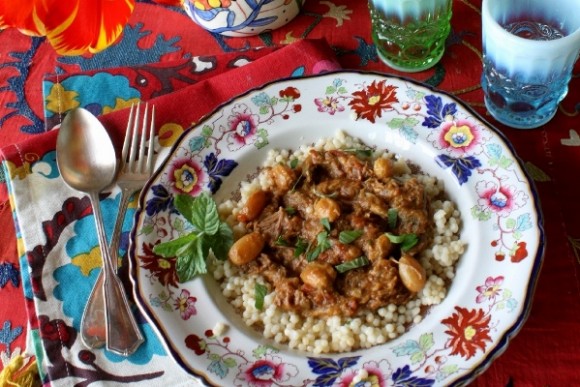
The recipe is for a lamb and rhubarb stew that uses rhubarb as a souring agent to complement the earthy lamb, much as sour plums or sour cherries are used in other recipes. I think that the recipe might be Central Asian in origin, because like many other Central Asian dishes, it also relies on herbs rather than spices for much of its flavor. It’s a great example of the foods that came flooding west from the various Persian conquests of the territories to its north and east, possibly during the Seljuk Dynasty.
Since rhubarb is being rediscovered as a vegetable, it is often available beyond its traditional short season, which allows this recipe to be made almost any time of the year. But with spring on the way, now is the time to make this dish to celebrate the seasonal rebirth that this time brings.
Lamb and Rhubarb Stew
Serves 2
Ingredients
2 tablespoons light sesame or peanut oil
¾ pound lamb cut into cubes
1 large onion, peeled, sliced and separated into crescents
3 teaspoons garlic, peeled and diced
4 hot, dried, red chili peppers
1 teaspoon salt
1 teaspoon black pepper
1 cup water
1 cup beef or chicken stock (or a mixture of both)
1 to 2 teaspoons nutmeg, grated
¼ cup fresh mint, chopped (more to taste)
1 medium bunch fresh cilantro, chopped
1½ tablespoons sugar (more to taste)
3 cups fresh rhubarb, cleaned and cut into 1-inch slices (peeled if desired)
Directions
1. Heat oil in a medium saucepan and when hot, sear lamb cubes over high heat until golden brown around the edges, stirring constantly. When meat is done, remove from the pan with a slotted spoon and set aside.
2. Lower heat to medium and add the onions, sautéing until they start to soften and color. Then add garlic, chili peppers, salt and pepper and stir until the garlic starts to swell and color. When garlic is done, add water and beef or chicken stock and cook to heat. When hot, add lamb back into the pot, add 1 teaspoon of the grated nutmeg to the stew. Cover and cook over medium-low or low for 1 hour, stirring occasionally, until lamb becomes tender.
3. When lamb is nearly done, add the chopped mint and stir well. Then add the cilantro and sugar and stir in as well. Cook for another 3 to 5 minutes and then add the rhubarb and cook another 3 to 5 minutes or until the rhubarb softens, but is still firm (not soggy). Remove from heat, grate the remainder of the nutmeg in and serve. This dish works best served with barley, but one can use millet or rice as well.
In addition to delicious desserts and savory stews, rhubarb is once again being used as medicine. It has joined the growing list of, “superfoods” because it is packed with vitamins C and K, is high in fiber, and contains calcium. Rhubarb extract is also being investigated as a chemotherapy agent to stop the spread of some cancers and to trigger cell death (apoptosis) in some tumors; as a cholinesterase inhibitor to help treat the symptoms of Alzheimer’s disease and other dementia disorders; as an antimicrobial drug; and as an antioxidant. The ancients knew that rhubarb was good for you, they just didn’t know why.
Top photo: Lamb and rhubarb stew. Credit: Kristin Nicholas