Articles in Travel

If it’s true that we are what we eat, then did my feasting on poulet rôti in Paris last summer render me more French or more chicken? Based on the sheer volume of roast chicken consumed, I would have to say “more chicken.”
FRENCH CHICKEN
Part 1: Do labels equal liberty for France’s best birds?
Part 2: A chicken-tasting tour of Paris.
Back home in Berkeley, Calif., there is so much really good traditional roast chicken available in restaurants and takeout shops — with French names like Poulet, Café Rouge, Bistro Liaison and Nizza la Bella (“Beautiful Nice”) — that I’m not sure whether my Paris binge was an homage to the gallocentric traditions in France that helped shape my passion for the humble roast, or merely a transatlantic extension of a preexisting culinary condition.
Granted, our farm-raised (poulet fermier) chicken production in the Bay Area (and the U.S. generally) does not yet measure up to France’s Label Rouge poultry program (See French Chicken, Part 1). And we are about 15 years behind European standards for animal welfare, according to advocates I’ve talked to.
But if Paris beats Berkeley in the overall quality of its poultry, not so in the roasting. Parisians seem to be taking their well-bred birds for granted these days, at least in their bistro kitchens if not in their homes and outdoor markets.
A tale of two birdies
At celebrity chef Guy Savoy’s L’Atelier Maître Albert in Paris’ 5th Arrondissement, the handsome wall-sized rotisserie had two enticing birds (from the les Landes region) twirling away on their spit, just waiting for me, right? Wrong.
About 25 minutes after ordering the 22-euro (about $28) Volaille fermière rôtie, my two small so-so-tasting chicken pieces, a small leg and quarter breast, arrived nestled against a typical mound of buttery bistro purée.
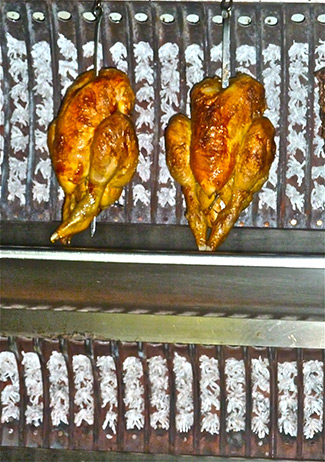
Love-y dove-y French chickens at L’Atelier Maître Albert. Credit: L. John Harris
Those love birds, still spinning as I left, were apparently all show and no go.
So where had my chicken pieces come from, the stork?
French chicken loves garlic
Equally disappointing was the Provençal-style roast chicken with thyme and whole cloves of garlic touted at La Bastide Odéon in the 6th Arrondisement. The traditional Provençal combination of chicken and garlic was popularized in the U.S. by folks like James Beard with their variations on the classic poulet aux quarante gousse d’ail (chicken with 40 cloves of garlic).
Either Beard was dreaming, or there was a garlic harvest blight in France last summer because my skinless chunks of white meat and a small leg were served with just one clove of garlic! It hadn’t even caramelized into that soft, sweetly nutty puddle of garlic heaven one expects. And what was with the skinless breast meat? Poulet rôti sacrilege!
The best chicken in the world?
Of the many poulet rôtis I gobbled down in Paris bistros, the only real standout was the 85-euro (about $108) whole chicken for two at Chez L’Ami Louis in the 3rd Arrondissement. This is the notoriously high-end, old-school bistro that food critics love to hate — including A.A. Gill who labeled it “the worst restaurant in the world” in his rather hilarious 2010 Vanity Fair thrashing of the place.
Inducement enough for me to go! I’m a bit of a rubbernecking ambulance chaser when it comes to hatchet-job restaurant reviews — I like to see (and taste) the damage for myself. On occasion, like this one, I even write rebuttals.
Not only was L’Ami Louis’ bird (a black-legged Label Rouge “noir” bird from the Challans region) moist and flavorful and its delicate skin crisp, but the bird was graciously served (Gill found the servers at L’Ami Louis “sullen”) in two brilliant courses — white meat first, then dark — both accompanied by ladles of perfect jus. If anything at L’Ami Louis was sullen, it was the limp mound of pommes frites served with the chicken.
Adding to the pleasingly retro pomp at L’Ami Louis, our server had first brought the whole roasted bird to the table for our inspection before carving, like a proud father showing off his newborn.
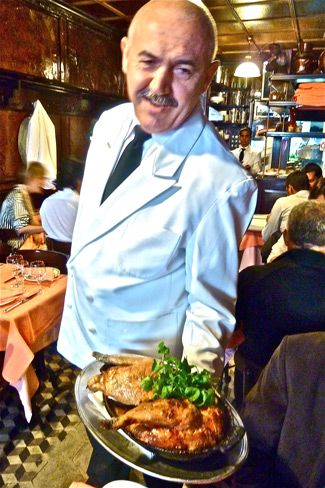
Honoring the humble poulet rôti at L’Ami Louis. Credit: L. John Harris
I have experienced this kind of poultry love ritual — usually reserved for home-roasted turkeys at Thanksgiving — only once before. Counterintuitively, it was at Wolfgang Puck’s upscale steak house, Cut, in Los Angeles, where the server shows off a small, locally-grown and brined poussin before carving and plating. Was I envious of the person at the next table with their $150 Japanese Wagyu rib eye? Well, just a little, though my $38 chicken was plenty good.
All you need is love, love, love
One of the tastiest, and surely the most love-infused roast chickens I had all summer was at the home of my American friend David Jester and his French wife Evy. Our Label Rouge plein air “jaune” bird (yellow skin and feet) purchased from Boucherie Dumont near Place Monge in the Latin Quarter, was raised in the Ain region in eastern France, where celebrity Bresse chickens come from. After 90 minutes in the oven, the coarse salt-rubbed five-pound bird had deliciously crisp skin and juicy, rosemary-scented meat. Evy served the bird with the pan juices and the caramelized carrots, garlic cloves and lemon rind that had roasted alongside the bird for the last hour in the oven. Heaven.
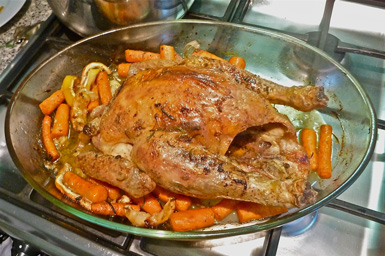
Evy’s home-roasted paradigm. Credit: L. John Harris
Evy says that the secret of her chicken’s succulent flesh and crisp skin, learned from her mother, is to start the bird out in a cold oven set at 400 degrees F. An interesting technique to be sure, but I can’t agree. Evy’s real secret, I believe, which I think too many Parisian chefs and restaurateurs have sadly forgotten, is that you must — and I say this at the risk of sounding pathetically Berkeley — love poulet rôti, love making it well and love those you are serving to do gastronomic justice to an honored bird, whether in Paris or Berkeley, or anywhere else.
Top illustration credit: L. John Harris
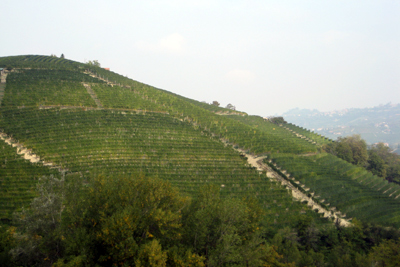
After 40 years of working in the wine field, there are few major regions that I have not visited. Italy’s Piedmont was one exception. That omission was finally rectified last month, with a week’s walking holiday in the hills of Barolo. We tramped through vineyards during the day and savoured Barolo wine in the evening.
I had always read that Nebbiolo, the principal grape variety of Piedmont, takes its name from the nebbia, the autumnal mists that cover the Langhe hills during the harvest. And that was just how it was. We stayed in hilltop villages such as Castiglione Falletto and Monforte d’Alba, and woke each morning to see a gentle mist covering the valley. By midday, the sun had burnt its way through the haze. In early October, the harvest was in full swing and the vines were beginning to change color to mellow reds and yellows. This was some of the most beautiful vineyard scenery that I had ever seen. It is not dramatic like the Douro or wild like the Languedoc, but has an appeal all of its own. The rows of vines follow the contours along hillsides that twist and turn, forming a series of amphitheaters.
And we visited just one wine estate, Paolo Scavino in Castiglione Falletto, where Elisa Scavino gave us a brilliant introduction to the wines of the region. Paolo Scavino, her grandfather, founded the family business in 1921. Today, they have a total of 21 hectares in 18 different plots in six villages.
Barbera, a grape which is characterized by less tannins and more acidity, was the perfect introduction to the Nebbiolo. The tannins were supple and harmonious, again with some fresh fruit, but a more structured palate.
The first Nebbiolo was a simple 2010 Langhe, what you might call a baby Barolo, made from the grapes of younger vines, and aged in old barrels for six months. It was beautifully elegant, with the hallmark notes of fruit cake and perfume that typify Nebbiolo. And then we moved on to serious things: a range of six different Barolos.
First came the entry-level wine, 2008 Barolo, a blend of seven vineyards in the village of Castiglione Falletto, Serralunga d’Alba and Barolo itself. The wine was elegant and long, with youthful fruit and silky tannins, with nuances of perfume and flavor.
Barolo Carobric is a blend of three different crus: Rocche di Castiglione, Cannubi and Bric del Fiasc. The blend remains constant, unlike the first wine which changes with the vintage. There were rich cherries on the palate, with depth and length and supple tannins.
The absolute opposite of Burgundy
And then it was time for the crus. Elisa observed that Barolo is the absolute opposite of Burgundy. Both are a myriad of different vineyards, but Barolo started out as a blend, so the crus are a recent phenomenon, and were really only developed later in the 1980s. Her father, Enrico, was one of the pioneers when he bottled Bric del Fiasc in 1978. And surprisingly, for a country where officialdom is obsessed with regulations, there are no bureaucratic hurdles to leap through before deciding to bottle a single vineyard. It is the wine grower’s own decision to put the vineyard or cru name on the label. If you look at the terrain, you can immediately understand the need to identify the different vineyard sites — they are very different, and the nuances are immediately apparent in the glass.
Bricco d’Ambrogio is in Roddi where the vineyard faces south on limestone slopes, and its wine was first made in 2002. It had an elegant palate with perfumed fruit, acidity, tannin and depth. Elisa noted that Nebbiolo can be very challenging in its youth. I could tell what she meant, but I was finding it more harmonious than Sangiovese, the other great red variety of Italy.
Monvigliero is in Verduno and is limestone and chalk, which give more minerality. Its first vintage, 2007, had youthful cherry fruit, and was tight-knit and elegant.
Cannubi came next. This name was recognized even before the name of Barolo, with documents dating back to 1752. There was some spice on the nose and it was richer, more fleshy and voluptuous than the preceding wines, but with structure.
And finally we enjoyed Bric del Fiasc, which is on sand and marl, which gives more muscle to the wine. It was also tight-knit and structured, with enormous potential. More reserved, Elisa said, more piemontese. It was a great finale to the tasting.
But Piedmont is not just Barolo and Nebbiolo; there is also Barbaresco, just northeast of Turin, and a range of other lesser known grape varieties. We enjoyed peppery Pelaverga from Verduno, some intriguing white Timorasso from the hills around Tortona; Favorita, which is a variation of Vermentino; and Nascetta, which is produced by just a handful of wine growers. There was a blended white wine from the Langhe that combined the pithy minerality of Sauvignon with the body and weight of the Chardonnay. Dolcetto d’Alba, with cherry fruit and a refreshing finish, has its place in the Piedmontese repertoire for immediate easy drinking.
And early October is the season for white truffles, deemed by the cognoscenti to be far superior to black truffles. Quite by chance we found ourselves in Alba for the first day of the annual truffle fair. We had a memorable lunch of fried eggs liberally smothered with shavings of white truffle and accompanied by Dolcetto, and then we wandered round the fair, savoring the aromas of truffle and porcini. I may have written two books on Tuscany and Sangiovese, but I have been quite seduced by the charms of Nebbiolo and Piedmont.
Photo: The hills of Barolo, in Piedmont, Italy. Credit: Rosemary George
A little more than 10 years ago, Elisa and Michel Gabrel arrived on Koh Samui from France searching, like most retirement-age foreign arrivals to this island in the Gulf of Thailand, for a piece of paradise. They found it on Koh Samui’s quiet south side, in a wedge of coconut palm-covered property where they built a modest home and settled in to savor island life. But it didn’t take long for the appeal of idleness to fade.
IN KOH SAMUI
Magic Alambic is open daily for tastings from noon to 6 p.m.
» Shots are 50 baht (about $1.62 U.S.) — 75 baht (about $2.44 U.S.) for 6-year aged rhum.
» Bottles are available for purchase at 650 baht (about $21.17) — 1,200 baht (about $39.08) for 6-year aged rhum.
Take a taxi or bring a designated driver.
44/5 Moo 3, Ban Thale, Koh Samui. 66-77/419-023. www.rhumdistillerie.com
“We’d visited Samui many times, and loved it. But if you live here you have to do something,” says Elisa, a tanned 61-year-old whose large, expressive eyes are capped by carefully penciled brows and framed by a mane of reddish flyaway hair. “Especially during three months of monsoon. If you only watch TV, believe me — it’s gonna be a hard life.”
Spirited retirees
Some retirees to Samui (most residents drop the “Koh,” which means “island”) fight boredom with frequent travel around Asia, or by taking up a sport or a hobby. Others open a bar or a café. But Elisa and Michel saw their salvation in liquor; they decided to make rhum agricole, or West Indies-style rum, distilled from pure sugarcane juice. (Ninety-nine percent of the world’s rum is rhum industriel, which is made from molasses, a by-product of sugar production.)
The Gabrel’s choice to make rhum agricole wasn’t entirely without foundation. They had enjoyed it in France, says Elisa, adding, “Rum is in my blood.” Her mother was Vietnamese and her father hailed from Martinique, where most of the world’s rhum agricole is made. Elise, who was born in Vietnam, moved to France with her parents when she was 4 years old.
Engaging the fruit of the land
The couple knew that Thailand, the world’s No. 1 exporter of sugarcane, could be counted on for a steady supply of raw material. And Samui, which is known to Thais as “Coconut Island,” provided further inspiration: The Gabrels decided to not only make natural rhum agricole but also flavor the liquor with coconut, the island’s biggest export, as well as other easily available island fruit. They named their venture Magic Alambic, (an alambic, or alembic, is a still) and became the first foreigners to distill liquor in Thailand.
Michel, who was a stonemason in Paris, had become interested in distilling during the years that the couple owned an orchard in Argent, France, where they decamped after a back injury forced him to quit his trade. Every year after harvest, Michel and Elisa would take plum, cherry and apricot juices to the local distiller, who would turn them into spirits. So, for their enterprise on Samui, they imported a still from Armagnac.
It took two months of experimentation to get the rhum process right. “We had the information from the factory, but it wasn’t enough. You have to distill with your heart, your feelings and your brain,” Elise told me one steamy afternoon, in thickly French-accented English, as we sat in Magic Alambic’s “tasting room,” a thatch-roofed open-air sala steps from her house. During those two months “Michel distilled, and I tasted.” Though she doesn’t drink often, she says, “I know rum.”
Michel passed away earlier this year at 70 years old, but not before witnessing the success of the unlikely enterprise he began with his wife. In the nine years since Michel and Elisa achieved their first drinkable batch of rhum agricole, Magic Alambic has attracted the attention of big names in the spirits world: Jamieson, Johnnie Walker, Pernod-Ricaux and Bacardi. The companies’ distillers come to Samui to taste Magic Alambic’s rhums and talk technique. Elisa’s happy to share. “There’s no secret,” she says. “We have exactly the same process as single malt whiskey.”
Simple hands-on operation for Thai rum
The Magic Alambic facility consists of little more than a cane presser, the single French still, and a small aging room. From January through June Elisa distills twice a day, starting at 4 a.m. She goes through 10 tons of sugarcane in a single season, capturing just 25 to 28 liters of rum from every 300 liters of cane juice. The juice is distilled after fermentation, and at this stage Magic Alambic’s flavored rums — coconut, orange, pineapple and lime — are infused with fruit. “Only fruit,” Elisa says. “No essence!” This ensures a natural taste.
The liquor is then aged in stainless steel (the company cannot obtain a license from Thailand to age liquor in wood) for at least one year at which point most of it is diluted to 40 proof to conform to Thai regulations. But some rhum is held back for further aging of up to six years. In the end, Magic Alambic produces less than 10,000 bottles annually, and it is sold by mail order or at the Samui facility.
Demand would support increased production, but “we don’t want to work more,” says Elisa, who relies on a team of four for help. “And when you distill, if you think about money first you won’t get the good quality.”
In the tasting room she opens bottle after bottle and waves each under the noses of visitors. The rhum smells exactly like its ingredients, the natural sweetness of sugar cane, the voluptuous milkiness of coconut, orange like the juice you’d drink for breakfast, and an oily essence of lime reminiscent of the scent that lingers in the air after a peel is twisted. (Elisa had already sold out of pineapple rhum when I visited). Swirling her rhum agricole in a glass, she shows its long legs and plump tears, similar to those of a fine wine. Then she pours shots. The liquor is slightly sweet and smooth, and goes down without a trace of burn. Elisa attributes its fine flavor to the cane. “We can take credit for the quality of the rum, but not for the taste,” she says. “That’s from the Thai soil.”
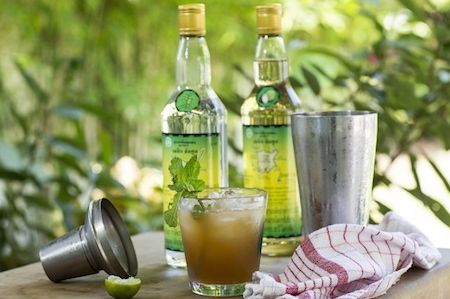
The rhums are especially delicious, and dangerously easy-drinking, mixed with Elisa’s homemade take on T’i punch sirop, which swaps brown cane sugar for the usual white and adds cinnamon, nutmeg, vanilla and lime juice. I ask for a recipe.
“No,” says Elise. “I don’t keep the rhum process a secret. The T’i punch, I do.”
Photo: T’i punch made with Magic Alambic rhum. Credit: David Hagerman
November is for strengthening your immunity. In the last post, I introduced the powerful Ayurvedic neem tree. For the second immune-boosting medicinal plant food, I turn from away from the bitter neem leaf toward a sour fruit, a powerhouse known as amla, or Indian gooseberry.
Integrative medicine practitioners have long observed that most chronic diseases are caused because of an excessive inflammatory response.
HELP FOR
THE HECTIC HOLIDAYS
In this three-month series, learn to pair simple herbal and yoga techniques to build immunity, counter holiday stress and start the New Year cleansed, detoxed and armed to activate your resolutions.
NOVEMBER: Double your body strength with simple yoga postures to stimulate your dynamic immune system:
» Amla
DECEMBER: Anti-stress herbs and calming yoga and breathing exercises:
» Brahmi
JANUARY: Detox herbs to recalibrate, rebalance and activate resolutions:
» Triphala
EAT TO HEAL: Previous articles covering the numerous benefits of herbs and foods:
black pepper | cilantro | cinnamon | cardamom | holy basil | nutmeg| ginger | turmeric | thyme | bay leaf | parsley
Origins, culinary and
traditional medicine uses
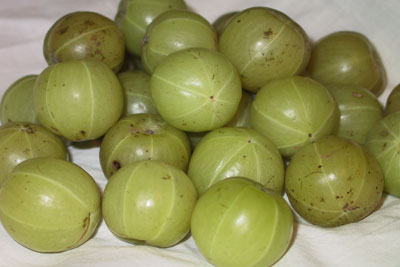
Amla, Emblica officinalis, is an exceptionally sour (think triple pucker), round and plum-sized fruit native to parts of tropical southeastern Asia such as central and southern India, Pakistan, Bangladesh, Sri Lanka and southern China. In the subcontinent, some sweeten or pickle amla into a murraba, a jam-like preserve in the north. Others boil the whole fruits in cardamom, saffron and sugary syrup. You can make the former or latter with dried amla that is available in local markets outside South Asia. One or two tablespoons are taken after a meal, or given to schoolchildren in the mornings to stave off illness.
In the ancient and rich tradition of Ayurveda, amla is the key ingredient in medicinal mixtures like chyawanprash and triphala (I’ll discuss triphala in more detail in January for the detox article). Both are considered rasayanas — complex poly-herbal preparations — prescribed to rejuvenate and prevent degenerative diseases. Amla is equally valued in other healing traditions like Unani, Siddha and homeopathy.
Take a look at the series of photos showing the steps to make a homemade Chyawanprash packed with anywhere from 10 to 50 additional health-protective spices and medicinal plants.
Contemporary research
Contemporary research in the laboratory and clinical trials has repeatedly supported amla’s ethnobotanical and traditional medicinal uses. In the European Journal of Cancer Prevention in 2011, a review of amla reported many protective, immune-enhancing and cancer-preventive effects due to a high concentration of ascorbic acid and many plant chemicals. Additionally, amla reduces fevers, pain and coughs. It can regulate cardiovascular disease and improve wound healing. Many phytochemicals present in amla may decrease the effects of radiation, chemotherapy and cancers, in addition to acting as a heavy-duty antioxidant and immune modulator.
Yoga for immunity
In the last article, I discussed yoga poses that support the immune system. I focused on learning the basic sun salutation series and inverted poses that stimulate and support the dynamic lymphatic system. Other yoga poses that strengthen immunity relate to the glandular system. The master gland, the thyroid — often referred to as the control center- is located below the Adam’s apple along the front of the windpipe. Three simple yoga poses that stimulate the thyroid gland are the cat (Marjaryasana), cobra (Bhujangasana) and bow (Dhanurasana) poses. When you complete your yoga practice, and after your meal, make sure to savor some sour and sweet amla preparations laced with subtle saffron and fragrant cardamom.
For health advice and recommendations, always consult with your chosen health-care professional. To ensure proper yoga training, seek the advice of a certified yoga specialist.
Photo: Amla. Credit: Sarah Khan
The French take their chicken, like their freedom, very, very seriously. In fact, they appear to equate the two. The national symbol of France dating to the French revolution is the rooster, le coq gaulois. And the most acclaimed chicken in France, prized for its depth of flavor, is still, after centuries of careful breeding, the white-feathered poulet de Bresse, which sports a red coxcomb and blue legs and feet. Patriotism in France is bottom up.
FRENCH CHICKEN
Part 1: Do labels equal liberty for France’s best birds?
Part 2: A chicken-tasting tour of Paris.
No surprise, then, that the signature French cigarette brand, Gauloise, features a highly stylized chicken logo on its blue package. The national motto of France — liberté, égalité, fraternité – was printed on that blue package back in the day when the New Wave movie star Jean-Paul Belmondo was often seen on screen with a Gauloise hanging from his full, pouty lips. Well, does a French chicken have lips?
As staple food and cherished symbol of freedom, the humble (sometimes comedic) chicken is at the very foundation of French culture and identity. King Henri IV knew this well when, in the 16th century, he called for a chicken in every peasant’s pot.
Sticker shock
I came to appreciate the special place (and price) of chicken in French culture this past summer while eating an awful lot of poulet rôti in Paris bistros and cafés. I plucked roasted chickens from twirling rotisseries at boucheries (butcher shops) and marchés (outdoor markets) all over town. There was a wonderful home-roasted chicken too (see description in Part 2), as one might expect from a culture that gave us the simple but delicious comfort food tradition known as cuisine de bonne femme.
But getting a handle on France’s highly evolved farm-raised poultry industry (poulet fermier) and its exhaustively (and sometimes confusingly) labeled products seems to require an advanced degree in agricultural science, if not French culture and linguistics.
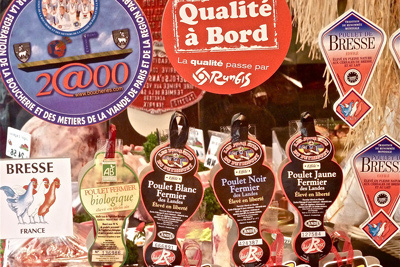
Among the most pampered chickens in France, perched at the pinnacle of France’s poultry hierarchy, are birds élevé en liberté or “raised in liberty.” This term is proudly printed on the colorful labels attached to pricey packages of poultry sold under France’s prestigious Label Rouge certification program.
It’s no accident that the term adopted for France’s premium birds appears first, ahead of both “égalité” and “fraternité,” in its national motto. It took almost the entire 19th century for the revolutionary tripartite motto’s terms and sequence to become fixed. Extending the term liberté to identify and market France’s finest poultry was set in motion in the 1960s when the Label Rouge program was launched.
French chicken a little less free
The liberté–raised birds are allowed to roam outdoors without fences or time restrictions. “Totally free” is another translation for “élevé en liberté.” Accordingly, these birds command the highest prices in French shops, save for organic (bio) poultry and specialty birds like those from the region around Bourg-en-Bresse in the east of France, which are AOC protected and produced, it is claimed, under conditions even more demanding than Label Rouge.
But there is no one-term-fits-all label in France for free-range birds as in the U.S. An existential notch below élevé en liberté chickens are those élevé en plein air, or raised out-of-doors. These plein air chickens (and ducks, geese, turkeys, etc.) are required under the Label Rouge program to have ample time to range outside their coops within a fenced but generous area of no less than 21 square feet per bird. The U.S. Department of Agriculture’s more lax standards require only that free-range poultry producers give their birds unspecified and unverified time outdoors with no space requirements. Home, home on the range? Well, at least once in awhile, if they are lucky.
Note that plein air is the same term used to describe the Impressionist landscape painting style of the late 19th century when French oil painting was liberated from the confines and subject matter of academic studio painting. Free-range painters.
From a French existentialist perspective
The freedom- and chicken-loving French may be all about liberty for themselves and their winged comestibles, but no matter how strict and humane the regulations under a certification program like Label Rouge (and several programs in the U.S. that emulate the standards), the chicken in France is far from free, existentially speaking. Modern chickens and all their related galliformes, whether free-range or factory-farmed, are bred, raised, slaughtered, labeled and consumed at the complete whim (and profit) of humans.
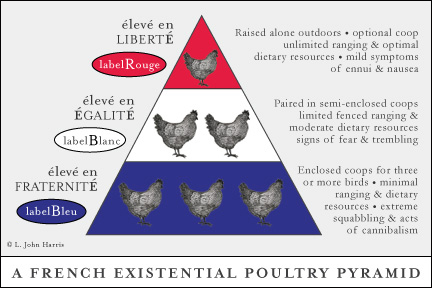
Any resemblance of this chart to any other French poultry labeling system is purely coincidental. Illustration credit: L. John Harris
As one butcher put it to me when I asked a lot of questions about the chicken I was investing in (a lovely plein air bird raised just outside the Bresse appellation, and at a more palatable price), “If chickens were really free to range they would take off and never return.” I laughed and shot back a gallinaceous variation on Jean-Paul Sartre’s famous line from his existentialist play, “No Exit,” “Yea, hell is other chickens.”
But after all the existential considerations of French poultry and the euphemistic terminology used by compassionate (and clever) carnivores to market it, one still has to cook the bird, and cook it well to fully appreciate its culinary virtues.
In Part 2 of this report, I present critical findings from my chicken-tasting tour of Parisian restaurants, shops, farmers markets and homes. The results may surprise you, as they did me.
Top photo: Chicken labels in a Paris shop window. Credit: L. John Harris
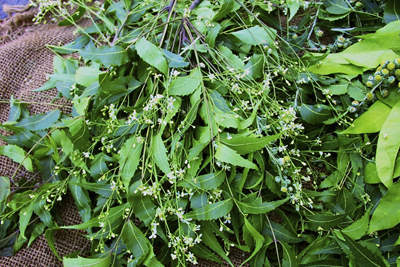
In this three-month series exploring simple teas and yoga postures (asanas) to keep you healthy during the holiday season, November will explore bitter neem (Azadirachta indica) and the powerful antioxidant amla (Emblica officinalis). First up is neem, often called “the wonder tree” or “nature’s pharmacy.”
Origins
Ancient neem most probably originated in the Assam region of northeast India and Myanmar and then rapidly spread through the drier South Asian subcontinent, including India, Pakistan and Bangladesh; West Africa; and more recently the Caribbean and South and Central America. Revered for its religious and medicinal significance, the neem tree vibrates a rhythmic beauty, especially the organization of the leaves.
Culinary and traditional medicine uses
In different parts of South Asia, young neem flowers are collected and sautéed in the spring. A bitter and sweeter variety of neem leaves are made into pickles. Unlike a North American fast-food palate, many culinary cultures seek out bitter flavors (another bitter food that I love is kerela, also known as bitter gourd in South Asia) because bitter foods often possess medicinal properties, alkaloids in particular, in large quantities. The bitter alkaloids fight potential plant pathogens, and those properties get passed on to those who consume the plant.
Neem has been used in Ayurvedic medicine for more than 4,000 years, and the earliest Sanskrit medical writings refer to the benefits of its fruits, seeds, oil, leaves, roots and bark. Moreover, both the water and oil extracts possess different plant properties for healing. It is used in agriculture to protect against pests, topically on the skin as an antibacterial soap and internally to prevent and treat chronic illnesses such as heart disease, stroke, cancer, respiratory diseases and diabetes.
Contemporary research
According to scientists reporting in the International Research Journal of Biological Sciences in October 2012, scientific research supports many of the ethnobotanical and traditional findings of its multiple uses. In another review article in the journal Current Medicinal Chemistry-Anticancer Agents, researchers state neem extracts fight inflammation, infections, fever, skin diseases and dental disorders. The leaf extracts, in particular, demonstrate immune enhancing, anti-inflammatory, anti-hyperglycemic, anti-ulcer, antimalarial, antifungal, antibacterial, antiviral, antioxidant, antimutagenic and anticarcinogenic properties. That’s a lot of “anti” for such a thin leaf.
Pair your food and herbs with yoga to build immunity
Yoga is about practice. No one asana (yoga posture) is a cure-all, just like no one super food can heal everything. If you are to pair your herbal teas and foods with yoga, then I suggest basic Hatha yoga as a starting point. I have found some of the best yoga teachers are Iyengar-trained. That certainly does not preclude many other traditions; it is merely a personal preference based on extensive study and experience in the U.S. and South Asia.
Practice the basic Sūrya Namaskāra series (sun salutation) and do it every day for general stretching and flexibility. To focus specifically on immunity, you want to keep two things in mind: the lymphatic system and inverted postures. The lymphatic system is part of the circulatory system. Unlike your vascular system (the system that moves blood around the body), the lymphatic system has no muscles helping move the lymph fluid. So walking, running and yoga postures — specifically inverted poses — facilitate fluid movement through the lymph system and toward the heart.
Find a certified yoga teacher, learn the Sūrya Namaskāra series and begin some basic inverted poses, such as bridge pose and downward facing dog. Building and strengthening your body, from a yogic perspective, is about daily practice not about how complex a yoga pose you can get into. Simple and consistent is the key. To make the most of your practice, make sure to top off your daily yoga practice with a cup of neem tea this season.
Neem tea
If you live in an urban area, you may find fresh neem leaves in a local South Asian food store in the early spring. If not, you can buy dried neem leaves in bulk. It is also available in tea bags from several tea companies. And, finally, it is available in a powder pill form.
If you have fresh neem leaves, steep 3 to 5 leaves in a cup and add a local honey to counter the bitter alkaloids. If you have dried leaves, steep 4 to 6 leaves in a cup and add honey.
For health advice and recommendations, always consult with your chosen health-care professional. To ensure proper yoga training, seek the advice of a certified yoga specialist.
Photo: Neem flowers and leaves at Pune Market in India. Credit: Sarah Khan 2001
Chef Austin Kirzner added a cup of butter to the sauté pan and used his tongs to stir the quickly melting butter together with chopped shallots, garlic, rosemary and Worcestershire sauce. He lifted the pan off the burner letting gas flames jump an inch into the air. He looked deeply into the sauce and decided, “Just a touch more butter.”
After suffering the punishment of Katrina, New Orleans is back. Tourists have returned to the city for good times, good food and good music. Walking around the city, you hear music everywhere — on the street, in parks, bars and nightclubs. In the French Quarter, restaurants and bars line every block.
Restaurants are crowded with diners enjoying café au lait and beignets heavily dusted with powdered sugar at Café du Monde, fried chicken at Willie Mae’s Scotch House Restaurant, hog jowls, charcuterie and ham at pork-centric Cochon, Oceana‘s Cajun gumbo and Jambalaya and fresh seafood at Red Fish Grill.
I’ve always wanted to visit New Orleans. Recently I was able to stay for a long weekend. To help me understand the food scene, Kirzner, executive chef at Red Fish Grill, agreed to give me an overview and a cooking demonstration.
Musicians and cooks
“The first thing to understand about the city,” Kirzner explained — and he should know, he’s a fifth-generation New Orleanian — is “in New Orleans, you’re either a cookor a musician. They’re both held in high esteem like doctors.”
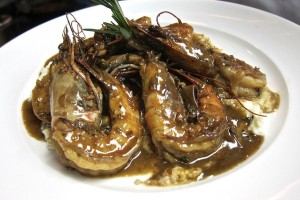
BBQ Shrimp with cheesy grits at Red Fish Grill in New Orleans. Credit: David Latt
Kirzner tells me that New Orleans cooking takes its influences from around the world and from different parts of the state. In the city you’ll find dishes typical of Louisiana where Cajun cooking predominates. “One pot cooking- red beans, étouffée, gumbos and jambalaya — family-style stuff you’d see in a fish camp or at home.” Every part of the state has its way of making these standards.
What sets New Orleans cuisine apart from the rest of the state is the embrace of its French influence, which he sums up as: “It must have butter. It must have cream. We take it to the extreme.”
There will be heads-on shrimp
The dish he demonstrates is a classic: New Orleans BBQ Shrimp. “You have to understand,” he tells me, “it’s not barbecued. Nobody knows how it came to be called that. Lots of restaurants make a version of the dish. Every one is different.”
Some restaurants serve the dish with the shell on as well as the head and tail. That makes for very messy dining.
For Kirzner, even though some of his customers are put off by the shrimp heads, he insists that’s what gives the sauce its distinctive, sweet richness.
In his version, to make the shrimp more diner-friendly, he leaves on the head and tail but strips the shell off the body.
Surprisingly easy to cook in 5 to 10 minutes, the dish should be prepared just before serving. Letting it sit around won’t do anybody any good.
In the restaurant, he flavors the shrimp with Creole seasoning. To illustrate how New Orleans cooking borrows freely from other cuisines, for the cooking demonstration, he used freshly chopped rosemary.
New Orleans Heads-On BBQ Shrimp
With fish and shellfish coming from the Gulf, New Orleans takes pride in the quality of the seafood served at its restaurants.
If you live in an area with fresh shrimp, definitely use them. Frozen shrimp will be OK, but you owe it to yourself to use heads-on shrimp at least once and that may require a trip to an Asian market where they are readily available.
A very large sauté pan is needed so the shrimp don’t sit on top of one another. That creates the best char and caramelization.
Serves 2
Kirzner’s note: This dish is prepared only two servings at a time because increasing the number of shrimp beyond 12 would require increasing the dish’s amount of sauce. Reducing the larger amount of sauce would require more cooking time, resulting in over-cooked shrimp.
Ingredients
12 to 14 raw colossal shrimp, bodies peeled, with heads and tails left on
2 teaspoons kosher salt
2 teaspoons finely chopped, fresh rosemary (or use the same amount of Creole seasoning)
1 teaspoon fresh garlic, minced
1 tablespoon fresh shallots, minced
2 tablespoons Worcestershire sauce
1½ tablespoons freshly ground coarse black pepper
1 to 3 tablespoons light lager beer, like New Orleans Abita beer (water can be substituted)
½ lemon, seeded
¼ pound butter, cold and unsalted (preferably Plugrá or other European-style butter), cut into ½-inch cubes
Directions
1. Season the shrimp with kosher salt. Set aside.
2. In a heavy 10-inch stainless-steel sauté pan on high heat, char the rosemary, garlic and shallots.
3. Add the half-peeled, salted shrimp, Worcestershire sauce, black pepper and 1 tablespoon beer (or water)
4. Squeeze the juice from the lemon over the shrimp.
5. Over high heat, cook the shrimp while gently stirring and occasionally turning the shrimp.
6. After about 2 minutes of cooking, the shrimp should start turning pink on both sides, indicating they are nearly half cooked. If the shrimp are the colossal size, add additional 2 tablespoons beer (or water) to the pan; otherwise, don’t add additional liquid. Remove the shrimp.
7. Reduce the heat to medium-high and continue cooking as you gradually add the cold pieces of butter to the pan.
8. Swirl the butter pieces until they are incorporated into the pan juices, the sauce turns light brown and creamy as it simmers. Add back the shrimp and coat with the sauce, turning frequently until the shrimp are just cooked through. This will take about 2 minutes total if the shrimp are extra-large, and about 3 minutes total if they’re colossal. Do not overcook the shrimp.
9. Remove the shrimp to a serving platter. Pour the sauce over the shrimp and carry to the table.
Serving suggestion: Pour the shrimp and sauce into a heated pasta bowl. Serve the shrimp and sauce immediately either with grits, rice or alongside slices of warm, crusty French bread for sopping up the sauce. Chef Kirzner prefers Leidenheimer French Bread.
Red Fish Grill executive chef Austin Kirzner with a dish of his BBQ Shrimp with cheesy grits. Credit: David Latt
Traveling in Sicily in June this year, I tried as many different versions of Sicilian zuppa di pesce, seafood soup, as I could find. And I found a lot, in a lot of great restaurants that should be on the list of anyone planning a trip to that glorious eater-friendly Italian island. Curiously (or maybe not), all the chefs I encountered had strong ties to Sicily’s fishing traditions, and all their restaurants were in towns renowned for their attachment to the sea. Those traditions go back millennia, to the earliest Greeks and Phoenicians, or maybe even to the native Siculi, about whom little is known. The soup itself, apart from tomatoes and chili peppers often added to the stock, probably goes back that far too. Certainly you sense links to both the glorious kakavia of the Aegean and the more famous bouillabaisse of Marseilles. But this Sicilian soup, in a dozen variations, stands proudly on its own.
At Cialoma in Marzamemi
The first chef I encountered was Lina Campisi at a delightful restaurant called Cialoma (Cha-LOE-mah) on the piazza of the old fishing port of Marzamemi — also famous for bottarga, salted fish roe. Lina’s grandfather, she told me, was the last rais, the boss, of the local tonnara – the Sicilian name for a kind of team-fishing of bluefin tuna when they came into the Canale di Sicilia in late spring. (Cialoma is the rather mournful song the tuna fishermen chanted in unison as they hunted the giant beasts.) The old-fashioned fishing is gone, but the traditions remain, and Lina vaunts them: “I learned, since I was a little girl, to recognize the infinite variety that the sea gives us, and how our own wisdom can create an exquisite dish from the most humble fruits of the sea.” Her seafood cuscussu might look North African at first glance, but it has deep roots here on the island, where it’s almost always topped with a broth rich with those humble fruits.
At La Bettola in Mazara del Vallo
Further west, almost at the point where the southern leg of the Sicilian triangle bends around a corner and heads north, is Mazara del Vallo, and the first thing anyone says is: “It looks so North African!” As well it might because many of the fishing boats that come and go hail from Tunisia and Algeria and the town, the largest fishing port in Italy, has that flat-roofed, low-domed, white-walled look of Tunisian coastal towns. Here, Pietro Sardo is king of the kitchen at his restaurant La Bettola, and I imagine he gives thanks every morning for the fate that led him one day many years ago to refuse a trip on a fishing vessel to stay behind and cook. The vessel went down, and Pietro would have gone with it because, like most fishermen, he couldn’t swim. The restaurant is almost exclusively seafood, although on bad weather days when no fish comes into Mazara’s clamorous market, a sign goes up outside: “Oggi non si mangia pexce” — No fish to eat today. On good days, his cuscussu is made properly, served with a sumptuous broth of scorfani — ugly, bony little creatures that give new meaning to the words trash fish — mixed with tomatoes, chili peppers, garlic and plenty of white wine and parsley.
At Cantina Siciliana in Trapani
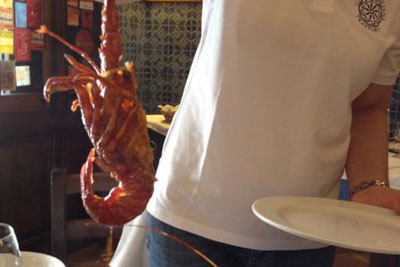
Trapani was my last stop, almost at the northwestern tip of the island, an ancient town on a long narrow peninsula beneath the lofty mountain of Erice. Here, in the old streets of Trapani’s ghetto, Pino Maggiore’s Cantina Siciliana is a humble-looking establishment that is a landmark itself, only this time to the best of the cooking traditions of this bustling seaport with its long connections to North Africa. I always plan to sample Pino’s cuscussu because he makes the tender grains himself, gracefully stroking the durum semolina around an antique bowl, adding driblets of water and oil from time to time. Like most Sicilian cooks, he, too, serves his cuscussu the traditional way, steeped in a rich fish stock with more fish piled on top. But that hot June afternoon, Pino had something else in store — a magnificent zuppa di aragosta, made with the spiny Mediterranean lobsters and deliciously thickened with almond flour from sweetly savory Sicilian almonds that have more flavor than any other almonds in the world. Here’s his recipe, as adapted by me to make with small Maine lobsters:
Pino Maggiore’s Zuppa di Aragosta della Cantina Siciliana
(Lobster Soup from Cantina Siciliana’s Pino Maggiore)
Serves 6
The fragrant stock that’s the base of this traditional Sicilian fish soup can be made a day or two ahead and kept refrigerated until ready to continue. Then it’s just a question of cooking and picking out the lobster and tossing it into the soup along with almond flour, pasta and herbs. Use small trash fish, if you can find them, for the stock. If trash fish aren’t available (and they’re often hard to find in U.S. seafood shops), ask the fish monger for “heads and frames,” meaning the discarded heads and bony skeletons after the fillets have been cut away. An important note: Don’t use heads and frames of fatty fish, such as salmon, tuna or mackerel, as they’ll give a strong flavor to what should be a delicate but savory broth.
Almond flour, which is basically finely ground blanched almonds, can be found in most health-food stores and at KingArthurFlour.com. A good brand is the almond flour or meal made by Bob’s Red Mill. You could also try making your own in a food processor, but commercial brands have better consistency.
In Sicily, Chef Pino uses small Mediterranean lobsters with no claws. He cooks and serves them right in the stew. In Maine, I find it easier to buy 1-pound Maine lobsters with the claws. I steam them in the basic broth, then remove and let them cool before shucking them, discarding the shells and cutting the meat into big chunks to add to the soup. If you want to use an appropriate extra virgin olive oil, look for Titone DOP Valli Trapanesi from groves along the coast south of Trapani — available through Manicaretti importers.
Ingredients
6 pounds of fish for broth (See note above)
3 cloves garlic, crushed with the flat blade of a knife and chopped
1 small onion, coarsely chopped
⅓ cup extra virgin olive oil, preferably Sicilian from the Valli Trapanesi or the Valle del Belice
2 tablespoons tomato concentrate
1 tablespoon sea salt
Freshly ground black pepper
Big pinch of chili flakes
1 two-inch cinnamon stick
Small bunch of flat-leaf parsley, coarsely chopped
Small bunch of fresh basil
3 small 1-pound Maine lobsters (with claws)
⅓ cup almond flour (very finely ground blanched almonds)
Pinch of freshly ground cinnamon
About ⅓ pound of spaghetti, broken into approximate 3-inch lengths
More olive oil for garnish
Directions
1. Rinse the fish and, if necessary, clean the interiors. Cut larger fish into smaller pieces no bigger than the palm of your hand. Set aside.
2. In a soup kettle or stock pot, mix the garlic, onion and olive oil and set over medium-low heat. Cook, stirring, until the onion is soft. Then add the tomato concentrate and a little water and stir over heat to dissolve.
3. When the tomato is completely dissolved, add 3 quarts (12 cups) water to the stock pot. Add the prepared fish with the salt, pepper, chili, cinnamon stick and parsley. Separate the leaves from the stems of basil. Add the stems to the stock, setting the leaves aside to use later for a garnish.
4. Bring the stock to a simmer over very low heat. Cover and simmer gently for 1 hour 15 minutes. When the soup is done, strain it in a fine-mesh sieve or through cheesecloth, pressing down on the fish to extract as much flavor as possible. Discard the fish and other contents of the stock.
5. When ready to cook the soup, bring the broth back to a simmer. Add the lobsters and cook until they’re done. Depending on the size, this can take from 6 to 12 minutes. One-pound Maine lobsters, which you should use for this soup, should be bright red in 6 or 7 minutes. Remove the lobsters when done and set aside to cool until you can handle them, then crack the shells and remove all the meat inside. Set the whole claw meat aside to use as a garnish, if you wish. Otherwise, have all the meat in bite-sized portions.
6. Bring the broth back to the boil and add a generous pinch of ground cinnamon and the almond flour. Stir to mix well and let simmer for 5 minutes or so to fix the flavors.
7. Just before you’re ready to serve, add the broken spaghetti to the broth and cook until the pasta is done — about 8 minutes, no more. Sliver the reserved basil leaves.
8. Serve the soup while it’s still very hot. Either add lobster pieces to the broth and serve from a tureen; or plate up individual servings, putting a quantity of lobster in the center of each plate, spooning the broth and pasta generously over the lobster and garnishing each plate with a piece of the claw meat and a sprinkle of slivered basil. Finally, dribble more olive oil on top.
Photo: A Mediterranean lobster Chef Pino Maggiore uses in his Zuppa di Aragosta. Credit: Nancy Harmon Jenkins
Upcoming Events
-
see all of our
Upcoming Events
-
Nathan’s Famous International Hot Dog-Eating Contest July 4Takes place on July 4, 2013Nathan’s Famous International Hot Dog-Eating Contest The men and women will compete separately for the title of Men’s Hot Dog Eating World Champion and Women’s…
-
The Park City Food & Wine Classic July 10-14Takes place on July 10, 2013The Park City Food & Wine Classic THE PARK CITY FOOD & WINE CLASSIC is a premier destination event where master winemakers, culinary greats, and…
-
Taste of Chicago 2013 July 10-14Takes place on July 10, 2013Taste of Chicago 2013 Taste of Chicago 2013 is Chicago’s biggest event. Getting its start as a modest food festival on the Fourth of July…
SmartBrief